‫الرحيم‬ ‫الرحمن‬ ‫هللا‬ ‫بسم‬
College of Dentistry
Pedodontic I
MANAGEMENT OF POTENTIALLY
RESISTANT CHILD -1-
Dr. Hazem El Ajrami
• The great majority of children introduced to the
dentistry by various approaches of behavior
management become relaxed and cooperative
and readily accept most operative procedures.
• Unfortunately, a minority remains or become
uncooperative. The most common reason for lack
of cooperation is fear and anxiety. If fear persists
despite carefully conducted introductory
resinous, some form of sedation may be helpful.
• Behavior management methods:
Behavior management can be achieved by
two methods:
1. Non-pharmacological methods
(psychological methods).
2. Pharmacological methods.
• Indication of pharmacological behavior
management:
Pharmacological behavior management is
useful in:
1. Extremely young children.
2. Children have reduced mental capacity.
3. Intensely fearful children.
4. Children have medical problems which
affect their ability to be cooperative.
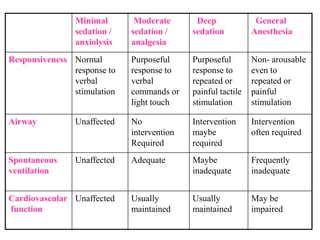
• Levels of sedation and anesthesia:
Four levels of sedation as defined on
recommendations made by the American
Society of Anesthesiologists (ASA) are as
follows: (Kaplan, 2005).
General
Anesthesia
Deep
sedation
Moderate
sedation /
analgesia
Minimal
sedation /
anxiolysis
Non- arousable
even to
repeated or
painful
stimulation
Purposeful
response to
repeated or
painful tactile
stimulation
Purposeful
response to
verbal
commands or
light touch
Normal
response to
verbal
stimulation
Responsiveness
Intervention
often required
Intervention
maybe
required
No
intervention
Required
UnaffectedAirway
Frequently
inadequate
Maybe
inadequate
AdequateUnaffectedSpontaneous
ventilation
May be
impaired
Usually
maintained
Usually
maintained
UnaffectedCardiovascular
function
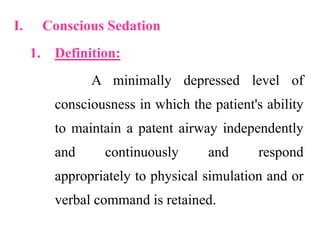
I. Conscious Sedation
1. Definition:
A minimally depressed level of
consciousness in which the patient's ability
to maintain a patent airway independently
and continuously and respond
appropriately to physical simulation and or
verbal command is retained.
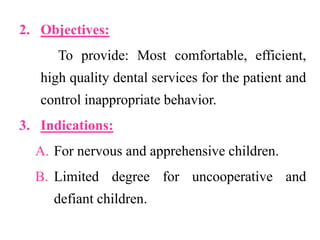
2. Objectives:
To provide: Most comfortable, efficient,
high quality dental services for the patient and
control inappropriate behavior.
3. Indications:
A. For nervous and apprehensive children.
B. Limited degree for uncooperative and
defiant children.
4. Contraindications:
1) Severely uncooperative child.
2) 1st trimester of pregnancy.
3) Hypersensitivity to the agent.
4) Chronic obstructive pulmonary disorder.
5) Psychiatric patient.
6) Cardiac patients.
7) Epilepsy, bleeding disorder.
Routes of Administration:
1. Oral:
 It is the most commonly employed route for
pediatric dentistry.
 The clinical effectiveness is not noted for at
least 30 minutes and peak drug effect may
require 1 hour or more. The duration of
action is relatively prolonged after 4 to 6
hours.
 Since absorption of drugs occurs in the
stomach and small intestine, instructions
should be given to the parents that:
• No solid foods should be taken after
midnight before the sedation appointment.
This recommendation is for two reasons:
1) Drug uptake is maximized when the
stomach is empty.
2) Prevent vomiting which may lead to severe
complications.
2. Intra-muscular:
Injection of the sedative agent into a
skeletal muscle mass. This method is used to
produce deep sedation in very uncooperative
young patients.
 Advantages: Faster absorption than
absorption from oral route. It doesn't require
patient cooperation.
 Disadvantages: Delayed absorption of the
drug. Possibility of tissue trauma at the
injection site.
3. Intra-venous:
 Advantages: It is the most efficient method
of ensuring adequate sedation for most
patients. Sedation onsets immediately
following the injection. The duration of
sedation is about 1 hour.
 Disadvantages: Complications, as hematoma
or allergic reactions may occur. It is not
recommended below 6 years of age. Needs a
period of post-operative recovery and
restriction of activities.
4. Subcutaneous:
The subcutaneous route involves the
injection of the drug beneath the skin. Drugs
that irritate tissues such as diazepam should
not be administered subcutaneously.
Disadvantages: Slow rate of absorption
limits the effectiveness of this route in
dentistry.
5. Rectal:
This method is most appropriate for very
young children and as an alternative for those
who refuse oral administration. Rapid uptake
of the drug with a faster onset. This method is
used in reduction of mild anxiety.
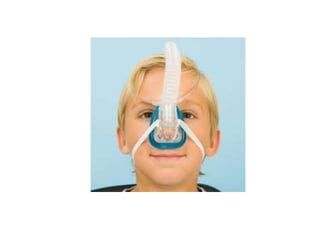
6. Intranasal.
7. Inhalation .
• Agents or drugs commonly used for
sedation:
The ideal sedative drug does not exist;
combinations of drugs achieve the desired
effect in each clinical setting, often with
adjuncts (e.g. Local anesthesia):
1. Gases: Nitrous oxide and oxygen
combination.
2. Antihistamines: Hydroxyzine,
Promethazine.
3. Benzodiazepines: Diazepam (Valium),
Midazolam (Dormincum).
4. Barbiturates: Short acting such as Seconal,
Pentobarbital.
5. Chloral hydrate.
6. Narcotics: Meperidine.
7. Propophol: (Deprivan).
• Factors influencing Dosage:
1. Age.
2. Body Weight.
3. Emotional state and activity: Extremely
anxious or defiant child will required more
premedication than will the mildly
apprehensive child.
4. Route of administration: Drugs given I.V.
will act more rapidly and are given in lower
dose, whereas a drug given orally act more
slowly and dosage requirement are higher.
Intramuscular administration of drugs results in
intermediate onset of action and dosage
requirements.
5. Time of the day: Dosage may sometimes be
reduced if given during the time when the child
usually takes a nap. Conversely dosages may
have to be elevated if the drug is administered
during the time when the child is usually
engaged in active play.
Nitrous Oxide (N20)
• It is the common inhalation agent used. It is a
colorless, odorless, and heavier than air, non-
inflammable gas. It is absorbed quickly from the
alveoli of the lungs and is physically dissolved in
the blood with no chemical combination
anywhere in the body. It is carried in the serum
portion of the blood and excreted through lungs
without any biotransformation. Small amount
may be found in the body fluids and intestinal
gas.
Actions (Pharmacodynamics) of nitrous oxide:
1. Creates an altered state of awareness without
impaired motor function and is a CNS
depressant.
2. Increases the respiratory rate.
3. Cardiac output is decreased and peripheral
vascular is increased (important in cardiac
patients).
4. Rapid induction and reversal may induce
vomiting.
• Indications for use of nitrous oxide/oxygen
analgesia include:
1. A fearful, anxious child who wishes to
receive dental treatment.
2. Certain mentally, physically, or medically
compromised patients.
3. A patient whose gag reflex interferes with
dental treatment.
4. A patient for whom profound local anesthesia
cannot be obtained.
5. A cooperative child undergoing a lengthy
dental procedure.
• Contraindications:
Contraindications for use of nitrous
oxide/oxygen inhalation may include:
1. Upper respiratory tract infection (e.g.
common cold).
2. Some chronic obstructive pulmonary
diseases (bronchitis, emphysema,
pulmonary fibrosis and T.B.).
3. Nasal obstruction.
4. Children with certain psychiatric disorders.
5. Children with history of motion sickness, who
may experience vomiting when, given nitrous
oxide.
6. Patients with otitis media, as nitrous oxide
increase pressure in air filled cavities.
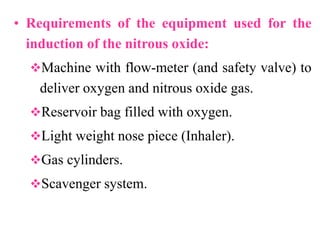
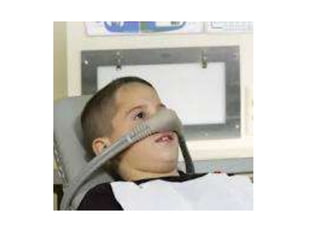
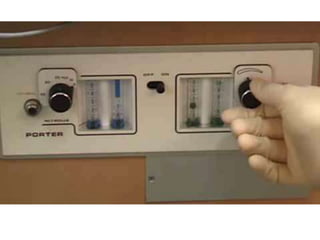
• Requirements of the equipment used for the
induction of the nitrous oxide:
Machine with flow-meter (and safety valve) to

deliver oxygen and nitrous oxide gas.
Reservoir bag filled with oxygen.
Light weight nose piece (Inhaler).
Gas cylinders.
Scavenger system.
• Techniques:
Two techniques have been described:
A. Slow induction technique, described by
Langa (1968).
B. Rapid induction or “surge” technique,
described by Sorenson and Roth (1973) and
Simon and Vogelsberg (1975).
A. Slow induction technique:
1. Explain to the child the sequence of the
procedure and how he will feel.
2. Introduce nose-piece and encourage the
child to breath through the nose.
3. Start with 100% oxygen for 3 - 5 min.
4. Gradually introduce nitrous oxide 5% - 10%
every 3-5 min. Till it reach 70% oxygen and
30% nitrous oxide.
5. Signs indicate adequate sedation:
 Floating sensation.
 Tingling of toes.
 Sagging of eye lids.
When this state is reached local anesthesia
is given.
6. By the end of the session give 100% oxygen
for 5 min.
B. Rapid induction technique:
1. Initiation is done by administering equal
parts of nitrous oxide and oxygen for 10-
15 minutes.
2. This is followed by maintenance phase
where the nitrous oxide is reduced by half
for 40 minutes.
3. Withdrawal is by administering oxygen
only.
4. Oxygen is used to prevent anoxia, which is
produced if nitrous oxide is used alone.
Adverse side effects:
1. Acute effect (on the patient):
 Hypoxia.
 Bone marrow depression due to
prolonged use in long term sedation of
chronic pain.
 Neurotoxicity.
2. Chronic effect (dentist and assistants):
 Reduced fertility.
 Spontaneous abortion.
 Neurological defects.
 Increased incidence of liver disease.
 Malignancy.
• Safety recommendations:
I. Use the minimum effective dose.
II. Use scavenging equipment.
III. Vent exhausts gases to outside.
IV. Check delivery system for leakage
monthly.
Thank You

Pedodontics I lecture 05

  • 1.
  • 2.
    College of Dentistry PedodonticI MANAGEMENT OF POTENTIALLY RESISTANT CHILD -1- Dr. Hazem El Ajrami
  • 3.
    • The greatmajority of children introduced to the dentistry by various approaches of behavior management become relaxed and cooperative and readily accept most operative procedures. • Unfortunately, a minority remains or become uncooperative. The most common reason for lack of cooperation is fear and anxiety. If fear persists despite carefully conducted introductory resinous, some form of sedation may be helpful.
  • 4.
    • Behavior managementmethods: Behavior management can be achieved by two methods: 1. Non-pharmacological methods (psychological methods). 2. Pharmacological methods.
  • 5.
    • Indication ofpharmacological behavior management: Pharmacological behavior management is useful in: 1. Extremely young children. 2. Children have reduced mental capacity. 3. Intensely fearful children. 4. Children have medical problems which affect their ability to be cooperative.
  • 6.
    • Levels ofsedation and anesthesia: Four levels of sedation as defined on recommendations made by the American Society of Anesthesiologists (ASA) are as follows: (Kaplan, 2005).
  • 7.
    General Anesthesia Deep sedation Moderate sedation / analgesia Minimal sedation / anxiolysis Non-arousable even to repeated or painful stimulation Purposeful response to repeated or painful tactile stimulation Purposeful response to verbal commands or light touch Normal response to verbal stimulation Responsiveness Intervention often required Intervention maybe required No intervention Required UnaffectedAirway Frequently inadequate Maybe inadequate AdequateUnaffectedSpontaneous ventilation May be impaired Usually maintained Usually maintained UnaffectedCardiovascular function
  • 8.
    I. Conscious Sedation 1.Definition: A minimally depressed level of consciousness in which the patient's ability to maintain a patent airway independently and continuously and respond appropriately to physical simulation and or verbal command is retained.
  • 9.
    2. Objectives: To provide:Most comfortable, efficient, high quality dental services for the patient and control inappropriate behavior. 3. Indications: A. For nervous and apprehensive children. B. Limited degree for uncooperative and defiant children.
  • 10.
    4. Contraindications: 1) Severelyuncooperative child. 2) 1st trimester of pregnancy. 3) Hypersensitivity to the agent. 4) Chronic obstructive pulmonary disorder. 5) Psychiatric patient. 6) Cardiac patients. 7) Epilepsy, bleeding disorder.
  • 11.
    Routes of Administration: 1.Oral:  It is the most commonly employed route for pediatric dentistry.  The clinical effectiveness is not noted for at least 30 minutes and peak drug effect may require 1 hour or more. The duration of action is relatively prolonged after 4 to 6 hours.  Since absorption of drugs occurs in the stomach and small intestine, instructions should be given to the parents that:
  • 12.
    • No solidfoods should be taken after midnight before the sedation appointment. This recommendation is for two reasons: 1) Drug uptake is maximized when the stomach is empty. 2) Prevent vomiting which may lead to severe complications.
  • 13.
    2. Intra-muscular: Injection ofthe sedative agent into a skeletal muscle mass. This method is used to produce deep sedation in very uncooperative young patients.  Advantages: Faster absorption than absorption from oral route. It doesn't require patient cooperation.  Disadvantages: Delayed absorption of the drug. Possibility of tissue trauma at the injection site.
  • 14.
    3. Intra-venous:  Advantages:It is the most efficient method of ensuring adequate sedation for most patients. Sedation onsets immediately following the injection. The duration of sedation is about 1 hour.  Disadvantages: Complications, as hematoma or allergic reactions may occur. It is not recommended below 6 years of age. Needs a period of post-operative recovery and restriction of activities.
  • 15.
    4. Subcutaneous: The subcutaneousroute involves the injection of the drug beneath the skin. Drugs that irritate tissues such as diazepam should not be administered subcutaneously. Disadvantages: Slow rate of absorption limits the effectiveness of this route in dentistry.
  • 16.
    5. Rectal: This methodis most appropriate for very young children and as an alternative for those who refuse oral administration. Rapid uptake of the drug with a faster onset. This method is used in reduction of mild anxiety. 6. Intranasal. 7. Inhalation .
  • 18.
    • Agents ordrugs commonly used for sedation: The ideal sedative drug does not exist; combinations of drugs achieve the desired effect in each clinical setting, often with adjuncts (e.g. Local anesthesia): 1. Gases: Nitrous oxide and oxygen combination. 2. Antihistamines: Hydroxyzine, Promethazine.
  • 19.
    3. Benzodiazepines: Diazepam(Valium), Midazolam (Dormincum). 4. Barbiturates: Short acting such as Seconal, Pentobarbital. 5. Chloral hydrate. 6. Narcotics: Meperidine. 7. Propophol: (Deprivan).
  • 20.
    • Factors influencingDosage: 1. Age. 2. Body Weight. 3. Emotional state and activity: Extremely anxious or defiant child will required more premedication than will the mildly apprehensive child.
  • 21.
    4. Route ofadministration: Drugs given I.V. will act more rapidly and are given in lower dose, whereas a drug given orally act more slowly and dosage requirement are higher. Intramuscular administration of drugs results in intermediate onset of action and dosage requirements. 5. Time of the day: Dosage may sometimes be reduced if given during the time when the child usually takes a nap. Conversely dosages may have to be elevated if the drug is administered during the time when the child is usually engaged in active play.
  • 22.
    Nitrous Oxide (N20) •It is the common inhalation agent used. It is a colorless, odorless, and heavier than air, non- inflammable gas. It is absorbed quickly from the alveoli of the lungs and is physically dissolved in the blood with no chemical combination anywhere in the body. It is carried in the serum portion of the blood and excreted through lungs without any biotransformation. Small amount may be found in the body fluids and intestinal gas.
  • 23.
    Actions (Pharmacodynamics) ofnitrous oxide: 1. Creates an altered state of awareness without impaired motor function and is a CNS depressant. 2. Increases the respiratory rate. 3. Cardiac output is decreased and peripheral vascular is increased (important in cardiac patients). 4. Rapid induction and reversal may induce vomiting.
  • 24.
    • Indications foruse of nitrous oxide/oxygen analgesia include: 1. A fearful, anxious child who wishes to receive dental treatment. 2. Certain mentally, physically, or medically compromised patients. 3. A patient whose gag reflex interferes with dental treatment. 4. A patient for whom profound local anesthesia cannot be obtained. 5. A cooperative child undergoing a lengthy dental procedure.
  • 25.
    • Contraindications: Contraindications foruse of nitrous oxide/oxygen inhalation may include: 1. Upper respiratory tract infection (e.g. common cold). 2. Some chronic obstructive pulmonary diseases (bronchitis, emphysema, pulmonary fibrosis and T.B.). 3. Nasal obstruction.
  • 26.
    4. Children withcertain psychiatric disorders. 5. Children with history of motion sickness, who may experience vomiting when, given nitrous oxide. 6. Patients with otitis media, as nitrous oxide increase pressure in air filled cavities.
  • 27.
    • Requirements ofthe equipment used for the induction of the nitrous oxide: Machine with flow-meter (and safety valve) to deliver oxygen and nitrous oxide gas. Reservoir bag filled with oxygen. Light weight nose piece (Inhaler). Gas cylinders. Scavenger system.
  • 29.
    • Techniques: Two techniqueshave been described: A. Slow induction technique, described by Langa (1968). B. Rapid induction or “surge” technique, described by Sorenson and Roth (1973) and Simon and Vogelsberg (1975).
  • 31.
    A. Slow inductiontechnique: 1. Explain to the child the sequence of the procedure and how he will feel. 2. Introduce nose-piece and encourage the child to breath through the nose. 3. Start with 100% oxygen for 3 - 5 min. 4. Gradually introduce nitrous oxide 5% - 10% every 3-5 min. Till it reach 70% oxygen and 30% nitrous oxide.
  • 32.
    5. Signs indicateadequate sedation:  Floating sensation.  Tingling of toes.  Sagging of eye lids. When this state is reached local anesthesia is given. 6. By the end of the session give 100% oxygen for 5 min.
  • 33.
    B. Rapid inductiontechnique: 1. Initiation is done by administering equal parts of nitrous oxide and oxygen for 10- 15 minutes. 2. This is followed by maintenance phase where the nitrous oxide is reduced by half for 40 minutes. 3. Withdrawal is by administering oxygen only. 4. Oxygen is used to prevent anoxia, which is produced if nitrous oxide is used alone.
  • 34.
    Adverse side effects: 1.Acute effect (on the patient):  Hypoxia.  Bone marrow depression due to prolonged use in long term sedation of chronic pain.  Neurotoxicity.
  • 35.
    2. Chronic effect(dentist and assistants):  Reduced fertility.  Spontaneous abortion.  Neurological defects.  Increased incidence of liver disease.  Malignancy.
  • 36.
    • Safety recommendations: I.Use the minimum effective dose. II. Use scavenging equipment. III. Vent exhausts gases to outside. IV. Check delivery system for leakage monthly.
  • 37.