


Pattern of nursing
education
MSc(N), MPhil(N) &
PhD(N) Programme
Submitted to: submitted by:
Mrs. Meenakshi Nikita Sharma
Associate professor MSc(N) 1st yr.
Community health nursing Roll no.-8
Nursing education
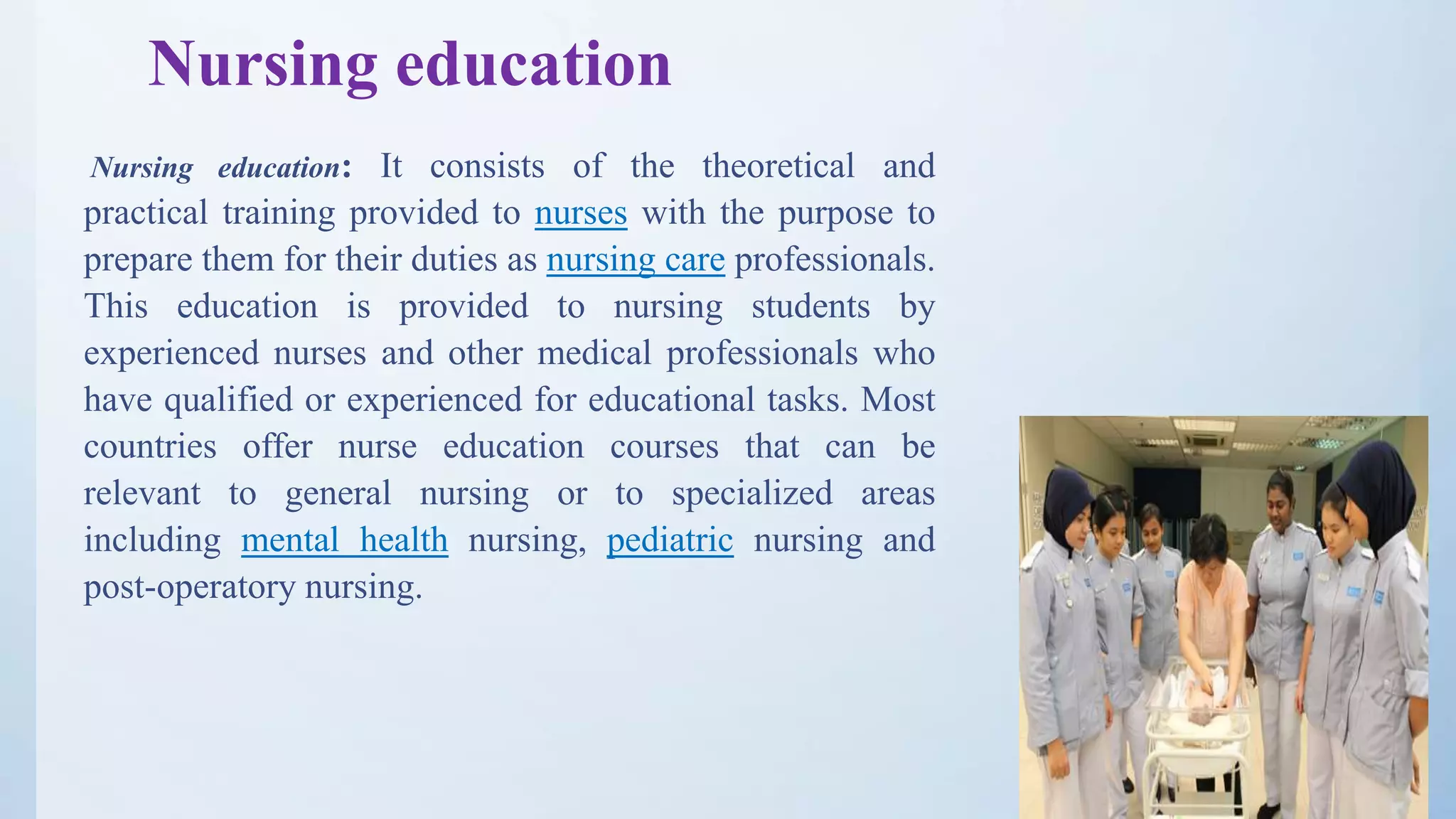
Nursing education: It consists of the theoretical and
practical training provided to nurses with the purpose to
prepare them for their duties as nursing care professionals.
This education is provided to nursing students by
experienced nurses and other medical professionals who
have qualified or experienced for educational tasks. Most
countries offer nurse education courses that can be
relevant to general nursing or to specialized areas
including mental health nursing, pediatric nursing and
post-operatory nursing.
Nursing education Programme
• It may be defined as in large part that influencing of one group of
human beings, the pupils to grow towards defined objectives:
utilizing a second group of human beings, the teacher as agents,
and operating in a setting of third group of human being, the public
variously concerned both with objectives and with means used to
achieve them.
Pattern of nursing education and
training Programme in India
Non university
nursing
Programme
University nursing Programme
1.certificate
course—
-ANM course/
-HW(F) Course/
-HA(F) Course/
LHV
2.Diploma—
GNM course
1.Degree (UG) -----
-B.Sc. nursing (Basic)
-Basic nursing (post certificate)
-PB BSc Nursing(IGNOU)
2. post basic diploma course
3.Masters education (PG)
-MN(masters of nursing)
-M.Sc. (nursing)
4. M.Phil. in nursing
5. doctoral programs-PhD(N)
6. Nurse practitioner in primary health
care.
PG (MSc.) nursing education program
INTRODUCTION
 Students are thought to conduct
research in nursing.
 A thesis is submitted by each
student in partial fulfillment of the
requirements for the degree.
 Courses in education and
administration are given to prepare
the students to take up
responsibility in it in nursing and
allied health areas.
 The entrance test is mandatory in
reputed institutes.
• University exams are conducted at
the end of the academic year or
• 2 years course is designed to
prepare clinical and community health
nursing specialists.
Objectives
CHART
The candidate seeking admission must:
 Have passed BSc nursing/ post certificate BSc, or
nursing degree of any university.
 Have a minimum of one year experience after obtaining
BSc, in hospitals or nursing educational institutions or
community health settings
Eligibility
Cont…..
For BSc, nursing post certificate, no such experience is
needed after graduation. The candidate
 shall be a registered nurse and midwife for admission to
medical surgical nursing, community health nursing,
pediatric nursing, obstetric and gynecological nursing and
psychiatric nursing.
 The candidate shall be selected on merit judged on the
basis of academic performance in BSc nursing, post
certificate BSc, or nursing and selection tests.
Specialties:
 Branch 1- Medical
surgical nursing (sub
specialties in 2nd yr. --
- Neuro nursing,
cardiovascular
Nursing, orthopedic
Nursing, Critical care
Nursing etc.
 Branch 2----Pediatric
Nursing
 Branch 3----Obstetric
and Gynecological
Nursing
Duration of course
Duration of course 2 years
Available 52 weeks
Vacation 4 weeks
Examination 2 weeks
Gazetted holidays 3 weeks
Total weeks available 43 weeks
Hours per week 40 hours
Hours for one year 1720 hours
Total hours for 2 years 3440 hours
Course of instruction and Examination
SUBJECT Course of
. Instruction
Course of examination
Theory Practical
1st Year Theory Practical Internal External Internal External
Nursing education 150 150 25 75 50 50
Advance Nursing
Practice 150 200
25 75
Nursing Research
And statistics 150 100
25 75
Clinical speciality 150 650
-I
25 75 100 100
Total 600 1100 100 300 150 150
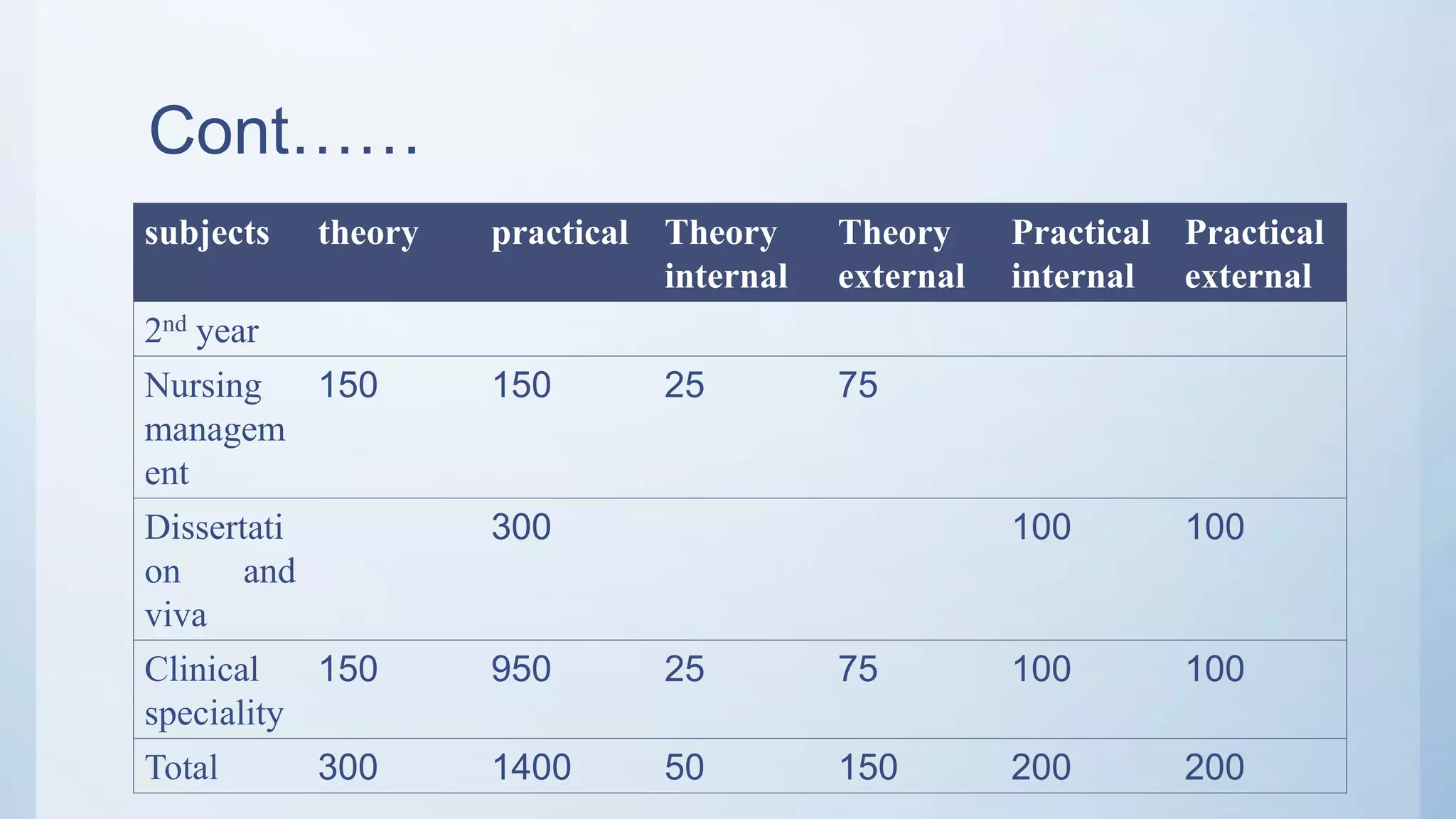
Cont……
subjects theory practical Theory
internal
Theory
external
Practical
internal
Practical
external
2nd year
Nursing
managem
ent
150 150 25 75
Dissertati
on and
viva
300 100 100
Clinical
speciality
150 950 25 75 100 100
Total 300 1400 50 150 200 200
Practical
• 4 hours of practical examination per student.
• The examination should be held in Clinical area for clinical specialties.
• One internal and external examiner should jointly conduct the practical.
• Examiner: nursing faculty teaching respective specialty area in MSc nursing
program with minimum 3 years’ experience after MSc(N).
• Regulation for examination:
• 75% of attendance for theory and practical’s. However, 100% of attendance
for practical before the award of degree.
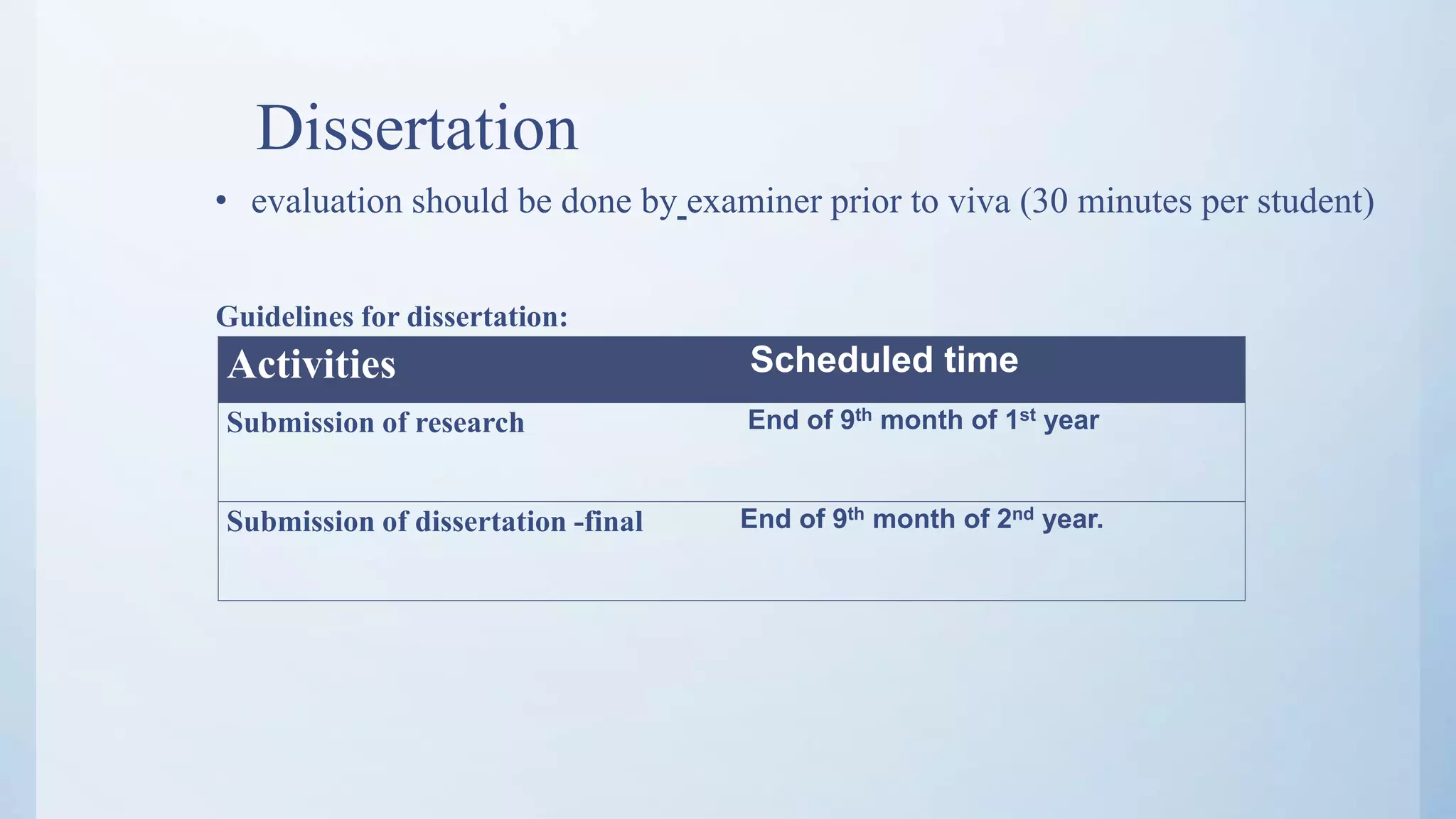
Dissertation
• evaluation should be done by examiner prior to viva (30 minutes per student)
Activities Scheduled time
Submission of research End of 9th month of 1st year
Submission of dissertation -final End of 9th month of 2nd year.
Guidelines for dissertation:
Cont.……
• NOTE: administrative approval and ethical clearance should be obtained.
• Research guides:
• Main guide: Nursing faculty in the same clinical speciality holding
PhD/MPhil/MSc(N) with a minimum of 3 years’ experience in Teaching in the PG
program in nursing.
• Co-Guide: is a nursing faculty in the field of study(may be outside the college but
should be within the city).
• Guide-student Ratio- maximum of 1:4( including as Co-Guide)
• Research committee: there should be a research committee in each college
comprising of minimum 5 members chaired by the principal, college of nursing.
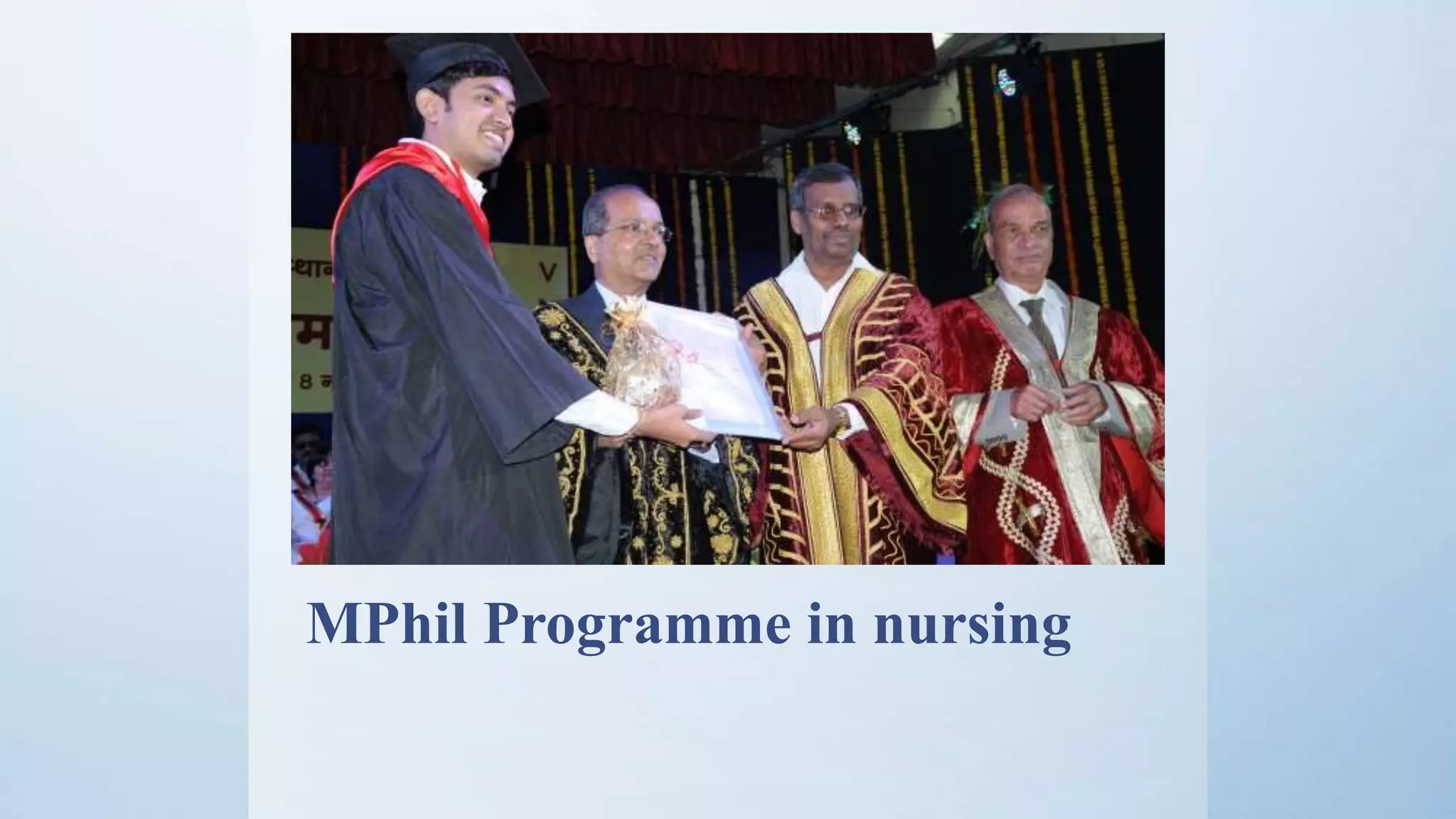
MPhil Programme in nursing
Objectives
» To strengthen the research foundations of the
nurses for encouraging research attitudes, and
problem-solving capabilities.
» To provide basic training required for research
in undertaking doctoral work.
Duration
 Full time = 1 year
 Part- time = 2 years
Attendance
Students will be required to attend not less
than 2/3rd of the total no. of lectures,
seminars and practical separately in each
course of part.
Course of study
• At the time of admission each candidate will be
required to indicate her/his priorities in regard to the
optimal courses she/he finally decide the courses to be
offered in that academic year.
• Final decision will be made accordance to resource
available and on the advice of MPhil committee.
• In lieu of the optimal courses offered by the
department of nursing, candidate may be offered one
course from MPhil program from the department of
anthropology, education, sociology, and psychology or
any suitable department , subject t the concerned of the
MPhil committee and the departments concerned
Contd……
Students will be in 2 distinct parts
1. Part-I: --- 3 courses
2. Part II: ---Dissertation
Part I :
It consists of 3 courses, one to be selected from each of 3
major groups A,B, C
Part II:
After passing the part I examination, a student shall be
required to write a dissertation
Cont……
Part I and Part II:
1.Each course in part I will carry 100 marks on the basis of equal
weightage for sessional work and end of semester written test.
• The evaluation of the sessional work of candidates will be based
on seminars, independent study, assignments administered by the
concerned teachers.
Part II evaluation : dissertation will be at end of the second
semester. It will be evaluated by the supervisor and one member
appointed by the MPhil
committee. It carries 300 marks.
Evaluation
Cont……
2. Provided that student clears at least 2 courses in the part 1exam,
she may be allowed to proceed with the dissertation work. Such
students will be permitted to submit the dissertation only when they
have passed the exam in all the 3 courses prescribed under part I.
3. In case of students who have not cleared all the courses at the
semester exam as prescribed in part-I, a special exam in the
remaining courses will be held by the MPhil committee at an
appropriate time.
No students will be allowed to appear in any part of the exam more
than twice and a student must clear the MPhil exam within 3 years of
her
1. initial registration for the MPhil full-time program and within 4
years of initial registration for the part time program.
Evaluation scheme
Exam
mark
s
I.A TOTAL
Part I
Group A: research methods in
nursing
Group B:
Major aspects of nursing
Group C:
Allied disciplines
50
50
50
50
50
50
100
100
100
Part II
Dissertation incl. viva voice
Total of part I and Part II
100 200 300
600
Classification of results OF Mphil (N)
program
Pass: at least 50% marks in each course in part I and 50% in the dissertation(part
-II)
First class: 60% marks in aggregate of part I and II
Distinction:75% marks in aggregate of part I and II
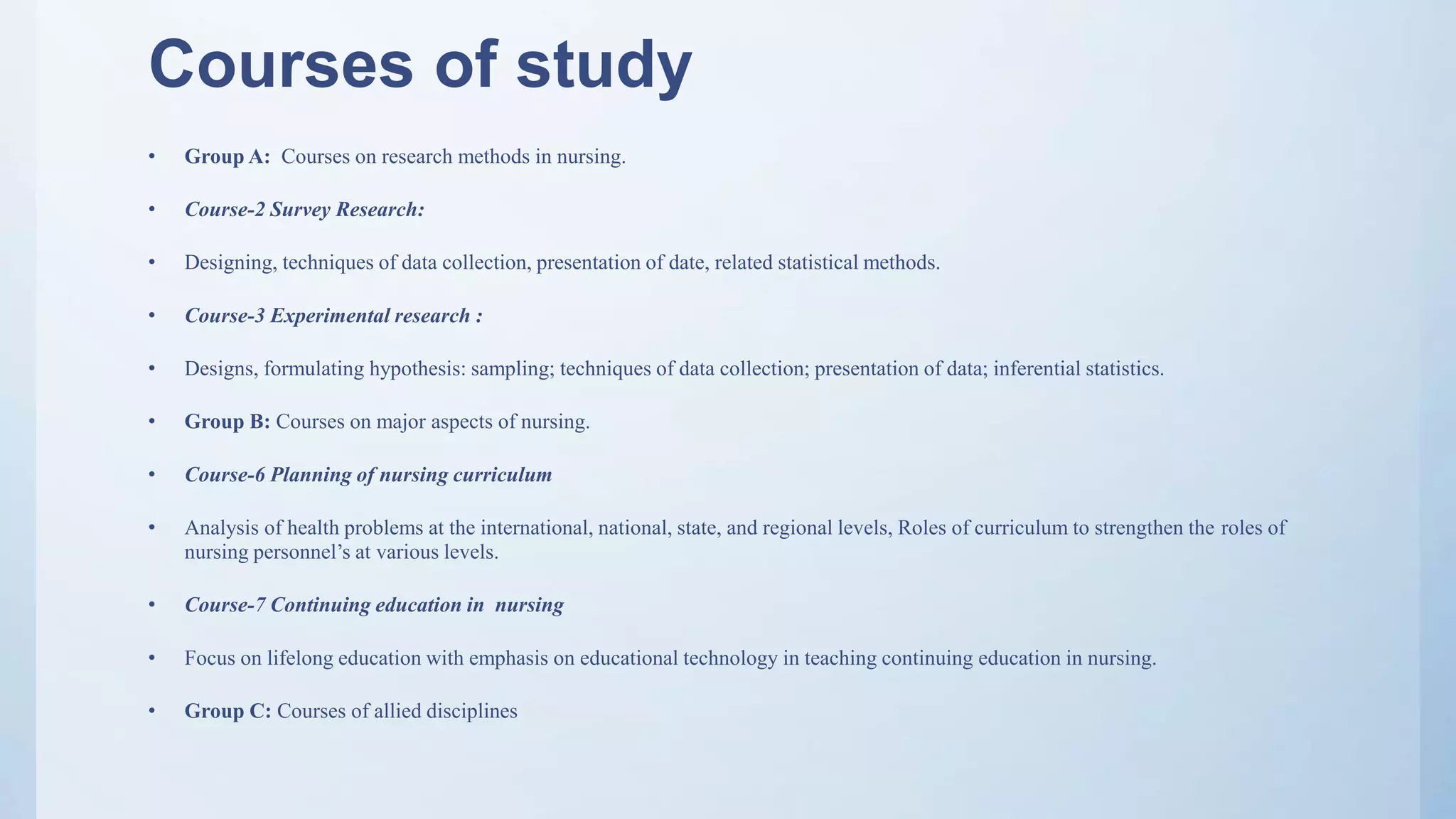
Courses of study
• Group A: Courses on research methods in nursing.
• Course-2 Survey Research:
• Designing, techniques of data collection, presentation of date, related statistical methods.
• Course-3 Experimental research :
• Designs, formulating hypothesis: sampling; techniques of data collection; presentation of data; inferential statistics.
• Group B: Courses on major aspects of nursing.
• Course-6 Planning of nursing curriculum
• Analysis of health problems at the international, national, state, and regional levels, Roles of curriculum to strengthen the roles of
nursing personnel’s at various levels.
• Course-7 Continuing education in nursing
• Focus on lifelong education with emphasis on educational technology in teaching continuing education in nursing.
• Group C: Courses of allied disciplines
Cont.….
• Course-10 Pathophysiologic mechanisms
• Altered regulatory mechanisms in selected clinical conditions.
• Course-11 Psychodynamic of human behavior
• Motivations, adjustments, family dynamics etc.
• Course-12 Attitudes and attitudinal change
• Personality traits, social attitudes, etc.
Fellowship and
scholarship
Students are eligible to compete for
junior research fellowship and other
scholarships that are available in the
department and university. They
may apply when those fellowships
and scholarships are advertised
 The Manipal Academy of Higher Education
(MAHE) in Karnataka, Manipal College of
Nursing, Manipal.
 Christian Medical College, Vellore
 Vivekananda Teaching Institute, Coimbatore
 University of Calicut
 RAK College of Nursing, Delhi
List of college for MPhil in
Nursing
Doctorate of philosophy in nursing
It is the university highest level supervised research degree.
Development
• currently there is a wide range of available doctoral degree for
nurses. The doctor of philosophy degree is the most accepted
academic degree and is designed to prepare individuals to conduct
research
Preamble
National consortium for Ph.D. in nursing has been constituted
by Indian Nursing Council (INC) in collaboration with Rajiv
Gandhi University of Health Sciences and W.H.O, under the
faculty of Nursing to promote doctoral education in various
fields of Nursing
Available seats = 30
Eligibility
 MPhil/ MSc(N) or a PG degree in nursing recognized by INC , for enrolment
for Ph.D.in nursing (part time) under faculty of nursing RGUHS.
 The candidates should have passed MSc.(N) with a minimum of 60% marks.
 Should have research background
• May or may not published articles in journals.
Selection criteria
 Merit in entrance exam (85 marks)
 Candidates obtaining MPhil in nursing (5marks)
 Publications(5marks)
 institutions (5marks)
• Selection will be made by Ph.D. consortium and the decision of the
consortium will be final
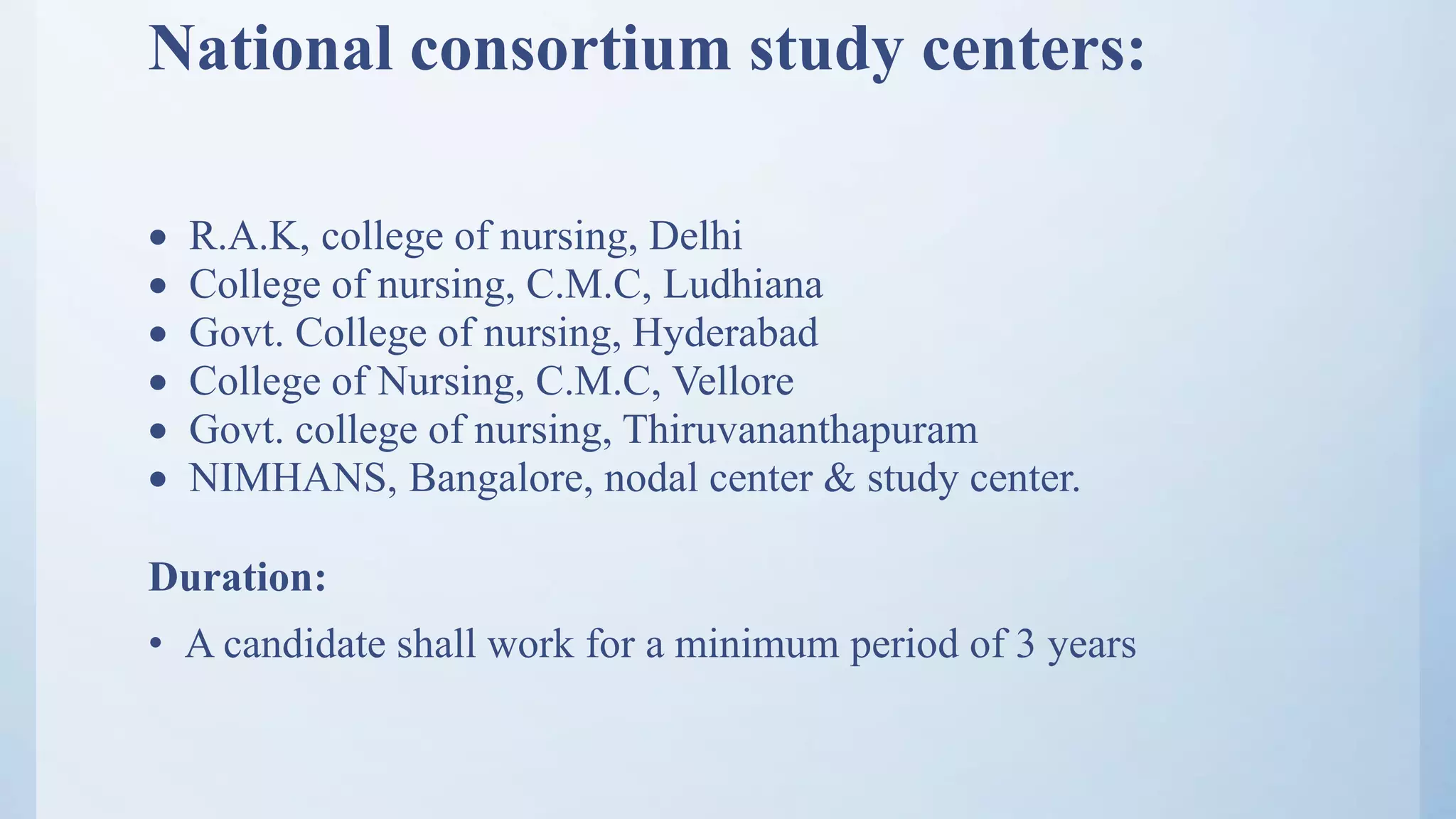
National consortium study centers:
 R.A.K, college of nursing, Delhi
 College of nursing, C.M.C, Ludhiana
 Govt. College of nursing, Hyderabad
 College of Nursing, C.M.C, Vellore
 Govt. college of nursing, Thiruvananthapuram
 NIMHANS, Bangalore, nodal center & study center.
Duration:
• A candidate shall work for a minimum period of 3 years
Cont…..
from the date of provisional registration
A full time/ part time candidate should complete research work
and submit the thesis to the university within 3 years from the date
of provisional.
For part time candidate, maximum period for submission of thesis
will be 4 years from the date of provisional registration subject to
the permission from the PhD registration committee on the
recommendation of the guide and with the approval of the PhD.
Consortium.
Cont……
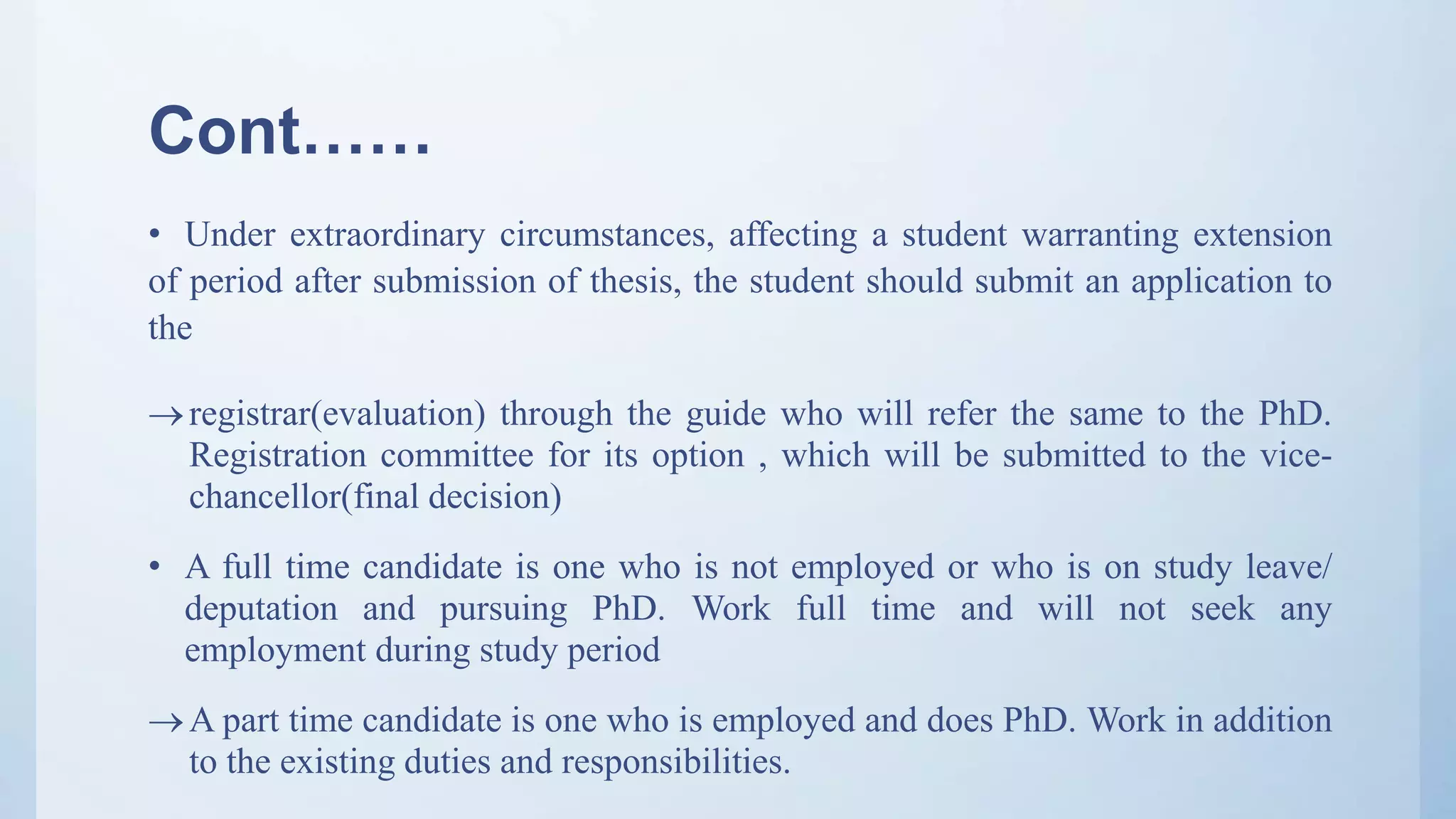
• Under extraordinary circumstances, affecting a student warranting extension
of period after submission of thesis, the student should submit an application to
the
registrar(evaluation) through the guide who will refer the same to the PhD.
Registration committee for its option , which will be submitted to the vice-
chancellor(final decision)
• A full time candidate is one who is not employed or who is on study leave/
deputation and pursuing PhD. Work full time and will not seek any
employment during study period
A part time candidate is one who is employed and does PhD. Work in addition
to the existing duties and responsibilities.
Board of research studies
 Dean and head of departments concerned
 Principals/ heads of medical institutions recognized for PG medical studies.
 Two members nominated by the academic councils.
 Three persons nominated by the medical faculty (for their special knowledge
in the medical sciences)
• The co-opted or nominate members shall hold office for a period of 2 years.
Each board shall be elect a chairman from among its own members who shall
hold office for a period of 2 years.
AWARD of PhD Degree
After successfully completing the viva-voice, award of
PhD Degree is awarded by RGUHS, Bangalore.
Nurse Practitioner in Primary Health Care
Introduction
• It is a new dimension to the nursing profession in India, which
aims at providing Primary Health Care to underserved, rural and
tribal areas in the country.
• Definition: According to INC: Nurse Practitioner in Primary
Health Care is a registered nurse who undergoes additional
advanced preparation to provide primary health care to clients of
all ages, implement National Health Programme, supervise and
manage PHC and to provide technical guidance to ANM’s& LHV’s
and other health personnel in the PHC and the villages served by
the PHC’s.
Objectives
• At the end students will be able to
• Describe concepts, principles, and elements of primary health care.
• Provide care, counselling and follow-up services by using a wide range of advanced skills as per clinical
guidelines.
• Use decision making skills in providing Primary health care for all .
• Diagnosis common diseases and prescribe the drugs that conform to Indian Laws and institutional
policies and protocol.
• Work with interdisciplinary groups, public health, local health care professionals and other relevant
community organization.
• Carryout simple research to promote evidence based practices.
• Apply ethical principles in providing care.
• Assume a leadership role.
Organization of the course
• Duration= 1 academic year
• -Distribution of the course= teaching and --clinical practice- 42 weeks
• -Internship- 4 weeks
• -Examination(including preparation)- 2 weeks
• -Vacation- 2 weeks
• -Public holidays – 2 weeks
• -total = 52 weeks
• Subjects: Primary health care-I (inclusive of foundation courses)
• Primary health care-II
• Supervision, management of primary health center and clinical teaching
• Internship CHC.
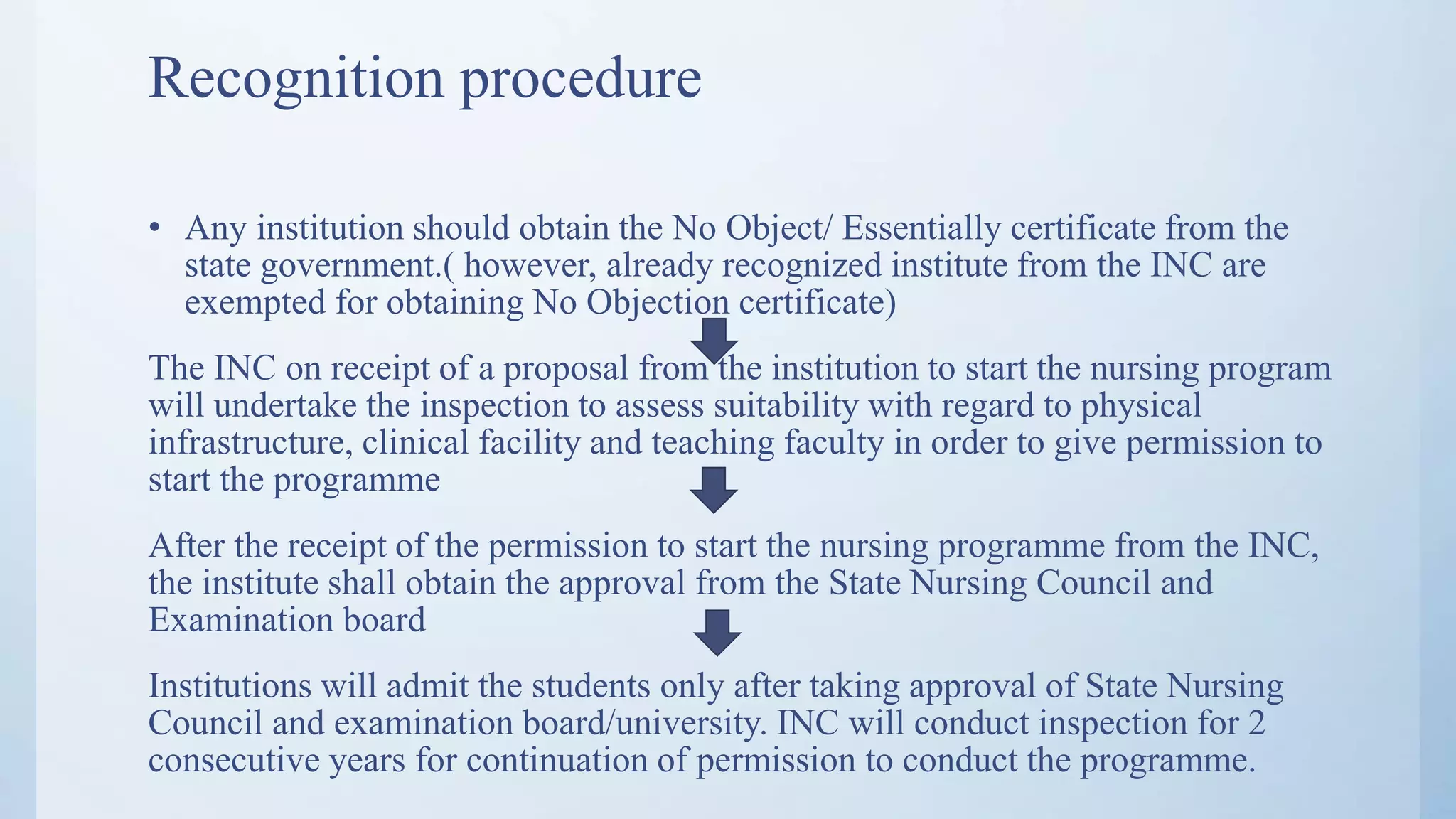
Recognition procedure
• Any institution should obtain the No Object/ Essentially certificate from the
state government.( however, already recognized institute from the INC are
exempted for obtaining No Objection certificate)
The INC on receipt of a proposal from the institution to start the nursing program
will undertake the inspection to assess suitability with regard to physical
infrastructure, clinical facility and teaching faculty in order to give permission to
start the programme
After the receipt of the permission to start the nursing programme from the INC,
the institute shall obtain the approval from the State Nursing Council and
Examination board
Institutions will admit the students only after taking approval of State Nursing
Council and examination board/university. INC will conduct inspection for 2
consecutive years for continuation of permission to conduct the programme.
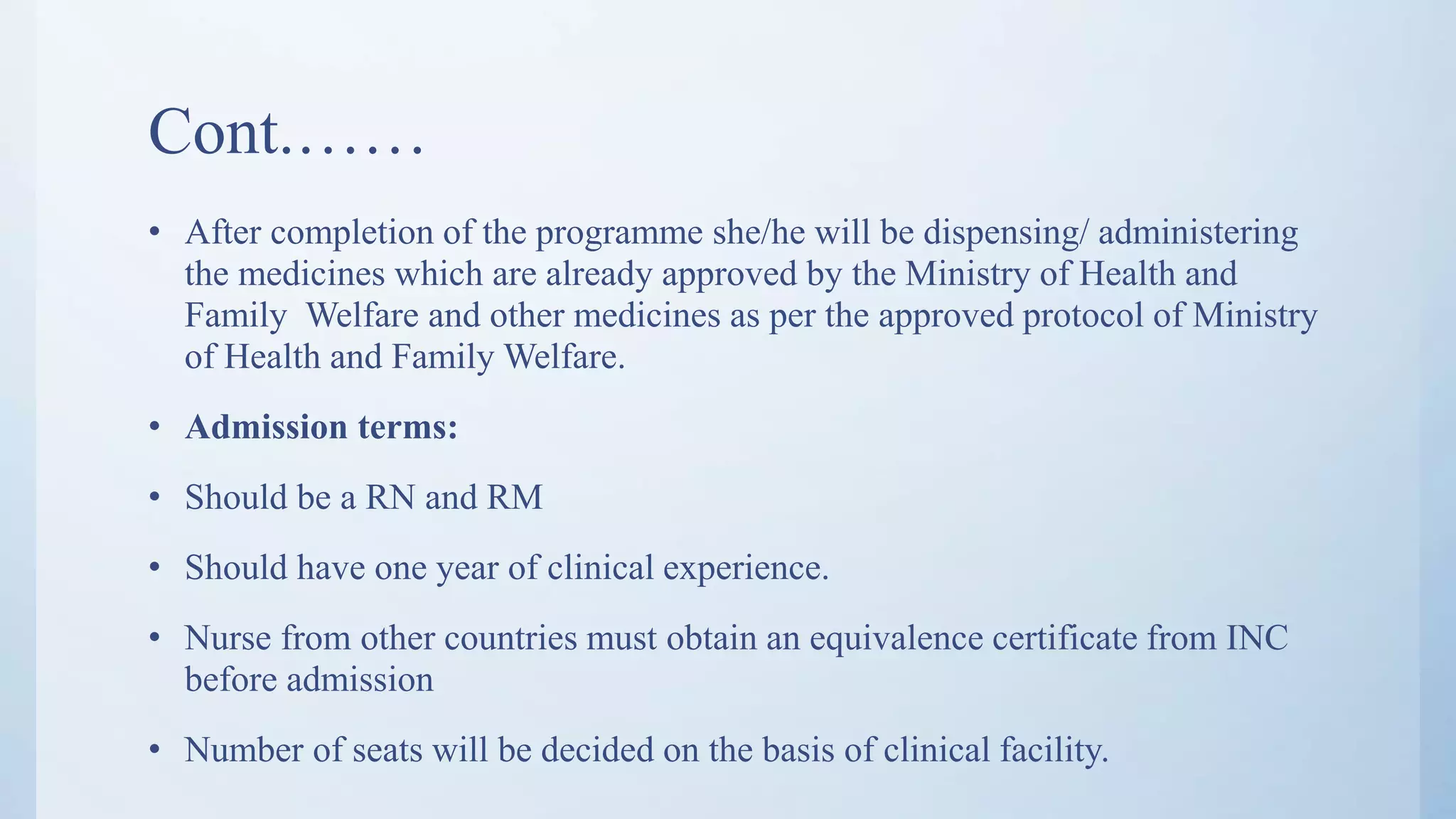
Cont.……
• After completion of the programme she/he will be dispensing/ administering
the medicines which are already approved by the Ministry of Health and
Family Welfare and other medicines as per the approved protocol of Ministry
of Health and Family Welfare.
• Admission terms:
• Should be a RN and RM
• Should have one year of clinical experience.
• Nurse from other countries must obtain an equivalence certificate from INC
before admission
• Number of seats will be decided on the basis of clinical facility.
Intern
al
asses
smen
t
mark
s
Extern
al
assess
ment
marks
Total
mark
s
Duration
(in
hours)
A. Theory
Primary health care and nursing-I
(behavioral science, advanced microbiology and pathology, pharmacology, anatomy and
pathophysiology, advanced health assessment, health education, communication and
counselling)
50 150 200 3
Primary health care and nursing-II(Maternity care, health programme and family
planning, First aid and emergency management)
50 150 200 3
Supervision, management of primary health Centre and clinical
teaching.
Internship PHC: (Health assessment, programme
and supervision)
B. Practical
50
100
150
100
200
200
3
Total 250 550 800
Cont.….
• Standard of passing: At least 50% of marks separately in internal and
external examination in each theory and practical examinations should be
obtained.
• Aggregate of marks will be graded as:
• Less than 60% is 2nd division
• Above 60% and below 75% is 1st division
• 75% and above is distinction.
• Students will be given the opportunity of maximum 3 attempts for passing the
examination.
Summarization:
 Definition of nursing and nursing education
 Pattern and training program in nursing education
 MSc(N) program, its objectives, eligibility criteria and specialties
 MPhil (N) program, its objectives, duration ,attendance, course of study,
evaluation scheme and other information
 PhD(N) program, its development, preamble, available seats, eligibility
criteria, selection criteria,
 National consortium study centers
 Duration and board of research study
 Introduction, objectives, recognition procedure, admission criteria and
evaluation criteria for the nurse practitioner in primary health care.
Recaptualization;
• MCQ
1. Duration of MSC(N) program is
• a)3yrs b) 4yrs
• c)1yr d)2yrs
1. University nursing Programme is
a) ANM b) HA
• c)LHV d) BSc(N)
1. It is not necessary to be registered for admission in PG program
2. For admission in PhD Candidate must have research background
3. Neuro nursing is a subspecialty of pediatric nursing
4. There are 5 parts in MPhil(N)
• FILL IN THE BLANKS
1. ------------% is required for distinction in MPhil(N) program
2. Consortium for PhD has been constituted by-------------------
3. ---------------seats are available in PhD(N) program
4. -----------years is the duration of MPhil(N) program
5. ---------------years are required for thesis submission in PhD(N) program
• True / false
key
• MCQ
• 1. d)
• 2. d)
• TRUE/FALSE:
• 3. False
• 4. True
• 5. False
• 6. False
• FILL IN THE BLANKS:
• 7. 75%
• 8. INC
• 9. 30
• 10. 1 year
• 11. 3 years
Bibliography
• Bhaskar nima,”textbook of nursing education”,EMMESS medical publishers,1st
edition, page no-312-316
• Sodhi k. jaspreet,”comprehensive textbook of nursing education”,jaypee
brothers medical publishers ltd.,1st edition,page no-292-312
• Basavanthappa BT, ”Nursing Education”, JayPee Publishers, 2nd Edition, Page
No.-815-816,818
 Sudha R, “Nursing Education Principles and Concepts”, JayPee Publishers,1st
Edition, Page No.- 211-216
 Neerja KP,” Textbook of Nursing Education”, JayPee Publishers,1st edition,
Page No.- 8-12, 67-78
•
Assignment
• assignment on guidelines for initiation of the MSc(N) program.
• Date of submission- 18-02-2019
• Venue- MSc(N) 1st year classroom
Pattern of nursing education

Pattern of nursing education

  • 1.
    Pattern of nursing education MSc(N),MPhil(N) & PhD(N) Programme Submitted to: submitted by: Mrs. Meenakshi Nikita Sharma Associate professor MSc(N) 1st yr. Community health nursing Roll no.-8
  • 2.
    Nursing education Nursing education:It consists of the theoretical and practical training provided to nurses with the purpose to prepare them for their duties as nursing care professionals. This education is provided to nursing students by experienced nurses and other medical professionals who have qualified or experienced for educational tasks. Most countries offer nurse education courses that can be relevant to general nursing or to specialized areas including mental health nursing, pediatric nursing and post-operatory nursing.
  • 3.
    Nursing education Programme •It may be defined as in large part that influencing of one group of human beings, the pupils to grow towards defined objectives: utilizing a second group of human beings, the teacher as agents, and operating in a setting of third group of human being, the public variously concerned both with objectives and with means used to achieve them.
  • 4.
    Pattern of nursingeducation and training Programme in India Non university nursing Programme University nursing Programme 1.certificate course— -ANM course/ -HW(F) Course/ -HA(F) Course/ LHV 2.Diploma— GNM course 1.Degree (UG) ----- -B.Sc. nursing (Basic) -Basic nursing (post certificate) -PB BSc Nursing(IGNOU) 2. post basic diploma course 3.Masters education (PG) -MN(masters of nursing) -M.Sc. (nursing) 4. M.Phil. in nursing 5. doctoral programs-PhD(N) 6. Nurse practitioner in primary health care.
  • 5.
    PG (MSc.) nursingeducation program
  • 6.
    INTRODUCTION  Students arethought to conduct research in nursing.  A thesis is submitted by each student in partial fulfillment of the requirements for the degree.  Courses in education and administration are given to prepare the students to take up responsibility in it in nursing and allied health areas.  The entrance test is mandatory in reputed institutes. • University exams are conducted at the end of the academic year or • 2 years course is designed to prepare clinical and community health nursing specialists.
  • 7.
  • 8.
    The candidate seekingadmission must:  Have passed BSc nursing/ post certificate BSc, or nursing degree of any university.  Have a minimum of one year experience after obtaining BSc, in hospitals or nursing educational institutions or community health settings Eligibility
  • 9.
    Cont….. For BSc, nursingpost certificate, no such experience is needed after graduation. The candidate  shall be a registered nurse and midwife for admission to medical surgical nursing, community health nursing, pediatric nursing, obstetric and gynecological nursing and psychiatric nursing.  The candidate shall be selected on merit judged on the basis of academic performance in BSc nursing, post certificate BSc, or nursing and selection tests.
  • 10.
    Specialties:  Branch 1-Medical surgical nursing (sub specialties in 2nd yr. -- - Neuro nursing, cardiovascular Nursing, orthopedic Nursing, Critical care Nursing etc.  Branch 2----Pediatric Nursing  Branch 3----Obstetric and Gynecological Nursing
  • 11.
    Duration of course Durationof course 2 years Available 52 weeks Vacation 4 weeks Examination 2 weeks Gazetted holidays 3 weeks Total weeks available 43 weeks Hours per week 40 hours Hours for one year 1720 hours Total hours for 2 years 3440 hours
  • 12.
    Course of instructionand Examination SUBJECT Course of . Instruction Course of examination Theory Practical 1st Year Theory Practical Internal External Internal External Nursing education 150 150 25 75 50 50 Advance Nursing Practice 150 200 25 75 Nursing Research And statistics 150 100 25 75 Clinical speciality 150 650 -I 25 75 100 100 Total 600 1100 100 300 150 150
  • 13.
    Cont…… subjects theory practicalTheory internal Theory external Practical internal Practical external 2nd year Nursing managem ent 150 150 25 75 Dissertati on and viva 300 100 100 Clinical speciality 150 950 25 75 100 100 Total 300 1400 50 150 200 200
  • 14.
    Practical • 4 hoursof practical examination per student. • The examination should be held in Clinical area for clinical specialties. • One internal and external examiner should jointly conduct the practical. • Examiner: nursing faculty teaching respective specialty area in MSc nursing program with minimum 3 years’ experience after MSc(N). • Regulation for examination: • 75% of attendance for theory and practical’s. However, 100% of attendance for practical before the award of degree.
  • 15.
    Dissertation • evaluation shouldbe done by examiner prior to viva (30 minutes per student) Activities Scheduled time Submission of research End of 9th month of 1st year Submission of dissertation -final End of 9th month of 2nd year. Guidelines for dissertation:
  • 16.
    Cont.…… • NOTE: administrativeapproval and ethical clearance should be obtained. • Research guides: • Main guide: Nursing faculty in the same clinical speciality holding PhD/MPhil/MSc(N) with a minimum of 3 years’ experience in Teaching in the PG program in nursing. • Co-Guide: is a nursing faculty in the field of study(may be outside the college but should be within the city). • Guide-student Ratio- maximum of 1:4( including as Co-Guide) • Research committee: there should be a research committee in each college comprising of minimum 5 members chaired by the principal, college of nursing.
  • 17.
  • 18.
    Objectives » To strengthenthe research foundations of the nurses for encouraging research attitudes, and problem-solving capabilities. » To provide basic training required for research in undertaking doctoral work. Duration  Full time = 1 year  Part- time = 2 years
  • 19.
    Attendance Students will berequired to attend not less than 2/3rd of the total no. of lectures, seminars and practical separately in each course of part.
  • 20.
    Course of study •At the time of admission each candidate will be required to indicate her/his priorities in regard to the optimal courses she/he finally decide the courses to be offered in that academic year. • Final decision will be made accordance to resource available and on the advice of MPhil committee. • In lieu of the optimal courses offered by the department of nursing, candidate may be offered one course from MPhil program from the department of anthropology, education, sociology, and psychology or any suitable department , subject t the concerned of the MPhil committee and the departments concerned
  • 21.
    Contd…… Students will bein 2 distinct parts 1. Part-I: --- 3 courses 2. Part II: ---Dissertation Part I : It consists of 3 courses, one to be selected from each of 3 major groups A,B, C Part II: After passing the part I examination, a student shall be required to write a dissertation
  • 22.
    Cont…… Part I andPart II: 1.Each course in part I will carry 100 marks on the basis of equal weightage for sessional work and end of semester written test. • The evaluation of the sessional work of candidates will be based on seminars, independent study, assignments administered by the concerned teachers. Part II evaluation : dissertation will be at end of the second semester. It will be evaluated by the supervisor and one member appointed by the MPhil committee. It carries 300 marks. Evaluation
  • 23.
    Cont…… 2. Provided thatstudent clears at least 2 courses in the part 1exam, she may be allowed to proceed with the dissertation work. Such students will be permitted to submit the dissertation only when they have passed the exam in all the 3 courses prescribed under part I. 3. In case of students who have not cleared all the courses at the semester exam as prescribed in part-I, a special exam in the remaining courses will be held by the MPhil committee at an appropriate time. No students will be allowed to appear in any part of the exam more than twice and a student must clear the MPhil exam within 3 years of her 1. initial registration for the MPhil full-time program and within 4 years of initial registration for the part time program.
  • 24.
    Evaluation scheme Exam mark s I.A TOTAL PartI Group A: research methods in nursing Group B: Major aspects of nursing Group C: Allied disciplines 50 50 50 50 50 50 100 100 100 Part II Dissertation incl. viva voice Total of part I and Part II 100 200 300 600
  • 25.
    Classification of resultsOF Mphil (N) program Pass: at least 50% marks in each course in part I and 50% in the dissertation(part -II) First class: 60% marks in aggregate of part I and II Distinction:75% marks in aggregate of part I and II
  • 26.
    Courses of study •Group A: Courses on research methods in nursing. • Course-2 Survey Research: • Designing, techniques of data collection, presentation of date, related statistical methods. • Course-3 Experimental research : • Designs, formulating hypothesis: sampling; techniques of data collection; presentation of data; inferential statistics. • Group B: Courses on major aspects of nursing. • Course-6 Planning of nursing curriculum • Analysis of health problems at the international, national, state, and regional levels, Roles of curriculum to strengthen the roles of nursing personnel’s at various levels. • Course-7 Continuing education in nursing • Focus on lifelong education with emphasis on educational technology in teaching continuing education in nursing. • Group C: Courses of allied disciplines
  • 27.
    Cont.…. • Course-10 Pathophysiologicmechanisms • Altered regulatory mechanisms in selected clinical conditions. • Course-11 Psychodynamic of human behavior • Motivations, adjustments, family dynamics etc. • Course-12 Attitudes and attitudinal change • Personality traits, social attitudes, etc.
  • 28.
    Fellowship and scholarship Students areeligible to compete for junior research fellowship and other scholarships that are available in the department and university. They may apply when those fellowships and scholarships are advertised  The Manipal Academy of Higher Education (MAHE) in Karnataka, Manipal College of Nursing, Manipal.  Christian Medical College, Vellore  Vivekananda Teaching Institute, Coimbatore  University of Calicut  RAK College of Nursing, Delhi List of college for MPhil in Nursing
  • 29.
    Doctorate of philosophyin nursing It is the university highest level supervised research degree.
  • 30.
    Development • currently thereis a wide range of available doctoral degree for nurses. The doctor of philosophy degree is the most accepted academic degree and is designed to prepare individuals to conduct research Preamble National consortium for Ph.D. in nursing has been constituted by Indian Nursing Council (INC) in collaboration with Rajiv Gandhi University of Health Sciences and W.H.O, under the faculty of Nursing to promote doctoral education in various fields of Nursing
  • 31.
    Available seats =30 Eligibility  MPhil/ MSc(N) or a PG degree in nursing recognized by INC , for enrolment for Ph.D.in nursing (part time) under faculty of nursing RGUHS.  The candidates should have passed MSc.(N) with a minimum of 60% marks.  Should have research background • May or may not published articles in journals.
  • 32.
    Selection criteria  Meritin entrance exam (85 marks)  Candidates obtaining MPhil in nursing (5marks)  Publications(5marks)  institutions (5marks) • Selection will be made by Ph.D. consortium and the decision of the consortium will be final
  • 33.
    National consortium studycenters:  R.A.K, college of nursing, Delhi  College of nursing, C.M.C, Ludhiana  Govt. College of nursing, Hyderabad  College of Nursing, C.M.C, Vellore  Govt. college of nursing, Thiruvananthapuram  NIMHANS, Bangalore, nodal center & study center. Duration: • A candidate shall work for a minimum period of 3 years
  • 34.
    Cont….. from the dateof provisional registration A full time/ part time candidate should complete research work and submit the thesis to the university within 3 years from the date of provisional. For part time candidate, maximum period for submission of thesis will be 4 years from the date of provisional registration subject to the permission from the PhD registration committee on the recommendation of the guide and with the approval of the PhD. Consortium.
  • 35.
    Cont…… • Under extraordinarycircumstances, affecting a student warranting extension of period after submission of thesis, the student should submit an application to the registrar(evaluation) through the guide who will refer the same to the PhD. Registration committee for its option , which will be submitted to the vice- chancellor(final decision) • A full time candidate is one who is not employed or who is on study leave/ deputation and pursuing PhD. Work full time and will not seek any employment during study period A part time candidate is one who is employed and does PhD. Work in addition to the existing duties and responsibilities.
  • 36.
    Board of researchstudies  Dean and head of departments concerned  Principals/ heads of medical institutions recognized for PG medical studies.  Two members nominated by the academic councils.  Three persons nominated by the medical faculty (for their special knowledge in the medical sciences) • The co-opted or nominate members shall hold office for a period of 2 years. Each board shall be elect a chairman from among its own members who shall hold office for a period of 2 years.
  • 37.
    AWARD of PhDDegree After successfully completing the viva-voice, award of PhD Degree is awarded by RGUHS, Bangalore.
  • 38.
    Nurse Practitioner inPrimary Health Care
  • 39.
    Introduction • It isa new dimension to the nursing profession in India, which aims at providing Primary Health Care to underserved, rural and tribal areas in the country. • Definition: According to INC: Nurse Practitioner in Primary Health Care is a registered nurse who undergoes additional advanced preparation to provide primary health care to clients of all ages, implement National Health Programme, supervise and manage PHC and to provide technical guidance to ANM’s& LHV’s and other health personnel in the PHC and the villages served by the PHC’s.
  • 40.
    Objectives • At theend students will be able to • Describe concepts, principles, and elements of primary health care. • Provide care, counselling and follow-up services by using a wide range of advanced skills as per clinical guidelines. • Use decision making skills in providing Primary health care for all . • Diagnosis common diseases and prescribe the drugs that conform to Indian Laws and institutional policies and protocol. • Work with interdisciplinary groups, public health, local health care professionals and other relevant community organization. • Carryout simple research to promote evidence based practices. • Apply ethical principles in providing care. • Assume a leadership role.
  • 41.
    Organization of thecourse • Duration= 1 academic year • -Distribution of the course= teaching and --clinical practice- 42 weeks • -Internship- 4 weeks • -Examination(including preparation)- 2 weeks • -Vacation- 2 weeks • -Public holidays – 2 weeks • -total = 52 weeks • Subjects: Primary health care-I (inclusive of foundation courses) • Primary health care-II • Supervision, management of primary health center and clinical teaching • Internship CHC.
  • 42.
    Recognition procedure • Anyinstitution should obtain the No Object/ Essentially certificate from the state government.( however, already recognized institute from the INC are exempted for obtaining No Objection certificate) The INC on receipt of a proposal from the institution to start the nursing program will undertake the inspection to assess suitability with regard to physical infrastructure, clinical facility and teaching faculty in order to give permission to start the programme After the receipt of the permission to start the nursing programme from the INC, the institute shall obtain the approval from the State Nursing Council and Examination board Institutions will admit the students only after taking approval of State Nursing Council and examination board/university. INC will conduct inspection for 2 consecutive years for continuation of permission to conduct the programme.
  • 43.
    Cont.…… • After completionof the programme she/he will be dispensing/ administering the medicines which are already approved by the Ministry of Health and Family Welfare and other medicines as per the approved protocol of Ministry of Health and Family Welfare. • Admission terms: • Should be a RN and RM • Should have one year of clinical experience. • Nurse from other countries must obtain an equivalence certificate from INC before admission • Number of seats will be decided on the basis of clinical facility.
  • 44.
    Intern al asses smen t mark s Extern al assess ment marks Total mark s Duration (in hours) A. Theory Primary healthcare and nursing-I (behavioral science, advanced microbiology and pathology, pharmacology, anatomy and pathophysiology, advanced health assessment, health education, communication and counselling) 50 150 200 3 Primary health care and nursing-II(Maternity care, health programme and family planning, First aid and emergency management) 50 150 200 3 Supervision, management of primary health Centre and clinical teaching. Internship PHC: (Health assessment, programme and supervision) B. Practical 50 100 150 100 200 200 3 Total 250 550 800
  • 45.
    Cont.…. • Standard ofpassing: At least 50% of marks separately in internal and external examination in each theory and practical examinations should be obtained. • Aggregate of marks will be graded as: • Less than 60% is 2nd division • Above 60% and below 75% is 1st division • 75% and above is distinction. • Students will be given the opportunity of maximum 3 attempts for passing the examination.
  • 46.
    Summarization:  Definition ofnursing and nursing education  Pattern and training program in nursing education  MSc(N) program, its objectives, eligibility criteria and specialties  MPhil (N) program, its objectives, duration ,attendance, course of study, evaluation scheme and other information  PhD(N) program, its development, preamble, available seats, eligibility criteria, selection criteria,  National consortium study centers  Duration and board of research study  Introduction, objectives, recognition procedure, admission criteria and evaluation criteria for the nurse practitioner in primary health care.
  • 47.
    Recaptualization; • MCQ 1. Durationof MSC(N) program is • a)3yrs b) 4yrs • c)1yr d)2yrs 1. University nursing Programme is a) ANM b) HA • c)LHV d) BSc(N)
  • 48.
    1. It isnot necessary to be registered for admission in PG program 2. For admission in PhD Candidate must have research background 3. Neuro nursing is a subspecialty of pediatric nursing 4. There are 5 parts in MPhil(N) • FILL IN THE BLANKS 1. ------------% is required for distinction in MPhil(N) program 2. Consortium for PhD has been constituted by------------------- 3. ---------------seats are available in PhD(N) program 4. -----------years is the duration of MPhil(N) program 5. ---------------years are required for thesis submission in PhD(N) program • True / false
  • 49.
    key • MCQ • 1.d) • 2. d) • TRUE/FALSE: • 3. False • 4. True • 5. False • 6. False • FILL IN THE BLANKS: • 7. 75% • 8. INC • 9. 30 • 10. 1 year • 11. 3 years
  • 50.
    Bibliography • Bhaskar nima,”textbookof nursing education”,EMMESS medical publishers,1st edition, page no-312-316 • Sodhi k. jaspreet,”comprehensive textbook of nursing education”,jaypee brothers medical publishers ltd.,1st edition,page no-292-312 • Basavanthappa BT, ”Nursing Education”, JayPee Publishers, 2nd Edition, Page No.-815-816,818  Sudha R, “Nursing Education Principles and Concepts”, JayPee Publishers,1st Edition, Page No.- 211-216  Neerja KP,” Textbook of Nursing Education”, JayPee Publishers,1st edition, Page No.- 8-12, 67-78 •
  • 51.
    Assignment • assignment onguidelines for initiation of the MSc(N) program. • Date of submission- 18-02-2019 • Venue- MSc(N) 1st year classroom