Definition
Health:
WHO defines Health as “a state of
complete physical, mental and
social wellbeing, not merely the
absence of disease or infirmity”.
Views of Health:
All people free of diseases are not
equally healthy
Health is condition of life rather
than pathological state
A complex concept, more than
absence of disease
Prevention
The goals of medicine are to promote
health, to preserve health & to restore
health when it is impaired.
Depends on knowledge of causation,
dynamics of transmission,
identification of risk factors,
availability of prophylaxis or early
treatment
Nurses’ role in Health
 A healing presence , willing to learn from
patients by listening, being attentive,
recognizing & respecting others way of
coping.
 Needs to have adequate knowledge
 Must understand & remember the concept
of health promotion, wellness & illness &
 that they mean differently to different
people.
Need for Prevention
Iceberg of Disease:
A disease in a community – Iceberg
The floating tip- clinical cases (What
the Physician sees)
The vast submerged portion- hidden
mass of disease, (latent, inappropriate,
undiagnosed cases)
•Detection & control of the
submerged part- a challenge to
modern technique in preventive
medicine.
•Especially in diseases like
hypertension, DM, anemia etc,
where unknown morbidity far
exceeds the known morbidity
Levels of Prevention
Primordial prevention
Primary prevention
Secondary prevention
Tertiary prevention
Primordial prevention
Primary prevention in purest sense
Prevention of emergence or
development of risk factors in
countries or population groups in
which they have not yet appeared
Eg: Discouraging children from
smoking & other ill habits to
prevent diseases like hypertension
Primary prevention
An action taken prior to the onset
of disease which removes the
possibility that a disease will occur.
Intervention in pathogenesis phase
of the disease
Secondary prevention
“A process which halts the progress of
the disease at its incipient stage and
prevents complications.”
Specific interventions or early
diagnosis & adequate treatment.
Attempts to arrest the disease process
An imperfect tool in the control of
transmission of disease
Tertiary prevention
Defined as “ All measures available to
reduce or limit impairments &
disabilities, minimize sufferings caused
by existing departures from good
health & to promote the patients
adjustment to irremediable
conditions.”
Done when the disease process has
advanced beyond its early stage.
Models of Health
Model: A theoretical way of
understanding a concept or an idea
They represent various ways of
approaching a complex issue.
Models of Health & Illness contain a
combination of biological
characteristics, behavioral factors &
social conditions.
Uses of Health models
1. To help nurses understand patient’s
attitudes & values about health & illness
in order to provide effective care
2. To help the nurses understand & predict
patient’s health behavior, including how
they use health services, participate in
recommended therapy & care for
themselves.
Health Belief model
Rosenstoch’s Model
Addresses the relationship
between a person,s beliefs &
behaviors
Health Beliefs are ideas,
convictions, & attitudes regarding
health & illness.
Health Belief model contd
As beliefs influence behavior,
they positively or negatively
affect patient’s level of health.
Positive health behaviors
Negative health behaviors
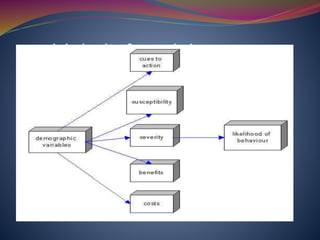
3 components:
Individual’s perception of illness
Modifying Factors
Variables affecting the likelihood of
client’s preventive action
Health belief model
Health Promotion Model
Pender’s Model
Complement to Health Belief
model
Explains the likelihood of health
promoting actions being taken.
Neuman system model
Betty Neuman (1972)
Health care system model
Depicts an open system in which
person and their environment are in
dynamic interaction
Five interacting variables:
Physiological
 Psychological
 Socio cultural
 Developmental
 Spiritual
3
preventions as intervention
modalities
Primary
Secondary
Tertiary
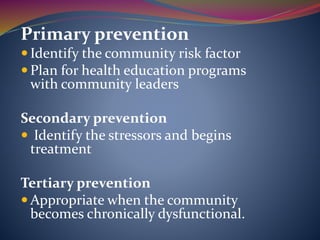
Primary prevention
 Identify the community risk factor
 Plan for health education programs
with community leaders
Secondary prevention
 Identify the stressors and begins
treatment
Tertiary prevention
 Appropriate when the community
becomes chronically dysfunctional.
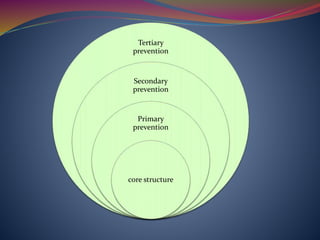
Tertiary
prevention
Secondary
prevention
Primary
prevention
core structure
Nightingale’s Environmental
Theory
Florence Nightingale - First Nurse
Theorist
Defined Nursing “The act of utilizing
the environment of the patient to assist
him in recovery”
Nightingale’s Assumptions
 Nursing is separate from medicine
 Nurses should be trained.
 The environment is important to the health
of the patient.
 The disease process is not important to
nursing
 Nursing should support the environment to
assist the patient in healing
Nightingale’s Assumptions
contd
 Research should be utilized through
observation on empirics to define the
nursing discipline.
 Nursing is both an empirical science & an
art
 Nursing’s concern is with the person in the
environment
 The person is interacting with the
environment
Nightingale’s Assumptions
contd
Sick and well are governed with
the same laws of health.
The nurse should be observant
and confidential.
Goal of Nursing
Assisting the patient in his
retention of his vital powers by
meeting his needs & thus putting
the patient in best possible
environment for healing.
Three Types of Environments
Physical
Psychological
Social
Physical environment
Consists of physical elements like
ventilation, warmth, cleanliness,
light, noise and drainage where the
patient is being treated
Affects all other aspects of the
environment.
Psychological environment
Can be affected by a negative physical
environment which then causes
STRESS.
Requires various activities like
manual work, appealing food, a
pleasing physical environment
to keep the mind active & help the
person survive psychologically.
Social environment
Involves collecting data about
illness and disease prevention.
Includes components of the
physical environment - clean air,
clean water, proper drainage.
Perspective on Nightingale’s
13 canon
Observation
Personal Cleanliness
Petty Management
Light
Health of Houses
Cleanliness of rooms
Perspective on Nightingale’s 13
canon contd
Ventilation & warming
Bed & Bedding
Taking food
What food
Noise
Chattering Hopes & advices
Variety
•Regarded one’s senses,
especially observation as
reliable means of obtaining &
verifying Knowledge
•Theory must be reformulated
if inconsistent with empirical
evidence
•Observation – important to
all nursing functions
PRECEDE- PROCEED Model
A comprehensive model for assessing
health & quality of life and for
designing, implementing & evaluating
health promotion & other public health
programs to meet those needs.
PRECEDE- PROCEED are acronyms
How the Model works?
Assesses the environment where the
group lives, considering social factors
that influence health behavior
Examines both internal & external
factors that predispose it to certain
behaviors & health problems
Identification of factors that help in
adopting healthy actions
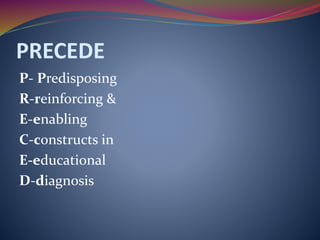
PRECEDE
P- Predisposing
R-reinforcing &
E-enabling
C-constructs in
E-educational
D-diagnosis
Phases of PRECEDE
 Has 4 phases
Phase I: Identifying the ultimate desired
result.
Phase II: Identifying & setting priorities
among health or community issues
Phase III: Identifying the predisposing,
enabling & reinforcing factors
Phase IV: Identifying the administrative &
policy factors
PROCEED
P-Policy
R- regulatory &
O- organisational
C-constructs in
E-Educational &
E- environmental
D-development
Phases of PROCEED
Phase V: Implementation
Phase VI: Process Evaluation
Phase V: Impact Evaluation
Phase V: Outcome Evaluation
The OMAHA System
A Nursing Process system.
Comprises of
 Nursing Diagnosis
Intervention
Evaluation
Nursing Diagnosis
 Called “ The OMAHA Problem
classification scheme”
 Organised at 4 discrete levels of abstraction
 All 4 levels consistent & parallel
 The four levels are
Problems
 Domains
Modifiers
Signs & symptoms
The Four Domains
Define the scope of community health nursing
 Environmental
 Psychosocial
 Psychological
 Health related behaviors
There are 40 client problems in all under
these domains
The term ‘Other’ included under each domain
Intervention Scale
A Systematic arrangement of nursing
actions
Organized under 3 levels of abstraction
& specificity (Categories)
Represents the essence of Community
Health Nursing
Intervention Scale
There are Four categories:
 Health teaching
Treatments & Procedures
Case Management
Surveillance
Intervention Scale
The second level of OMAHA intervention
scheme is a list of 62 ‘Targets’
 Used to delineate a problem specific intervention
Eg:
 Anatomy/ Physiology
 Behavior modification
 Bronchial Hygiene
 Bonding ….
Intervention Scale contd
The Third Level:
Designed for client specific information
Example:
Income
 Low/no income
 Uninsured medical expenses
 Inadequate money management
 Able to buy only necessities
 Difficulty buying necessities
 Other
Problem Rating Scale for
Outcomes
For evaluation purpose
A Five point Likert Rating scale
 Offers a systematic, recurring way of
measuring client progress through out
Initial rating established on admission
Used as baseline
Problem Rating Scale for Outcomes
contd
Consists of likert scale for 3 concepts
Knowledge
Behavior
Status
Each has a continuum of 5 categories
from very positive to negative
Milio’s framework for
prevention
Nancy Milio- nurse& leader in
public health policy & education
Includes concepts of community-
oriented, population focused care
Behavioural patterns of
populations
Main determinant of unhealthful
choices is lack of knowledge
• Neglected role of community
nursing to examine determinants of
community health through public policy
Milio’s proposition
Health status of population is a
function of lack or excess of health
sustaining resources
Behavior patterns of population are
related to habits of choice from actual
or perceived resources available
Organisational decisions determine th
erange of personal resources available.
Milio’s proposition contd
Individual health related decisions are
influenced by efforts to maximize valued
resources in both personal & societal domains
Social change reflects a change in population
behavior pattern
Health education impacts behavior patterns
minimally without new health promoting
options for investing personal resources
THANK
YOU!!!!

Models of Prevention.pptx

  • 2.
    Definition Health: WHO defines Healthas “a state of complete physical, mental and social wellbeing, not merely the absence of disease or infirmity”.
  • 3.
    Views of Health: Allpeople free of diseases are not equally healthy Health is condition of life rather than pathological state A complex concept, more than absence of disease
  • 4.
    Prevention The goals ofmedicine are to promote health, to preserve health & to restore health when it is impaired. Depends on knowledge of causation, dynamics of transmission, identification of risk factors, availability of prophylaxis or early treatment
  • 5.
    Nurses’ role inHealth  A healing presence , willing to learn from patients by listening, being attentive, recognizing & respecting others way of coping.  Needs to have adequate knowledge  Must understand & remember the concept of health promotion, wellness & illness &  that they mean differently to different people.
  • 6.
    Need for Prevention Icebergof Disease: A disease in a community – Iceberg The floating tip- clinical cases (What the Physician sees) The vast submerged portion- hidden mass of disease, (latent, inappropriate, undiagnosed cases)
  • 7.
    •Detection & controlof the submerged part- a challenge to modern technique in preventive medicine. •Especially in diseases like hypertension, DM, anemia etc, where unknown morbidity far exceeds the known morbidity
  • 8.
    Levels of Prevention Primordialprevention Primary prevention Secondary prevention Tertiary prevention
  • 9.
    Primordial prevention Primary preventionin purest sense Prevention of emergence or development of risk factors in countries or population groups in which they have not yet appeared Eg: Discouraging children from smoking & other ill habits to prevent diseases like hypertension
  • 10.
    Primary prevention An actiontaken prior to the onset of disease which removes the possibility that a disease will occur. Intervention in pathogenesis phase of the disease
  • 11.
    Secondary prevention “A processwhich halts the progress of the disease at its incipient stage and prevents complications.” Specific interventions or early diagnosis & adequate treatment. Attempts to arrest the disease process An imperfect tool in the control of transmission of disease
  • 12.
    Tertiary prevention Defined as“ All measures available to reduce or limit impairments & disabilities, minimize sufferings caused by existing departures from good health & to promote the patients adjustment to irremediable conditions.” Done when the disease process has advanced beyond its early stage.
  • 13.
    Models of Health Model:A theoretical way of understanding a concept or an idea They represent various ways of approaching a complex issue. Models of Health & Illness contain a combination of biological characteristics, behavioral factors & social conditions.
  • 14.
    Uses of Healthmodels 1. To help nurses understand patient’s attitudes & values about health & illness in order to provide effective care 2. To help the nurses understand & predict patient’s health behavior, including how they use health services, participate in recommended therapy & care for themselves.
  • 15.
    Health Belief model Rosenstoch’sModel Addresses the relationship between a person,s beliefs & behaviors Health Beliefs are ideas, convictions, & attitudes regarding health & illness.
  • 16.
    Health Belief modelcontd As beliefs influence behavior, they positively or negatively affect patient’s level of health. Positive health behaviors Negative health behaviors
  • 17.
    3 components: Individual’s perceptionof illness Modifying Factors Variables affecting the likelihood of client’s preventive action
  • 18.
  • 19.
    Health Promotion Model Pender’sModel Complement to Health Belief model Explains the likelihood of health promoting actions being taken.
  • 20.
    Neuman system model BettyNeuman (1972) Health care system model Depicts an open system in which person and their environment are in dynamic interaction
  • 21.
    Five interacting variables: Physiological Psychological  Socio cultural  Developmental  Spiritual
  • 22.
  • 23.
    Primary prevention  Identifythe community risk factor  Plan for health education programs with community leaders Secondary prevention  Identify the stressors and begins treatment Tertiary prevention  Appropriate when the community becomes chronically dysfunctional.
  • 24.
  • 25.
    Nightingale’s Environmental Theory Florence Nightingale- First Nurse Theorist Defined Nursing “The act of utilizing the environment of the patient to assist him in recovery”
  • 26.
    Nightingale’s Assumptions  Nursingis separate from medicine  Nurses should be trained.  The environment is important to the health of the patient.  The disease process is not important to nursing  Nursing should support the environment to assist the patient in healing
  • 27.
    Nightingale’s Assumptions contd  Researchshould be utilized through observation on empirics to define the nursing discipline.  Nursing is both an empirical science & an art  Nursing’s concern is with the person in the environment  The person is interacting with the environment
  • 28.
    Nightingale’s Assumptions contd Sick andwell are governed with the same laws of health. The nurse should be observant and confidential.
  • 29.
    Goal of Nursing Assistingthe patient in his retention of his vital powers by meeting his needs & thus putting the patient in best possible environment for healing.
  • 30.
    Three Types ofEnvironments Physical Psychological Social
  • 31.
    Physical environment Consists ofphysical elements like ventilation, warmth, cleanliness, light, noise and drainage where the patient is being treated Affects all other aspects of the environment.
  • 32.
    Psychological environment Can beaffected by a negative physical environment which then causes STRESS. Requires various activities like manual work, appealing food, a pleasing physical environment to keep the mind active & help the person survive psychologically.
  • 33.
    Social environment Involves collectingdata about illness and disease prevention. Includes components of the physical environment - clean air, clean water, proper drainage.
  • 34.
    Perspective on Nightingale’s 13canon Observation Personal Cleanliness Petty Management Light Health of Houses Cleanliness of rooms
  • 35.
    Perspective on Nightingale’s13 canon contd Ventilation & warming Bed & Bedding Taking food What food Noise Chattering Hopes & advices Variety
  • 36.
    •Regarded one’s senses, especiallyobservation as reliable means of obtaining & verifying Knowledge •Theory must be reformulated if inconsistent with empirical evidence •Observation – important to all nursing functions
  • 37.
    PRECEDE- PROCEED Model Acomprehensive model for assessing health & quality of life and for designing, implementing & evaluating health promotion & other public health programs to meet those needs. PRECEDE- PROCEED are acronyms
  • 38.
    How the Modelworks? Assesses the environment where the group lives, considering social factors that influence health behavior Examines both internal & external factors that predispose it to certain behaviors & health problems Identification of factors that help in adopting healthy actions
  • 39.
  • 40.
    Phases of PRECEDE Has 4 phases Phase I: Identifying the ultimate desired result. Phase II: Identifying & setting priorities among health or community issues Phase III: Identifying the predisposing, enabling & reinforcing factors Phase IV: Identifying the administrative & policy factors
  • 41.
    PROCEED P-Policy R- regulatory & O-organisational C-constructs in E-Educational & E- environmental D-development
  • 42.
    Phases of PROCEED PhaseV: Implementation Phase VI: Process Evaluation Phase V: Impact Evaluation Phase V: Outcome Evaluation
  • 43.
    The OMAHA System ANursing Process system. Comprises of  Nursing Diagnosis Intervention Evaluation
  • 44.
    Nursing Diagnosis  Called“ The OMAHA Problem classification scheme”  Organised at 4 discrete levels of abstraction  All 4 levels consistent & parallel  The four levels are Problems  Domains Modifiers Signs & symptoms
  • 45.
    The Four Domains Definethe scope of community health nursing  Environmental  Psychosocial  Psychological  Health related behaviors There are 40 client problems in all under these domains The term ‘Other’ included under each domain
  • 46.
    Intervention Scale A Systematicarrangement of nursing actions Organized under 3 levels of abstraction & specificity (Categories) Represents the essence of Community Health Nursing
  • 47.
    Intervention Scale There areFour categories:  Health teaching Treatments & Procedures Case Management Surveillance
  • 48.
    Intervention Scale The secondlevel of OMAHA intervention scheme is a list of 62 ‘Targets’  Used to delineate a problem specific intervention Eg:  Anatomy/ Physiology  Behavior modification  Bronchial Hygiene  Bonding ….
  • 49.
    Intervention Scale contd TheThird Level: Designed for client specific information Example: Income  Low/no income  Uninsured medical expenses  Inadequate money management  Able to buy only necessities  Difficulty buying necessities  Other
  • 50.
    Problem Rating Scalefor Outcomes For evaluation purpose A Five point Likert Rating scale  Offers a systematic, recurring way of measuring client progress through out Initial rating established on admission Used as baseline
  • 51.
    Problem Rating Scalefor Outcomes contd Consists of likert scale for 3 concepts Knowledge Behavior Status Each has a continuum of 5 categories from very positive to negative
  • 52.
    Milio’s framework for prevention NancyMilio- nurse& leader in public health policy & education Includes concepts of community- oriented, population focused care Behavioural patterns of populations Main determinant of unhealthful choices is lack of knowledge
  • 53.
    • Neglected roleof community nursing to examine determinants of community health through public policy
  • 54.
    Milio’s proposition Health statusof population is a function of lack or excess of health sustaining resources Behavior patterns of population are related to habits of choice from actual or perceived resources available Organisational decisions determine th erange of personal resources available.
  • 55.
    Milio’s proposition contd Individualhealth related decisions are influenced by efforts to maximize valued resources in both personal & societal domains Social change reflects a change in population behavior pattern Health education impacts behavior patterns minimally without new health promoting options for investing personal resources
  • 56.