welcome
PRESENTATION BY
KARTOORI SAISANTHOSH
Ph.D. SCHOLAR UASD.
•PATHWAY OF MOVEMENT OF ASSIMILATES
IN DEVELOPING GRAINS OF MONOCOTS
AND DICOTS
•CHEMICAL COMPOSITION OF SEEDS
•STORAGE OF CARBOHYDRATES, PROTEINS
AND FATS IN SEEDS AND THEIR
BIOSYNTHESIS
Pathway of movement of assimilates in developing grains
of monocots and dicots
• Shot distance transport system
• Long distance transport system
• Shot distance transport system:
• Intracellular transport- diffusion, protoplasmic streaming,
transporters
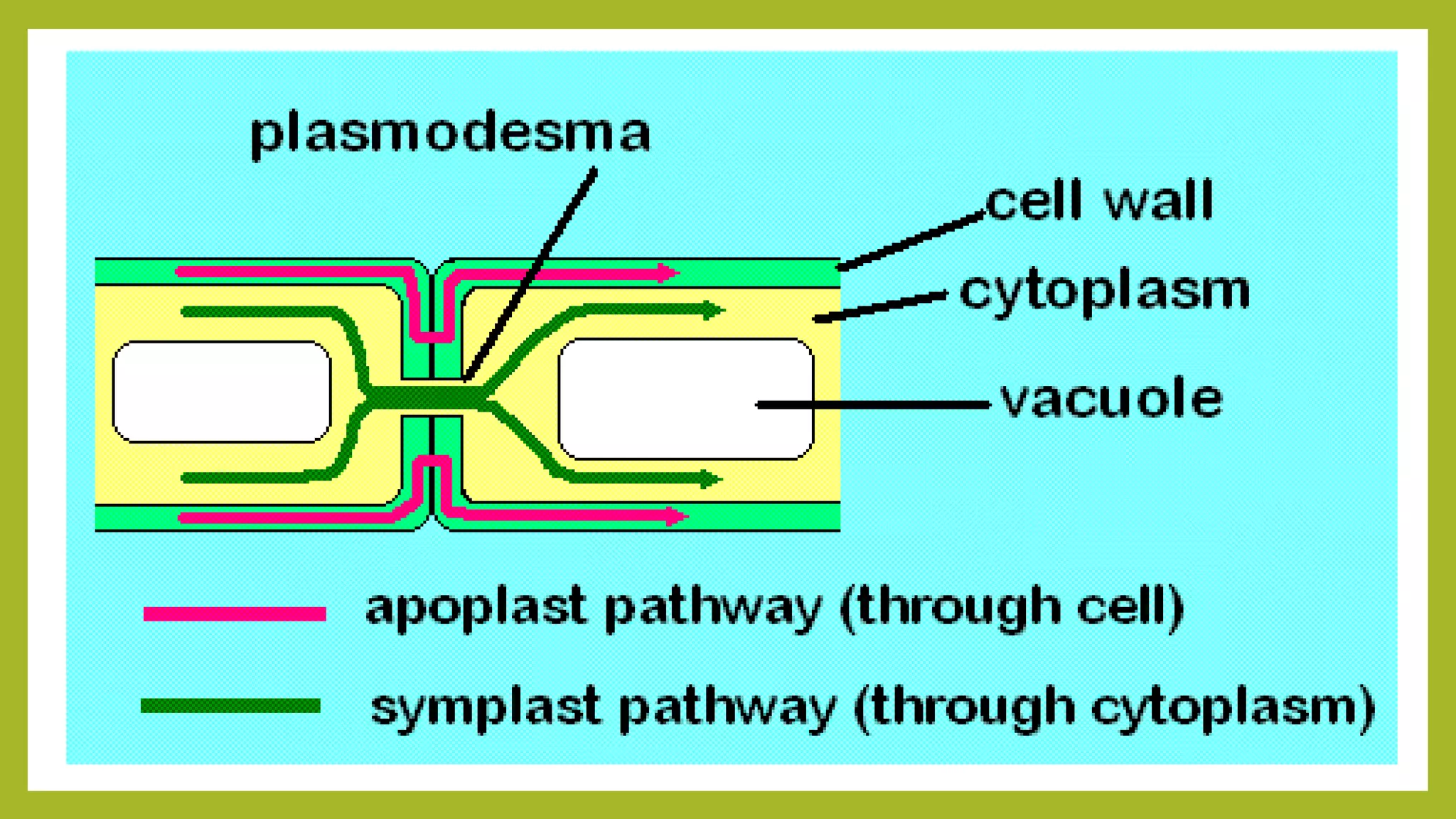
• Inter cellular transport-through apoplast and symplast
• Transfer cells: a group of specific cells exist in the terminal in
conduct tissue, flower or fruits
• Companion cells and intermediary cells are considered as transfer
cells
• Main function: loading assimilates into phloem from source and
unloading assimilate into sink cell from phloem to other conduct
tissue
• Long distance translocation of photo assimilates occurs via
phloem
• Apoplastic pathway: movement of water from cell to cell via
cellulose cell wall
• Symplastic pathway: movement of water from cell to cell via
plasma membrane or plasmodesmata
• Active transport requires energy and moves particles up their
concentration gradient. Passive transport does not requires energy
and moves particles down their gradient energy
• Passive transport is a process which is carried out along the
concentration gradient.
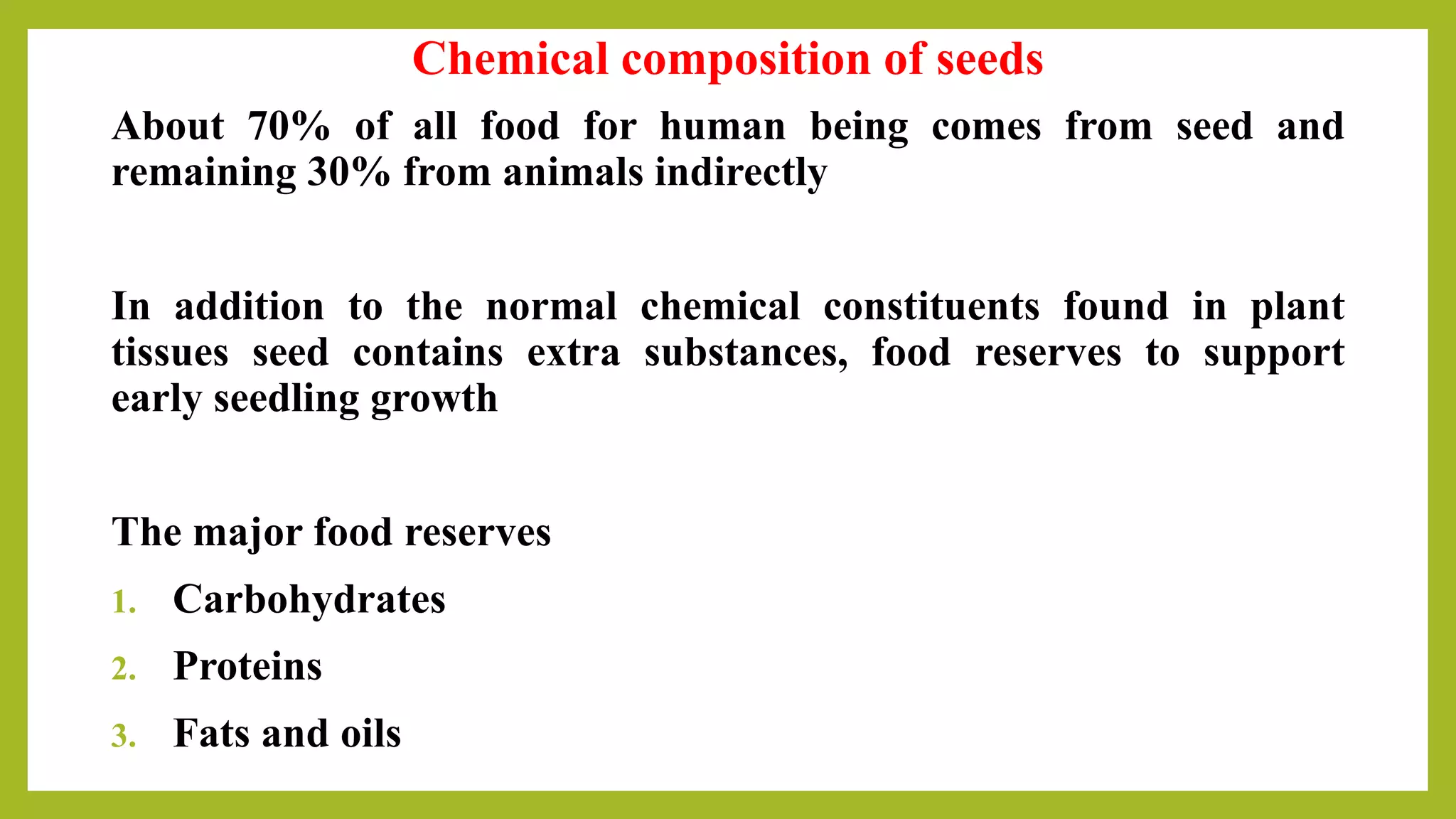
Chemical composition of seeds
About 70% of all food for human being comes from seed and
remaining 30% from animals indirectly
In addition to the normal chemical constituents found in plant
tissues seed contains extra substances, food reserves to support
early seedling growth
The major food reserves
1. Carbohydrates
2. Proteins
3. Fats and oils
The minor food reserves
• 1. phytin and some nutritionally undesirable or even toxic
substances like
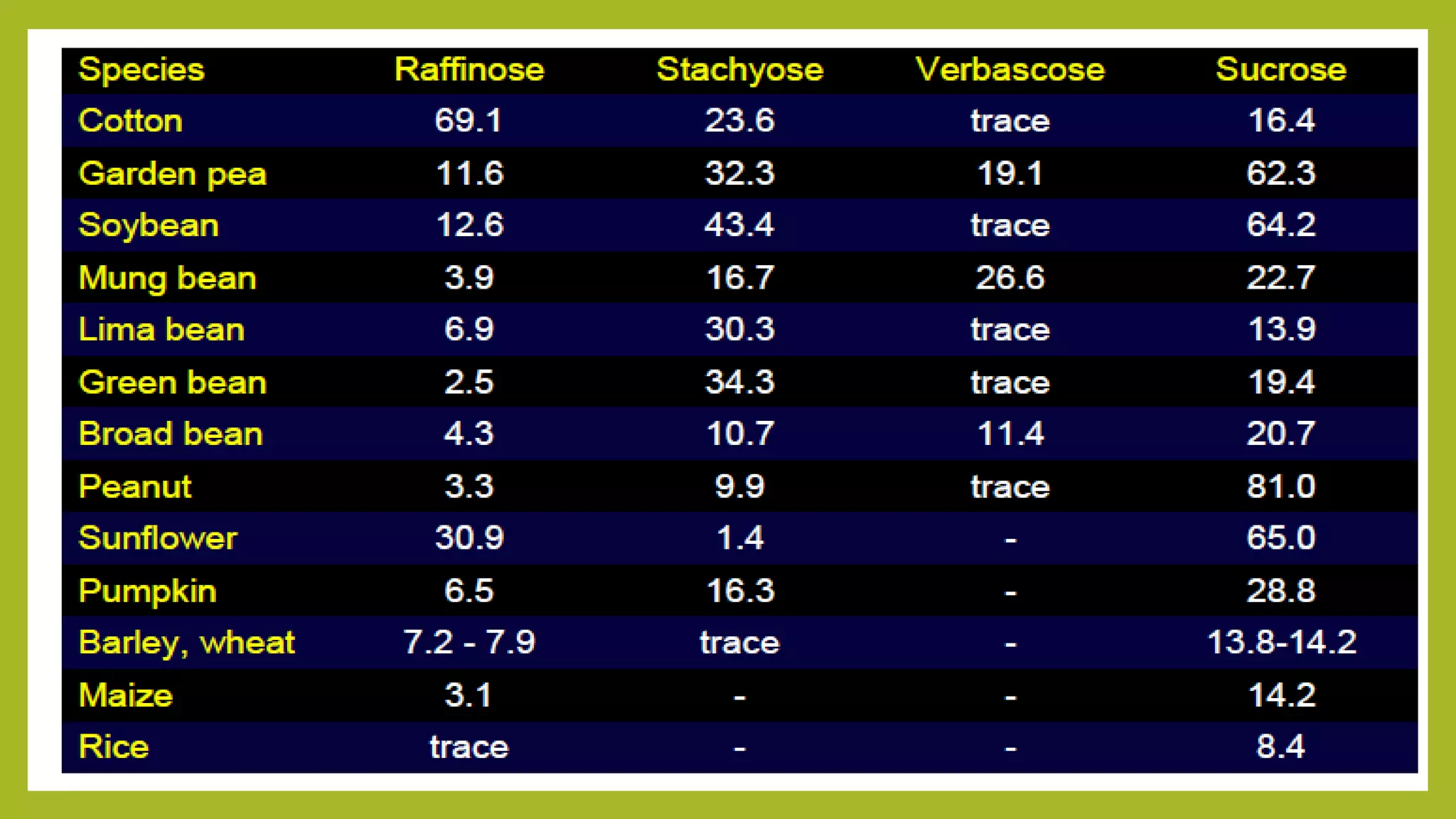
• 2. raffinose and oligosaccharides
• 3. Proteinase inhibitors
• 4. Lectins
• 5. Alkaloids
Chemical composition of seed is determined by
• 1. Genetic factors
• 2. Agronomic practices
• 3. Environment
Average per cent composition
Crops Protein Oil Carbohydrates Major storage
organs
Barley 12 3 76 Endosperm
Maize 10 5 80 Endosperm
Oats 13 8 66 Endosperm
Rye 12 2 76 Endosperm
Wheat 12 2 75 Endosperm
Broadbean 23 1 56 Cotyledons
Garden pea 25 6 52 Cotyledons
Peanut 31 48 12 Cotyledons
Soybean 37 17 26 Cotyledons
Castor bean 18 64 Negligible Endosperm
Oilpalm 9 49 28 Endosperm
Rapeseed 21 48 19 Cotyledons
From Bewley and Black. 1994. Seeds: Physiology of development and germination
Carbohydrates
• Major storage substances in seed
• Cereal and grasses are rich in carbohydrates and low in proteins
and fats
• Major forms of carbohydrate storage in seed are
• A. starch
• B. hemicellulose
• Amyloids and raffinose series oligosaccharides are present as
minor carbohydrate reserves
• Sometimes non storage forms like cellulose, pectins and mucilages
occur
Carbohydrate storage in seeds
• Starch Polysaccharide (…-glucose-glucose-glucose-…)
• Two forms: 1. Amylose, 2. Amylopectin
• 1. amylose structure
From Horton et al. 2002. Principles of Biochemistry
2. Amylopectin
From Horton et al. 2002. Principles of Biochemistry
Starch grains in starchy endosperm cells
of rye.
• 50-75% amylopectin
• 20-25% amylose
• Sl: large starch grain
• Ss: small starch grain
• p: protein matrix
• w: cell wall
From Bewley and Black. 1994. Seeds: Physiology of development and germination
Amaranth starch
(Bar: 1 µm)
Arrowroot starch
(Bar: 20 µm)
Buckwheat starch
(Bar: 5 µm)
Cassava starch
(Bar: 10 µm)
Corn starch
(Bar: 10 µm)
Oat starch
(Bar: 5 µm)
Potato starch
(Bar: 50 µm)
Rice starch
(Bar: 2 µm)
Kidney bean starch
(Bar: 20 µm)
Hemicelluloses
• Found in cell wall of plants and seed as reserves
• It is the major storage carbohydrate in endospermic legumes
• Many hemicelluloses are mannans with B(1-4) linkage between
mannose units
• Galactomannans have a (1-6) linkage at galactose side chains
• Xyloglucans are known as amyloids
Hemicelluloses
• Large heteropolymers of several sugars
• Chemical structure of galactomannan
From Bewley and Black. 1994. Seeds: Physiology of development and germination
• Mucilages: are complex carbohydreates consisting of polyuronides
and galacto uronides that chemically resemble pectic compounds
and hemicelluloses
• Pectic compounds
• Found in primary cell wall and middle lamella
• Occurs as pectic acid pectin and propectin
• During ripening of fruits propectin is converted into pectins
• Free sugars
• Main storage carbohydrate in sugar maple disaccharides and
oligosaccharides are common minor reserves in embryo and
reserve tissues
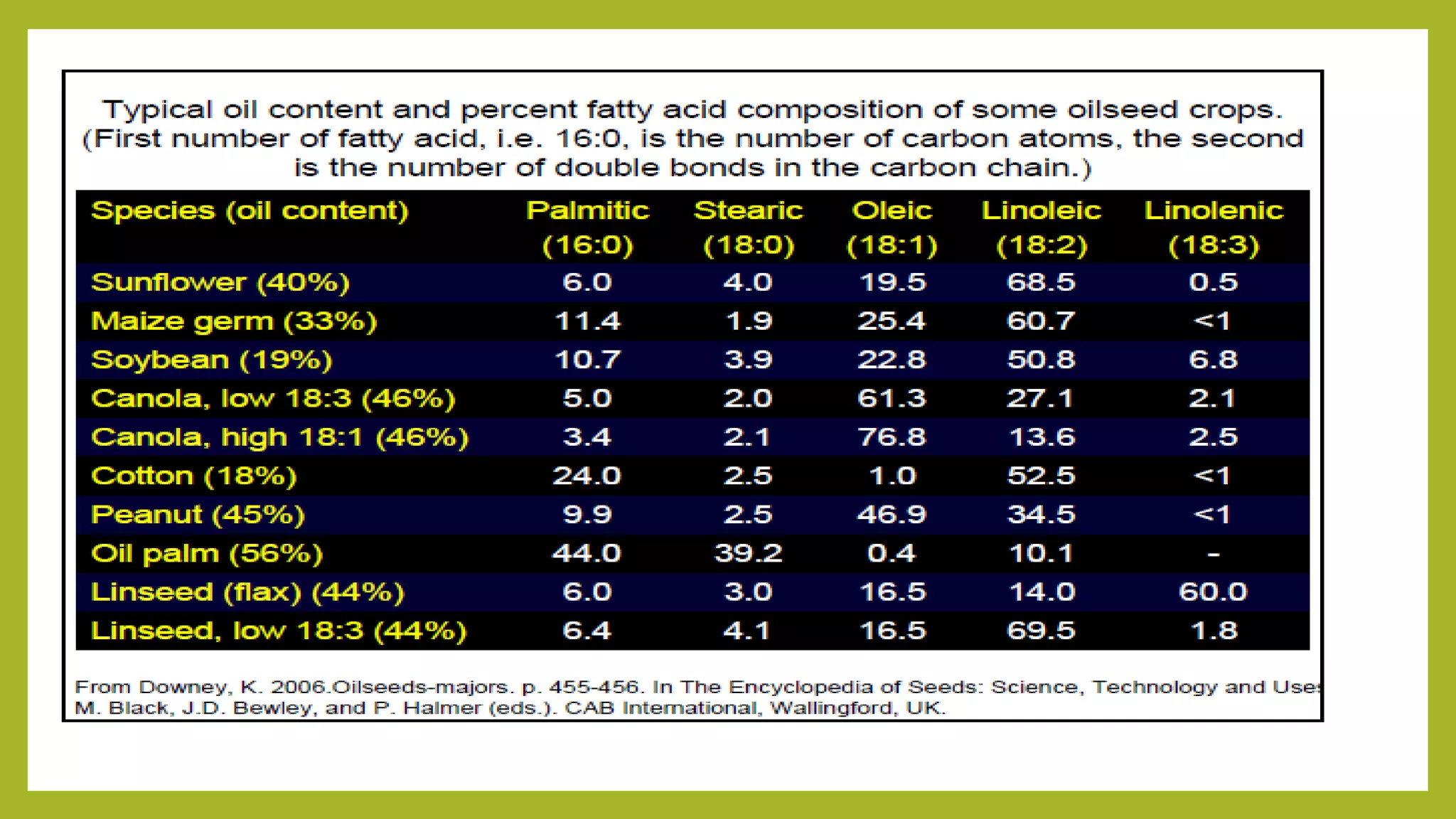
Lipids –(triacylglycerides/fats/oil)
• Simple lipids- fats, fatty oils and waxes-major
• Compound lipids-phospholipids, glycolipids
• Derived lipids- cholesterol
• The predominant FA in seeds are unsaturated FA (UFA)
• Lipids are stored in oil storage bodies called spherosomes which
range in size 0.2 to 6.0 microns diameter.
• Enzymes for lipid synthesis & hydrolysis are present in
spherosomes
• During germination lipids disappear and sucrose content in
increases
• Lipase activity increases and hydrolysis tryglycerides to di and
monoglycerides
• High lipid content is associated with low protein content
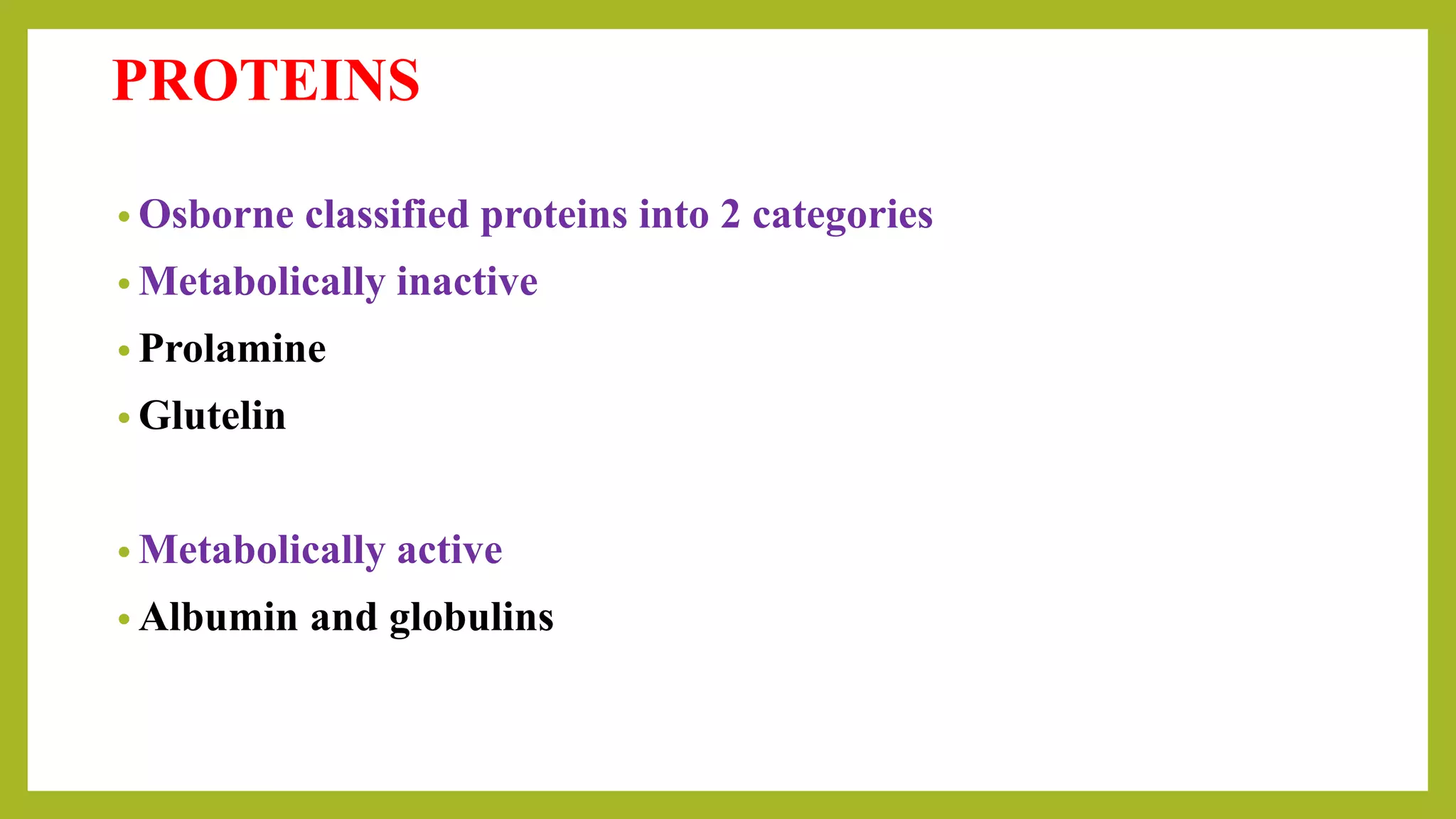
PROTEINS
• Osborne classified proteins into 2 categories
• Metabolically inactive
• Prolamine
• Glutelin
• Metabolically active
• Albumin and globulins
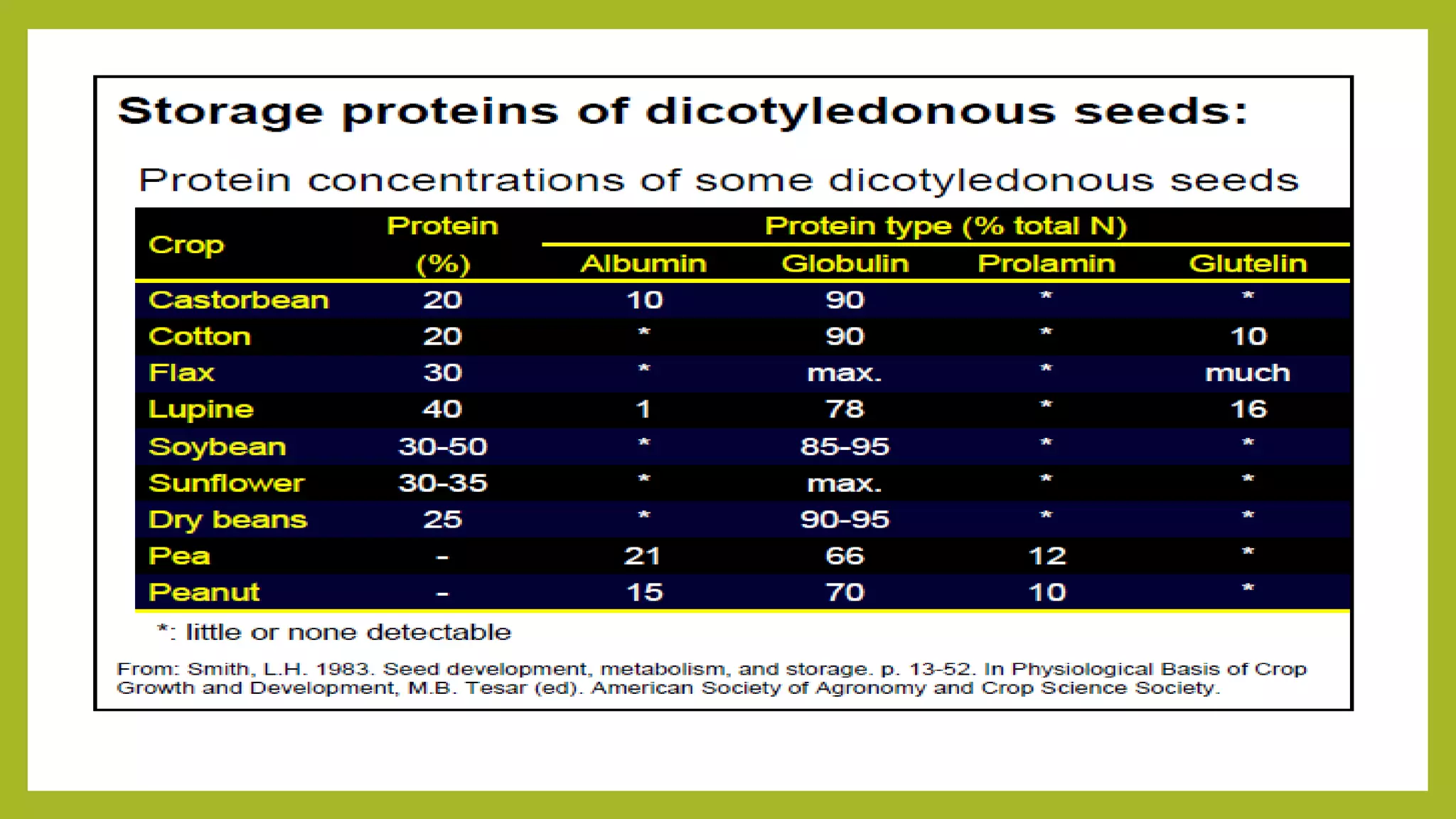
• Albumins and globulins are not deficient in specific amino acids so
they are good sources of dietary protein
• Storage proteins are oligomeric
• Most storage proteins are not single but bounded together by
intermolecular disulphide groups, hydrogen bonding ionic
bonding and hydrophobic bonding
• In legumes the major storage protein is globulins, which account
for 70% of total seed nitrogen
• In addition to these proteins glycoproteins like lectins are present
in seeds
• Some proteins are part of defence mechanism against pests and
predators
• Arcelin- conifers resistance against bruchid beetles
• Chitinase increases resistance to fungal attack
• Seed storage proteins are deposited in protein bodies
CENTRAL DOGMA OF MOLECULAR
BIOLOGY DNA
RNA
Protein
transcription
translation
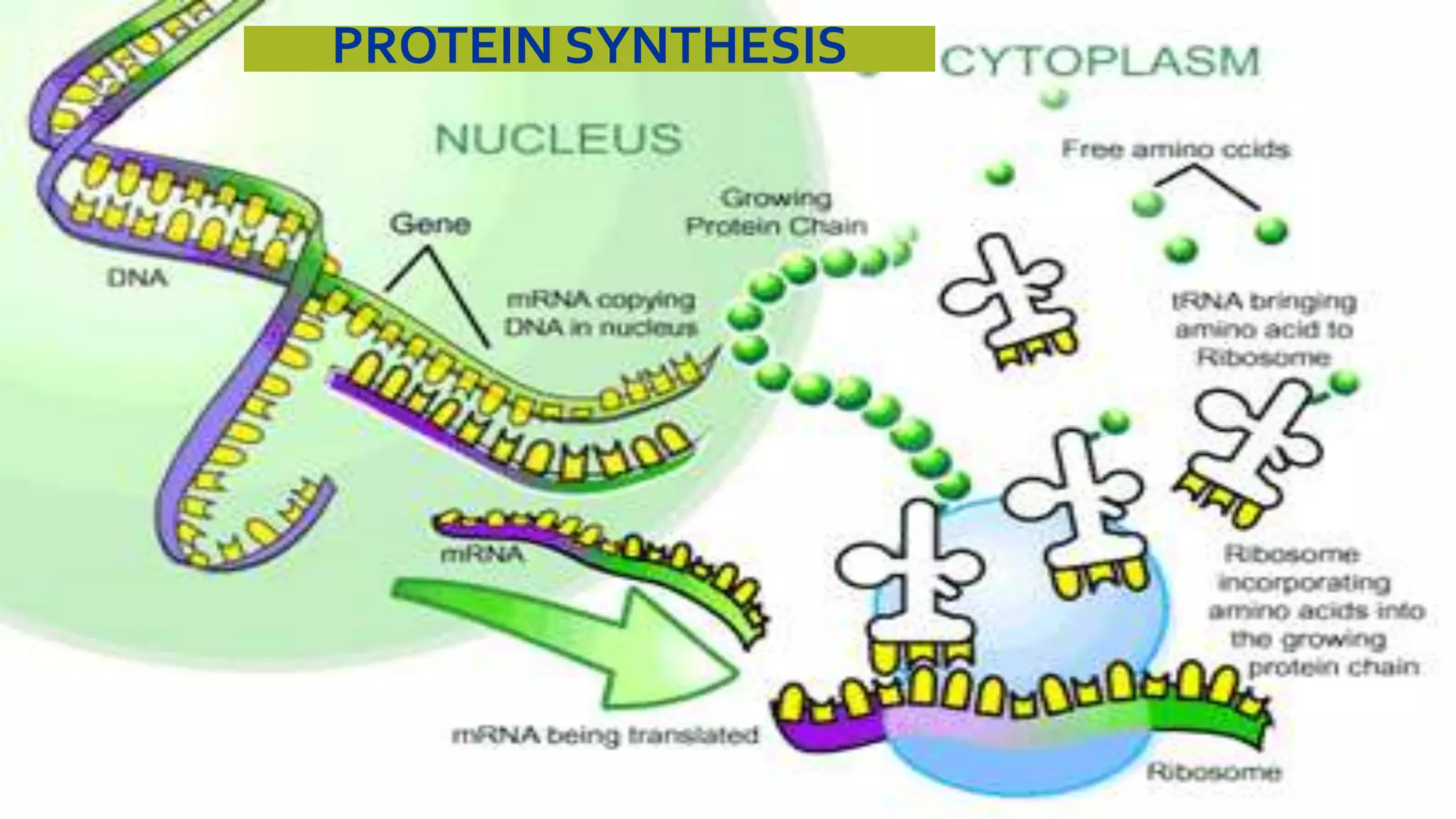
PROTEIN SYNTHESIS
TRANSCRIPTION
THE PROTEINS ARE MADE IN THE
CYTOPLASM IN THE RIBOSOMES
THE INFO FROM THE DNA IS
COPIED INTO m RNA, WHICH CAN
LEAVE THE NUCLEUS AND GET TO
THE RIBOSOMES IN THE
CYTOPLASM.
THE INFORMATION FOR PROTEIN
SYNTHESIS IS IN THE DNA IN THE
NUCLEUS.
DNA INFO COPIED TO mRNA
GROWING CELL
Before cell division the
cell’s DNA has to
duplicate
(DNA
REPLICATION)
While the cell is
growing it needs
enzymes and extra
proteins…
TRANSLATION
DNA
M RNA
PROTEIN
transcription
DNA info is copied into to RNA code, which
is still in the “language” of nitrogenous
bases, except that adenine on the DNA pairs
with uracil (in place of thymine) on the
RNA. HAPPENS IN NUCLEUS.
translation
The RNA code is then translated to protein
code, which is a different “language.”
(nitrogenous bases to aminoacids.
This process involves ribosomes and two
kinds of RNA: mRNA and tRNA.
HAPPENS IN CYTOPLASM
INFORMATION IN THE mRNA
Codon: sequence of 3 nucleotides on
m-RNA that codes for one amino acid.
The GENETIC CODE states which codon
stands for which aminoacid.
1 aminoacid
1 aminoacid
TRANSLATION LOADED tRNA
RIBOSOME
mRNA
COMPONENTS PRESENT
IN THE PROCESS
anticodon
Aminoacid
carried
codon
TRANSLATION
The newly made mRNA (transcription) leaves the nuceus and binds with the
ribosome in the cytoplasm.
ONE codon is exposed at site P and
another codon at site A
A tRNA with a complementary codon in
its anticodon site will bind with the
codon at site P, bringing an aminoacid.
1º AMINOACID:
Methionine (AUG)
in site P.
TRANSLATION
Even though every protein begins with the
Methionine amino acid, not all proteins will ultimately
have methionine at one end.
If the "start" methionine is not needed, it is
removed before the new protein goes to work (either
inside the cell or outside the cell, depending on the
type of protein synthesized)
TRANSLATION
A
2ºAMINOACID:
Glycine (only in this case) in site A.
PEPTIDIC BOND IS FORMED
TRANSLATION
STOP codon NO aminoacid is added. Its the
END of the polypeptide!
Growing polypeptide
POLYSOMES
Fatty Acids
• Building blocks for triglycerides and phospholipids
• A chain of carbon and hydrogen atoms with a carboxyl group at the alpha end and a methyl
group at the omega end
Figure 5.1
Saturated and Unsaturated Fatty Acids Help Shape Foods
Figure 5.3
• Sucrose entering the developing oil seed is used mainly for synthesis
of storage triacylglycerols and proteins.
The triacylglycerols synthesis can be considered in three parts:
The production of the glycerol back bone.
The formation of fatty acids.
The esterification of glycerols with fatty acids components to give
triacylglycerols.
Sucrose is translocated into the developing seed and converted to
hexose phosphates and triose phosphates by the reaction of glycolysis.
Fatty acid synthesis occurs in the plastids utilizing acetyl-coA, which
can be generated by glycolytic reactions in the organelle.
Portion of Figure 5.7
Triglycerides
• Three fatty acids connected to a glycerol backbone
Summary of Lipogenesis
Thank you

PATHWAY OF MOVEMENT OF ASSIMILATES IN DEVELOPING GRAINS OF MONOCOTS AND DICOTS CHEMICAL COMPOSITION OF SEEDS STORAGE OF CARBOHYDRATES, PROTEINS AND FATS IN SEEDS AND THEIR BIOSYNTHESIS

  • 1.
  • 2.
    •PATHWAY OF MOVEMENTOF ASSIMILATES IN DEVELOPING GRAINS OF MONOCOTS AND DICOTS •CHEMICAL COMPOSITION OF SEEDS •STORAGE OF CARBOHYDRATES, PROTEINS AND FATS IN SEEDS AND THEIR BIOSYNTHESIS
  • 3.
    Pathway of movementof assimilates in developing grains of monocots and dicots • Shot distance transport system • Long distance transport system • Shot distance transport system: • Intracellular transport- diffusion, protoplasmic streaming, transporters • Inter cellular transport-through apoplast and symplast
  • 4.
    • Transfer cells:a group of specific cells exist in the terminal in conduct tissue, flower or fruits • Companion cells and intermediary cells are considered as transfer cells • Main function: loading assimilates into phloem from source and unloading assimilate into sink cell from phloem to other conduct tissue • Long distance translocation of photo assimilates occurs via phloem
  • 5.
    • Apoplastic pathway:movement of water from cell to cell via cellulose cell wall • Symplastic pathway: movement of water from cell to cell via plasma membrane or plasmodesmata • Active transport requires energy and moves particles up their concentration gradient. Passive transport does not requires energy and moves particles down their gradient energy • Passive transport is a process which is carried out along the concentration gradient.
  • 7.
    Chemical composition ofseeds About 70% of all food for human being comes from seed and remaining 30% from animals indirectly In addition to the normal chemical constituents found in plant tissues seed contains extra substances, food reserves to support early seedling growth The major food reserves 1. Carbohydrates 2. Proteins 3. Fats and oils
  • 8.
    The minor foodreserves • 1. phytin and some nutritionally undesirable or even toxic substances like • 2. raffinose and oligosaccharides • 3. Proteinase inhibitors • 4. Lectins • 5. Alkaloids Chemical composition of seed is determined by • 1. Genetic factors • 2. Agronomic practices • 3. Environment
  • 9.
    Average per centcomposition Crops Protein Oil Carbohydrates Major storage organs Barley 12 3 76 Endosperm Maize 10 5 80 Endosperm Oats 13 8 66 Endosperm Rye 12 2 76 Endosperm Wheat 12 2 75 Endosperm Broadbean 23 1 56 Cotyledons Garden pea 25 6 52 Cotyledons Peanut 31 48 12 Cotyledons Soybean 37 17 26 Cotyledons Castor bean 18 64 Negligible Endosperm Oilpalm 9 49 28 Endosperm Rapeseed 21 48 19 Cotyledons From Bewley and Black. 1994. Seeds: Physiology of development and germination
  • 10.
    Carbohydrates • Major storagesubstances in seed • Cereal and grasses are rich in carbohydrates and low in proteins and fats • Major forms of carbohydrate storage in seed are • A. starch • B. hemicellulose • Amyloids and raffinose series oligosaccharides are present as minor carbohydrate reserves • Sometimes non storage forms like cellulose, pectins and mucilages occur
  • 11.
    Carbohydrate storage inseeds • Starch Polysaccharide (…-glucose-glucose-glucose-…) • Two forms: 1. Amylose, 2. Amylopectin • 1. amylose structure From Horton et al. 2002. Principles of Biochemistry
  • 12.
    2. Amylopectin From Hortonet al. 2002. Principles of Biochemistry
  • 13.
    Starch grains instarchy endosperm cells of rye. • 50-75% amylopectin • 20-25% amylose • Sl: large starch grain • Ss: small starch grain • p: protein matrix • w: cell wall From Bewley and Black. 1994. Seeds: Physiology of development and germination
  • 14.
    Amaranth starch (Bar: 1µm) Arrowroot starch (Bar: 20 µm) Buckwheat starch (Bar: 5 µm) Cassava starch (Bar: 10 µm) Corn starch (Bar: 10 µm) Oat starch (Bar: 5 µm) Potato starch (Bar: 50 µm) Rice starch (Bar: 2 µm) Kidney bean starch (Bar: 20 µm)
  • 15.
    Hemicelluloses • Found incell wall of plants and seed as reserves • It is the major storage carbohydrate in endospermic legumes • Many hemicelluloses are mannans with B(1-4) linkage between mannose units • Galactomannans have a (1-6) linkage at galactose side chains • Xyloglucans are known as amyloids
  • 16.
    Hemicelluloses • Large heteropolymersof several sugars • Chemical structure of galactomannan From Bewley and Black. 1994. Seeds: Physiology of development and germination
  • 21.
    • Mucilages: arecomplex carbohydreates consisting of polyuronides and galacto uronides that chemically resemble pectic compounds and hemicelluloses • Pectic compounds • Found in primary cell wall and middle lamella • Occurs as pectic acid pectin and propectin • During ripening of fruits propectin is converted into pectins • Free sugars • Main storage carbohydrate in sugar maple disaccharides and oligosaccharides are common minor reserves in embryo and reserve tissues
  • 22.
    Lipids –(triacylglycerides/fats/oil) • Simplelipids- fats, fatty oils and waxes-major • Compound lipids-phospholipids, glycolipids • Derived lipids- cholesterol • The predominant FA in seeds are unsaturated FA (UFA)
  • 23.
    • Lipids arestored in oil storage bodies called spherosomes which range in size 0.2 to 6.0 microns diameter. • Enzymes for lipid synthesis & hydrolysis are present in spherosomes • During germination lipids disappear and sucrose content in increases • Lipase activity increases and hydrolysis tryglycerides to di and monoglycerides • High lipid content is associated with low protein content
  • 32.
    PROTEINS • Osborne classifiedproteins into 2 categories • Metabolically inactive • Prolamine • Glutelin • Metabolically active • Albumin and globulins
  • 33.
    • Albumins andglobulins are not deficient in specific amino acids so they are good sources of dietary protein • Storage proteins are oligomeric • Most storage proteins are not single but bounded together by intermolecular disulphide groups, hydrogen bonding ionic bonding and hydrophobic bonding • In legumes the major storage protein is globulins, which account for 70% of total seed nitrogen • In addition to these proteins glycoproteins like lectins are present in seeds
  • 34.
    • Some proteinsare part of defence mechanism against pests and predators • Arcelin- conifers resistance against bruchid beetles • Chitinase increases resistance to fungal attack • Seed storage proteins are deposited in protein bodies
  • 47.
    CENTRAL DOGMA OFMOLECULAR BIOLOGY DNA RNA Protein transcription translation
  • 48.
  • 50.
    TRANSCRIPTION THE PROTEINS AREMADE IN THE CYTOPLASM IN THE RIBOSOMES THE INFO FROM THE DNA IS COPIED INTO m RNA, WHICH CAN LEAVE THE NUCLEUS AND GET TO THE RIBOSOMES IN THE CYTOPLASM. THE INFORMATION FOR PROTEIN SYNTHESIS IS IN THE DNA IN THE NUCLEUS. DNA INFO COPIED TO mRNA
  • 51.
    GROWING CELL Before celldivision the cell’s DNA has to duplicate (DNA REPLICATION) While the cell is growing it needs enzymes and extra proteins…
  • 52.
    TRANSLATION DNA M RNA PROTEIN transcription DNA infois copied into to RNA code, which is still in the “language” of nitrogenous bases, except that adenine on the DNA pairs with uracil (in place of thymine) on the RNA. HAPPENS IN NUCLEUS. translation The RNA code is then translated to protein code, which is a different “language.” (nitrogenous bases to aminoacids. This process involves ribosomes and two kinds of RNA: mRNA and tRNA. HAPPENS IN CYTOPLASM
  • 53.
    INFORMATION IN THEmRNA Codon: sequence of 3 nucleotides on m-RNA that codes for one amino acid. The GENETIC CODE states which codon stands for which aminoacid. 1 aminoacid 1 aminoacid
  • 54.
    TRANSLATION LOADED tRNA RIBOSOME mRNA COMPONENTSPRESENT IN THE PROCESS anticodon Aminoacid carried codon
  • 55.
    TRANSLATION The newly mademRNA (transcription) leaves the nuceus and binds with the ribosome in the cytoplasm. ONE codon is exposed at site P and another codon at site A A tRNA with a complementary codon in its anticodon site will bind with the codon at site P, bringing an aminoacid. 1º AMINOACID: Methionine (AUG) in site P.
  • 56.
    TRANSLATION Even though everyprotein begins with the Methionine amino acid, not all proteins will ultimately have methionine at one end. If the "start" methionine is not needed, it is removed before the new protein goes to work (either inside the cell or outside the cell, depending on the type of protein synthesized)
  • 57.
    TRANSLATION A 2ºAMINOACID: Glycine (only inthis case) in site A. PEPTIDIC BOND IS FORMED
  • 58.
    TRANSLATION STOP codon NOaminoacid is added. Its the END of the polypeptide! Growing polypeptide
  • 59.
  • 60.
    Fatty Acids • Buildingblocks for triglycerides and phospholipids • A chain of carbon and hydrogen atoms with a carboxyl group at the alpha end and a methyl group at the omega end Figure 5.1
  • 61.
    Saturated and UnsaturatedFatty Acids Help Shape Foods Figure 5.3
  • 62.
    • Sucrose enteringthe developing oil seed is used mainly for synthesis of storage triacylglycerols and proteins. The triacylglycerols synthesis can be considered in three parts: The production of the glycerol back bone. The formation of fatty acids. The esterification of glycerols with fatty acids components to give triacylglycerols. Sucrose is translocated into the developing seed and converted to hexose phosphates and triose phosphates by the reaction of glycolysis. Fatty acid synthesis occurs in the plastids utilizing acetyl-coA, which can be generated by glycolytic reactions in the organelle.
  • 63.
    Portion of Figure5.7 Triglycerides • Three fatty acids connected to a glycerol backbone
  • 64.
  • 66.