SEED
BORNE DISEASES AND MANAGEMENT
Prepared by:
MANJU. K. P
RAD/13-18
INTRODUCTION
 Seed borne diseases assumed a greater importance to seed
industries.
 Seed borne pathogens results in seed rots, seedling decay,
pre and post emergence mortalities, abnormalities,
discoloration, reduced seed size and shrivelledness of
seeds.
 The seed borne pathogens not only affect the market value
but also nutritive value of the products.
Losses due to seed borne diseases
 Late blight of potato caused by Phytopthora infestence was responsible for Irish famine during
1845.
 Brown spot of rice caused by the seed borne Helmenthosporium oryzae was responsible for
Bengal Famine during 1942.
 The loss by downey mildew of pearl millet in Rajasthan in 1962-64 was estimated to be 20
million rupees.
 Occurrence of tobacco bud blight in soybean caused 66.43% yield loss. (Dhingra and Chenulu,
1980)
 AICRP on millet showed an average annual loss of about 30% in high yielding varieties
equivalent to 270 million $ annually.
 Cause economic losses in cultivated crops world wide.
Losses due to seed borne diseases
Crop Diseas/ Pathogen Yield loss (%)
Rice Blast 75
Bacterial Blight 6-60
Brown spot 50-90
Sheath Rot 50
Wheat Loose smut 100
Ear cockle 100
Chickpea Ascochyta rabici 80-90
cowpea Anthracnose 30-35
Leaf crinkle virus 3-61
Soya bean Tobacco bud blight 66
Soya bean mosaic virus 25-94
Cucumber Cucumber mosaic virus (planting of 0.5% infected seeds) 34-53
Cabbage Black rot, Planting 2 seeds infected by Xanthomonas campestris out of 10,000
seeds.
Black rot epidemic occurs
Crop Disease Causal organism
Brinjal Fruit rot Phomopsis vexans
Carrot Black root rot or
Seedling blight
Alternia radicina
A.dauci
Onion Damping off
Downy mildew
Purple blotch
Stemphylium Blight
Botrytis allii
Peronospora destructor
Alternia porri
Stemphylium vesicarium
Pepper and chilli Anthracnose or fruit rot Colletrotrichum capsici
Radish Grey leaf spot
Leaf spot
Alternia brassicae
A. Raphani
Crucifers Grey and black leaf
Spot
Alternia brassicae
A. Brassicicola
Tomato Buck eye rot
Damping off
Early Blight
Late blight or Fruit rot
Phytophthora parasitica
Phythium aphanidermatum
Alternia solani
Phytopthora infestans
Important seed borne diseases
Crops Diseases Causal organism
Wheat Loost smut
Karnal smut
Flag smut
Ustilago segetum var. tritci
Neovossia indica
Urocystis agropyri
Rice Bunt
False Smut
Stack burn
Neovossia horrid
Ustilaginoidea virens
Pyricularia oryzae
Trichoconiella padwickii
Maize Black kernel rot
Cob rot
Southern leaf blight
Botryodiplodia theobromae
Fusarium Moniliformae
Drechlera maydis
Pearl millet Downy mildew
Smut
Sclerospora graminicola
Tolyposporium penicillsriae
Sorghum Anthracnose
Kernel or grain smut
Downy mildew
Colletotrichum graminicola
Sphacelotheca sorghi
Peronosclerospora sorghi
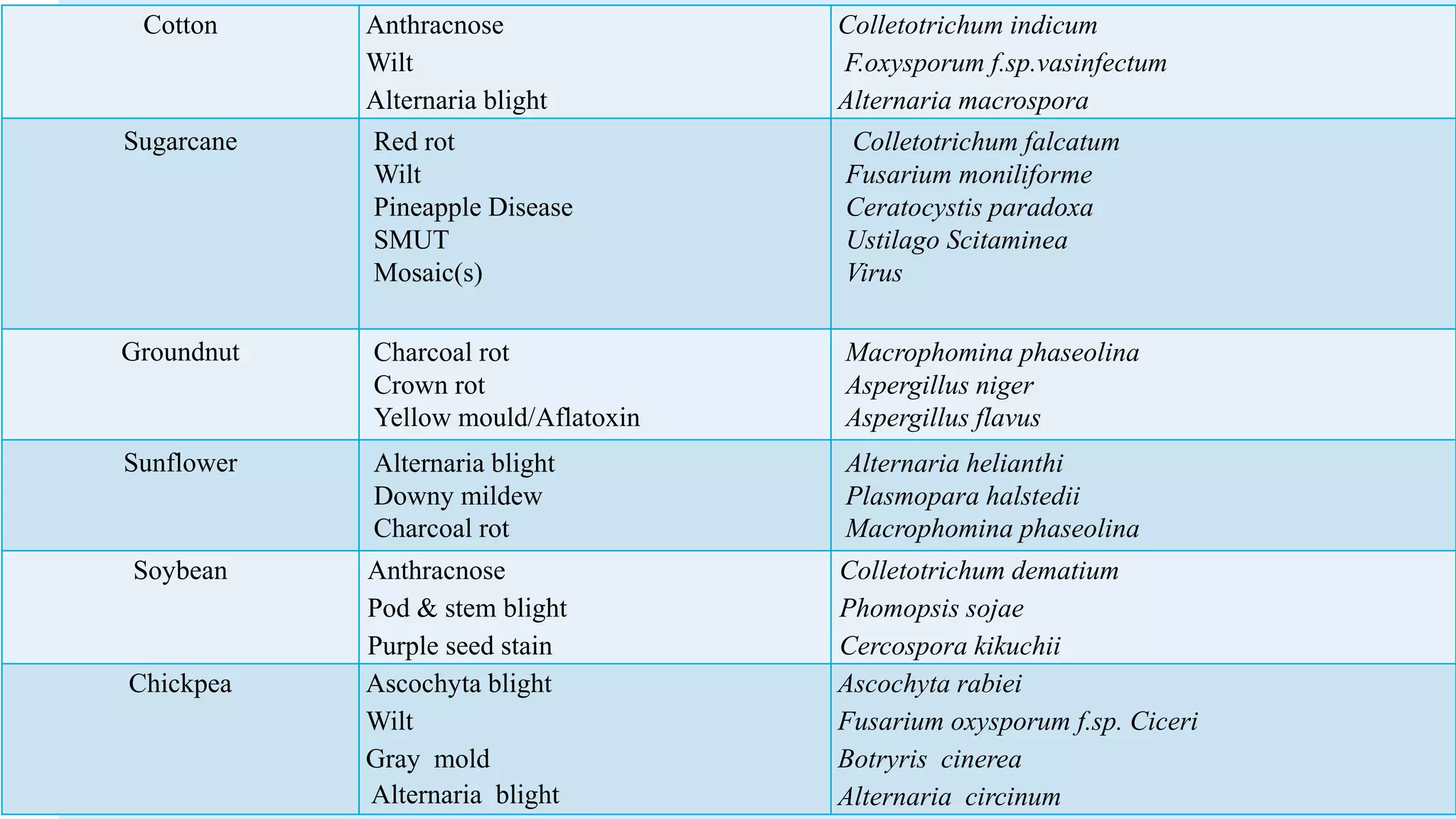
Cotton Anthracnose
Wilt
Alternaria blight
Colletotrichum indicum
F.oxysporum f.sp.vasinfectum
Alternaria macrospora
Sugarcane Red rot
Wilt
Pineapple Disease
SMUT
Mosaic(s)
Colletotrichum falcatum
Fusarium moniliforme
Ceratocystis paradoxa
Ustilago Scitaminea
Virus
Groundnut Charcoal rot
Crown rot
Yellow mould/Aflatoxin
Macrophomina phaseolina
Aspergillus niger
Aspergillus flavus
Sunflower Alternaria blight
Downy mildew
Charcoal rot
Alternaria helianthi
Plasmopara halstedii
Macrophomina phaseolina
Soybean Anthracnose
Pod & stem blight
Purple seed stain
Colletotrichum dematium
Phomopsis sojae
Cercospora kikuchii
Chickpea Ascochyta blight
Wilt
Gray mold
Alternaria blight
Ascochyta rabiei
Fusarium oxysporum f.sp. Ciceri
Botryris cinerea
Alternaria circinum
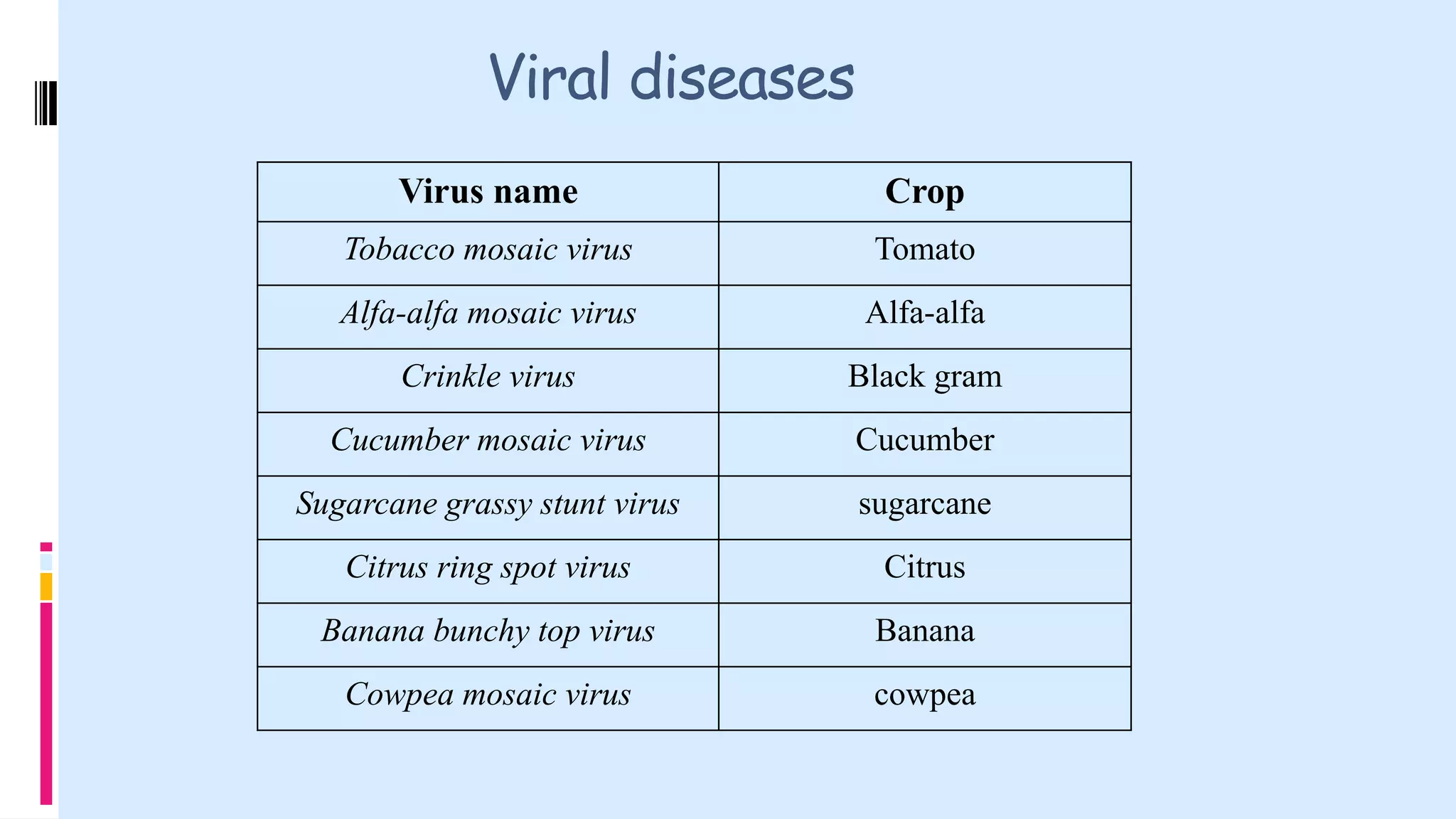
Viral diseases
Virus name Crop
Tobacco mosaic virus Tomato
Alfa-alfa mosaic virus Alfa-alfa
Crinkle virus Black gram
Cucumber mosaic virus Cucumber
Sugarcane grassy stunt virus sugarcane
Citrus ring spot virus Citrus
Banana bunchy top virus Banana
Cowpea mosaic virus cowpea
As a seed grower, what do I need to worry about?
 RED ALERT diseases:
 highly virulent, highly seed-borne
 ORANGE ALERT diseases:
 moderately virulent and highly seed-borne
 OR highly virulent and moderately seed-borne
 YELLOW ALERT diseases:
 Moderately virulent and seed-borne
RED ALERT DISEASES
 Brassica Black Rot Bacteria (Xanthomonas
campestris)
 Brassica Blackleg Fungus (Phoma lingam /
Leptosphaeria maculans )
 Lettuce Mosaic Virus
 Carrot Bacterial Blight (Xanthomonas
campestris pv. carotae)
 Tomato Mosaic Virus
Orange alert diseases
Carrot Fungal Blights
 Alternaria blight (Alternaria dauci)
 Cercospora blight (cercospora carotae)
Tomato bacterial diseases
 Bacterial canker (Corynebacterium michiganense pv,
michiganense)
 Bacterial Spot (Xanthomonas campesiris pv, vesicatoria)
 Bacterial Speck (Pseudomonas syringae )
Onion white rot fungus (Sclerotinia sclerotiorum)
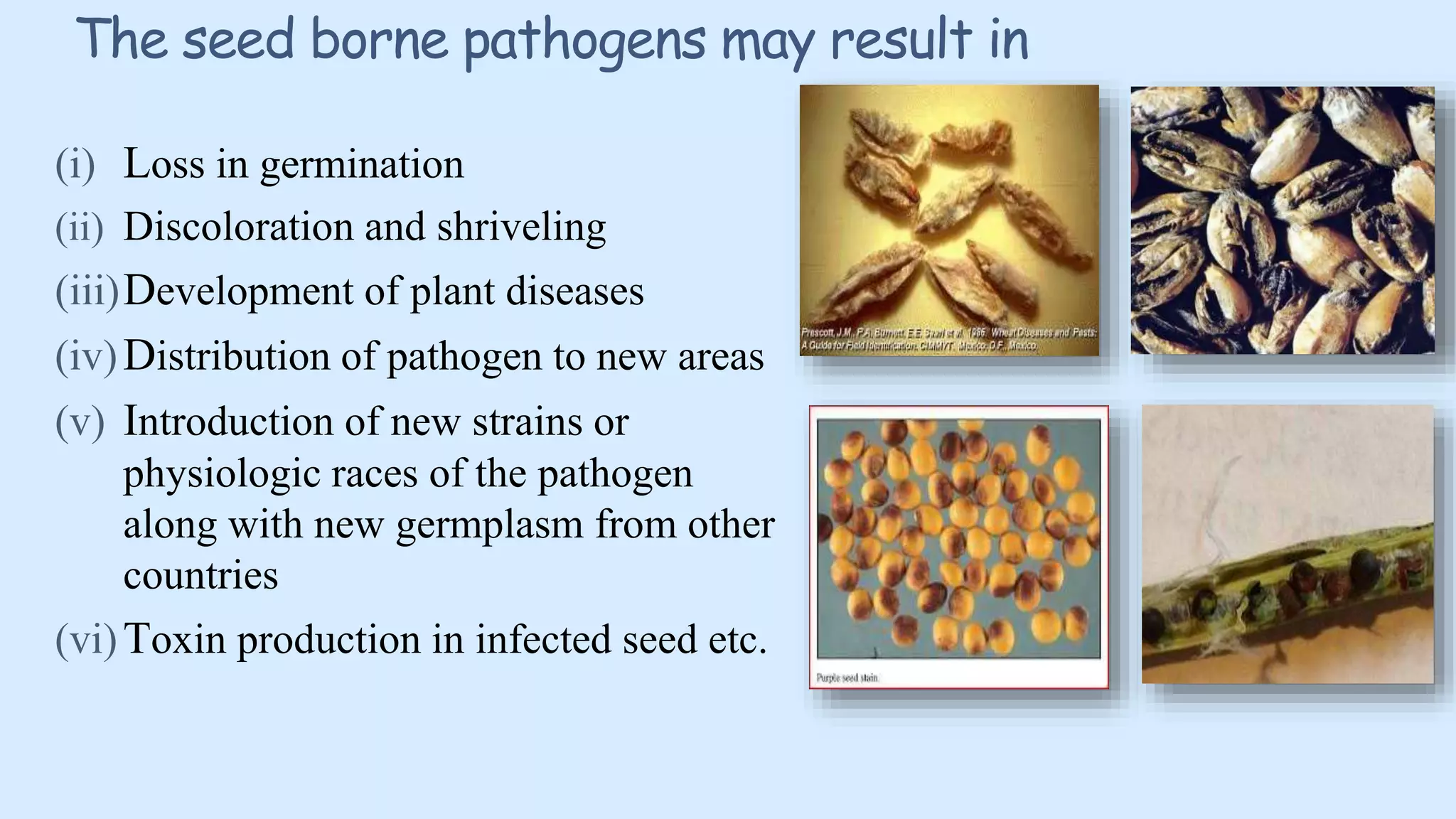
The seed borne pathogens may result in
(i) Loss in germination
(ii) Discoloration and shriveling
(iii)Development of plant diseases
(iv)Distribution of pathogen to new areas
(v) Introduction of new strains or
physiologic races of the pathogen
along with new germplasm from other
countries
(vi)Toxin production in infected seed etc.
Methods for Detecting Seed Borne pathogens
* Visual examination
* Water Agar method
* Standard blotter method
* Examination of seed soaked in water
* Examination of seed washing.
* Embryo count method
* Rolled paper towel method
* Examination of dry seeds
* Growing on test
* Phage plaque method
* PCR
* ELISA
* Electron microscopy
Visual inspection of seeds
 Presence of smut balls of
smut of sorghum and pearl
millet,
 sclerotia (ergot) of sorghum,
pearl millet and triticale,
 sclerotia of black scurf
diseases of potato embedded
on tuber skin can be easily
be detected by visual
examination.
 Black powder of bunt spores
can be seen in wheat and rice.
Paths of seed infections
The infestation/contamination of the seed may occur during
harvesting, threshing and processing. The pathogen may, thus, be
carried with the seeds in three ways.
MANAGEMENT OF SEED BORNE DISEASES:
AN INTEGRAL APPROACH
A) Seed selection
B) Quarantine
C) Seed treatments
E) Cultural practices.
F) Cultivation of resistant varieties
Approved sources for quality seeds
Plant Quarantine: All activities designed to
prevent the spread of quarantine diseases
and pests to ensure their official control
"Plant Quarantine is legal enforcement of
measures planned to prevent pests and
diseases from spreading to new areas, or to
prevent them from multiplying and
spreading further incase if they have
already found entry"
(www.plantquarantineindia.org)
Notification to regulate the
transport of plant / plant
material within the country.
Domestic Quarantine
Sl. No. Pest Prohibited from
1 Banana bunchy top Assam, Kerala, Orissa, Tamil Nadu,
West Bengal
2 Mosaic disease of banana Gujarat and Maharashtra
3 Potato wart (Synchytrium endobioticum) West Bengal
4 Apple scab (Venturia inequalis) Jammu and Kashmir
Domestic quarantine regulations were in vogue for the
following pests
SEED TREATMENTS FOR DISEASE MANAGEMENT
• Physical seed treatments
• Chemical treatments
• Biological seed treatments
HOT WATER TREATMENT
 Advantages:
 Most effective
 Kills disease on both inside and outside of seed
 Can fully eradicate heat-sensitive pathogens
 no residue
 Disadvantages: –
 requires an investment –
 Requires careful handling,
 can damage seed –
 Can’t be done as easily during harvest, so often requires wetting and re-
drying seed
Hot Water Requirements
 42-50°C (118-122°F)
 15-25 minutes
 Seed fully immersed,
 typically in cotton bags
 Need a setup with temperature control
 Better option is a lab-grade water bath
incubator
 Does not damage seed if done carefully
 Temperature should be sufficiently high to kill the associated
pest/pathogen but not the host. However, in most cases, margin of
safety is very narrow and, therefore, the temperature should be
very accurately controlled. Some recommended hot water
treatments (Kahn, 1977) are:
• Against nematodes: chrysanthemum- 48° C for 25 min; potato
tubers- 45° C for 5 min
• Against insects and mites: strawberry runners- 46° C for 10 min;
• Against viruses: Grape vine, 45° C for 120-180 min; sugarcane sets-
50° C for 120 min; potato tubers- 50° C for 17 min;
• Against fungi: Celery seed, 50° C for 25 min; wheat seed, 52-54° C
for 10 min;
Brassica
 Hot water treatment at 52ºC for 30 minutes against
 Alternaria brassicae, A. brassicicola, Phoma lingam, Xanthomonas
campestrispv. Campestris.
Rice
 Hot water treatment at 52ºC for 30 minutes against Nematode-
(Aphelenchoides besseyi) & Bacteria-(Xanthomonas campestrispv.
oryzae)
 Bacterial blight of cluster bean (X. campestris pv. cyamopsidis) at
56° C for 10 min (Srivastava and Rao, 1963);
 Bacterial blight of sesame (X. campestris pv. sesami) at 52° C for
10 min (Rao and Durgapal, 1966).
Chemical seed treatment
Important chemicals used for seed treatment
Technical Names Available formlation
Captan 50% WP
Carbendazim 50% WP
Deltamethrin 2.8 % EC
Imidacloprid 70% Ws, 48% Fs
Metalaxyl 35% Ws
Thiamethoxam 70% Ws, 30% Fs
Thiram 75% Ws
Biological seed treatment
IDEAL CHARACTERISTICS OF BIOCONTROL AGENTS
 Not be pathogenic - plant, human, animal and other beneficial microorganisms
 Should be broad spectrum
 Fast growth and sporulation
 Withstand adverse environment condition
 Can be cultured under artificial media
Pseudomonas fluorescensTrichoderma viride
Bacillus subtilis
RECOMMENDATION OF BIOCONTROL AGENTS AS SEED
TREATMENT IN DIFFERENT CROPS
Name of crop Pests/diseases Seed treatment
Rice Root rot disease, other insects/pests,
bacterial sheath blight
Trichoderma 5-10 g/kg. seed (before
transplanting)
Pseudomonas flourescens 0.5% W.P. 10 g/kg.
Wheat Termite, bunt/false smut/loose
smut/covered smut
Teat the seed before sowing.
T. viride 1.15 % WP @ 4 g/kg.
Gram Wilt, damping off Seed treatment with Trichoderma viride 1% WP
@ 9 g/kg seeds
Sunflower Seed rot, jassids, whitefly Trichoderma viride @ 6 g/kg seed.
Pigeon pea Wilt, blight and root rot Trichoderma spp. @ 4 g/kg. Seed
Pea Root rot, White rot Seed treatment with
Bacillus subtilis or Pseudomonas fluorescens
Sugarcane Root rot, wilt Trichoderma sp. 4-6 g/kg.
Coriander Wilt Trichoderma viride @ 4 g/kg seed.
Brinjal Bacterial wilt Pseudomonas fluorescens @ 10g/kg.
Leguminous Vegetables Soil borne infection, Nematode Trichoderma viride @ 2 g/100g seed.
Cruciferous vegetables
(cabbage, cauliflower,
broccoli, knol-khol, radish)
Soil / seed borne diseases
(Damping off) Root knot nematode
Seed treatment with Trichoderma viride
@ 2 g / 100 g seeds
Pseudomonas fluorescens and Verticillium
clamydosporium @ 10g/kg seed as seed dresser
Capsicum Root knot nematode Pseudomonas fluorescens 1% WP, Paecilomyces
lilacirius and Verticillium chlamydosporium 1%
WP @ 10g/kg as seed dresser.
Chillies Anthracnose spp. damping off Seed treatment with Trichoderma viride 4g/kg
Bhendi Root knot nematode Paecilomyces lilacinus and
Pseudomonas fluorescens @ 10 g/kg as seed
dresser.
Tomato Soil borne infection of fungal
diseases, early blight, damping off,
wilt
T. viride @ 2 g/100g seed.
Pseudomonas fluorescens and V. clamydosporium
@ 10g/kg as seed dresser.
Seed borne diseases seminar

Seed borne diseases seminar

  • 2.
    SEED BORNE DISEASES ANDMANAGEMENT Prepared by: MANJU. K. P RAD/13-18
  • 3.
  • 4.
     Seed bornediseases assumed a greater importance to seed industries.  Seed borne pathogens results in seed rots, seedling decay, pre and post emergence mortalities, abnormalities, discoloration, reduced seed size and shrivelledness of seeds.  The seed borne pathogens not only affect the market value but also nutritive value of the products.
  • 5.
    Losses due toseed borne diseases  Late blight of potato caused by Phytopthora infestence was responsible for Irish famine during 1845.  Brown spot of rice caused by the seed borne Helmenthosporium oryzae was responsible for Bengal Famine during 1942.  The loss by downey mildew of pearl millet in Rajasthan in 1962-64 was estimated to be 20 million rupees.  Occurrence of tobacco bud blight in soybean caused 66.43% yield loss. (Dhingra and Chenulu, 1980)  AICRP on millet showed an average annual loss of about 30% in high yielding varieties equivalent to 270 million $ annually.  Cause economic losses in cultivated crops world wide.
  • 6.
    Losses due toseed borne diseases Crop Diseas/ Pathogen Yield loss (%) Rice Blast 75 Bacterial Blight 6-60 Brown spot 50-90 Sheath Rot 50 Wheat Loose smut 100 Ear cockle 100 Chickpea Ascochyta rabici 80-90 cowpea Anthracnose 30-35 Leaf crinkle virus 3-61 Soya bean Tobacco bud blight 66 Soya bean mosaic virus 25-94 Cucumber Cucumber mosaic virus (planting of 0.5% infected seeds) 34-53 Cabbage Black rot, Planting 2 seeds infected by Xanthomonas campestris out of 10,000 seeds. Black rot epidemic occurs
  • 7.
    Crop Disease Causalorganism Brinjal Fruit rot Phomopsis vexans Carrot Black root rot or Seedling blight Alternia radicina A.dauci Onion Damping off Downy mildew Purple blotch Stemphylium Blight Botrytis allii Peronospora destructor Alternia porri Stemphylium vesicarium Pepper and chilli Anthracnose or fruit rot Colletrotrichum capsici Radish Grey leaf spot Leaf spot Alternia brassicae A. Raphani Crucifers Grey and black leaf Spot Alternia brassicae A. Brassicicola Tomato Buck eye rot Damping off Early Blight Late blight or Fruit rot Phytophthora parasitica Phythium aphanidermatum Alternia solani Phytopthora infestans Important seed borne diseases
  • 8.
    Crops Diseases Causalorganism Wheat Loost smut Karnal smut Flag smut Ustilago segetum var. tritci Neovossia indica Urocystis agropyri Rice Bunt False Smut Stack burn Neovossia horrid Ustilaginoidea virens Pyricularia oryzae Trichoconiella padwickii Maize Black kernel rot Cob rot Southern leaf blight Botryodiplodia theobromae Fusarium Moniliformae Drechlera maydis Pearl millet Downy mildew Smut Sclerospora graminicola Tolyposporium penicillsriae Sorghum Anthracnose Kernel or grain smut Downy mildew Colletotrichum graminicola Sphacelotheca sorghi Peronosclerospora sorghi
  • 9.
    Cotton Anthracnose Wilt Alternaria blight Colletotrichumindicum F.oxysporum f.sp.vasinfectum Alternaria macrospora Sugarcane Red rot Wilt Pineapple Disease SMUT Mosaic(s) Colletotrichum falcatum Fusarium moniliforme Ceratocystis paradoxa Ustilago Scitaminea Virus Groundnut Charcoal rot Crown rot Yellow mould/Aflatoxin Macrophomina phaseolina Aspergillus niger Aspergillus flavus Sunflower Alternaria blight Downy mildew Charcoal rot Alternaria helianthi Plasmopara halstedii Macrophomina phaseolina Soybean Anthracnose Pod & stem blight Purple seed stain Colletotrichum dematium Phomopsis sojae Cercospora kikuchii Chickpea Ascochyta blight Wilt Gray mold Alternaria blight Ascochyta rabiei Fusarium oxysporum f.sp. Ciceri Botryris cinerea Alternaria circinum
  • 10.
    Viral diseases Virus nameCrop Tobacco mosaic virus Tomato Alfa-alfa mosaic virus Alfa-alfa Crinkle virus Black gram Cucumber mosaic virus Cucumber Sugarcane grassy stunt virus sugarcane Citrus ring spot virus Citrus Banana bunchy top virus Banana Cowpea mosaic virus cowpea
  • 11.
    As a seedgrower, what do I need to worry about?  RED ALERT diseases:  highly virulent, highly seed-borne  ORANGE ALERT diseases:  moderately virulent and highly seed-borne  OR highly virulent and moderately seed-borne  YELLOW ALERT diseases:  Moderately virulent and seed-borne
  • 12.
    RED ALERT DISEASES Brassica Black Rot Bacteria (Xanthomonas campestris)  Brassica Blackleg Fungus (Phoma lingam / Leptosphaeria maculans )  Lettuce Mosaic Virus  Carrot Bacterial Blight (Xanthomonas campestris pv. carotae)  Tomato Mosaic Virus
  • 13.
    Orange alert diseases CarrotFungal Blights  Alternaria blight (Alternaria dauci)  Cercospora blight (cercospora carotae) Tomato bacterial diseases  Bacterial canker (Corynebacterium michiganense pv, michiganense)  Bacterial Spot (Xanthomonas campesiris pv, vesicatoria)  Bacterial Speck (Pseudomonas syringae ) Onion white rot fungus (Sclerotinia sclerotiorum)
  • 14.
    The seed bornepathogens may result in (i) Loss in germination (ii) Discoloration and shriveling (iii)Development of plant diseases (iv)Distribution of pathogen to new areas (v) Introduction of new strains or physiologic races of the pathogen along with new germplasm from other countries (vi)Toxin production in infected seed etc.
  • 15.
    Methods for DetectingSeed Borne pathogens * Visual examination * Water Agar method * Standard blotter method * Examination of seed soaked in water * Examination of seed washing. * Embryo count method * Rolled paper towel method * Examination of dry seeds * Growing on test * Phage plaque method * PCR * ELISA * Electron microscopy
  • 16.
    Visual inspection ofseeds  Presence of smut balls of smut of sorghum and pearl millet,  sclerotia (ergot) of sorghum, pearl millet and triticale,  sclerotia of black scurf diseases of potato embedded on tuber skin can be easily be detected by visual examination.  Black powder of bunt spores can be seen in wheat and rice.
  • 17.
    Paths of seedinfections
  • 18.
    The infestation/contamination ofthe seed may occur during harvesting, threshing and processing. The pathogen may, thus, be carried with the seeds in three ways.
  • 22.
    MANAGEMENT OF SEEDBORNE DISEASES: AN INTEGRAL APPROACH A) Seed selection B) Quarantine C) Seed treatments E) Cultural practices. F) Cultivation of resistant varieties
  • 23.
    Approved sources forquality seeds
  • 24.
    Plant Quarantine: Allactivities designed to prevent the spread of quarantine diseases and pests to ensure their official control "Plant Quarantine is legal enforcement of measures planned to prevent pests and diseases from spreading to new areas, or to prevent them from multiplying and spreading further incase if they have already found entry" (www.plantquarantineindia.org)
  • 25.
    Notification to regulatethe transport of plant / plant material within the country. Domestic Quarantine
  • 26.
    Sl. No. PestProhibited from 1 Banana bunchy top Assam, Kerala, Orissa, Tamil Nadu, West Bengal 2 Mosaic disease of banana Gujarat and Maharashtra 3 Potato wart (Synchytrium endobioticum) West Bengal 4 Apple scab (Venturia inequalis) Jammu and Kashmir Domestic quarantine regulations were in vogue for the following pests
  • 27.
    SEED TREATMENTS FORDISEASE MANAGEMENT • Physical seed treatments • Chemical treatments • Biological seed treatments
  • 28.
    HOT WATER TREATMENT Advantages:  Most effective  Kills disease on both inside and outside of seed  Can fully eradicate heat-sensitive pathogens  no residue  Disadvantages: –  requires an investment –  Requires careful handling,  can damage seed –  Can’t be done as easily during harvest, so often requires wetting and re- drying seed
  • 29.
    Hot Water Requirements 42-50°C (118-122°F)  15-25 minutes  Seed fully immersed,  typically in cotton bags  Need a setup with temperature control  Better option is a lab-grade water bath incubator  Does not damage seed if done carefully
  • 30.
     Temperature shouldbe sufficiently high to kill the associated pest/pathogen but not the host. However, in most cases, margin of safety is very narrow and, therefore, the temperature should be very accurately controlled. Some recommended hot water treatments (Kahn, 1977) are: • Against nematodes: chrysanthemum- 48° C for 25 min; potato tubers- 45° C for 5 min • Against insects and mites: strawberry runners- 46° C for 10 min; • Against viruses: Grape vine, 45° C for 120-180 min; sugarcane sets- 50° C for 120 min; potato tubers- 50° C for 17 min; • Against fungi: Celery seed, 50° C for 25 min; wheat seed, 52-54° C for 10 min;
  • 31.
    Brassica  Hot watertreatment at 52ºC for 30 minutes against  Alternaria brassicae, A. brassicicola, Phoma lingam, Xanthomonas campestrispv. Campestris. Rice  Hot water treatment at 52ºC for 30 minutes against Nematode- (Aphelenchoides besseyi) & Bacteria-(Xanthomonas campestrispv. oryzae)  Bacterial blight of cluster bean (X. campestris pv. cyamopsidis) at 56° C for 10 min (Srivastava and Rao, 1963);  Bacterial blight of sesame (X. campestris pv. sesami) at 52° C for 10 min (Rao and Durgapal, 1966).
  • 32.
  • 33.
    Important chemicals usedfor seed treatment Technical Names Available formlation Captan 50% WP Carbendazim 50% WP Deltamethrin 2.8 % EC Imidacloprid 70% Ws, 48% Fs Metalaxyl 35% Ws Thiamethoxam 70% Ws, 30% Fs Thiram 75% Ws
  • 34.
  • 35.
    IDEAL CHARACTERISTICS OFBIOCONTROL AGENTS  Not be pathogenic - plant, human, animal and other beneficial microorganisms  Should be broad spectrum  Fast growth and sporulation  Withstand adverse environment condition  Can be cultured under artificial media
  • 36.
  • 37.
    RECOMMENDATION OF BIOCONTROLAGENTS AS SEED TREATMENT IN DIFFERENT CROPS Name of crop Pests/diseases Seed treatment Rice Root rot disease, other insects/pests, bacterial sheath blight Trichoderma 5-10 g/kg. seed (before transplanting) Pseudomonas flourescens 0.5% W.P. 10 g/kg. Wheat Termite, bunt/false smut/loose smut/covered smut Teat the seed before sowing. T. viride 1.15 % WP @ 4 g/kg. Gram Wilt, damping off Seed treatment with Trichoderma viride 1% WP @ 9 g/kg seeds Sunflower Seed rot, jassids, whitefly Trichoderma viride @ 6 g/kg seed. Pigeon pea Wilt, blight and root rot Trichoderma spp. @ 4 g/kg. Seed Pea Root rot, White rot Seed treatment with Bacillus subtilis or Pseudomonas fluorescens Sugarcane Root rot, wilt Trichoderma sp. 4-6 g/kg.
  • 38.
    Coriander Wilt Trichodermaviride @ 4 g/kg seed. Brinjal Bacterial wilt Pseudomonas fluorescens @ 10g/kg. Leguminous Vegetables Soil borne infection, Nematode Trichoderma viride @ 2 g/100g seed. Cruciferous vegetables (cabbage, cauliflower, broccoli, knol-khol, radish) Soil / seed borne diseases (Damping off) Root knot nematode Seed treatment with Trichoderma viride @ 2 g / 100 g seeds Pseudomonas fluorescens and Verticillium clamydosporium @ 10g/kg seed as seed dresser Capsicum Root knot nematode Pseudomonas fluorescens 1% WP, Paecilomyces lilacirius and Verticillium chlamydosporium 1% WP @ 10g/kg as seed dresser. Chillies Anthracnose spp. damping off Seed treatment with Trichoderma viride 4g/kg Bhendi Root knot nematode Paecilomyces lilacinus and Pseudomonas fluorescens @ 10 g/kg as seed dresser. Tomato Soil borne infection of fungal diseases, early blight, damping off, wilt T. viride @ 2 g/100g seed. Pseudomonas fluorescens and V. clamydosporium @ 10g/kg as seed dresser.