


Seed Development &
Maturation
Department of Seed Science & Technology
TAMIL NADU AGRICULTURAL UNVIVERSITY
Coimbatore – 641 003
Department of Seed Science & Technology, TNAU, Coimbatore
Stages of Seed Development
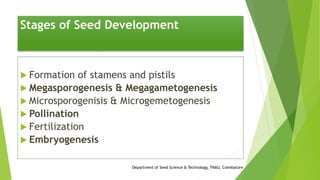
 Formation of stamens and pistils
 Megasporogenesis & Megagametogenesis
 Microsporogenisis & Microgemetogenesis
 Pollination
 Fertilization
 Embryogenesis
Department of Seed Science & Technology, TNAU, Coimbatore
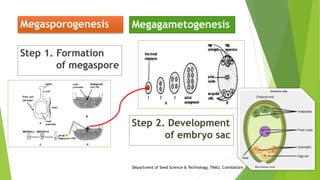
Megasporogenesis Megagametogenesis
Step 1. Formation
of megaspore
Step 2. Development
of embryo sac
Department of Seed Science & Technology, TNAU, Coimbatore
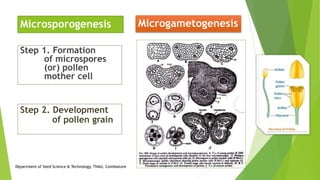
Microsporogenesis Microgametogenesis
Step 1. Formation
of microspores
(or) pollen
mother cell
Step 2. Development
of pollen grain
Department of Seed Science & Technology, TNAU, Coimbatore
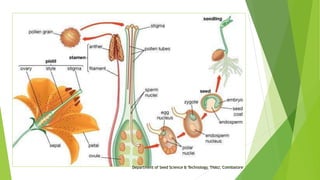
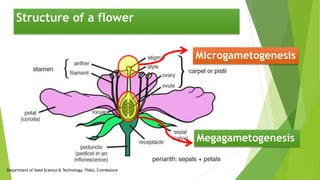
Structure of a flower
Megagametogenesis
Microgametogenesis
Department of Seed Science & Technology, TNAU, Coimbatore
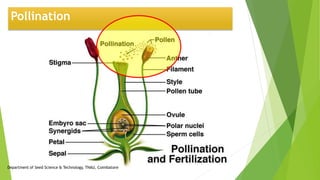
Pollination
Department of Seed Science & Technology, TNAU, Coimbatore
Types of Pollination
• Rice, black gram, green gram,
• Closer Isolation DistanceSelf
• Maize, Bajra, Bhendi
• Wider Isolation DistanceCross
• Cotton, Red gram
• Wider Isolation DistanceOCS
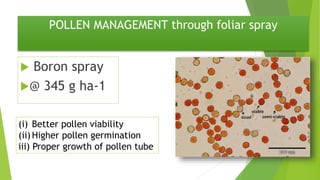
POLLEN MANAGEMENT through foliar spray
 Boron spray
@ 345 g ha-1
(i) Better pollen viability
(ii)Higher pollen germination
iii) Proper growth of pollen tube
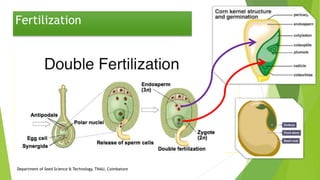
Fertilization
Department of Seed Science & Technology, TNAU, Coimbatore
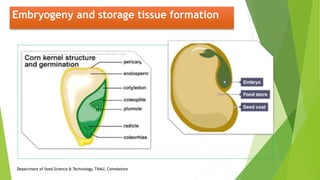
Embryogeny and storage tissue formation
Department of Seed Science & Technology, TNAU, Coimbatore
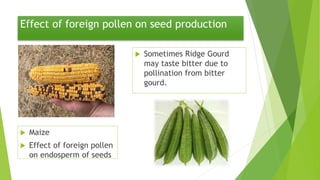
Effect of foreign pollen on seed production
 Maize
 Effect of foreign pollen
on endosperm of seeds
 Sometimes Ridge Gourd
may taste bitter due to
pollination from bitter
gourd.
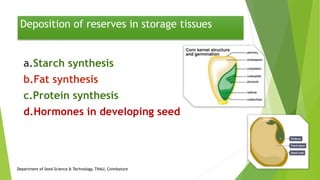
Deposition of reserves in storage tissues
a.Starch synthesis
b.Fat synthesis
c.Protein synthesis
d.Hormones in developing seed
Department of Seed Science & Technology, TNAU, Coimbatore
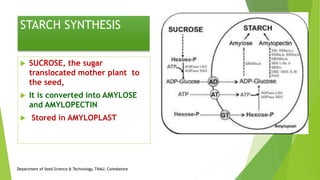
STARCH SYNTHESIS
 SUCROSE, the sugar
translocated mother plant to
the seed,
 It is converted into AMYLOSE
and AMYLOPECTIN
 Stored in AMYLOPLAST
Department of Seed Science & Technology, TNAU, Coimbatore
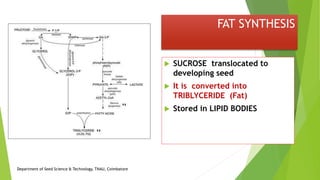
FAT SYNTHESIS
 SUCROSE translocated to
developing seed
 It is converted into
TRIBLYCERIDE (Fat)
 Stored in LIPID BODIES
Department of Seed Science & Technology, TNAU, Coimbatore
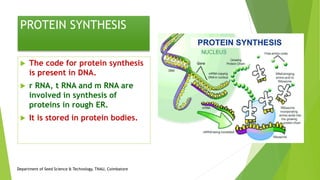
PROTEIN SYNTHESIS
 The code for protein synthesis
is present in DNA.
 r RNA, t RNA and m RNA are
involved in synthesis of
proteins in rough ER.
 It is stored in protein bodies.
Department of Seed Science & Technology, TNAU, Coimbatore
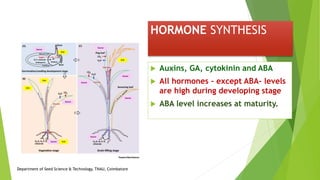
HORMONE SYNTHESIS
 Auxins, GA, cytokinin and ABA
 All hormones – except ABA- levels
are high during developing stage
 ABA level increases at maturity.
Department of Seed Science & Technology, TNAU, Coimbatore
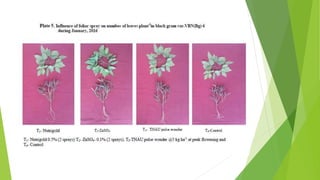
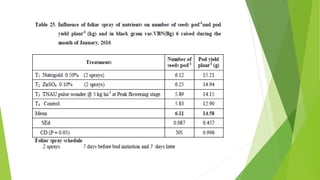
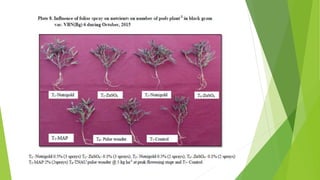
• Supply of nutrition to mother plants
• It is important to supply the nutrients
required for all the above morphological &
synthetic processes
• It helps to increase number of flowers,
number of seeds, 100 seed weight of seeds
& crop yield
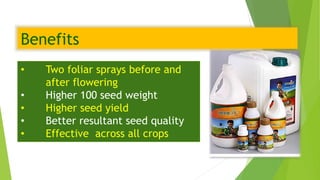
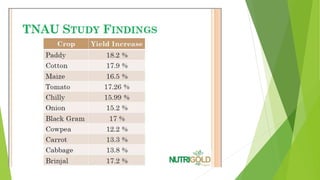
Benefits
• Two foliar sprays before and
after flowering
• Higher 100 seed weight
• Higher seed yield
• Better resultant seed quality
• Effective across all crops
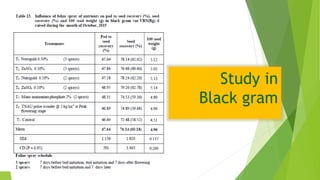
Study in
Black gram
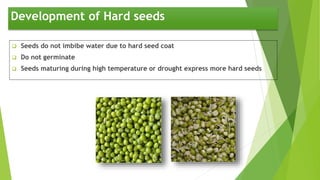
 Seeds do not imbibe water due to hard seed coat
 Do not germinate
 Seeds maturing during high temperature or drought express more hard seeds
Development of Hard seeds
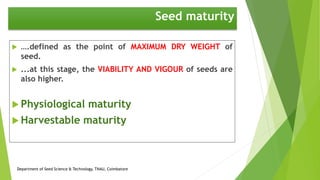
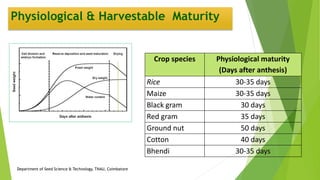
 ….defined as the point of MAXIMUM DRY WEIGHT of
seed.
 ...at this stage, the VIABILITY AND VIGOUR of seeds are
also higher.
 Physiological maturity
 Harvestable maturity
Seed maturity
Department of Seed Science & Technology, TNAU, Coimbatore
Crop species Physiological maturity
(Days after anthesis)
Rice 30-35 days
Maize 30-35 days
Black gram 30 days
Red gram 35 days
Ground nut 50 days
Cotton 40 days
Bhendi 30-35 days
Physiological & Harvestable Maturity
Department of Seed Science & Technology, TNAU, Coimbatore
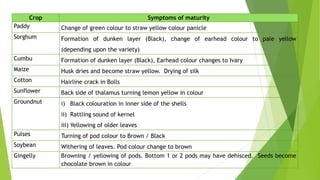
Crop Symptoms of maturity
Paddy Change of green colour to straw yellow colour panicle
Sorghum Formation of dunken layer (Black), change of earhead colour to pale yellow
(depending upon the variety)
Cumbu Formation of dunken layer (Black), Earhead colour changes to Ivary
Maize Husk dries and become straw yellow. Drying of silk
Cotton Hairline crack in Bolls
Sunflower Back side of thalamus turning lemon yellow in colour
Groundnut i) Black colouration in inner side of the shells
ii) Rattling sound of kernel
iii) Yellowing of older leaves
Pulses Turning of pod colour to Brown / Black
Soybean Withering of leaves. Pod colour change to brown
Gingelly Browning / yellowing of pods. Bottom 1 or 2 pods may have dehisced. Seeds become
chocolate brown in colour
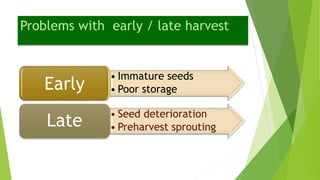
Problems with early / late harvest
• Immature seeds
• Poor storageEarly
• Seed deterioration
• Preharvest sproutingLate
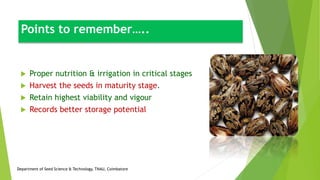
 Proper nutrition & irrigation in critical stages
 Harvest the seeds in maturity stage.
 Retain highest viability and vigour
 Records better storage potential
Points to remember…..
Department of Seed Science & Technology, TNAU, Coimbatore

Seed development and maturation

  • 1.
    Seed Development & Maturation Departmentof Seed Science & Technology TAMIL NADU AGRICULTURAL UNVIVERSITY Coimbatore – 641 003 Department of Seed Science & Technology, TNAU, Coimbatore
  • 2.
    Department of SeedScience & Technology, TNAU, Coimbatore
  • 3.
    Stages of SeedDevelopment  Formation of stamens and pistils  Megasporogenesis & Megagametogenesis  Microsporogenisis & Microgemetogenesis  Pollination  Fertilization  Embryogenesis Department of Seed Science & Technology, TNAU, Coimbatore
  • 4.
    Megasporogenesis Megagametogenesis Step 1.Formation of megaspore Step 2. Development of embryo sac Department of Seed Science & Technology, TNAU, Coimbatore
  • 5.
    Microsporogenesis Microgametogenesis Step 1.Formation of microspores (or) pollen mother cell Step 2. Development of pollen grain Department of Seed Science & Technology, TNAU, Coimbatore
  • 6.
    Structure of aflower Megagametogenesis Microgametogenesis Department of Seed Science & Technology, TNAU, Coimbatore
  • 7.
    Pollination Department of SeedScience & Technology, TNAU, Coimbatore
  • 8.
    Types of Pollination •Rice, black gram, green gram, • Closer Isolation DistanceSelf • Maize, Bajra, Bhendi • Wider Isolation DistanceCross • Cotton, Red gram • Wider Isolation DistanceOCS
  • 9.
    POLLEN MANAGEMENT throughfoliar spray  Boron spray @ 345 g ha-1 (i) Better pollen viability (ii)Higher pollen germination iii) Proper growth of pollen tube
  • 10.
    Fertilization Department of SeedScience & Technology, TNAU, Coimbatore
  • 11.
    Embryogeny and storagetissue formation Department of Seed Science & Technology, TNAU, Coimbatore
  • 12.
    Effect of foreignpollen on seed production  Maize  Effect of foreign pollen on endosperm of seeds  Sometimes Ridge Gourd may taste bitter due to pollination from bitter gourd.
  • 13.
    Deposition of reservesin storage tissues a.Starch synthesis b.Fat synthesis c.Protein synthesis d.Hormones in developing seed Department of Seed Science & Technology, TNAU, Coimbatore
  • 14.
    STARCH SYNTHESIS  SUCROSE,the sugar translocated mother plant to the seed,  It is converted into AMYLOSE and AMYLOPECTIN  Stored in AMYLOPLAST Department of Seed Science & Technology, TNAU, Coimbatore
  • 15.
    FAT SYNTHESIS  SUCROSEtranslocated to developing seed  It is converted into TRIBLYCERIDE (Fat)  Stored in LIPID BODIES Department of Seed Science & Technology, TNAU, Coimbatore
  • 16.
    PROTEIN SYNTHESIS  Thecode for protein synthesis is present in DNA.  r RNA, t RNA and m RNA are involved in synthesis of proteins in rough ER.  It is stored in protein bodies. Department of Seed Science & Technology, TNAU, Coimbatore
  • 17.
    HORMONE SYNTHESIS  Auxins,GA, cytokinin and ABA  All hormones – except ABA- levels are high during developing stage  ABA level increases at maturity. Department of Seed Science & Technology, TNAU, Coimbatore
  • 19.
    • Supply ofnutrition to mother plants • It is important to supply the nutrients required for all the above morphological & synthetic processes • It helps to increase number of flowers, number of seeds, 100 seed weight of seeds & crop yield
  • 20.
    Benefits • Two foliarsprays before and after flowering • Higher 100 seed weight • Higher seed yield • Better resultant seed quality • Effective across all crops
  • 21.
  • 27.
     Seeds donot imbibe water due to hard seed coat  Do not germinate  Seeds maturing during high temperature or drought express more hard seeds Development of Hard seeds
  • 28.
     ….defined asthe point of MAXIMUM DRY WEIGHT of seed.  ...at this stage, the VIABILITY AND VIGOUR of seeds are also higher.  Physiological maturity  Harvestable maturity Seed maturity Department of Seed Science & Technology, TNAU, Coimbatore
  • 29.
    Crop species Physiologicalmaturity (Days after anthesis) Rice 30-35 days Maize 30-35 days Black gram 30 days Red gram 35 days Ground nut 50 days Cotton 40 days Bhendi 30-35 days Physiological & Harvestable Maturity Department of Seed Science & Technology, TNAU, Coimbatore
  • 30.
    Crop Symptoms ofmaturity Paddy Change of green colour to straw yellow colour panicle Sorghum Formation of dunken layer (Black), change of earhead colour to pale yellow (depending upon the variety) Cumbu Formation of dunken layer (Black), Earhead colour changes to Ivary Maize Husk dries and become straw yellow. Drying of silk Cotton Hairline crack in Bolls Sunflower Back side of thalamus turning lemon yellow in colour Groundnut i) Black colouration in inner side of the shells ii) Rattling sound of kernel iii) Yellowing of older leaves Pulses Turning of pod colour to Brown / Black Soybean Withering of leaves. Pod colour change to brown Gingelly Browning / yellowing of pods. Bottom 1 or 2 pods may have dehisced. Seeds become chocolate brown in colour
  • 31.
    Problems with early/ late harvest • Immature seeds • Poor storageEarly • Seed deterioration • Preharvest sproutingLate
  • 32.
     Proper nutrition& irrigation in critical stages  Harvest the seeds in maturity stage.  Retain highest viability and vigour  Records better storage potential Points to remember….. Department of Seed Science & Technology, TNAU, Coimbatore
  • 33.
    Department of SeedScience & Technology, TNAU, Coimbatore