Seed genomics for seedling vigour and initial high
crop stand
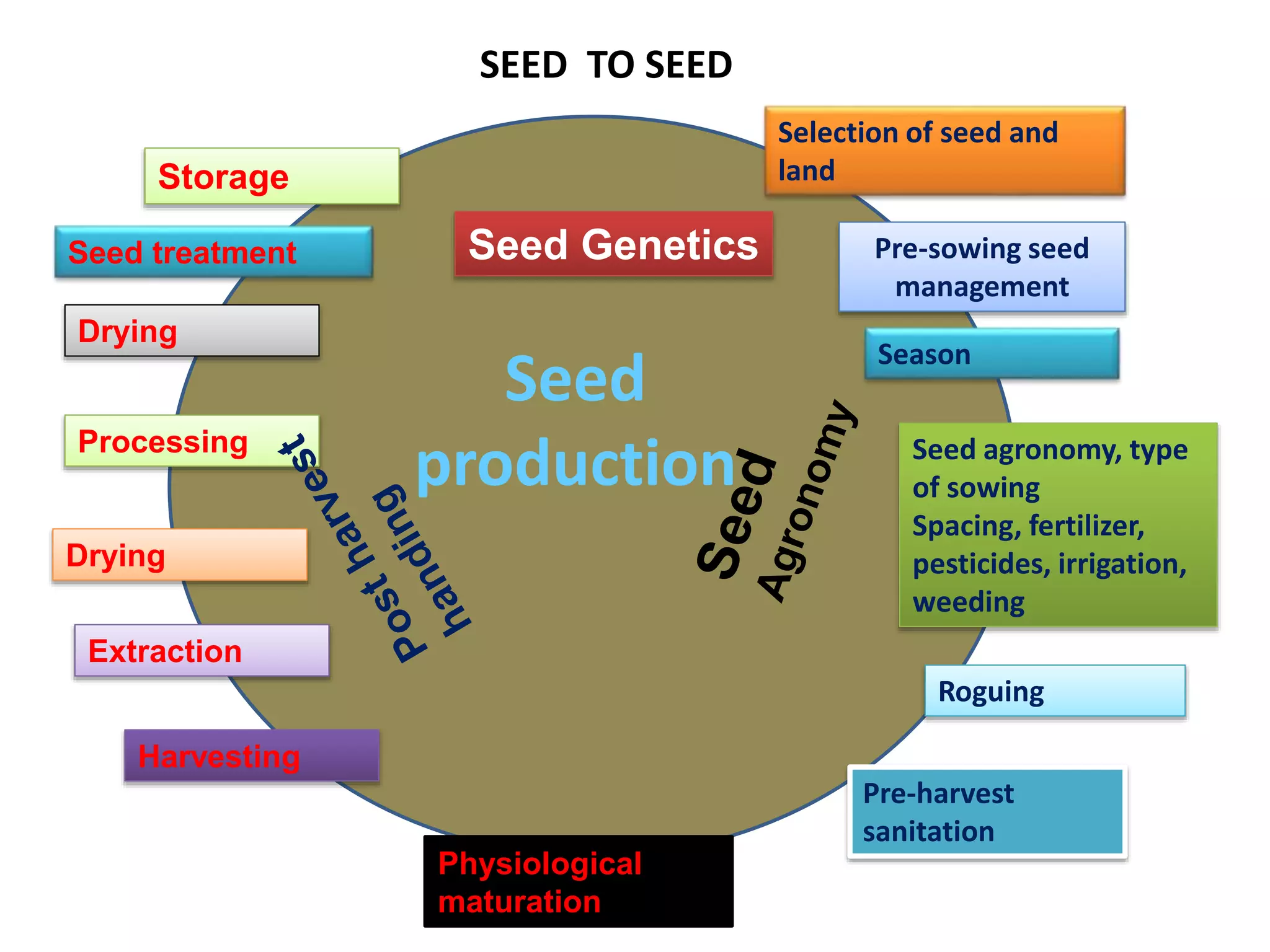
Seed
production
SEED TO SEED
Pre-sowing seed
management
Seed agronomy, type
of sowing
Spacing, fertilizer,
pesticides, irrigation,
weeding
Physiological
maturation
Pre-harvest
sanitation
Harvesting
Extraction
Drying
Processing
Drying
Seed treatment
Storage
Selection of seed and
land
Season
Seed Genetics
Roguing
Quality seed
• Quality seed is defined as pure
variety with a high germination
percentage, free from
disease/disease organisms and with
a proper moisture content and
weight.
• Quality seed insures good
germination, rapid emergence and
vigourous growth. These aspects
translate to a good field stand.
• Seed quality is the sum of all
properties contributing to seed
performance.
4
Structural concept of seed quality
Knowledge about the various seed quality aspects of seeds
greatly contributed to agricultural development in the past
and will continue to play a major role in future
enhancement of crop production. Seed quality is a
multiple concept comprising several components
(Thomson, 1979)
Structural concept of seed quality ( Huda, 2001)
6
Seed vigour
 Seed vigour is a sum of those properties that determine the activity
and level of performance of seed lots of acceptable germination in a
wide range of environments.
◦ Rate and uniformity of seed germination and seedling growth.
◦ Emergence ability of seeds under unfavourable environmental
conditions.
◦ Performance after storage, particularly the retention of ability to
germinate.
◦ A vigorous seedlot is one that is potentially able to perform well
even under environmental conditions that are not optimal for
species.
7
Seed vigour characteristics
 Comparison of the characteristics of high and low
vigour seed lots.
Characters Vigour level
High Low
Mean germination Fast Slow
Synchrony of germination Good Poor
Mean seedling size Large, uniform Small, variable
Emergence potential Good in most soil
condition
Poor in less than
optimum soil
condition
Storage potential Good poor
Encyclopedia of seeds, pg. 742
8
Components of seed vigour
Yield
S:R ratio
Germination
Plant height
9
Relationship between vigour, field performance and yield
 The germination ability and vigour of a seed lot is directly
related to performance in the field.
 Seeds low in vigour generally produces weak seedlings that are
susceptible to environmental stresses.
 High level of vigour in seeds can be expected to provide an
early and uniform stands which give the growing seedlings the
competitive advantage against various environmental stresses.
10
 Provides a very good estimate of potential field performance
and subsequently, the field planting value
 The ability of the germinating seed to continue to grow and
survive then determines crop establishment
 Low seed vigour contributes to the development of smaller and
uneven seedlings
 Which leads to poor plant stand and growth (weaker seedlings)
and uneven time of maturity, resulting in the possibility of yield
loss
11
 The central dogma of molecular biology was
first articulated by Francis Crick in 1958
 Explained the of the flow of genetic information
within a biological system
DNA mRNA Protein
Transcripti
on
Translatio
n
It is the link between genotypes and
phenotypes
 Genome: Total amount of DNA/RNA, genetic information
present in a cell.
 Gene: Segment of DNA contains biological information & codes
for RNA/ polypeptide molecule
 Most of the eukaryotic genome: non-coding
 Humans – only 5% coding DNA, plants have more repetitive
DNA
 Genomics is a discipline in genetics that applies recombinant
DNA, DNA sequencing methods, and bioinformatics to
sequence, assemble, and analyze the function and structure
of genomes
1. Structural Genomics: is a worldwide effort aimed at determining the
three-dimensional structures of gene products in an efficient and high-
throughput mode. When the focus is on proteins, this effort may be
called Structural Proteomics
2. Functional Genomics: To understand the function of
information in genome
3. Comparative Genomics: Comparing the genomes of different organisms
TYPES
16
Quantitative trait locus
 A quantitative trait locus (QTL) is a section of DNA (the locus)
that correlates with variation in a phenotype (the quantitative
trait).
 The QTL typically is linked to, or contains, the genes that control
that phenotype.
 QTLs are mapped by identifying which molecular markers (such
as SNPs or AFLPs) correlate with an observed trait. This is often
an early step in identifying and sequencing the actual genes that
cause the trait variation.
17
 Lipid peroxidation plays a major role in seed longevity and
viability.
 In rice grains, lipid peroxidation is catalysed by the enzyme
lipoxygenase 3 (LOX3).
 Grain from the rice variety DawDam in which the LOX3 gene
was deleted had less stale flavour after grain storage than
normal rice.
 The transgenic plants exhibited a marked decrease in LOX
mRNA levels.
 LOX3 activity and its ability to produce (9-HPOD) from
linoleic acid were significantly lower in transgenic seeds than in
wild-type seeds
TS-91WT; Hang 1
Huibin Xu et al. (2015)
18
 The suppression of LOX3 expression in rice endosperm
increased grain storability.
 The germination rate of TS-91 (antisense LOX3 transgenic
line) was much higher than the WT (29% higher after artificial
ageing for 21 days, and 40% higher after natural ageing for 12
months).
Variation in germinability after artificial ageing for
0–30 days.
Huibin Xu et al. (2015)19
Variation in germinability after natural ageing
Huibin Xu et al. (2015)20
Scanning electron microscope images of starch granules in antisense LOX3
transgenic plants and wild-type (WT) plants. (a) WT seeds without ageing.
(b) WT seeds aged for 30 days. (c) Antisense LOX3 transgenic seeds without
ageing. (d) Antisense LOX3 transgenic seeds aged for 30 days. Bar = 5 lm.
Increasing longevity of seeds with genetic
engineering
• Researchers of the IBMCP (Institute for Plant Molecular and Cell
Biology) traced half a million seeds, related to one hundred
thousand lines of Arabidopsis mutated by T-DNA insertion, using
the natural system of Agrobacterium tumefaciens.
• The key is the over expression of the ATHB25 gene. This gene
encodes a protein that regulates gene expression, producing a new
mutant that gives the seed new properties.
• Researchers have proven that this mutant has more gibberellin -the
hormone that promotes plant growth-, which means the seed coat is
reinforced as well.
Eduardo Bueso et al. (2013)
21
22
 "The seed coat is responsible for preventing oxygen from
entering the seed; the increase in gibberellin strengthens it and
this leads to a more durable and longer lasting seed," (Eduardo
Bueso, researcher at the IBMCP ).
 Researchers compared the longevity of genetically modified
Arabidopsis seeds and seeds which were not modified. In order to
do this, they preserved them for thirty months under specific
conditions of room temperature and humidity. After thirty
months, only 20% of the control plants germinated again,
whereas almost the all of the modified plants (90%) began the
germination process again.
 The increase of the lifespan of seeds would mean a reduction in
their purchase price."
Eduardo Bueso et al. (2013)
 The sweet corn inbred line P39 and the field corn inbred line
EP44 were used as plant material.
 Bulks of living and dead seeds after 20 and 22 years of
storage were compared by using simple sequence repeats
(SSRs).
 Differences between dead and living seeds could be explained
by residual variability, spontaneous mutation, or ageing.
23
Revilla et al. (2009)
 Variability was larger for chromosome 7 than for other
chromosomes, suggesting some relationships between position
in the genome and viability in aged seed.
 Polymorphic SSRs between living and dead seeds were found
in six known genes, including pathogenesis-related protein 2,
superoxide dismutase 4, catalase 3, opaque endosperm 2, and
metallothionein1 are related to germination, along with golden
plant 2.
Revilla et al. (2009)
24
 Phospholipase Da1 is the most abundant form of PLD in A.
thaliana
 Phospholipase D (PLD), which cleaves phospholipids to
generate phosphatidic acid (PA), has been proposed to
catalyze an early step in the process of membrane degradation
and seed deterioration.
 The PLDa1 knockout (KO) mutant, designated plda1-1, had
no detectable PLDa1 protein.
Shivakumar et al. (2007)
25
Immunoblotting of PLDa1 protein (upper
panel) and PLDa1 activity (lower panel) in seeds
of WT, plda1-1 (KO) and plda1-AS (AS).
The western blot (sometimes called the protein immunoblot) is
used to detect specific proteins in a sample of tissue
homogenate or extract.
Shivakumar et al. (2007)
26
Germination rate of WT and PLD mutant seeds without (C = control seeds)
and with aging (AA = accelerated aging) treatment. Accelerated aging was
performed by placing the seeds at 43C in a tightly closed box with 100%
relative humidity for 48 h.
Shivakumar et al. (2007)
27
• Maize seeds homozygous for luteus2 and luteus4 genes lose
viability more quickly than seeds homozygous for any of the
remaining six luteus gene
(Weiss &wentz, 1937).
28
Genetic dissection of seed vigour under artificial ageing conditions using
two joined maize recombinant inbred line populations
 Yu82 9 X Shen137 and Yu537A 9 X Shen137 crosses were
evaluated for the mean germination time (MGT) under
artificial ageing.
 Twenty-two key candidate genes associated with four seed
vigour-related traits mapped to 14 QTLs .
 GRMZM2G163749,
GRMZM2G122172/GRMZM2G554885/
GRMZM2G122871 and GRMZM2G150367 genes mapped
within the QTL5–4, QTL6 and QTL8 regions.
Lixia Ku et al. (2014)
29
DOG1 is a key regulator of seed dormancy in Arabidopsis
• HISTONE MONOUBIQUITINATION
1 (HUB1) , REDUCED DORMANCY
2(RDO2) and SUPPRESSOR OF ABI3-5,
DOG1 are responsible for dormancy.
• Mutations in most of these genes cause
reduced dormancy, resulting in a higher
germination of freshly harvested seeds.
• The dog1 and rdo5 mutants show a complete
loss of dormancy upon mutation.
Mutants with reduced seed dormancy.
Germination percentages of freshly harvested
seeds are shown for the wild-type Columbia
accession and the mutants dog1, rdo5, hub1,
and rdo2.
Graeber et al.(2012)30
Genetic mapping within the wheat D genome reveals QTL for
germination, seed vigour and longevity, and early seedling growth
• In wheat D the QTL analysis for the traits related to
germination, seed vigour and longevity, 17 QTL were
identified.
• These loci were distributed on chromosomes 1D (9 QTL),
5D (5), 7D (4), 2D (1) and 4D (1). QTL were detected for
19 of the 38 studied traits, among which nine were for
germination-related traits, two were for seed vigour-
related traits, five were for seed longevity-related traits,
and three were for seedling growth traits.
• QTL responsible for the germination capacity following
AA were located on chromosomes 5D and 1D.
(Landjeva et al., 2009). 31
Quantitative Trait Locus Analysis of Seed
Germination and Seedling Vigour in Brassica rapa
• Doubled haploid population from a cross of a yellow-
seeded oil-type yellow sarson and a black-seeded
vegetable-type pak choi were chosen .
• 26 QTL regions across all 10 linkage groups for traits
related to seed weight, seed germination and seedling
vigour under non-stress and salt stress conditions
illustrating the polygenic nature of these traits were
identified.
• QTLs for multiple traits co-localized, eight hotspots for
quantitative trait loci (QTL) of seed weight, seed
germination, and root and shoot lengths.
• A QTL hotspot for seed germination on A02 mapped at
the B. rapa Flowering Locus C (BrFLC2).
32(Basnet, R.K et al., 2015).
• Another hotspot on A05 with salt stress specific
QTLs co-located with the B. rapa Fatty acid
desaturase 2 (BrFAD2) locus
• For the 24 seedling vigour traits measured in 2010
and 2011 seed batches, 10 QTL regions with 69
QTLs were identified.
• The explained variances ranged from 7.1 to
24.3%. For the 2010 seed batch, 22 QTLs for 13
traits were identified on different linkage groups
with at least one QTL per trait and an additional
24 putative QTLs for 13 different traits.
• For the 2011 seed batch, 47 QTLs were identified
for 20 traits with at least one QTL per trait and all
those traits also had putative QTLs.
33(Basnet, R.K et al., 2015).
Quantitative genetic analysis of seed vigour and pre-
emergence seedling growth traits in Brassica oleracea
• Traits associated with seed vigour and pre-
emergence seedling growth in a segregating
population of 105 doubled haploid
Brassica oleracea lines were studied.
• Quantitative trait loci analyses revealed
significant loci on linkage groups O1, O3, O6,
O7 and O9
34
Quantitative trait loci analysis for rice
seed vigour during the germination stage
• RIL population derived from a cross between japonica
Daguandao and indica IR28.
• The results showed that indica rice presented stronger seed
vigour during the germination stage than japonica rice.
• A total of ten QTLs, and at least five novel alleles, were
detected to control rice seed vigour, and the amount of
variation (R2) explained by an individual QTL ranged from
7.5% to 68.5%, with three major QTLs with R2>20%.
• Most of the QTLs detected here are likely to coincide with
QTLs for seed weight, seed size, or seed dormancy,
35
(Wang et al., 2010).
• Three QTLs controlling germination rate were
identified on chromosomes 1, 2, and 11, respectively.
• Among them, qGR-1 might be one major QTL
(R2=68.5%), the other two of the minor QTLs (qGR-2
and qGR-11).
• Four QTLs associated with germination percentage
were found on chromosomes 4, 6, 8, and 11,
respectively and one major QTL qGP-6, Three QTLs
(qGI-1, qGI-7, and qGI-11) were responsible for
germination index located on chromosomes 1, 7, and
11, respectively
36
QTLs for Seed Vigour-Related Traits Identified in Maize
Seeds Germinated under Artificial Aging Conditions
• Twenty-three candidate genes for association with
seed vigour traits coincided with 13 mQTLs.
• The candidate genes had functions in the
glycolytic pathway and in protein metabolism.
• Candidate genes included a calcium-dependent
protein kinase gene (302810918) involved in
signal transduction that mapped in the mQTL3-2
interval associated with germination energy (GE)
and germination percentage (GP).
37
(Zanping, H et al., 2014)
• hsp20/alpha crystallin family protein gene
(At5g51440) that mapped in the mQTL3-4
interval associated with GE and GP.
• A cucumisin-like Ser protease gene
(At5g67360) mapped in the mQTL5-2 interval
associated with GP.
• The chromosome regions for mQTL2,
mQTL3-2, mQTL3-4, and mQTL5-2 may be
hot spots for QTLs related to seed vigour traits
38
Thank you
39

Seed genomics

  • 2.
    Seed genomics forseedling vigour and initial high crop stand
  • 3.
    Seed production SEED TO SEED Pre-sowingseed management Seed agronomy, type of sowing Spacing, fertilizer, pesticides, irrigation, weeding Physiological maturation Pre-harvest sanitation Harvesting Extraction Drying Processing Drying Seed treatment Storage Selection of seed and land Season Seed Genetics Roguing
  • 4.
    Quality seed • Qualityseed is defined as pure variety with a high germination percentage, free from disease/disease organisms and with a proper moisture content and weight. • Quality seed insures good germination, rapid emergence and vigourous growth. These aspects translate to a good field stand. • Seed quality is the sum of all properties contributing to seed performance. 4
  • 5.
    Structural concept ofseed quality Knowledge about the various seed quality aspects of seeds greatly contributed to agricultural development in the past and will continue to play a major role in future enhancement of crop production. Seed quality is a multiple concept comprising several components (Thomson, 1979)
  • 6.
    Structural concept ofseed quality ( Huda, 2001) 6
  • 7.
    Seed vigour  Seedvigour is a sum of those properties that determine the activity and level of performance of seed lots of acceptable germination in a wide range of environments. ◦ Rate and uniformity of seed germination and seedling growth. ◦ Emergence ability of seeds under unfavourable environmental conditions. ◦ Performance after storage, particularly the retention of ability to germinate. ◦ A vigorous seedlot is one that is potentially able to perform well even under environmental conditions that are not optimal for species. 7
  • 8.
    Seed vigour characteristics Comparison of the characteristics of high and low vigour seed lots. Characters Vigour level High Low Mean germination Fast Slow Synchrony of germination Good Poor Mean seedling size Large, uniform Small, variable Emergence potential Good in most soil condition Poor in less than optimum soil condition Storage potential Good poor Encyclopedia of seeds, pg. 742 8
  • 9.
    Components of seedvigour Yield S:R ratio Germination Plant height 9
  • 10.
    Relationship between vigour,field performance and yield  The germination ability and vigour of a seed lot is directly related to performance in the field.  Seeds low in vigour generally produces weak seedlings that are susceptible to environmental stresses.  High level of vigour in seeds can be expected to provide an early and uniform stands which give the growing seedlings the competitive advantage against various environmental stresses. 10
  • 11.
     Provides avery good estimate of potential field performance and subsequently, the field planting value  The ability of the germinating seed to continue to grow and survive then determines crop establishment  Low seed vigour contributes to the development of smaller and uneven seedlings  Which leads to poor plant stand and growth (weaker seedlings) and uneven time of maturity, resulting in the possibility of yield loss 11
  • 12.
     The centraldogma of molecular biology was first articulated by Francis Crick in 1958  Explained the of the flow of genetic information within a biological system DNA mRNA Protein Transcripti on Translatio n
  • 13.
    It is thelink between genotypes and phenotypes
  • 14.
     Genome: Totalamount of DNA/RNA, genetic information present in a cell.  Gene: Segment of DNA contains biological information & codes for RNA/ polypeptide molecule  Most of the eukaryotic genome: non-coding  Humans – only 5% coding DNA, plants have more repetitive DNA  Genomics is a discipline in genetics that applies recombinant DNA, DNA sequencing methods, and bioinformatics to sequence, assemble, and analyze the function and structure of genomes
  • 15.
    1. Structural Genomics:is a worldwide effort aimed at determining the three-dimensional structures of gene products in an efficient and high- throughput mode. When the focus is on proteins, this effort may be called Structural Proteomics 2. Functional Genomics: To understand the function of information in genome 3. Comparative Genomics: Comparing the genomes of different organisms TYPES
  • 16.
    16 Quantitative trait locus A quantitative trait locus (QTL) is a section of DNA (the locus) that correlates with variation in a phenotype (the quantitative trait).  The QTL typically is linked to, or contains, the genes that control that phenotype.  QTLs are mapped by identifying which molecular markers (such as SNPs or AFLPs) correlate with an observed trait. This is often an early step in identifying and sequencing the actual genes that cause the trait variation.
  • 17.
  • 18.
     Lipid peroxidationplays a major role in seed longevity and viability.  In rice grains, lipid peroxidation is catalysed by the enzyme lipoxygenase 3 (LOX3).  Grain from the rice variety DawDam in which the LOX3 gene was deleted had less stale flavour after grain storage than normal rice.  The transgenic plants exhibited a marked decrease in LOX mRNA levels.  LOX3 activity and its ability to produce (9-HPOD) from linoleic acid were significantly lower in transgenic seeds than in wild-type seeds TS-91WT; Hang 1 Huibin Xu et al. (2015) 18
  • 19.
     The suppressionof LOX3 expression in rice endosperm increased grain storability.  The germination rate of TS-91 (antisense LOX3 transgenic line) was much higher than the WT (29% higher after artificial ageing for 21 days, and 40% higher after natural ageing for 12 months). Variation in germinability after artificial ageing for 0–30 days. Huibin Xu et al. (2015)19 Variation in germinability after natural ageing
  • 20.
    Huibin Xu etal. (2015)20 Scanning electron microscope images of starch granules in antisense LOX3 transgenic plants and wild-type (WT) plants. (a) WT seeds without ageing. (b) WT seeds aged for 30 days. (c) Antisense LOX3 transgenic seeds without ageing. (d) Antisense LOX3 transgenic seeds aged for 30 days. Bar = 5 lm.
  • 21.
    Increasing longevity ofseeds with genetic engineering • Researchers of the IBMCP (Institute for Plant Molecular and Cell Biology) traced half a million seeds, related to one hundred thousand lines of Arabidopsis mutated by T-DNA insertion, using the natural system of Agrobacterium tumefaciens. • The key is the over expression of the ATHB25 gene. This gene encodes a protein that regulates gene expression, producing a new mutant that gives the seed new properties. • Researchers have proven that this mutant has more gibberellin -the hormone that promotes plant growth-, which means the seed coat is reinforced as well. Eduardo Bueso et al. (2013) 21
  • 22.
    22  "The seedcoat is responsible for preventing oxygen from entering the seed; the increase in gibberellin strengthens it and this leads to a more durable and longer lasting seed," (Eduardo Bueso, researcher at the IBMCP ).  Researchers compared the longevity of genetically modified Arabidopsis seeds and seeds which were not modified. In order to do this, they preserved them for thirty months under specific conditions of room temperature and humidity. After thirty months, only 20% of the control plants germinated again, whereas almost the all of the modified plants (90%) began the germination process again.  The increase of the lifespan of seeds would mean a reduction in their purchase price." Eduardo Bueso et al. (2013)
  • 23.
     The sweetcorn inbred line P39 and the field corn inbred line EP44 were used as plant material.  Bulks of living and dead seeds after 20 and 22 years of storage were compared by using simple sequence repeats (SSRs).  Differences between dead and living seeds could be explained by residual variability, spontaneous mutation, or ageing. 23 Revilla et al. (2009)
  • 24.
     Variability waslarger for chromosome 7 than for other chromosomes, suggesting some relationships between position in the genome and viability in aged seed.  Polymorphic SSRs between living and dead seeds were found in six known genes, including pathogenesis-related protein 2, superoxide dismutase 4, catalase 3, opaque endosperm 2, and metallothionein1 are related to germination, along with golden plant 2. Revilla et al. (2009) 24
  • 25.
     Phospholipase Da1is the most abundant form of PLD in A. thaliana  Phospholipase D (PLD), which cleaves phospholipids to generate phosphatidic acid (PA), has been proposed to catalyze an early step in the process of membrane degradation and seed deterioration.  The PLDa1 knockout (KO) mutant, designated plda1-1, had no detectable PLDa1 protein. Shivakumar et al. (2007) 25
  • 26.
    Immunoblotting of PLDa1protein (upper panel) and PLDa1 activity (lower panel) in seeds of WT, plda1-1 (KO) and plda1-AS (AS). The western blot (sometimes called the protein immunoblot) is used to detect specific proteins in a sample of tissue homogenate or extract. Shivakumar et al. (2007) 26
  • 27.
    Germination rate ofWT and PLD mutant seeds without (C = control seeds) and with aging (AA = accelerated aging) treatment. Accelerated aging was performed by placing the seeds at 43C in a tightly closed box with 100% relative humidity for 48 h. Shivakumar et al. (2007) 27
  • 28.
    • Maize seedshomozygous for luteus2 and luteus4 genes lose viability more quickly than seeds homozygous for any of the remaining six luteus gene (Weiss &wentz, 1937). 28
  • 29.
    Genetic dissection ofseed vigour under artificial ageing conditions using two joined maize recombinant inbred line populations  Yu82 9 X Shen137 and Yu537A 9 X Shen137 crosses were evaluated for the mean germination time (MGT) under artificial ageing.  Twenty-two key candidate genes associated with four seed vigour-related traits mapped to 14 QTLs .  GRMZM2G163749, GRMZM2G122172/GRMZM2G554885/ GRMZM2G122871 and GRMZM2G150367 genes mapped within the QTL5–4, QTL6 and QTL8 regions. Lixia Ku et al. (2014) 29
  • 30.
    DOG1 is akey regulator of seed dormancy in Arabidopsis • HISTONE MONOUBIQUITINATION 1 (HUB1) , REDUCED DORMANCY 2(RDO2) and SUPPRESSOR OF ABI3-5, DOG1 are responsible for dormancy. • Mutations in most of these genes cause reduced dormancy, resulting in a higher germination of freshly harvested seeds. • The dog1 and rdo5 mutants show a complete loss of dormancy upon mutation. Mutants with reduced seed dormancy. Germination percentages of freshly harvested seeds are shown for the wild-type Columbia accession and the mutants dog1, rdo5, hub1, and rdo2. Graeber et al.(2012)30
  • 31.
    Genetic mapping withinthe wheat D genome reveals QTL for germination, seed vigour and longevity, and early seedling growth • In wheat D the QTL analysis for the traits related to germination, seed vigour and longevity, 17 QTL were identified. • These loci were distributed on chromosomes 1D (9 QTL), 5D (5), 7D (4), 2D (1) and 4D (1). QTL were detected for 19 of the 38 studied traits, among which nine were for germination-related traits, two were for seed vigour- related traits, five were for seed longevity-related traits, and three were for seedling growth traits. • QTL responsible for the germination capacity following AA were located on chromosomes 5D and 1D. (Landjeva et al., 2009). 31
  • 32.
    Quantitative Trait LocusAnalysis of Seed Germination and Seedling Vigour in Brassica rapa • Doubled haploid population from a cross of a yellow- seeded oil-type yellow sarson and a black-seeded vegetable-type pak choi were chosen . • 26 QTL regions across all 10 linkage groups for traits related to seed weight, seed germination and seedling vigour under non-stress and salt stress conditions illustrating the polygenic nature of these traits were identified. • QTLs for multiple traits co-localized, eight hotspots for quantitative trait loci (QTL) of seed weight, seed germination, and root and shoot lengths. • A QTL hotspot for seed germination on A02 mapped at the B. rapa Flowering Locus C (BrFLC2). 32(Basnet, R.K et al., 2015).
  • 33.
    • Another hotspoton A05 with salt stress specific QTLs co-located with the B. rapa Fatty acid desaturase 2 (BrFAD2) locus • For the 24 seedling vigour traits measured in 2010 and 2011 seed batches, 10 QTL regions with 69 QTLs were identified. • The explained variances ranged from 7.1 to 24.3%. For the 2010 seed batch, 22 QTLs for 13 traits were identified on different linkage groups with at least one QTL per trait and an additional 24 putative QTLs for 13 different traits. • For the 2011 seed batch, 47 QTLs were identified for 20 traits with at least one QTL per trait and all those traits also had putative QTLs. 33(Basnet, R.K et al., 2015).
  • 34.
    Quantitative genetic analysisof seed vigour and pre- emergence seedling growth traits in Brassica oleracea • Traits associated with seed vigour and pre- emergence seedling growth in a segregating population of 105 doubled haploid Brassica oleracea lines were studied. • Quantitative trait loci analyses revealed significant loci on linkage groups O1, O3, O6, O7 and O9 34
  • 35.
    Quantitative trait locianalysis for rice seed vigour during the germination stage • RIL population derived from a cross between japonica Daguandao and indica IR28. • The results showed that indica rice presented stronger seed vigour during the germination stage than japonica rice. • A total of ten QTLs, and at least five novel alleles, were detected to control rice seed vigour, and the amount of variation (R2) explained by an individual QTL ranged from 7.5% to 68.5%, with three major QTLs with R2>20%. • Most of the QTLs detected here are likely to coincide with QTLs for seed weight, seed size, or seed dormancy, 35 (Wang et al., 2010).
  • 36.
    • Three QTLscontrolling germination rate were identified on chromosomes 1, 2, and 11, respectively. • Among them, qGR-1 might be one major QTL (R2=68.5%), the other two of the minor QTLs (qGR-2 and qGR-11). • Four QTLs associated with germination percentage were found on chromosomes 4, 6, 8, and 11, respectively and one major QTL qGP-6, Three QTLs (qGI-1, qGI-7, and qGI-11) were responsible for germination index located on chromosomes 1, 7, and 11, respectively 36
  • 37.
    QTLs for SeedVigour-Related Traits Identified in Maize Seeds Germinated under Artificial Aging Conditions • Twenty-three candidate genes for association with seed vigour traits coincided with 13 mQTLs. • The candidate genes had functions in the glycolytic pathway and in protein metabolism. • Candidate genes included a calcium-dependent protein kinase gene (302810918) involved in signal transduction that mapped in the mQTL3-2 interval associated with germination energy (GE) and germination percentage (GP). 37 (Zanping, H et al., 2014)
  • 38.
    • hsp20/alpha crystallinfamily protein gene (At5g51440) that mapped in the mQTL3-4 interval associated with GE and GP. • A cucumisin-like Ser protease gene (At5g67360) mapped in the mQTL5-2 interval associated with GP. • The chromosome regions for mQTL2, mQTL3-2, mQTL3-4, and mQTL5-2 may be hot spots for QTLs related to seed vigour traits 38
  • 39.

Editor's Notes

  • #13  section of DNA is replicated( dna polymerase) in the form of a newly assembled piece of messenger RNA (mRNA), include RNA polymerase and transcription factors. In eukaryoticcells the primary transcript is (pre-mRNA) Information is increases, variation is also increses but material is decrease- less amount amount from DNA After protein synthesis different biochemical pathways occurs- metabolic pathways- its shows different phenotypic charecors- colour
  • #15 The term genome was used by German botanist Hans Winker in 1920, The complete set of DNA found in each cell is known as the genome MAS- to identify the locus of intrest nd gene