CONTENTS
 Introduction
 Oxidative stress & reactive oxygen species
 Antioxidants
 Classification of antioxidants
 Site of production of enzymatic antioxidants
 Protective role of enzymatic antioxidants
 Case studies.
What are free radicals?
 Any molecule containing one or
more unpaired electrons.
 Highly reactive
 Very short half-life
 Generate new radicals by chain
reaction
 Cause damage to biomolecules,
cells and tissues.
Types of free radical
Various causes responsible for the generation of ROS
SOURCES OF ROS IN PLANT CELLS AND THEIR REACTIVITY IN
VARIOUS CELLULAR COMPONENTS
1. Flavoenzyme ERO1
2. Lipoxygenases
3. Cyclo oxygenases
4. Flavin dependent demethylase
5. Oxidases for polyamines and amino acids
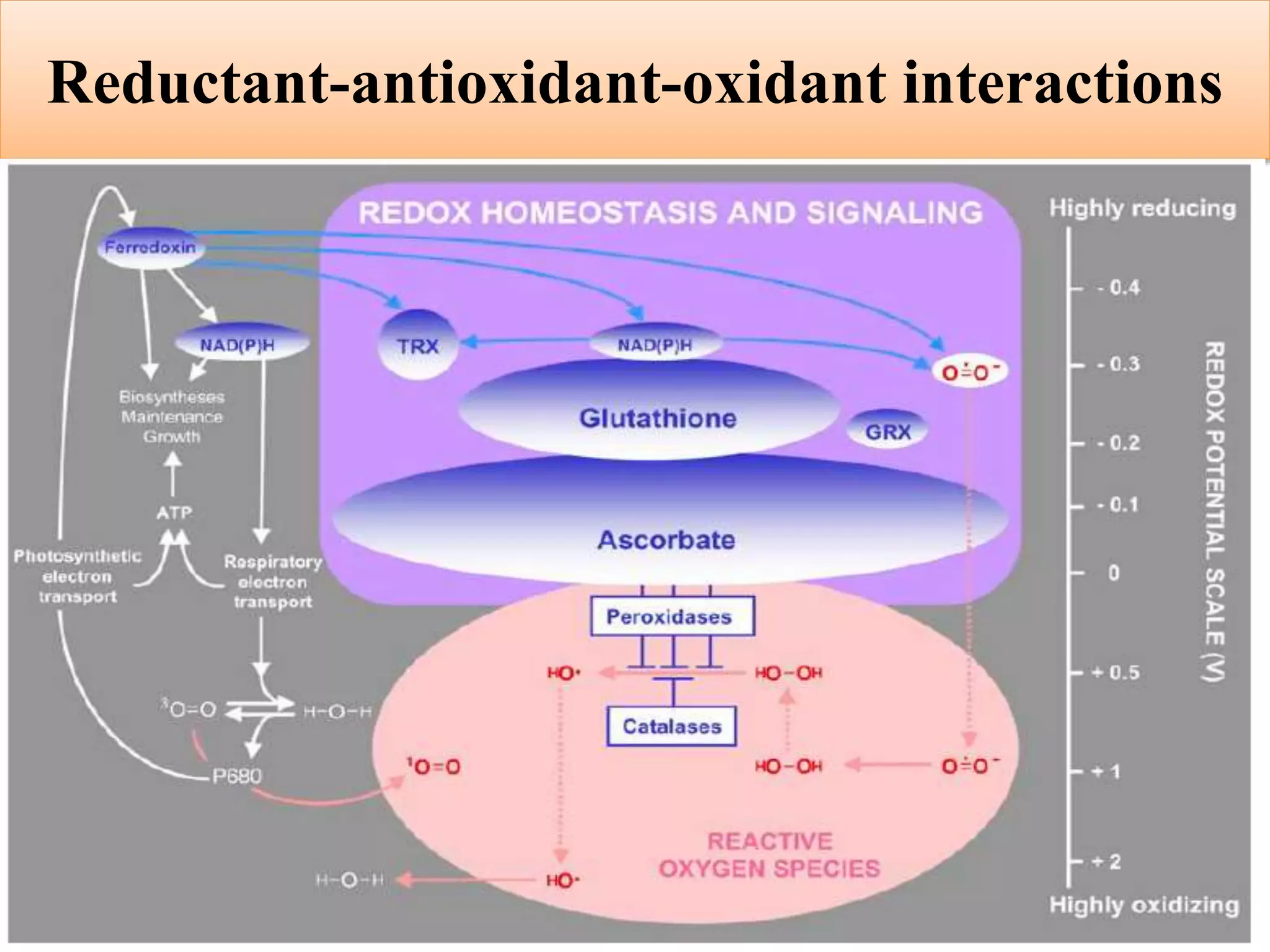
Reductant-antioxidant-oxidant interactions
ROS : nature and origin
Reactive Oxygen Species (ROS)
The
formed
chemical
upon
species
incomplete
of molecularreduction
oxygen
Reduction
Accumulation of ROS leads
to cell
disturbances
injury
in
and
seed
development or germination
processes
Reduction Reduction Reduction
Figure 1. Formation of ROS through energy- and electron-transfer reactions
Krumova and Cosa, 2016
Non radical
derivatives
Radical
derivatives
Various targets of ROS
Autoxidation
Oxidation of lipid in presence of oxygen around the
unsaturated fatty acid resulting in formation of peroxides
and hydroperoxides.
Lipid peroxidation
 The oxidative degradation of lipids
 The process in which free radicles steal electrons from
the lipids in cell membranes, resulting in cell damage.
 It is stimulated by Lipoxygenases enzyme
 Occurs in all seeds, more in oil seeds
ROS : cause of seed deterioration
Proposed involvement of oxidative
mechanisms in seed ageing.
An antioxidant is a molecule capable
of inhibiting the oxidation of other
molecules. Oxidation is a chemical
reaction that transfers electrons or
hydrogen from a substance to an
oxidizing agent.
Oxidation reactions can produce free
radicals. In turn, these radicals can
start chain reactions.
What are Antioxidants ?
 An antioxidant defence differ from species to species.
 The presence of antioxidant defence is universal.
 Enzymatic antioxidants work by breaking down and
removing free radicals.
 Non-enzymatic antioxidants work by interrupting free
radical chain reactions.
 It fill electron needs of free radicals that are ferociously
searching for their missing electrons, without becoming
free radicals themselves
Antioxidants are the substances that are present in plants or in
seeds at lower concentration compared to that of oxidizable
substrates, significantly delays or prevent oxidation of
substrates.
Antioxidants and Plants
SOD, GP,CAT
Se, Cu, Mn, Zn
Vitamin A, C, E (α-Tocopherol)
Enzymes Minerals &
Vitamins
weight
compounds
High molecular Low molecular
weight
compounds
Why plant produce antioxidants?
To protect themselves from the ultraviolet
light from the sun and the reactive
oxygen species generated during
photosynthesis that would cause
irreparable damage in plants
1958:- Kaloyereast introduced the (FRTA- Free-
Radical Theory of Ageing) into seed science by
arguing that lipid oxidation might underlie loss of
viability in seeds
Non enzymatic
antioxidants
Lipid soluble antioxidant
Water soluble antioxidant
Proteins:-
albumins,
transferin,
Late 20th century - role of antioxidants in biology
focused on their use in preventing the oxidation of
unsaturated fats, which is the cause of rancidity
4
Gupta and Sharma, 2006
Sources of Enzymatic Antioxidants within a plant cell
First line defence
SOD - quenching superoxide radical
CAT - catalysing decomposition of
hydrogen peroxide to water
GPX- Se containing enzyme, catalyse
reduction of H2O2
GR- efficient scavenging of peroxides
from cytosol and cell membrane
Role of Antioxidants in plants- seeds ?
Second line defence
Glutathione (GSH)- good scavenger of free
radiclas like O2
-, hydroxyl, and various lipid
hyperperoxides.
Vitamin E (α-tocopherol) - interacts directly with
free radicals like O2
- , hydroxyl, scavenge peroxyl
radical intermediates in lipid peroxidation, also
protects LDL
Carotenoid (β- carotene)- excellent scavenger of
singlet oxygen
Flavinoid- phenolic compound that inhibit lipid
peroxidation and lipoxygenase activity
Role of Antioxidants in plants- seeds ?
Third line defence
 Complex group of enzymes repair damaged DNA,
damaged proteins, oxidized lipids and peroxides and
also stop chain propagation of peroxyl lipid radical
 Enzymes repair the damage to biomolecules and
reconstitute the damaged cell membrane
 DNA repair enzymes, transferase, methionine
sulphoxide reductase
Action of enzymatic antioxidants in seed
Ascorbate (ASA)
Ascorbate peroxidase (APX)
H2O H2O2 H2O
O2
-
OH +O2
CAT
SOD
APX
ASA M DHA
Catalase (CAT)
Dehydroascorbate reductase (DHAR)
Glutathion reductase (GR)
Monodehydroascorbate reductase
(MDAR) Oxidized glutathione
(GSSG)
Reduced glutathione (GSH )
MDHAR
DHA
DHAR
GSSG GSH
GR
Superoxide dismutase (SOD)
NADPH NADP
electrontransport 12
A metabolic pathway that detoxifies
hydrogen peroxide (H2O2- a ROS and
a waste product in plant metabolism).
A metabolic pathway
Abbrevations
Fover-Halliwell- Asada cycle, 1976
OR
Ascorbate-Glutathione cycle
GLUTATHIONE –ASCORBATE CYCLE
 Ascorbate peroxidase (APX)
 Monodehydroascorbate reductase MDAR
 Dehydroascorbate reductase (DHAR)
 Glutathion reductase (GR)
 Oxidized glutathione (GSSG)
SOD
 Important protective mechanism against oxidative damage
 It works in collaboration with POD and CAT which act to remove O2
-
and Hydrogen peroxide
 Removal of ROS produced under various stress conditions thus
avoiding oxidative damage
 POD and CAT keeps H2O2 balance in seeds
 In oil seeds it removes H2O2 produced during β –oxidation of fatty acid
 Associated with essential metabolic processes:- Cell elongation,
lignification, phenolic oxidation, pathogen defence and defence against
stress
 Important role in seed germination, growth, morphogenesis, senescence
and death
Seed and enzymatic antioxidants: Functions
CAT
POD
List of all the enzymatic and non-enzymatic antioxidants along with
their functions and cellular localization
Orthodox seeds
 Maximum effective antioxidant system before maturation
drying of orthodox seeds, and again when seeds take up
water upon imbibition.
 Seeds are devoid of ascorbate peroxidase (AP) at end of
desiccation period
 They are desiccation tolerant
Recalcitrant seeds
 Maximum effective antioxidant system when shed from the
mother plant at a high moisture content and very active
metabolism. This declines in case of stress
 Seeds contain high ascorbate peroxidase (AP) activity to
eliminate Toxic H2O2 as they never reach the quiescent
phase
 Desiccation sensitive
Variation in antioxidants among different seeds
Berjak and Pammenter, 2002
Changes in total protein content, SOD, POD and PAL activities
during seed maturation
Hea and Gao, 2008
20
Changes of antioxidant enzyme and phenylalanine ammonia-lyase
activities during Chimonanthus praecox seed maturation
Developmental stage
weeks after flowering
Protein
content
(mg/g fresh
weight)
SOD
activity
(U/g fresh
weight)
POD
activity
(U/g fresh
weight)
PAL
activity
(U/g fresh
weight)
8 21.4 87 234 336
10 23.7 112 345 242
12 63.3 180 475 229
15 52.1 175 348 211
Fig. 1. PAGE showing isoenzyme pattern of a. superoxide dismutase
(SOD) and b. peroxidase (POD) during seed maturation.
Hea and Gao, 2008
20
Changes of antioxidant enzyme and phenylalanine ammonia-lyase
activities during Chimonanthus praecox seed maturation
Lipid Peroxidation and Antioxidant Responses during Seed
Germination of Jatropha curcas
 Is considered sensitive marker used for assessing membrane lipid peroxidation
 An increase in free radicals causes over production of MDA
 Increased MDA contents in endosperms and cotyledons suggest an increase in lipid
peroxidation during seed germination Cai etal.,2011
Changes of malondialdehyde (MDA) contents in
endosperms and cotyledons during seed germination.
Lipid Peroxidation and Antioxidant Responses during Seed
Germination of Jatropha curcas
Cai etal.,2011
Fig. 5: Native PAGE for SOD isoenzymes
in endosperms and cotyledons during
germination. A: endosperms; B:
cotyledons.
Fig. 2: Changes in SOD contents in
endosperms and cotyledons during
seed germination.
Lipid Peroxidation and Antioxidant Responses during Seed
Germination of Jatropha curcas
Cai etal.,2011
Fig. 4: Changes in peroxidase (POD)
contents in endosperms and
cotyledons during seed germination.
Fig. 5: Native PAGE for POD isoenzymes
in endosperms and cotyledons during
germination. A: endosperms; B:
cotyledons.
Lipid Peroxidation and Antioxidant Responses during Seed
Germination of Jatropha curcas
Cai etal.,2011
Fig. 6: Changes in Catalase (CAT)
contents in endosperms and
cotyledons during seed germination.
Fig. 7: Native PAGE for CAT isoenzymes
in endosperms and cotyledons during
germination. A: endosperms; B:
cotyledons.
Improvement of quality, membrane integrity and antioxidant systems in
sweet pepper (Capsicum annuum Linn.) seeds affected by osmopriming
Changes in the total peroxide (A) and MDA content (B) of aged and primed sweet pepper seeds.
Siri et al., 2013
Improvement of quality, membrane integrity and antioxidant systems in
sweet pepper (Capsicum annuum Linn.) seeds affected by osmopriming
Changes in the total TAA (C) and Toatal ascorbate content (D) of aged and primed sweet pepper
seeds. Siri et al., 2013
Improvement of quality, membrane integrity and antioxidant systems in sweet
pepper (Capsicum annuum Linn.) seeds affected by osmopriming
Siri et al., 2013
Seeds were desiccated at 15% relative humidity at 15⁰C temperature at five different
intervals of time 0, 20, 40, 60 and 80 hours
Effect of desiccation on antioxidant enzymes activity of
recalcitrant tea (Camellia sinensis L.) seeds
Jamalomodi et al., 2013
Dormancy and enzymatic activity of rice cultivars seeds
stored in different environments
Figure 1. Specific activity of the catalase enzyme (CAT) (mmol of H2O2 min -1μg of prot-1) in rice cultivar seeds during storage
in different environments. Marques et al., 2014
Dormancy and enzymatic activity of rice cultivars seeds
stored in different environments
Specific activity of the enzyme ascorbate peroxidase (APX) (μmol de asc min-1 μg of prot-1)
in seeds of rice cultivars during storage in different environments. Marques et al., 2014
b.
Figure 1 a. Lipoxygenase (nm/g.f.w) activity, b. Catalase (μ mol g-1 dw/min) activity on
zero day, three days and five days of ageing respectively in different varieties (SL 525, PK 262,
PK 416 and PK 327) of soybean Chandelet et al., 2016
a.
Changes in enzyme activity during accelerated ageing in
soybean (Glycine max L.)
Figure 2 a. Peroxidase (μmol g-1 dw/min) activity, b. Superoxide dismutase (unit/mgdw)
activity on zero day, three days and five days of ageing respectively in different varieties (SL
525, PK 262, PK 416 and PK 327) of soybean Chandelet et al., 2016
a.
Changes in enzyme activity during acclerared ageing in
soybean (Glycine max L.)
Isoenzyme patterns of sunflower seeds, (BRS 122) subjected to different storage durations (0, 4, 8, and 12 months) and conditions
(P10°C, 25°C, and 30°C, V 10°C, 25°C, and 30°C) revealed for enzymes: (A) superoxide dismutase (SOD), (B) catalase (CAT),
(C) dehydrogenase alcohol (ADH), and (D) malate dismutase (MDH). C=control, P=paper, V=vacuum.
Physiological, enzymatic, and microstructural analyses of sunflower
seeds during storage
Lins et al., 2014
Activity of antioxidant enzymes and proline accumulation in Erythrina velutina
Willd. seeds subjected to abiotic stresses during germination
Ribeiro et al., 2014
Activity of antioxidant enzymes and proline accumulation in Erythrina velutina
Willd. seeds subjected to abiotic stresses during germination
Ribeiro et al., 2014
Activity of antioxidant enzymes and proline accumulation in Erythrina velutina
Willd. seeds subjected to abiotic stresses during germination
Ribeiro et al., 2014
Antioxidant enzyme activity and germination characteristics of
different maize hybrid seeds during ageing
Mansouri et al., 2014
SC704
SC700
SC647
SC500
SC370
SC260
Changes in activities of antioxidant enzymes
during Chenopodium murale seed germination
Bogdanovic et al., 2008
Antioxidant response and related gene
expression in aged oat seed
Effect of storage duration on germination and O2
.-
production rate and H2O2 content of oat seed with
different MC at 4◦C.
Kong et al., 2015
Antioxidant response and related gene
expression in aged oat seed
Effect of storage duration on antioxidant enzymes and gene expression of oat seed
Kong et al., 2015
Antioxidant response and related gene
expression in aged oat seed
Effect of storage duration on proline
content and gene expression of P5CS1 and
PDH1 of oat seed with different MC at 4◦C.
Kong et al., 2015
Impact of ultra-dry storage on vigor capacity and antioxidant
enzyme activities in seed of Ammopiptanthus mongolica
Li et al., 2010
Impact of ultra-dry storage on vigor capacity and antioxidant
enzyme activities in seed of Ammopiptanthus mongolica
Li et al., 2010
Gene expression of antioxidant enzymes
and coffee seed quality during pre- and post-physiological maturity
Santos et al., 2014
Gene expression of antioxidant enzymes
and coffee seed quality during pre- and post-physiological maturity
Santos et al., 2014
Enzymatic antioxidants and seed storability
CROP SCIENTIST SUMMARY OF WORK DONE
Erythrina Shen and oden, 1998  There exist relationship between seed
deterioration and the enzymes involved in
lipid peroxidation, free radical removal,
and seed respiratory metabolism
Radish Scialaba et al., 2002  Peroxidase activity decreased in aged seeds
as compare to fresh seeds
Sunflower Pallavi et al., 2003
Abreu et al., 2013
 Sharp decline in peroxidase enzyme
during ageing
 The oil content in seeds of sunflower
decreases along time
Chenapodium Metrovic et al., 2005  Peroxidase and catalase activities were
found higher in younger seeds
Arabidopsis Loycrajjou et al., 2008  Ageing induced deterioration increase
the extent of protein oxidation thus
inducing loss of functional properties of
proteins and enzymes
Soybean Chandel et al., 2016  Activities of CAT, POD, SOD and APX
enzymes decreased during seed storage
thus play an important role longevity
 Activity of enzymatic antioxidants SOD, CAT,
APX and SOD are up regulated as an
antioxidant defence system against
endogenous oxidant radicals generated during
seed germination, desiccation, maturation,
storage and ageing
 Enzymatic antioxidants are an important class
of phytochemicals that plays a very crucial
role in maintaining seed quality by
counteracting the oxidative stress
Conclusion
Future line of work
 Quantification of antioxidants presentin seeds of wild and cultivable
species
 Identification of gene responsible for the production of enzymatic
antioxidants and transfer to the cultivable species
 Seed quality enhancement through treatment with chemicals that
improve the activity of enzymatic antioxidants
 Priming duration, combinations of antioxidant substances and their
effects on seed longevity.
 Prediction of seed longevity based on antioxidant content of seed in
storage
Antioxidant enzymes

Antioxidant enzymes

  • 3.
    CONTENTS  Introduction  Oxidativestress & reactive oxygen species  Antioxidants  Classification of antioxidants  Site of production of enzymatic antioxidants  Protective role of enzymatic antioxidants  Case studies.
  • 5.
    What are freeradicals?  Any molecule containing one or more unpaired electrons.  Highly reactive  Very short half-life  Generate new radicals by chain reaction  Cause damage to biomolecules, cells and tissues. Types of free radical
  • 6.
    Various causes responsiblefor the generation of ROS
  • 7.
    SOURCES OF ROSIN PLANT CELLS AND THEIR REACTIVITY IN VARIOUS CELLULAR COMPONENTS 1. Flavoenzyme ERO1 2. Lipoxygenases 3. Cyclo oxygenases 4. Flavin dependent demethylase 5. Oxidases for polyamines and amino acids
  • 8.
  • 9.
    ROS : natureand origin Reactive Oxygen Species (ROS) The formed chemical upon species incomplete of molecularreduction oxygen Reduction Accumulation of ROS leads to cell disturbances injury in and seed development or germination processes Reduction Reduction Reduction Figure 1. Formation of ROS through energy- and electron-transfer reactions Krumova and Cosa, 2016 Non radical derivatives Radical derivatives
  • 10.
  • 12.
    Autoxidation Oxidation of lipidin presence of oxygen around the unsaturated fatty acid resulting in formation of peroxides and hydroperoxides. Lipid peroxidation  The oxidative degradation of lipids  The process in which free radicles steal electrons from the lipids in cell membranes, resulting in cell damage.  It is stimulated by Lipoxygenases enzyme  Occurs in all seeds, more in oil seeds ROS : cause of seed deterioration
  • 13.
    Proposed involvement ofoxidative mechanisms in seed ageing.
  • 15.
    An antioxidant isa molecule capable of inhibiting the oxidation of other molecules. Oxidation is a chemical reaction that transfers electrons or hydrogen from a substance to an oxidizing agent. Oxidation reactions can produce free radicals. In turn, these radicals can start chain reactions.
  • 16.
    What are Antioxidants?  An antioxidant defence differ from species to species.  The presence of antioxidant defence is universal.  Enzymatic antioxidants work by breaking down and removing free radicals.  Non-enzymatic antioxidants work by interrupting free radical chain reactions.  It fill electron needs of free radicals that are ferociously searching for their missing electrons, without becoming free radicals themselves Antioxidants are the substances that are present in plants or in seeds at lower concentration compared to that of oxidizable substrates, significantly delays or prevent oxidation of substrates.
  • 17.
    Antioxidants and Plants SOD,GP,CAT Se, Cu, Mn, Zn Vitamin A, C, E (α-Tocopherol) Enzymes Minerals & Vitamins weight compounds High molecular Low molecular weight compounds Why plant produce antioxidants? To protect themselves from the ultraviolet light from the sun and the reactive oxygen species generated during photosynthesis that would cause irreparable damage in plants 1958:- Kaloyereast introduced the (FRTA- Free- Radical Theory of Ageing) into seed science by arguing that lipid oxidation might underlie loss of viability in seeds Non enzymatic antioxidants Lipid soluble antioxidant Water soluble antioxidant Proteins:- albumins, transferin, Late 20th century - role of antioxidants in biology focused on their use in preventing the oxidation of unsaturated fats, which is the cause of rancidity 4 Gupta and Sharma, 2006
  • 19.
    Sources of EnzymaticAntioxidants within a plant cell
  • 20.
    First line defence SOD- quenching superoxide radical CAT - catalysing decomposition of hydrogen peroxide to water GPX- Se containing enzyme, catalyse reduction of H2O2 GR- efficient scavenging of peroxides from cytosol and cell membrane Role of Antioxidants in plants- seeds ?
  • 21.
    Second line defence Glutathione(GSH)- good scavenger of free radiclas like O2 -, hydroxyl, and various lipid hyperperoxides. Vitamin E (α-tocopherol) - interacts directly with free radicals like O2 - , hydroxyl, scavenge peroxyl radical intermediates in lipid peroxidation, also protects LDL Carotenoid (β- carotene)- excellent scavenger of singlet oxygen Flavinoid- phenolic compound that inhibit lipid peroxidation and lipoxygenase activity Role of Antioxidants in plants- seeds ?
  • 22.
    Role of Antioxidantsin plants- seeds ? Third line defence  Complex group of enzymes repair damaged DNA, damaged proteins, oxidized lipids and peroxides and also stop chain propagation of peroxyl lipid radical  Enzymes repair the damage to biomolecules and reconstitute the damaged cell membrane  DNA repair enzymes, transferase, methionine sulphoxide reductase
  • 23.
    Action of enzymaticantioxidants in seed Ascorbate (ASA) Ascorbate peroxidase (APX) H2O H2O2 H2O O2 - OH +O2 CAT SOD APX ASA M DHA Catalase (CAT) Dehydroascorbate reductase (DHAR) Glutathion reductase (GR) Monodehydroascorbate reductase (MDAR) Oxidized glutathione (GSSG) Reduced glutathione (GSH ) MDHAR DHA DHAR GSSG GSH GR Superoxide dismutase (SOD) NADPH NADP electrontransport 12 A metabolic pathway that detoxifies hydrogen peroxide (H2O2- a ROS and a waste product in plant metabolism). A metabolic pathway Abbrevations Fover-Halliwell- Asada cycle, 1976 OR Ascorbate-Glutathione cycle
  • 24.
    GLUTATHIONE –ASCORBATE CYCLE Ascorbate peroxidase (APX)  Monodehydroascorbate reductase MDAR  Dehydroascorbate reductase (DHAR)  Glutathion reductase (GR)  Oxidized glutathione (GSSG)
  • 25.
    SOD  Important protectivemechanism against oxidative damage  It works in collaboration with POD and CAT which act to remove O2 - and Hydrogen peroxide  Removal of ROS produced under various stress conditions thus avoiding oxidative damage  POD and CAT keeps H2O2 balance in seeds  In oil seeds it removes H2O2 produced during β –oxidation of fatty acid  Associated with essential metabolic processes:- Cell elongation, lignification, phenolic oxidation, pathogen defence and defence against stress  Important role in seed germination, growth, morphogenesis, senescence and death Seed and enzymatic antioxidants: Functions CAT POD
  • 26.
    List of allthe enzymatic and non-enzymatic antioxidants along with their functions and cellular localization
  • 27.
    Orthodox seeds  Maximumeffective antioxidant system before maturation drying of orthodox seeds, and again when seeds take up water upon imbibition.  Seeds are devoid of ascorbate peroxidase (AP) at end of desiccation period  They are desiccation tolerant Recalcitrant seeds  Maximum effective antioxidant system when shed from the mother plant at a high moisture content and very active metabolism. This declines in case of stress  Seeds contain high ascorbate peroxidase (AP) activity to eliminate Toxic H2O2 as they never reach the quiescent phase  Desiccation sensitive Variation in antioxidants among different seeds Berjak and Pammenter, 2002
  • 29.
    Changes in totalprotein content, SOD, POD and PAL activities during seed maturation Hea and Gao, 2008 20 Changes of antioxidant enzyme and phenylalanine ammonia-lyase activities during Chimonanthus praecox seed maturation Developmental stage weeks after flowering Protein content (mg/g fresh weight) SOD activity (U/g fresh weight) POD activity (U/g fresh weight) PAL activity (U/g fresh weight) 8 21.4 87 234 336 10 23.7 112 345 242 12 63.3 180 475 229 15 52.1 175 348 211
  • 30.
    Fig. 1. PAGEshowing isoenzyme pattern of a. superoxide dismutase (SOD) and b. peroxidase (POD) during seed maturation. Hea and Gao, 2008 20 Changes of antioxidant enzyme and phenylalanine ammonia-lyase activities during Chimonanthus praecox seed maturation
  • 31.
    Lipid Peroxidation andAntioxidant Responses during Seed Germination of Jatropha curcas  Is considered sensitive marker used for assessing membrane lipid peroxidation  An increase in free radicals causes over production of MDA  Increased MDA contents in endosperms and cotyledons suggest an increase in lipid peroxidation during seed germination Cai etal.,2011 Changes of malondialdehyde (MDA) contents in endosperms and cotyledons during seed germination.
  • 32.
    Lipid Peroxidation andAntioxidant Responses during Seed Germination of Jatropha curcas Cai etal.,2011 Fig. 5: Native PAGE for SOD isoenzymes in endosperms and cotyledons during germination. A: endosperms; B: cotyledons. Fig. 2: Changes in SOD contents in endosperms and cotyledons during seed germination.
  • 33.
    Lipid Peroxidation andAntioxidant Responses during Seed Germination of Jatropha curcas Cai etal.,2011 Fig. 4: Changes in peroxidase (POD) contents in endosperms and cotyledons during seed germination. Fig. 5: Native PAGE for POD isoenzymes in endosperms and cotyledons during germination. A: endosperms; B: cotyledons.
  • 34.
    Lipid Peroxidation andAntioxidant Responses during Seed Germination of Jatropha curcas Cai etal.,2011 Fig. 6: Changes in Catalase (CAT) contents in endosperms and cotyledons during seed germination. Fig. 7: Native PAGE for CAT isoenzymes in endosperms and cotyledons during germination. A: endosperms; B: cotyledons.
  • 35.
    Improvement of quality,membrane integrity and antioxidant systems in sweet pepper (Capsicum annuum Linn.) seeds affected by osmopriming Changes in the total peroxide (A) and MDA content (B) of aged and primed sweet pepper seeds. Siri et al., 2013
  • 36.
    Improvement of quality,membrane integrity and antioxidant systems in sweet pepper (Capsicum annuum Linn.) seeds affected by osmopriming Changes in the total TAA (C) and Toatal ascorbate content (D) of aged and primed sweet pepper seeds. Siri et al., 2013
  • 37.
    Improvement of quality,membrane integrity and antioxidant systems in sweet pepper (Capsicum annuum Linn.) seeds affected by osmopriming Siri et al., 2013
  • 38.
    Seeds were desiccatedat 15% relative humidity at 15⁰C temperature at five different intervals of time 0, 20, 40, 60 and 80 hours Effect of desiccation on antioxidant enzymes activity of recalcitrant tea (Camellia sinensis L.) seeds Jamalomodi et al., 2013
  • 39.
    Dormancy and enzymaticactivity of rice cultivars seeds stored in different environments Figure 1. Specific activity of the catalase enzyme (CAT) (mmol of H2O2 min -1μg of prot-1) in rice cultivar seeds during storage in different environments. Marques et al., 2014
  • 40.
    Dormancy and enzymaticactivity of rice cultivars seeds stored in different environments Specific activity of the enzyme ascorbate peroxidase (APX) (μmol de asc min-1 μg of prot-1) in seeds of rice cultivars during storage in different environments. Marques et al., 2014
  • 41.
    b. Figure 1 a.Lipoxygenase (nm/g.f.w) activity, b. Catalase (μ mol g-1 dw/min) activity on zero day, three days and five days of ageing respectively in different varieties (SL 525, PK 262, PK 416 and PK 327) of soybean Chandelet et al., 2016 a. Changes in enzyme activity during accelerated ageing in soybean (Glycine max L.)
  • 42.
    Figure 2 a.Peroxidase (μmol g-1 dw/min) activity, b. Superoxide dismutase (unit/mgdw) activity on zero day, three days and five days of ageing respectively in different varieties (SL 525, PK 262, PK 416 and PK 327) of soybean Chandelet et al., 2016 a. Changes in enzyme activity during acclerared ageing in soybean (Glycine max L.)
  • 43.
    Isoenzyme patterns ofsunflower seeds, (BRS 122) subjected to different storage durations (0, 4, 8, and 12 months) and conditions (P10°C, 25°C, and 30°C, V 10°C, 25°C, and 30°C) revealed for enzymes: (A) superoxide dismutase (SOD), (B) catalase (CAT), (C) dehydrogenase alcohol (ADH), and (D) malate dismutase (MDH). C=control, P=paper, V=vacuum. Physiological, enzymatic, and microstructural analyses of sunflower seeds during storage Lins et al., 2014
  • 44.
    Activity of antioxidantenzymes and proline accumulation in Erythrina velutina Willd. seeds subjected to abiotic stresses during germination Ribeiro et al., 2014
  • 45.
    Activity of antioxidantenzymes and proline accumulation in Erythrina velutina Willd. seeds subjected to abiotic stresses during germination Ribeiro et al., 2014
  • 46.
    Activity of antioxidantenzymes and proline accumulation in Erythrina velutina Willd. seeds subjected to abiotic stresses during germination Ribeiro et al., 2014
  • 47.
    Antioxidant enzyme activityand germination characteristics of different maize hybrid seeds during ageing Mansouri et al., 2014 SC704 SC700 SC647 SC500 SC370 SC260
  • 48.
    Changes in activitiesof antioxidant enzymes during Chenopodium murale seed germination Bogdanovic et al., 2008
  • 49.
    Antioxidant response andrelated gene expression in aged oat seed Effect of storage duration on germination and O2 .- production rate and H2O2 content of oat seed with different MC at 4◦C. Kong et al., 2015
  • 50.
    Antioxidant response andrelated gene expression in aged oat seed Effect of storage duration on antioxidant enzymes and gene expression of oat seed Kong et al., 2015
  • 51.
    Antioxidant response andrelated gene expression in aged oat seed Effect of storage duration on proline content and gene expression of P5CS1 and PDH1 of oat seed with different MC at 4◦C. Kong et al., 2015
  • 52.
    Impact of ultra-drystorage on vigor capacity and antioxidant enzyme activities in seed of Ammopiptanthus mongolica Li et al., 2010
  • 53.
    Impact of ultra-drystorage on vigor capacity and antioxidant enzyme activities in seed of Ammopiptanthus mongolica Li et al., 2010
  • 54.
    Gene expression ofantioxidant enzymes and coffee seed quality during pre- and post-physiological maturity Santos et al., 2014
  • 55.
    Gene expression ofantioxidant enzymes and coffee seed quality during pre- and post-physiological maturity Santos et al., 2014
  • 56.
    Enzymatic antioxidants andseed storability CROP SCIENTIST SUMMARY OF WORK DONE Erythrina Shen and oden, 1998  There exist relationship between seed deterioration and the enzymes involved in lipid peroxidation, free radical removal, and seed respiratory metabolism Radish Scialaba et al., 2002  Peroxidase activity decreased in aged seeds as compare to fresh seeds Sunflower Pallavi et al., 2003 Abreu et al., 2013  Sharp decline in peroxidase enzyme during ageing  The oil content in seeds of sunflower decreases along time Chenapodium Metrovic et al., 2005  Peroxidase and catalase activities were found higher in younger seeds Arabidopsis Loycrajjou et al., 2008  Ageing induced deterioration increase the extent of protein oxidation thus inducing loss of functional properties of proteins and enzymes Soybean Chandel et al., 2016  Activities of CAT, POD, SOD and APX enzymes decreased during seed storage thus play an important role longevity
  • 57.
     Activity ofenzymatic antioxidants SOD, CAT, APX and SOD are up regulated as an antioxidant defence system against endogenous oxidant radicals generated during seed germination, desiccation, maturation, storage and ageing  Enzymatic antioxidants are an important class of phytochemicals that plays a very crucial role in maintaining seed quality by counteracting the oxidative stress Conclusion
  • 58.
    Future line ofwork  Quantification of antioxidants presentin seeds of wild and cultivable species  Identification of gene responsible for the production of enzymatic antioxidants and transfer to the cultivable species  Seed quality enhancement through treatment with chemicals that improve the activity of enzymatic antioxidants  Priming duration, combinations of antioxidant substances and their effects on seed longevity.  Prediction of seed longevity based on antioxidant content of seed in storage