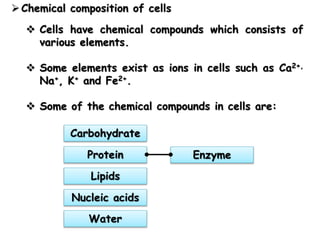
 Cells have chemical compounds which consists of
various elements.
 Some elements exist as ions in cells such as Ca2+,
Na+, K+ and Fe2+.
 Some of the chemical compounds in cells are:
Carbohydrate
Protein
Lipids
Nucleic acids
Water
Enzyme
 Chemical composition of cells
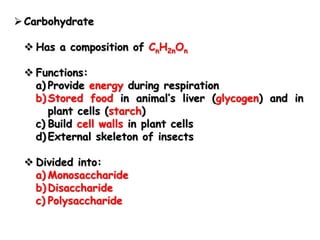
 Carbohydrate
 Has a composition of CnH2nOn
 Functions:
a) Provide energy during respiration
b) Stored food in animal’s liver (glycogen) and in
plant cells (starch)
c) Build cell walls in plant cells
d) External skeleton of insects
 Divided into:
a) Monosaccharide
b) Disaccharide
c) Polysaccharide
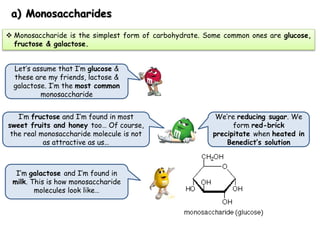
 Monosaccharide is the simplest form of carbohydrate. Some common ones are glucose,
fructose & galactose.
Let’s assume that I’m glucose &
these are my friends, lactose &
galactose. I’m the most common
monosaccharide
I’m fructose and I’m found in most
sweet fruits and honey too… Of course,
the real monosaccharide molecule is not
as attractive as us…
I’m galactose and I’m found in
milk. This is how monosaccharide
molecules look like…
We’re reducing sugar. We
form red-brick
precipitate when heated in
Benedict’s solution
a) Monosaccharides
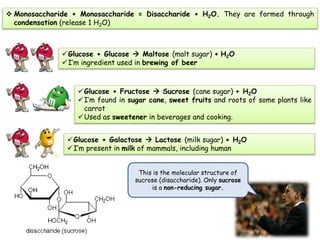
 Monosaccharide + Monosaccharide = Disaccharide + H2O. They are formed through
condensation (release 1 H2O)
Glucose + Glucose  Maltose (malt sugar) + H2O
I’m ingredient used in brewing of beer
Glucose + Fructose  Sucrose (cane sugar) + H2O
I’m found in sugar cane, sweet fruits and roots of some plants like
carrot
Used as sweetener in beverages and cooking.
Glucose + Galactose  Lactose (milk sugar) + H2O
I’m present in milk of mammals, including human
This is the molecular structure of
sucrose (disaccharide). Only sucrose
is a non-reducing sugar.
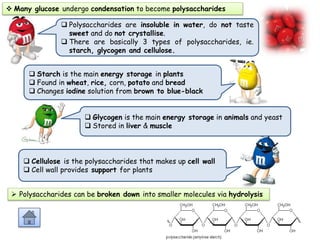
 Cellulose is the polysaccharides that makes up cell wall
 Cell wall provides support for plants
 Many glucose undergo condensation to become polysaccharides
 Polysaccharides are insoluble in water, do not taste
sweet and do not crystallise.
 There are basically 3 types of polysaccharides, ie.
starch, glycogen and cellulose.
 Starch is the main energy storage in plants
 Found in wheat, rice, corn, potato and bread
 Changes iodine solution from brown to blue-black
 Glycogen is the main energy storage in animals and yeast
 Stored in liver & muscle
 Polysaccharides can be broken down into smaller molecules via hydrolysis
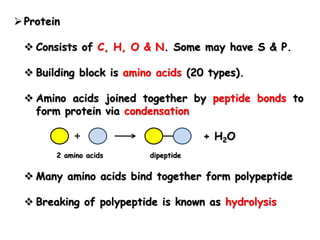
 Protein
 Consists of C, H, O & N. Some may have S & P.
 Building block is amino acids (20 types).
 Amino acids joined together by peptide bonds to
form protein via condensation
2 amino acids dipeptide
+ H2O
 Many amino acids bind together form polypeptide
 Breaking of polypeptide is known as hydrolysis
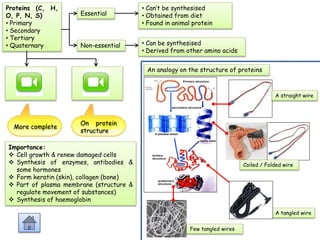
Proteins (C, H,
O, P, N, S)
• Primary
• Secondary
• Tertiary
• Quaternary
Importance:
 Cell growth & renew damaged cells
 Synthesis of enzymes, antibodies &
some hormones
 Form keratin (skin), collagen (bone)
 Part of plasma membrane (structure &
regulate movement of substances)
 Synthesis of haemoglobin
Essential
Non-essential
• Can’t be synthesised
• Obtained from diet
• Found in animal protein
• Can be synthesised
• Derived from other amino acids
An analogy on the structure of proteins
A straight wire
Coiled / Folded wire
A tangled wire
Few tangled wires
More complete
On protein
structure
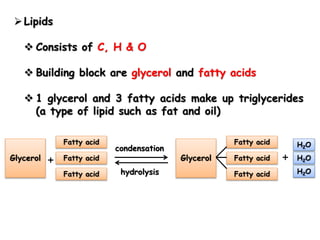
 Lipids
 Consists of C, H & O
 Building block are glycerol and fatty acids
 1 glycerol and 3 fatty acids make up triglycerides
(a type of lipid such as fat and oil)
Glycerol
Fatty acid
Fatty acid
Fatty acid
Glycerol
Fatty acid
Fatty acid
Fatty acid
H2O
H2O
H2O
condensation
hydrolysis
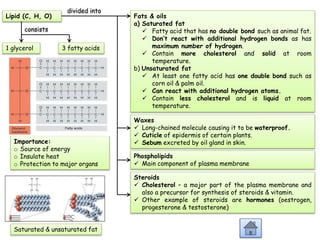
Lipid (C, H, O)
Importance:
o Source of energy
o Insulate heat
o Protection to major organs
1 glycerol 3 fatty acids
consists
Fats & oils
a) Saturated fat
 Fatty acid that has no double bond such as animal fat.
 Don’t react with additional hydrogen bonds as has
maximum number of hydrogen.
 Contain more cholesterol and solid at room
temperature.
b) Unsaturated fat
 At least one fatty acid has one double bond such as
corn oil & palm oil.
 Can react with additional hydrogen atoms.
 Contain less cholesterol and is liquid at room
temperature.
divided into
Waxes
 Long-chained molecule causing it to be waterproof.
 Cuticle of epidermis of certain plants.
 Sebum excreted by oil gland in skin.
Phospholipids
 Main component of plasma membrane
Steroids
 Cholesterol – a mojor part of the plasma membrane and
also a precursor for synthesis of steroids & vitamin.
 Other example of steroids are hormones (oestrogen,
progesterone & testosterone)
Saturated & unsaturated fat
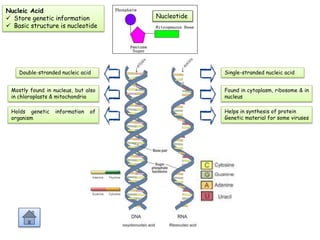
Nucleotide
Nucleic Acid
 Store genetic information
 Basic structure is nucleotide
Double-stranded nucleic acid Single-stranded nucleic acid
Mostly found in nucleus, but also
in chloroplasts & mitochondria
Found in cytoplasm, ribosome & in
nucleus
Holds genetic information of
organism
Helps in synthesis of protein
Genetic material for some viruses
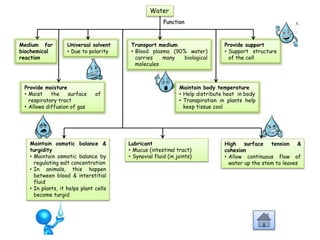
Water
Function
Medium for
biochemical
reaction
Universal solvent
• Due to polarity
Transport medium
• Blood plasma (90% water)
carries many biological
molecules
Maintain osmotic balance &
turgidity
• Maintain osmotic balance by
regulating salt concentration
• In animals, this happen
between blood & interstitial
fluid
• In plants, it helps plant cells
become turgid
Provide support
• Support structure
of the cell
Provide moisture
• Moist the surface of
respiratory tract
• Allows diffusion of gas
Maintain body temperature
• Help distribute heat in body
• Transpiration in plants help
keep tissue cool
High surface tension &
cohesion
• Allow continuous flow of
water up the stem to leaves
Lubricant
• Mucus (intestinal tract)
• Synovial fluid (in joints)
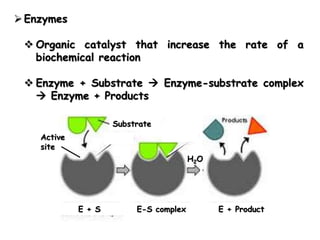
 Enzymes
 Organic catalyst that increase the rate of a
biochemical reaction
 Enzyme + Substrate  Enzyme-substrate complex
 Enzyme + Products
Substrate
Active
site
H2O
E + S E-S complex E + Product
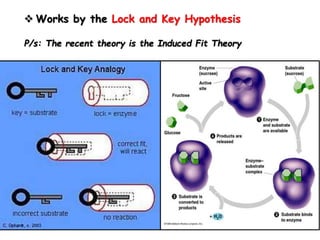
 Works by the Lock and Key Hypothesis
P/s: The recent theory is the Induced Fit Theory
 Characteristics:
a) Speed up biochemical reactions
b) Not changed or destroyed after reaction
c) Needed in a very small amount
d) Reversible reaction
e) Work within narrow range of temperature (350C
– 400C)
f) Sensitive to pH. Has their own optimal pH range
 Naming of enzyme:
a) Add suffix –ase to the substrate. Eg: Maltose
(maltase), sucrose (sucrase) etc.
b) Some enzymes’ name are fixed. Eg: Trypsin,
renin, pepsin etc.
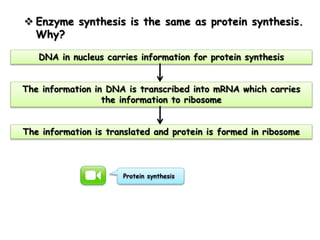
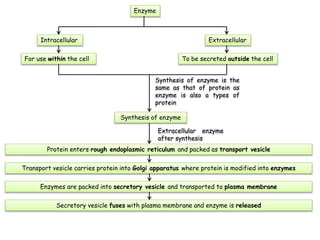
 Enzyme synthesis is the same as protein synthesis.
Why?
DNA in nucleus carries information for protein synthesis
The information in DNA is transcribed into mRNA which carries
the information to ribosome
The information is translated and protein is formed in ribosome
Protein synthesis
Enzyme
Intracellular Extracellular
For use within the cell To be secreted outside the cell
Synthesis of enzyme
Extracellular enzyme
after synthesis
Synthesis of enzyme is the
same as that of protein as
enzyme is also a types of
protein
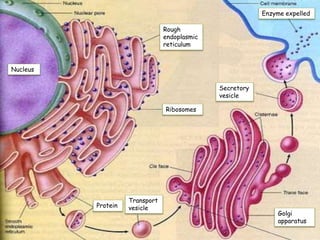
Protein enters rough endoplasmic reticulum and packed as transport vesicle
Transport vesicle carries protein into Golgi apparatus where protein is modified into enzymes
Enzymes are packed into secretory vesicle and transported to plasma membrane
Secretory vesicle fuses with plasma membrane and enzyme is released
Protein
Transport
vesicle
Rough
endoplasmic
reticulum
Nucleus
Ribosomes
Golgi
apparatus
Enzyme expelled
Secretory
vesicle
Enzyme
denature
Enzyme
inactive
Optimum temperature
Optimum pH
Excess H+ /
OH- changes
the shape of
active site
Limiting value Limiting value
Enzyme concentration
d) Enzyme concentration
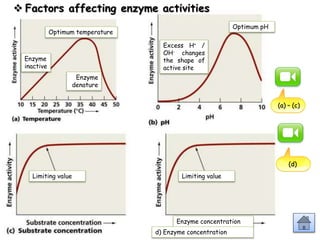
 Factors affecting enzyme activities
(a) – (c)
(d)
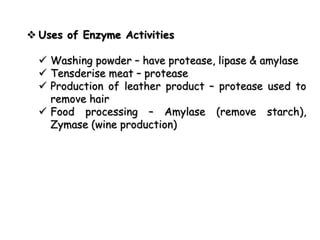
 Uses of Enzyme Activities
 Washing powder – have protease, lipase & amylase
 Tensderise meat – protease
 Production of leather product – protease used to
remove hair
 Food processing – Amylase (remove starch),
Zymase (wine production)

Chap 4

  • 2.
     Cells havechemical compounds which consists of various elements.  Some elements exist as ions in cells such as Ca2+, Na+, K+ and Fe2+.  Some of the chemical compounds in cells are: Carbohydrate Protein Lipids Nucleic acids Water Enzyme  Chemical composition of cells
  • 3.
     Carbohydrate  Hasa composition of CnH2nOn  Functions: a) Provide energy during respiration b) Stored food in animal’s liver (glycogen) and in plant cells (starch) c) Build cell walls in plant cells d) External skeleton of insects  Divided into: a) Monosaccharide b) Disaccharide c) Polysaccharide
  • 4.
     Monosaccharide isthe simplest form of carbohydrate. Some common ones are glucose, fructose & galactose. Let’s assume that I’m glucose & these are my friends, lactose & galactose. I’m the most common monosaccharide I’m fructose and I’m found in most sweet fruits and honey too… Of course, the real monosaccharide molecule is not as attractive as us… I’m galactose and I’m found in milk. This is how monosaccharide molecules look like… We’re reducing sugar. We form red-brick precipitate when heated in Benedict’s solution a) Monosaccharides
  • 5.
     Monosaccharide +Monosaccharide = Disaccharide + H2O. They are formed through condensation (release 1 H2O) Glucose + Glucose  Maltose (malt sugar) + H2O I’m ingredient used in brewing of beer Glucose + Fructose  Sucrose (cane sugar) + H2O I’m found in sugar cane, sweet fruits and roots of some plants like carrot Used as sweetener in beverages and cooking. Glucose + Galactose  Lactose (milk sugar) + H2O I’m present in milk of mammals, including human This is the molecular structure of sucrose (disaccharide). Only sucrose is a non-reducing sugar.
  • 6.
     Cellulose isthe polysaccharides that makes up cell wall  Cell wall provides support for plants  Many glucose undergo condensation to become polysaccharides  Polysaccharides are insoluble in water, do not taste sweet and do not crystallise.  There are basically 3 types of polysaccharides, ie. starch, glycogen and cellulose.  Starch is the main energy storage in plants  Found in wheat, rice, corn, potato and bread  Changes iodine solution from brown to blue-black  Glycogen is the main energy storage in animals and yeast  Stored in liver & muscle  Polysaccharides can be broken down into smaller molecules via hydrolysis
  • 7.
     Protein  Consistsof C, H, O & N. Some may have S & P.  Building block is amino acids (20 types).  Amino acids joined together by peptide bonds to form protein via condensation 2 amino acids dipeptide + H2O  Many amino acids bind together form polypeptide  Breaking of polypeptide is known as hydrolysis
  • 8.
    Proteins (C, H, O,P, N, S) • Primary • Secondary • Tertiary • Quaternary Importance:  Cell growth & renew damaged cells  Synthesis of enzymes, antibodies & some hormones  Form keratin (skin), collagen (bone)  Part of plasma membrane (structure & regulate movement of substances)  Synthesis of haemoglobin Essential Non-essential • Can’t be synthesised • Obtained from diet • Found in animal protein • Can be synthesised • Derived from other amino acids An analogy on the structure of proteins A straight wire Coiled / Folded wire A tangled wire Few tangled wires More complete On protein structure
  • 9.
     Lipids  Consistsof C, H & O  Building block are glycerol and fatty acids  1 glycerol and 3 fatty acids make up triglycerides (a type of lipid such as fat and oil) Glycerol Fatty acid Fatty acid Fatty acid Glycerol Fatty acid Fatty acid Fatty acid H2O H2O H2O condensation hydrolysis
  • 10.
    Lipid (C, H,O) Importance: o Source of energy o Insulate heat o Protection to major organs 1 glycerol 3 fatty acids consists Fats & oils a) Saturated fat  Fatty acid that has no double bond such as animal fat.  Don’t react with additional hydrogen bonds as has maximum number of hydrogen.  Contain more cholesterol and solid at room temperature. b) Unsaturated fat  At least one fatty acid has one double bond such as corn oil & palm oil.  Can react with additional hydrogen atoms.  Contain less cholesterol and is liquid at room temperature. divided into Waxes  Long-chained molecule causing it to be waterproof.  Cuticle of epidermis of certain plants.  Sebum excreted by oil gland in skin. Phospholipids  Main component of plasma membrane Steroids  Cholesterol – a mojor part of the plasma membrane and also a precursor for synthesis of steroids & vitamin.  Other example of steroids are hormones (oestrogen, progesterone & testosterone) Saturated & unsaturated fat
  • 11.
    Nucleotide Nucleic Acid  Storegenetic information  Basic structure is nucleotide Double-stranded nucleic acid Single-stranded nucleic acid Mostly found in nucleus, but also in chloroplasts & mitochondria Found in cytoplasm, ribosome & in nucleus Holds genetic information of organism Helps in synthesis of protein Genetic material for some viruses
  • 12.
    Water Function Medium for biochemical reaction Universal solvent •Due to polarity Transport medium • Blood plasma (90% water) carries many biological molecules Maintain osmotic balance & turgidity • Maintain osmotic balance by regulating salt concentration • In animals, this happen between blood & interstitial fluid • In plants, it helps plant cells become turgid Provide support • Support structure of the cell Provide moisture • Moist the surface of respiratory tract • Allows diffusion of gas Maintain body temperature • Help distribute heat in body • Transpiration in plants help keep tissue cool High surface tension & cohesion • Allow continuous flow of water up the stem to leaves Lubricant • Mucus (intestinal tract) • Synovial fluid (in joints)
  • 13.
     Enzymes  Organiccatalyst that increase the rate of a biochemical reaction  Enzyme + Substrate  Enzyme-substrate complex  Enzyme + Products Substrate Active site H2O E + S E-S complex E + Product
  • 14.
     Works bythe Lock and Key Hypothesis P/s: The recent theory is the Induced Fit Theory
  • 15.
     Characteristics: a) Speedup biochemical reactions b) Not changed or destroyed after reaction c) Needed in a very small amount d) Reversible reaction e) Work within narrow range of temperature (350C – 400C) f) Sensitive to pH. Has their own optimal pH range  Naming of enzyme: a) Add suffix –ase to the substrate. Eg: Maltose (maltase), sucrose (sucrase) etc. b) Some enzymes’ name are fixed. Eg: Trypsin, renin, pepsin etc.
  • 16.
     Enzyme synthesisis the same as protein synthesis. Why? DNA in nucleus carries information for protein synthesis The information in DNA is transcribed into mRNA which carries the information to ribosome The information is translated and protein is formed in ribosome Protein synthesis
  • 17.
    Enzyme Intracellular Extracellular For usewithin the cell To be secreted outside the cell Synthesis of enzyme Extracellular enzyme after synthesis Synthesis of enzyme is the same as that of protein as enzyme is also a types of protein Protein enters rough endoplasmic reticulum and packed as transport vesicle Transport vesicle carries protein into Golgi apparatus where protein is modified into enzymes Enzymes are packed into secretory vesicle and transported to plasma membrane Secretory vesicle fuses with plasma membrane and enzyme is released
  • 18.
  • 19.
    Enzyme denature Enzyme inactive Optimum temperature Optimum pH ExcessH+ / OH- changes the shape of active site Limiting value Limiting value Enzyme concentration d) Enzyme concentration  Factors affecting enzyme activities (a) – (c) (d)
  • 20.
     Uses ofEnzyme Activities  Washing powder – have protease, lipase & amylase  Tensderise meat – protease  Production of leather product – protease used to remove hair  Food processing – Amylase (remove starch), Zymase (wine production)