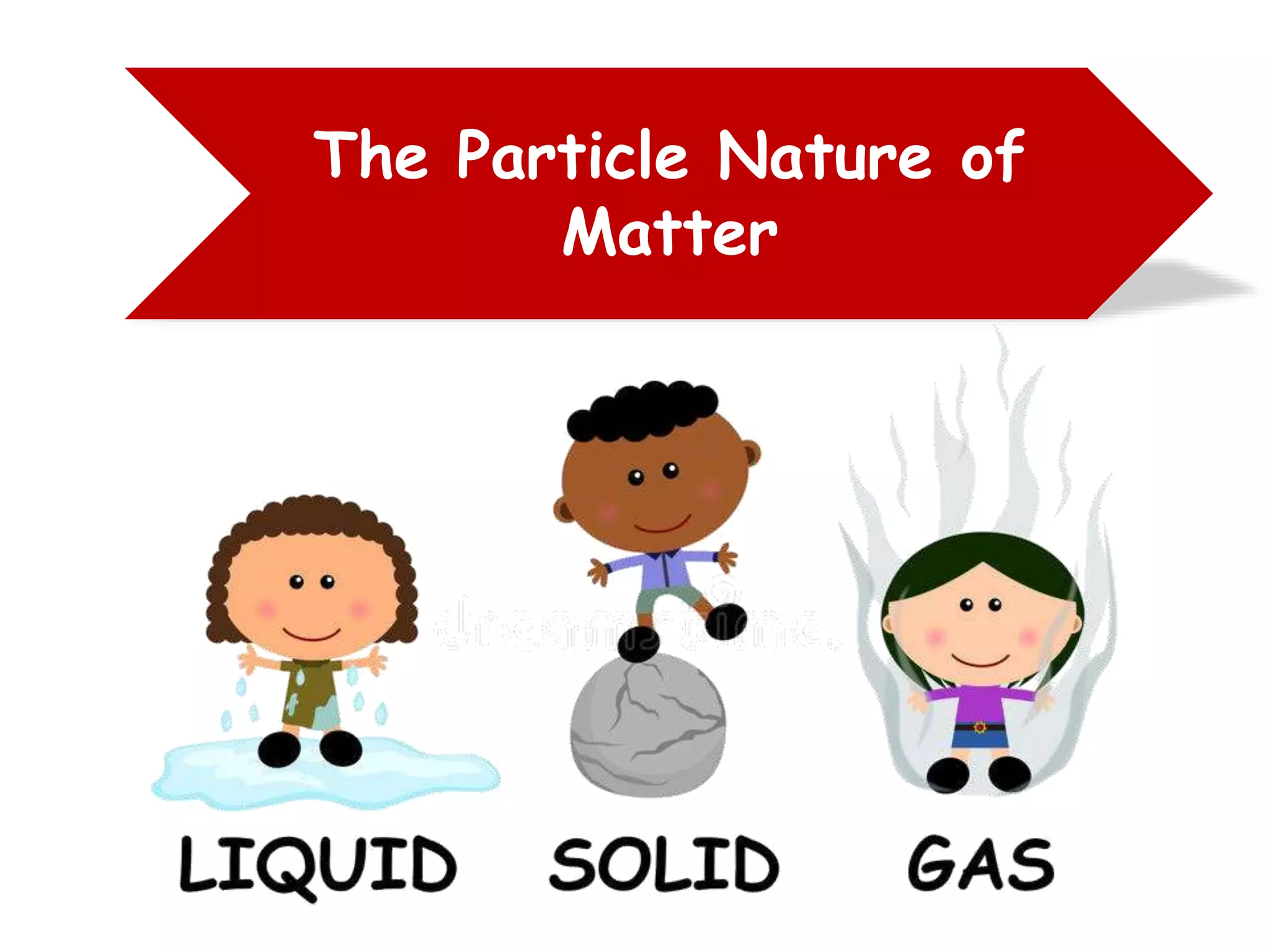

The Particle Nature of
Matter
What is Matter?
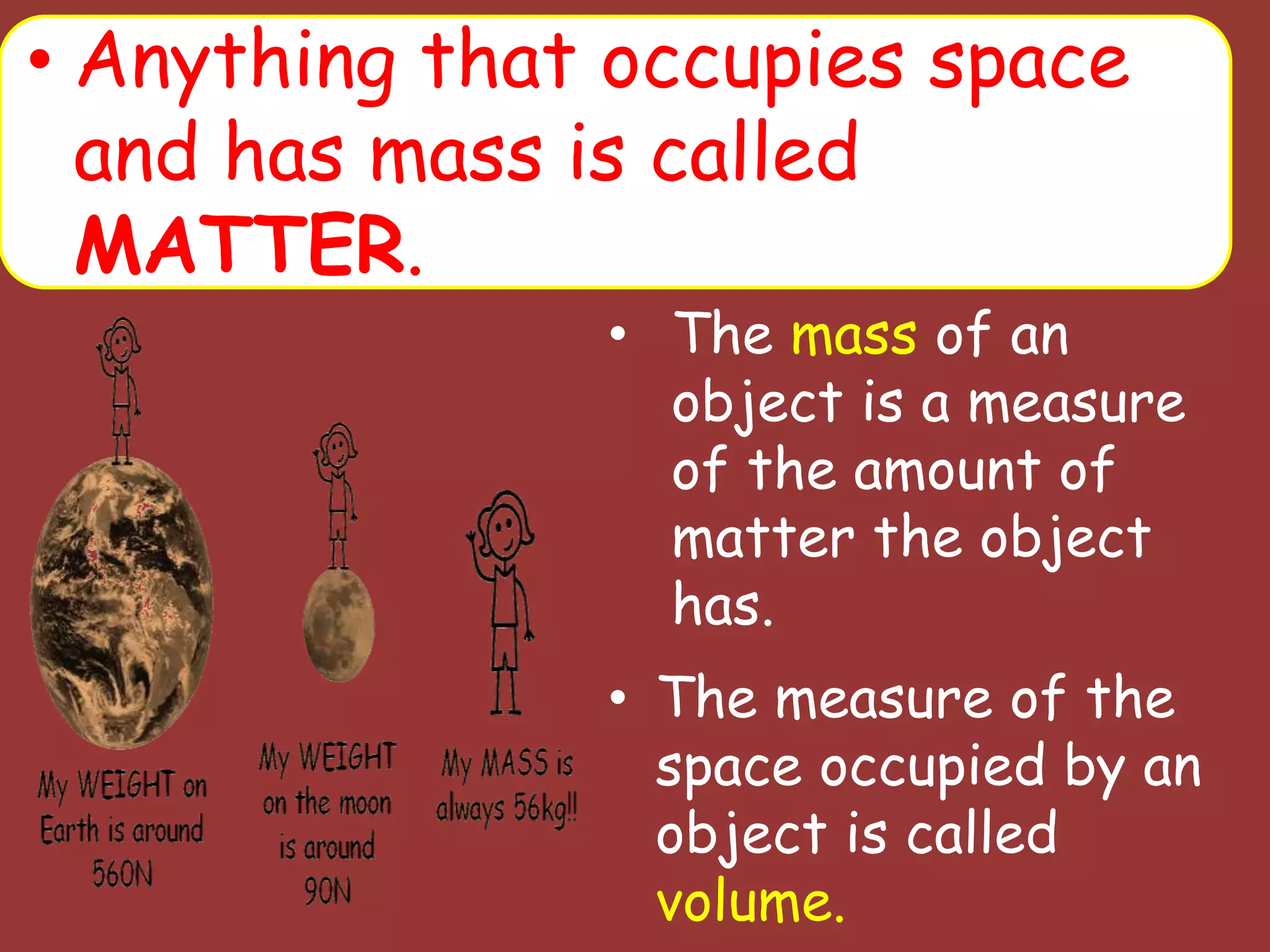
• Anything that occupies space
and has mass is called
MATTER.
• The mass of an
object is a measure
of the amount of
matter the object
has.
• The measure of the
space occupied by an
object is called
volume.
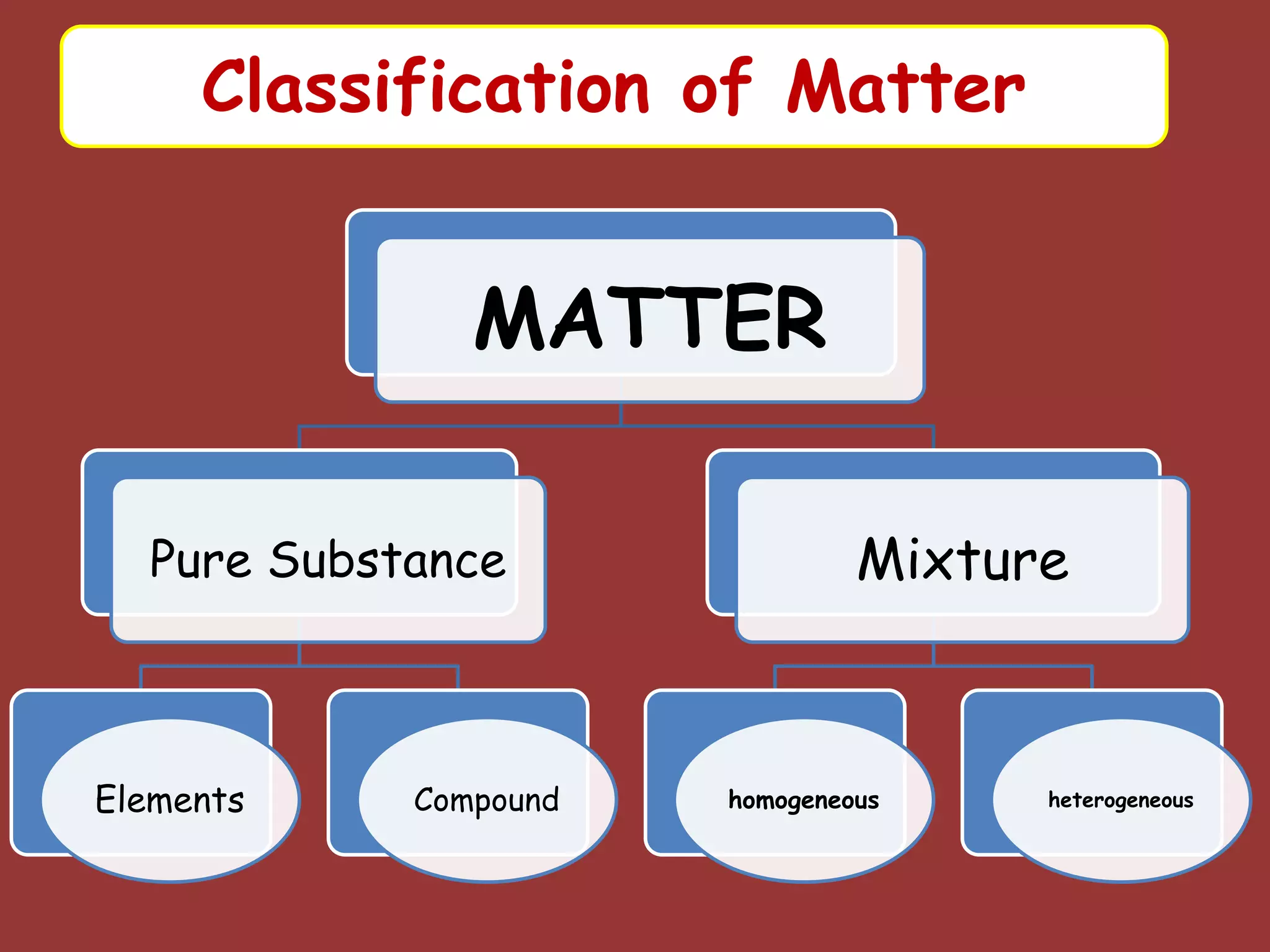
Classification of Matter
MATTER
Pure Substance
Elements Compound
Mixture
homogeneous heterogeneous
WHAT MATTER WAS MADE OF?
• Almost 2,500 years ago, Leucippus and his
disciple, Democritus believed that nature
consisted of two things, “atoms and the void
that surrounds them”
• They believed that “atoms are physically, but
not geometrically, indivisible.”
• Atomos, a Greek word which means indivisible
particle.
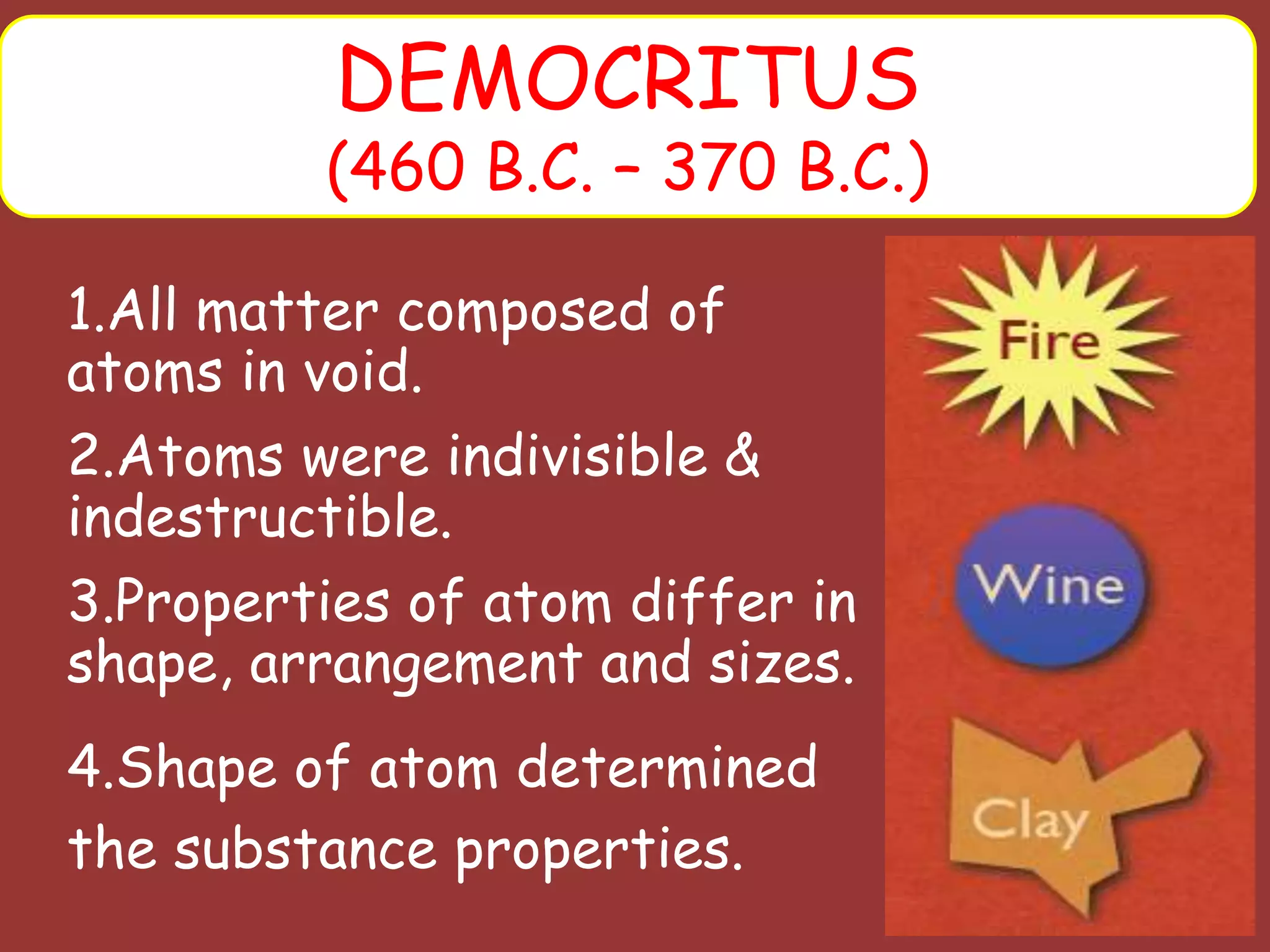
1.All matter composed of
atoms in void.
2.Atoms were indivisible &
indestructible.
3.Properties of atom differ in
shape, arrangement and sizes.
4.Shape of atom determined
the substance properties.
DEMOCRITUS
(460 B.C. – 370 B.C.)
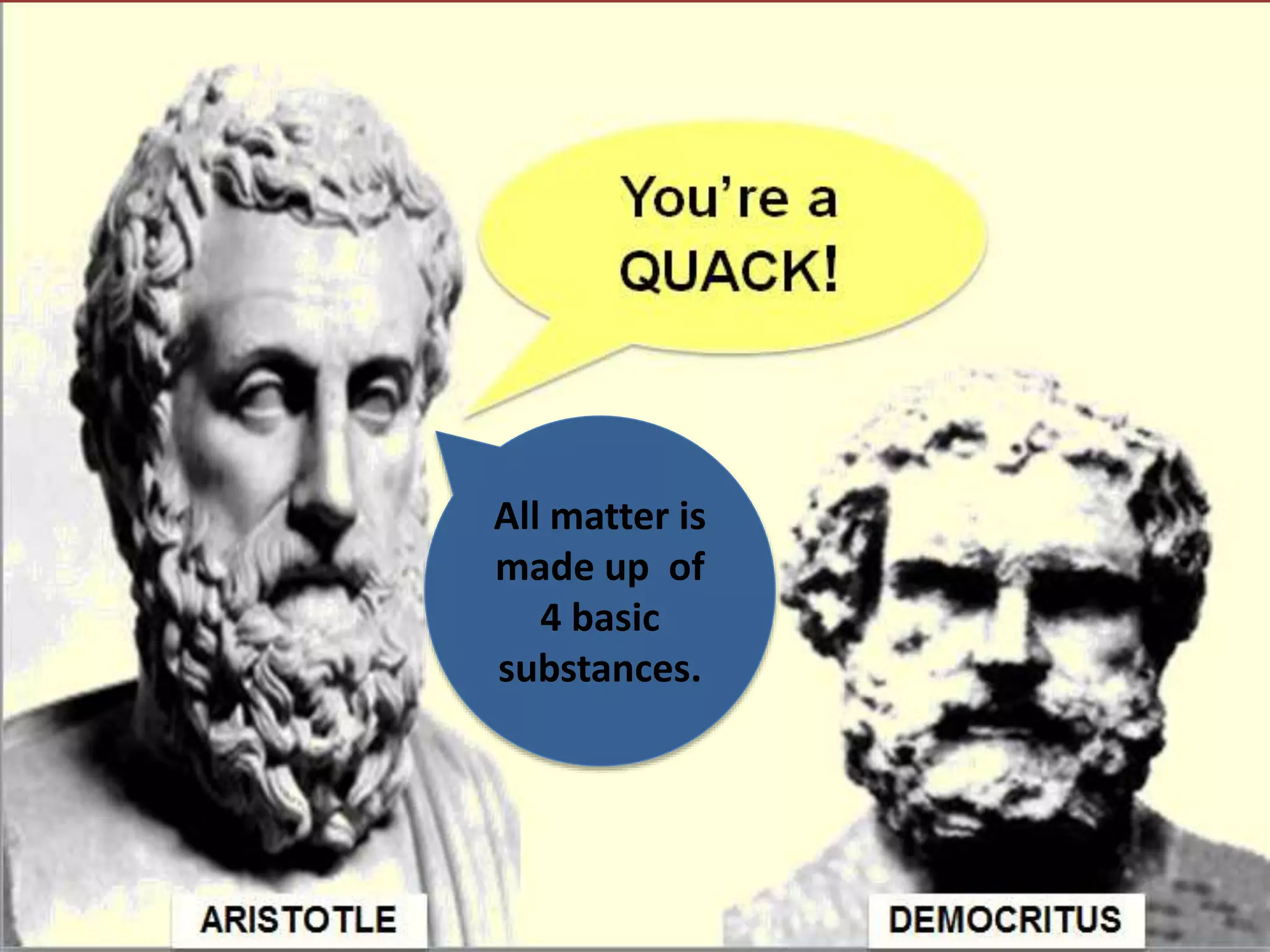
All matter is
made up of
4 basic
substances.
• He developed a theory to explain why the
elements in a compound always join in the
same way.
• He proposed explanations for many of the
known laws describing the behaviour of
matter.
• Dalton’s theory states “All matter is made up
of individual particles called atoms, which
cannot be divided”.
JOHN DALTON
(1766 – 1844)
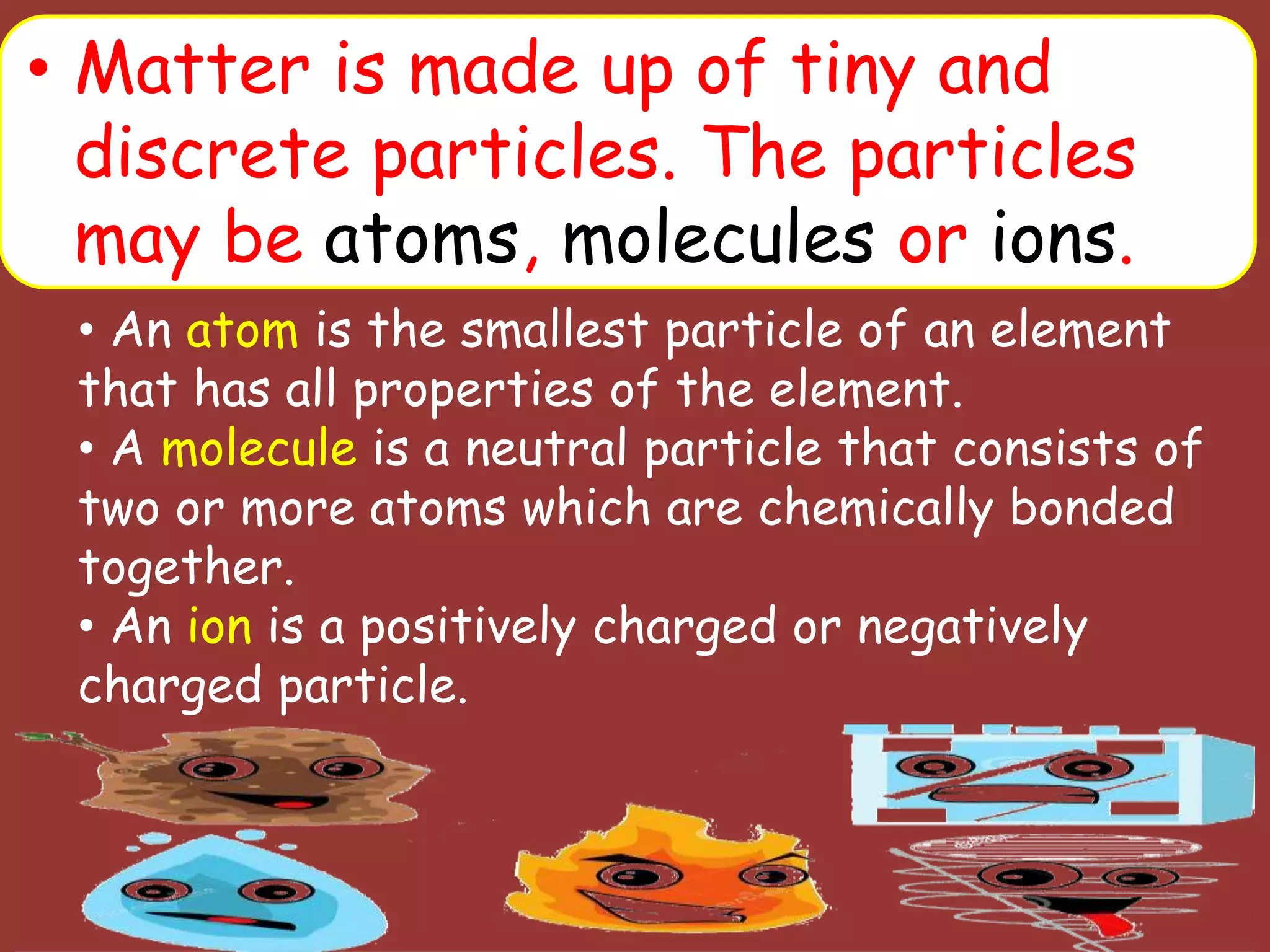
• Matter is made up of tiny and
discrete particles. The particles
may be atoms, molecules or ions.
• An atom is the smallest particle of an element
that has all properties of the element.
• A molecule is a neutral particle that consists of
two or more atoms which are chemically bonded
together.
• An ion is a positively charged or negatively
charged particle.
• Matter is made up of tiny and
discrete particles. The particles
may be atoms, molecules or ions.
• The size of an atom is measured in angstroms.
 One angstrom is a unit of length equal to one
ten millionth of a millimeter.
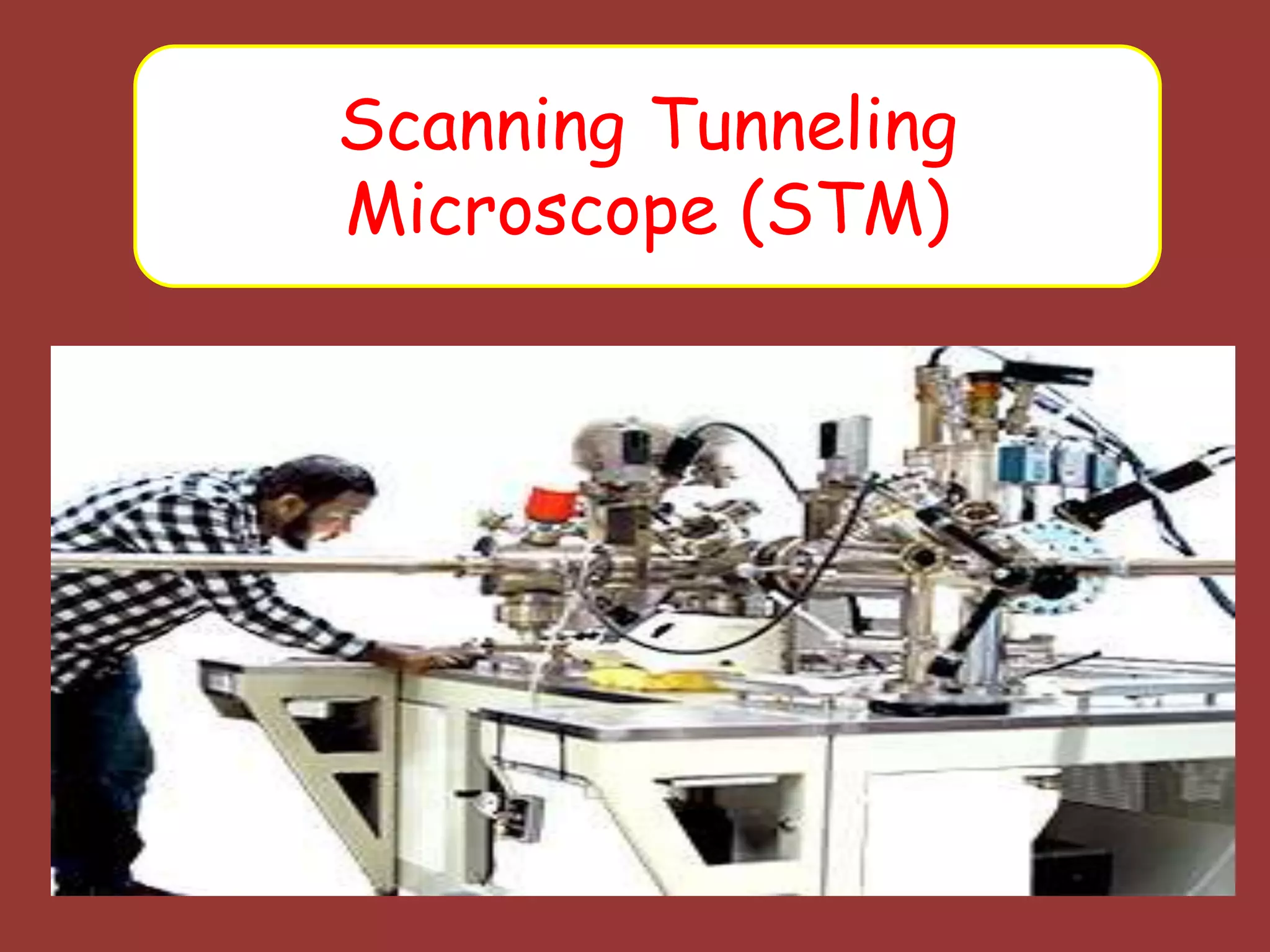
 Scanning Tunneling Microscope (STM) - It can
magnify an image 10 million times. And it
creates a profile of the surface of an atom and
then a computer-generated model or contour
map is produced.
Scanning Tunneling
Microscope (STM)
Characteristics of Particles of
Matter
Everything around us is made up of tiny
pieces or particles. The particles that make
up matter are atoms, ions or molecules
1. The particles of matter are very, very
small.
2. The particles of matter have spaces
between them,
3. The particles of matter are constantly
moving.
4. The particles of matter attract each
other.
Matter can have different
properties
Everything around us is made up of tiny
pieces or particles. The particles that make
up matter are atoms, ions or molecules
1. Hardness
2. Color and texture
3. Malleability
4. Flexibility
5. Conductivity
6. Viscosity
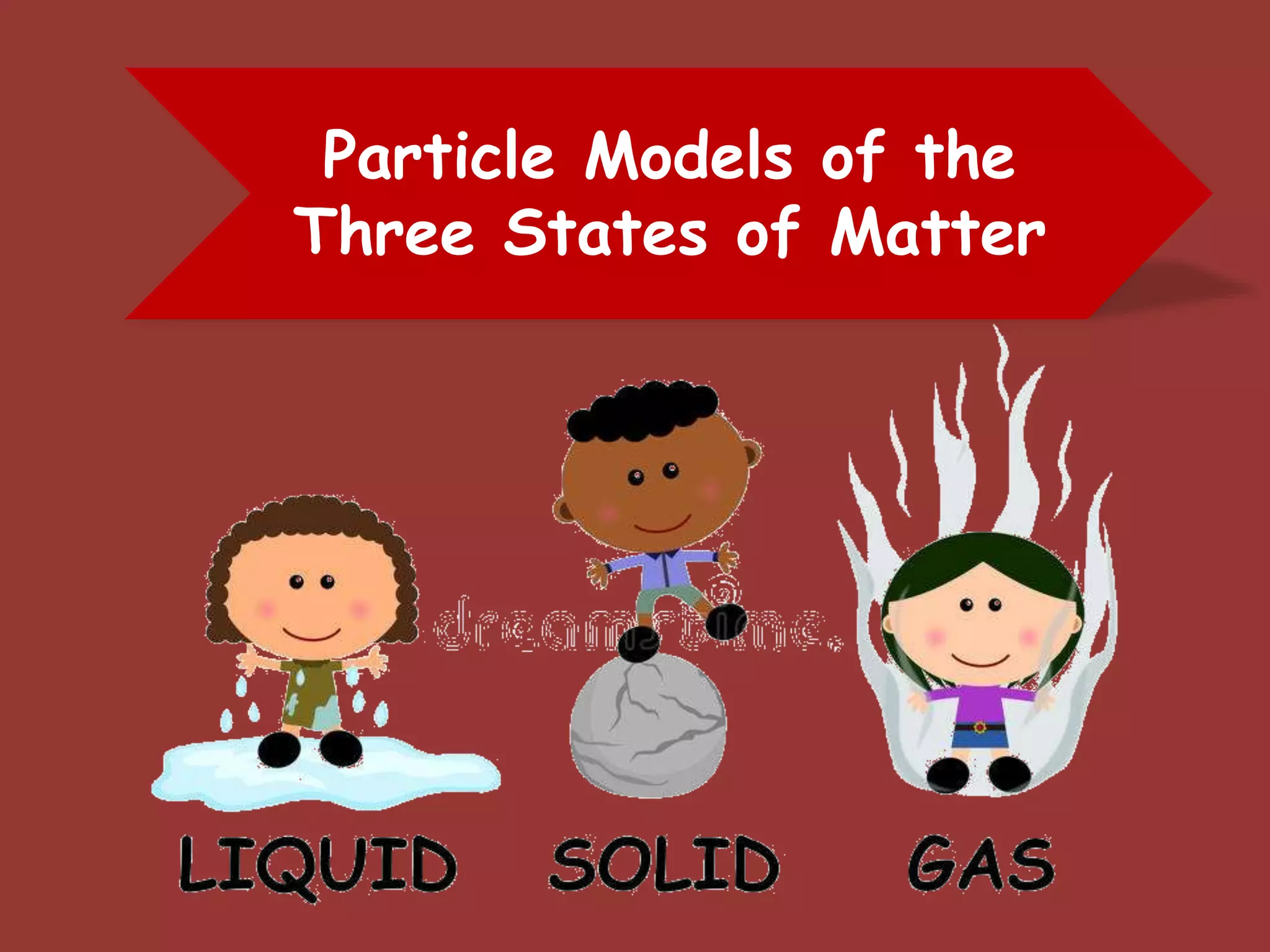
Particle Models of the
Three States of Matter
State of Matter
On the basis of physical states, all
the matter can be classified into
three groups.
1. Solids
2.Liquids
3.Gases
Properties of Solids
1. Solids have a fixed shape and a fixed
volume
2. Solids cannot be compressed much
3. Solids have high densities
4. Solids do not fill their container
completely
5. Solids do not flow
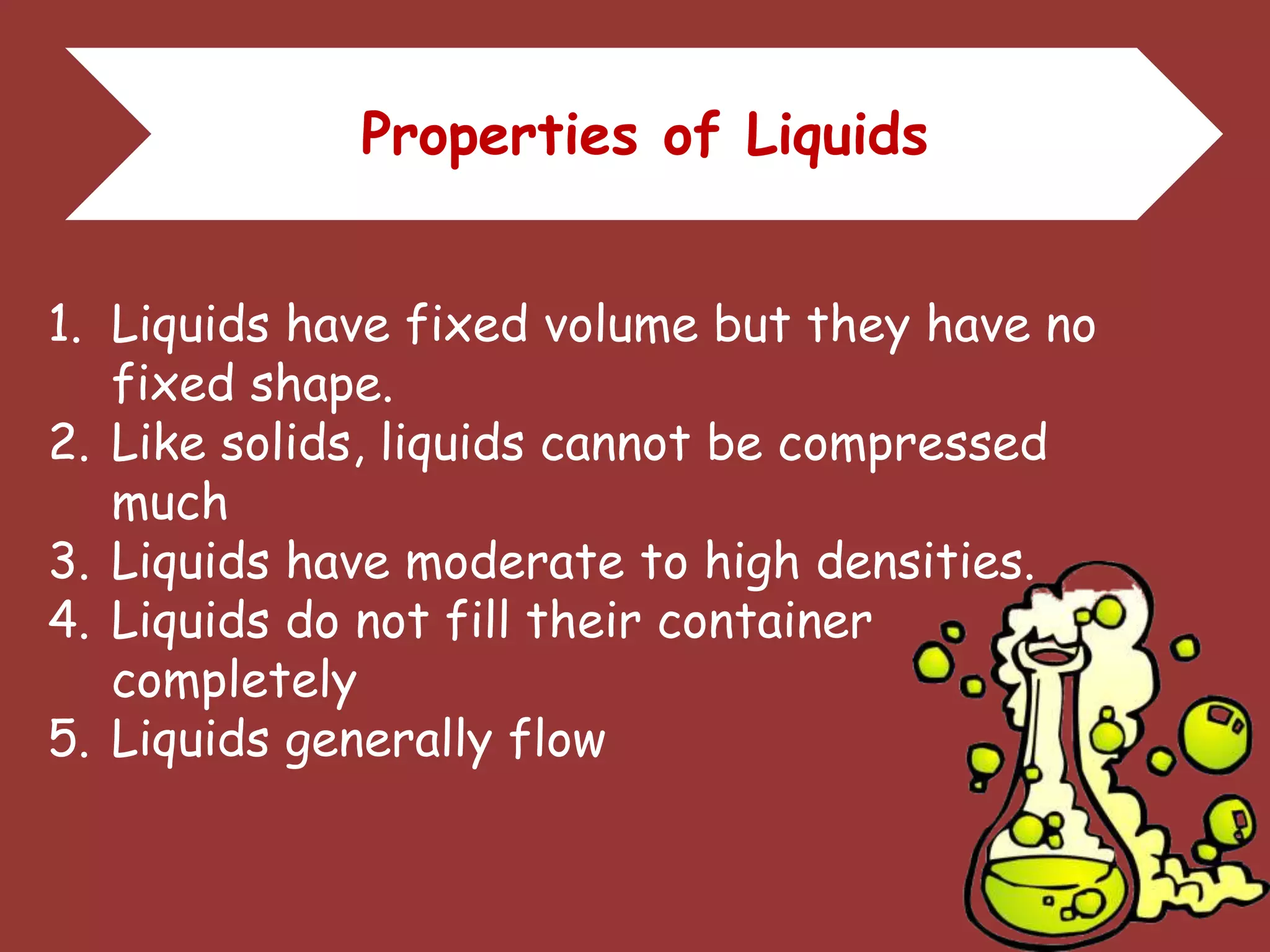
Properties of Liquids
1. Liquids have fixed volume but they have no
fixed shape.
2. Like solids, liquids cannot be compressed
much
3. Liquids have moderate to high densities.
4. Liquids do not fill their container
completely
5. Liquids generally flow
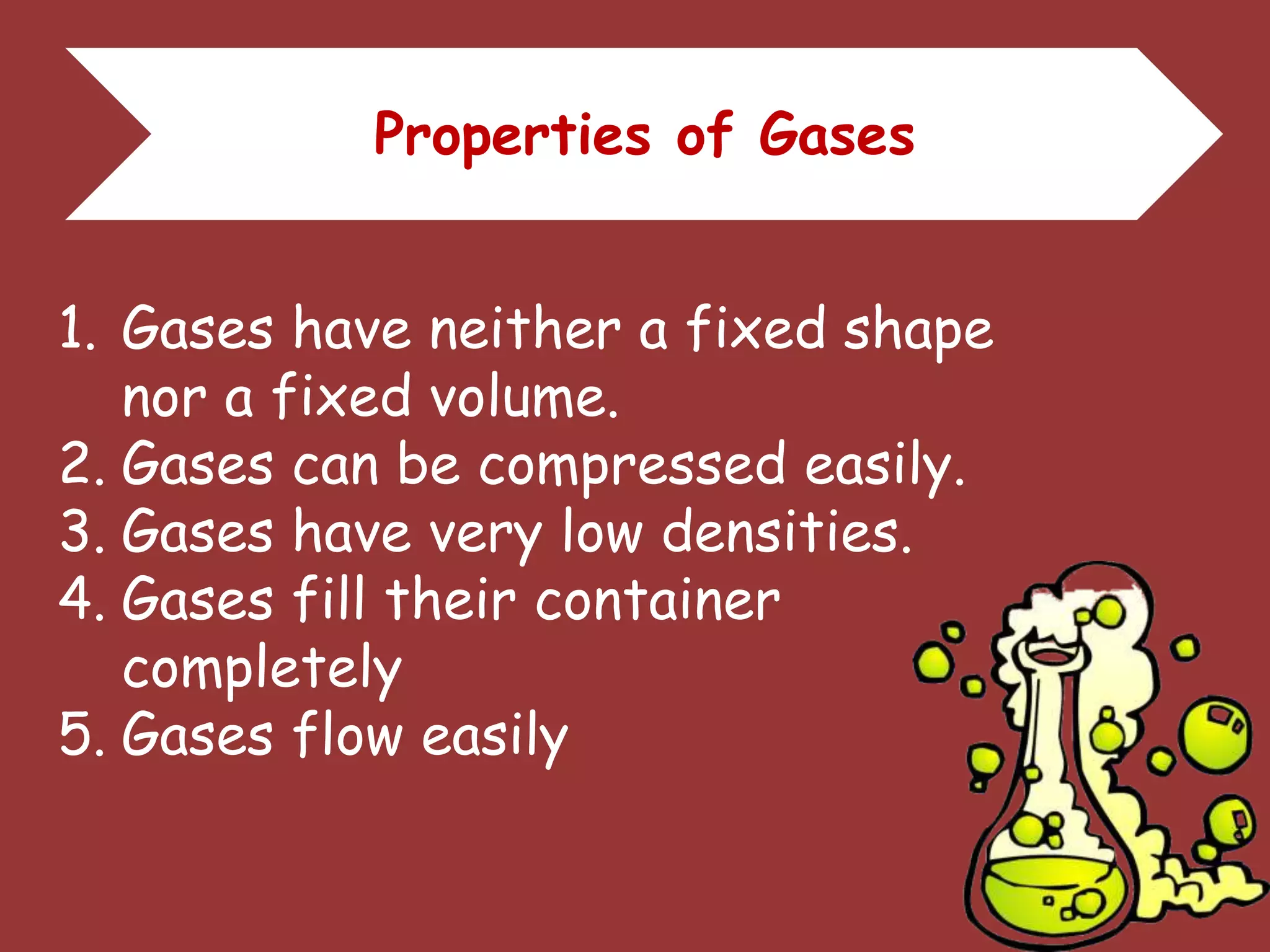
Properties of Gases
1. Gases have neither a fixed shape
nor a fixed volume.
2. Gases can be compressed easily.
3. Gases have very low densities.
4. Gases fill their container
completely
5. Gases flow easily
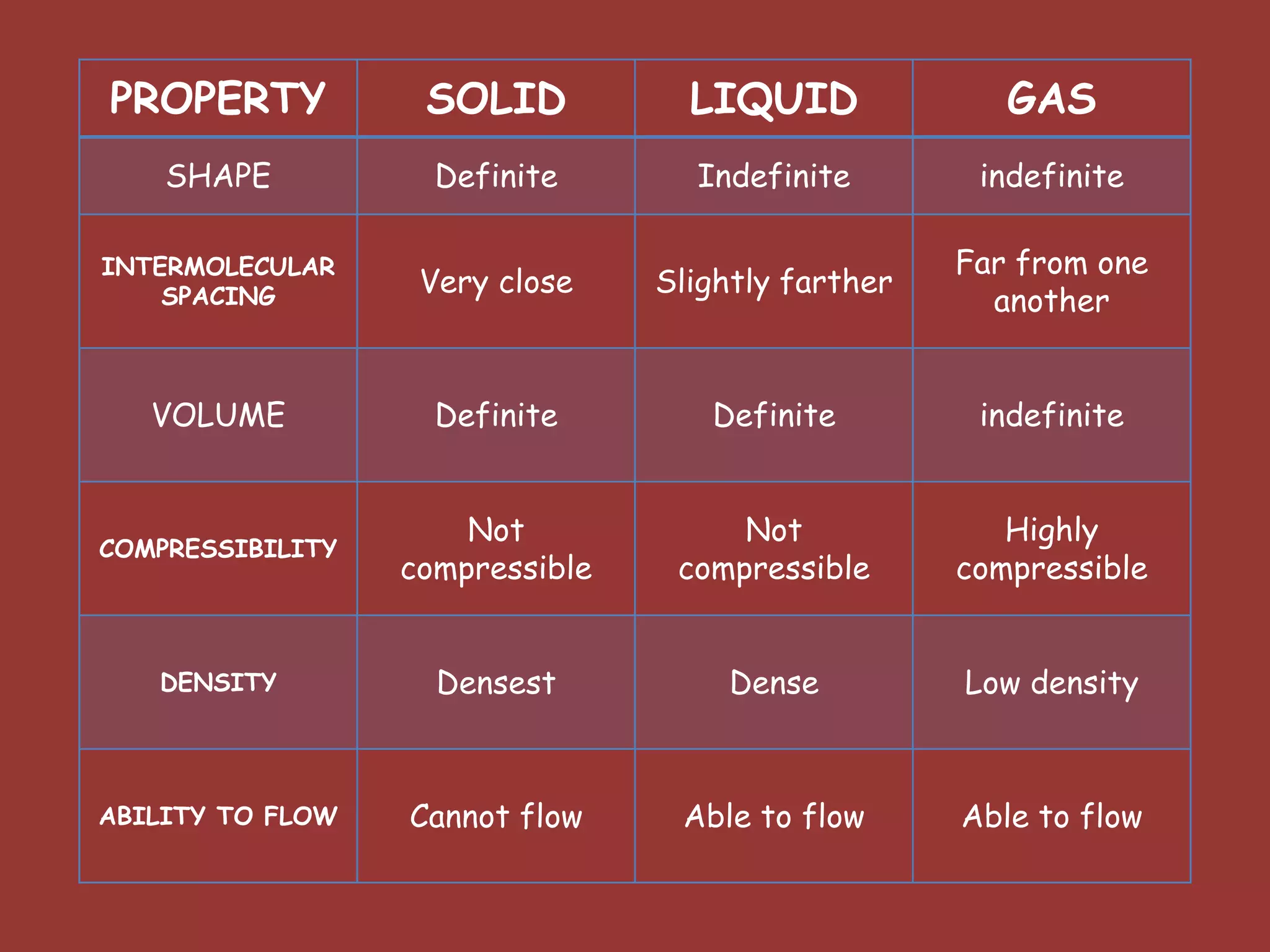
PROPERTY SOLID LIQUID GAS
SHAPE Definite Indefinite indefinite
INTERMOLECULAR
SPACING
Very close Slightly farther
Far from one
another
VOLUME Definite Definite indefinite
COMPRESSIBILITY
Not
compressible
Not
compressible
Highly
compressible
DENSITY Densest Dense Low density
ABILITY TO FLOW Cannot flow Able to flow Able to flow
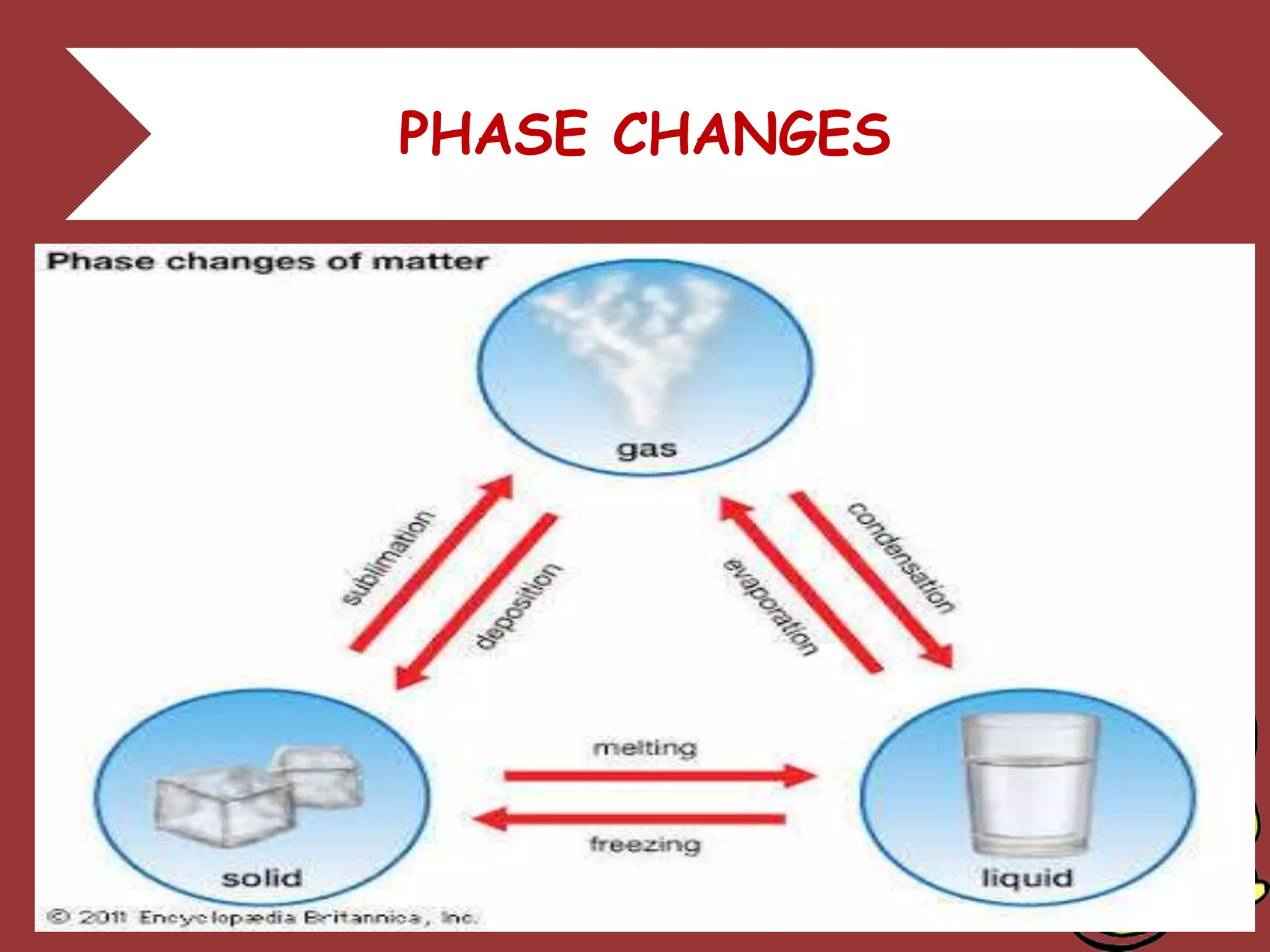
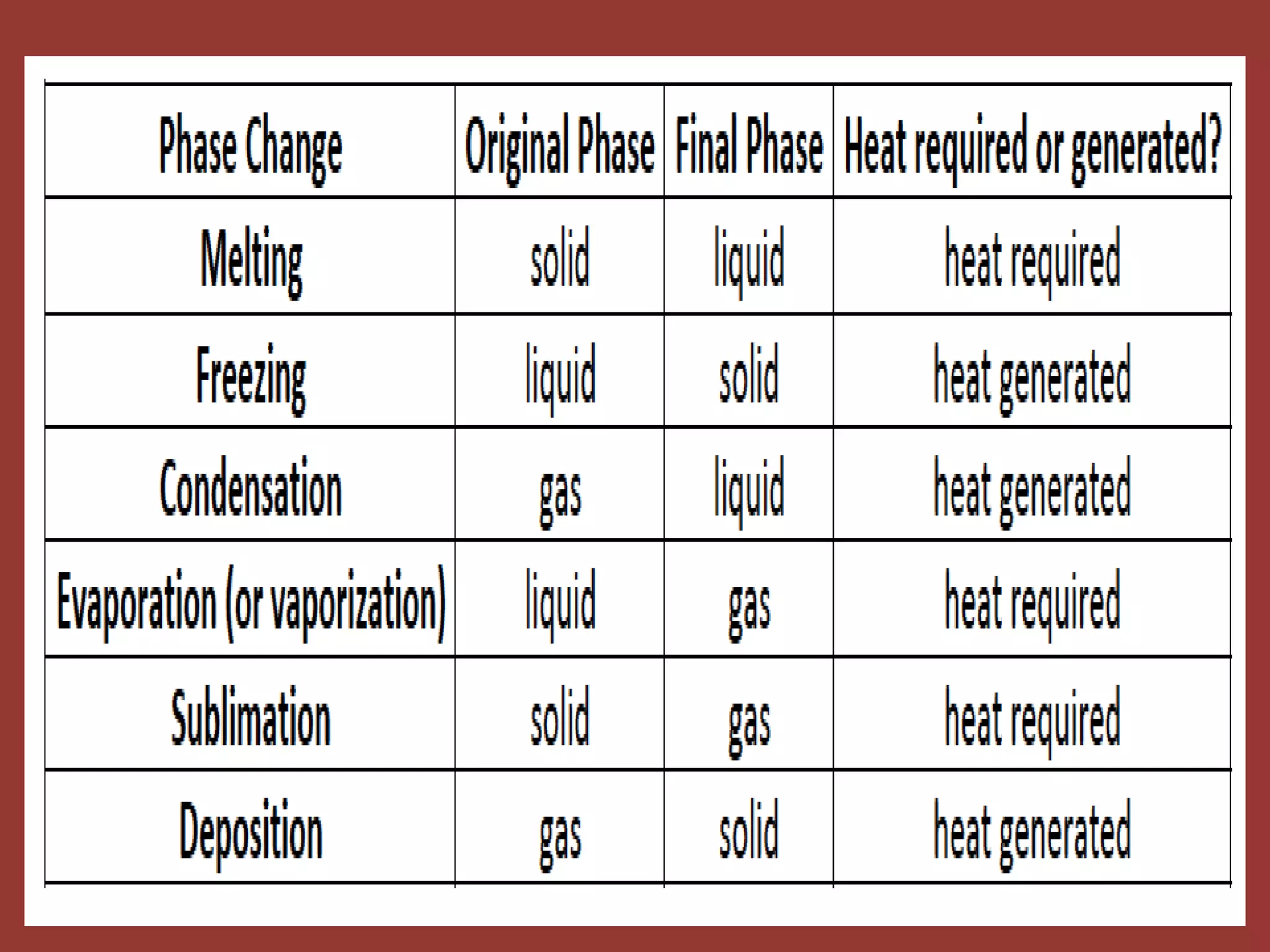
PHASE CHANGES
ACTIVITY 2:
State of Matter
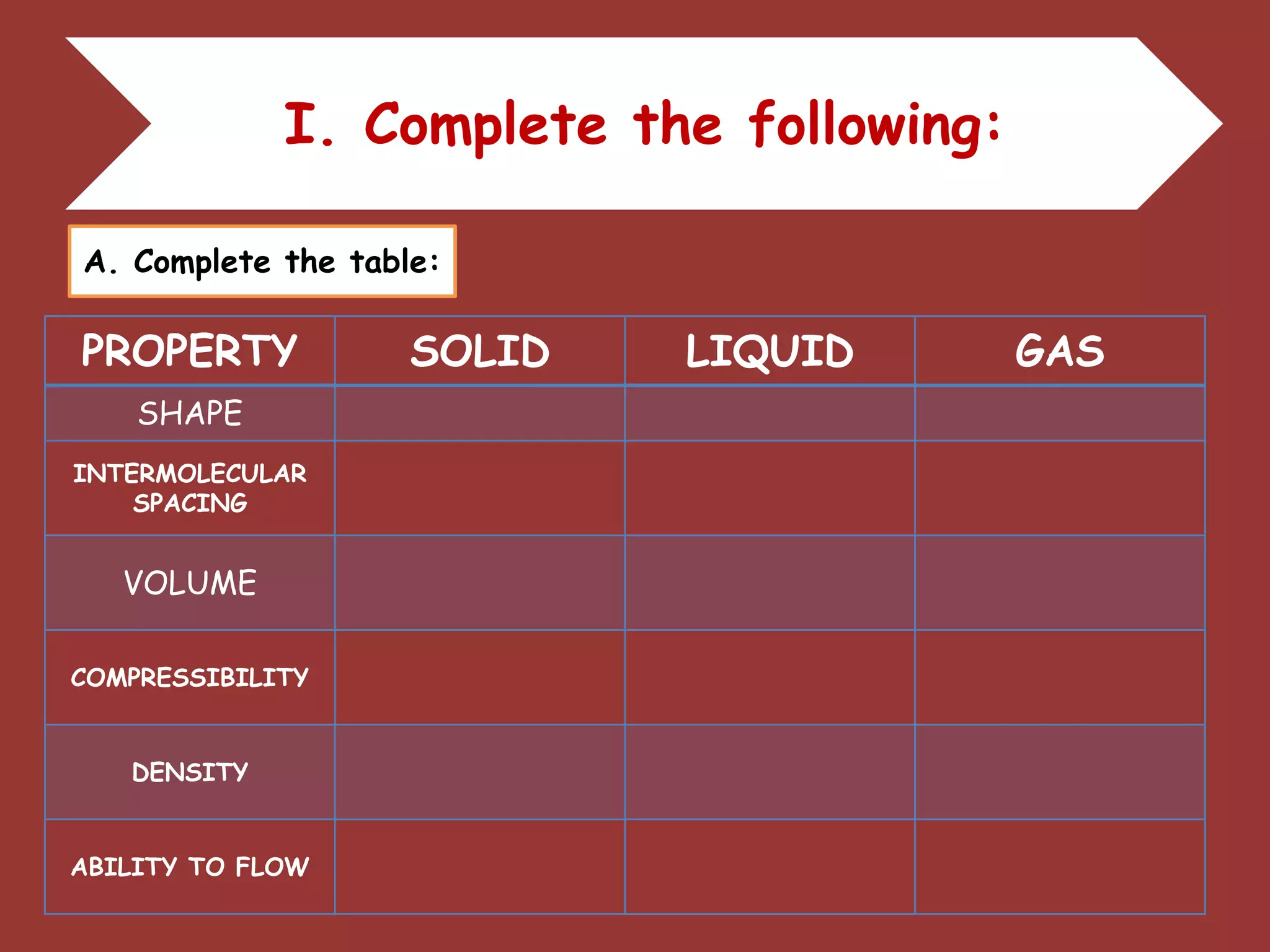
PROPERTY SOLID LIQUID GAS
SHAPE
INTERMOLECULAR
SPACING
VOLUME
COMPRESSIBILITY
DENSITY
ABILITY TO FLOW
I. Complete the following:
A. Complete the table:
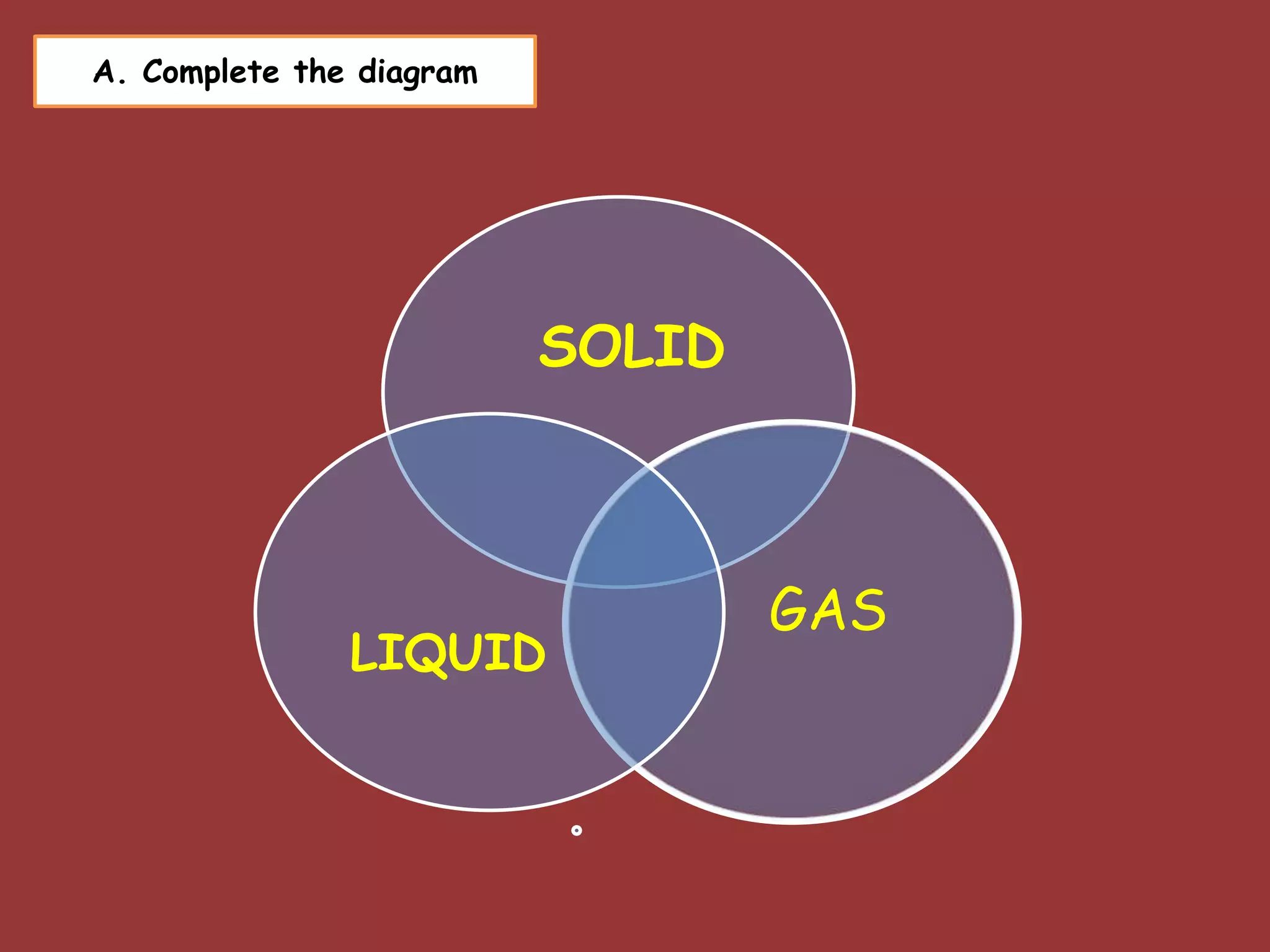
A. Complete the diagram
SOLID
LIQUID
GAS
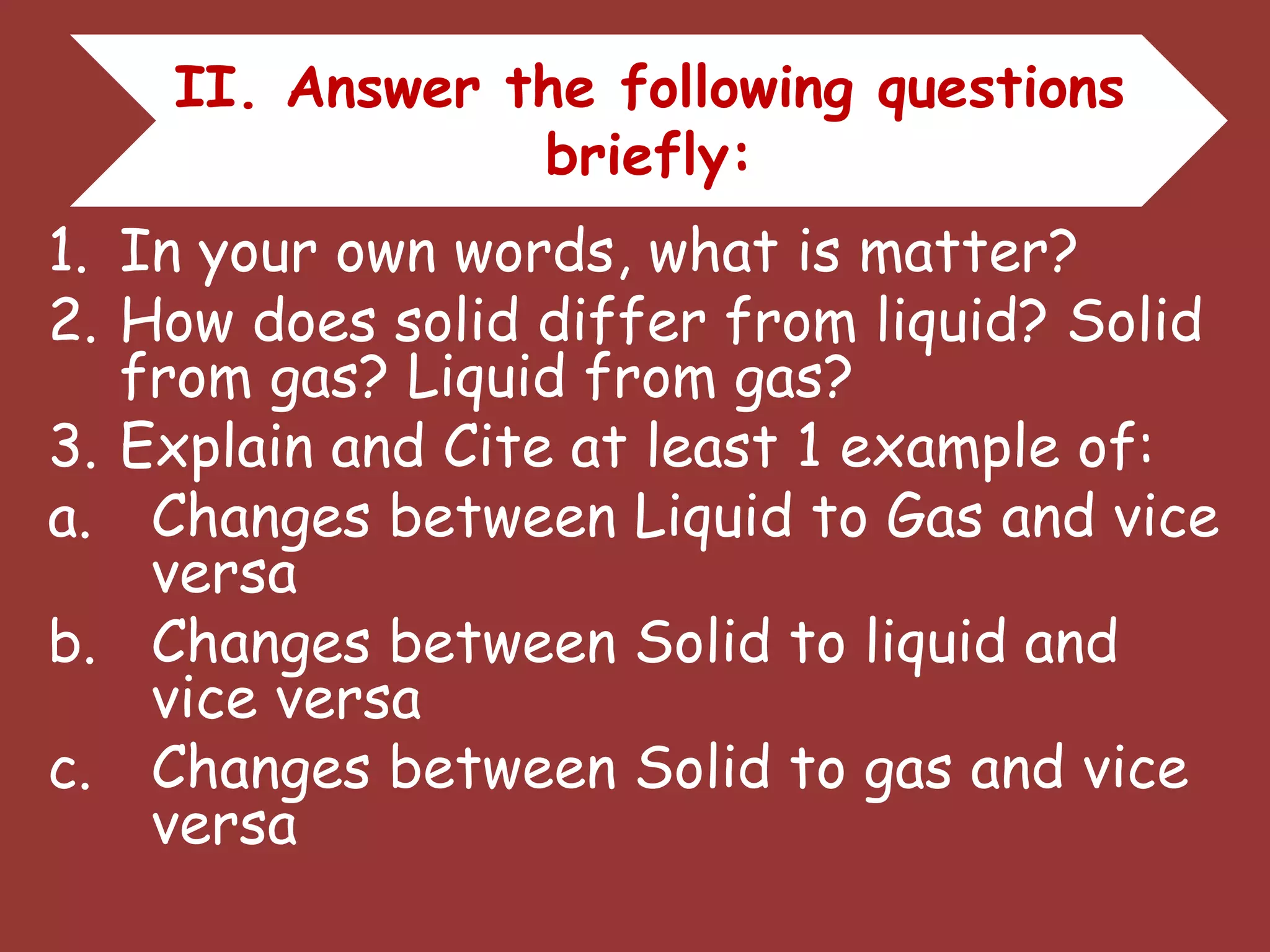
II. Answer the following questions
briefly:
1. In your own words, what is matter?
2. How does solid differ from liquid? Solid
from gas? Liquid from gas?
3. Explain and Cite at least 1 example of:
a. Changes between Liquid to Gas and vice
versa
b. Changes between Solid to liquid and
vice versa
c. Changes between Solid to gas and vice
versa

Particle Nature of Matter

  • 1.
  • 2.
  • 3.
    • Anything thatoccupies space and has mass is called MATTER. • The mass of an object is a measure of the amount of matter the object has. • The measure of the space occupied by an object is called volume.
  • 4.
    Classification of Matter MATTER PureSubstance Elements Compound Mixture homogeneous heterogeneous
  • 5.
    WHAT MATTER WASMADE OF? • Almost 2,500 years ago, Leucippus and his disciple, Democritus believed that nature consisted of two things, “atoms and the void that surrounds them” • They believed that “atoms are physically, but not geometrically, indivisible.” • Atomos, a Greek word which means indivisible particle.
  • 6.
    1.All matter composedof atoms in void. 2.Atoms were indivisible & indestructible. 3.Properties of atom differ in shape, arrangement and sizes. 4.Shape of atom determined the substance properties. DEMOCRITUS (460 B.C. – 370 B.C.)
  • 7.
    All matter is madeup of 4 basic substances.
  • 8.
    • He developeda theory to explain why the elements in a compound always join in the same way. • He proposed explanations for many of the known laws describing the behaviour of matter. • Dalton’s theory states “All matter is made up of individual particles called atoms, which cannot be divided”. JOHN DALTON (1766 – 1844)
  • 9.
    • Matter ismade up of tiny and discrete particles. The particles may be atoms, molecules or ions. • An atom is the smallest particle of an element that has all properties of the element. • A molecule is a neutral particle that consists of two or more atoms which are chemically bonded together. • An ion is a positively charged or negatively charged particle.
  • 10.
    • Matter ismade up of tiny and discrete particles. The particles may be atoms, molecules or ions. • The size of an atom is measured in angstroms.  One angstrom is a unit of length equal to one ten millionth of a millimeter.  Scanning Tunneling Microscope (STM) - It can magnify an image 10 million times. And it creates a profile of the surface of an atom and then a computer-generated model or contour map is produced.
  • 11.
  • 12.
    Characteristics of Particlesof Matter Everything around us is made up of tiny pieces or particles. The particles that make up matter are atoms, ions or molecules 1. The particles of matter are very, very small. 2. The particles of matter have spaces between them, 3. The particles of matter are constantly moving. 4. The particles of matter attract each other.
  • 13.
    Matter can havedifferent properties Everything around us is made up of tiny pieces or particles. The particles that make up matter are atoms, ions or molecules 1. Hardness 2. Color and texture 3. Malleability 4. Flexibility 5. Conductivity 6. Viscosity
  • 14.
    Particle Models ofthe Three States of Matter
  • 15.
    State of Matter Onthe basis of physical states, all the matter can be classified into three groups. 1. Solids 2.Liquids 3.Gases
  • 16.
    Properties of Solids 1.Solids have a fixed shape and a fixed volume 2. Solids cannot be compressed much 3. Solids have high densities 4. Solids do not fill their container completely 5. Solids do not flow
  • 17.
    Properties of Liquids 1.Liquids have fixed volume but they have no fixed shape. 2. Like solids, liquids cannot be compressed much 3. Liquids have moderate to high densities. 4. Liquids do not fill their container completely 5. Liquids generally flow
  • 18.
    Properties of Gases 1.Gases have neither a fixed shape nor a fixed volume. 2. Gases can be compressed easily. 3. Gases have very low densities. 4. Gases fill their container completely 5. Gases flow easily
  • 19.
    PROPERTY SOLID LIQUIDGAS SHAPE Definite Indefinite indefinite INTERMOLECULAR SPACING Very close Slightly farther Far from one another VOLUME Definite Definite indefinite COMPRESSIBILITY Not compressible Not compressible Highly compressible DENSITY Densest Dense Low density ABILITY TO FLOW Cannot flow Able to flow Able to flow
  • 20.
  • 22.
  • 23.
    PROPERTY SOLID LIQUIDGAS SHAPE INTERMOLECULAR SPACING VOLUME COMPRESSIBILITY DENSITY ABILITY TO FLOW I. Complete the following: A. Complete the table:
  • 24.
    A. Complete thediagram SOLID LIQUID GAS
  • 25.
    II. Answer thefollowing questions briefly: 1. In your own words, what is matter? 2. How does solid differ from liquid? Solid from gas? Liquid from gas? 3. Explain and Cite at least 1 example of: a. Changes between Liquid to Gas and vice versa b. Changes between Solid to liquid and vice versa c. Changes between Solid to gas and vice versa