THE PARTICLE NATURE
OF MATTER
LESSON 1
CONTENT STANDARD
To demonstrate an understanding of
the particle nature of matter as basis
for explaining properties, physical
changes, and structure of substances
and mixtures.
PERFORMANCE STANDARD
The learners shall be able to
present how water behaves in
its different states within the
water cycle.
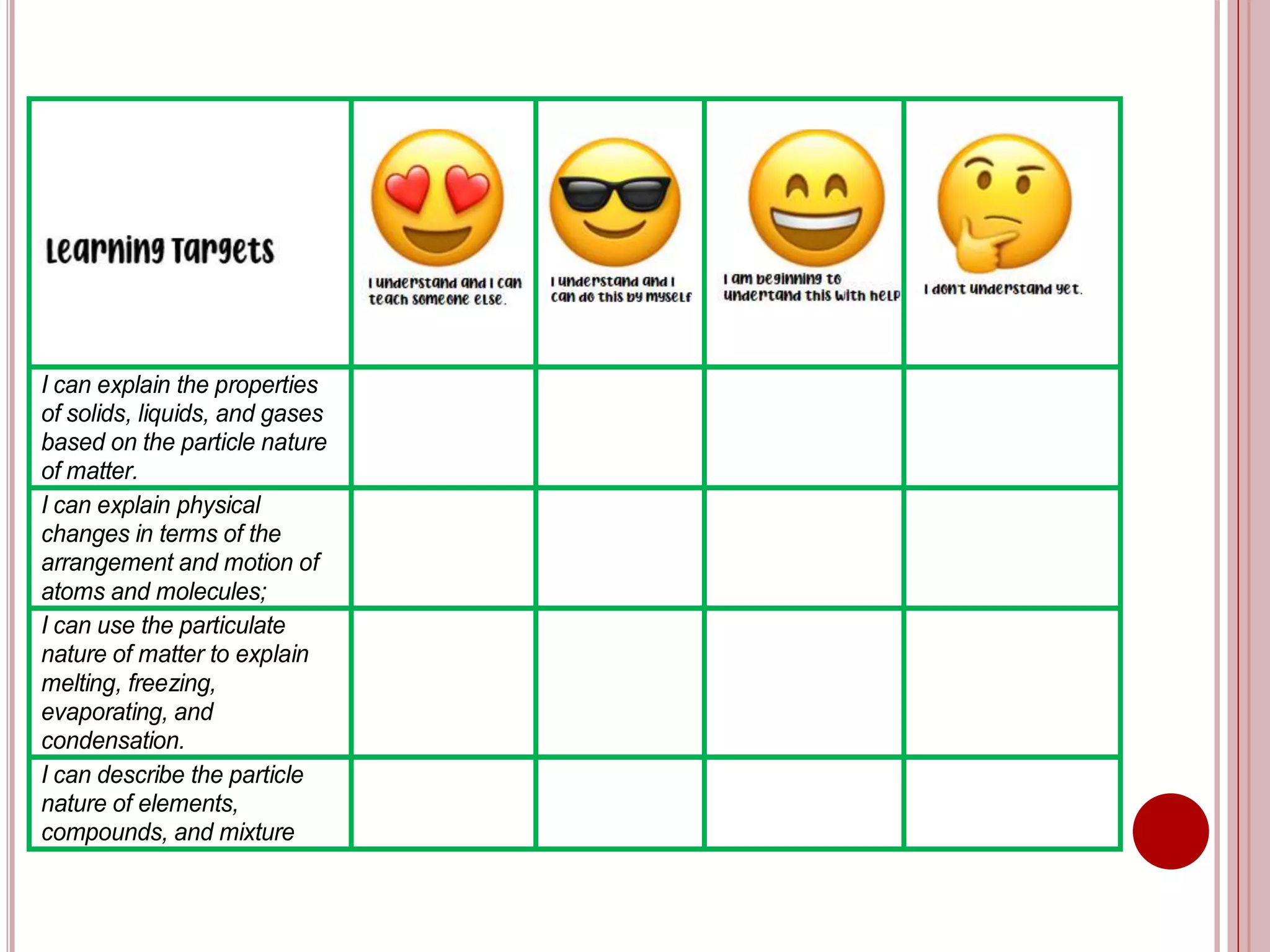
I can explain the properties
of solids, liquids, and gases
based on the particle nature
of matter.
I can explain physical
changes in terms of the
arrangement and motion of
atoms and molecules;
I can use the particulate
nature of matter to explain
melting, freezing,
evaporating, and
condensation.
I can describe the particle
nature of elements,
compounds, and mixture
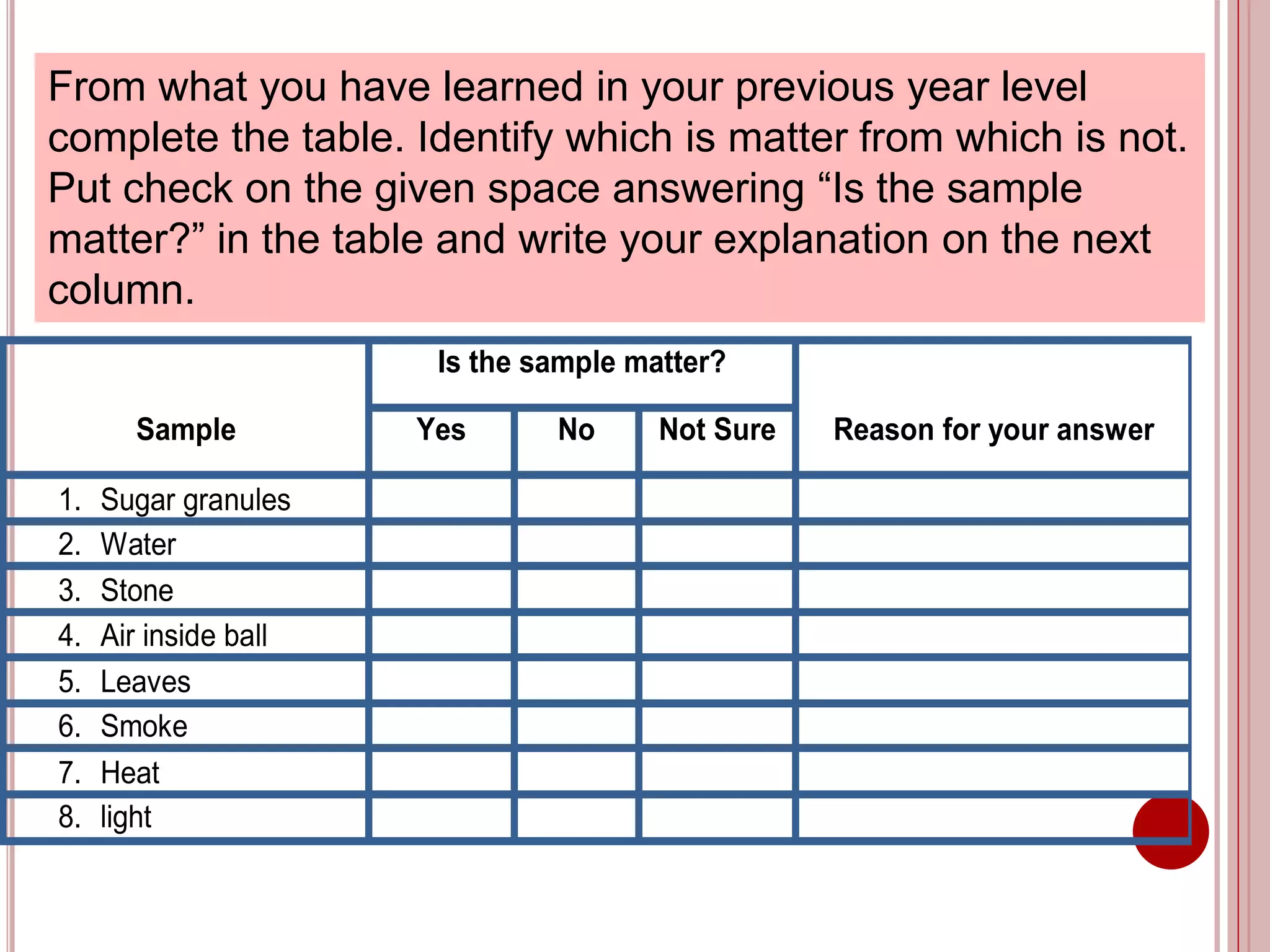
Sample
Is the sample matter?
Reason for your answer
Yes No Not Sure
1. Sugar granules
2. Water
3. Stone
4. Air inside ball
5. Leaves
6. Smoke
7. Heat
8. light
From what you have learned in your previous year level
complete the table. Identify which is matter from which is not.
Put check on the given space answering “Is the sample
matter?” in the table and write your explanation on the next
column.
To understand more about Kinetic Molecular Theory of Matter
you may read your textbook page 236.
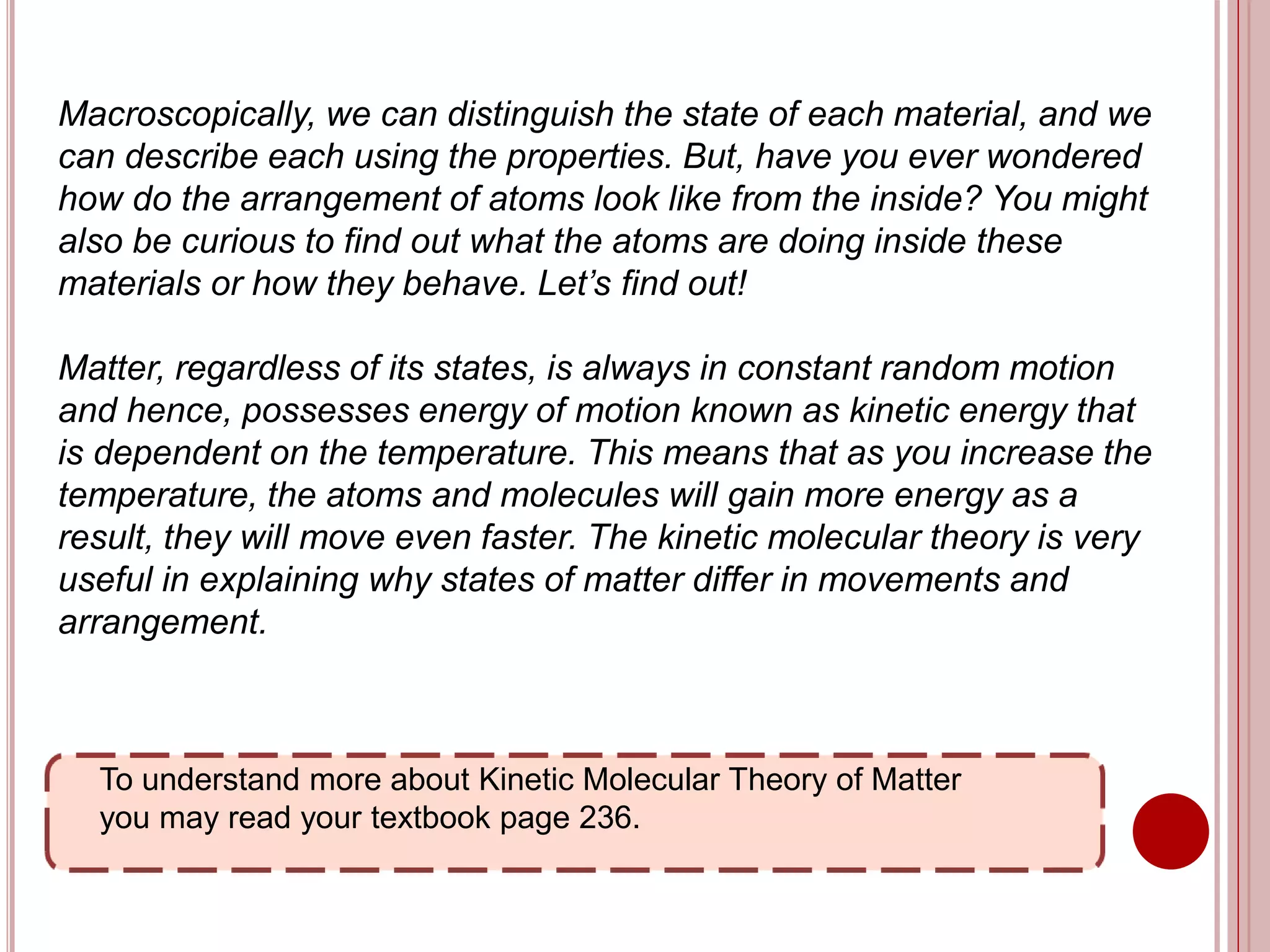
Macroscopically, we can distinguish the state of each material, and we
can describe each using the properties. But, have you ever wondered
how do the arrangement of atoms look like from the inside? You might
also be curious to find out what the atoms are doing inside these
materials or how they behave. Let’s find out!
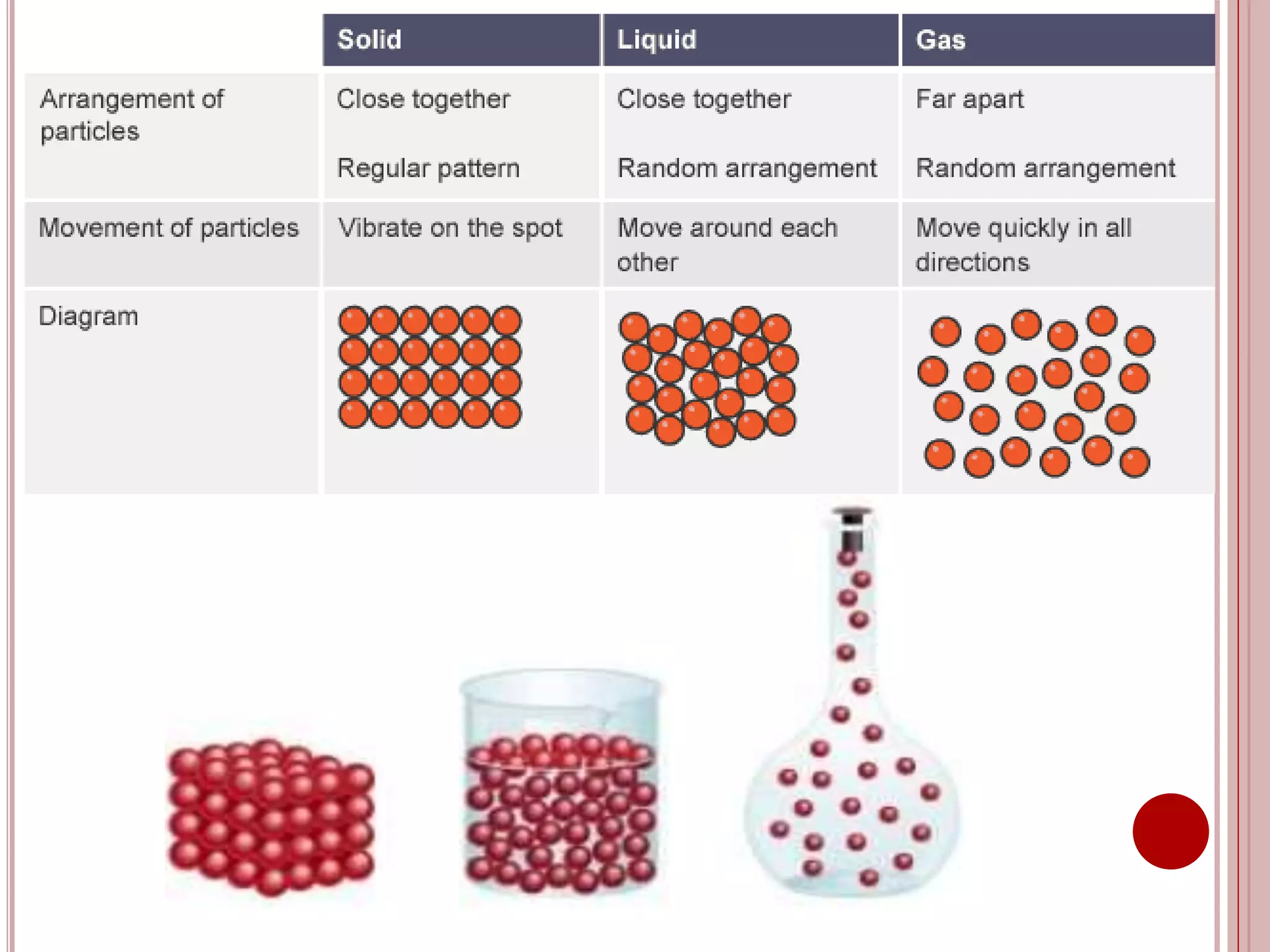
Matter, regardless of its states, is always in constant random motion
and hence, possesses energy of motion known as kinetic energy that
is dependent on the temperature. This means that as you increase the
temperature, the atoms and molecules will gain more energy as a
result, they will move even faster. The kinetic molecular theory is very
useful in explaining why states of matter differ in movements and
arrangement.
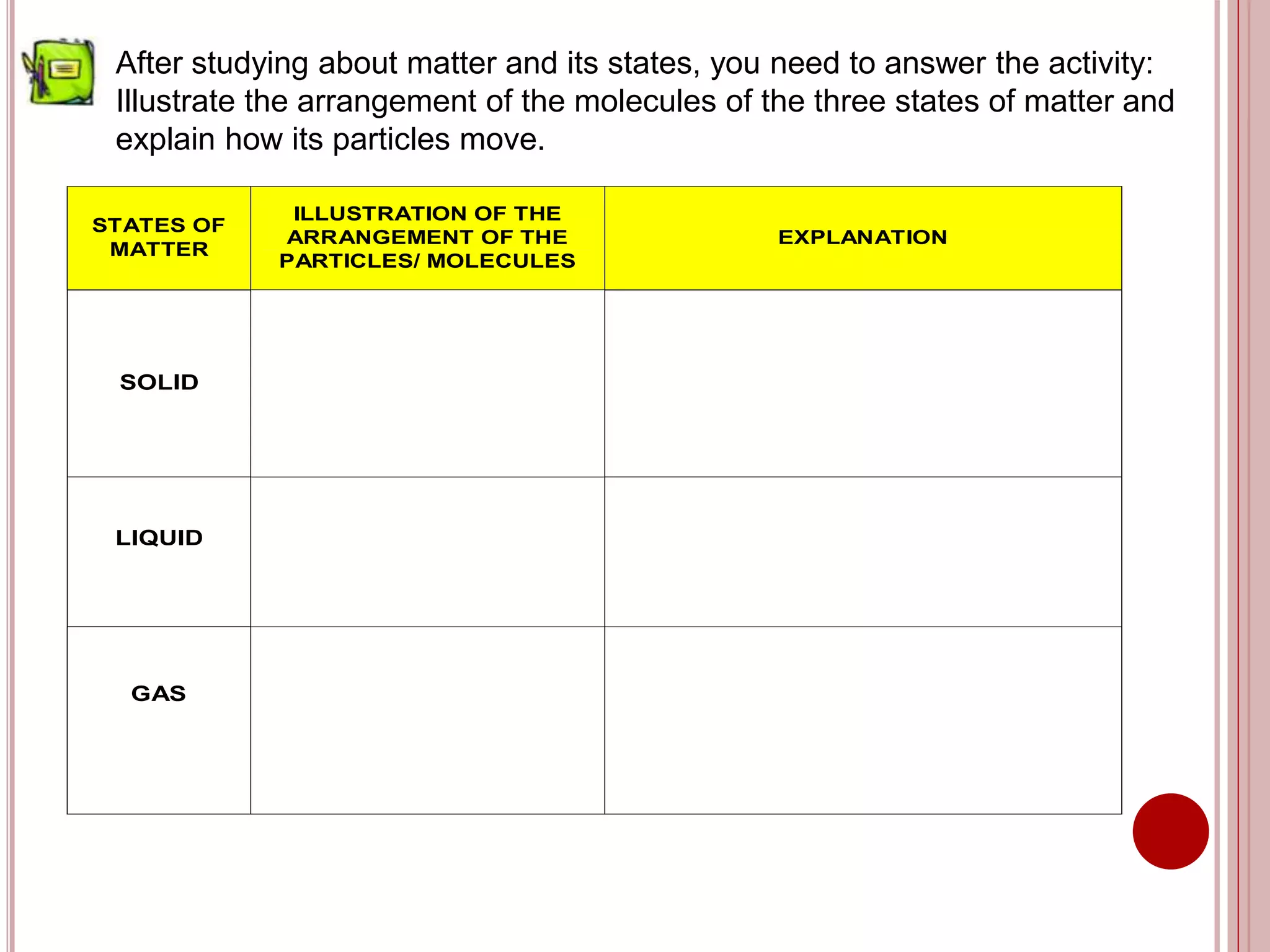
After studying about matter and its states, you need to answer the activity:
Illustrate the arrangement of the molecules of the three states of matter and
explain how its particles move.
STATES OF
MATTER
ILLUSTRATION OF THE
ARRANGEMENT OF THE
PARTICLES/ MOLECULES
EXPLANATION
SOLID
LIQUID
GAS
PROPERTIES OF SOLIDS
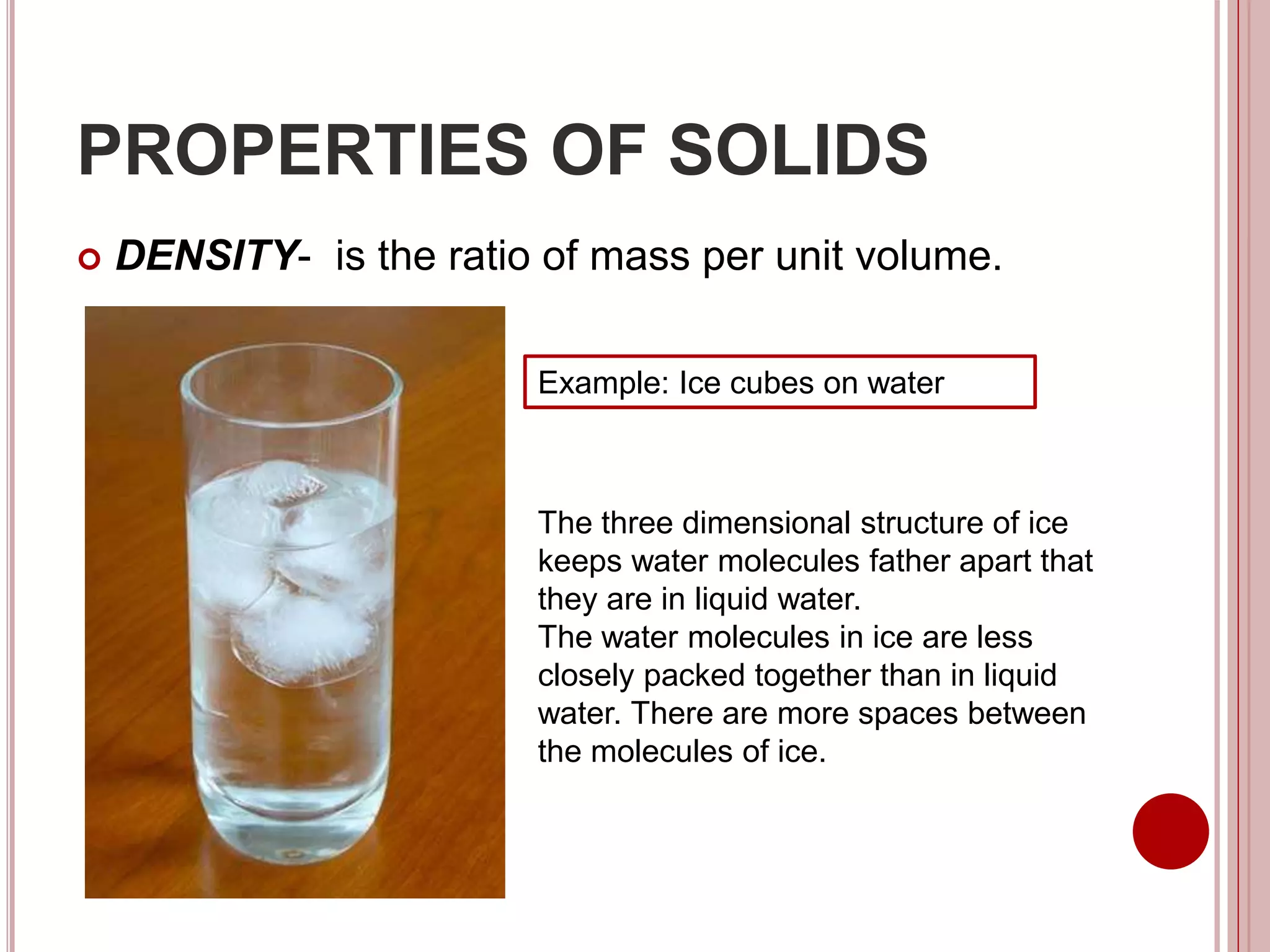
 DENSITY- is the ratio of mass per unit volume.
The three dimensional structure of ice
keeps water molecules father apart that
they are in liquid water.
The water molecules in ice are less
closely packed together than in liquid
water. There are more spaces between
the molecules of ice.
Example: Ice cubes on water
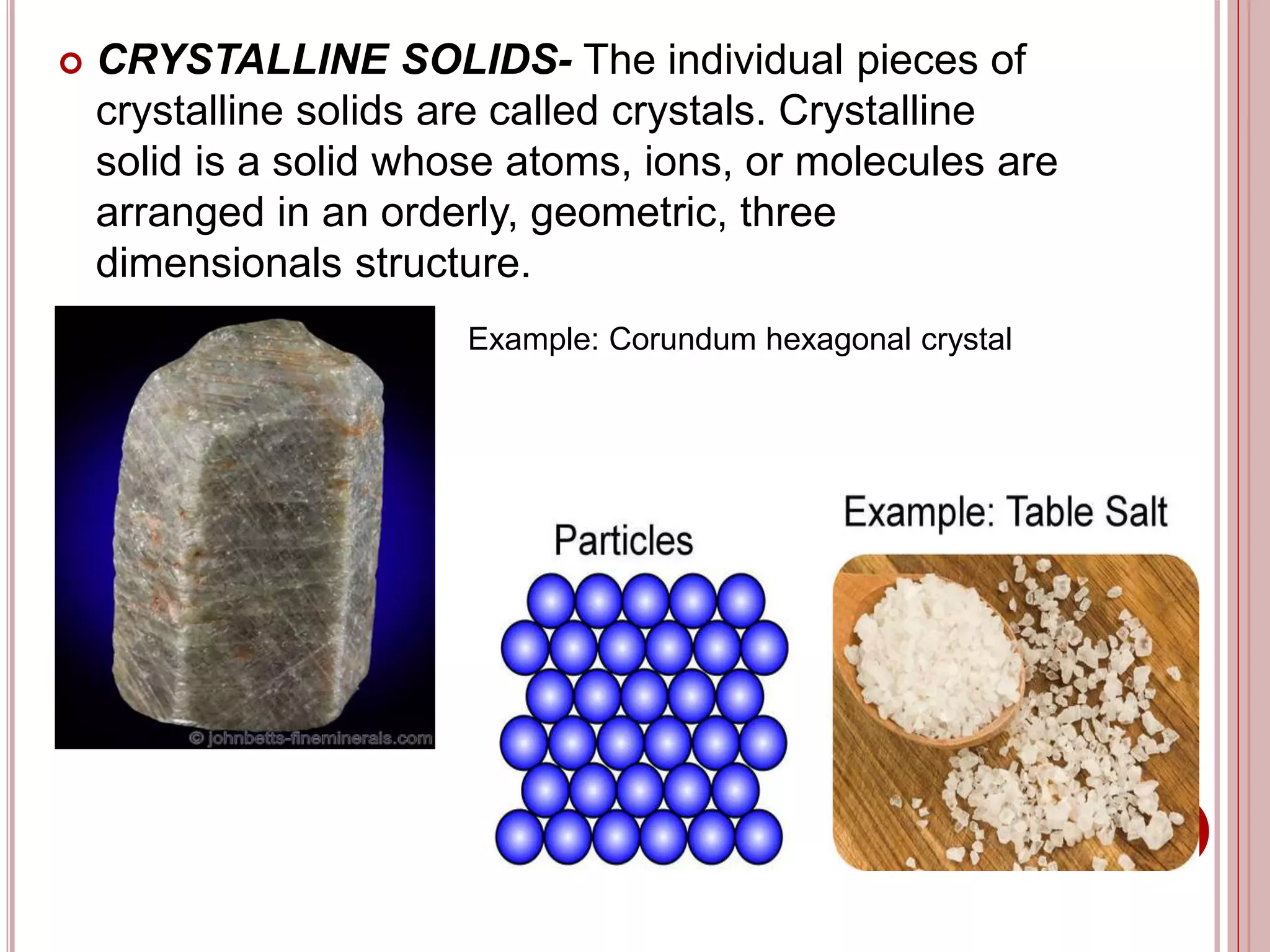
 CRYSTALLINE SOLIDS- The individual pieces of
crystalline solids are called crystals. Crystalline
solid is a solid whose atoms, ions, or molecules are
arranged in an orderly, geometric, three
dimensionals structure.
Example: Corundum hexagonal crystal
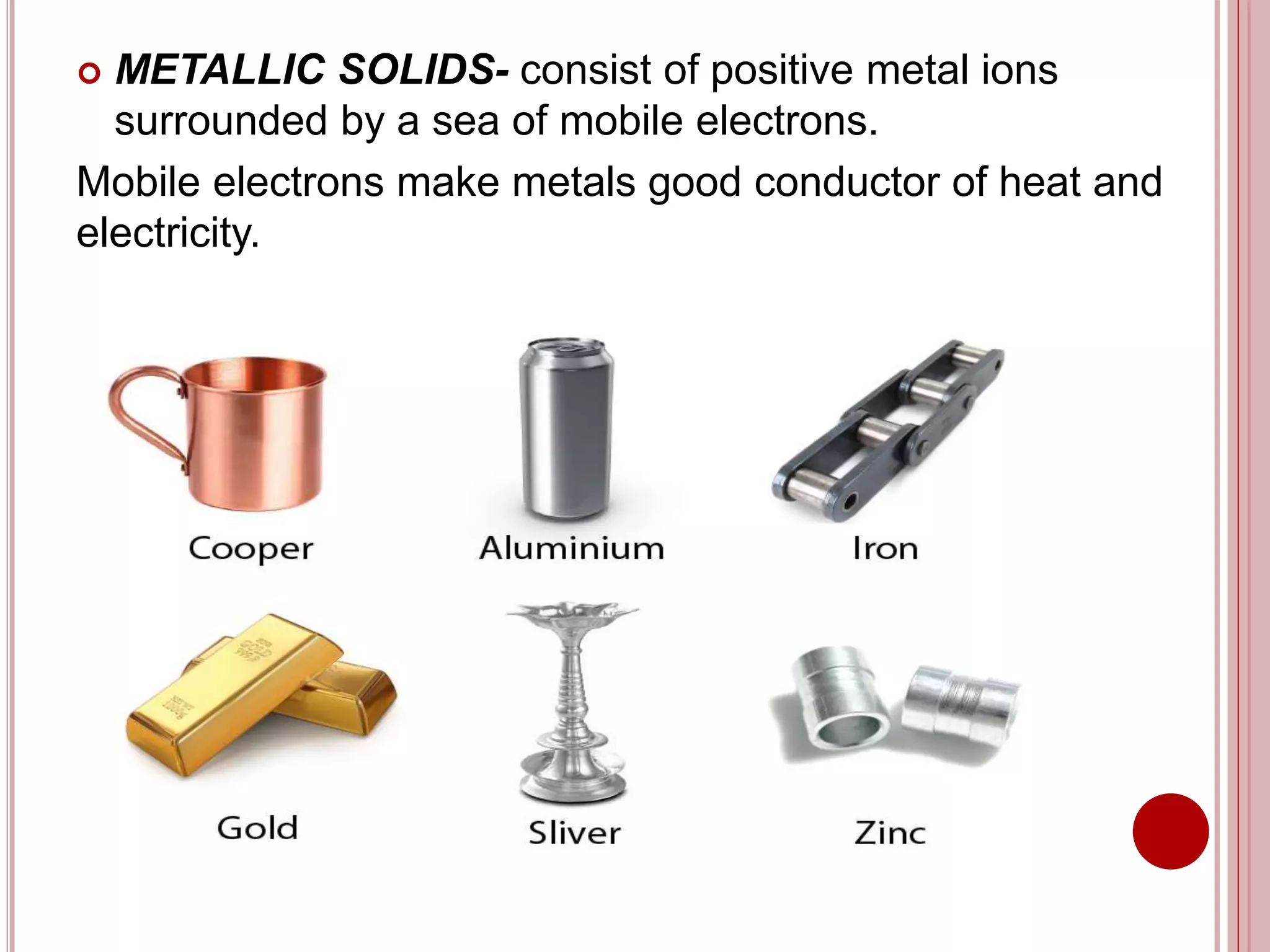
 METALLIC SOLIDS- consist of positive metal ions
surrounded by a sea of mobile electrons.
Mobile electrons make metals good conductor of heat and
electricity.
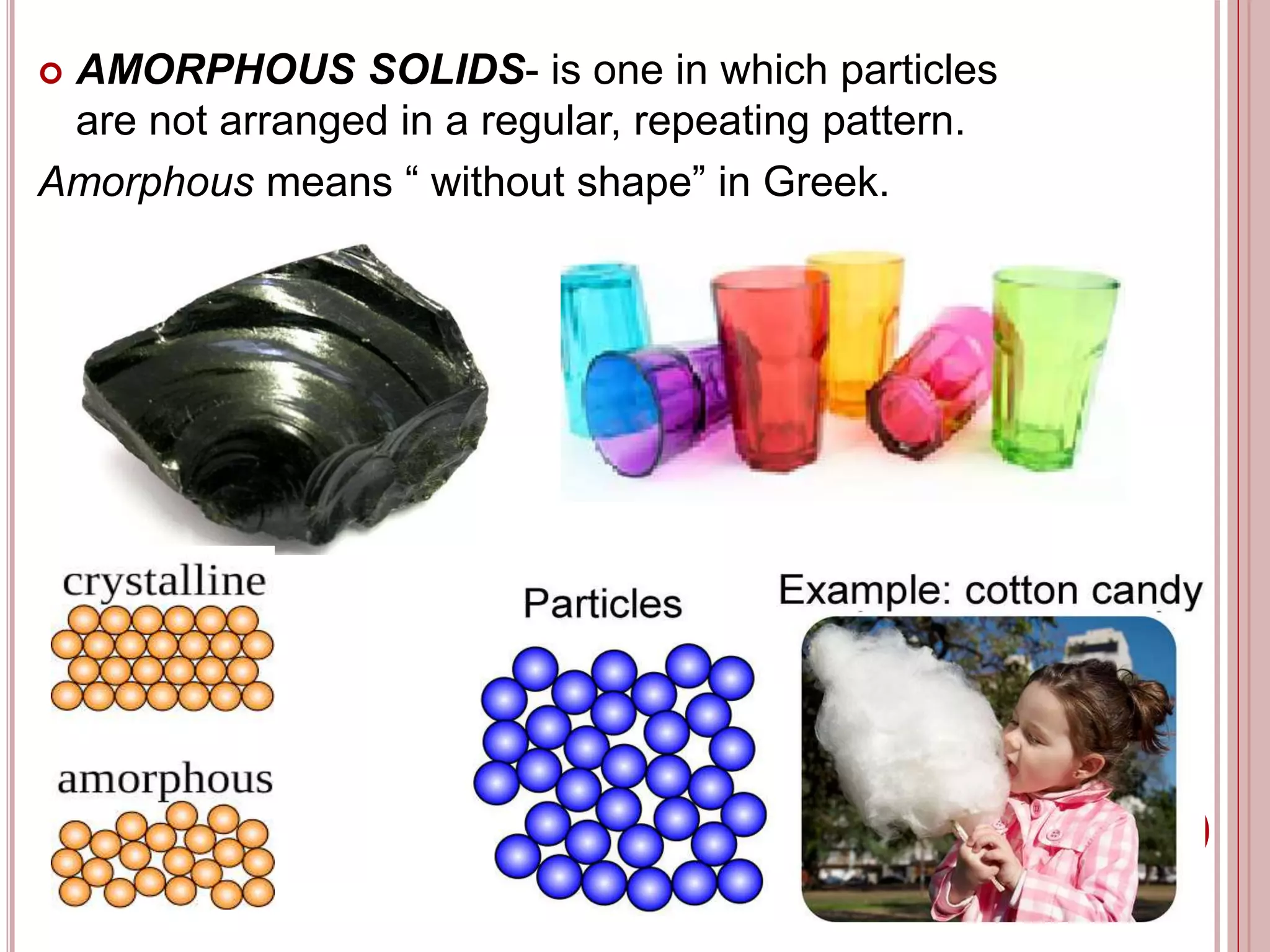
 AMORPHOUS SOLIDS- is one in which particles
are not arranged in a regular, repeating pattern.
Amorphous means “ without shape” in Greek.
PROPERTIES OF LIQUIDS
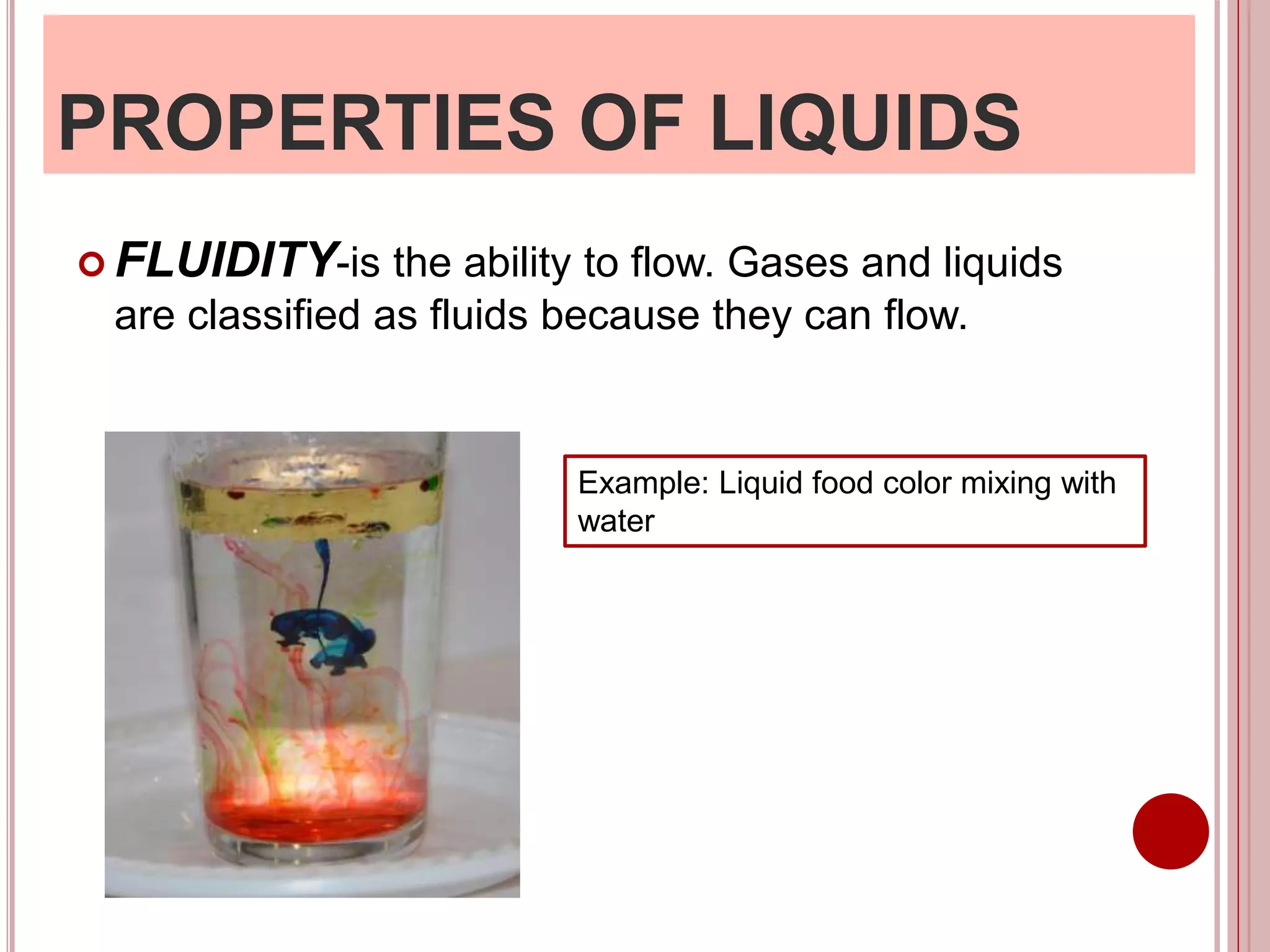
 FLUIDITY-is the ability to flow. Gases and liquids
are classified as fluids because they can flow.
Example: Liquid food color mixing with
water
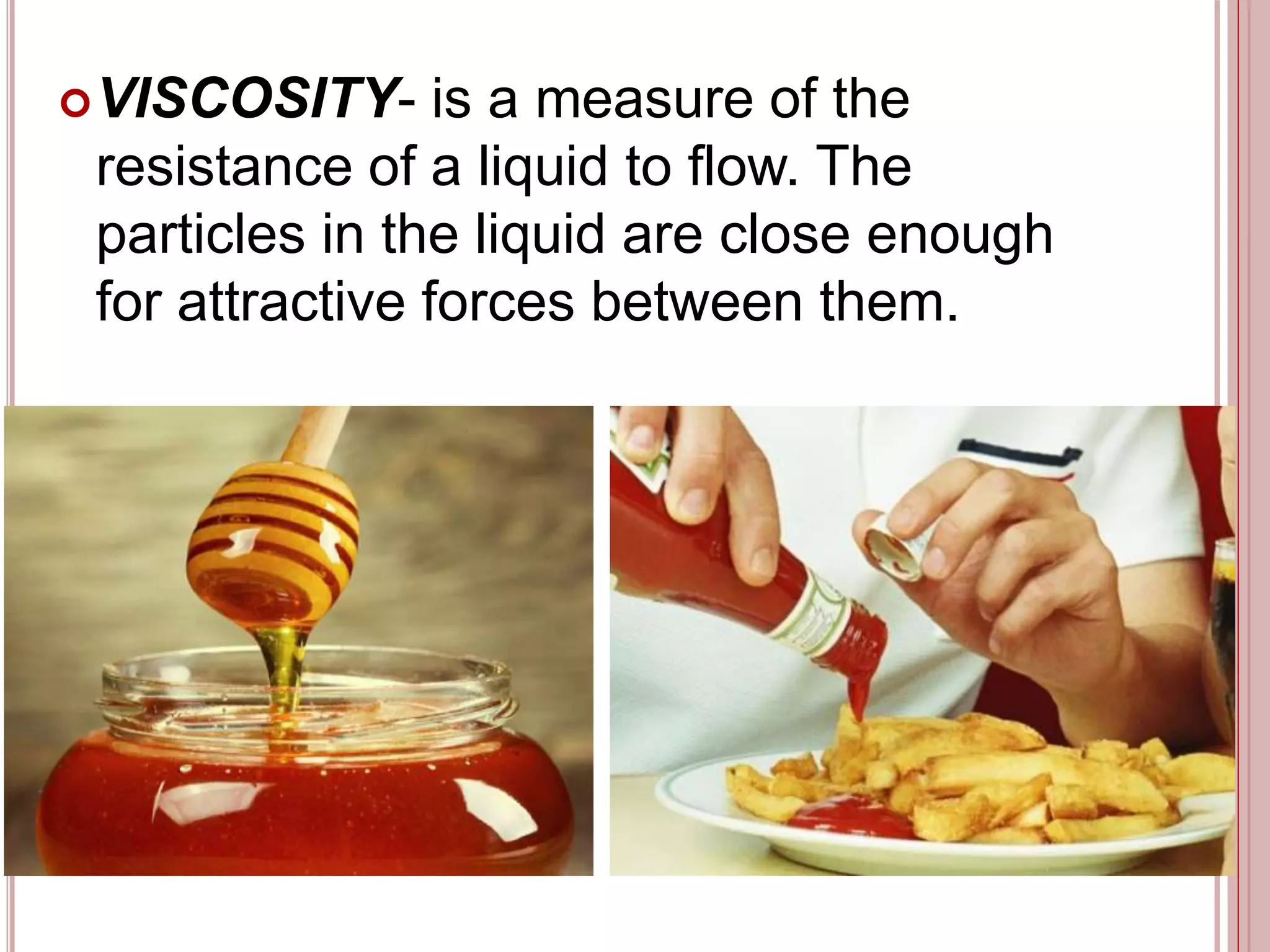
VISCOSITY- is a measure of the
resistance of a liquid to flow. The
particles in the liquid are close enough
for attractive forces between them.
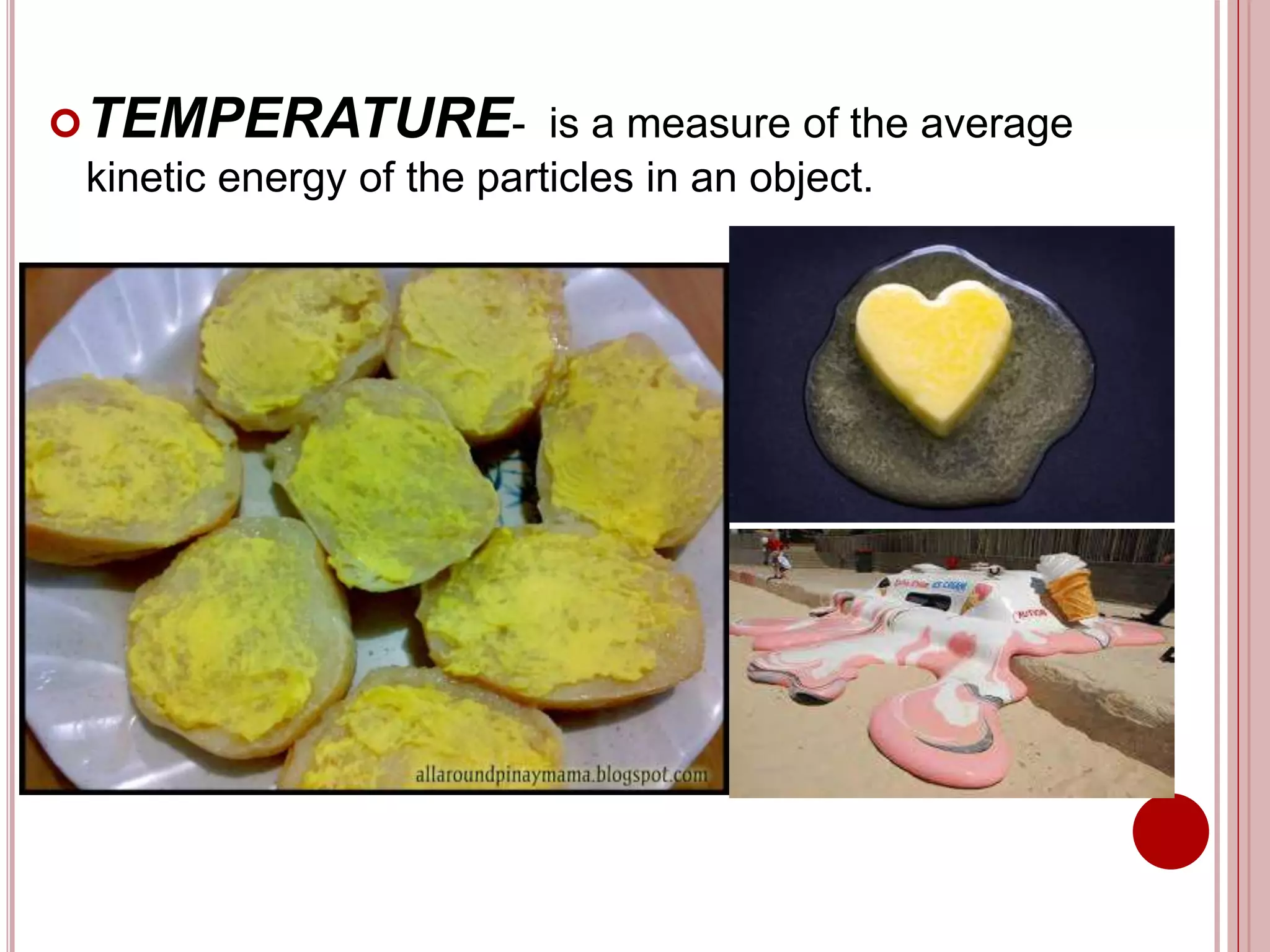
TEMPERATURE- is a measure of the average
kinetic energy of the particles in an object.
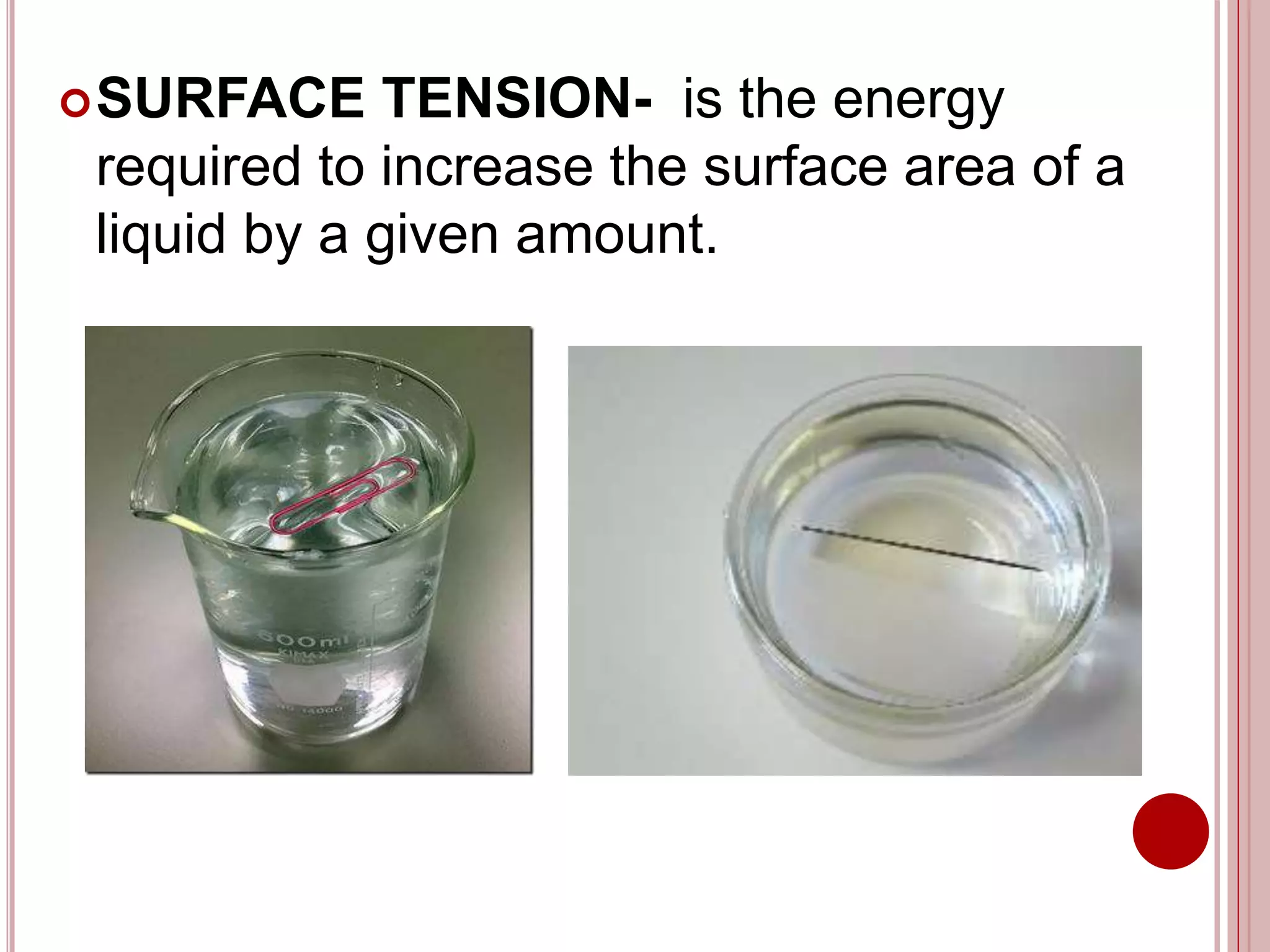
SURFACE TENSION- is the energy
required to increase the surface area of a
liquid by a given amount.
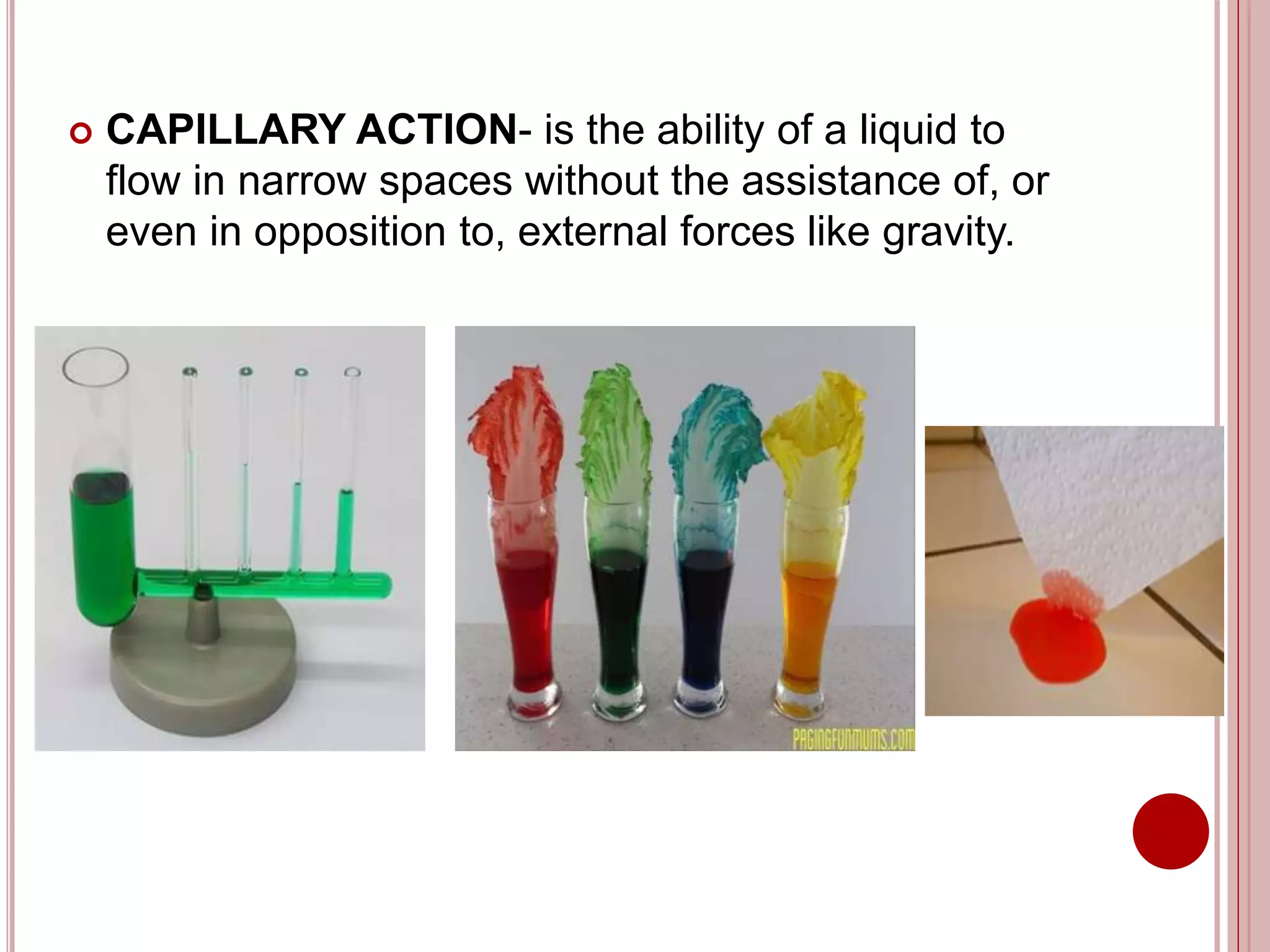
 CAPILLARY ACTION- is the ability of a liquid to
flow in narrow spaces without the assistance of, or
even in opposition to, external forces like gravity.
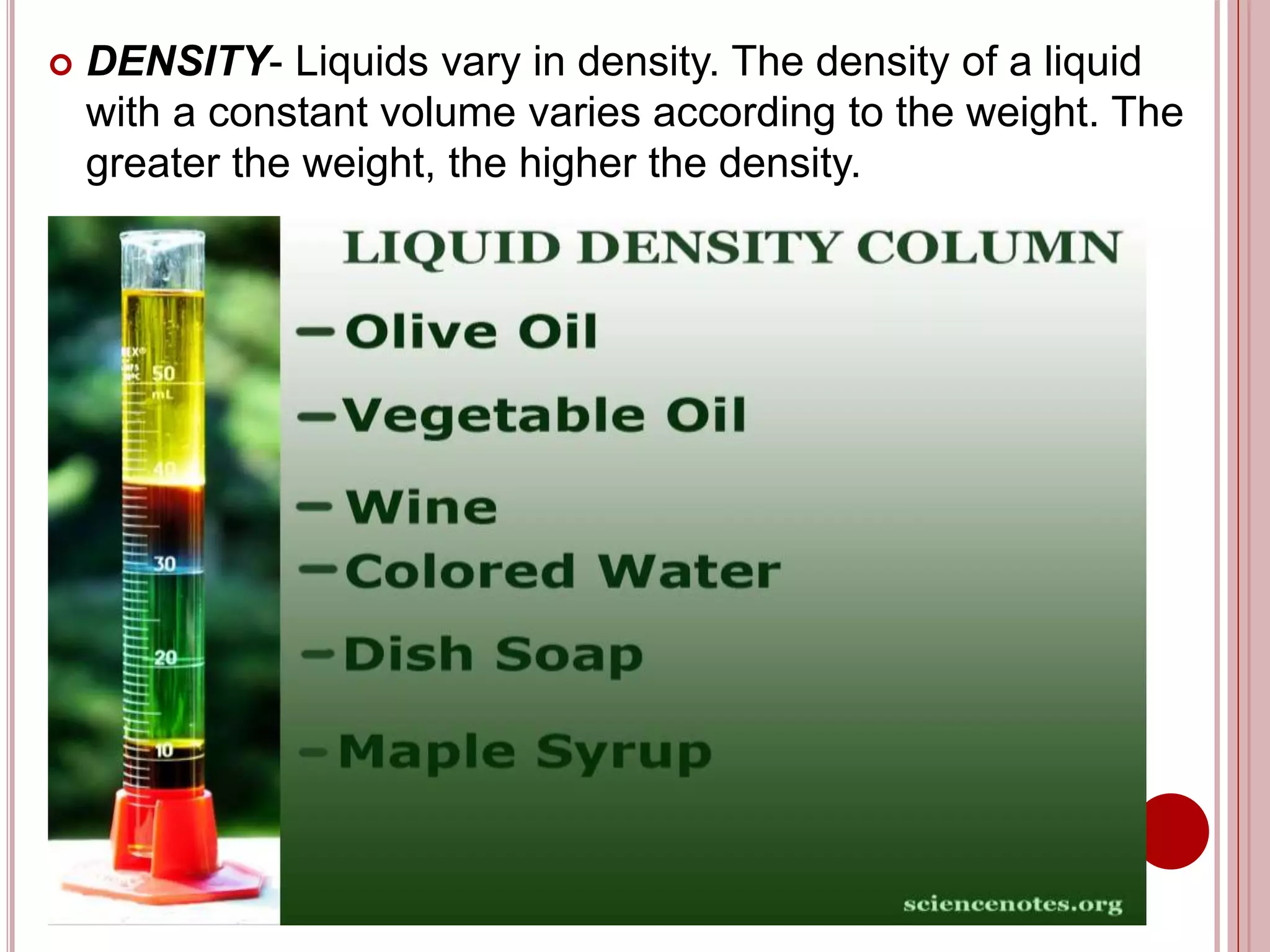
 DENSITY- Liquids vary in density. The density of a liquid
with a constant volume varies according to the weight. The
greater the weight, the higher the density.
PROPERTIES OF GAS
VOLUME- Gases do not have definite
volume. This means that a gas will fill whatever
volume is available.
 The volume of gas is measured using a calibrated
tube called burette. The SI unit for volume is cubic
meter but often use liter (L) and mililiter (mL) or
cubic centimeter.

Lesson 1 the particle nature of matter

  • 1.
    THE PARTICLE NATURE OFMATTER LESSON 1
  • 2.
    CONTENT STANDARD To demonstratean understanding of the particle nature of matter as basis for explaining properties, physical changes, and structure of substances and mixtures.
  • 3.
    PERFORMANCE STANDARD The learnersshall be able to present how water behaves in its different states within the water cycle.
  • 4.
    I can explainthe properties of solids, liquids, and gases based on the particle nature of matter. I can explain physical changes in terms of the arrangement and motion of atoms and molecules; I can use the particulate nature of matter to explain melting, freezing, evaporating, and condensation. I can describe the particle nature of elements, compounds, and mixture
  • 6.
    Sample Is the samplematter? Reason for your answer Yes No Not Sure 1. Sugar granules 2. Water 3. Stone 4. Air inside ball 5. Leaves 6. Smoke 7. Heat 8. light From what you have learned in your previous year level complete the table. Identify which is matter from which is not. Put check on the given space answering “Is the sample matter?” in the table and write your explanation on the next column.
  • 7.
    To understand moreabout Kinetic Molecular Theory of Matter you may read your textbook page 236. Macroscopically, we can distinguish the state of each material, and we can describe each using the properties. But, have you ever wondered how do the arrangement of atoms look like from the inside? You might also be curious to find out what the atoms are doing inside these materials or how they behave. Let’s find out! Matter, regardless of its states, is always in constant random motion and hence, possesses energy of motion known as kinetic energy that is dependent on the temperature. This means that as you increase the temperature, the atoms and molecules will gain more energy as a result, they will move even faster. The kinetic molecular theory is very useful in explaining why states of matter differ in movements and arrangement.
  • 8.
    After studying aboutmatter and its states, you need to answer the activity: Illustrate the arrangement of the molecules of the three states of matter and explain how its particles move. STATES OF MATTER ILLUSTRATION OF THE ARRANGEMENT OF THE PARTICLES/ MOLECULES EXPLANATION SOLID LIQUID GAS
  • 10.
    PROPERTIES OF SOLIDS DENSITY- is the ratio of mass per unit volume. The three dimensional structure of ice keeps water molecules father apart that they are in liquid water. The water molecules in ice are less closely packed together than in liquid water. There are more spaces between the molecules of ice. Example: Ice cubes on water
  • 11.
     CRYSTALLINE SOLIDS-The individual pieces of crystalline solids are called crystals. Crystalline solid is a solid whose atoms, ions, or molecules are arranged in an orderly, geometric, three dimensionals structure. Example: Corundum hexagonal crystal
  • 12.
     METALLIC SOLIDS-consist of positive metal ions surrounded by a sea of mobile electrons. Mobile electrons make metals good conductor of heat and electricity.
  • 13.
     AMORPHOUS SOLIDS-is one in which particles are not arranged in a regular, repeating pattern. Amorphous means “ without shape” in Greek.
  • 14.
    PROPERTIES OF LIQUIDS FLUIDITY-is the ability to flow. Gases and liquids are classified as fluids because they can flow. Example: Liquid food color mixing with water
  • 15.
    VISCOSITY- is ameasure of the resistance of a liquid to flow. The particles in the liquid are close enough for attractive forces between them.
  • 16.
    TEMPERATURE- is ameasure of the average kinetic energy of the particles in an object.
  • 17.
    SURFACE TENSION- isthe energy required to increase the surface area of a liquid by a given amount.
  • 18.
     CAPILLARY ACTION-is the ability of a liquid to flow in narrow spaces without the assistance of, or even in opposition to, external forces like gravity.
  • 19.
     DENSITY- Liquidsvary in density. The density of a liquid with a constant volume varies according to the weight. The greater the weight, the higher the density.
  • 20.
    PROPERTIES OF GAS VOLUME-Gases do not have definite volume. This means that a gas will fill whatever volume is available.  The volume of gas is measured using a calibrated tube called burette. The SI unit for volume is cubic meter but often use liter (L) and mililiter (mL) or cubic centimeter.