Chemistry – States of Matter
The Particle Model
Learning Objective
• To understand how particles are arranged in the three states of matter.
Success Criteria
• To identify the arrangement of particles in each state of matter.
• To define density.
• To link the arrangement of particles in each state of matter to their properties.
Starter
Can you identify any states of matter in this picture?
Recap: Matter Key
Points
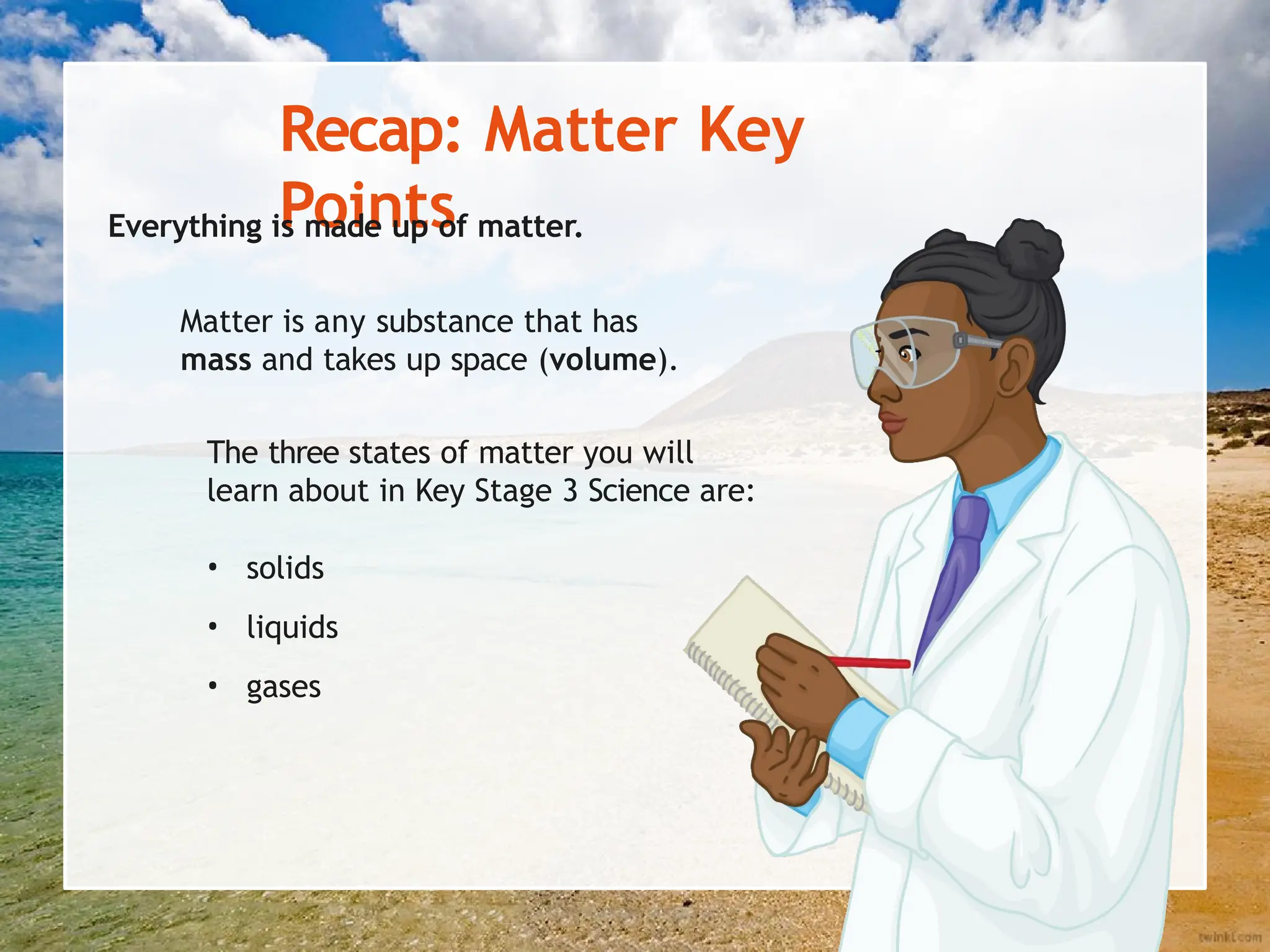
Everything is made up of matter.
Matter is any substance that has
mass and takes up space (volume).
The three states of matter you will
learn about in Key Stage 3 Science are:
• solids
• liquids
• gases
Matter Key Points: Zooming In
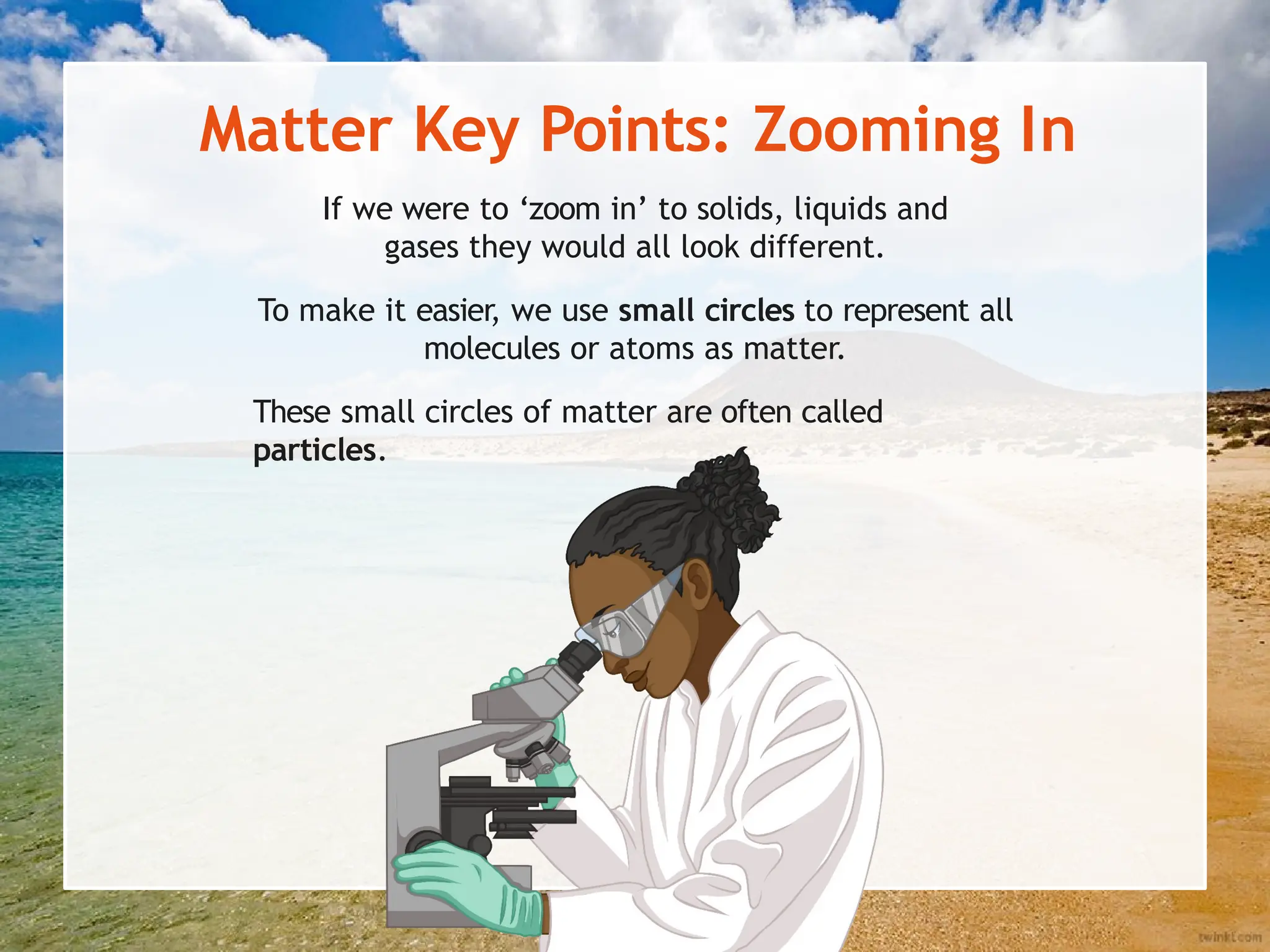
If we were to ‘zoom in’ to solids, liquids and
gases they would all look different.
To make it easier, we use small circles to represent all
molecules or atoms as matter.
These small circles of matter are often called
particles.
Arranging Particles: Thinking
Activity
In pairs you have two minutes to use the equipment
from your pencil cases to represent how you think
the particles are arranged in solids, liquids and
gases!
Take a handful of pens and pretend they are particles and
arrange them how you think particles would look like in a
solid.
Then, a few centimetres away, repeat
this process with liquids and gases.
One minute
left!
Time’s up!
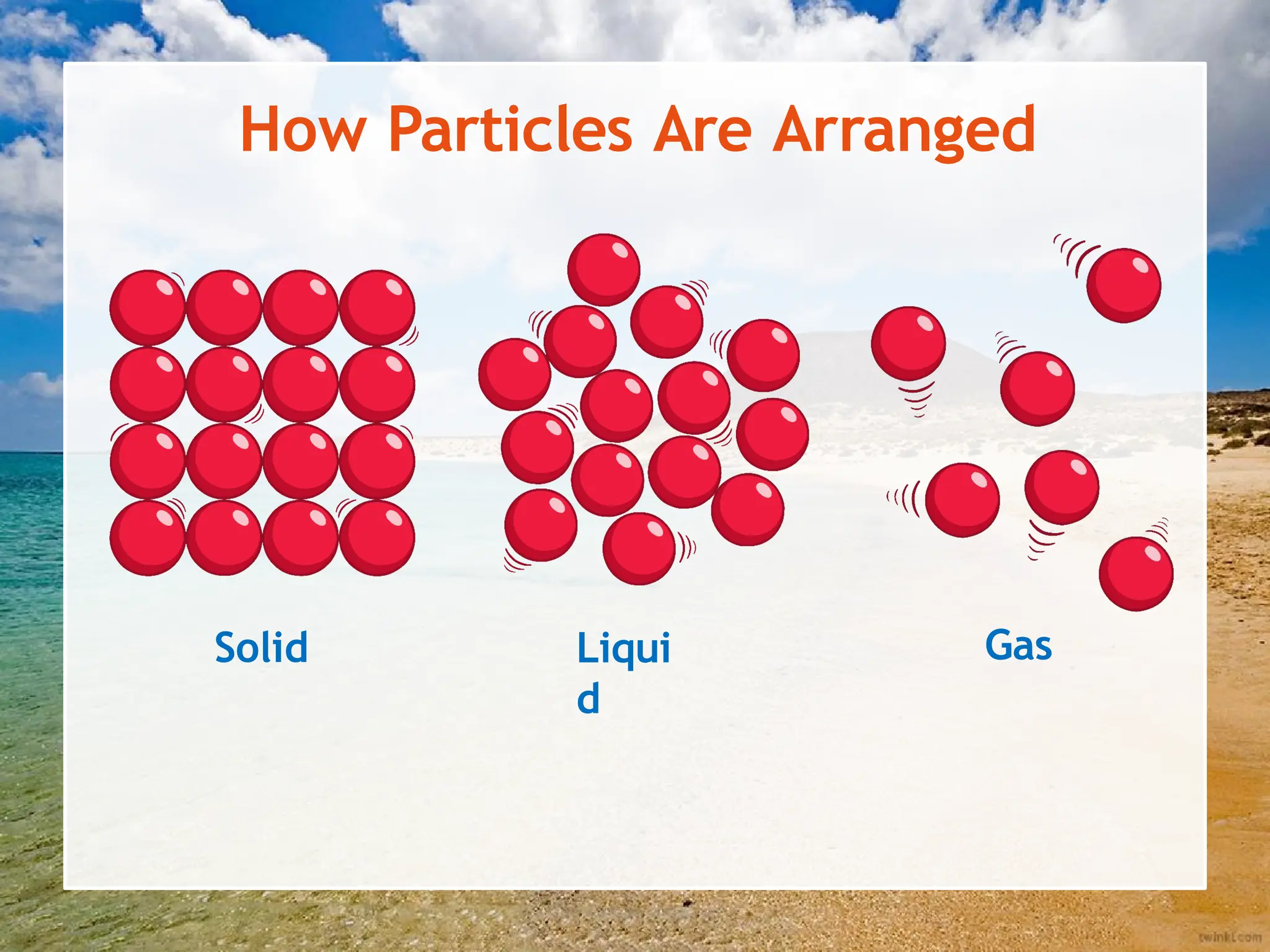
How Particles Are Arranged
Solid Liqui
d
Gas
The History of the Particle
Model
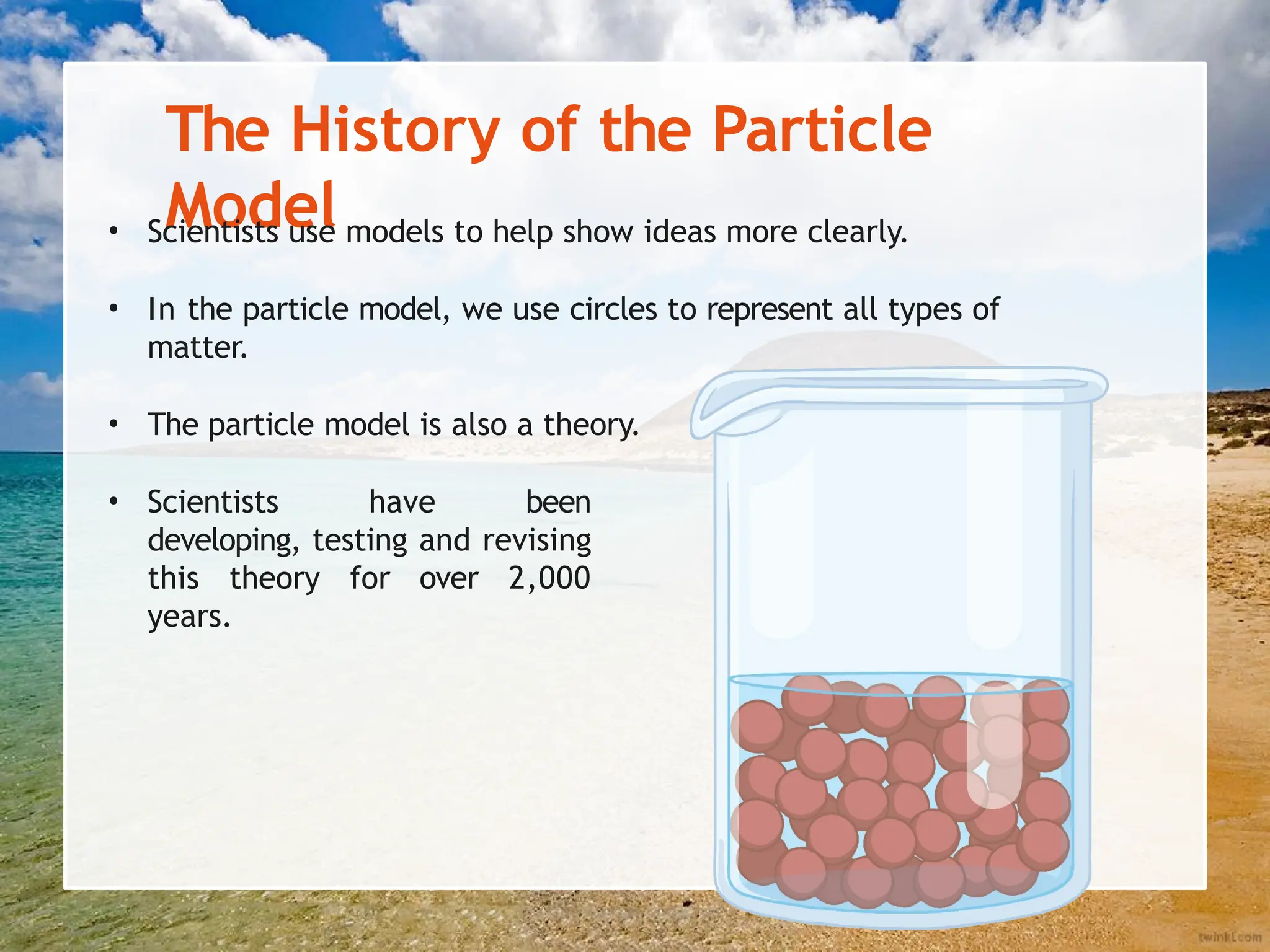
• Scientists use models to help show ideas more clearly.
• In the particle model, we use circles to represent all types of
matter.
• The particle model is also a theory.
• Scientists have been
developing, testing and revising
this theory for over 2,000
years.
The History of the Particle
Model
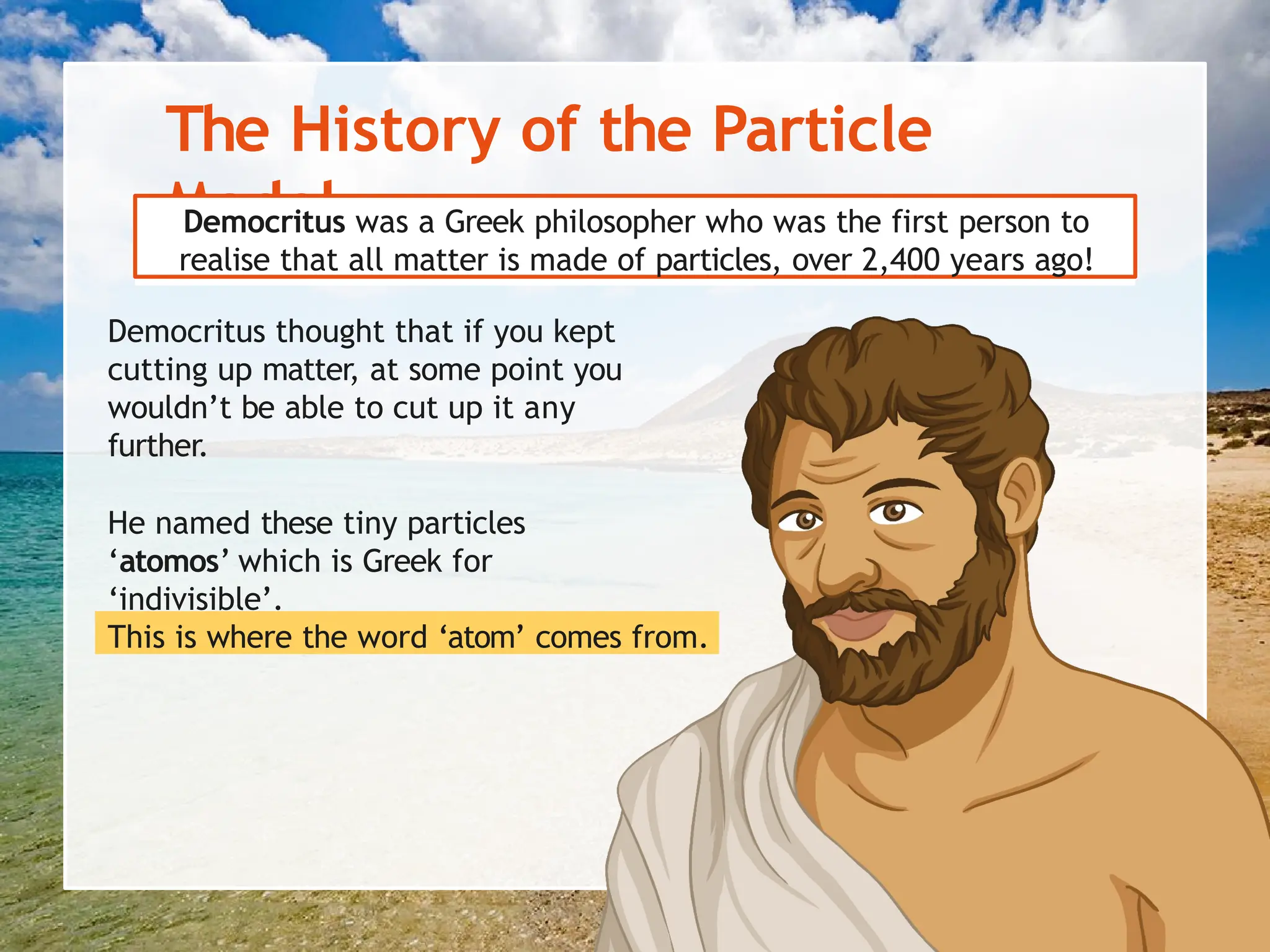
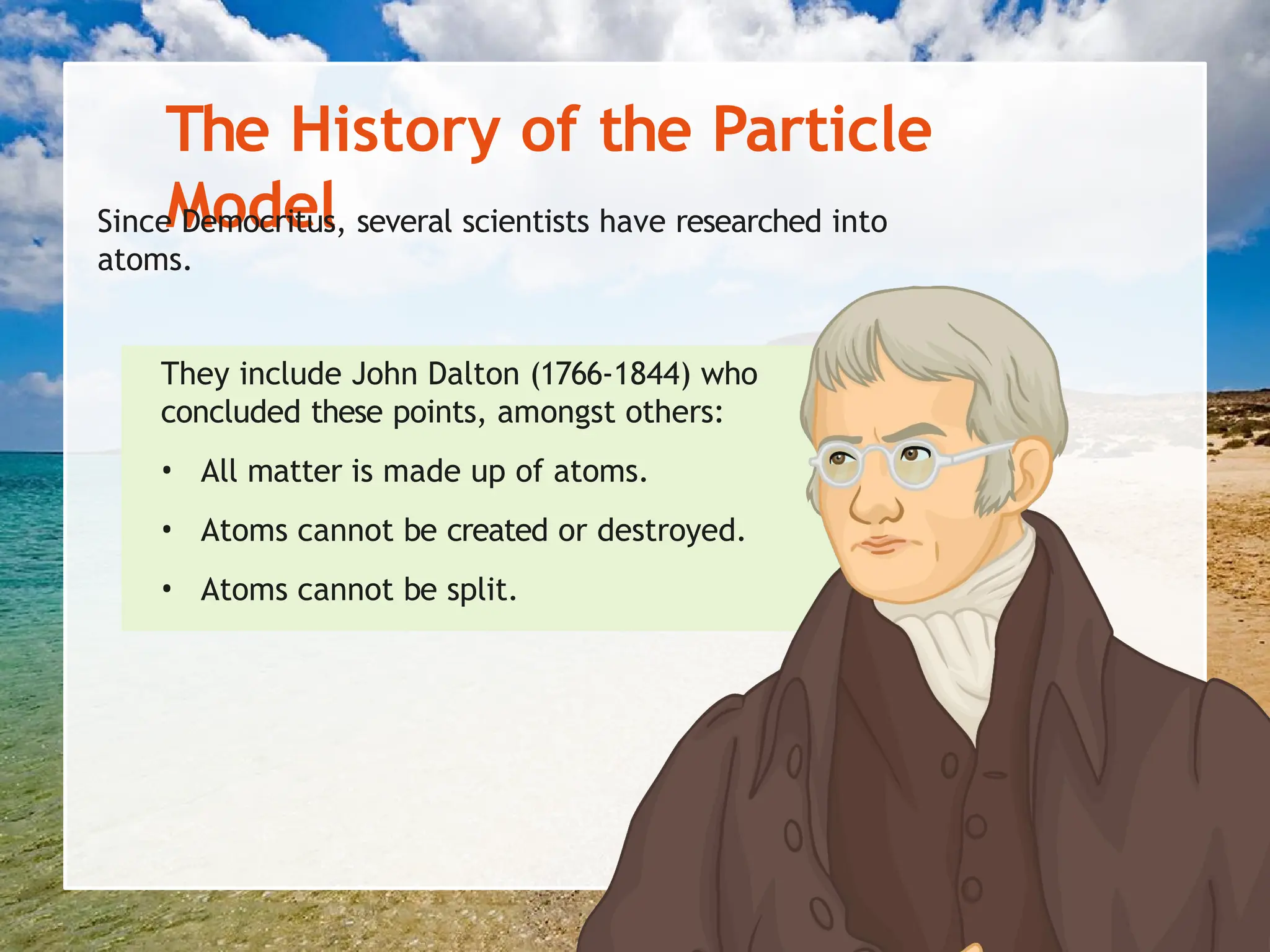
Democritus was a Greek philosopher who was the first person to
realise that all matter is made of particles, over 2,400 years ago!
Democritus thought that if you kept
cutting up matter, at some point you
wouldn’t be able to cut up it any
further.
He named these tiny particles
‘atomos’ which is Greek for
‘indivisible’.
This is where the word ‘atom’ comes from.
The History of the Particle
Model
Since Democritus, several scientists have researched into
atoms.
They include John Dalton (1766-1844) who
concluded these points, amongst others:
• All matter is made up of atoms.
• Atoms cannot be created or destroyed.
• Atoms cannot be split.
Density Key
Points
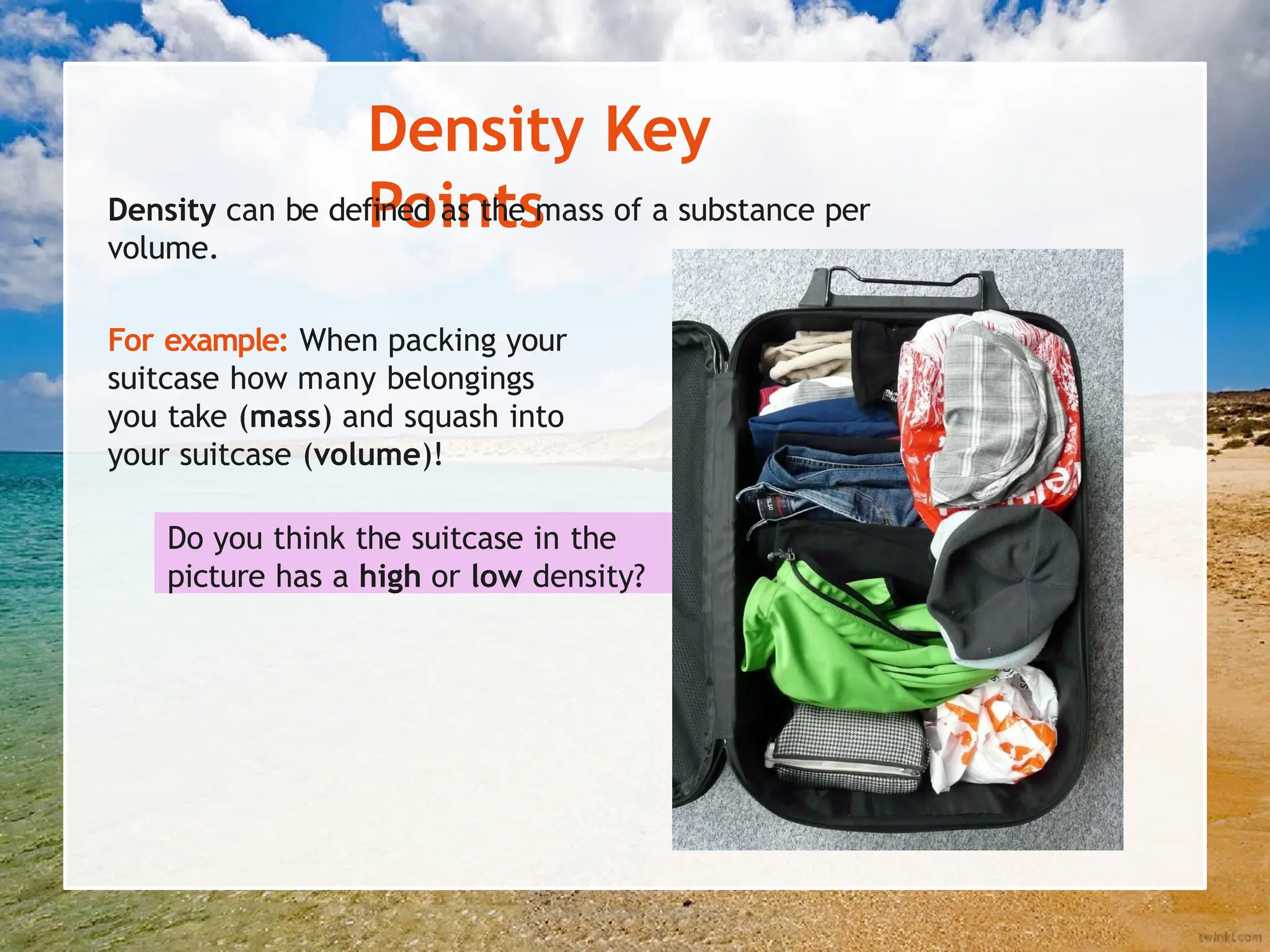
Density can be defined as the mass of a substance per
volume.
For example: When packing your
suitcase how many belongings
you take (mass) and squash into
your suitcase (volume)!
Do you think the suitcase in the
picture has a high or low density?
Density Key
Points
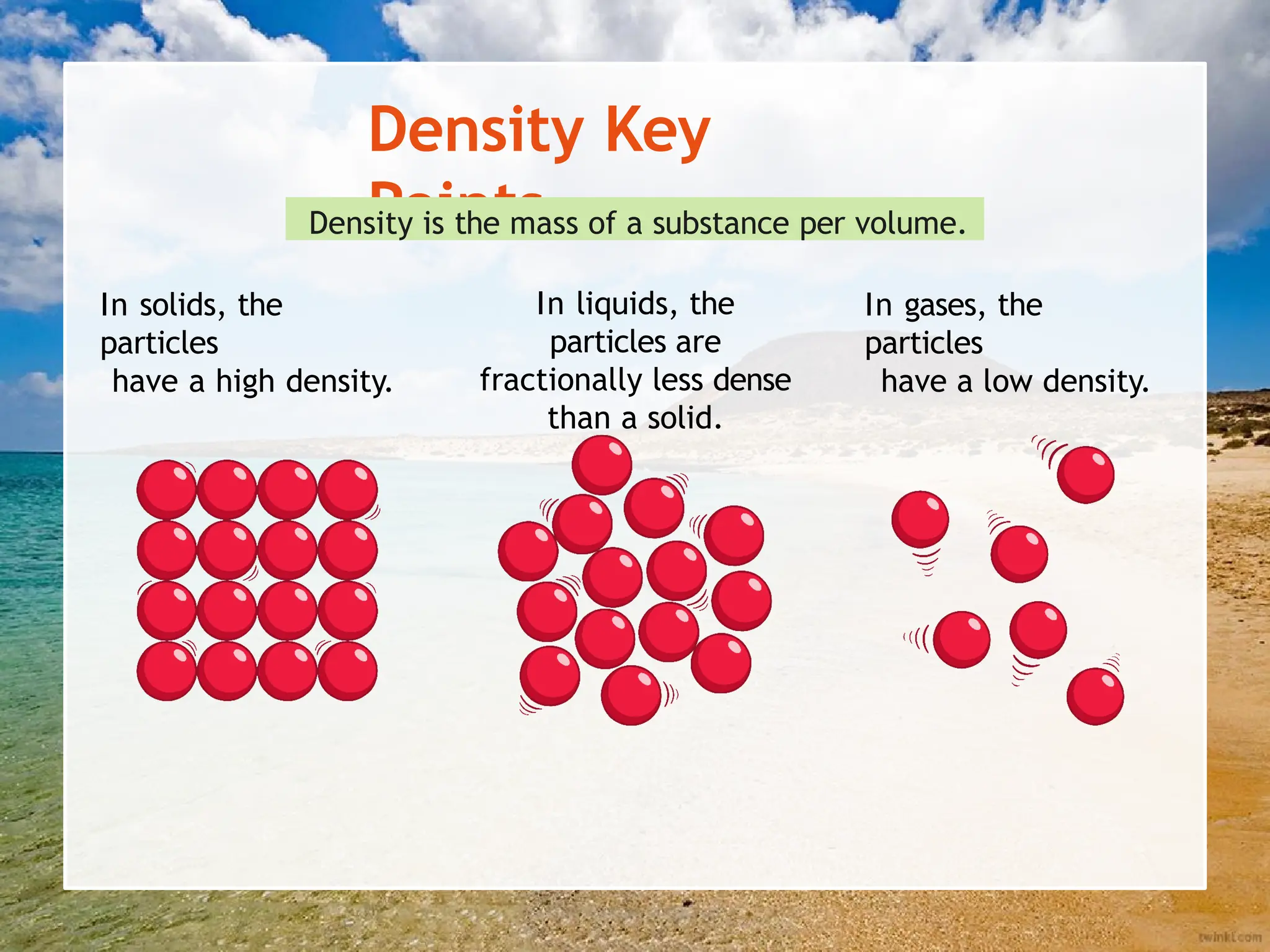
Density is the mass of a substance per volume.
In gases, the
particles
have a low density.
In liquids, the
particles are
fractionally less dense
than a solid.
In solids, the
particles
have a high density.
Analogy Activity: …is like… because…
Challenge 1:
Add some of your
own examples.
Challenge 2:
Can you use the word density
in your explanation?
By mailer_diablo, via Wikimedia
Commons
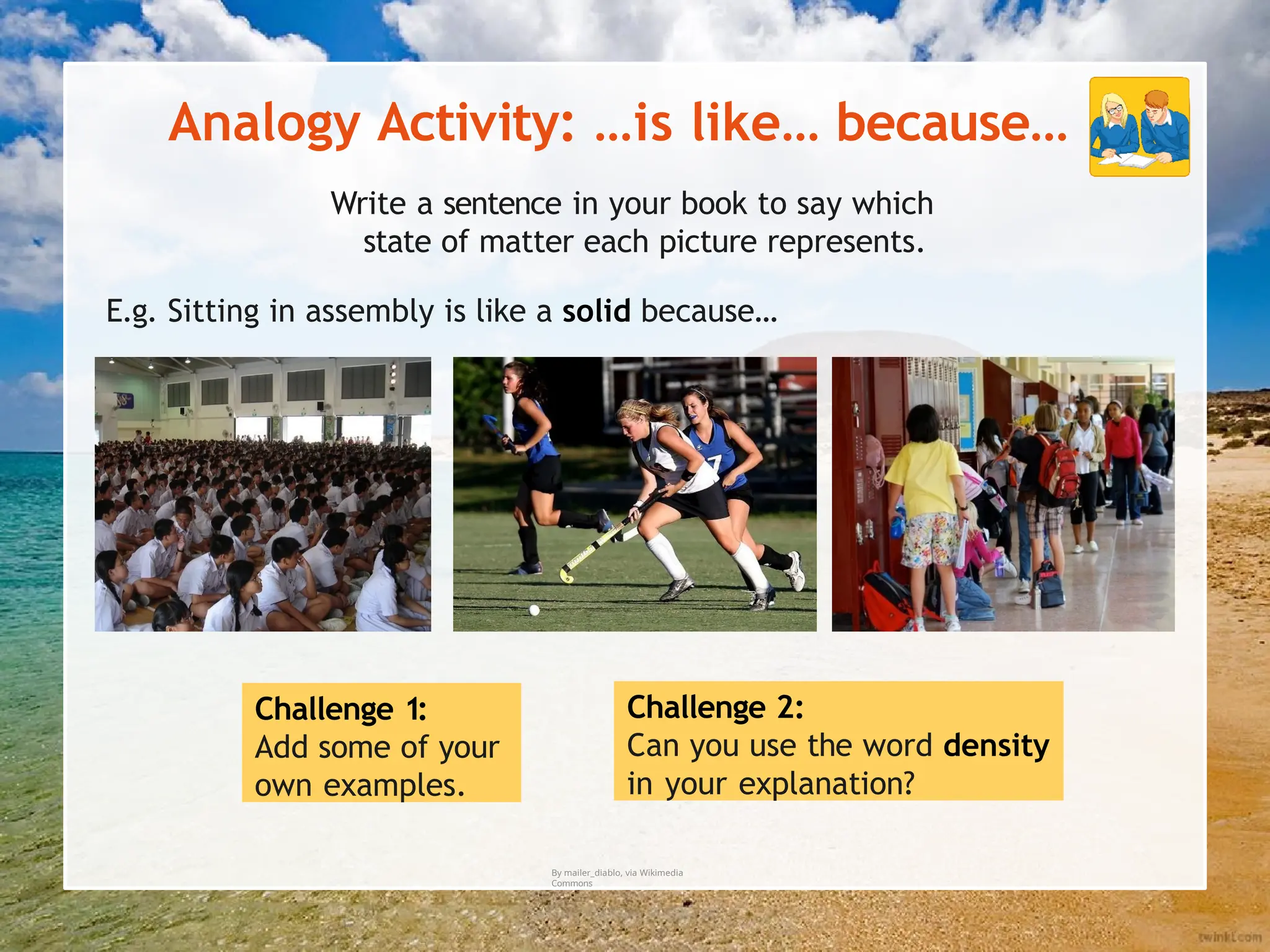
Write a sentence in your book to say which
state of matter each picture represents.
E.g. Sitting in assembly is like a solid because…
Example Responses
By mailer_diablo, via Wikimedia
Commons
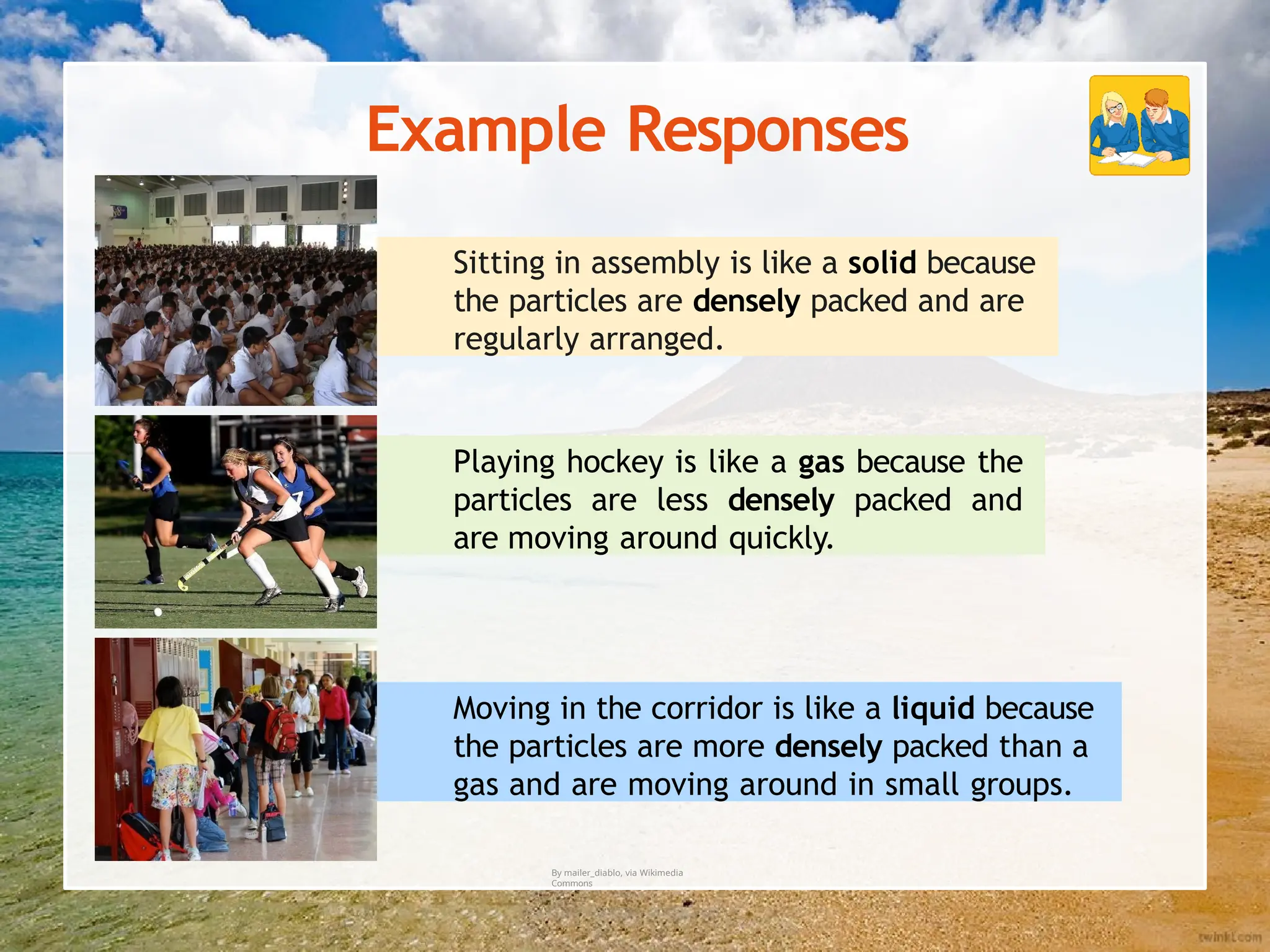
Sitting in assembly is like a solid because
the particles are densely packed and are
regularly arranged.
Playing hockey is like a gas because the
particles are less densely packed and
are moving around quickly.
Moving in the corridor is like a liquid because
the particles are more densely packed than a
gas and are moving around in small groups.
Particle Model Key Points
How particles are arranged in solids, liquids
and gases gives them certain properties.
In this situation, properties
are characteristics or
features, not houses or
buildings!
Properties of a Solid
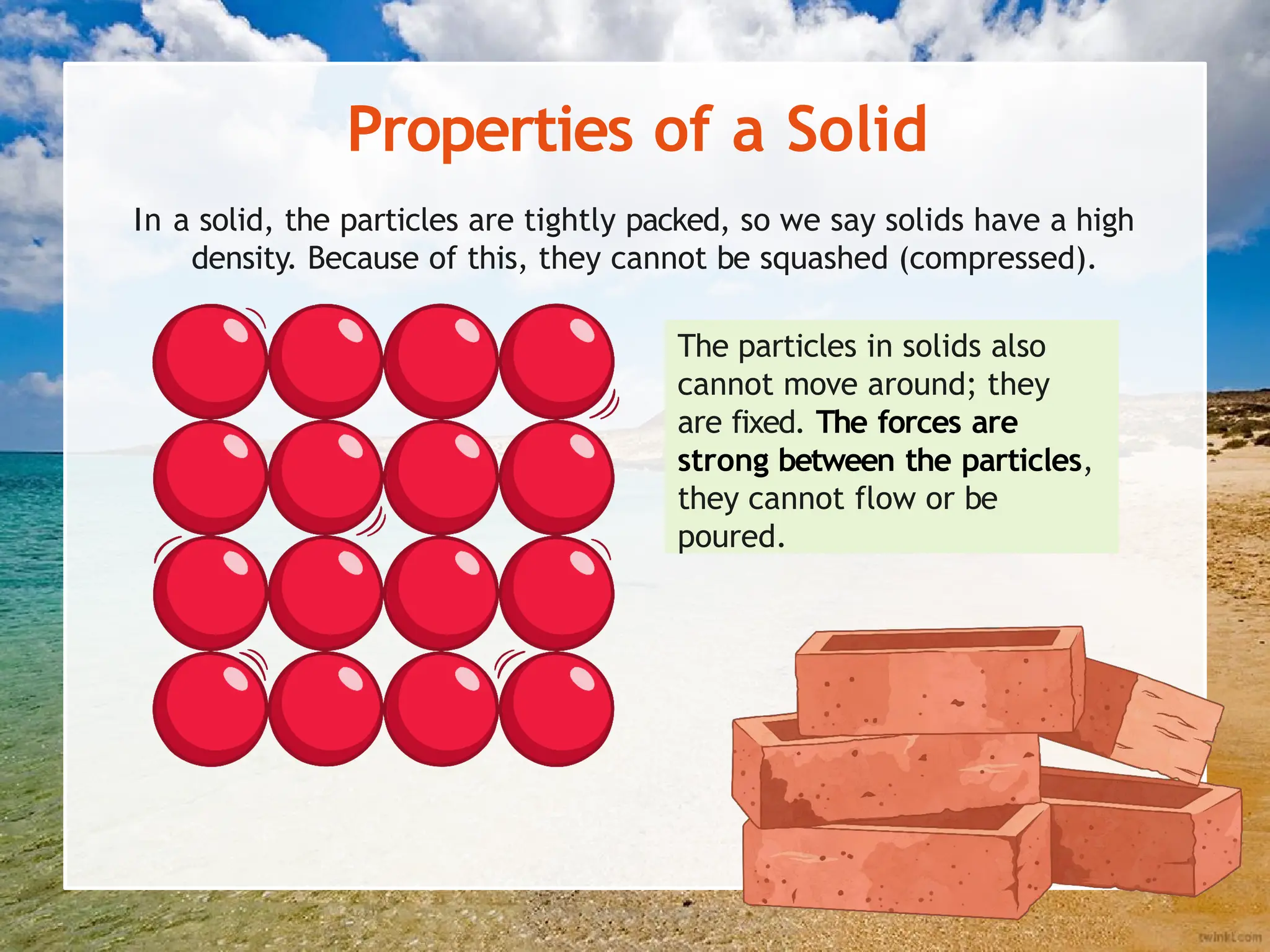
In a solid, the particles are tightly packed, so we say solids have a high
density. Because of this, they cannot be squashed (compressed).
The particles in solids also
cannot move around; they
are fixed. The forces are
strong between the particles,
they cannot flow or be
poured.
Properties of a Liquid
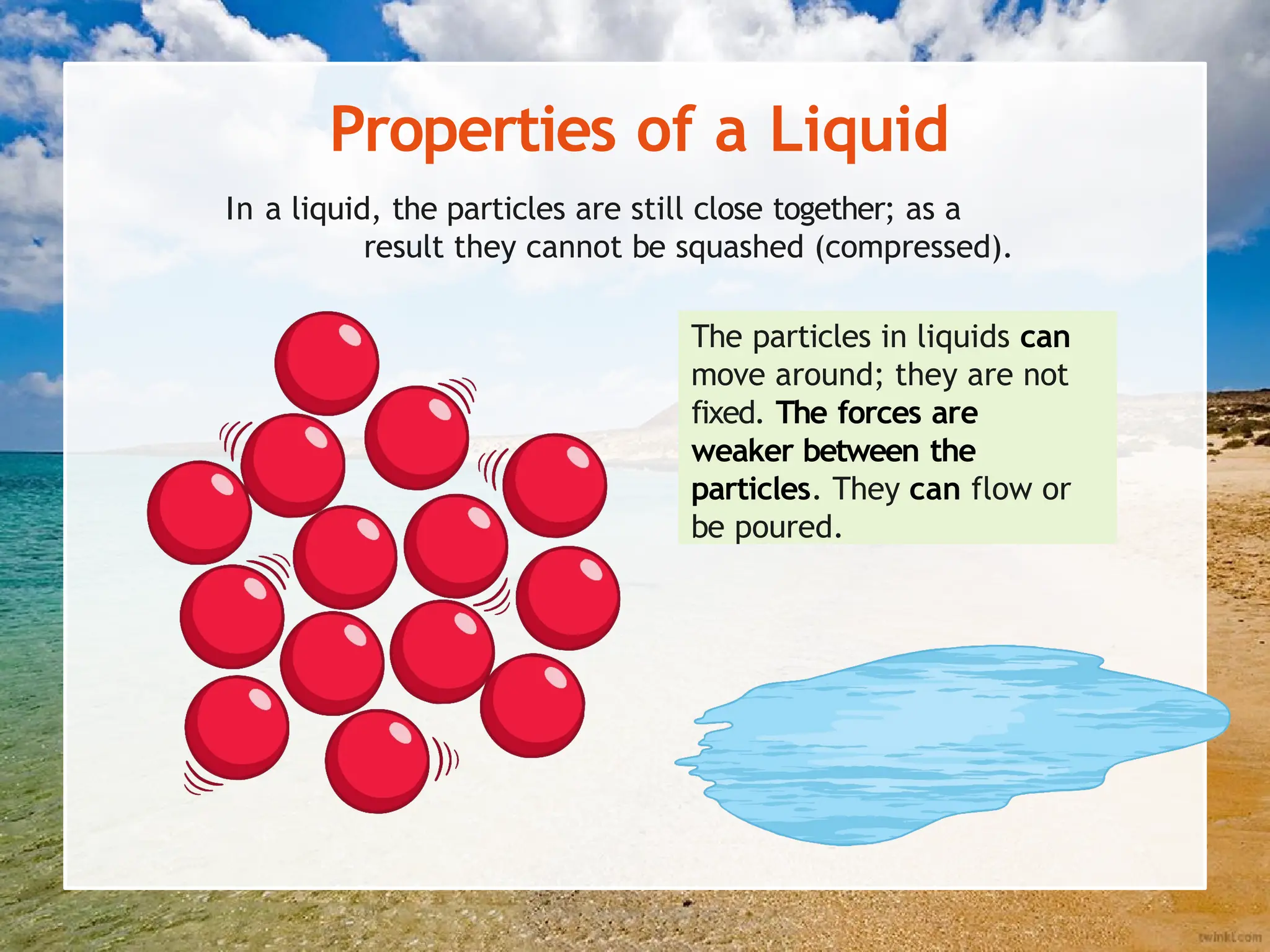
In a liquid, the particles are still close together; as a
result they cannot be squashed (compressed).
The particles in liquids can
move around; they are not
fixed. The forces are
weaker between the
particles. They can flow or
be poured.
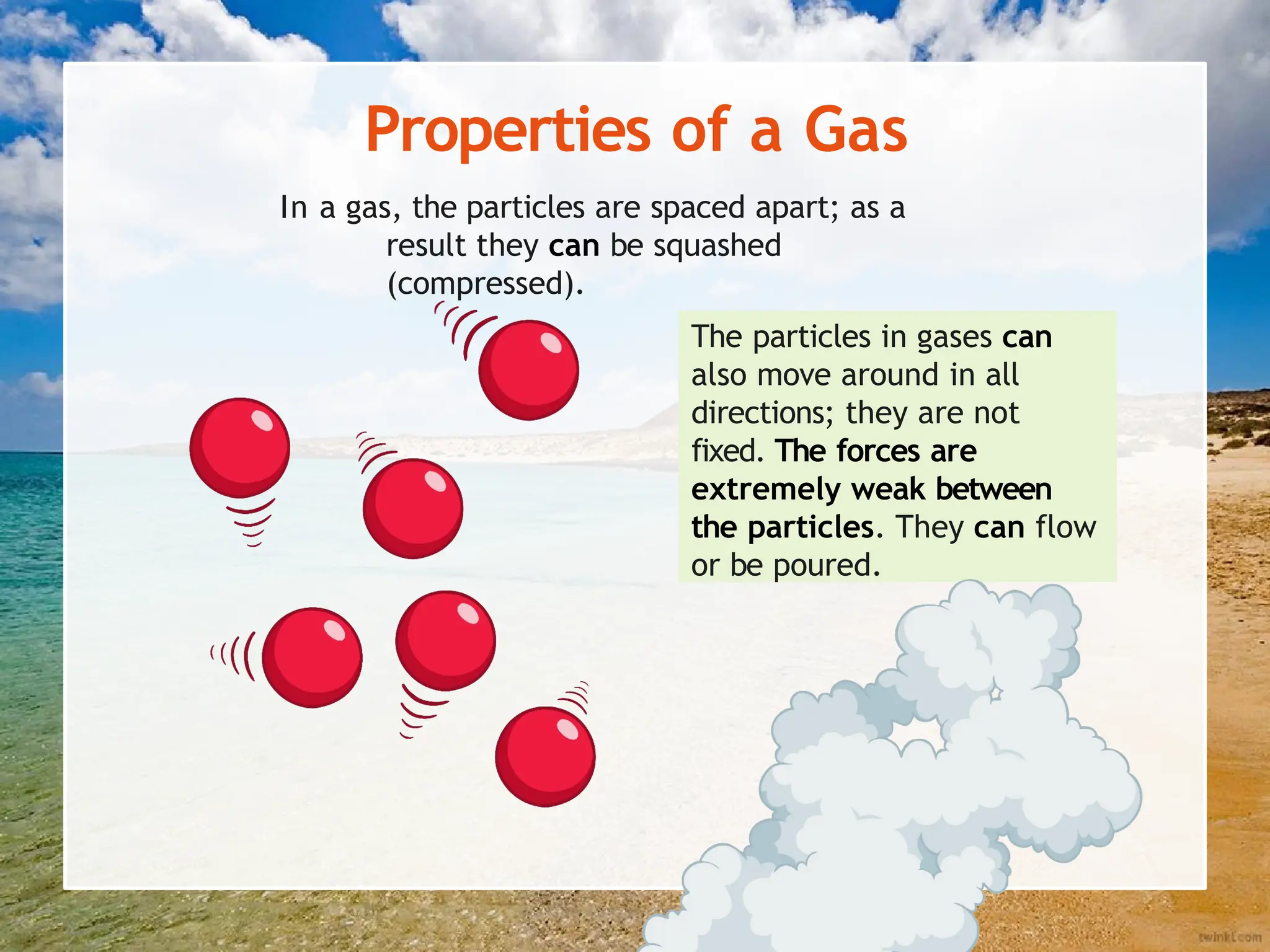
Properties of a Gas
In a gas, the particles are spaced apart; as a
result they can be squashed
(compressed).
The particles in gases can
also move around in all
directions; they are not
fixed. The forces are
extremely weak between
the particles. They can flow
or be poured.
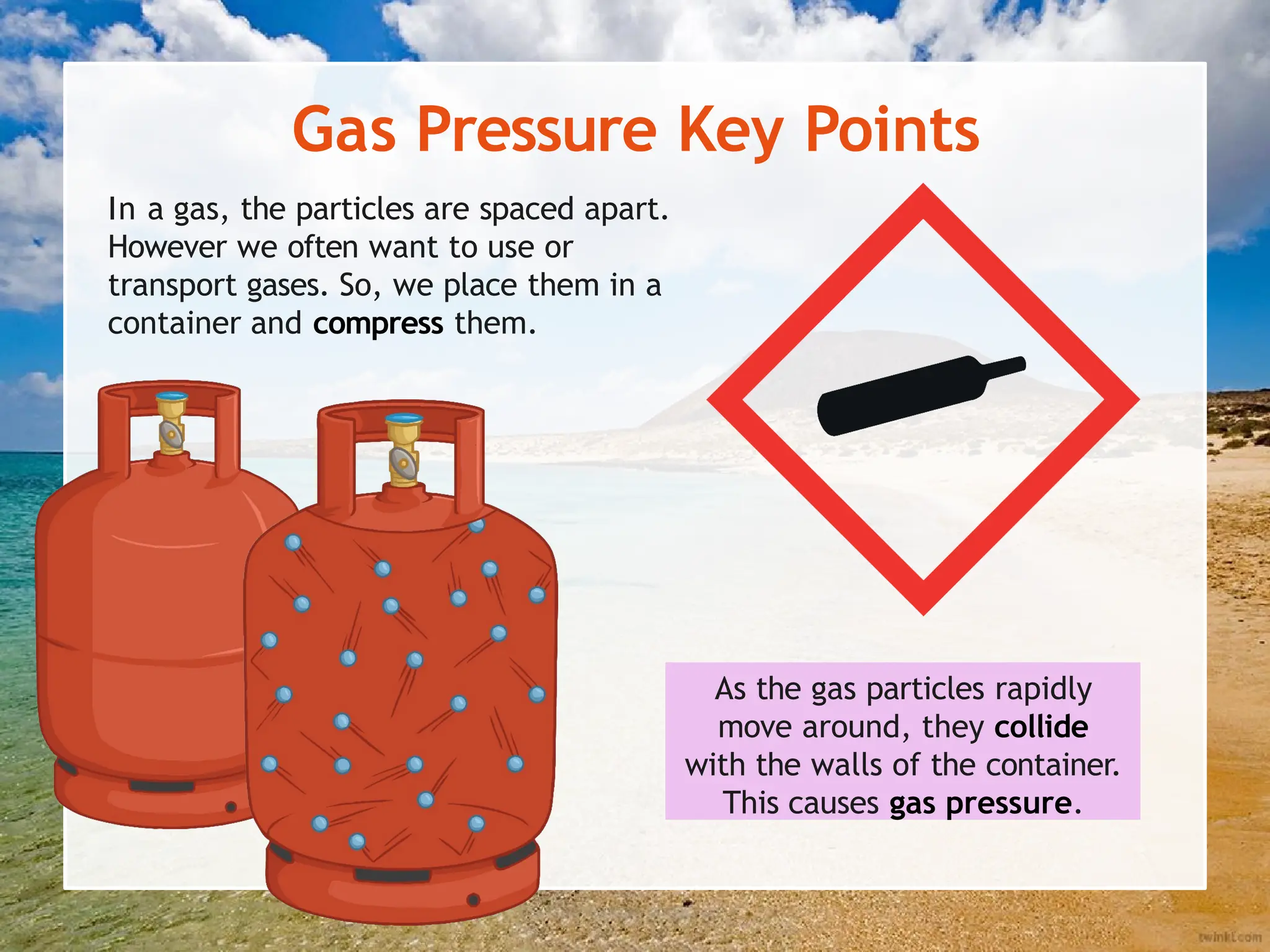
Gas Pressure Key Points
In a gas, the particles are spaced apart.
However we often want to use or
transport gases. So, we place them in a
container and compress them.
As the gas particles rapidly
move around, they collide
with the walls of the container.
This causes gas pressure.
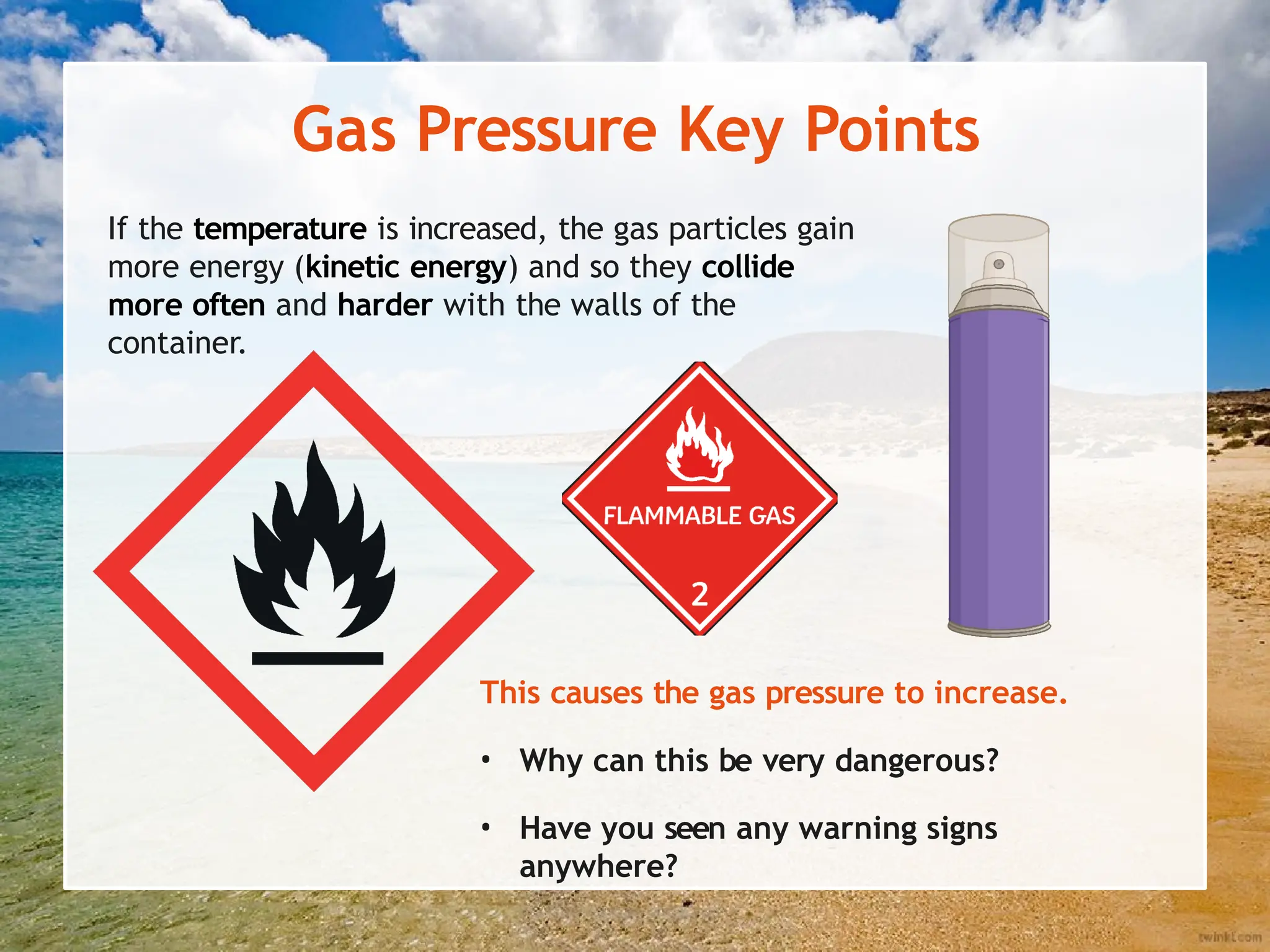
Gas Pressure Key Points
If the temperature is increased, the gas particles gain
more energy (kinetic energy) and so they collide
more often and harder with the walls of the
container.
This causes the gas pressure to increase.
• Why can this be very dangerous?
• Have you seen any warning signs
anywhere?
‘Lift Off’ Plenary
3
keywords
2 facts
1 question
What Did You Achieve Today?
I can identify and describe the arrangement
of particles in each state of matter.
I can define density.
I can link the arrangement of particles in
each state of matter to their properties.
1-states-of-matter-particle-model-powerpoint.pptx

1-states-of-matter-particle-model-powerpoint.pptx

  • 1.
    Chemistry – Statesof Matter The Particle Model
  • 2.
    Learning Objective • Tounderstand how particles are arranged in the three states of matter. Success Criteria • To identify the arrangement of particles in each state of matter. • To define density. • To link the arrangement of particles in each state of matter to their properties.
  • 3.
    Starter Can you identifyany states of matter in this picture?
  • 4.
    Recap: Matter Key Points Everythingis made up of matter. Matter is any substance that has mass and takes up space (volume). The three states of matter you will learn about in Key Stage 3 Science are: • solids • liquids • gases
  • 5.
    Matter Key Points:Zooming In If we were to ‘zoom in’ to solids, liquids and gases they would all look different. To make it easier, we use small circles to represent all molecules or atoms as matter. These small circles of matter are often called particles.
  • 6.
    Arranging Particles: Thinking Activity Inpairs you have two minutes to use the equipment from your pencil cases to represent how you think the particles are arranged in solids, liquids and gases! Take a handful of pens and pretend they are particles and arrange them how you think particles would look like in a solid. Then, a few centimetres away, repeat this process with liquids and gases. One minute left! Time’s up!
  • 7.
    How Particles AreArranged Solid Liqui d Gas
  • 8.
    The History ofthe Particle Model • Scientists use models to help show ideas more clearly. • In the particle model, we use circles to represent all types of matter. • The particle model is also a theory. • Scientists have been developing, testing and revising this theory for over 2,000 years.
  • 9.
    The History ofthe Particle Model Democritus was a Greek philosopher who was the first person to realise that all matter is made of particles, over 2,400 years ago! Democritus thought that if you kept cutting up matter, at some point you wouldn’t be able to cut up it any further. He named these tiny particles ‘atomos’ which is Greek for ‘indivisible’. This is where the word ‘atom’ comes from.
  • 10.
    The History ofthe Particle Model Since Democritus, several scientists have researched into atoms. They include John Dalton (1766-1844) who concluded these points, amongst others: • All matter is made up of atoms. • Atoms cannot be created or destroyed. • Atoms cannot be split.
  • 11.
    Density Key Points Density canbe defined as the mass of a substance per volume. For example: When packing your suitcase how many belongings you take (mass) and squash into your suitcase (volume)! Do you think the suitcase in the picture has a high or low density?
  • 12.
    Density Key Points Density isthe mass of a substance per volume. In gases, the particles have a low density. In liquids, the particles are fractionally less dense than a solid. In solids, the particles have a high density.
  • 13.
    Analogy Activity: …islike… because… Challenge 1: Add some of your own examples. Challenge 2: Can you use the word density in your explanation? By mailer_diablo, via Wikimedia Commons Write a sentence in your book to say which state of matter each picture represents. E.g. Sitting in assembly is like a solid because…
  • 14.
    Example Responses By mailer_diablo,via Wikimedia Commons Sitting in assembly is like a solid because the particles are densely packed and are regularly arranged. Playing hockey is like a gas because the particles are less densely packed and are moving around quickly. Moving in the corridor is like a liquid because the particles are more densely packed than a gas and are moving around in small groups.
  • 15.
    Particle Model KeyPoints How particles are arranged in solids, liquids and gases gives them certain properties. In this situation, properties are characteristics or features, not houses or buildings!
  • 16.
    Properties of aSolid In a solid, the particles are tightly packed, so we say solids have a high density. Because of this, they cannot be squashed (compressed). The particles in solids also cannot move around; they are fixed. The forces are strong between the particles, they cannot flow or be poured.
  • 17.
    Properties of aLiquid In a liquid, the particles are still close together; as a result they cannot be squashed (compressed). The particles in liquids can move around; they are not fixed. The forces are weaker between the particles. They can flow or be poured.
  • 18.
    Properties of aGas In a gas, the particles are spaced apart; as a result they can be squashed (compressed). The particles in gases can also move around in all directions; they are not fixed. The forces are extremely weak between the particles. They can flow or be poured.
  • 19.
    Gas Pressure KeyPoints In a gas, the particles are spaced apart. However we often want to use or transport gases. So, we place them in a container and compress them. As the gas particles rapidly move around, they collide with the walls of the container. This causes gas pressure.
  • 20.
    Gas Pressure KeyPoints If the temperature is increased, the gas particles gain more energy (kinetic energy) and so they collide more often and harder with the walls of the container. This causes the gas pressure to increase. • Why can this be very dangerous? • Have you seen any warning signs anywhere?
  • 21.
  • 22.
    What Did YouAchieve Today? I can identify and describe the arrangement of particles in each state of matter. I can define density. I can link the arrangement of particles in each state of matter to their properties.