Computerized system
validation
Presenter:
Amruta Balekundri
M.Pharm 2nd semester,
Department of Pharmaceutical
Quality Assurance,
KLE College of Pharmacy, Belagavi.
1
CONTENTS
• Computerized system validation
• Electronic records and Digital signatures as per CFR 21 part
11
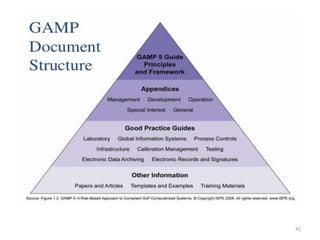
• GAMP
• GAMP 5 --Quality Risk Management
2
Computer System Validation(CSV)
Computer system installed in the corporations are validated to
assure that:
1.Systems are developed according to quality software
engineering principles.
2. Systems meet the business needs of their users
3. Continue to operate correctly and reliably throughout their life
cycle. we can say that CSV provides documented proof that
the system (e.g. hardware, software, peripherals and networks)
will repeatedly and reliably do what it is designed to do, is
“fit-for-purpose”, and complies with the applicable rules and
regulations
3
Regulatory Requirements
• In 1983, FDA published a guide to the inspection of
Computerized Systems in Pharmaceutical Processing, also
known as the ‘bluebook’ (FDA 1983).
• FDA introduced 21 CFR Part 11 for rules on the use of
electronic records and electronic signatures (FDA 1997).
• Part 11 applies to electronic records and electronic signatures
that persons create, modify, maintain, archive, retrieve, or
transmit under any records or signature requirement set forth
in the Federal Food, Drug, and Cosmetic Act, the Public
Health Service Act (PHS Act), or any FDA regulation.
4
What is 21 CFR Part 11?
21 CFR Part 11: Allow the industry to use electronic records
and signatures alternatively to paper records and hand-
written signatures
21 CFR Part 11 applies: -
• To all FDA regulated environments - When using computers in
the creation, modification, archiving, retrieval or transmission
of data or records
• To records required by predicate rules – GLP, GCP, GMP –
that impact patient safety.
5
Purpose of Part 11
• Ensure data is not corrupted or lost.
• Data is secure.
• Approvals cannot be repudiated(rejected).
• Changes to data can be traced.
• Attempts to falsify records are made difficult and can be
detected.
6
PART 11 ELECTRONIC RECORDS
ELECTRONIC SIGNATURES :
Subpart A--General Provisions
11.1- Scope.
11.2 - Implementation.
11.3 - Definitions
Subpart B—Electronic Records
11.10 - Controls for closed systems.
11.30 - Controls for open systems.
11.50 - Signature manifestations.
11.70 - Signature/record linking.
7
PART 11 ELECTRONIC RECORDS
ELECTRONIC SIGNATURES :
Subpart C--Electronic Signatures
11.100 - General requirements.
11.200 - Electronic signature components and controls.
11.300 - Controls for identification codes/passwords
8
11.1 Scope
a) electronic records to be trustworthy, reliable, and generally
equivalent to paper records.
b) records in electronic form that are created, modified,
maintained, archived, retrieved, or transmitted,
c) electronic signatures to be equivalent to full handwritten
signatures, initials, and other general signings ,effective on or
after August 20, 1997.
d) Electronic records may be use in lieu(instead) of paper records
e) Computer systems (including hardware and software)
9
Sub part A
General provisions
11.2 Implementation.
a) For records required to be maintained but not submitted to the
agency.
b) For records submitted to the agency
1) The requirements of this part are met
2) document to be submitted have been identified in public
docket No. 92S–0251
10
Sub part A
General provisions
Sub part A
General provisions
11.3 Definitions
• Agency means the Food and Drug Administration.
• Biometrics means a method of verifying an individual’s
identity based on measurement of the individual’s physical
feature(s) or repeatable action(s) where those features and/or
actions are both unique to that individual and measurable .
• Closed system means an environment in which system access
is controlled by persons who are responsible for the content of
electronic records that are on the system.
11
Sub part A
General provisions
11.3 Definitions
• Digital signature means an electronic signature based upon
cryptographic methods of originator authentication, computed
by using a set of rules and a set of parameters such that the
identity of the signer.
• Electronic record means any combination of text, graphics,
data, audio, pictorial, or other information representation in
digital form that is created, modified, maintained, archived,
retrieved, or distributed by a computer system.
• Open system means an environment in which system access is
not controlled by persons who are responsible for the content
of electronic records that are on the system.
12
Sub part A
General provisions
11.10 Controls for closed systems
Controls designed to ensure the authenticity, integrity and, when
appropriate, the confidentiality of electronic records
a) Validation of systems
b) Accurate and complete copies
c) Protection of records by ready retrieval
d) Limiting system access
e) Audit trails
13
Sub part B
Electronic Records
11.10 Controls for closed systems
f) Operational system checks
g) Authority checks
h) Device (e.g., terminal) checks
i) Education, training, and experience
J) Written policies
K) Documentation
• Distribution of, access and system operation and
maintenance.
• Revision and change control.
14
Sub part B
Electronic Records
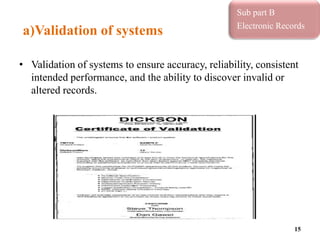
a)Validation of systems
• Validation of systems to ensure accuracy, reliability, consistent
intended performance, and the ability to discover invalid or
altered records.
15
Sub part B
Electronic Records
Sub part B
Electronic Records
b) Accurate and complete copies
• The ability to generate accurate and complete copies of
records in both human readable and electronic form suitable
for inspection, review, and copying by the agency.
• Persons should contact the agency if there are any questions
regarding the ability of the agency to perform such review and
copying of the electronic records.
16
Sub part B
Electronic Records
c) Protection of records by ready retrieval
• Protection of records to enable their accurate and ready
retrieval throughout the records retention period.
d) Limiting System Access
• Limiting system access to authorized individuals
17
Sub part B
Electronic Records
e) Audit Trails
• Use of secure, computer-generated, time-stamped audit trails
to independently record the date and time of operator entries
and actions that create, modify, or delete electronic records.
• Record changes shall not obscure previously recorded
information. Such audit trail documentation shall be retained
for a period at least as long as that required for the subject
electronic records and shall be available for agency review and
copying.
18
Sub part B
Electronic Records
f) Operation Check
• Use of operational system checks to enforce permitted
sequencing of steps and events, as appropriate.
• Empower 3 software uses Wizards to ensure proper
sequencing.
• New Project Wizard
• Processing Method Wizard
• Sample Set Method Wizard
• Backup Project Wizard
• Restore Project Wizard
19
Sub part B
Electronic Records
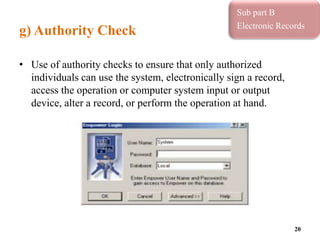
g) Authority Check
• Use of authority checks to ensure that only authorized
individuals can use the system, electronically sign a record,
access the operation or computer system input or output
device, alter a record, or perform the operation at hand.
20
Sub part B
Electronic Records
h) Device Check
• Use of device (e.g., terminal) checks to determine, as
appropriate, the validity of the source of data input or
operational instruction.
• If it is a requirement of the system that data input or
instructions can only come from specific input devices (e.g.
instruments, terminals); does the system check for the correct
device?
21
Sub part B
Electronic Records
i) Education, training, and
experience
• Determination that persons who develop, maintain, or use
electronic record/electronic signature systems have the
education, training, and experience to perform their assigned
tasks.
22
Sub part B
Electronic Records
j) Written Policies
• The establishment of/and adherence to, written policies that
hold individuals accountable and responsible for actions
initiated under their electronic signatures, in order to determine
record and signature falsification .
• Written policies shall be party of user account open with user
sign and statement “I am accountable and responsible for
actions initiated under my electronic signature in order to
determine record and signature falsification” .
23
Sub part B
Electronic Records
k) Documentation
• Use of appropriate controls over systems documentation
including:
(1) Adequate controls over the distribution of access to, and use
of documentation for system operation and maintenance.
(2) Revision and change control procedures to maintain an audit
trail that documents time- sequenced development and
modification of systems documentation
• Distribution of access annexure
• System operation and maintenance log
• Revision procedure
• Change control procedure
• Audit trial with Time sequenced
24
Sub part B
Electronic Records
11.30 Controls for open systems
• Persons who use open systems to create, modify, maintain, or
transmit electronic records shall employ procedures and
controls designed to ensure the authenticity, integrity, and, as
appropriate, the confidentiality of electronic records from the
point of their creation to the point of their receipt.
• Such procedures and controls shall include those identified in
§ 11.10, as appropriate, and additional measures such as
document encryption and use of appropriate digital signature
standards to ensure, as necessary under the circumstances,
record authenticity, integrity, and confidentiality.
25
Sub part B
Electronic Records
11.50 Signature manifestations.
a) Signed electronic records shall contain information
associated with the signing that clearly indicates all of the
following:
(1) The printed name of the signer;
(2) The date and time when the signature was executed;
(3) The meaning (such as review, approval, responsibility, or
authorship) associated with the signature.
b) The items identified in paragraphs
(a)(1), (a)(2), and (a)(3) of this section shall be subject to the
same controls as for electronic records and shall be included as
part of any human readable form of the electronic record (such
as electronic display or printout).
26
Sub part B
Electronic Records
11.70 Signature/record linking.
• Electronic signatures and handwritten signatures executed to
electronic records shall be linked to their respective electronic
records to ensure that the signatures cannot be excised, copied,
or otherwise transferred to falsify an electronic record by
ordinary means.
27
Sub part B
Electronic Records
11.100 General requirements
a) Unique : Each electronic signature shall be unique to one
individual and shall not be reused by, or reassigned to, anyone
else.
b)Verify the identity : Before an organization establishes,
assigns, certifies, or otherwise sanctions an individual’s
electronic signature, or any element of such electronic
signature, the organization shall verify the identity of the
individual.
• At the time of joining that activity done by HR Department .
• For vendor in service agreement need to be clarification.
28
Sub part C
Electronic Signatures
11.100 General requirements
c) Certify to the agency :Persons using electronic signatures shall,
prior to or at the time of such use, certify to the agency that the
electronic signatures in their system, used on or after August 20,
1997, are intended to be the legally binding equivalent of traditional
handwritten signatures.
1) The certification shall be submitted in paper form and signed with a
traditional handwritten signature, to the Office of Regional
Operations (HFC–100), 5600 Fishers Lane, Rockville, MD 20857.
2) Persons using electronic signatures shall, upon agency request,
provide additional certification or testimony that a specific
electronic signature is the legally binding equivalent of the signer’s
handwritten signature.
 For 11.2 Implementation. b) For records submitted to the agency
29
Sub part C
Electronic Signatures
11.200 Electronic Signatures
components and controls
a) Non Biometric :Electronic signatures that are not based upon
biometrics shall--
(1) Employ at least two distinct identification components such
as an identification code and password.
(i) When an individual executes a series of signings during a
single, continuous period of controlled system access, the first
signing shall be executed using all electronic signature
components; subsequent signings shall be executed using at
least one electronic signature component that is only
executable by, and designed to be used only by, the individual.
30
Sub part C
Electronic Signatures
11.200 Electronic Signatures
components and controls
(ii) When an individual executes one or more signings not
performed during a single, continuous period of controlled
system access, each signing shall be executed using all of the
electronic signature components.
2) Be used only by their genuine owners;
3) Be administered and executed to ensure that attempted use of
an individual’s electronic signature by anyone other than its
genuine owner requires collaboration of two or more
individuals.
31
Sub part C
Electronic Signatures
11.200 Electronic Signatures
components and controls
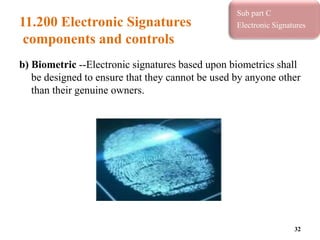
b) Biometric --Electronic signatures based upon biometrics shall
be designed to ensure that they cannot be used by anyone other
than their genuine owners.
32
Sub part C
Electronic Signatures
11.300 Controls for
identification codes/ passwords
• Persons who use electronic signatures based upon use of
identification codes in combination with passwords shall
employ controls to ensure their security and integrity. Such
controls shall include:
a) Uniqueness --Maintaining the uniqueness of each combined
identification code and password, such that no two individuals
have the same combination of identification code and
password.
33
Sub part C
Electronic Signatures
11.300 Controls for
identification codes/ passwords
b) Code and password Periodically Checked --Ensuring that
identification code and password issuances are periodically
checked, recalled, or revised (e.g., to cover such events as
password aging).
c) Loss management --Following loss management procedures
to electronically de-authorize lost, stolen, missing, or
otherwise potentially compromised tokens, cards, and other
devices that bear or generate identification code or password
information, and to issue temporary or permanent
replacements using suitable, rigorous.
34
Sub part C
Electronic Signatures
11.300 Controls for
identification codes/ passwords
d) Safeguard to prevent unauthorized --Use of transaction
safeguards to prevent unauthorized use of passwords and/or
identification codes, and to detect and report in an immediate
and urgent manner any attempts at their unauthorized use to
the system security unit, and, as appropriate, to organizational
management.
e) Periodic testing of devices --Initial and periodic testing of
devices, such as tokens or cards, that bear or generate
identification code or password information to ensure that they
function properly and have not been altered in an unauthorized
manner.
35
Sub part C
Electronic Signatures
GAMP – Good Automated Manufacturing
Practices
• It was founded in 1991 and is a trademark of the International
Society for Pharmaceutical Engineering (ISPE).
• GAMP-5 was launched in 2008 and includes a set of
procedures that help to ensure automation equipment/software
meets required quality standards.
36
GAMP – Good Automated Manufacturing
Practices
• Quality by design is a central principle of GAMP and
advocates that quality is built into each stage of the
manufacturing process.
• All aspects of production from the raw materials, facility and
equipment to the training and hygiene of staff are covered by
GAMP recommendations
• Although Good Automated Manufacturing Practice (GAMP)
is not legislation, it’s an important guideline for companies
involved in the development and/or implementation of
automated production systems.
37
GAMP Objectives
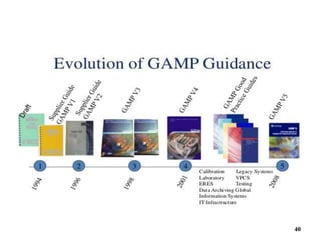
• GAMP® guidance aims to achieve computerized systems that
are fit for intended use and meet current regulatory
requirements, by building upon existing industry good practice
in an efficient and effective manner.
38
Guidance
 It is not a prescriptive method or a standard , but..
• Pragmatic guidance
• Approaches
• Tools for the practitioner
 Applied with expertise and good judgment
39
40
41
42
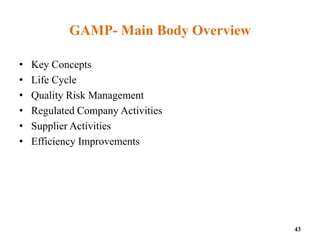
GAMP- Main Body Overview
• Key Concepts
• Life Cycle
• Quality Risk Management
• Regulated Company Activities
• Supplier Activities
• Efficiency Improvements
43
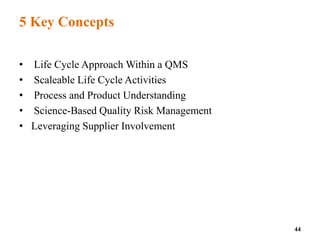
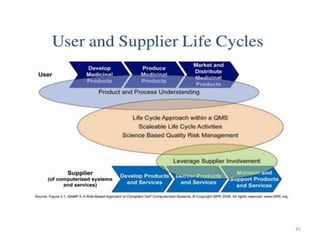
5 Key Concepts
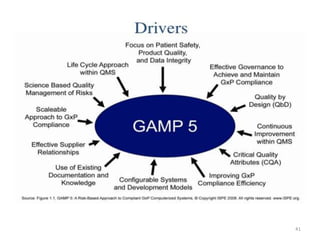
• Life Cycle Approach Within a QMS
• Scaleable Life Cycle Activities
• Process and Product Understanding
• Science-Based Quality Risk Management
• Leveraging Supplier Involvement
44
45
Product and Process Understanding
• Basis of science- and risk-based decisions
• Focus on critical aspects
– Identify
– Specify
– Verify
• Critical Quality Attributes / Critical Process Parameters.
46
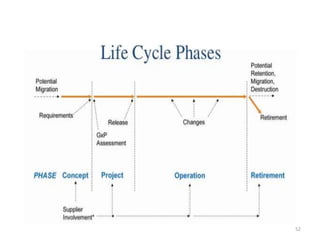
Life Cycle Approach Within a QMS
• Suitable Life Cycle.
–Intrinsic to QMS
• Continuous improvement.
• Life cycle approach is fundamental to GAMP 5.
47
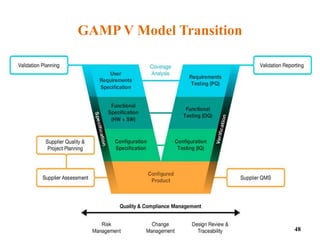
GAMP V Model Transition
48
Scaleable Life Cycle Activities
Scalability is based on --
• Risk
• Complexity and Novelty
• Supplier
49
Science Based Quality Risk Management
 Review Based on ICH Q9
 Assessment
 Control
 Communication
 Focus on patient
 Safety
 product quality
 data integrity
50
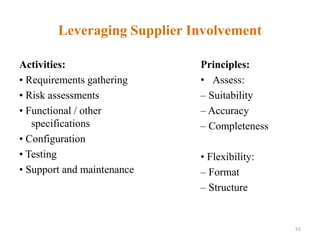
Leveraging Supplier Involvement
Activities:
• Requirements gathering
• Risk assessments
• Functional / other
specifications
• Configuration
• Testing
• Support and maintenance
Principles:
• Assess:
– Suitability
– Accuracy
– Completeness
• Flexibility:
– Format
– Structure
51
52
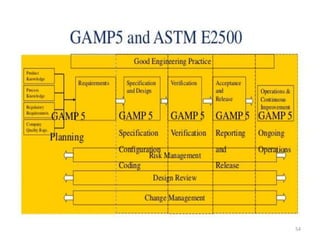
Compatibility with Other Standards
• ASTM( American Society for Testing and Materials) E2500
Standard Guide for Specification, Design, and Verification of
Pharmaceutical and Biopharmaceutical Manufacturing
Systems and Equipment.
53
54
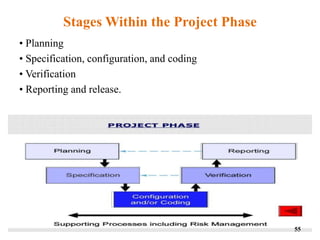
Stages Within the Project Phase
• Planning
• Specification, configuration, and coding
• Verification
• Reporting and release.
55
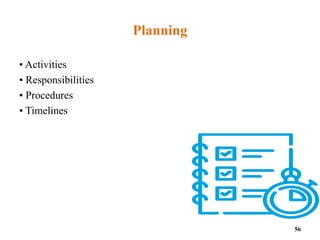
Planning
• Activities
• Responsibilities
• Procedures
• Timelines
56
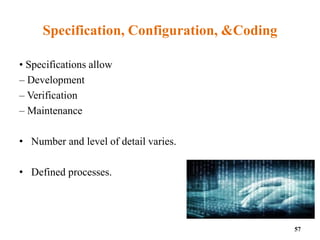
Specification, Configuration, &Coding
• Specifications allow
– Development
– Verification
– Maintenance
• Number and level of detail varies.
• Defined processes.
57
Verification
• Testing
• Reviews
• Identify defects
58
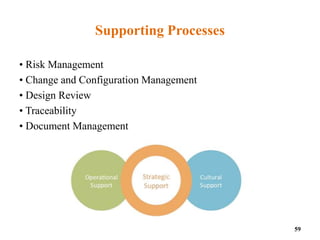
Supporting Processes
• Risk Management
• Change and Configuration Management
• Design Review
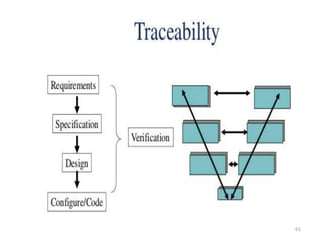
• Traceability
• Document Management
59
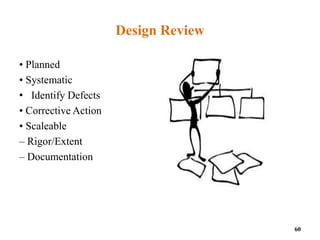
Design Review
• Planned
• Systematic
• Identify Defects
• Corrective Action
• Scaleable
– Rigor/Extent
– Documentation
60
61
62
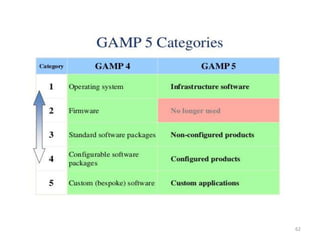
GAMP 5
Quality Risk Management
63
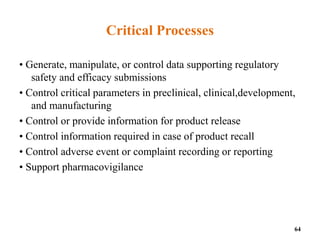
Critical Processes
• Generate, manipulate, or control data supporting regulatory
safety and efficacy submissions
• Control critical parameters in preclinical, clinical,development,
and manufacturing
• Control or provide information for product release
• Control information required in case of product recall
• Control adverse event or complaint recording or reporting
• Support pharmacovigilance
64
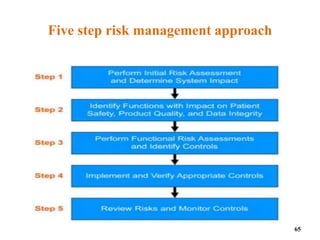
Five step risk management approach
65
Step 1:Initial assessment
• An initial assessment should be performed based on an
understanding of the business process.
• The understanding can be derived from user requirements,
design specifications, operating procedures, regulatory
requirements, and known functional areas.
• The assessment should include a decision on whether the
system is GxP regulated and include an overall assessment of
the system impact.
66
Step 2 – Identify Functions with Impact on
Patient Safety, Product Quality, and Data
Integrity
• Building upon the information obtained in Step 1, the specific
functions that have impact on patient safety, product quality,
and data integrity can be identified and addressed.
• It must be remembered that no function can be assessed as
having higher risk or impact than the process itself.
67
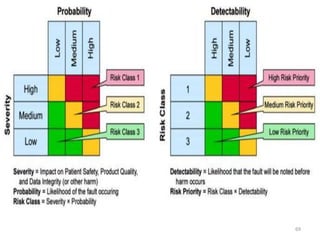
Step 3 – Perform Functional Risk Assessments
and Identify Controls
• The functions identified in the previous step can now be
analyzed by considering possible hazards and what controls
may be needed to minimize potential harm.
• A company’s risk tolerance is also a factor to be considered
when selecting possible controls.
68
69
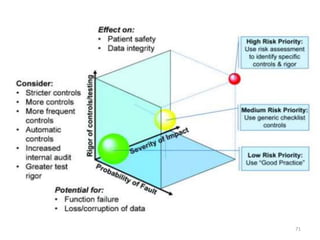
Step 4 – Implement and Verify Appropriate
Testing and Controls
• Once the severity and risk are understood, the appropriate
level of challenge testing can be selected.
• The concept of planning testing and selecting controls based
on assessed risk and impact.
70
71
Step 5 – Review Risks and Monitor Controls
• Once the controls are implemented, they need to be monitored.
The implementation of the controls may reduce the level of
effort for many current activities, such as audits, assessments,
documentation, testing, and even the degree of quality unit
involvement.
72
Conclusion
• The GAMP 5 QRM strategy offers a pragmatic approach to
computer systems compliance.
• It avoids reliance on a single standard that can be excessive
and/or inadequate, and is consistent with ICH Q9 and has
incorporated some elements from ISO-14971.
• It is a framework that is flexible and scalable and assists with
the identification and application of appropriate controls where
they are needed.
73
REFERENCES
• GAMP 5 Quality Risk Management Approach by Kevin C.
Martin and Dr. Arthur (Randy) Perez
• https://www.hpra.ie/docs/default-source/default-document-
library/5-2-cleaning-validation.pdf?sfvrsn=0
• ProPharmaGroup/overview-of-computerized-systems-
compliance-using-the-gamp-5-guide
• https://www.pharmout.net/downloads/white-paper-computer-
system-validation.pdf
• https://www.researchgate.net/publication/215485194_Comput
er_Software_Validation_In_Pharmaceuticals
74
75

Computer system validations

  • 1.
    Computerized system validation Presenter: Amruta Balekundri M.Pharm2nd semester, Department of Pharmaceutical Quality Assurance, KLE College of Pharmacy, Belagavi. 1
  • 2.
    CONTENTS • Computerized systemvalidation • Electronic records and Digital signatures as per CFR 21 part 11 • GAMP • GAMP 5 --Quality Risk Management 2
  • 3.
    Computer System Validation(CSV) Computersystem installed in the corporations are validated to assure that: 1.Systems are developed according to quality software engineering principles. 2. Systems meet the business needs of their users 3. Continue to operate correctly and reliably throughout their life cycle. we can say that CSV provides documented proof that the system (e.g. hardware, software, peripherals and networks) will repeatedly and reliably do what it is designed to do, is “fit-for-purpose”, and complies with the applicable rules and regulations 3
  • 4.
    Regulatory Requirements • In1983, FDA published a guide to the inspection of Computerized Systems in Pharmaceutical Processing, also known as the ‘bluebook’ (FDA 1983). • FDA introduced 21 CFR Part 11 for rules on the use of electronic records and electronic signatures (FDA 1997). • Part 11 applies to electronic records and electronic signatures that persons create, modify, maintain, archive, retrieve, or transmit under any records or signature requirement set forth in the Federal Food, Drug, and Cosmetic Act, the Public Health Service Act (PHS Act), or any FDA regulation. 4
  • 5.
    What is 21CFR Part 11? 21 CFR Part 11: Allow the industry to use electronic records and signatures alternatively to paper records and hand- written signatures 21 CFR Part 11 applies: - • To all FDA regulated environments - When using computers in the creation, modification, archiving, retrieval or transmission of data or records • To records required by predicate rules – GLP, GCP, GMP – that impact patient safety. 5
  • 6.
    Purpose of Part11 • Ensure data is not corrupted or lost. • Data is secure. • Approvals cannot be repudiated(rejected). • Changes to data can be traced. • Attempts to falsify records are made difficult and can be detected. 6
  • 7.
    PART 11 ELECTRONICRECORDS ELECTRONIC SIGNATURES : Subpart A--General Provisions 11.1- Scope. 11.2 - Implementation. 11.3 - Definitions Subpart B—Electronic Records 11.10 - Controls for closed systems. 11.30 - Controls for open systems. 11.50 - Signature manifestations. 11.70 - Signature/record linking. 7
  • 8.
    PART 11 ELECTRONICRECORDS ELECTRONIC SIGNATURES : Subpart C--Electronic Signatures 11.100 - General requirements. 11.200 - Electronic signature components and controls. 11.300 - Controls for identification codes/passwords 8
  • 9.
    11.1 Scope a) electronicrecords to be trustworthy, reliable, and generally equivalent to paper records. b) records in electronic form that are created, modified, maintained, archived, retrieved, or transmitted, c) electronic signatures to be equivalent to full handwritten signatures, initials, and other general signings ,effective on or after August 20, 1997. d) Electronic records may be use in lieu(instead) of paper records e) Computer systems (including hardware and software) 9 Sub part A General provisions
  • 10.
    11.2 Implementation. a) Forrecords required to be maintained but not submitted to the agency. b) For records submitted to the agency 1) The requirements of this part are met 2) document to be submitted have been identified in public docket No. 92S–0251 10 Sub part A General provisions Sub part A General provisions
  • 11.
    11.3 Definitions • Agencymeans the Food and Drug Administration. • Biometrics means a method of verifying an individual’s identity based on measurement of the individual’s physical feature(s) or repeatable action(s) where those features and/or actions are both unique to that individual and measurable . • Closed system means an environment in which system access is controlled by persons who are responsible for the content of electronic records that are on the system. 11 Sub part A General provisions
  • 12.
    11.3 Definitions • Digitalsignature means an electronic signature based upon cryptographic methods of originator authentication, computed by using a set of rules and a set of parameters such that the identity of the signer. • Electronic record means any combination of text, graphics, data, audio, pictorial, or other information representation in digital form that is created, modified, maintained, archived, retrieved, or distributed by a computer system. • Open system means an environment in which system access is not controlled by persons who are responsible for the content of electronic records that are on the system. 12 Sub part A General provisions
  • 13.
    11.10 Controls forclosed systems Controls designed to ensure the authenticity, integrity and, when appropriate, the confidentiality of electronic records a) Validation of systems b) Accurate and complete copies c) Protection of records by ready retrieval d) Limiting system access e) Audit trails 13 Sub part B Electronic Records
  • 14.
    11.10 Controls forclosed systems f) Operational system checks g) Authority checks h) Device (e.g., terminal) checks i) Education, training, and experience J) Written policies K) Documentation • Distribution of, access and system operation and maintenance. • Revision and change control. 14 Sub part B Electronic Records
  • 15.
    a)Validation of systems •Validation of systems to ensure accuracy, reliability, consistent intended performance, and the ability to discover invalid or altered records. 15 Sub part B Electronic Records Sub part B Electronic Records
  • 16.
    b) Accurate andcomplete copies • The ability to generate accurate and complete copies of records in both human readable and electronic form suitable for inspection, review, and copying by the agency. • Persons should contact the agency if there are any questions regarding the ability of the agency to perform such review and copying of the electronic records. 16 Sub part B Electronic Records
  • 17.
    c) Protection ofrecords by ready retrieval • Protection of records to enable their accurate and ready retrieval throughout the records retention period. d) Limiting System Access • Limiting system access to authorized individuals 17 Sub part B Electronic Records
  • 18.
    e) Audit Trails •Use of secure, computer-generated, time-stamped audit trails to independently record the date and time of operator entries and actions that create, modify, or delete electronic records. • Record changes shall not obscure previously recorded information. Such audit trail documentation shall be retained for a period at least as long as that required for the subject electronic records and shall be available for agency review and copying. 18 Sub part B Electronic Records
  • 19.
    f) Operation Check •Use of operational system checks to enforce permitted sequencing of steps and events, as appropriate. • Empower 3 software uses Wizards to ensure proper sequencing. • New Project Wizard • Processing Method Wizard • Sample Set Method Wizard • Backup Project Wizard • Restore Project Wizard 19 Sub part B Electronic Records
  • 20.
    g) Authority Check •Use of authority checks to ensure that only authorized individuals can use the system, electronically sign a record, access the operation or computer system input or output device, alter a record, or perform the operation at hand. 20 Sub part B Electronic Records
  • 21.
    h) Device Check •Use of device (e.g., terminal) checks to determine, as appropriate, the validity of the source of data input or operational instruction. • If it is a requirement of the system that data input or instructions can only come from specific input devices (e.g. instruments, terminals); does the system check for the correct device? 21 Sub part B Electronic Records
  • 22.
    i) Education, training,and experience • Determination that persons who develop, maintain, or use electronic record/electronic signature systems have the education, training, and experience to perform their assigned tasks. 22 Sub part B Electronic Records
  • 23.
    j) Written Policies •The establishment of/and adherence to, written policies that hold individuals accountable and responsible for actions initiated under their electronic signatures, in order to determine record and signature falsification . • Written policies shall be party of user account open with user sign and statement “I am accountable and responsible for actions initiated under my electronic signature in order to determine record and signature falsification” . 23 Sub part B Electronic Records
  • 24.
    k) Documentation • Useof appropriate controls over systems documentation including: (1) Adequate controls over the distribution of access to, and use of documentation for system operation and maintenance. (2) Revision and change control procedures to maintain an audit trail that documents time- sequenced development and modification of systems documentation • Distribution of access annexure • System operation and maintenance log • Revision procedure • Change control procedure • Audit trial with Time sequenced 24 Sub part B Electronic Records
  • 25.
    11.30 Controls foropen systems • Persons who use open systems to create, modify, maintain, or transmit electronic records shall employ procedures and controls designed to ensure the authenticity, integrity, and, as appropriate, the confidentiality of electronic records from the point of their creation to the point of their receipt. • Such procedures and controls shall include those identified in § 11.10, as appropriate, and additional measures such as document encryption and use of appropriate digital signature standards to ensure, as necessary under the circumstances, record authenticity, integrity, and confidentiality. 25 Sub part B Electronic Records
  • 26.
    11.50 Signature manifestations. a)Signed electronic records shall contain information associated with the signing that clearly indicates all of the following: (1) The printed name of the signer; (2) The date and time when the signature was executed; (3) The meaning (such as review, approval, responsibility, or authorship) associated with the signature. b) The items identified in paragraphs (a)(1), (a)(2), and (a)(3) of this section shall be subject to the same controls as for electronic records and shall be included as part of any human readable form of the electronic record (such as electronic display or printout). 26 Sub part B Electronic Records
  • 27.
    11.70 Signature/record linking. •Electronic signatures and handwritten signatures executed to electronic records shall be linked to their respective electronic records to ensure that the signatures cannot be excised, copied, or otherwise transferred to falsify an electronic record by ordinary means. 27 Sub part B Electronic Records
  • 28.
    11.100 General requirements a)Unique : Each electronic signature shall be unique to one individual and shall not be reused by, or reassigned to, anyone else. b)Verify the identity : Before an organization establishes, assigns, certifies, or otherwise sanctions an individual’s electronic signature, or any element of such electronic signature, the organization shall verify the identity of the individual. • At the time of joining that activity done by HR Department . • For vendor in service agreement need to be clarification. 28 Sub part C Electronic Signatures
  • 29.
    11.100 General requirements c)Certify to the agency :Persons using electronic signatures shall, prior to or at the time of such use, certify to the agency that the electronic signatures in their system, used on or after August 20, 1997, are intended to be the legally binding equivalent of traditional handwritten signatures. 1) The certification shall be submitted in paper form and signed with a traditional handwritten signature, to the Office of Regional Operations (HFC–100), 5600 Fishers Lane, Rockville, MD 20857. 2) Persons using electronic signatures shall, upon agency request, provide additional certification or testimony that a specific electronic signature is the legally binding equivalent of the signer’s handwritten signature.  For 11.2 Implementation. b) For records submitted to the agency 29 Sub part C Electronic Signatures
  • 30.
    11.200 Electronic Signatures componentsand controls a) Non Biometric :Electronic signatures that are not based upon biometrics shall-- (1) Employ at least two distinct identification components such as an identification code and password. (i) When an individual executes a series of signings during a single, continuous period of controlled system access, the first signing shall be executed using all electronic signature components; subsequent signings shall be executed using at least one electronic signature component that is only executable by, and designed to be used only by, the individual. 30 Sub part C Electronic Signatures
  • 31.
    11.200 Electronic Signatures componentsand controls (ii) When an individual executes one or more signings not performed during a single, continuous period of controlled system access, each signing shall be executed using all of the electronic signature components. 2) Be used only by their genuine owners; 3) Be administered and executed to ensure that attempted use of an individual’s electronic signature by anyone other than its genuine owner requires collaboration of two or more individuals. 31 Sub part C Electronic Signatures
  • 32.
    11.200 Electronic Signatures componentsand controls b) Biometric --Electronic signatures based upon biometrics shall be designed to ensure that they cannot be used by anyone other than their genuine owners. 32 Sub part C Electronic Signatures
  • 33.
    11.300 Controls for identificationcodes/ passwords • Persons who use electronic signatures based upon use of identification codes in combination with passwords shall employ controls to ensure their security and integrity. Such controls shall include: a) Uniqueness --Maintaining the uniqueness of each combined identification code and password, such that no two individuals have the same combination of identification code and password. 33 Sub part C Electronic Signatures
  • 34.
    11.300 Controls for identificationcodes/ passwords b) Code and password Periodically Checked --Ensuring that identification code and password issuances are periodically checked, recalled, or revised (e.g., to cover such events as password aging). c) Loss management --Following loss management procedures to electronically de-authorize lost, stolen, missing, or otherwise potentially compromised tokens, cards, and other devices that bear or generate identification code or password information, and to issue temporary or permanent replacements using suitable, rigorous. 34 Sub part C Electronic Signatures
  • 35.
    11.300 Controls for identificationcodes/ passwords d) Safeguard to prevent unauthorized --Use of transaction safeguards to prevent unauthorized use of passwords and/or identification codes, and to detect and report in an immediate and urgent manner any attempts at their unauthorized use to the system security unit, and, as appropriate, to organizational management. e) Periodic testing of devices --Initial and periodic testing of devices, such as tokens or cards, that bear or generate identification code or password information to ensure that they function properly and have not been altered in an unauthorized manner. 35 Sub part C Electronic Signatures
  • 36.
    GAMP – GoodAutomated Manufacturing Practices • It was founded in 1991 and is a trademark of the International Society for Pharmaceutical Engineering (ISPE). • GAMP-5 was launched in 2008 and includes a set of procedures that help to ensure automation equipment/software meets required quality standards. 36
  • 37.
    GAMP – GoodAutomated Manufacturing Practices • Quality by design is a central principle of GAMP and advocates that quality is built into each stage of the manufacturing process. • All aspects of production from the raw materials, facility and equipment to the training and hygiene of staff are covered by GAMP recommendations • Although Good Automated Manufacturing Practice (GAMP) is not legislation, it’s an important guideline for companies involved in the development and/or implementation of automated production systems. 37
  • 38.
    GAMP Objectives • GAMP®guidance aims to achieve computerized systems that are fit for intended use and meet current regulatory requirements, by building upon existing industry good practice in an efficient and effective manner. 38
  • 39.
    Guidance  It isnot a prescriptive method or a standard , but.. • Pragmatic guidance • Approaches • Tools for the practitioner  Applied with expertise and good judgment 39
  • 40.
  • 41.
  • 42.
  • 43.
    GAMP- Main BodyOverview • Key Concepts • Life Cycle • Quality Risk Management • Regulated Company Activities • Supplier Activities • Efficiency Improvements 43
  • 44.
    5 Key Concepts •Life Cycle Approach Within a QMS • Scaleable Life Cycle Activities • Process and Product Understanding • Science-Based Quality Risk Management • Leveraging Supplier Involvement 44
  • 45.
  • 46.
    Product and ProcessUnderstanding • Basis of science- and risk-based decisions • Focus on critical aspects – Identify – Specify – Verify • Critical Quality Attributes / Critical Process Parameters. 46
  • 47.
    Life Cycle ApproachWithin a QMS • Suitable Life Cycle. –Intrinsic to QMS • Continuous improvement. • Life cycle approach is fundamental to GAMP 5. 47
  • 48.
    GAMP V ModelTransition 48
  • 49.
    Scaleable Life CycleActivities Scalability is based on -- • Risk • Complexity and Novelty • Supplier 49
  • 50.
    Science Based QualityRisk Management  Review Based on ICH Q9  Assessment  Control  Communication  Focus on patient  Safety  product quality  data integrity 50
  • 51.
    Leveraging Supplier Involvement Activities: •Requirements gathering • Risk assessments • Functional / other specifications • Configuration • Testing • Support and maintenance Principles: • Assess: – Suitability – Accuracy – Completeness • Flexibility: – Format – Structure 51
  • 52.
  • 53.
    Compatibility with OtherStandards • ASTM( American Society for Testing and Materials) E2500 Standard Guide for Specification, Design, and Verification of Pharmaceutical and Biopharmaceutical Manufacturing Systems and Equipment. 53
  • 54.
  • 55.
    Stages Within theProject Phase • Planning • Specification, configuration, and coding • Verification • Reporting and release. 55
  • 56.
  • 57.
    Specification, Configuration, &Coding •Specifications allow – Development – Verification – Maintenance • Number and level of detail varies. • Defined processes. 57
  • 58.
  • 59.
    Supporting Processes • RiskManagement • Change and Configuration Management • Design Review • Traceability • Document Management 59
  • 60.
    Design Review • Planned •Systematic • Identify Defects • Corrective Action • Scaleable – Rigor/Extent – Documentation 60
  • 61.
  • 62.
  • 63.
    GAMP 5 Quality RiskManagement 63
  • 64.
    Critical Processes • Generate,manipulate, or control data supporting regulatory safety and efficacy submissions • Control critical parameters in preclinical, clinical,development, and manufacturing • Control or provide information for product release • Control information required in case of product recall • Control adverse event or complaint recording or reporting • Support pharmacovigilance 64
  • 65.
    Five step riskmanagement approach 65
  • 66.
    Step 1:Initial assessment •An initial assessment should be performed based on an understanding of the business process. • The understanding can be derived from user requirements, design specifications, operating procedures, regulatory requirements, and known functional areas. • The assessment should include a decision on whether the system is GxP regulated and include an overall assessment of the system impact. 66
  • 67.
    Step 2 –Identify Functions with Impact on Patient Safety, Product Quality, and Data Integrity • Building upon the information obtained in Step 1, the specific functions that have impact on patient safety, product quality, and data integrity can be identified and addressed. • It must be remembered that no function can be assessed as having higher risk or impact than the process itself. 67
  • 68.
    Step 3 –Perform Functional Risk Assessments and Identify Controls • The functions identified in the previous step can now be analyzed by considering possible hazards and what controls may be needed to minimize potential harm. • A company’s risk tolerance is also a factor to be considered when selecting possible controls. 68
  • 69.
  • 70.
    Step 4 –Implement and Verify Appropriate Testing and Controls • Once the severity and risk are understood, the appropriate level of challenge testing can be selected. • The concept of planning testing and selecting controls based on assessed risk and impact. 70
  • 71.
  • 72.
    Step 5 –Review Risks and Monitor Controls • Once the controls are implemented, they need to be monitored. The implementation of the controls may reduce the level of effort for many current activities, such as audits, assessments, documentation, testing, and even the degree of quality unit involvement. 72
  • 73.
    Conclusion • The GAMP5 QRM strategy offers a pragmatic approach to computer systems compliance. • It avoids reliance on a single standard that can be excessive and/or inadequate, and is consistent with ICH Q9 and has incorporated some elements from ISO-14971. • It is a framework that is flexible and scalable and assists with the identification and application of appropriate controls where they are needed. 73
  • 74.
    REFERENCES • GAMP 5Quality Risk Management Approach by Kevin C. Martin and Dr. Arthur (Randy) Perez • https://www.hpra.ie/docs/default-source/default-document- library/5-2-cleaning-validation.pdf?sfvrsn=0 • ProPharmaGroup/overview-of-computerized-systems- compliance-using-the-gamp-5-guide • https://www.pharmout.net/downloads/white-paper-computer- system-validation.pdf • https://www.researchgate.net/publication/215485194_Comput er_Software_Validation_In_Pharmaceuticals 74
  • 75.