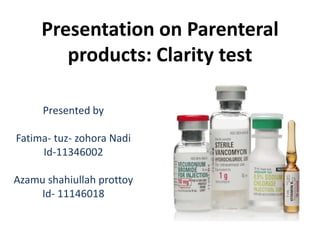
Presentation on Parenteral
products: Clarity test
Presented by
Fatima- tuz- zohora Nadi
Id-11346002
Azamu shahiullah prottoy
Id- 11146018
PARENTERAL PRODUCTS
PARA- OUTSIDE
ENTERON- INTESTINE
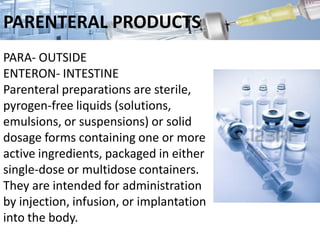
Parenteral preparations are sterile,
pyrogen-free liquids (solutions,
emulsions, or suspensions) or solid
dosage forms containing one or more
active ingredients, packaged in either
single-dose or multidose containers.
They are intended for administration
by injection, infusion, or implantation
into the body.
Quality control
• Sterility testing
• Pyrogen test
• Clarity test
• Leakage test
Clarity Test
• Clarity is tested by visual inspection of containers under
light and against a black and white background.
• Instrumental methods of evaluation is based on the
principles of light scattering, light absorption and
electrical resistance which are used to count particle
and particle size distribution.
• Unwanted mobile insoluble matter other than gas
bubbles are present in the given product.
• It may be dangerous when the particle size is larger
than R.B.C. and may block the blood vessel.
Particulate Matter
• Matter of biological or non-biological origin.
• With observable length, width, and thickness
e.g., bacteria, fungi, dust, dirt, fibers, plastic,rubber, lint
etc.
• It may be any matter, mixed accidentally during
manufacturing in the parenteral product which does
not belong to the product.
• Particulate mater may be tiny pieces of lint, glass, dust,
rubber, metal fibers, hair, microbes or unidentified and
can make the product impure, unclean or unfit for use.
Sources of Particulate Matter
• Material arising from the drug: undissolved
substances and trace contaminants etc.
• Material arising from vehicle or added substances:
These may include those material not filtered out
during a clarification process before to filling the final
container.
• Materials present in the final container: Material
already present in container and which were not
removed by rinsing prior to filling.
• Materials falling by chance into the final container
during the filling process.
Sources of Particulate Matter
• The container or closures which may be deposited in
the produce during sterilization, e.g. carbon black,
whiting, zinc oxide and clay.
• Packaging components: Including glass, plastic,
rubber, I/V administration sets, etc.
• Environmental contaminants: Including air, work tops,
insects’ parts.
• Processing equipments: Including glass, stainless
steel, rubber, or filter fiber, etc.
• Personnel: Including skin, hair, and clothing etc.
Particle Size
• A person with 20/20 vision under inspection conditions is able to
detect particles of size range 40 – 50 μm. However, it is universally
accepted that the particles size of 50 μm is detected visually by an
unaided eye.
• Particle size greater than 7 μm diameter is considered to be more
threatening. Pulmonary capillary are approximately 7 μm in diameter,
thus particle of this much size entrapped in vascular bed resulting in
multiple pulmonary infarction.
Identification of Particulates
1. Microscopy.
2. X-ray powder diffraction.
3. Mass spectroscopy.
4. Polarized light spectroscopy.
5. Scanning electron microscopy (SEM)
Methods of Monitoring
1. Coulter- current method
2. Visual method
3. Light scattering and light absorption
4. Light blockage method
Coulter- current method
• This is a destructive test.
• Large errors in measuring flakes and fibers are
expected.
• This test is not recommended by FDA for parenterals.
• High Accuracy (HIAC) Instrument is based on light
blockage principle. The test is highly effective for
counting the both solid and liquid suspended
particles. The instrument is calibrated easily and the
test is recommended by USP. This is destructive test
method and is expensive.
Coulter- current method
2. Visual method
3. Light scattering and light absorption
4. Light blockage method
Methods of Monitoring
Parenteral products

Parenteral products

  • 1.
    Presentation on Parenteral products:Clarity test Presented by Fatima- tuz- zohora Nadi Id-11346002 Azamu shahiullah prottoy Id- 11146018
  • 2.
    PARENTERAL PRODUCTS PARA- OUTSIDE ENTERON-INTESTINE Parenteral preparations are sterile, pyrogen-free liquids (solutions, emulsions, or suspensions) or solid dosage forms containing one or more active ingredients, packaged in either single-dose or multidose containers. They are intended for administration by injection, infusion, or implantation into the body.
  • 3.
    Quality control • Sterilitytesting • Pyrogen test • Clarity test • Leakage test
  • 4.
    Clarity Test • Clarityis tested by visual inspection of containers under light and against a black and white background. • Instrumental methods of evaluation is based on the principles of light scattering, light absorption and electrical resistance which are used to count particle and particle size distribution. • Unwanted mobile insoluble matter other than gas bubbles are present in the given product. • It may be dangerous when the particle size is larger than R.B.C. and may block the blood vessel.
  • 5.
    Particulate Matter • Matterof biological or non-biological origin. • With observable length, width, and thickness e.g., bacteria, fungi, dust, dirt, fibers, plastic,rubber, lint etc. • It may be any matter, mixed accidentally during manufacturing in the parenteral product which does not belong to the product. • Particulate mater may be tiny pieces of lint, glass, dust, rubber, metal fibers, hair, microbes or unidentified and can make the product impure, unclean or unfit for use.
  • 6.
    Sources of ParticulateMatter • Material arising from the drug: undissolved substances and trace contaminants etc. • Material arising from vehicle or added substances: These may include those material not filtered out during a clarification process before to filling the final container. • Materials present in the final container: Material already present in container and which were not removed by rinsing prior to filling. • Materials falling by chance into the final container during the filling process.
  • 7.
    Sources of ParticulateMatter • The container or closures which may be deposited in the produce during sterilization, e.g. carbon black, whiting, zinc oxide and clay. • Packaging components: Including glass, plastic, rubber, I/V administration sets, etc. • Environmental contaminants: Including air, work tops, insects’ parts. • Processing equipments: Including glass, stainless steel, rubber, or filter fiber, etc. • Personnel: Including skin, hair, and clothing etc.
  • 8.
    Particle Size • Aperson with 20/20 vision under inspection conditions is able to detect particles of size range 40 – 50 μm. However, it is universally accepted that the particles size of 50 μm is detected visually by an unaided eye. • Particle size greater than 7 μm diameter is considered to be more threatening. Pulmonary capillary are approximately 7 μm in diameter, thus particle of this much size entrapped in vascular bed resulting in multiple pulmonary infarction.
  • 9.
    Identification of Particulates 1.Microscopy. 2. X-ray powder diffraction. 3. Mass spectroscopy. 4. Polarized light spectroscopy. 5. Scanning electron microscopy (SEM)
  • 10.
    Methods of Monitoring 1.Coulter- current method 2. Visual method 3. Light scattering and light absorption 4. Light blockage method
  • 11.
  • 12.
    • This isa destructive test. • Large errors in measuring flakes and fibers are expected. • This test is not recommended by FDA for parenterals. • High Accuracy (HIAC) Instrument is based on light blockage principle. The test is highly effective for counting the both solid and liquid suspended particles. The instrument is calibrated easily and the test is recommended by USP. This is destructive test method and is expensive. Coulter- current method
  • 13.
    2. Visual method 3.Light scattering and light absorption 4. Light blockage method Methods of Monitoring