Particulate Matter - Visual Detection   to   Identification Scott Aldrich PDA Visual Inspection, October 19-20, 2009
Concepts Visual inspection is the start of the analytical process for particle identification Inspection-coupled isolation provides the necessary understanding of defect character Inspection allows connection of package defects to particle content
Rules for Products Appropriate Design Robust Formulation No Changes Clean Stable
Visual Inspection Often unappreciated as a diagnostic tool Vital process for stability evaluation Essential first step in particle identification process Provides high-level overview of product character
Tracking Product Physical Stability Why? Primary Verifies Acceptable and Stable Presentation Expedites Development by Revealing Problems Avoids Surprises Secondary Problem-solving defect incidents Investigates all components Why Used How Used Fabrication, Process Stream
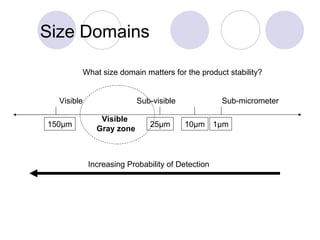
Visible Sub-visible Sub-micrometer Size Domains 1µm 25µm 10µm 150µm Increasing Probability of Detection What size domain matters for the product stability? Visible  Gray zone
Pharma Liquid Products and Presentations – A Complex Array PARENTERAL PRODUCTS, AQUEOUS AND NON-AQUEOUS Small Molecule; <1000mw Large Molecule; >1000mw Low Concentration High Concentration Ophthalmic Systems Others Novel Deliveries Sub-Q Systems Gels, Diffusion substrates
Pharma Liquid Products and Presentations – A Complex Array Package Systems Glass Vial/closure Ampoule Plastic Blow-Fill-Seal Formed sheets Syringes Pre-filled Syringes Devices Delivery (IV) Sets Commercial RTU’s Formulations Liquid, aseptic/terminal Lyophilized Solids Suspension, aseptic/terminal Dry-filled sterile powders Emulsions Nano-particle delivery
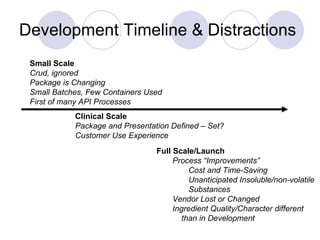
Development Timeline & Distractions Small Scale Crud, ignored Package is Changing Small Batches, Few Containers Used First of many API Processes Clinical Scale Package and Presentation Defined – Set? Customer Use Experience Full Scale/Launch Process “Improvements” Cost and Time-Saving Unanticipated Insoluble/non-volatile  Substances Vendor Lost or Changed Ingredient Quality/Character different  than in Development
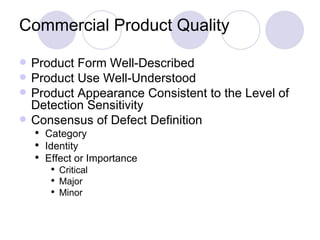
Commercial Product Quality Product Form Well-Described Product Use Well-Understood Product Appearance Consistent to the Level of Detection Sensitivity Consensus of Defect Definition Category Identity Effect or Importance Critical Major Minor
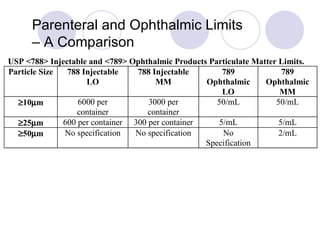
Compendial Requirements Robust, Safe, Sterile, Pure and Effective USP Chapter <1> Injections USP Chapter <788> Injections/<789> Ophthalmic Products USP/EP/JP have Harmonized <788> PM Testing Pharm. Forum re: Chapter <788>: IM and Sub-Q must meet <788>  Pharm. Forum 35[3] May-June 2009, page 628 Radiopharmaceuticals are exempt from <788> limits Parenteral products for which labeling specifies use of a final filter are exempt from <788>, provided scientific data are available to justify the exemption. (do your homework). Irrigating solutions are exempt.
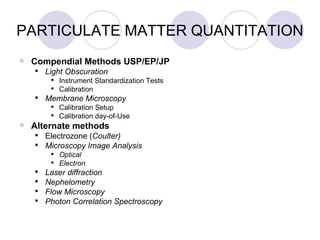
PARTICULATE MATTER QUANTITATION Compendial Methods USP/EP/JP Light Obscuration Instrument Standardization Tests Calibration Membrane Microscopy Calibration Setup Calibration day-of-Use Alternate methods Electrozone ( Coulter)  Microscopy Image Analysis Optical Electron Laser diffraction Nephelometry Flow Microscopy Photon Correlation Spectroscopy
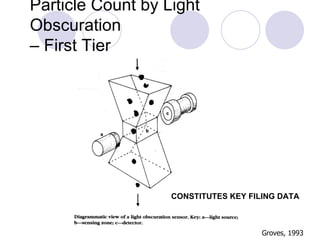
Particle Count by Light Obscuration – First Tier Groves, 1993 CONSTITUTES KEY FILING DATA
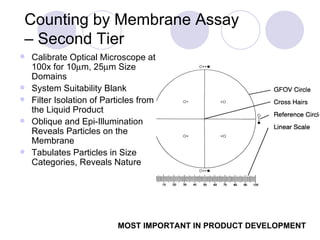
Counting by Membrane Assay  – Second Tier Calibrate Optical Microscope at 100x for 10  m, 25  m Size Domains System Suitability Blank Filter Isolation of Particles from the Liquid Product Oblique and Epi-Illumination Reveals Particles on the Membrane Tabulates Particles in Size Categories, Reveals Nature MOST IMPORTANT IN PRODUCT DEVELOPMENT
The ID Process Confirm Isolate Characterize Identify Locate
What Constitutes a Defect? … Appearance and Evident Changes Color Haze Solids/Particles Container to Container Differences  Time of Release Failure Trend over Time 3 Sigma Failure ? Catastrophic Failure
Just What is Acceptable?  “ Essentially free” Just a few per container? Just a few per batch? After defect removal, the batch is essentially free of foreign and visible particulate matter Inspection result at historical AQL? The Long Range View: “ Essentially free of visible particulate matter means free of particles that are considered indicative of physical instability of the product or of interaction between the formulation and the container/closure system.”…and  The low incidence of containers with observed extrinsic material have been removed. Identification process should not depend upon definition!
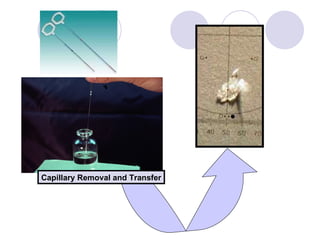
Isolation Methods Direct removal, liquids Capillary tube (Wiretrol) Poly tube, drawn to fine tip Membrane swipe Filtration Centrifugation Direct removal, dry materials Tungsten wire, 1-5µm tip Fine hair Fine scalpel, cleaver (MicroTool) Facilitate with water, or weak known adhesive Transfers, Concentrators Dried KBr Cleaned filter paper Capillary rounds/flats
Capillary Removal and Transfer
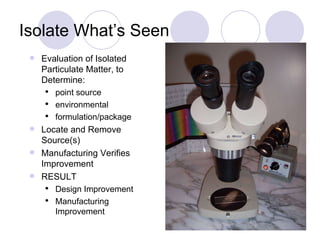
Isolate What’s Seen Evaluation of Isolated Particulate Matter, to Determine: point source environmental formulation/package Locate and Remove Source(s) Manufacturing Verifies Improvement RESULT Design Improvement Manufacturing Improvement
Inspect – Detect – Isolate - Identify Observation in Context with Event Inspection with observers or in duplication Categorization of All “Species” Package vs. Free Tiny vs. Obvious Audit of Species Microscopy-Spectroscopy Process of Characterization Tracking Source from Character/Identity
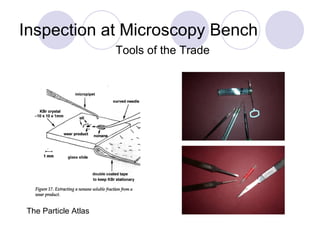
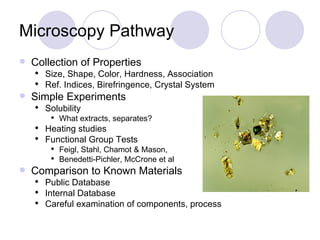
Inspection at Microscopy Bench Tools of the Trade The Particle Atlas
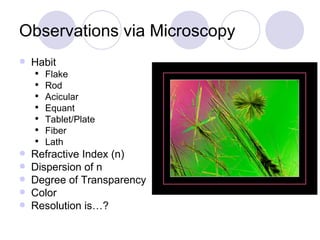
Microscopy Pathway Collection of Properties Size, Shape, Color, Hardness, Association Ref. Indices, Birefringence, Crystal System Simple Experiments Solubility What extracts, separates? Heating studies Functional Group Tests Feigl, Stahl, Chamot & Mason,  Benedetti-Pichler, McCrone et al Comparison to Known Materials Public Database Internal Database Careful examination of components, process
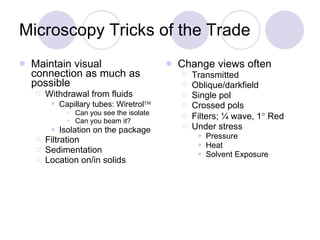
Observations via Microscopy Habit Flake Rod Acicular Equant Tablet/Plate Fiber Lath Refractive Index (n) Dispersion of n Degree of Transparency Color Resolution is…?
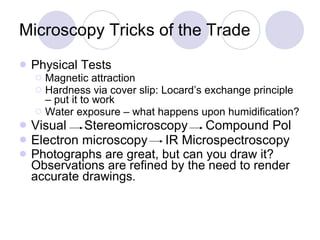
Microscopy Tricks of the Trade Maintain visual connection as much as possible Withdrawal from fluids Capillary tubes: Wiretrol  Can you see the isolate Can you beam it? Isolation on the package Filtration Sedimentation Location on/in solids Change views often Transmitted Oblique/darkfield Single pol Crossed pols Filters; ¼ wave, 1   Red Under stress Pressure Heat Solvent Exposure
Microscopy Tricks of the Trade Physical Tests Magnetic attraction Hardness via cover slip: Locard’s exchange principle – put it to work Water exposure – what happens upon humidification? Visual  Stereomicroscopy  Compound Pol  Electron microscopy  IR Microspectroscopy Photographs are great, but can you draw it?  Observations are refined by the need to render accurate drawings .
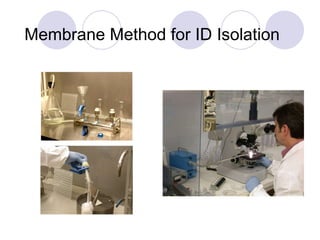
Membrane Method for ID Isolation
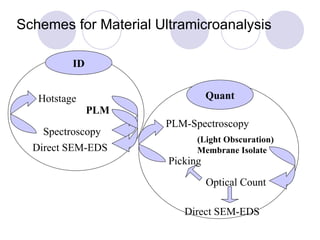
PLM Spectroscopy Hotstage Schemes for Material Ultramicroanalysis (Light Obscuration) Membrane Isolate Picking Direct SEM-EDS Optical Count PLM-Spectroscopy Direct SEM-EDS ID Quant
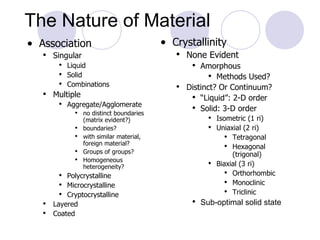
The Nature of Material Association Singular Liquid Solid Combinations Multiple Aggregate/Agglomerate no distinct boundaries (matrix evident?) boundaries? with similar material, foreign material? Groups of groups? Homogeneous heterogeneity? Polycrystalline Microcrystalline Cryptocrystalline Layered Coated Crystallinity None Evident Amorphous Methods Used? Distinct? Or Continuum? “ Liquid”: 2-D order Solid: 3-D order Isometric (1 ri) Uniaxial (2 ri) Tetragonal Hexagonal (trigonal) Biaxial (3 ri) Orthorhombic Monoclinic Triclinic  Sub-optimal solid state
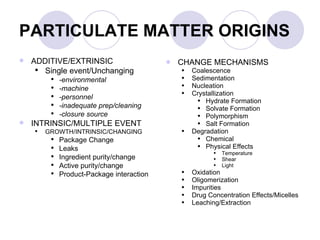
PARTICULATE MATTER ORIGINS ADDITIVE/EXTRINSIC Single event/Unchanging -environmental -machine -personnel -inadequate prep/cleaning   -closure source INTRINSIC/MULTIPLE EVENT GROWTH/INTRINSIC/CHANGING Package Change Leaks Ingredient purity/change Active purity/change Product-Package interaction CHANGE MECHANISMS Coalescence Sedimentation Nucleation Crystallization   Hydrate Formation Solvate Formation Polymorphism Salt Formation Degradation Chemical Physical Effects Temperature Shear Light Oxidation Oligomerization Impurities Drug Concentration Effects/Micelles Leaching/Extraction
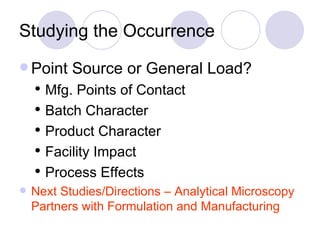
Studying the Occurrence Point Source or General Load?  Mfg. Points of Contact Batch Character Product Character Facility Impact Process Effects Next Studies/Directions – Analytical Microscopy Partners with Formulation and Manufacturing
Thanks for Your Attention Questions?
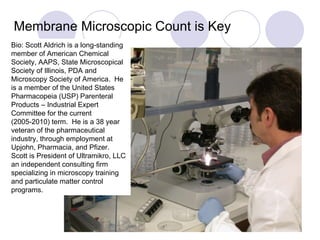
Membrane Microscopic Count is Key Bio: Scott Aldrich is a long-standing member of American Chemical Society, AAPS, State Microscopical Society of Illinois, PDA and Microscopy Society of America.  He is a member of the United States Pharmacopeia (USP) Parenteral Products – Industrial Expert Committee for the current (2005-2010) term.  He is a 38 year veteran of the pharmaceutical industry, through employment at Upjohn, Pharmacia, and Pfizer.  Scott is President of Ultramikro, LLC an independent consulting firm specializing in microscopy training and particulate matter control programs.
Parenteral and Ophthalmic Limits  – A Comparison
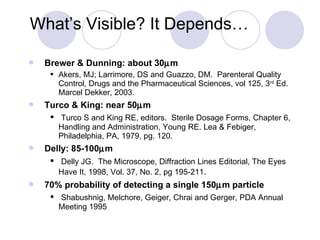
What’s Visible? It Depends… Brewer & Dunning: about 30  m Akers, MJ; Larrimore, DS and Guazzo, DM.  Parenteral Quality Control, Drugs and the Pharmaceutical Sciences, vol 125, 3 rd  Ed. Marcel Dekker, 2003. Turco & King: near 50  m Turco S and King RE, editors.  Sterile Dosage Forms, Chapter 6, Handling and Administration, Young RE. Lea & Febiger, Philadelphia, PA, 1979, pg. 120. Delly: 85-100  m Delly JG.  The Microscope, Diffraction Lines Editorial, The Eyes Have It, 1998, Vol. 37, No. 2, pg 195-211 . 70% probability of detecting a single 150  m particle Shabushnig, Melchore, Geiger, Chrai and Gerger, PDA Annual Meeting 1995
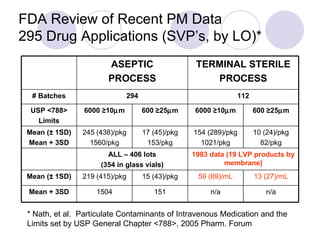
FDA Review of Recent PM Data 295 Drug Applications (SVP’s, by LO)* * Nath, et al.  Particulate Contaminants of Intravenous Medication and the Limits set by USP General Chapter <788>, 2005 Pharm. Forum n/a n/a 151 1504 Mean + 3SD 13 (27)/mL 59 (89)/mL 15 (43)/pkg 219 (415)/pkg Mean (± 1SD) 1983 data (19 LVP products by membrane) ALL – 406 lots (354 in glass vials) 10 (24)/pkg 82/pkg 154 (289)/pkg 1021/pkg 17 (45)/pkg 153/pkg 245 (438)/pkg 1560/pkg Mean (± 1SD) Mean + 3SD 600 ≥25  m 6000 ≥10  m 600 ≥25  m 6000 ≥10  m USP <788> Limits 112 294 # Batches TERMINAL STERILE PROCESS ASEPTIC PROCESS

Pda Visual Inspection 2009 Aldrich

  • 1.
    Particulate Matter -Visual Detection to Identification Scott Aldrich PDA Visual Inspection, October 19-20, 2009
  • 2.
    Concepts Visual inspectionis the start of the analytical process for particle identification Inspection-coupled isolation provides the necessary understanding of defect character Inspection allows connection of package defects to particle content
  • 3.
    Rules for ProductsAppropriate Design Robust Formulation No Changes Clean Stable
  • 4.
    Visual Inspection Oftenunappreciated as a diagnostic tool Vital process for stability evaluation Essential first step in particle identification process Provides high-level overview of product character
  • 5.
    Tracking Product PhysicalStability Why? Primary Verifies Acceptable and Stable Presentation Expedites Development by Revealing Problems Avoids Surprises Secondary Problem-solving defect incidents Investigates all components Why Used How Used Fabrication, Process Stream
  • 6.
    Visible Sub-visible Sub-micrometerSize Domains 1µm 25µm 10µm 150µm Increasing Probability of Detection What size domain matters for the product stability? Visible Gray zone
  • 7.
    Pharma Liquid Productsand Presentations – A Complex Array PARENTERAL PRODUCTS, AQUEOUS AND NON-AQUEOUS Small Molecule; <1000mw Large Molecule; >1000mw Low Concentration High Concentration Ophthalmic Systems Others Novel Deliveries Sub-Q Systems Gels, Diffusion substrates
  • 8.
    Pharma Liquid Productsand Presentations – A Complex Array Package Systems Glass Vial/closure Ampoule Plastic Blow-Fill-Seal Formed sheets Syringes Pre-filled Syringes Devices Delivery (IV) Sets Commercial RTU’s Formulations Liquid, aseptic/terminal Lyophilized Solids Suspension, aseptic/terminal Dry-filled sterile powders Emulsions Nano-particle delivery
  • 9.
    Development Timeline &Distractions Small Scale Crud, ignored Package is Changing Small Batches, Few Containers Used First of many API Processes Clinical Scale Package and Presentation Defined – Set? Customer Use Experience Full Scale/Launch Process “Improvements” Cost and Time-Saving Unanticipated Insoluble/non-volatile Substances Vendor Lost or Changed Ingredient Quality/Character different than in Development
  • 10.
    Commercial Product QualityProduct Form Well-Described Product Use Well-Understood Product Appearance Consistent to the Level of Detection Sensitivity Consensus of Defect Definition Category Identity Effect or Importance Critical Major Minor
  • 11.
    Compendial Requirements Robust,Safe, Sterile, Pure and Effective USP Chapter <1> Injections USP Chapter <788> Injections/<789> Ophthalmic Products USP/EP/JP have Harmonized <788> PM Testing Pharm. Forum re: Chapter <788>: IM and Sub-Q must meet <788> Pharm. Forum 35[3] May-June 2009, page 628 Radiopharmaceuticals are exempt from <788> limits Parenteral products for which labeling specifies use of a final filter are exempt from <788>, provided scientific data are available to justify the exemption. (do your homework). Irrigating solutions are exempt.
  • 12.
    PARTICULATE MATTER QUANTITATIONCompendial Methods USP/EP/JP Light Obscuration Instrument Standardization Tests Calibration Membrane Microscopy Calibration Setup Calibration day-of-Use Alternate methods Electrozone ( Coulter) Microscopy Image Analysis Optical Electron Laser diffraction Nephelometry Flow Microscopy Photon Correlation Spectroscopy
  • 13.
    Particle Count byLight Obscuration – First Tier Groves, 1993 CONSTITUTES KEY FILING DATA
  • 14.
    Counting by MembraneAssay – Second Tier Calibrate Optical Microscope at 100x for 10  m, 25  m Size Domains System Suitability Blank Filter Isolation of Particles from the Liquid Product Oblique and Epi-Illumination Reveals Particles on the Membrane Tabulates Particles in Size Categories, Reveals Nature MOST IMPORTANT IN PRODUCT DEVELOPMENT
  • 15.
    The ID ProcessConfirm Isolate Characterize Identify Locate
  • 16.
    What Constitutes aDefect? … Appearance and Evident Changes Color Haze Solids/Particles Container to Container Differences Time of Release Failure Trend over Time 3 Sigma Failure ? Catastrophic Failure
  • 17.
    Just What isAcceptable? “ Essentially free” Just a few per container? Just a few per batch? After defect removal, the batch is essentially free of foreign and visible particulate matter Inspection result at historical AQL? The Long Range View: “ Essentially free of visible particulate matter means free of particles that are considered indicative of physical instability of the product or of interaction between the formulation and the container/closure system.”…and The low incidence of containers with observed extrinsic material have been removed. Identification process should not depend upon definition!
  • 18.
    Isolation Methods Directremoval, liquids Capillary tube (Wiretrol) Poly tube, drawn to fine tip Membrane swipe Filtration Centrifugation Direct removal, dry materials Tungsten wire, 1-5µm tip Fine hair Fine scalpel, cleaver (MicroTool) Facilitate with water, or weak known adhesive Transfers, Concentrators Dried KBr Cleaned filter paper Capillary rounds/flats
  • 19.
  • 20.
    Isolate What’s SeenEvaluation of Isolated Particulate Matter, to Determine: point source environmental formulation/package Locate and Remove Source(s) Manufacturing Verifies Improvement RESULT Design Improvement Manufacturing Improvement
  • 21.
    Inspect – Detect– Isolate - Identify Observation in Context with Event Inspection with observers or in duplication Categorization of All “Species” Package vs. Free Tiny vs. Obvious Audit of Species Microscopy-Spectroscopy Process of Characterization Tracking Source from Character/Identity
  • 22.
    Inspection at MicroscopyBench Tools of the Trade The Particle Atlas
  • 23.
    Microscopy Pathway Collectionof Properties Size, Shape, Color, Hardness, Association Ref. Indices, Birefringence, Crystal System Simple Experiments Solubility What extracts, separates? Heating studies Functional Group Tests Feigl, Stahl, Chamot & Mason, Benedetti-Pichler, McCrone et al Comparison to Known Materials Public Database Internal Database Careful examination of components, process
  • 24.
    Observations via MicroscopyHabit Flake Rod Acicular Equant Tablet/Plate Fiber Lath Refractive Index (n) Dispersion of n Degree of Transparency Color Resolution is…?
  • 25.
    Microscopy Tricks ofthe Trade Maintain visual connection as much as possible Withdrawal from fluids Capillary tubes: Wiretrol  Can you see the isolate Can you beam it? Isolation on the package Filtration Sedimentation Location on/in solids Change views often Transmitted Oblique/darkfield Single pol Crossed pols Filters; ¼ wave, 1  Red Under stress Pressure Heat Solvent Exposure
  • 26.
    Microscopy Tricks ofthe Trade Physical Tests Magnetic attraction Hardness via cover slip: Locard’s exchange principle – put it to work Water exposure – what happens upon humidification? Visual Stereomicroscopy Compound Pol Electron microscopy IR Microspectroscopy Photographs are great, but can you draw it? Observations are refined by the need to render accurate drawings .
  • 27.
    Membrane Method forID Isolation
  • 28.
    PLM Spectroscopy HotstageSchemes for Material Ultramicroanalysis (Light Obscuration) Membrane Isolate Picking Direct SEM-EDS Optical Count PLM-Spectroscopy Direct SEM-EDS ID Quant
  • 29.
    The Nature ofMaterial Association Singular Liquid Solid Combinations Multiple Aggregate/Agglomerate no distinct boundaries (matrix evident?) boundaries? with similar material, foreign material? Groups of groups? Homogeneous heterogeneity? Polycrystalline Microcrystalline Cryptocrystalline Layered Coated Crystallinity None Evident Amorphous Methods Used? Distinct? Or Continuum? “ Liquid”: 2-D order Solid: 3-D order Isometric (1 ri) Uniaxial (2 ri) Tetragonal Hexagonal (trigonal) Biaxial (3 ri) Orthorhombic Monoclinic Triclinic Sub-optimal solid state
  • 30.
    PARTICULATE MATTER ORIGINSADDITIVE/EXTRINSIC Single event/Unchanging -environmental -machine -personnel -inadequate prep/cleaning -closure source INTRINSIC/MULTIPLE EVENT GROWTH/INTRINSIC/CHANGING Package Change Leaks Ingredient purity/change Active purity/change Product-Package interaction CHANGE MECHANISMS Coalescence Sedimentation Nucleation Crystallization Hydrate Formation Solvate Formation Polymorphism Salt Formation Degradation Chemical Physical Effects Temperature Shear Light Oxidation Oligomerization Impurities Drug Concentration Effects/Micelles Leaching/Extraction
  • 31.
    Studying the OccurrencePoint Source or General Load? Mfg. Points of Contact Batch Character Product Character Facility Impact Process Effects Next Studies/Directions – Analytical Microscopy Partners with Formulation and Manufacturing
  • 32.
    Thanks for YourAttention Questions?
  • 33.
    Membrane Microscopic Countis Key Bio: Scott Aldrich is a long-standing member of American Chemical Society, AAPS, State Microscopical Society of Illinois, PDA and Microscopy Society of America. He is a member of the United States Pharmacopeia (USP) Parenteral Products – Industrial Expert Committee for the current (2005-2010) term. He is a 38 year veteran of the pharmaceutical industry, through employment at Upjohn, Pharmacia, and Pfizer. Scott is President of Ultramikro, LLC an independent consulting firm specializing in microscopy training and particulate matter control programs.
  • 34.
    Parenteral and OphthalmicLimits – A Comparison
  • 35.
    What’s Visible? ItDepends… Brewer & Dunning: about 30  m Akers, MJ; Larrimore, DS and Guazzo, DM. Parenteral Quality Control, Drugs and the Pharmaceutical Sciences, vol 125, 3 rd Ed. Marcel Dekker, 2003. Turco & King: near 50  m Turco S and King RE, editors. Sterile Dosage Forms, Chapter 6, Handling and Administration, Young RE. Lea & Febiger, Philadelphia, PA, 1979, pg. 120. Delly: 85-100  m Delly JG. The Microscope, Diffraction Lines Editorial, The Eyes Have It, 1998, Vol. 37, No. 2, pg 195-211 . 70% probability of detecting a single 150  m particle Shabushnig, Melchore, Geiger, Chrai and Gerger, PDA Annual Meeting 1995
  • 36.
    FDA Review ofRecent PM Data 295 Drug Applications (SVP’s, by LO)* * Nath, et al. Particulate Contaminants of Intravenous Medication and the Limits set by USP General Chapter <788>, 2005 Pharm. Forum n/a n/a 151 1504 Mean + 3SD 13 (27)/mL 59 (89)/mL 15 (43)/pkg 219 (415)/pkg Mean (± 1SD) 1983 data (19 LVP products by membrane) ALL – 406 lots (354 in glass vials) 10 (24)/pkg 82/pkg 154 (289)/pkg 1021/pkg 17 (45)/pkg 153/pkg 245 (438)/pkg 1560/pkg Mean (± 1SD) Mean + 3SD 600 ≥25  m 6000 ≥10  m 600 ≥25  m 6000 ≥10  m USP <788> Limits 112 294 # Batches TERMINAL STERILE PROCESS ASEPTIC PROCESS