Assignment On
Prodrug
Submitted To Submitted By
Zara Sheikh Azamu Shahiullah Prottoy
Course Instructor Id - 11146018
Technology-1
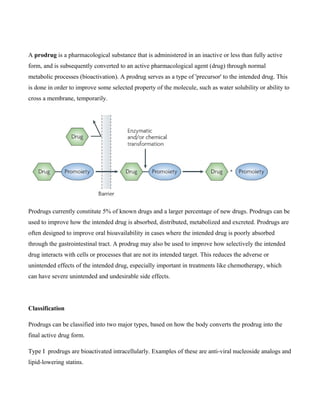
A prodrug is a pharmacological substance that is administered in an inactive or less than fully active
form, and is subsequently converted to an active pharmacological agent (drug) through normal
metabolic processes (bioactivation). A prodrug serves as a type of 'precursor' to the intended drug. This
is done in order to improve some selected property of the molecule, such as water solubility or ability to
cross a membrane, temporarily.
Prodrugs currently constitute 5% of known drugs and a larger percentage of new drugs. Prodrugs can be
used to improve how the intended drug is absorbed, distributed, metabolized and excreted. Prodrugs are
often designed to improve oral bioavailability in cases where the intended drug is poorly absorbed
through the gastrointestinal tract. A prodrug may also be used to improve how selectively the intended
drug interacts with cells or processes that are not its intended target. This reduces the adverse or
unintended effects of the intended drug, especially important in treatments like chemotherapy, which
can have severe unintended and undesirable side effects.
Classification
Prodrugs can be classified into two major types, based on how the body converts the prodrug into the
final active drug form.
Type I prodrugs are bioactivated intracellularly. Examples of these are anti-viral nucleoside analogs and
lipid-lowering statins.
Type II prodrugs are bioactivated extracellularly, especially in digestive fluids or in the body's
circulation system. Examples of these are antibody-, gene- or virus-directed enzyme prodrugs used in
chemotherapy or immunotherapy.
Both major types can be further categorized into Subtypes, based on factors such as (Type I) whether the
intracellular bioactivation location is also the site of therapeutic action, or (Type 2) whether or not
bioactivation occurs in the body's gastrointestinal fluids or its circulation system.
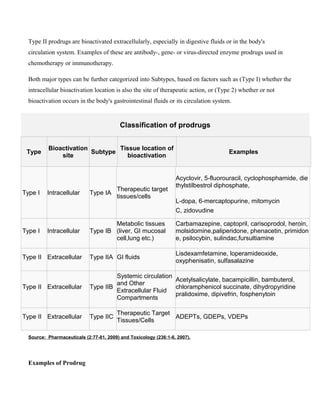
Classification of prodrugs
Type
Bioactivation
site
Subtype
Tissue location of
bioactivation
Examples
Type I Intracellular Type IA
Therapeutic target
tissues/cells
Acyclovir, 5-fluorouracil, cyclophosphamide, die
thylstilbestrol diphosphate,
L-dopa, 6-mercaptopurine, mitomycin
C, zidovudine
Type I Intracellular Type IB
Metabolic tissues
(liver, GI mucosal
cell,lung etc.)
Carbamazepine, captopril, carisoprodol, heroin,
molsidomine,paliperidone, phenacetin, primidon
e, psilocybin, sulindac,fursultiamine
Type II Extracellular Type IIA GI fluids
Lisdexamfetamine, loperamideoxide,
oxyphenisatin, sulfasalazine
Type II Extracellular Type IIB
Systemic circulation
and Other
Extracellular Fluid
Compartments
Acetylsalicylate, bacampicillin, bambuterol,
chloramphenicol succinate, dihydropyridine
pralidoxime, dipivefrin, fosphenytoin
Type II Extracellular Type IIC
Therapeutic Target
Tissues/Cells
ADEPTs, GDEPs, VDEPs
Source: Pharmaceuticals (2:77-81, 2009) and Toxicology (236:1-6, 2007).
Examples of Prodrug
Enalapril
• One example of prodrug is the monoethyl ester of enalaprilat, which is called enalapril.
• Enalaprilate (upper left) was first discovered as an inhibitor of angiotensin converting enzyme
(ACE) and used to treat hypertension.
• Due to its high polarity, note two COOH’s, it was not orally bioavailable, and thus needed to be
administered by injection. The monomethyl ester, enalapril (upper right) is orally bioavailable.
Oseltamivir (Tamiflu®)
• Act as an anti-viral agent.
• It is an ethyl ester of Oseltamivir Carboxylate.
• Bioconversion by Esterases.
• The bioavailability is of 5% in rat & marmoset for Ostalmivir Carboxylate is increased to 80%
for Ostalmivir in humans.
• Noticeable is that the oral bioavailability is improved by employing the ethyl ester of the
carboxylic acid.
Famciclovir
• Act as an anti-viral agent.
• Diacetate Ester of the corresponding diol (penciclovir).
• Bioconversion by Esterases & oxidation from purine to guanide.
• The oral bioavailability of 4% for Penciclovir increased to 75% for Famciclovir.
Other Examples
• 6-Monoacetylmorphine (6-MAM) is a heroin metabolite which converts into active morphine in
vivo.
• Carisoprodol is metabolized into meprobamate. Until 2012, carisoprodol was not a controlled
substance in the United States, but meprobamate was classified as a potentially
addictive controlled substance that can produce dangerous and painful withdrawal symptoms
upon discontinuation of the drug.
• Enalapril is bioactivated by esterase to the active enalaprilat.
• Valaciclovir is bioactivated by esterase to the active aciclovir.
• Fosamprenavir is hydrolysed to the active amprenavir.
• Levodopa is bioactivated by DOPA decarboxylase to the active dopamine.
• Chloramphenicol succinate ester is used as an intravenous prodrug of chloramphenicol, because
pure chloramphenicol does not dissolve in water.
• Psilocybin is dephosphorylated to the active psilocin.
• Heroin is deacetylated by esterase to the active morphine.
• Molsidomine is metabolized into SIN-1 which decomposes into the active compound nitric
oxide.
• Paliperidone is an atypical antipsychotic for schizophrenia. It is the active metabolite
of risperidone.
• Prednisone, a synthetic cortico-steroid drug, is bioactivated by the liver into the active
drug prednisolone, which is also a steroid.
• Primidone is metabolized by cytochrome P450 enzymes into phenobarbital, which is major,
and phenylethylmalonamide, which is minor.
• Dipivefrine, given topically as an anti-glaucoma drug, is bioactivated to epinephrine.
• Lisdexamfetamine is metabolized in the small intestine to produce dextroamphetamine at a
controlled (slow) rate for the treatment of attention-deficit hyperactivity disorder
• Diethylpropion is a diet pill that does not become active as a monoamine releaser or reuptake
inhibitor until it has been N-dealkylated to ethylpropion.
• Fesoterodine is an antimuscarinic that is bioactivated to 5-hydroxymethyl tolterodine, the
principle active metabolite of tolterodine.
• Tenofovir disoproxil fumarate is an anti-HIV drug (NtRTI class) that is bioactivated
to tenofovir (PMPA).
• Ximelagatran is dealkylated and dehydroxylated to the active melagatran.

Prodrug

  • 1.
    Assignment On Prodrug Submitted ToSubmitted By Zara Sheikh Azamu Shahiullah Prottoy Course Instructor Id - 11146018 Technology-1
  • 2.
    A prodrug isa pharmacological substance that is administered in an inactive or less than fully active form, and is subsequently converted to an active pharmacological agent (drug) through normal metabolic processes (bioactivation). A prodrug serves as a type of 'precursor' to the intended drug. This is done in order to improve some selected property of the molecule, such as water solubility or ability to cross a membrane, temporarily. Prodrugs currently constitute 5% of known drugs and a larger percentage of new drugs. Prodrugs can be used to improve how the intended drug is absorbed, distributed, metabolized and excreted. Prodrugs are often designed to improve oral bioavailability in cases where the intended drug is poorly absorbed through the gastrointestinal tract. A prodrug may also be used to improve how selectively the intended drug interacts with cells or processes that are not its intended target. This reduces the adverse or unintended effects of the intended drug, especially important in treatments like chemotherapy, which can have severe unintended and undesirable side effects. Classification Prodrugs can be classified into two major types, based on how the body converts the prodrug into the final active drug form. Type I prodrugs are bioactivated intracellularly. Examples of these are anti-viral nucleoside analogs and lipid-lowering statins.
  • 3.
    Type II prodrugsare bioactivated extracellularly, especially in digestive fluids or in the body's circulation system. Examples of these are antibody-, gene- or virus-directed enzyme prodrugs used in chemotherapy or immunotherapy. Both major types can be further categorized into Subtypes, based on factors such as (Type I) whether the intracellular bioactivation location is also the site of therapeutic action, or (Type 2) whether or not bioactivation occurs in the body's gastrointestinal fluids or its circulation system. Classification of prodrugs Type Bioactivation site Subtype Tissue location of bioactivation Examples Type I Intracellular Type IA Therapeutic target tissues/cells Acyclovir, 5-fluorouracil, cyclophosphamide, die thylstilbestrol diphosphate, L-dopa, 6-mercaptopurine, mitomycin C, zidovudine Type I Intracellular Type IB Metabolic tissues (liver, GI mucosal cell,lung etc.) Carbamazepine, captopril, carisoprodol, heroin, molsidomine,paliperidone, phenacetin, primidon e, psilocybin, sulindac,fursultiamine Type II Extracellular Type IIA GI fluids Lisdexamfetamine, loperamideoxide, oxyphenisatin, sulfasalazine Type II Extracellular Type IIB Systemic circulation and Other Extracellular Fluid Compartments Acetylsalicylate, bacampicillin, bambuterol, chloramphenicol succinate, dihydropyridine pralidoxime, dipivefrin, fosphenytoin Type II Extracellular Type IIC Therapeutic Target Tissues/Cells ADEPTs, GDEPs, VDEPs Source: Pharmaceuticals (2:77-81, 2009) and Toxicology (236:1-6, 2007). Examples of Prodrug
  • 4.
    Enalapril • One exampleof prodrug is the monoethyl ester of enalaprilat, which is called enalapril. • Enalaprilate (upper left) was first discovered as an inhibitor of angiotensin converting enzyme (ACE) and used to treat hypertension. • Due to its high polarity, note two COOH’s, it was not orally bioavailable, and thus needed to be administered by injection. The monomethyl ester, enalapril (upper right) is orally bioavailable. Oseltamivir (Tamiflu®)
  • 5.
    • Act asan anti-viral agent. • It is an ethyl ester of Oseltamivir Carboxylate. • Bioconversion by Esterases. • The bioavailability is of 5% in rat & marmoset for Ostalmivir Carboxylate is increased to 80% for Ostalmivir in humans. • Noticeable is that the oral bioavailability is improved by employing the ethyl ester of the carboxylic acid. Famciclovir • Act as an anti-viral agent.
  • 6.
    • Diacetate Esterof the corresponding diol (penciclovir). • Bioconversion by Esterases & oxidation from purine to guanide. • The oral bioavailability of 4% for Penciclovir increased to 75% for Famciclovir. Other Examples • 6-Monoacetylmorphine (6-MAM) is a heroin metabolite which converts into active morphine in vivo. • Carisoprodol is metabolized into meprobamate. Until 2012, carisoprodol was not a controlled substance in the United States, but meprobamate was classified as a potentially addictive controlled substance that can produce dangerous and painful withdrawal symptoms upon discontinuation of the drug. • Enalapril is bioactivated by esterase to the active enalaprilat. • Valaciclovir is bioactivated by esterase to the active aciclovir. • Fosamprenavir is hydrolysed to the active amprenavir. • Levodopa is bioactivated by DOPA decarboxylase to the active dopamine. • Chloramphenicol succinate ester is used as an intravenous prodrug of chloramphenicol, because pure chloramphenicol does not dissolve in water. • Psilocybin is dephosphorylated to the active psilocin. • Heroin is deacetylated by esterase to the active morphine. • Molsidomine is metabolized into SIN-1 which decomposes into the active compound nitric oxide. • Paliperidone is an atypical antipsychotic for schizophrenia. It is the active metabolite of risperidone.
  • 7.
    • Prednisone, asynthetic cortico-steroid drug, is bioactivated by the liver into the active drug prednisolone, which is also a steroid. • Primidone is metabolized by cytochrome P450 enzymes into phenobarbital, which is major, and phenylethylmalonamide, which is minor. • Dipivefrine, given topically as an anti-glaucoma drug, is bioactivated to epinephrine. • Lisdexamfetamine is metabolized in the small intestine to produce dextroamphetamine at a controlled (slow) rate for the treatment of attention-deficit hyperactivity disorder • Diethylpropion is a diet pill that does not become active as a monoamine releaser or reuptake inhibitor until it has been N-dealkylated to ethylpropion. • Fesoterodine is an antimuscarinic that is bioactivated to 5-hydroxymethyl tolterodine, the principle active metabolite of tolterodine. • Tenofovir disoproxil fumarate is an anti-HIV drug (NtRTI class) that is bioactivated to tenofovir (PMPA). • Ximelagatran is dealkylated and dehydroxylated to the active melagatran.