Quality Control Test Of
Ointment
M. M. College of Pharmacy, Presented By:- GEORGE KUMAR SAHA
Maharishi Markandeshwar (Deemed To Be University), M. Pharm 2nd Sem.
Mullana, Ambala, Haryana-133207, India (Quality Assurance)
Roll No.- 14177039
28-Mar-18 1
TABLE OF CONTENTS
 What is Ointments ?
 Types of ointment
 Advantages & Disadvantages
 Ointment bases
 Types of method
 Quality Control Tests
 Evaluation Test
28-Mar-18 2
What is Ointments ?
 The word ointment comes from the Latin ungere meaning anoint with oil.
 Any greasy or oily semi-solid preparation, usually medicated, that can be
applied externally to the skin in order to heal, soothe or protect it.
 It is a viscous semisolid preparation used topically on a variety of body
surfaces.
 Drug ingredients can be dissolved, emulsified or suspended in the
ointment base.
28-Mar-18 3
Types of Ointments
The various types of ointments are:
1. Unmedicated ointments:- These ointments do not contain any drugs. They are useful as emollients,
protectants . Example: Petroleum jelly.
2. Medicated ointments:- These ointments contain drugs which show local or systemic effects.
These are of several sub-types:
I. Dermatologic ointments (Ex- Ketoconazole ointment).
II. Opthalmic ointments (Ex- Sulfacetamide sodium ointment).
III. Rectal ointments (Ex- Benzocaine ointment).
IV. Vaginal ointments (Ex- Candicidin ointment).
V. Nasal ointments (Ex- Ipratropium bromide ointment).
28-Mar-18 4
ADVANTAGES & DISADVANTAGES
ADVANTAGES
• Handling of ointments is easier than bulky
liquid dosage forms.
• They are chemically more stable than liquid
dosage forms.
• They prolong the contact time between the drug
and effected area.
• They are suitable for patients who find it
difficult to take the drugs by parenteral and oral.
DISADVANTAGES
• They are bulkier than solid dosage forms.
• When applications of an exact quantity of
ointment to the affected area is required, it is
difficult to determine the same.
• They are less stable than solid dosage forms.
28-Mar-18 5
Ointment Bases
There are five classes or types of ointment bases which are differentiated on
the basis of their physical composition. These are:
1. Oleaginous bases.
2. Absorption bases.
3. Water in oil emulsion bases.
4. Oil in water emulsion bases.
5. Water soluble or water miscible bases.
28-Mar-18 6
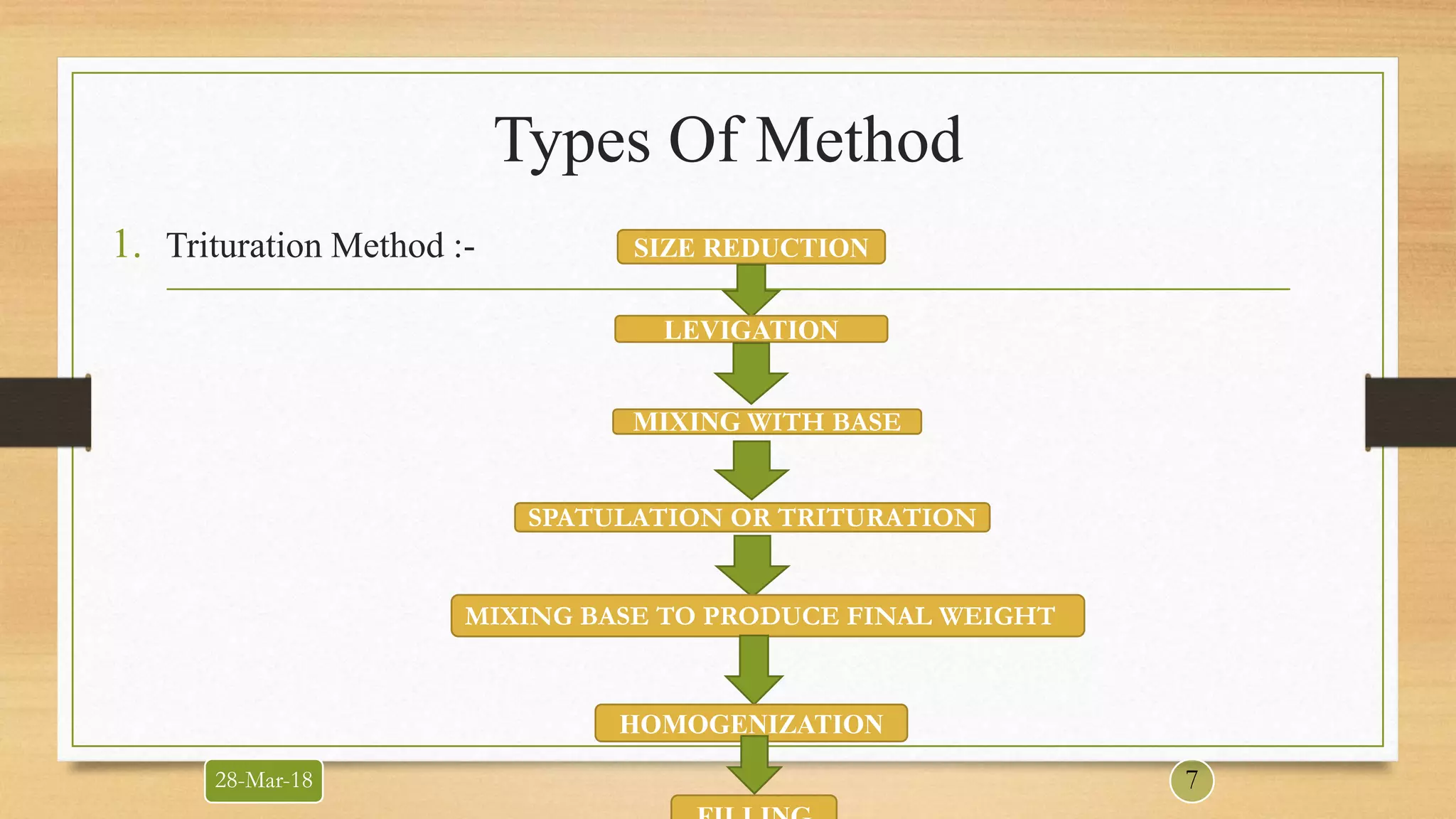
Types Of Method
1. Trituration Method :- SIZE REDUCTION
LEVIGATION
MIXING WITH BASE
SPATULATION OR TRITURATION
MIXING BASE TO PRODUCE FINAL WEIGHT
HOMOGENIZATION
28-Mar-18 7
Types Of Method
2. Fusion Method:- GRATE THE WAXY BASE
MELT USING WATER BATH
HIGH M.P. BASE 1ST MIX LOW M.P.
IN IT
MELT BASE TOGETHER
DISSOLVE OIL SOLUBLE DRUG
ADD SMALL VOLUME PHASE IN LARGE
VOLUME PHASE
COOLING FOR STIRRING
SOFT MASS OF 40°C
HOMOGENIZATION
FILLING
28-Mar-18 8
Quality Control Test
 Quality Control Test which is defined that the set of activities for ensuring
the quality of the product that’s depends upon the customer requirements.
 Quality Control Test which is to identify & correct defects in the finished
products.
28-Mar-18
9
Quality Control Test of Ointment
28-Mar-18 10
1. UNIVERSAL TESTS
A. Description: This includes visual examination to identify changes in color, separation,
crystallization etc., in the final appearance of the product.
 The description should specify the content or label claim of the product.
B. Identification: Quantitative identification of active ingredients in the finished dosage
from.
 Methods:
 IR,
 Raman Spectroscopy,
 Chromatography.
28-Mar-18 11
Cont…
C. Assay : The quantity of drug present in unit weight or volume of ointment is
determined by-
• Spectrophotometric method,
• Titrimetric method,
• Chromatographic method,
• Microbial assay.
D. Impurities: The impurities arising from degradation of drug substance and
during the manufacturing process of drug product should be assessed and
controlled.
On 14th Day No. of vegetative cells NMT 0.1% of intial conc.
On 28th Day No. of organisms should be below or equal to intial conc.
28-Mar-18 12
2. Specific Tests
A. PH : Ointments contain very limited quantities of water or aqueous phase.
• Hence this test is not always warranted.
• Formation dependent.
• Not included in compendia drug product monograph.
B. Apparent Viscosity:
 Formulation and/or process dependent.
 Not included in compendia drug product monograph.
C. Particle Size Determination:
 Dilute preparation with equal volume of glycerol/ liquid paraffin as per
monograph.
28-Mar-18 13
Cont…
• Mount on glass slide.
• Observe through microscope.
• Calculate the no. of particles having max. diameter within stated limit.
D. Microbial Limit: Microbial limits are recommended for preparations
containing antibiotics. Such as –
o Amphotericin-B
o Bacitracin
o Chlortetracycline HCL
o Gentamycin sulphate
28-Mar-18 14
3. SPECIAL TESTS
A. Phase Separation Test:
• Visual test.
• Done by measuring the volume of separated phases.
B. Uniformity In Containers:
Type Assay Limit
Multiple dose products containing ≥5gm 90-110% of product lable
Multiple dose products containing <5gm 90-110% of product lable
28-Mar-18 15
Cont…
C. In-Vitro Drug Release Study:
In In-vitro diffusion study of the ointment was carried out on Franz
diffusion cell and whatman filter paper no. 41 was used as diffusion
membrane.
 That’s filter papers were soaked in Phosphate Buffer pH 6.0 for 24 hours
and temp. was maintained at 37 ± 0.5ºC.
 Then the formulation was spread on the filter paper as a thin layer.
That sample amount of drug permeated was determined using a UV-
Spectrophotometer at 340 nm.
28-Mar-18
16
EVALUATION TESTS FOR OINTMENTS
28-Mar-18 17
1. Test for rate of Absorption
 The diadermatic ointment should be evaluated for the rate of absorption
of drug into the blood stream.
 This test can be done in-vivo only.
 The ointment should be applied over a definite area of the skin by
rubbing.
 At regular intervals of time, serum and urine samples should be analyzed
for the quantity of drug absorbed. The rate of absorption i.e., the amount
of drug absorbed per unit time should be more.
28-Mar-18 18
2. Test of Non-irritancy
 The bases used in the formulation of ointments may cause irritation or allergic
reactions.
 Non-irritancy of the preparation is evaluated by patch test.
 In this test 24 human volunteers are selected.
 Daily the type of pharmacological action observed is noted. No visible reaction
or erythema or intense erythema with edema and vesicular erosion should occur.
A good ointment base shows no visible reaction.
28-Mar-18 19
3. Test of rate of Penetration
The difference between the initial and the final weights of the preparation gives
the amount of preparation penetrated through the skin and this when divided by
the area and time period of application gives the rate of penetration of the
preparation. The test should be repeated twice or thrice. The rate of penetration
of a semisolid dosage form is crucial in the onset and duration of action of the
drug.
Weighed quantity of the preparation should be applied over selected area of the
skin for a definite period of time.
 Then the preparation left over is collected and weighed.
28-Mar-18 20
THANK YOU 
28-Mar-18 21

Quality control test of ointment

  • 1.
    Quality Control TestOf Ointment M. M. College of Pharmacy, Presented By:- GEORGE KUMAR SAHA Maharishi Markandeshwar (Deemed To Be University), M. Pharm 2nd Sem. Mullana, Ambala, Haryana-133207, India (Quality Assurance) Roll No.- 14177039 28-Mar-18 1
  • 2.
    TABLE OF CONTENTS What is Ointments ?  Types of ointment  Advantages & Disadvantages  Ointment bases  Types of method  Quality Control Tests  Evaluation Test 28-Mar-18 2
  • 3.
    What is Ointments?  The word ointment comes from the Latin ungere meaning anoint with oil.  Any greasy or oily semi-solid preparation, usually medicated, that can be applied externally to the skin in order to heal, soothe or protect it.  It is a viscous semisolid preparation used topically on a variety of body surfaces.  Drug ingredients can be dissolved, emulsified or suspended in the ointment base. 28-Mar-18 3
  • 4.
    Types of Ointments Thevarious types of ointments are: 1. Unmedicated ointments:- These ointments do not contain any drugs. They are useful as emollients, protectants . Example: Petroleum jelly. 2. Medicated ointments:- These ointments contain drugs which show local or systemic effects. These are of several sub-types: I. Dermatologic ointments (Ex- Ketoconazole ointment). II. Opthalmic ointments (Ex- Sulfacetamide sodium ointment). III. Rectal ointments (Ex- Benzocaine ointment). IV. Vaginal ointments (Ex- Candicidin ointment). V. Nasal ointments (Ex- Ipratropium bromide ointment). 28-Mar-18 4
  • 5.
    ADVANTAGES & DISADVANTAGES ADVANTAGES •Handling of ointments is easier than bulky liquid dosage forms. • They are chemically more stable than liquid dosage forms. • They prolong the contact time between the drug and effected area. • They are suitable for patients who find it difficult to take the drugs by parenteral and oral. DISADVANTAGES • They are bulkier than solid dosage forms. • When applications of an exact quantity of ointment to the affected area is required, it is difficult to determine the same. • They are less stable than solid dosage forms. 28-Mar-18 5
  • 6.
    Ointment Bases There arefive classes or types of ointment bases which are differentiated on the basis of their physical composition. These are: 1. Oleaginous bases. 2. Absorption bases. 3. Water in oil emulsion bases. 4. Oil in water emulsion bases. 5. Water soluble or water miscible bases. 28-Mar-18 6
  • 7.
    Types Of Method 1.Trituration Method :- SIZE REDUCTION LEVIGATION MIXING WITH BASE SPATULATION OR TRITURATION MIXING BASE TO PRODUCE FINAL WEIGHT HOMOGENIZATION 28-Mar-18 7
  • 8.
    Types Of Method 2.Fusion Method:- GRATE THE WAXY BASE MELT USING WATER BATH HIGH M.P. BASE 1ST MIX LOW M.P. IN IT MELT BASE TOGETHER DISSOLVE OIL SOLUBLE DRUG ADD SMALL VOLUME PHASE IN LARGE VOLUME PHASE COOLING FOR STIRRING SOFT MASS OF 40°C HOMOGENIZATION FILLING 28-Mar-18 8
  • 9.
    Quality Control Test Quality Control Test which is defined that the set of activities for ensuring the quality of the product that’s depends upon the customer requirements.  Quality Control Test which is to identify & correct defects in the finished products. 28-Mar-18 9
  • 10.
    Quality Control Testof Ointment 28-Mar-18 10
  • 11.
    1. UNIVERSAL TESTS A.Description: This includes visual examination to identify changes in color, separation, crystallization etc., in the final appearance of the product.  The description should specify the content or label claim of the product. B. Identification: Quantitative identification of active ingredients in the finished dosage from.  Methods:  IR,  Raman Spectroscopy,  Chromatography. 28-Mar-18 11
  • 12.
    Cont… C. Assay :The quantity of drug present in unit weight or volume of ointment is determined by- • Spectrophotometric method, • Titrimetric method, • Chromatographic method, • Microbial assay. D. Impurities: The impurities arising from degradation of drug substance and during the manufacturing process of drug product should be assessed and controlled. On 14th Day No. of vegetative cells NMT 0.1% of intial conc. On 28th Day No. of organisms should be below or equal to intial conc. 28-Mar-18 12
  • 13.
    2. Specific Tests A.PH : Ointments contain very limited quantities of water or aqueous phase. • Hence this test is not always warranted. • Formation dependent. • Not included in compendia drug product monograph. B. Apparent Viscosity:  Formulation and/or process dependent.  Not included in compendia drug product monograph. C. Particle Size Determination:  Dilute preparation with equal volume of glycerol/ liquid paraffin as per monograph. 28-Mar-18 13
  • 14.
    Cont… • Mount onglass slide. • Observe through microscope. • Calculate the no. of particles having max. diameter within stated limit. D. Microbial Limit: Microbial limits are recommended for preparations containing antibiotics. Such as – o Amphotericin-B o Bacitracin o Chlortetracycline HCL o Gentamycin sulphate 28-Mar-18 14
  • 15.
    3. SPECIAL TESTS A.Phase Separation Test: • Visual test. • Done by measuring the volume of separated phases. B. Uniformity In Containers: Type Assay Limit Multiple dose products containing ≥5gm 90-110% of product lable Multiple dose products containing <5gm 90-110% of product lable 28-Mar-18 15
  • 16.
    Cont… C. In-Vitro DrugRelease Study: In In-vitro diffusion study of the ointment was carried out on Franz diffusion cell and whatman filter paper no. 41 was used as diffusion membrane.  That’s filter papers were soaked in Phosphate Buffer pH 6.0 for 24 hours and temp. was maintained at 37 ± 0.5ºC.  Then the formulation was spread on the filter paper as a thin layer. That sample amount of drug permeated was determined using a UV- Spectrophotometer at 340 nm. 28-Mar-18 16
  • 17.
    EVALUATION TESTS FOROINTMENTS 28-Mar-18 17
  • 18.
    1. Test forrate of Absorption  The diadermatic ointment should be evaluated for the rate of absorption of drug into the blood stream.  This test can be done in-vivo only.  The ointment should be applied over a definite area of the skin by rubbing.  At regular intervals of time, serum and urine samples should be analyzed for the quantity of drug absorbed. The rate of absorption i.e., the amount of drug absorbed per unit time should be more. 28-Mar-18 18
  • 19.
    2. Test ofNon-irritancy  The bases used in the formulation of ointments may cause irritation or allergic reactions.  Non-irritancy of the preparation is evaluated by patch test.  In this test 24 human volunteers are selected.  Daily the type of pharmacological action observed is noted. No visible reaction or erythema or intense erythema with edema and vesicular erosion should occur. A good ointment base shows no visible reaction. 28-Mar-18 19
  • 20.
    3. Test ofrate of Penetration The difference between the initial and the final weights of the preparation gives the amount of preparation penetrated through the skin and this when divided by the area and time period of application gives the rate of penetration of the preparation. The test should be repeated twice or thrice. The rate of penetration of a semisolid dosage form is crucial in the onset and duration of action of the drug. Weighed quantity of the preparation should be applied over selected area of the skin for a definite period of time.  Then the preparation left over is collected and weighed. 28-Mar-18 20
  • 21.