IN-PROCESS QUALITY CONTROL TEST FOR
OPHTHALMIC AND PARENTERALS
MQA103T
Guided by : Presented by:
Dr. Bhavna Patel Henisha Patel
Department of pharmaceutical science,
Quality Assurance 1
Definition
Historical background
Drug delivery routes
Type/classes of ophthalmic dosage form
Ophthalmic preparation characteristic
Various IPQC Tests
Documentation
content
2
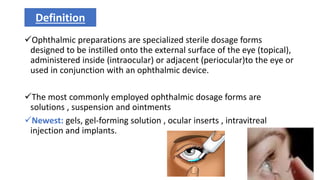
Ophthalmic preparations are specialized sterile dosage forms
designed to be instilled onto the external surface of the eye (topical),
administered inside (intraocular) or adjacent (periocular)to the eye or
used in conjunction with an ophthalmic device.
The most commonly employed ophthalmic dosage forms are
solutions , suspension and ointments
Newest: gels, gel-forming solution , ocular inserts , intravitreal
injection and implants.
Definition
3
‱ Prior to World war II, &into the 1950’s, ophthalmic preparations were
mostly compounded by the pharmacist for immediate use.
‱ Even until 1953, there was not a legal requirements by FDA that all
manufactured ophthalmic solutions be sterile.
‱ But in the past 50 years, a modern pharmaceutical industry
specializing in ophthalmic preparations has developed to support the
advances in diagnosis and treatment of eye diseases, eye surgery and
contact lenses.
HISTORICAL BACKGROUND
4
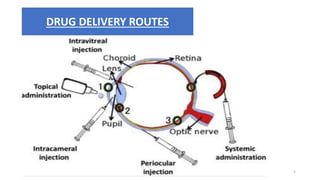
DRUG DELIVERY ROUTES
5
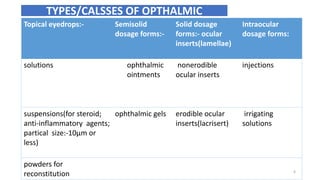
TYPES/CALSSES OF OPTHALMIC
Topical eyedrops:- Semisolid
dosage forms:-
Solid dosage
forms:- ocular
inserts(lamellae)
Intraocular
dosage forms:
solutions ophthalmic
ointments
nonerodible
ocular inserts
injections
suspensions(for steroid;
anti-inflammatory agents;
partical size:-10”m or
less)
ophthalmic gels erodible ocular
inserts(lacrisert)
irrigating
solutions
powders for
reconstitution 6
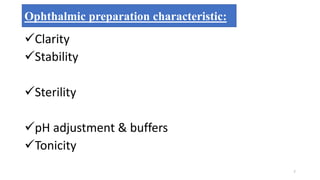
Clarity
Stability
Sterility
pH adjustment & buffers
Tonicity
Ophthalmic preparation characteristic:
7
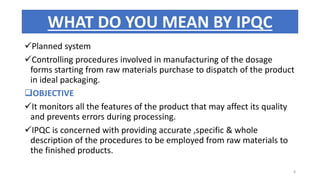
Planned system
Controlling procedures involved in manufacturing of the dosage
forms starting from raw materials purchase to dispatch of the product
in ideal packaging.
OBJECTIVE
It monitors all the features of the product that may affect its quality
and prevents errors during processing.
IPQC is concerned with providing accurate ,specific & whole
description of the procedures to be employed from raw materials to
the finished products.
WHAT DO YOU MEAN BY IPQC
8
1)Uniformity of volume
2)Metal particles
3)Insoluble particulate matter test
4)Particle size
5)Sterility test
6)Pyrogen test
7)Leaker test
8)Uniformity of weight
Various IPQC Tests:
9
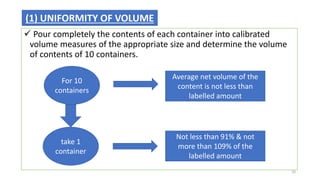
 Pour completely the contents of each container into calibrated
volume measures of the appropriate size and determine the volume
of contents of 10 containers.
(1) UNIFORMITY OF VOLUME
For 10
containers
Average net volume of the
content is not less than
labelled amount
take 1
container
Not less than 91% & not
more than 109% of the
labelled amount
10
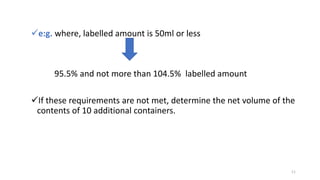
e:g. where, labelled amount is 50ml or less
95.5% and not more than 104.5% labelled amount
If these requirements are not met, determine the net volume of the
contents of 10 additional containers.
11
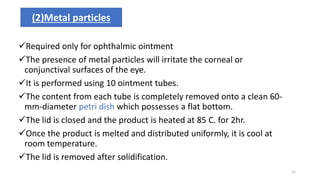
Required only for ophthalmic ointment
The presence of metal particles will irritate the corneal or
conjunctival surfaces of the eye.
It is performed using 10 ointment tubes.
The content from each tube is completely removed onto a clean 60-
mm-diameter petri dish which possesses a flat bottom.
The lid is closed and the product is heated at 85 C. for 2hr.
Once the product is melted and distributed uniformly, it is cool at
room temperature.
The lid is removed after solidification.
(2)Metal particles
12
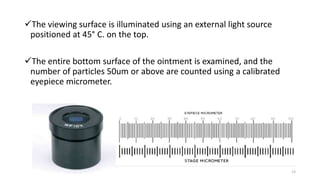
The viewing surface is illuminated using an external light source
positioned at 45° C. on the top.
The entire bottom surface of the ointment is examined, and the
number of particles 50um or above are counted using a calibrated
eyepiece micrometer.
13
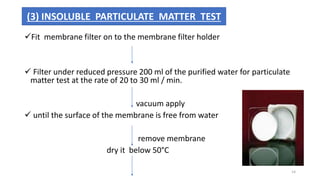
Fit membrane filter on to the membrane filter holder
 Filter under reduced pressure 200 ml of the purified water for particulate
matter test at the rate of 20 to 30 ml / min.
vacuum apply
 until the surface of the membrane is free from water
remove membrane
dry it below 50°C
(3) INSOLUBLE PARTICULATE MATTER TEST
14
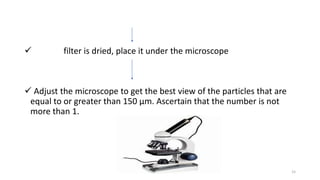
 filter is dried, place it under the microscope
 Adjust the microscope to get the best view of the particles that are
equal to or greater than 150 ”m. Ascertain that the number is not
more than 1.
15
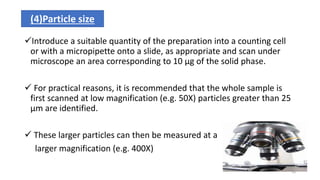
Introduce a suitable quantity of the preparation into a counting cell
or with a micropipette onto a slide, as appropriate and scan under
microscope an area corresponding to 10 ”g of the solid phase.
 For practical reasons, it is recommended that the whole sample is
first scanned at low magnification (e.g. 50X) particles greater than 25
”m are identified.
 These larger particles can then be measured at a
larger magnification (e.g. 400X)
(4)Particle size
16
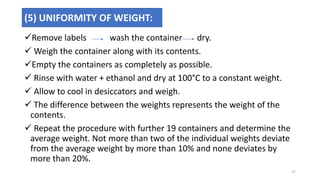
Remove labels wash the container dry.
 Weigh the container along with its contents.
Empty the containers as completely as possible.
 Rinse with water + ethanol and dry at 100°C to a constant weight.
 Allow to cool in desiccators and weigh.
 The difference between the weights represents the weight of the
contents.
 Repeat the procedure with further 19 containers and determine the
average weight. Not more than two of the individual weights deviate
from the average weight by more than 10% and none deviates by
more than 20%.
(5) UNIFORMITY OF WEIGHT:
17
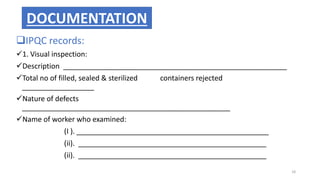
IPQC records:
1. Visual inspection:
Description ________________________________________________________
Total no of filled, sealed & sterilized containers rejected
__________________
Nature of defects
____________________________________________________
Name of worker who examined:
(I ). ________________________________________________
(ii). _______________________________________________
DOCUMENTATION
18
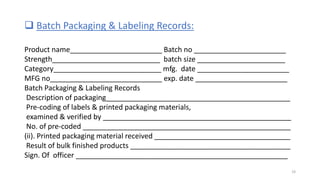
 Batch Packaging & Labeling Records:
Product name_______________________ Batch no _______________________
Strength___________________________ batch size ______________________
Category___________________________ mfg. date _______________________
MFG no____________________________ exp. date _______________________
Batch Packaging & Labeling Records
Description of packaging______________________________________________
Pre-coding of labels & printed packaging materials,
examined & verified by _______________________________________________
No. of pre-coded ____________________________________________________
(ii). Printed packaging material received __________________________________
Result of bulk finished products ________________________________________
Sign. Of officer _____________________________________________________
19
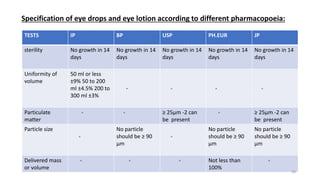
TESTS IP BP USP PH.EUR JP
sterility No growth in 14
days
No growth in 14
days
No growth in 14
days
No growth in 14
days
No growth in 14
days
Uniformity of
volume
50 ml or less
±9% 50 to 200
ml ±4.5% 200 to
300 ml ±3%
- - - -
Particulate
matter
- - ≄ 25”m -2 can
be present
- ≄ 25”m -2 can
be present
Particle size
-
No particle
should be ≄ 90
”m
-
No particle
should be ≄ 90
”m
No particle
should be ≄ 90
”m
Delivered mass
or volume
- - - Not less than
100%
-
Specification of eye drops and eye lotion according to different pharmacopoeia:
20
IN-PROCESS QUALITY
CONTROL TEST FOR
PARENTERAL
21
Definition
Drug delivery routes
Type/classes of parenteral dosage form
Parenteral preparation characteristic
Various IPQC Tests
Documentation
Reference
content
22
Parenteral dosage form
are sterile, pyrogen free
solutions or dispersions
(emulsions or suspensions)
of one or more active
ingredients in a suitable
vehicle.
The unique attributes of
the parenteral dosage
form: rapid absorption and
distribution, high
bioavailability, zero
enzymatic degradation in
the gastrointestinal tract,
and an ability to be
administered to
unconscious patients.
Definition
23
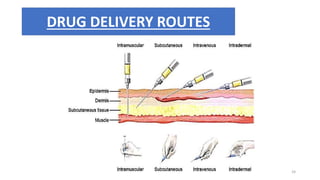
DRUG DELIVERY ROUTES
24
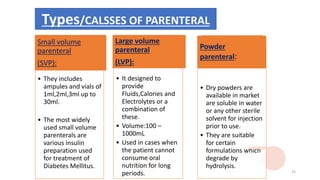
Types/CALSSES OF PARENTERAL
‱ They includes
ampules and vials of
1ml,2ml,3ml up to
30ml.
‱ The most widely
used small volume
parenterals are
various insulin
preparation used
for treatment of
Diabetes Mellitus.
Small volume
parenteral
(SVP):
‱ It designed to
provide
Fluids,Calories and
Electrolytes or a
combination of
these.
‱ Volume:100 –
1000mL
‱ Used in cases when
the patient cannot
consume oral
nutrition for long
periods.
Large volume
parenteral
(LVP):
‱ Dry powders are
available in market
are soluble in water
or any other sterile
solvent for injection
prior to use.
‱ They are suitable
for certain
formulations which
degrade by
hydrolysis.
Powder
parenteral:
25
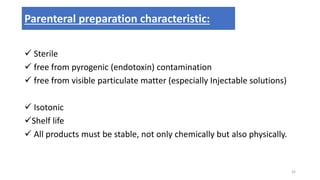
 Sterile
 free from pyrogenic (endotoxin) contamination
 free from visible particulate matter (especially Injectable solutions)
 Isotonic
Shelf life
 All products must be stable, not only chemically but also physically.
Parenteral preparation characteristic:
26
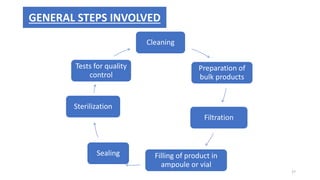
GENERAL STEPS INVOLVED
Cleaning
Preparation of
bulk products
Filtration
Filling of product in
ampoule or vial
Sealing
Sterilization
Tests for quality
control
27
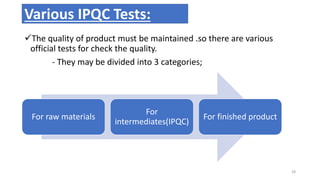
The quality of product must be maintained .so there are various
official tests for check the quality.
- They may be divided into 3 categories;
Various IPQC Tests:
For raw materials
For
intermediates(IPQC)
For finished product
28
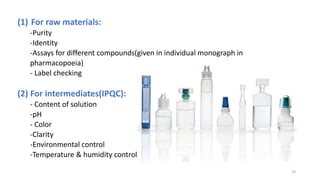
(1) For raw materials:
-Purity
-Identity
-Assays for different compounds(given in individual monograph in
pharmacopoeia)
- Label checking
(2) For intermediates(IPQC):
- Content of solution
-pH
- Color
-Clarity
-Environmental control
-Temperature & humidity control
29
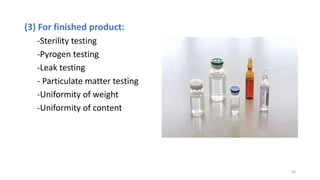
(3) For finished product:
-Sterility testing
-Pyrogen testing
-Leak testing
- Particulate matter testing
-Uniformity of weight
-Uniformity of content
30
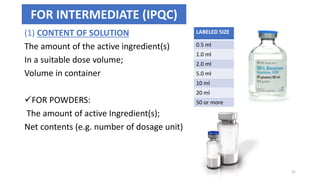
(1) CONTENT OF SOLUTION
The amount of the active ingredient(s)
In a suitable dose volume;
Volume in container
FOR POWDERS:
The amount of active Ingredient(s);
Net contents (e.g. number of dosage unit)
FOR INTERMEDIATE (IPQC)
LABELED SIZE
0.5 ml
1.0 ml
2.0 ml
5.0 ml
10 ml
20 ml
50 or more
31
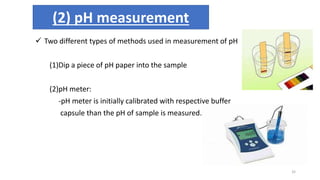
(2) pH measurement
 Two different types of methods used in measurement of pH
(1)Dip a piece of pH paper into the sample
(2)pH meter:
-pH meter is initially calibrated with respective buffer
capsule than the pH of sample is measured.
32
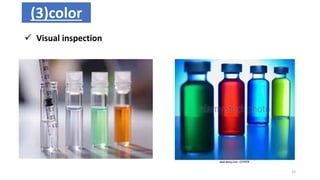
(3)color
 Visual inspection
33
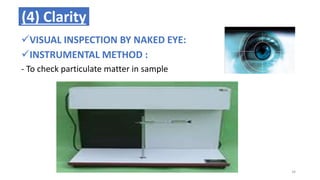
(4) Clarity
VISUAL INSPECTION BY NAKED EYE:
INSTRUMENTAL METHOD :
- To check particulate matter in sample
34
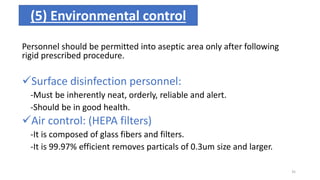
Personnel should be permitted into aseptic area only after following
rigid prescribed procedure.
Surface disinfection personnel:
-Must be inherently neat, orderly, reliable and alert.
-Should be in good health.
Air control: (HEPA filters)
-It is composed of glass fibers and filters.
-It is 99.97% efficient removes particals of 0.3um size and larger.
(5) Environmental control
35
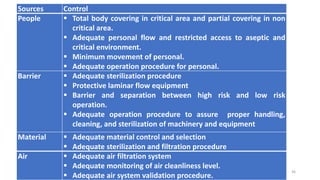
Sources Control
People  Total body covering in critical area and partial covering in non
critical area.
 Adequate personal flow and restricted access to aseptic and
critical environment.
 Minimum movement of personal.
 Adequate operation procedure for personal.
Barrier  Adequate sterilization procedure
 Protective laminar flow equipment
 Barrier and separation between high risk and low risk
operation.
 Adequate operation procedure to assure proper handling,
cleaning, and sterilization of machinery and equipment
Material  Adequate material control and selection
 Adequate sterilization and filtration procedure
Air  Adequate air filtration system
 Adequate monitoring of air cleanliness level.
 Adequate air system validation procedure.
36
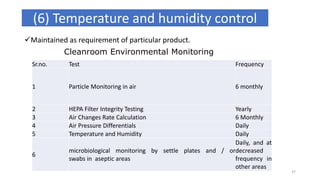
(6) Temperature and humidity control
Maintained as requirement of particular product.
Cleanroom Environmental Monitoring
Sr.no. Test Frequency
1 Particle Monitoring in air 6 monthly
2 HEPA Filter Integrity Testing Yearly
3 Air Changes Rate Calculation 6 Monthly
4 Air Pressure Differentials Daily
5 Temperature and Humidity Daily
6
microbiological monitoring by settle plates and / or
swabs in aseptic areas
Daily, and at
decreased
frequency in
other areas
37
(1)sterility testing :
-Essential characteristic of parenteral
WHAT DO YOU UNDERSTAND BY STERILITY?
- The test intended for detect absence of viable forms of microbes in
preparation.
Steps for sterility testing :
(1)Direct transfer method:
(2)membrane filtration method:
FOR FINISHED PRODUCTS
38
(1)Direct transfer method:
 traditional sterility test method
 which involves a direct inoculation of required volume of a sample
in two tests tube containing a culture medium that is FTM, SCDM.
 This method is simple in theory but difficult in practice.
Direct inoculation of the culture medium suitable quantity of the
preparation to be examined is transfer directly into the appropriate
culture medium and incubate for not less than 14 days.
39
(2)membrane filtration method:
 It is official in U.S.P. 1970.
 This method basically involves filtration of Sample through membrane
filters of porosity 0.22 micron and Diameter 47mm.
The filtration is assisted under Vacuum, after filtration completion the
membrane is cut into 2 halves and one halve is placed in two test tubes
containing FTM, SCDM medium.
Interpretation:–If no visible evidence of microbial growth in culture
medium in test tube then it is interpreted that the sample representing lot
is without intrinsic contamination.
40
Pyrogenic -means producing fever
Pyrogens – fever inducing substances
 Having nature:
-endogenous(inside body)
-exogenous (outside body)
When the volume to be injected in a single dose is 10 ml or more,
Injections comply with the test for pyrogens.
Mainly 2 tests:
1) Rabbit test
2) LAL test
(2)Pyrogen
41
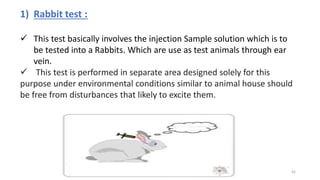
1) Rabbit test :
 This test basically involves the injection Sample solution which is to
be tested into a Rabbits. Which are use as test animals through ear
vein.
 This test is performed in separate area designed solely for this
purpose under environmental conditions similar to animal house should
be free from disturbances that likely to excite them.
42
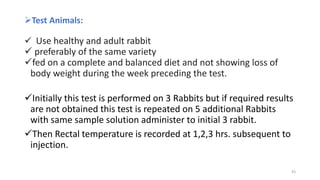
Test Animals:
 Use healthy and adult rabbit
 preferably of the same variety
fed on a complete and balanced diet and not showing loss of
body weight during the week preceding the test.
Initially this test is performed on 3 Rabbits but if required results
are not obtained this test is repeated on 5 additional Rabbits
with same sample solution administer to initial 3 rabbit.
Then Rectal temperature is recorded at 1,2,3 hrs. subsequent to
injection.
43
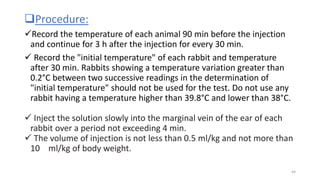
Procedure:
Record the temperature of each animal 90 min before the injection
and continue for 3 h after the injection for every 30 min.
 Record the "initial temperature" of each rabbit and temperature
after 30 min. Rabbits showing a temperature variation greater than
0.2°C between two successive readings in the determination of
"initial temperature" should not be used for the test. Do not use any
rabbit having a temperature higher than 39.8°C and lower than 38°C.
 Inject the solution slowly into the marginal vein of the ear of each
rabbit over a period not exceeding 4 min.
 The volume of injection is not less than 0.5 ml/kg and not more than
10 ml/kg of body weight.
44
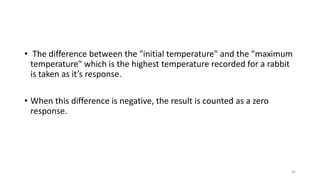
‱ The difference between the "initial temperature" and the "maximum
temperature" which is the highest temperature recorded for a rabbit
is taken as it’s response.
‱ When this difference is negative, the result is counted as a zero
response.
45
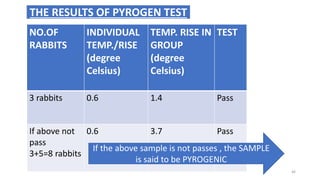
NO.OF
RABBITS
INDIVIDUAL
TEMP./RISE
(degree
Celsius)
TEMP. RISE IN
GROUP
(degree
Celsius)
TEST
3 rabbits 0.6 1.4 Pass
If above not
pass
3+5=8 rabbits
0.6 3.7 Pass
THE RESULTS OF PYROGEN TEST
If the above sample is not passes , the SAMPLE
is said to be PYROGENIC
46
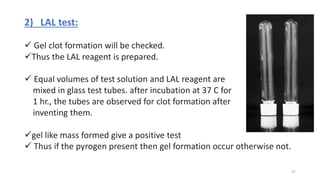
2) LAL test:
 Gel clot formation will be checked.
Thus the LAL reagent is prepared.
 Equal volumes of test solution and LAL reagent are
mixed in glass test tubes. after incubation at 37 C for
1 hr., the tubes are observed for clot formation after
inventing them.
gel like mass formed give a positive test
 Thus if the pyrogen present then gel formation occur otherwise not.
47
Main advantages of LAL test :
Particularly useful for:
Radiopharmaceuticals and cytotoxic agents
Products with marked pharmacological or toxicological activity in
rabbit (e.g. Insulin)
Blood products which sometime give misleading results in the rabbit
Water for injection where LAL test is potentially more stringent and
readily applied
Alternative to animal model
48
 This test is generally applicable to ampoules, not used for the vials or
bottles because the rubber closure used in it are not rigid however
bottles are often sealed while a vacuum is being pulled so that the
bottles remains evacuated during its shelf life.
 The container should be properly sealed so the interchange
between the contents of the container (ampoule) & environment can
not occur.
 Here from the leakage microbes can also enter from it.
 The content may leak outside & also spoil the appearance of
package
That’s why the leak test is preferred.
(3) LEAK TEST
49
 Method:
 First fill the ampoules & seal it properly.
 Then put into the container filled with colored dye solution.
 Put this container into the vacuum chamber for 30 min.
 Then check it,
If leakage may be there then the dye solution penetrate into ampoules
 Instead of vacuum chamber autoclave may also be used
it fulfill 2 purposes
I . Sterilization purpose
II . For study of leak testing
Thus the leakage will examine
50
Particulate matter refers to the extraneous, mobile ,undissolved
particles, other than gas bubbles , unintentionally present in
solution.
Particulate count is done by:
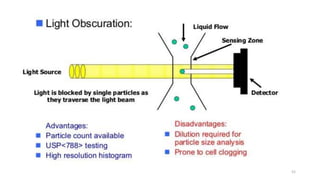
(I)Light obscuration particle count test
(ii)Microscopic particle count test
(4) PARTICULATE MATTER
51
52
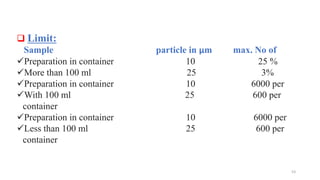
 Limit:
Sample particle in ”m max. No of
Preparation in container 10 25 %
More than 100 ml 25 3%
Preparation in container 10 6000 per
With 100 ml 25 600 per
container
Preparation in container 10 6000 per
Less than 100 ml 25 600 per
container
53
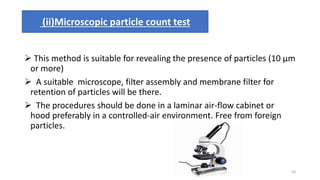
 This method is suitable for revealing the presence of particles (10 ÎŒm
or more)
 A suitable microscope, filter assembly and membrane filter for
retention of particles will be there.
 The procedures should be done in a laminar air-flow cabinet or
hood preferably in a controlled-air environment. Free from foreign
particles.
(ii)Microscopic particle count test
54
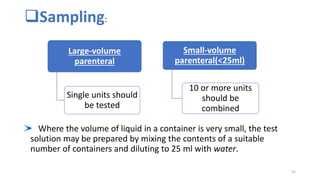
Sampling:
Where the volume of liquid in a container is very small, the test
solution may be prepared by mixing the contents of a suitable
number of containers and diluting to 25 ml with water.
Large-volume
parenteral
Single units should
be tested
Small-volume
parenteral(<25ml)
10 or more units
should be
combined
55
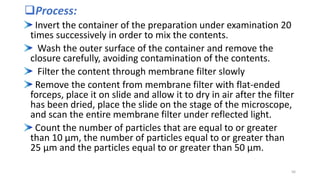
Process:
Invert the container of the preparation under examination 20
times successively in order to mix the contents.
Wash the outer surface of the container and remove the
closure carefully, avoiding contamination of the contents.
Filter the content through membrane filter slowly
Remove the content from membrane filter with flat-ended
forceps, place it on slide and allow it to dry in air after the filter
has been dried, place the slide on the stage of the microscope,
and scan the entire membrane filter under reflected light.
Count the number of particles that are equal to or greater
than 10 ÎŒm, the number of particles equal to or greater than
25 ÎŒm and the particles equal to or greater than 50 ÎŒm.
56
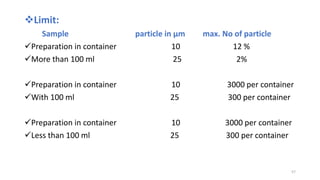
Limit:
Sample particle in ”m max. No of particle
Preparation in container 10 12 %
More than 100 ml 25 2%
Preparation in container 10 3000 per container
With 100 ml 25 300 per container
Preparation in container 10 3000 per container
Less than 100 ml 25 300 per container
57
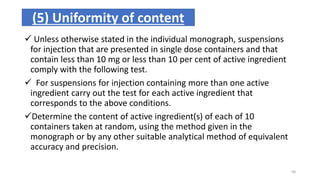
 Unless otherwise stated in the individual monograph, suspensions
for injection that are presented in single dose containers and that
contain less than 10 mg or less than 10 per cent of active ingredient
comply with the following test.
 For suspensions for injection containing more than one active
ingredient carry out the test for each active ingredient that
corresponds to the above conditions.
Determine the content of active ingredient(s) of each of 10
containers taken at random, using the method given in the
monograph or by any other suitable analytical method of equivalent
accuracy and precision.
(5) Uniformity of content
58
 Remove label - wash the container - dry.
 Weigh the container along with its contents.
Empty the containers as completely as possible.
 Rinse with water + ethanol and dry at 100°C to a constant weight.
 Allow to cool in desiccators and weigh.
 The difference between the weights represents the weight of the
contents.
 Repeat the procedure with further 19 containers and determine the
average weight. Not more than two of the individual weights deviate
from the average weight by more than 10% and none deviates by
more than 20%.
(6) UNIFORMITY OF WEIGHT
59
IPQC records
1. Visual inspection:
Description
________________________________________________________
Total no of filled, sealed & sterilized containers rejected
__________________
Nature of defects
____________________________________________________
Name of worker who examined:
(i ). ______________________
(ii). _____________________
DOCUMENTATION
60
www.pharmpress.com/files/docs/Remington
Pharmaceutical dosage forms parenteral medications volume 2
edited by Kenneth E. Avis, Leon Lachman
Sterile Pharmaceutical Manufacturing by Groves Gisan
Aseptic Pharmaceutical Manufacturing by M.J.Groves
 THE INDIAN PHARMACOPOEIA,
GOVT. OF INDIA, MINISTRY OF HEALTH & FAMILY WELFARE,
“Monograph of parenteral”, Volume 2, 2007,Pg no,39-42
International Journal of Pharmacy Teaching & Practices 2012, Vol.3,
Issue 2, 261-265.
REFERENCE
61
62

in process quality control test for ophthalmic and parenterals

  • 1.
    IN-PROCESS QUALITY CONTROLTEST FOR OPHTHALMIC AND PARENTERALS MQA103T Guided by : Presented by: Dr. Bhavna Patel Henisha Patel Department of pharmaceutical science, Quality Assurance 1
  • 2.
    Definition Historical background Drug deliveryroutes Type/classes of ophthalmic dosage form Ophthalmic preparation characteristic Various IPQC Tests Documentation content 2
  • 3.
    Ophthalmic preparations arespecialized sterile dosage forms designed to be instilled onto the external surface of the eye (topical), administered inside (intraocular) or adjacent (periocular)to the eye or used in conjunction with an ophthalmic device. The most commonly employed ophthalmic dosage forms are solutions , suspension and ointments Newest: gels, gel-forming solution , ocular inserts , intravitreal injection and implants. Definition 3
  • 4.
    ‱ Prior toWorld war II, &into the 1950’s, ophthalmic preparations were mostly compounded by the pharmacist for immediate use. ‱ Even until 1953, there was not a legal requirements by FDA that all manufactured ophthalmic solutions be sterile. ‱ But in the past 50 years, a modern pharmaceutical industry specializing in ophthalmic preparations has developed to support the advances in diagnosis and treatment of eye diseases, eye surgery and contact lenses. HISTORICAL BACKGROUND 4
  • 5.
  • 6.
    TYPES/CALSSES OF OPTHALMIC Topicaleyedrops:- Semisolid dosage forms:- Solid dosage forms:- ocular inserts(lamellae) Intraocular dosage forms: solutions ophthalmic ointments nonerodible ocular inserts injections suspensions(for steroid; anti-inflammatory agents; partical size:-10”m or less) ophthalmic gels erodible ocular inserts(lacrisert) irrigating solutions powders for reconstitution 6
  • 7.
    Clarity Stability Sterility pH adjustment &buffers Tonicity Ophthalmic preparation characteristic: 7
  • 8.
    Planned system Controlling proceduresinvolved in manufacturing of the dosage forms starting from raw materials purchase to dispatch of the product in ideal packaging. OBJECTIVE It monitors all the features of the product that may affect its quality and prevents errors during processing. IPQC is concerned with providing accurate ,specific & whole description of the procedures to be employed from raw materials to the finished products. WHAT DO YOU MEAN BY IPQC 8
  • 9.
    1)Uniformity of volume 2)Metalparticles 3)Insoluble particulate matter test 4)Particle size 5)Sterility test 6)Pyrogen test 7)Leaker test 8)Uniformity of weight Various IPQC Tests: 9
  • 10.
     Pour completelythe contents of each container into calibrated volume measures of the appropriate size and determine the volume of contents of 10 containers. (1) UNIFORMITY OF VOLUME For 10 containers Average net volume of the content is not less than labelled amount take 1 container Not less than 91% & not more than 109% of the labelled amount 10
  • 11.
    e:g. where, labelledamount is 50ml or less 95.5% and not more than 104.5% labelled amount If these requirements are not met, determine the net volume of the contents of 10 additional containers. 11
  • 12.
    Required only forophthalmic ointment The presence of metal particles will irritate the corneal or conjunctival surfaces of the eye. It is performed using 10 ointment tubes. The content from each tube is completely removed onto a clean 60- mm-diameter petri dish which possesses a flat bottom. The lid is closed and the product is heated at 85 C. for 2hr. Once the product is melted and distributed uniformly, it is cool at room temperature. The lid is removed after solidification. (2)Metal particles 12
  • 13.
    The viewing surfaceis illuminated using an external light source positioned at 45° C. on the top. The entire bottom surface of the ointment is examined, and the number of particles 50um or above are counted using a calibrated eyepiece micrometer. 13
  • 14.
    Fit membrane filteron to the membrane filter holder  Filter under reduced pressure 200 ml of the purified water for particulate matter test at the rate of 20 to 30 ml / min. vacuum apply  until the surface of the membrane is free from water remove membrane dry it below 50°C (3) INSOLUBLE PARTICULATE MATTER TEST 14
  • 15.
     filter isdried, place it under the microscope  Adjust the microscope to get the best view of the particles that are equal to or greater than 150 ”m. Ascertain that the number is not more than 1. 15
  • 16.
    Introduce a suitablequantity of the preparation into a counting cell or with a micropipette onto a slide, as appropriate and scan under microscope an area corresponding to 10 ”g of the solid phase.  For practical reasons, it is recommended that the whole sample is first scanned at low magnification (e.g. 50X) particles greater than 25 ”m are identified.  These larger particles can then be measured at a larger magnification (e.g. 400X) (4)Particle size 16
  • 17.
    Remove labels washthe container dry.  Weigh the container along with its contents. Empty the containers as completely as possible.  Rinse with water + ethanol and dry at 100°C to a constant weight.  Allow to cool in desiccators and weigh.  The difference between the weights represents the weight of the contents.  Repeat the procedure with further 19 containers and determine the average weight. Not more than two of the individual weights deviate from the average weight by more than 10% and none deviates by more than 20%. (5) UNIFORMITY OF WEIGHT: 17
  • 18.
    IPQC records: 1. Visualinspection: Description ________________________________________________________ Total no of filled, sealed & sterilized containers rejected __________________ Nature of defects ____________________________________________________ Name of worker who examined: (I ). ________________________________________________ (ii). _______________________________________________ (ii). _______________________________________________ DOCUMENTATION 18
  • 19.
     Batch Packaging& Labeling Records: Product name_______________________ Batch no _______________________ Strength___________________________ batch size ______________________ Category___________________________ mfg. date _______________________ MFG no____________________________ exp. date _______________________ Batch Packaging & Labeling Records Description of packaging______________________________________________ Pre-coding of labels & printed packaging materials, examined & verified by _______________________________________________ No. of pre-coded ____________________________________________________ (ii). Printed packaging material received __________________________________ Result of bulk finished products ________________________________________ Sign. Of officer _____________________________________________________ 19
  • 20.
    TESTS IP BPUSP PH.EUR JP sterility No growth in 14 days No growth in 14 days No growth in 14 days No growth in 14 days No growth in 14 days Uniformity of volume 50 ml or less ±9% 50 to 200 ml ±4.5% 200 to 300 ml ±3% - - - - Particulate matter - - ≄ 25”m -2 can be present - ≄ 25”m -2 can be present Particle size - No particle should be ≄ 90 ”m - No particle should be ≄ 90 ”m No particle should be ≄ 90 ”m Delivered mass or volume - - - Not less than 100% - Specification of eye drops and eye lotion according to different pharmacopoeia: 20
  • 21.
  • 22.
    Definition Drug delivery routes Type/classesof parenteral dosage form Parenteral preparation characteristic Various IPQC Tests Documentation Reference content 22
  • 23.
    Parenteral dosage form aresterile, pyrogen free solutions or dispersions (emulsions or suspensions) of one or more active ingredients in a suitable vehicle. The unique attributes of the parenteral dosage form: rapid absorption and distribution, high bioavailability, zero enzymatic degradation in the gastrointestinal tract, and an ability to be administered to unconscious patients. Definition 23
  • 24.
  • 25.
    Types/CALSSES OF PARENTERAL ‱They includes ampules and vials of 1ml,2ml,3ml up to 30ml. ‱ The most widely used small volume parenterals are various insulin preparation used for treatment of Diabetes Mellitus. Small volume parenteral (SVP): ‱ It designed to provide Fluids,Calories and Electrolytes or a combination of these. ‱ Volume:100 – 1000mL ‱ Used in cases when the patient cannot consume oral nutrition for long periods. Large volume parenteral (LVP): ‱ Dry powders are available in market are soluble in water or any other sterile solvent for injection prior to use. ‱ They are suitable for certain formulations which degrade by hydrolysis. Powder parenteral: 25
  • 26.
     Sterile  freefrom pyrogenic (endotoxin) contamination  free from visible particulate matter (especially Injectable solutions)  Isotonic Shelf life  All products must be stable, not only chemically but also physically. Parenteral preparation characteristic: 26
  • 27.
    GENERAL STEPS INVOLVED Cleaning Preparationof bulk products Filtration Filling of product in ampoule or vial Sealing Sterilization Tests for quality control 27
  • 28.
    The quality ofproduct must be maintained .so there are various official tests for check the quality. - They may be divided into 3 categories; Various IPQC Tests: For raw materials For intermediates(IPQC) For finished product 28
  • 29.
    (1) For rawmaterials: -Purity -Identity -Assays for different compounds(given in individual monograph in pharmacopoeia) - Label checking (2) For intermediates(IPQC): - Content of solution -pH - Color -Clarity -Environmental control -Temperature & humidity control 29
  • 30.
    (3) For finishedproduct: -Sterility testing -Pyrogen testing -Leak testing - Particulate matter testing -Uniformity of weight -Uniformity of content 30
  • 31.
    (1) CONTENT OFSOLUTION The amount of the active ingredient(s) In a suitable dose volume; Volume in container FOR POWDERS: The amount of active Ingredient(s); Net contents (e.g. number of dosage unit) FOR INTERMEDIATE (IPQC) LABELED SIZE 0.5 ml 1.0 ml 2.0 ml 5.0 ml 10 ml 20 ml 50 or more 31
  • 32.
    (2) pH measurement Two different types of methods used in measurement of pH (1)Dip a piece of pH paper into the sample (2)pH meter: -pH meter is initially calibrated with respective buffer capsule than the pH of sample is measured. 32
  • 33.
  • 34.
    (4) Clarity VISUAL INSPECTIONBY NAKED EYE: INSTRUMENTAL METHOD : - To check particulate matter in sample 34
  • 35.
    Personnel should bepermitted into aseptic area only after following rigid prescribed procedure. Surface disinfection personnel: -Must be inherently neat, orderly, reliable and alert. -Should be in good health. Air control: (HEPA filters) -It is composed of glass fibers and filters. -It is 99.97% efficient removes particals of 0.3um size and larger. (5) Environmental control 35
  • 36.
    Sources Control People Total body covering in critical area and partial covering in non critical area.  Adequate personal flow and restricted access to aseptic and critical environment.  Minimum movement of personal.  Adequate operation procedure for personal. Barrier  Adequate sterilization procedure  Protective laminar flow equipment  Barrier and separation between high risk and low risk operation.  Adequate operation procedure to assure proper handling, cleaning, and sterilization of machinery and equipment Material  Adequate material control and selection  Adequate sterilization and filtration procedure Air  Adequate air filtration system  Adequate monitoring of air cleanliness level.  Adequate air system validation procedure. 36
  • 37.
    (6) Temperature andhumidity control Maintained as requirement of particular product. Cleanroom Environmental Monitoring Sr.no. Test Frequency 1 Particle Monitoring in air 6 monthly 2 HEPA Filter Integrity Testing Yearly 3 Air Changes Rate Calculation 6 Monthly 4 Air Pressure Differentials Daily 5 Temperature and Humidity Daily 6 microbiological monitoring by settle plates and / or swabs in aseptic areas Daily, and at decreased frequency in other areas 37
  • 38.
    (1)sterility testing : -Essentialcharacteristic of parenteral WHAT DO YOU UNDERSTAND BY STERILITY? - The test intended for detect absence of viable forms of microbes in preparation. Steps for sterility testing : (1)Direct transfer method: (2)membrane filtration method: FOR FINISHED PRODUCTS 38
  • 39.
    (1)Direct transfer method: traditional sterility test method  which involves a direct inoculation of required volume of a sample in two tests tube containing a culture medium that is FTM, SCDM.  This method is simple in theory but difficult in practice. Direct inoculation of the culture medium suitable quantity of the preparation to be examined is transfer directly into the appropriate culture medium and incubate for not less than 14 days. 39
  • 40.
    (2)membrane filtration method: It is official in U.S.P. 1970.  This method basically involves filtration of Sample through membrane filters of porosity 0.22 micron and Diameter 47mm. The filtration is assisted under Vacuum, after filtration completion the membrane is cut into 2 halves and one halve is placed in two test tubes containing FTM, SCDM medium. Interpretation:–If no visible evidence of microbial growth in culture medium in test tube then it is interpreted that the sample representing lot is without intrinsic contamination. 40
  • 41.
    Pyrogenic -means producingfever Pyrogens – fever inducing substances  Having nature: -endogenous(inside body) -exogenous (outside body) When the volume to be injected in a single dose is 10 ml or more, Injections comply with the test for pyrogens. Mainly 2 tests: 1) Rabbit test 2) LAL test (2)Pyrogen 41
  • 42.
    1) Rabbit test:  This test basically involves the injection Sample solution which is to be tested into a Rabbits. Which are use as test animals through ear vein.  This test is performed in separate area designed solely for this purpose under environmental conditions similar to animal house should be free from disturbances that likely to excite them. 42
  • 43.
    Test Animals:  Usehealthy and adult rabbit  preferably of the same variety fed on a complete and balanced diet and not showing loss of body weight during the week preceding the test. Initially this test is performed on 3 Rabbits but if required results are not obtained this test is repeated on 5 additional Rabbits with same sample solution administer to initial 3 rabbit. Then Rectal temperature is recorded at 1,2,3 hrs. subsequent to injection. 43
  • 44.
    Procedure: Record the temperatureof each animal 90 min before the injection and continue for 3 h after the injection for every 30 min.  Record the "initial temperature" of each rabbit and temperature after 30 min. Rabbits showing a temperature variation greater than 0.2°C between two successive readings in the determination of "initial temperature" should not be used for the test. Do not use any rabbit having a temperature higher than 39.8°C and lower than 38°C.  Inject the solution slowly into the marginal vein of the ear of each rabbit over a period not exceeding 4 min.  The volume of injection is not less than 0.5 ml/kg and not more than 10 ml/kg of body weight. 44
  • 45.
    ‱ The differencebetween the "initial temperature" and the "maximum temperature" which is the highest temperature recorded for a rabbit is taken as it’s response. ‱ When this difference is negative, the result is counted as a zero response. 45
  • 46.
    NO.OF RABBITS INDIVIDUAL TEMP./RISE (degree Celsius) TEMP. RISE IN GROUP (degree Celsius) TEST 3rabbits 0.6 1.4 Pass If above not pass 3+5=8 rabbits 0.6 3.7 Pass THE RESULTS OF PYROGEN TEST If the above sample is not passes , the SAMPLE is said to be PYROGENIC 46
  • 47.
    2) LAL test: Gel clot formation will be checked. Thus the LAL reagent is prepared.  Equal volumes of test solution and LAL reagent are mixed in glass test tubes. after incubation at 37 C for 1 hr., the tubes are observed for clot formation after inventing them. gel like mass formed give a positive test  Thus if the pyrogen present then gel formation occur otherwise not. 47
  • 48.
    Main advantages ofLAL test : Particularly useful for: Radiopharmaceuticals and cytotoxic agents Products with marked pharmacological or toxicological activity in rabbit (e.g. Insulin) Blood products which sometime give misleading results in the rabbit Water for injection where LAL test is potentially more stringent and readily applied Alternative to animal model 48
  • 49.
     This testis generally applicable to ampoules, not used for the vials or bottles because the rubber closure used in it are not rigid however bottles are often sealed while a vacuum is being pulled so that the bottles remains evacuated during its shelf life.  The container should be properly sealed so the interchange between the contents of the container (ampoule) & environment can not occur.  Here from the leakage microbes can also enter from it.  The content may leak outside & also spoil the appearance of package That’s why the leak test is preferred. (3) LEAK TEST 49
  • 50.
     Method:  Firstfill the ampoules & seal it properly.  Then put into the container filled with colored dye solution.  Put this container into the vacuum chamber for 30 min.  Then check it, If leakage may be there then the dye solution penetrate into ampoules  Instead of vacuum chamber autoclave may also be used it fulfill 2 purposes I . Sterilization purpose II . For study of leak testing Thus the leakage will examine 50
  • 51.
    Particulate matter refersto the extraneous, mobile ,undissolved particles, other than gas bubbles , unintentionally present in solution. Particulate count is done by: (I)Light obscuration particle count test (ii)Microscopic particle count test (4) PARTICULATE MATTER 51
  • 52.
  • 53.
     Limit: Sample particlein ”m max. No of Preparation in container 10 25 % More than 100 ml 25 3% Preparation in container 10 6000 per With 100 ml 25 600 per container Preparation in container 10 6000 per Less than 100 ml 25 600 per container 53
  • 54.
     This methodis suitable for revealing the presence of particles (10 ÎŒm or more)  A suitable microscope, filter assembly and membrane filter for retention of particles will be there.  The procedures should be done in a laminar air-flow cabinet or hood preferably in a controlled-air environment. Free from foreign particles. (ii)Microscopic particle count test 54
  • 55.
    Sampling: Where the volumeof liquid in a container is very small, the test solution may be prepared by mixing the contents of a suitable number of containers and diluting to 25 ml with water. Large-volume parenteral Single units should be tested Small-volume parenteral(<25ml) 10 or more units should be combined 55
  • 56.
    Process: Invert the containerof the preparation under examination 20 times successively in order to mix the contents. Wash the outer surface of the container and remove the closure carefully, avoiding contamination of the contents. Filter the content through membrane filter slowly Remove the content from membrane filter with flat-ended forceps, place it on slide and allow it to dry in air after the filter has been dried, place the slide on the stage of the microscope, and scan the entire membrane filter under reflected light. Count the number of particles that are equal to or greater than 10 Όm, the number of particles equal to or greater than 25 Όm and the particles equal to or greater than 50 Όm. 56
  • 57.
    Limit: Sample particle in”m max. No of particle Preparation in container 10 12 % More than 100 ml 25 2% Preparation in container 10 3000 per container With 100 ml 25 300 per container Preparation in container 10 3000 per container Less than 100 ml 25 300 per container 57
  • 58.
     Unless otherwisestated in the individual monograph, suspensions for injection that are presented in single dose containers and that contain less than 10 mg or less than 10 per cent of active ingredient comply with the following test.  For suspensions for injection containing more than one active ingredient carry out the test for each active ingredient that corresponds to the above conditions. Determine the content of active ingredient(s) of each of 10 containers taken at random, using the method given in the monograph or by any other suitable analytical method of equivalent accuracy and precision. (5) Uniformity of content 58
  • 59.
     Remove label- wash the container - dry.  Weigh the container along with its contents. Empty the containers as completely as possible.  Rinse with water + ethanol and dry at 100°C to a constant weight.  Allow to cool in desiccators and weigh.  The difference between the weights represents the weight of the contents.  Repeat the procedure with further 19 containers and determine the average weight. Not more than two of the individual weights deviate from the average weight by more than 10% and none deviates by more than 20%. (6) UNIFORMITY OF WEIGHT 59
  • 60.
    IPQC records 1. Visualinspection: Description ________________________________________________________ Total no of filled, sealed & sterilized containers rejected __________________ Nature of defects ____________________________________________________ Name of worker who examined: (i ). ______________________ (ii). _____________________ (ii). _____________________ DOCUMENTATION 60
  • 61.
    www.pharmpress.com/files/docs/Remington Pharmaceutical dosage formsparenteral medications volume 2 edited by Kenneth E. Avis, Leon Lachman Sterile Pharmaceutical Manufacturing by Groves Gisan Aseptic Pharmaceutical Manufacturing by M.J.Groves  THE INDIAN PHARMACOPOEIA, GOVT. OF INDIA, MINISTRY OF HEALTH & FAMILY WELFARE, “Monograph of parenteral”, Volume 2, 2007,Pg no,39-42 International Journal of Pharmacy Teaching & Practices 2012, Vol.3, Issue 2, 261-265. REFERENCE 61
  • 62.