College of Health Sciences
Dep. of Medical Laboratories
Parasitology Practice
3rd stage
Lecture 1
Dr.: Shameeran S. Ismael
BVM & S, M.Sc Medical Microbiology(Parasitology),
PhD Molecular Parasitology
11/28/2020
– Confirmation of clinical suspicion
– Identification of unsuspected infection
Purpose of laboratory diagnosis :
• A portion or segment that is representative of a whole
body, is taken for analysis or testing, ex., stool
sample, blood sample, urine sample, etc…..
Sample or Specimens:
Types of specimens which can be examined
for diagnosis of parasites:
1.Natural secretions: stool, sputum, and urine are used to
detect lumen dwelling parasites of GI, pulmonary and
genitourinary tracts.
2. Blood - usual specimen for detection of blood and tissue
parasites.
3.Skin scraping
4. Biopsy and Autopsy
• Stool specimen are examined for detection of protozoa ,
helminthes larvae or eggs.
• The stages of protozoa found in stool samples are
trophozoites , cysts or Oocysts.
• The stages of helminthes usually found in the stool
samples are eggs and larvae, through whole adult worms
or segment of worms may also be seen.
1.Stool or fecal Specimen
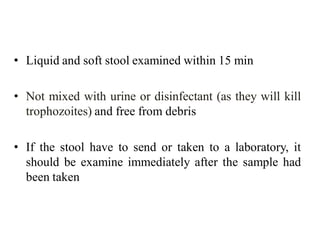
Stool sample collection:
• Sample is collected in clean, dry container
• Handled carefully
• The container with the specimen should be
clearly labeled with the following:
o Date and time of collection.
o Species of patient
o Sex of patient
o Age of patient
o Time and readable number
.
• Liquid and soft stool examined within 15 min
• Not mixed with urine or disinfectant (as they will kill
trophozoites) and free from debris
• If the stool have to send or taken to a laboratory, it
should be examine immediately after the sample had
been taken
• If immediate examination is not possible, the stool
samples should be stored in the refrigerator for few
hrs ( not more than 24 hrs.)
• Any worm appears in the stool, it should be preserved
in 5-10% forlmaline or 70% alcohol solution.
• For receiving the specimens, it is stored by adding
few drops of 3% formalin for saving larvae and eggs.
• For samples send through the post, the addition of
twice the fecal volume of 10% formalin to the feces
will minimize development and hatching of eggs.
• 10% formalsalin (5%formalin + 5% saline) is
prepare for protozoan preservation.
• If the patient has been treated with anti-diarrhea
preparation containing bismuth or cooline, mineral or
oral contrast material (barium) or antibiotics, therefore
repeating fecal examination 5-10 days after treatment
should be done
• Entamoeba histolytica (Trophozoite and cyst)
• Giardia lamblia (Trophozoite and cyst)
• Ascaris lumbricoides (larval and adult)
• Faschiola hepatica and schistosoma spp.
(japonicum and mansoni) eggs
• Oocyst of sporozoa
Expected parasites in stool:
• Required equipment: we need the followings:
1. tubes.
2. Sterile cotton, wool, or swabs.
3. Sterile lancet.
4. Slides.
5. Disinfect puncture site with
I. 70% alcohol
II. Povidone-iodine
II. Blood Specimen
• Blood and Lymph is stored in small tubes containing
aticoagulant or fresh smear is prepared.
Expected parasites in blood smears:
• Trypanosoma Spp.
• Leishmania Spp.
• Plasmodium Spp.
• Containers for collection of urine should be
wide mouthed, clean and dry.
• Should be labeled with basic information
associated with patient as in fecal collection
III. Urine collection
• Should examined directly or within 1 hr.
(Trophozoite of Trichomonis vaginalis)
• If not, keep it in the refrigerator at around 4ºC for no
longer than 24 hours.
• Preservative used to preserve urine samples such as
Hydrochloric acid, Boric acid, Glacial acetic
acid, Formaldehyde, etc.,
Preservation of Urine
• Trichomonas vaginalis (Trophozoites)
• Schistosoma haematobium
Expected parasites in urine
• Proper cleaning and drying of the site before scraping.
• Scrapings are made from the center and the margin
• Slide and cover slip
• Normal saline or mineral oil
• Using aseptic technique , clean the area in and over the
lesions with sterile saline and sterile gauze prior to
collection.
IV. Skin Scraping
• Debride skin lesions, removing the crust and
any purulent exudates with the moistened
gauze. Explore the base of the lesion with a
sterile moistened swab rolling the swab
through any visible exudates. Replace the
swab in the gel tube, label and transport to the
laboratory promptly.
• Amastigote of Leishmania tropica.
(cutaneous leishmaniasis)
• Onchocerca
Expected parasites in skin scraping:
V. Sputum sample
Sputum should be obtained from the lower
respiratory passages not saliva.
Sputum specimens should be collected first
thing in the morning
• Strongyloides larvae,
•Ascaris larvae,
•Hookworm larvae.
•Entamoeba histolytica (amebic lung abscess)
Expected parasites in Sputum:
VI. Vaginal discharge
 Vaginal discharge is used for the demonstration of
trophozoites is usually done by preparing wet mounts
made from vaginal swabs or scrapings.
 If the specimen cannot be examined immediately,
it should be preserved in PVA and stained smears
examined later
 Trichomonis vaginalis trophozoite
VII. Tissue Biopsies:
Tissue specimens, including biopsy, surgical or
necropsy specimens, may be collected for the
detection of free-living amebae (Naegleria,
Balamuthia, and Acanthamoeba).
Encysted Larva of Trichinella spiralis in
muscles.
I. Stool examination
Examination of the stool sample:
There are two types of method for examination of
stool sample in for detection and identification of
parasites:
A. Qualitative Methods:
I. Macroscopic or gross examination
II. Microscopic examination:
1. Direct stool smear
2. Concentration methods:
a. Floatation technique
b. Sedimentation techniques
c. Telmann Method
d. Baerman Method.
e. Adhesive Tape Method
B. Quantitative Stool Methods:
1.MacMaster Method
2. Stoll Method
Thanks for attention

Parasitology practice 1/Health Sciences

  • 1.
    College of HealthSciences Dep. of Medical Laboratories Parasitology Practice 3rd stage Lecture 1 Dr.: Shameeran S. Ismael BVM & S, M.Sc Medical Microbiology(Parasitology), PhD Molecular Parasitology 11/28/2020
  • 2.
    – Confirmation ofclinical suspicion – Identification of unsuspected infection Purpose of laboratory diagnosis :
  • 3.
    • A portionor segment that is representative of a whole body, is taken for analysis or testing, ex., stool sample, blood sample, urine sample, etc….. Sample or Specimens:
  • 4.
    Types of specimenswhich can be examined for diagnosis of parasites: 1.Natural secretions: stool, sputum, and urine are used to detect lumen dwelling parasites of GI, pulmonary and genitourinary tracts. 2. Blood - usual specimen for detection of blood and tissue parasites. 3.Skin scraping 4. Biopsy and Autopsy
  • 5.
    • Stool specimenare examined for detection of protozoa , helminthes larvae or eggs. • The stages of protozoa found in stool samples are trophozoites , cysts or Oocysts. • The stages of helminthes usually found in the stool samples are eggs and larvae, through whole adult worms or segment of worms may also be seen. 1.Stool or fecal Specimen
  • 6.
    Stool sample collection: •Sample is collected in clean, dry container • Handled carefully • The container with the specimen should be clearly labeled with the following: o Date and time of collection. o Species of patient o Sex of patient o Age of patient o Time and readable number .
  • 7.
    • Liquid andsoft stool examined within 15 min • Not mixed with urine or disinfectant (as they will kill trophozoites) and free from debris • If the stool have to send or taken to a laboratory, it should be examine immediately after the sample had been taken
  • 8.
    • If immediateexamination is not possible, the stool samples should be stored in the refrigerator for few hrs ( not more than 24 hrs.) • Any worm appears in the stool, it should be preserved in 5-10% forlmaline or 70% alcohol solution.
  • 9.
    • For receivingthe specimens, it is stored by adding few drops of 3% formalin for saving larvae and eggs. • For samples send through the post, the addition of twice the fecal volume of 10% formalin to the feces will minimize development and hatching of eggs. • 10% formalsalin (5%formalin + 5% saline) is prepare for protozoan preservation.
  • 10.
    • If thepatient has been treated with anti-diarrhea preparation containing bismuth or cooline, mineral or oral contrast material (barium) or antibiotics, therefore repeating fecal examination 5-10 days after treatment should be done
  • 11.
    • Entamoeba histolytica(Trophozoite and cyst) • Giardia lamblia (Trophozoite and cyst) • Ascaris lumbricoides (larval and adult) • Faschiola hepatica and schistosoma spp. (japonicum and mansoni) eggs • Oocyst of sporozoa Expected parasites in stool:
  • 12.
    • Required equipment:we need the followings: 1. tubes. 2. Sterile cotton, wool, or swabs. 3. Sterile lancet. 4. Slides. 5. Disinfect puncture site with I. 70% alcohol II. Povidone-iodine II. Blood Specimen
  • 13.
    • Blood andLymph is stored in small tubes containing aticoagulant or fresh smear is prepared. Expected parasites in blood smears: • Trypanosoma Spp. • Leishmania Spp. • Plasmodium Spp.
  • 14.
    • Containers forcollection of urine should be wide mouthed, clean and dry. • Should be labeled with basic information associated with patient as in fecal collection III. Urine collection
  • 15.
    • Should examineddirectly or within 1 hr. (Trophozoite of Trichomonis vaginalis) • If not, keep it in the refrigerator at around 4ºC for no longer than 24 hours. • Preservative used to preserve urine samples such as Hydrochloric acid, Boric acid, Glacial acetic acid, Formaldehyde, etc., Preservation of Urine
  • 16.
    • Trichomonas vaginalis(Trophozoites) • Schistosoma haematobium Expected parasites in urine
  • 17.
    • Proper cleaningand drying of the site before scraping. • Scrapings are made from the center and the margin • Slide and cover slip • Normal saline or mineral oil • Using aseptic technique , clean the area in and over the lesions with sterile saline and sterile gauze prior to collection. IV. Skin Scraping
  • 18.
    • Debride skinlesions, removing the crust and any purulent exudates with the moistened gauze. Explore the base of the lesion with a sterile moistened swab rolling the swab through any visible exudates. Replace the swab in the gel tube, label and transport to the laboratory promptly.
  • 19.
    • Amastigote ofLeishmania tropica. (cutaneous leishmaniasis) • Onchocerca Expected parasites in skin scraping:
  • 20.
    V. Sputum sample Sputumshould be obtained from the lower respiratory passages not saliva. Sputum specimens should be collected first thing in the morning
  • 21.
    • Strongyloides larvae, •Ascarislarvae, •Hookworm larvae. •Entamoeba histolytica (amebic lung abscess) Expected parasites in Sputum:
  • 22.
    VI. Vaginal discharge Vaginal discharge is used for the demonstration of trophozoites is usually done by preparing wet mounts made from vaginal swabs or scrapings.  If the specimen cannot be examined immediately, it should be preserved in PVA and stained smears examined later  Trichomonis vaginalis trophozoite
  • 23.
    VII. Tissue Biopsies: Tissuespecimens, including biopsy, surgical or necropsy specimens, may be collected for the detection of free-living amebae (Naegleria, Balamuthia, and Acanthamoeba). Encysted Larva of Trichinella spiralis in muscles.
  • 24.
  • 25.
    Examination of thestool sample: There are two types of method for examination of stool sample in for detection and identification of parasites: A. Qualitative Methods: I. Macroscopic or gross examination II. Microscopic examination:
  • 26.
    II. Microscopic examination: 1.Direct stool smear 2. Concentration methods: a. Floatation technique b. Sedimentation techniques c. Telmann Method d. Baerman Method. e. Adhesive Tape Method
  • 27.
    B. Quantitative StoolMethods: 1.MacMaster Method 2. Stoll Method
  • 28.