
College of Health Sciences
Dep. of Medical Laboratories
Parasitology Theory
3rd stage
Lecture 7
Dr.: Shameeran S. Ismael
BVM & S, M.Sc Medical Microbiology(Parasitology),
PhD Molecular Parasitology
Dr. Shameeran S., Medical Parasitology,
Health Sciences,2021
Plasmodium spp.
Malaria
Dr. Shameeran S., Medical Parasitology, Health Sciences,2021
Malaria
• Malaria is derived from Italian word
• Mal Bad
• Aria Air
Malaria is caused by members of Plasmodium
parasite :P. falciparum, P. vivax, P. ovale
and P. malariae and transmitted by
infected female anopheles mosquitoes
Dr. Shameeran S., Medical Parasitology,
Health Sciences,2021
Plasmodium spp:
Kingdome: Protista
Phylum: Protozoa
Sub-phylum: Sporozoa
Class: Haemosporidia
Family: Plasmodidae
Genus: Plasmodium
Species: P. falciparum (Malignant tertian malaria)
P. vivax (Benign tertian malaria)
P. ovale (Ovale malaria)
P. malariae (Quartan malaria)
Dr. Shameeran S., Medical Parasitology, Health Sciences,2021
Human species including: P. falciparum, P. vivax, P. Ovale
and P. malariae
Intermediate host: human
Vector or final host: Mosquitoes (Female Anopheles)
Site of infection: Intracellular Protozoa (blood)
Infective stage: Sporozoites for intermediate host &
Gametocyte for Mosquitoes
Infection: When mosquitoes bite the human during blood
meals
Disease: Malaria
Dr. Shameeran S., Medical Parasitology, Health Sciences,2021
Morphology
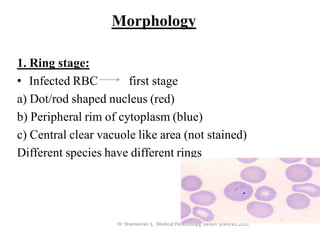
1. Ring stage:
• Infected RBC first stage
a) Dot/rod shaped nucleus (red)
b) Peripheral rim of cytoplasm (blue)
c) Central clear vacuole like area (not stained)
Different species have different rings
Dr. Shameeran S., Medical Parasitology, Health Sciences,2021
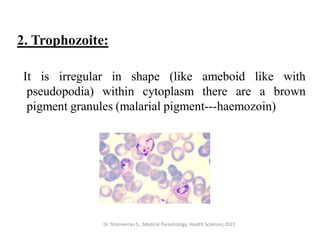
2. Trophozoite:
It is irregular in shape (like ameboid like with
pseudopodia) within cytoplasm there are a brown
pigment granules (malarial pigment---haemozoin)
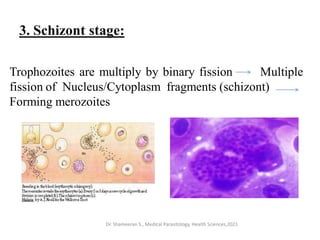
3. Schizont stage:
Dr. Shameeran S., Medical Parasitology, Health Sciences,2021
Trophozoites are multiply by binary fission Multiple
fission of Nucleus/Cytoplasm fragments (schizont)
Forming merozoites
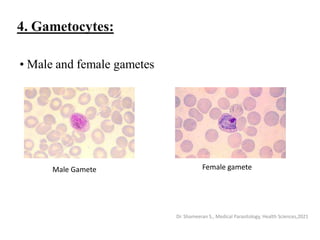
4. Gametocytes:
• Male and female gametes
Dr. Shameeran S., Medical Parasitology, Health Sciences,2021
Male Gamete Female gamete
Life Cycle
Hosts:
• Definitive Host : Female anopheles (sexual cycle,
sporogony)
• Intermediate Host : Man (asexual cycle:
exoerythrocytic and endoerythrocytic or erythrocytic)
Vector:
• Female Anopheles
Dr. Shameeran S., Medical Parasitology, Health Sciences,2021
Besides infection by the bite of infected female
mosquito the infection may also be transmitted by:
• Transfusion of blood from a patient of malaria
• Transmission of infection to foetus in utero through
some placental defect (Congenital Malaria)
• By the use of contaminated syringes particularly in
drug addicts.
Dr. Shameeran S., Medical Parasitology, Health Sciences,2021
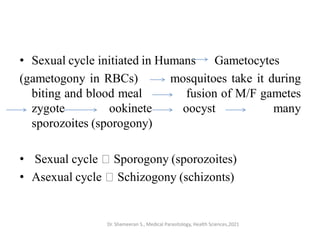
• Sexual cycle initiated in Humans Gametocytes
(gametogony in RBCs) mosquitoes take it during
biting and blood meal fusion of M/F gametes
zygote ookinete oocyst many
sporozoites (sporogony)
• Sexual cycle Sporogony (sporozoites)
• Asexual cycle Schizogony (schizonts)
Dr. Shameeran S., Medical Parasitology, Health Sciences,2021
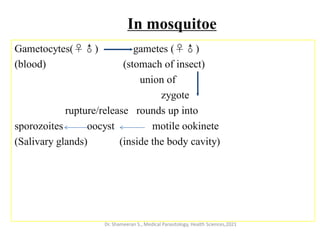
In mosquitoe
Gametocytes(♀♂) gametes (♀♂)
(blood) (stomach of insect)
union of
zygote
rupture/release rounds up into
sporozoites oocyst motile ookinete
(Salivary glands) (inside the body cavity)
Dr. Shameeran S., Medical Parasitology, Health Sciences,2021
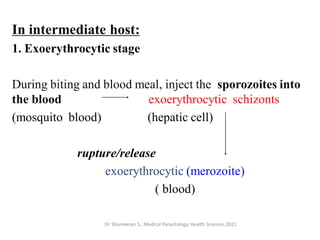
In intermediate host:
1. Exoerythrocytic stage
During biting and blood meal, inject the sporozoites into
the blood exoerythrocytic schizonts
(mosquito blood) (hepatic cell)
rupture/release
exoerythrocytic (merozoite)
( blood)
Dr. Shameeran S., Medical Parasitology, Health Sciences,2021
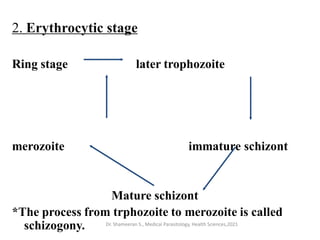
2. Erythrocytic stage
Ring stage later trophozoite
merozoite immature schizont
Mature schizont
*The process from trphozoite to merozoite is called
schizogony. Dr. Shameeran S., Medical Parasitology, Health Sciences,2021
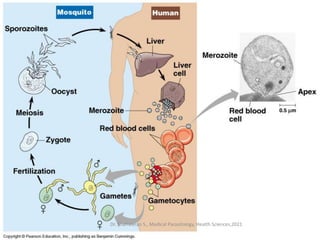
3. Gametgenesis
----After completing a few schizogonic cycles, some
merozoites develop into sexual cells, the male and
female gametocytes. They continue their development in
the mosquito.
Dr. Shameeran S., Medical Parasitology, Health Sciences,2021
Malaria
Dr. Shameeran S., Medical Parasitology, Health Sciences,2021
P. falciparum is the most deadly one; because these
parasites promote physiologic changes of the red cell,
which causes agglutination and lysis. Schizogony takes
place in the capillaries and blood sinuses of the brain,
visceral organs, and placenta, with infected cells tending
to adhere to one another and to the surrounding vessel
walls. Vessels become blocked, causing local infarction
and damage to the regional tissue.
Pathogenesis
Causing cerebral malaria:
• This is the most commonest cause of coma and death
in P.falciparum malaria, particularly in children and
non immune adults.
• Many parasitized cells can be found in the capillaries
of the brain and in late stage, hemorrhaging from small
blood vessels can occur
Dr. Shameeran S., Medical Parasitology, Health Sciences,2021
Causing Blackwater Fever
• It is a rare but acute condition in which there is a
rapid and massive intravascular haemolysis of both
parasitized and non parasitized red blood cells
• It result in haemoglobinanemia, haemoglobinuria
(The urine appears dark red to brown-black).
• It can occur in non-immune adults with sever
P.falciparum malaria
Dr. Shameeran S., Medical Parasitology, Health Sciences,2021
Merozoites of P. malariae can invade only older cells;
those of P. vivax and P. ovale infect primarily
reticulocytes (immature RBCs) and the P. falciparum -
RBCs of every age.
A characteristic brown malaria pigment derived from
hemoglobin, called hematin is released from ruptured
RBCs and produces discoloration of the spleen. Liver,
lymph nodes and bone marrow.
 P. vivax is the most widely disseminated and most
prevalent parasite causing malaria. There is repeated
exoerythrocytic development in the liver; therefore, P.
vivax can cause a relapse (hypnozoites), with
erythrocytic cycles starting again years after the initial
infection sequence. This is thought to result from
sequestered hypnozoites in the liver. P. ovale can also
cause relapses, but infections with this parasite are
usually less severe and often resolve themselves
within 6 to 10 paroxysms
Dr. Shameeran S., Medical Parasitology, Health Sciences,2021
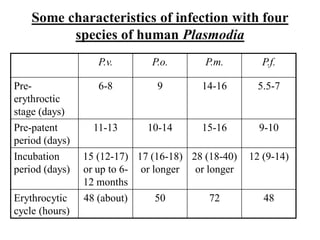
Some characteristics of infection with four
species of human Plasmodia
P.v. P.o. P.m. P.f.
Pre-
erythroctic
stage (days)
6-8 9 14-16 5.5-7
Pre-patent
period (days)
11-13 10-14 15-16 9-10
Incubation
period (days)
15 (12-17)
or up to 6-
12 months
17 (16-18)
or longer
28 (18-40)
or longer
12 (9-14)
Erythrocytic
cycle (hours)
48 (about) 50 72 48
• Complications of P.
falciparum malaria
– Cerebral malaria ( coma )
– Convulsions
– Hyperpyrexia
– Severe anemia
– Metabolic (Lactic) Acidosis
– jaundice
– renal failure
– Pulmonary odema & ARDS
– hypoglycemia
– Hypotention & shock
– Bleeding & clotting
disorder
– haemoglobinuria
– hyperparasitemia
– Associated infection
• Complications of P.
vivax / P. malariae
– Rupture of spleen
– Hepatic dysfunction
– Thrombocytopenia
– Severe anemia
– malarial nephropathy
Dr. Shameeran S., Medical Parasitology, Health Sciences,2021
Predisposing factors for complications
1. Extremes of age.
2. Pregnancy, especially in primigravidae and in 2nd
half of pregnancy.
3. Immunosuppressed - patients on steroids, anti- cancer
drugs, immunosuppressant drugs.
4. Immunocompromised patients with advanced
tuberculosis and cancers.
5. Splenectomy.
6. Lack of previous exposure to malaria (non-immune)
7. Pre-existing organ failure.
8. Traveling or living in a region where malaria is present.
Dr. Shameeran S., Medical Parasitology, Health Sciences,2021
Clinical signs
In case of P. falciparum:
• Tropics, 50% of malaria in the world
• Falciparum malaria, malignant tertian malaria
• The most dangerous type.
Clinical signs including:
• Malaise, headache, vomiting.
• Fever.
• Cough, diarrhea.
• Jaundice.
• Tender hepatosplenomegaly.
• Anemia develops rapidly.
Dr. Shameeran S., Medical Parasitology, Health Sciences,2021
Why P. falciparum Infections are
Dangerous
• Can produce fatal complications:
1.Cerebral malaria
2.Malarial hyperpyrexia
3.Gastrointestinal disorders.
4. Shock
5 Black water fever can lead to death
Dr. Shameeran S., Medical Parasitology,
Health Sciences,2021
In case of P.vivax and P.oval:
• Fever: classically every 48 h.
• Rigors.
• Gradual hepatosplenomegaly.
• Anemia develops slowly.
• Relapse is common.
Dr. Shameeran S., Medical Parasitology, Health Sciences,2021
In case of P.malariae:
o Fever: every third day.
o Mild symptoms.
o Parasitaemia may persist for many years.
o Causes glomerulonephritis and nephrotic
syndrome in children.
Dr. Shameeran S., Medical Parasitology, Health Sciences,2021
Diagnosis
1.Malaria should be suspected clinically by make of :
• Thick and thin blood films:
• Thin films: essential to confirm the diagnosis and to
identify the species of the parasite.
2.Immunochromatographicor rapid diagnostic test: is
based on the detection of antigens derived from malaria
patients in lysed blood, using
Dr. Shameeran S., Medical Parasitology, Health Sciences,2021
3. Molecular Diagnosis:
Parasite nucleic acids are detected using
polymerase chain reaction (PCR). This technique is
more accurate than microscopy.
Treatment:
Treatment of P. vivax malaria:
1. Confirmed Cases:
Chloroquine in full therapeutic dose of 25
mg/kg divided over three days.
2. To prevent relapse (Hypnozoites ):
Primaquine 0.25 mg/kg bw daily for 14 days
Dr. Shameeran S., Medical Parasitology,
Health Sciences,2021
Treatment of P. falciparum malaria:
• Artemisinin Combination Therapy (ACT)
ACT + with a long acting antimalarial
(amodiaquine, lumefantrine, mefloquine or
sulfadoxine-pyrimethamine).
• On day 2 , single dose of primaquine (0.75
mg/kg body weight).
Dr. Shameeran S., Medical Parasitology,
Health Sciences,2021
Malaria Vaccines:
1 Anti-sporozoite vaccines
2 Anti-asexual blood stage vaccines
3 Transmission-blocking vaccines
Vaccines are being developed and tried but none is
available yet for routine use .
Dr. Shameeran S., Medical Parasitology, Health Sciences,2021
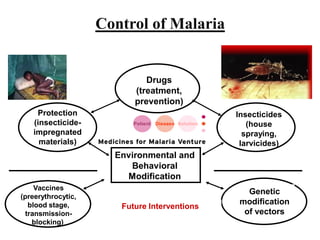
Environmental and
Behavioral
Modification
Genetic
modification
of vectors
Future Interventions
Vaccines
(preerythrocytic,
blood stage,
transmission-
blocking)
Protection
(insecticide-
impregnated
materials)
Drugs
(treatment,
prevention)
Insecticides
(house
spraying,
larvicides)
Control of Malaria
Thanks,,
Dr. Shameeran S., Medical Parasitology, Health Sciences,2021

Malaria

  • 1.
    College of HealthSciences Dep. of Medical Laboratories Parasitology Theory 3rd stage Lecture 7 Dr.: Shameeran S. Ismael BVM & S, M.Sc Medical Microbiology(Parasitology), PhD Molecular Parasitology Dr. Shameeran S., Medical Parasitology, Health Sciences,2021
  • 2.
    Plasmodium spp. Malaria Dr. ShameeranS., Medical Parasitology, Health Sciences,2021
  • 3.
    Malaria • Malaria isderived from Italian word • Mal Bad • Aria Air Malaria is caused by members of Plasmodium parasite :P. falciparum, P. vivax, P. ovale and P. malariae and transmitted by infected female anopheles mosquitoes Dr. Shameeran S., Medical Parasitology, Health Sciences,2021
  • 4.
    Plasmodium spp: Kingdome: Protista Phylum:Protozoa Sub-phylum: Sporozoa Class: Haemosporidia Family: Plasmodidae Genus: Plasmodium Species: P. falciparum (Malignant tertian malaria) P. vivax (Benign tertian malaria) P. ovale (Ovale malaria) P. malariae (Quartan malaria) Dr. Shameeran S., Medical Parasitology, Health Sciences,2021
  • 5.
    Human species including:P. falciparum, P. vivax, P. Ovale and P. malariae Intermediate host: human Vector or final host: Mosquitoes (Female Anopheles) Site of infection: Intracellular Protozoa (blood) Infective stage: Sporozoites for intermediate host & Gametocyte for Mosquitoes Infection: When mosquitoes bite the human during blood meals Disease: Malaria Dr. Shameeran S., Medical Parasitology, Health Sciences,2021
  • 6.
    Morphology 1. Ring stage: •Infected RBC first stage a) Dot/rod shaped nucleus (red) b) Peripheral rim of cytoplasm (blue) c) Central clear vacuole like area (not stained) Different species have different rings Dr. Shameeran S., Medical Parasitology, Health Sciences,2021
  • 7.
    Dr. Shameeran S.,Medical Parasitology, Health Sciences,2021 2. Trophozoite: It is irregular in shape (like ameboid like with pseudopodia) within cytoplasm there are a brown pigment granules (malarial pigment---haemozoin)
  • 8.
    3. Schizont stage: Dr.Shameeran S., Medical Parasitology, Health Sciences,2021 Trophozoites are multiply by binary fission Multiple fission of Nucleus/Cytoplasm fragments (schizont) Forming merozoites
  • 9.
    4. Gametocytes: • Maleand female gametes Dr. Shameeran S., Medical Parasitology, Health Sciences,2021 Male Gamete Female gamete
  • 10.
    Life Cycle Hosts: • DefinitiveHost : Female anopheles (sexual cycle, sporogony) • Intermediate Host : Man (asexual cycle: exoerythrocytic and endoerythrocytic or erythrocytic) Vector: • Female Anopheles Dr. Shameeran S., Medical Parasitology, Health Sciences,2021
  • 11.
    Besides infection bythe bite of infected female mosquito the infection may also be transmitted by: • Transfusion of blood from a patient of malaria • Transmission of infection to foetus in utero through some placental defect (Congenital Malaria) • By the use of contaminated syringes particularly in drug addicts. Dr. Shameeran S., Medical Parasitology, Health Sciences,2021
  • 12.
    • Sexual cycleinitiated in Humans Gametocytes (gametogony in RBCs) mosquitoes take it during biting and blood meal fusion of M/F gametes zygote ookinete oocyst many sporozoites (sporogony) • Sexual cycle Sporogony (sporozoites) • Asexual cycle Schizogony (schizonts) Dr. Shameeran S., Medical Parasitology, Health Sciences,2021
  • 13.
    In mosquitoe Gametocytes(♀♂) gametes(♀♂) (blood) (stomach of insect) union of zygote rupture/release rounds up into sporozoites oocyst motile ookinete (Salivary glands) (inside the body cavity) Dr. Shameeran S., Medical Parasitology, Health Sciences,2021
  • 14.
    In intermediate host: 1.Exoerythrocytic stage During biting and blood meal, inject the sporozoites into the blood exoerythrocytic schizonts (mosquito blood) (hepatic cell) rupture/release exoerythrocytic (merozoite) ( blood) Dr. Shameeran S., Medical Parasitology, Health Sciences,2021
  • 15.
    2. Erythrocytic stage Ringstage later trophozoite merozoite immature schizont Mature schizont *The process from trphozoite to merozoite is called schizogony. Dr. Shameeran S., Medical Parasitology, Health Sciences,2021
  • 16.
    3. Gametgenesis ----After completinga few schizogonic cycles, some merozoites develop into sexual cells, the male and female gametocytes. They continue their development in the mosquito. Dr. Shameeran S., Medical Parasitology, Health Sciences,2021
  • 17.
    Malaria Dr. Shameeran S.,Medical Parasitology, Health Sciences,2021
  • 18.
    Dr. Shameeran S.,Medical Parasitology, Health Sciences,2021 P. falciparum is the most deadly one; because these parasites promote physiologic changes of the red cell, which causes agglutination and lysis. Schizogony takes place in the capillaries and blood sinuses of the brain, visceral organs, and placenta, with infected cells tending to adhere to one another and to the surrounding vessel walls. Vessels become blocked, causing local infarction and damage to the regional tissue. Pathogenesis
  • 19.
    Causing cerebral malaria: •This is the most commonest cause of coma and death in P.falciparum malaria, particularly in children and non immune adults. • Many parasitized cells can be found in the capillaries of the brain and in late stage, hemorrhaging from small blood vessels can occur Dr. Shameeran S., Medical Parasitology, Health Sciences,2021
  • 20.
    Causing Blackwater Fever •It is a rare but acute condition in which there is a rapid and massive intravascular haemolysis of both parasitized and non parasitized red blood cells • It result in haemoglobinanemia, haemoglobinuria (The urine appears dark red to brown-black). • It can occur in non-immune adults with sever P.falciparum malaria Dr. Shameeran S., Medical Parasitology, Health Sciences,2021
  • 21.
    Dr. Shameeran S.,Medical Parasitology, Health Sciences,2021 Merozoites of P. malariae can invade only older cells; those of P. vivax and P. ovale infect primarily reticulocytes (immature RBCs) and the P. falciparum - RBCs of every age. A characteristic brown malaria pigment derived from hemoglobin, called hematin is released from ruptured RBCs and produces discoloration of the spleen. Liver, lymph nodes and bone marrow.
  • 22.
     P. vivaxis the most widely disseminated and most prevalent parasite causing malaria. There is repeated exoerythrocytic development in the liver; therefore, P. vivax can cause a relapse (hypnozoites), with erythrocytic cycles starting again years after the initial infection sequence. This is thought to result from sequestered hypnozoites in the liver. P. ovale can also cause relapses, but infections with this parasite are usually less severe and often resolve themselves within 6 to 10 paroxysms Dr. Shameeran S., Medical Parasitology, Health Sciences,2021
  • 23.
    Some characteristics ofinfection with four species of human Plasmodia P.v. P.o. P.m. P.f. Pre- erythroctic stage (days) 6-8 9 14-16 5.5-7 Pre-patent period (days) 11-13 10-14 15-16 9-10 Incubation period (days) 15 (12-17) or up to 6- 12 months 17 (16-18) or longer 28 (18-40) or longer 12 (9-14) Erythrocytic cycle (hours) 48 (about) 50 72 48
  • 24.
    • Complications ofP. falciparum malaria – Cerebral malaria ( coma ) – Convulsions – Hyperpyrexia – Severe anemia – Metabolic (Lactic) Acidosis – jaundice – renal failure – Pulmonary odema & ARDS – hypoglycemia – Hypotention & shock – Bleeding & clotting disorder – haemoglobinuria – hyperparasitemia – Associated infection • Complications of P. vivax / P. malariae – Rupture of spleen – Hepatic dysfunction – Thrombocytopenia – Severe anemia – malarial nephropathy Dr. Shameeran S., Medical Parasitology, Health Sciences,2021
  • 25.
    Predisposing factors forcomplications 1. Extremes of age. 2. Pregnancy, especially in primigravidae and in 2nd half of pregnancy. 3. Immunosuppressed - patients on steroids, anti- cancer drugs, immunosuppressant drugs. 4. Immunocompromised patients with advanced tuberculosis and cancers. 5. Splenectomy. 6. Lack of previous exposure to malaria (non-immune) 7. Pre-existing organ failure. 8. Traveling or living in a region where malaria is present. Dr. Shameeran S., Medical Parasitology, Health Sciences,2021
  • 26.
    Clinical signs In caseof P. falciparum: • Tropics, 50% of malaria in the world • Falciparum malaria, malignant tertian malaria • The most dangerous type. Clinical signs including: • Malaise, headache, vomiting. • Fever. • Cough, diarrhea. • Jaundice. • Tender hepatosplenomegaly. • Anemia develops rapidly. Dr. Shameeran S., Medical Parasitology, Health Sciences,2021
  • 27.
    Why P. falciparumInfections are Dangerous • Can produce fatal complications: 1.Cerebral malaria 2.Malarial hyperpyrexia 3.Gastrointestinal disorders. 4. Shock 5 Black water fever can lead to death Dr. Shameeran S., Medical Parasitology, Health Sciences,2021
  • 28.
    In case ofP.vivax and P.oval: • Fever: classically every 48 h. • Rigors. • Gradual hepatosplenomegaly. • Anemia develops slowly. • Relapse is common. Dr. Shameeran S., Medical Parasitology, Health Sciences,2021
  • 29.
    In case ofP.malariae: o Fever: every third day. o Mild symptoms. o Parasitaemia may persist for many years. o Causes glomerulonephritis and nephrotic syndrome in children. Dr. Shameeran S., Medical Parasitology, Health Sciences,2021
  • 30.
    Diagnosis 1.Malaria should besuspected clinically by make of : • Thick and thin blood films: • Thin films: essential to confirm the diagnosis and to identify the species of the parasite. 2.Immunochromatographicor rapid diagnostic test: is based on the detection of antigens derived from malaria patients in lysed blood, using Dr. Shameeran S., Medical Parasitology, Health Sciences,2021
  • 31.
    Dr. Shameeran S.,Medical Parasitology, Health Sciences,2021 3. Molecular Diagnosis: Parasite nucleic acids are detected using polymerase chain reaction (PCR). This technique is more accurate than microscopy.
  • 32.
    Treatment: Treatment of P.vivax malaria: 1. Confirmed Cases: Chloroquine in full therapeutic dose of 25 mg/kg divided over three days. 2. To prevent relapse (Hypnozoites ): Primaquine 0.25 mg/kg bw daily for 14 days Dr. Shameeran S., Medical Parasitology, Health Sciences,2021
  • 33.
    Treatment of P.falciparum malaria: • Artemisinin Combination Therapy (ACT) ACT + with a long acting antimalarial (amodiaquine, lumefantrine, mefloquine or sulfadoxine-pyrimethamine). • On day 2 , single dose of primaquine (0.75 mg/kg body weight). Dr. Shameeran S., Medical Parasitology, Health Sciences,2021
  • 34.
    Malaria Vaccines: 1 Anti-sporozoitevaccines 2 Anti-asexual blood stage vaccines 3 Transmission-blocking vaccines Vaccines are being developed and tried but none is available yet for routine use . Dr. Shameeran S., Medical Parasitology, Health Sciences,2021
  • 35.
    Environmental and Behavioral Modification Genetic modification of vectors FutureInterventions Vaccines (preerythrocytic, blood stage, transmission- blocking) Protection (insecticide- impregnated materials) Drugs (treatment, prevention) Insecticides (house spraying, larvicides) Control of Malaria
  • 36.
    Thanks,, Dr. Shameeran S.,Medical Parasitology, Health Sciences,2021