Parasitology
Maya El Eter
22/03/2021
Definition of Parasite
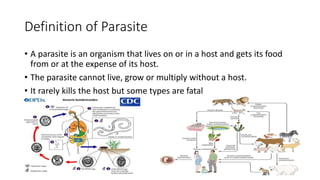
• A parasite is an organism that lives on or in a host and gets its food
from or at the expense of its host.
• The parasite cannot live, grow or multiply without a host.
• It rarely kills the host but some types are fatal
Diagnosis
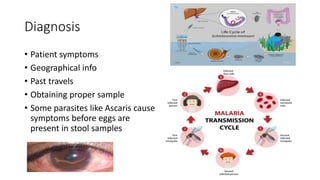
• Patient symptoms
• Geographical info
• Past travels
• Obtaining proper sample
• Some parasites like Ascaris cause
symptoms before eggs are
present in stool samples
Transmission
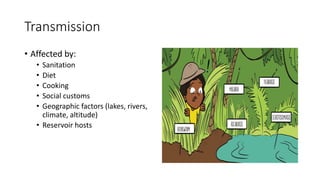
• Affected by:
• Sanitation
• Diet
• Cooking
• Social customs
• Geographic factors (lakes, rivers,
climate, altitude)
• Reservoir hosts
Types of Parasites
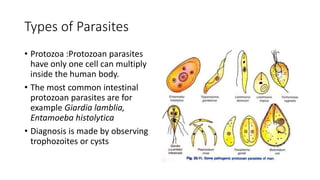
• Protozoa :Protozoan parasites
have only one cell can multiply
inside the human body.
• The most common intestinal
protozoan parasites are for
example Giardia lamblia,
Entamoeba histolytica
• Diagnosis is made by observing
trophozoites or cysts
Types of Parasites
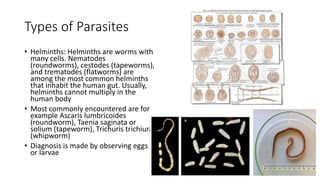
• Helminths: Helminths are worms with
many cells. Nematodes
(roundworms), cestodes (tapeworms),
and trematodes (flatworms) are
among the most common helminths
that inhabit the human gut. Usually,
helminths cannot multiply in the
human body
• Most commonly encountered are for
example Ascaris lumbricoides
(roundworm), Taenia saginata or
solium (tapeworm), Trichuris trichiura
(whipworm)
• Diagnosis is made by observing eggs
or larvae
Types of Samples
• Stool
• Urine
• Respiratory tract
• Tissue
• Amniotic fluid
• Blood
• ….
Blood Examination
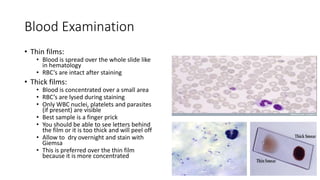
• Thin films:
• Blood is spread over the whole slide like
in hematology
• RBC’s are intact after staining
• Thick films:
• Blood is concentrated over a small area
• RBC’s are lysed during staining
• Only WBC nuclei, platelets and parasites
(if present) are visible
• Best sample is a finger prick
• You should be able to see letters behind
the film or it is too thick and will peel off
• Allow to dry overnight and stain with
Giemsa
• This is preferred over the thin film
because it is more concentrated
Fecal Specimens
• Sample collection
• Samples should be properly labelled
• Fresh sample is needed. Old or poorly preserved samples are unacceptable
• Samples should be free of urine and not contaminated with toilet water or
soil
• Samples should be collected directly in urine cups
• Obtain 3 samples day in day out
• Trophozoites degenerate overtime
Fecal Specimens
• Macroscopic examination
• Consistency: Hard, soft, loose, watery
• Color
• Visible larvae, proglottids
• Microscopic examination
• Prepare a wet mount
• Concentration
• Permanent stain
Fecal Specimens
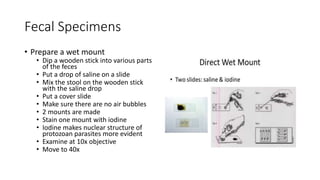
• Prepare a wet mount
• Dip a wooden stick into various parts
of the feces
• Put a drop of saline on a slide
• Mix the stool on the wooden stick
with the saline drop
• Put a cover slide
• Make sure there are no air bubbles
• 2 mounts are made
• Stain one mount with iodine
• Iodine makes nuclear structure of
protozoan parasites more evident
• Examine at 10x objective
• Move to 40x
Cellulose tape for Pinworms
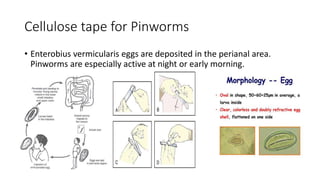
• Enterobius vermicularis eggs are deposited in the perianal area.
Pinworms are especially active at night or early morning.
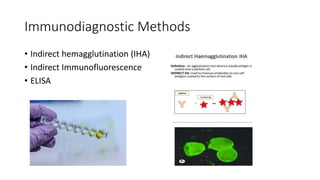
Immunodiagnostic Methods
• Indirect hemagglutination (IHA)
• Indirect Immunofluorescence
• ELISA
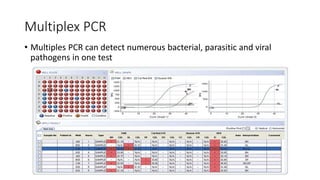
Multiplex PCR
• Multiples PCR can detect numerous bacterial, parasitic and viral
pathogens in one test

Parasitology PPT.pptx

  • 1.
  • 2.
    Definition of Parasite •A parasite is an organism that lives on or in a host and gets its food from or at the expense of its host. • The parasite cannot live, grow or multiply without a host. • It rarely kills the host but some types are fatal
  • 3.
    Diagnosis • Patient symptoms •Geographical info • Past travels • Obtaining proper sample • Some parasites like Ascaris cause symptoms before eggs are present in stool samples
  • 4.
    Transmission • Affected by: •Sanitation • Diet • Cooking • Social customs • Geographic factors (lakes, rivers, climate, altitude) • Reservoir hosts
  • 5.
    Types of Parasites •Protozoa :Protozoan parasites have only one cell can multiply inside the human body. • The most common intestinal protozoan parasites are for example Giardia lamblia, Entamoeba histolytica • Diagnosis is made by observing trophozoites or cysts
  • 6.
    Types of Parasites •Helminths: Helminths are worms with many cells. Nematodes (roundworms), cestodes (tapeworms), and trematodes (flatworms) are among the most common helminths that inhabit the human gut. Usually, helminths cannot multiply in the human body • Most commonly encountered are for example Ascaris lumbricoides (roundworm), Taenia saginata or solium (tapeworm), Trichuris trichiura (whipworm) • Diagnosis is made by observing eggs or larvae
  • 7.
    Types of Samples •Stool • Urine • Respiratory tract • Tissue • Amniotic fluid • Blood • ….
  • 8.
    Blood Examination • Thinfilms: • Blood is spread over the whole slide like in hematology • RBC’s are intact after staining • Thick films: • Blood is concentrated over a small area • RBC’s are lysed during staining • Only WBC nuclei, platelets and parasites (if present) are visible • Best sample is a finger prick • You should be able to see letters behind the film or it is too thick and will peel off • Allow to dry overnight and stain with Giemsa • This is preferred over the thin film because it is more concentrated
  • 9.
    Fecal Specimens • Samplecollection • Samples should be properly labelled • Fresh sample is needed. Old or poorly preserved samples are unacceptable • Samples should be free of urine and not contaminated with toilet water or soil • Samples should be collected directly in urine cups • Obtain 3 samples day in day out • Trophozoites degenerate overtime
  • 10.
    Fecal Specimens • Macroscopicexamination • Consistency: Hard, soft, loose, watery • Color • Visible larvae, proglottids • Microscopic examination • Prepare a wet mount • Concentration • Permanent stain
  • 11.
    Fecal Specimens • Preparea wet mount • Dip a wooden stick into various parts of the feces • Put a drop of saline on a slide • Mix the stool on the wooden stick with the saline drop • Put a cover slide • Make sure there are no air bubbles • 2 mounts are made • Stain one mount with iodine • Iodine makes nuclear structure of protozoan parasites more evident • Examine at 10x objective • Move to 40x
  • 12.
    Cellulose tape forPinworms • Enterobius vermicularis eggs are deposited in the perianal area. Pinworms are especially active at night or early morning.
  • 13.
    Immunodiagnostic Methods • Indirecthemagglutination (IHA) • Indirect Immunofluorescence • ELISA
  • 14.
    Multiplex PCR • MultiplesPCR can detect numerous bacterial, parasitic and viral pathogens in one test