University of Duhok
College of Health Sciences
Dep. of Medical Laboratories
Biology/1st Stage
Lecture 4
Dr.: Shameeran S. Ismael
BVM & S, M.Sc Medical Microbiology(Parasitology),
PhD Molecular Parasitology
Cell Reproduction
• As a cell prepares to divide, the DNA inside
the nucleus becomes organized into
chromosomes
• This is to ensure that both of the new cells get
all of the genetic information from the original
cell
• Chromosomes consist of 2 identical halves
called chromatids. When a cell divides, each of
the two new cells will receive one chromatid .
• Two chromatids are attached at the centromere
• Between cell divisions, DNA is not so tightly
coiled. This form is called chromatin
Cell division:
Cell Division in Prokaryotes :
• Binary Fission
The equal splitting of a cell
through mitosis to form two
new cells.
• Budding
The unequal splitting of a cell
through mitosis to form on
parent cell and one daughter
cell.
Cell Division in Eukaryotes
• There are two types of cell division including:
1.Mitosis results in new cells that are identical to
the original cell
2.Meiosis occurs during the formation of
gametes (haploid reproductive cells)
The Cell Cycle
• Most cells in an organism go through a cycle
of growth, development, and division called
the cell cycle
• The cell cycle makes it possible for
organisms:
1. To grow and develop
2. To replace cells that are old or damaged
3. To produce new cells
Five Phases of the Cell Cycle
G1 primary growth phase
S synthesis; DNA replicated
G2 secondary growth phase
*The above three stages are called interphase
M mitosis Mitotic Phase
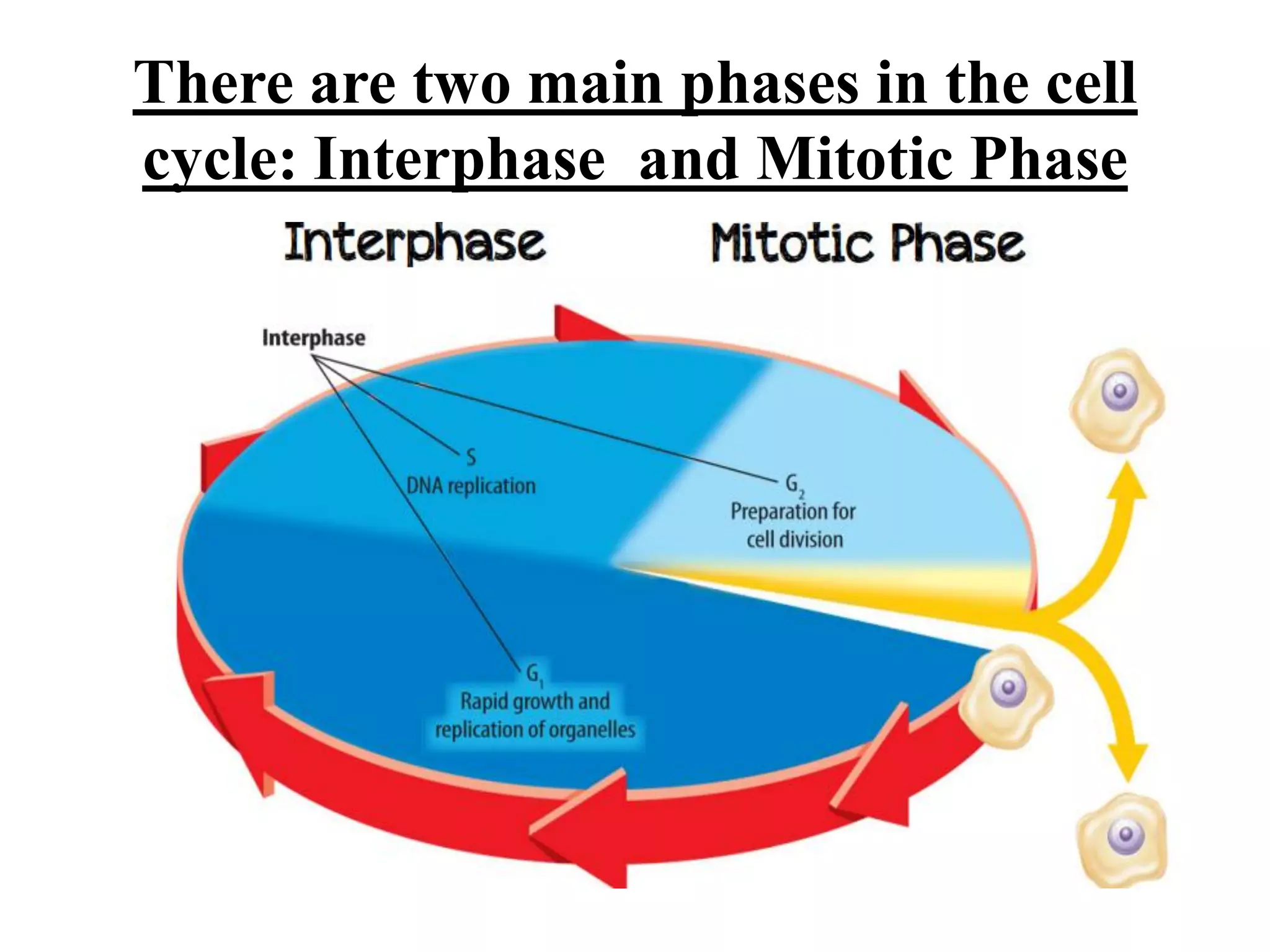
There are two main phases in the cell
cycle: Interphase and Mitotic Phase
Interphase - G1 Stage
• First stage, growth stage after cell division
• Cells mature by making more cytoplasm &
organelles
• Cell carries on its normal metabolic activities
Interphase – S Stage
• Synthesis stage
• DNA is copied or replicated
Interphase – G2 Stage
• Second Growth Stage
• Occurs after DNA has been copied
• All cell structures needed for division are
made (e.g. centrioles)
• Both organelles & proteins are synthesized
What’s Happening in Interphase?
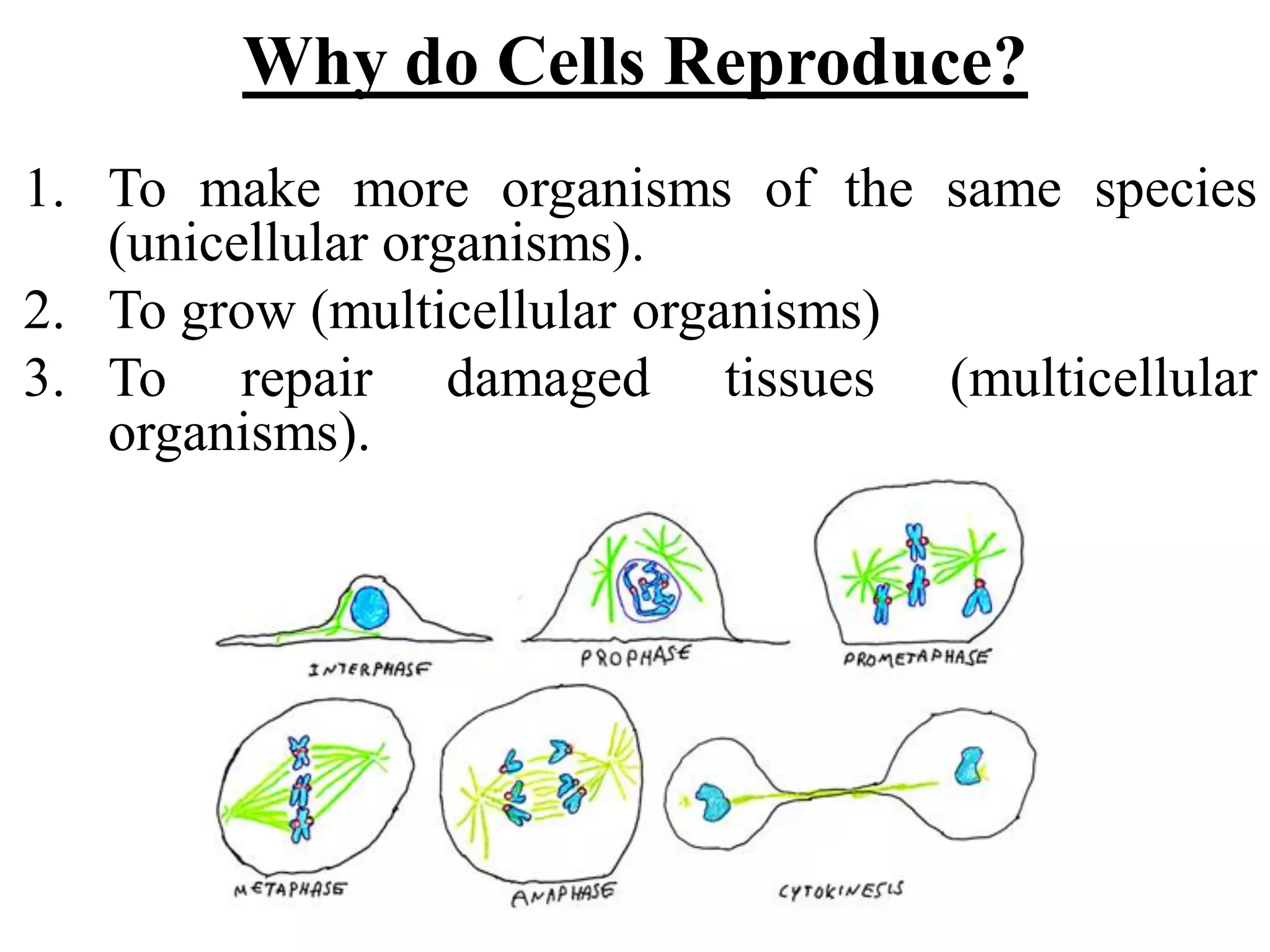
Why do Cells Reproduce?
1. To make more organisms of the same species
(unicellular organisms).
2. To grow (multicellular organisms)
3. To repair damaged tissues (multicellular
organisms).
Cell Division in Eukaryotes
I.Mitosis
• The process of cell nucleus division which results
in the production of two daughter cells from a
single parent cell.
• The daughter cells are identical to one another and
to the original parent cell
.
Mitosis vs. Meiosis
Mitosis: is a division of the nucleus
Meiosis: is a making of haploid gametes
• Mitosis involves ONE nuclear division
• Meiosis involves TWO nuclear divisions
Why does Mitosis occur?
• When cells get too big they can no longer get
enough nutrients through the cell membrane in order
to sustain it’s entire self.
• In other words it does not have enough surface area
to diffuse in enough nutrients or diffuse out all
wastes.
Mitosis can be explained in Phases
• Regular cell activity and Mitosis can be
explained in 5 basic phases including:
1. Interphase
2. Prophase
3. Metaphase
4. Anaphase
5. Telophase.
1.Interphase
• The cell prepares for
division
• DNA replicated
• Organelles replicated
• Cell increases in size
Chromatin
Interphase – In Between
2.Prophase
• The cell prepares for nuclear
division
• Packages DNA into
chromosomes
Prophase - “Preparing”
Doubled Chromosomes
Sister Chromatids
3.Metaphase
• The cell prepares chromosomes for
division
• Chromosomes line up at the center of
the cell
• Spindle fibers attach from daughter
cells to chromosomes at the centromere
Metaphase –
“Middle”
Pole
Equator
4.Anaphase
• The chromosomes divide
• Spindle fibers pull
chromosomes apart
• ½ of each chromosome
(called chromotid) moves to
• each daughter cellAnaphase –
“Away” or “Apart”
5.Telophase
• The cytoplasm divides
• DNA spreads out
• Two nuclei form
• Cell wall pinches in to form the 2 new
daughter cellsTelophase – “Two”
II. Meiosis
• Meiosis is the process of cell division in which
gametes are formed and the number of
chromosomes is halved. So that sexual reproduction
and zygote formation can occur.
• Zygote: Fertilized egg which has a diploid number
of chromosomes.
• During meiosis, DNA replicates once, but the
nucleus divides twic
Stages of Meiosis
1. Interphase:
– Chromosomes replicate
– Each chromosome consists of 2 identical sister
chromatids
2.Prophase I
– Each chromosome duplicates and remains closely
associated. These are called sister chromatids.
3.Metaphase I:Chromosomes align at the center of
the cell
4. Anaphase 1: Chromosome pairs separate with
sister chromatids remaining together.
5.Telophase 1: Two daughter cells are formed with
each daughter containing only one chromosome of
the chromosome pair.
Meiosis II
• Is basically just like mitosis, but remember the
chromosomes did not duplicate in interphase II.
1.Prophase 2: DNA does not replicate.
2. Metaphase 2: Chromosomes line up at the
center of the cell
3. Anaphase 2: Centromeres divide and sister
chromatids move separately to each pole
4. Telophase 2:
• Cell division is complete.
• Four haploid daughter cells are formed.
Products of Mitosis & Meiosis
• Mitosis produces two identical daughter cells
• Meiosis produces four genetically different
daughter cells
The Numbers
• The cells from mitosis are diploid or 2n.
• The cells from meiosis are haploid or n.
Definitions:
• Diploid (2n) – full set of chromosomes
• Haploid (n) – half set of chromosomes
Haploid vs Diploid
• The diploid number (2n) in humans is 46.
• The haploid number (n) in humans is 23.
• Example: The diploid number in a horse is 64.
What is the haploid number?
• Example: The haploid number in cats is 19.
What is the diploid number?
Where do these processes occur?
• Mitosis occurs in somatic cells (body cells)
like heart cells, skin cells, etc
• Meiosis occurs in sex cells (gametes) like
sperm & egg cells only.
The reason why: mitosis
• To replace damaged cells
• To allow for growth & development
• To prevent cells from getting too big
• For asexual reproduction
The reason why: meiosis
• To create gametes that can combine to make a
zygote
• For sexual reproduction
• To increase genetic diversity (crossing over,
independent assortment, random fertilization)
Mitosis VS. Meiosis
Mitosis
• Asexual
• Cell divides once
• Two daughter cells
• Genetic information
is identical
Meiosis
•Sexual
•Cell divides twice
• Four haploid daughter
cells
• Genetic information is
different
Mitosis vs. Meiosis
Thanks for attention,,,

Biology theory 4: cell division and cell cycle

  • 1.
    University of Duhok Collegeof Health Sciences Dep. of Medical Laboratories Biology/1st Stage Lecture 4 Dr.: Shameeran S. Ismael BVM & S, M.Sc Medical Microbiology(Parasitology), PhD Molecular Parasitology
  • 2.
    Cell Reproduction • Asa cell prepares to divide, the DNA inside the nucleus becomes organized into chromosomes • This is to ensure that both of the new cells get all of the genetic information from the original cell
  • 3.
    • Chromosomes consistof 2 identical halves called chromatids. When a cell divides, each of the two new cells will receive one chromatid . • Two chromatids are attached at the centromere • Between cell divisions, DNA is not so tightly coiled. This form is called chromatin
  • 4.
    Cell division: Cell Divisionin Prokaryotes : • Binary Fission The equal splitting of a cell through mitosis to form two new cells. • Budding The unequal splitting of a cell through mitosis to form on parent cell and one daughter cell.
  • 5.
    Cell Division inEukaryotes • There are two types of cell division including: 1.Mitosis results in new cells that are identical to the original cell 2.Meiosis occurs during the formation of gametes (haploid reproductive cells)
  • 6.
    The Cell Cycle •Most cells in an organism go through a cycle of growth, development, and division called the cell cycle • The cell cycle makes it possible for organisms: 1. To grow and develop 2. To replace cells that are old or damaged 3. To produce new cells
  • 7.
    Five Phases ofthe Cell Cycle G1 primary growth phase S synthesis; DNA replicated G2 secondary growth phase *The above three stages are called interphase M mitosis Mitotic Phase
  • 8.
    There are twomain phases in the cell cycle: Interphase and Mitotic Phase
  • 9.
    Interphase - G1Stage • First stage, growth stage after cell division • Cells mature by making more cytoplasm & organelles • Cell carries on its normal metabolic activities
  • 10.
    Interphase – SStage • Synthesis stage • DNA is copied or replicated
  • 11.
    Interphase – G2Stage • Second Growth Stage • Occurs after DNA has been copied • All cell structures needed for division are made (e.g. centrioles) • Both organelles & proteins are synthesized
  • 12.
  • 13.
    Why do CellsReproduce? 1. To make more organisms of the same species (unicellular organisms). 2. To grow (multicellular organisms) 3. To repair damaged tissues (multicellular organisms).
  • 14.
    Cell Division inEukaryotes
  • 15.
    I.Mitosis • The processof cell nucleus division which results in the production of two daughter cells from a single parent cell. • The daughter cells are identical to one another and to the original parent cell .
  • 16.
    Mitosis vs. Meiosis Mitosis:is a division of the nucleus Meiosis: is a making of haploid gametes • Mitosis involves ONE nuclear division • Meiosis involves TWO nuclear divisions
  • 17.
    Why does Mitosisoccur? • When cells get too big they can no longer get enough nutrients through the cell membrane in order to sustain it’s entire self. • In other words it does not have enough surface area to diffuse in enough nutrients or diffuse out all wastes.
  • 18.
    Mitosis can beexplained in Phases • Regular cell activity and Mitosis can be explained in 5 basic phases including: 1. Interphase 2. Prophase 3. Metaphase 4. Anaphase 5. Telophase.
  • 19.
    1.Interphase • The cellprepares for division • DNA replicated • Organelles replicated • Cell increases in size Chromatin Interphase – In Between
  • 20.
    2.Prophase • The cellprepares for nuclear division • Packages DNA into chromosomes Prophase - “Preparing” Doubled Chromosomes Sister Chromatids
  • 21.
    3.Metaphase • The cellprepares chromosomes for division • Chromosomes line up at the center of the cell • Spindle fibers attach from daughter cells to chromosomes at the centromere Metaphase – “Middle” Pole Equator
  • 22.
    4.Anaphase • The chromosomesdivide • Spindle fibers pull chromosomes apart • ½ of each chromosome (called chromotid) moves to • each daughter cellAnaphase – “Away” or “Apart”
  • 23.
    5.Telophase • The cytoplasmdivides • DNA spreads out • Two nuclei form • Cell wall pinches in to form the 2 new daughter cellsTelophase – “Two”
  • 24.
    II. Meiosis • Meiosisis the process of cell division in which gametes are formed and the number of chromosomes is halved. So that sexual reproduction and zygote formation can occur. • Zygote: Fertilized egg which has a diploid number of chromosomes. • During meiosis, DNA replicates once, but the nucleus divides twic
  • 25.
    Stages of Meiosis 1.Interphase: – Chromosomes replicate – Each chromosome consists of 2 identical sister chromatids 2.Prophase I – Each chromosome duplicates and remains closely associated. These are called sister chromatids.
  • 26.
    3.Metaphase I:Chromosomes alignat the center of the cell 4. Anaphase 1: Chromosome pairs separate with sister chromatids remaining together. 5.Telophase 1: Two daughter cells are formed with each daughter containing only one chromosome of the chromosome pair.
  • 27.
    Meiosis II • Isbasically just like mitosis, but remember the chromosomes did not duplicate in interphase II. 1.Prophase 2: DNA does not replicate. 2. Metaphase 2: Chromosomes line up at the center of the cell 3. Anaphase 2: Centromeres divide and sister chromatids move separately to each pole
  • 28.
    4. Telophase 2: •Cell division is complete. • Four haploid daughter cells are formed.
  • 29.
    Products of Mitosis& Meiosis • Mitosis produces two identical daughter cells • Meiosis produces four genetically different daughter cells
  • 30.
    The Numbers • Thecells from mitosis are diploid or 2n. • The cells from meiosis are haploid or n. Definitions: • Diploid (2n) – full set of chromosomes • Haploid (n) – half set of chromosomes
  • 31.
    Haploid vs Diploid •The diploid number (2n) in humans is 46. • The haploid number (n) in humans is 23. • Example: The diploid number in a horse is 64. What is the haploid number? • Example: The haploid number in cats is 19. What is the diploid number?
  • 32.
    Where do theseprocesses occur? • Mitosis occurs in somatic cells (body cells) like heart cells, skin cells, etc • Meiosis occurs in sex cells (gametes) like sperm & egg cells only.
  • 34.
    The reason why:mitosis • To replace damaged cells • To allow for growth & development • To prevent cells from getting too big • For asexual reproduction
  • 35.
    The reason why:meiosis • To create gametes that can combine to make a zygote • For sexual reproduction • To increase genetic diversity (crossing over, independent assortment, random fertilization)
  • 36.
    Mitosis VS. Meiosis Mitosis •Asexual • Cell divides once • Two daughter cells • Genetic information is identical Meiosis •Sexual •Cell divides twice • Four haploid daughter cells • Genetic information is different
  • 37.
  • 38.