College of Health Sciences
Dep. of Medical Laboratories
Parasitology Practice
3rd stage
Lecture 4
Dr.: Shameeran S. Ismael
BVM & S, M.Sc Medical Microbiology(Parasitology),
PhD Molecular Parasitology
Shameeran S. Ismael Parasitolog
Practice.Medical Laboratories, 2020
 A concentration technique is performed
mainly to separate the parasites from fecal
debris.
 The concentration procedure not only
increases the number of parasites in the
sediment but it also unmasks them, making
them more visible by removing organic and
inorganic debris.
Shameeran S. Ismael Parasitolog
Practice.Medical Laboratories, 2020
II. Concentration Methods
Advantages of concentration method:
 Detect the light infection
 Reduce background fecal debris
 Increase relative number of parasites
 Preserve morphology of parasites
Disadvantages:
 Destroys trophozoite stages.
Shameeran S. Ismael Parasitolog
Practice.Medical Laboratories, 2020
1. Flotation Method:
• In tape water, worms eggs will sink because their
specific gravity is a little higher than 1. When
fecal samples are suspended in a liquid with
specific gravity higher than that of the eggs and
the water, the eggs will float up to the surface.
Shameeran S. Ismael Parasitolog
Practice.Medical Laboratories, 2020
Concentration methods includes:
 Operculated eggs as well as schistosoma spp. and
Ascaris eggs are not easily recovered by this method.
 Also trophozoites are killed due to the high specific
gravity
Shameeran S. Ismael Parasitolog
Practice.Medical Laboratories, 2020
1. Saturated sodium chloride (salt): Mixed 400g of salt
with 1L of hot distal water.
2. Sugar solution (Sheather’s sugar) : 1300 g/L of D.W
3. Saturated sodium Nitrate NaNO3: (400g/ L of
D.W)
4. Saturated Zinc Sulphate ZnSO4: (700g/ L of D.W)
5. Magnesium Sulphate MgSO4: (500g/L of D.W)
Shameeran S. Ismael Parasitolog
Practice.Medical Laboratories, 2020
Common Flotation or Saturated solution
Advantages:-
 The concentrate is clear of debris
Disadvantages:-
 Delay in examination can result in distortion
 Larvae and some fluke eggs do not concentrate
Shameeran S. Ismael Parasitolog
Practice.Medical Laboratories, 2020
Advantages and Disadvantages of flotation fecal
method:
1.Mix 3-5 g of fresh feces with little amount of
concentration solution.
2.Dilute then with concentration solution while stirring
vigorously to obtain a homogenous mixture.
3.Solution will be strained through a fine sieve and
residue will be pressed out.
4.Fills test tubes with this solution and carefully put
cover slide on the top of the tube.
Shameeran S. Ismael Parasitolog
Practice.Medical Laboratories, 2020
Procedure:
5. After 10-30 minutes, the cover slide is gently removed
and put on slide, then examined under microscope.
6. This method is suitable for the majority of nematode
eggs, cestodes and protozoa.
Shameeran S. Ismael Parasitolog
Practice.Medical Laboratories, 2020
7. Nematodes and cestodes eggs float in a liquid with
a specific gravity between 1.10-1.2 by using sodium
chloride or magnesium sulphate flotation solution.
Trematode eggs which are heavier require a specific
gravity of 1.30-1.35 by using zinc chloride or zinc
sulphate flotation solution.
Shameeran S. Ismael Parasitolog
Practice.Medical Laboratories, 2020
• Sedimentation, it is primarily used to detect eggs
or cysts that have too high a specific gravity.
When we use water with feces the eggs /or larvea
deposited at button of tubes, because the specific
gravity of eggs/or larvae higher the specific
gravity of water.
Shameeran S. Ismael Parasitology theory.
Vet. Med, 2019
2- Sedimentation Method
Advantages:
 Recovers most ova, cysts and larvae .
 Morphology of most parasites is retained.
Disadvantages:
 Preparation contains debris.
 Some parasites do not concentrate well.
 Liquid faeces do not concentrate well .
Shameeran S. Ismael Parasitology theory.
Vet. Med, 2019
Advantages and Disadvantages:
1- Mix 1-2g of fecal with 30-60ml of tap water or normal
saline in a cup or beaker.
2- Strain the mixture through a tea strainer into a centrifuge
tube.
3- Centrifuge the sample at 1500 rpm /5 minutes. If a
centrifuge is unavailable, allow the mixture to sit without
disturbed for 20-30 minutes.
Shameeran S. Ismael Parasitology theory.
Vet. Med, 2019
Procedure:
4-Pour off the liquid in the top of the tube without
disturbed the sediment at the button.
5- Using pipette and transfer a small amount of the top
layer of sediment to a slide. If the drop is too thick,
dilute it with a drop of water.
6- Placed a cover slide to the drop and examine under
the microscope
Shameeran S. Ismael Parasitology theory.
Vet. Med, 2019
Shameeran S. Ismael Parasitology theory.
Vet. Med, 2019
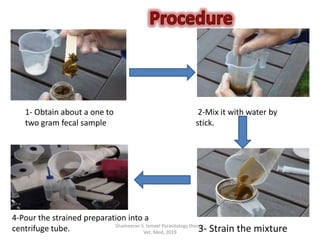
1- Obtain about a one to
two gram fecal sample
2-Mix it with water by
stick.
3- Strain the mixture
4-Pour the strained preparation into a
centrifuge tube.
Shameeran S. Ismael Parasitology theory.
Vet. Med, 2019
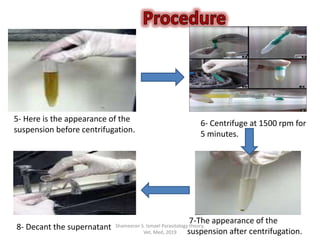
6- Centrifuge at 1500 rpm for
5 minutes.
5- Here is the appearance of the
suspension before centrifugation.
7-The appearance of the
suspension after centrifugation.8- Decant the supernatant
Shameeran S. Ismael Parasitology theory.
Vet. Med, 2019
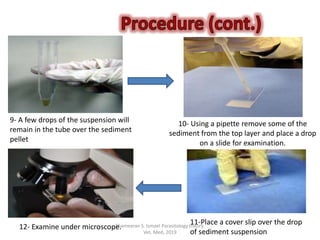
9- A few drops of the suspension will
remain in the tube over the sediment
pellet
10- Using a pipette remove some of the
sediment from the top layer and place a drop
on a slide for examination.
11-Place a cover slip over the drop
of sediment suspension
12- Examine under microscope.
Shameeran S. Ismael Parasitology theory.
Vet. Med, 2019
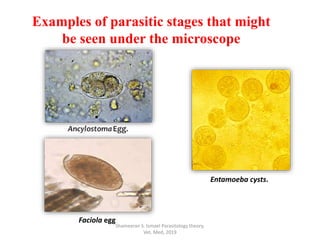
Examples of parasitic stages that might
be seen under the microscope
Entamoeba cysts.
Faciola egg
Shameeran S. Ismael Parasitology theory.
Vet. Med, 2019
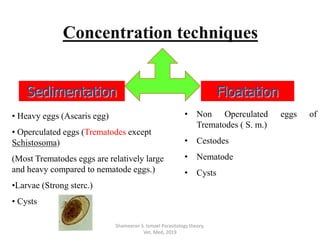
Concentration techniques
Sedimentation Floatation
• Heavy eggs (Ascaris egg)
• Operculated eggs (Trematodes except
Schistosoma)
(Most Trematodes eggs are relatively large
and heavy compared to nematode eggs.)
•Larvae (Strong sterc.)
• Cysts
• Non Operculated eggs of
Trematodes ( S. m.)
• Cestodes
• Nematode
• Cysts
Thanks for attention,,,
Shameeran S. Ismael Parasitolog
Practice.Medical Laboratories, 2020

Parasitology paractice 4

  • 1.
    College of HealthSciences Dep. of Medical Laboratories Parasitology Practice 3rd stage Lecture 4 Dr.: Shameeran S. Ismael BVM & S, M.Sc Medical Microbiology(Parasitology), PhD Molecular Parasitology Shameeran S. Ismael Parasitolog Practice.Medical Laboratories, 2020
  • 2.
     A concentrationtechnique is performed mainly to separate the parasites from fecal debris.  The concentration procedure not only increases the number of parasites in the sediment but it also unmasks them, making them more visible by removing organic and inorganic debris. Shameeran S. Ismael Parasitolog Practice.Medical Laboratories, 2020 II. Concentration Methods
  • 3.
    Advantages of concentrationmethod:  Detect the light infection  Reduce background fecal debris  Increase relative number of parasites  Preserve morphology of parasites Disadvantages:  Destroys trophozoite stages. Shameeran S. Ismael Parasitolog Practice.Medical Laboratories, 2020
  • 4.
    1. Flotation Method: •In tape water, worms eggs will sink because their specific gravity is a little higher than 1. When fecal samples are suspended in a liquid with specific gravity higher than that of the eggs and the water, the eggs will float up to the surface. Shameeran S. Ismael Parasitolog Practice.Medical Laboratories, 2020 Concentration methods includes:
  • 5.
     Operculated eggsas well as schistosoma spp. and Ascaris eggs are not easily recovered by this method.  Also trophozoites are killed due to the high specific gravity Shameeran S. Ismael Parasitolog Practice.Medical Laboratories, 2020
  • 6.
    1. Saturated sodiumchloride (salt): Mixed 400g of salt with 1L of hot distal water. 2. Sugar solution (Sheather’s sugar) : 1300 g/L of D.W 3. Saturated sodium Nitrate NaNO3: (400g/ L of D.W) 4. Saturated Zinc Sulphate ZnSO4: (700g/ L of D.W) 5. Magnesium Sulphate MgSO4: (500g/L of D.W) Shameeran S. Ismael Parasitolog Practice.Medical Laboratories, 2020 Common Flotation or Saturated solution
  • 7.
    Advantages:-  The concentrateis clear of debris Disadvantages:-  Delay in examination can result in distortion  Larvae and some fluke eggs do not concentrate Shameeran S. Ismael Parasitolog Practice.Medical Laboratories, 2020 Advantages and Disadvantages of flotation fecal method:
  • 8.
    1.Mix 3-5 gof fresh feces with little amount of concentration solution. 2.Dilute then with concentration solution while stirring vigorously to obtain a homogenous mixture. 3.Solution will be strained through a fine sieve and residue will be pressed out. 4.Fills test tubes with this solution and carefully put cover slide on the top of the tube. Shameeran S. Ismael Parasitolog Practice.Medical Laboratories, 2020 Procedure:
  • 9.
    5. After 10-30minutes, the cover slide is gently removed and put on slide, then examined under microscope. 6. This method is suitable for the majority of nematode eggs, cestodes and protozoa. Shameeran S. Ismael Parasitolog Practice.Medical Laboratories, 2020
  • 10.
    7. Nematodes andcestodes eggs float in a liquid with a specific gravity between 1.10-1.2 by using sodium chloride or magnesium sulphate flotation solution. Trematode eggs which are heavier require a specific gravity of 1.30-1.35 by using zinc chloride or zinc sulphate flotation solution. Shameeran S. Ismael Parasitolog Practice.Medical Laboratories, 2020
  • 11.
    • Sedimentation, itis primarily used to detect eggs or cysts that have too high a specific gravity. When we use water with feces the eggs /or larvea deposited at button of tubes, because the specific gravity of eggs/or larvae higher the specific gravity of water. Shameeran S. Ismael Parasitology theory. Vet. Med, 2019 2- Sedimentation Method
  • 12.
    Advantages:  Recovers mostova, cysts and larvae .  Morphology of most parasites is retained. Disadvantages:  Preparation contains debris.  Some parasites do not concentrate well.  Liquid faeces do not concentrate well . Shameeran S. Ismael Parasitology theory. Vet. Med, 2019 Advantages and Disadvantages:
  • 13.
    1- Mix 1-2gof fecal with 30-60ml of tap water or normal saline in a cup or beaker. 2- Strain the mixture through a tea strainer into a centrifuge tube. 3- Centrifuge the sample at 1500 rpm /5 minutes. If a centrifuge is unavailable, allow the mixture to sit without disturbed for 20-30 minutes. Shameeran S. Ismael Parasitology theory. Vet. Med, 2019 Procedure:
  • 14.
    4-Pour off theliquid in the top of the tube without disturbed the sediment at the button. 5- Using pipette and transfer a small amount of the top layer of sediment to a slide. If the drop is too thick, dilute it with a drop of water. 6- Placed a cover slide to the drop and examine under the microscope Shameeran S. Ismael Parasitology theory. Vet. Med, 2019
  • 15.
    Shameeran S. IsmaelParasitology theory. Vet. Med, 2019 1- Obtain about a one to two gram fecal sample 2-Mix it with water by stick. 3- Strain the mixture 4-Pour the strained preparation into a centrifuge tube.
  • 16.
    Shameeran S. IsmaelParasitology theory. Vet. Med, 2019 6- Centrifuge at 1500 rpm for 5 minutes. 5- Here is the appearance of the suspension before centrifugation. 7-The appearance of the suspension after centrifugation.8- Decant the supernatant
  • 17.
    Shameeran S. IsmaelParasitology theory. Vet. Med, 2019 9- A few drops of the suspension will remain in the tube over the sediment pellet 10- Using a pipette remove some of the sediment from the top layer and place a drop on a slide for examination. 11-Place a cover slip over the drop of sediment suspension 12- Examine under microscope.
  • 18.
    Shameeran S. IsmaelParasitology theory. Vet. Med, 2019 Examples of parasitic stages that might be seen under the microscope Entamoeba cysts. Faciola egg
  • 19.
    Shameeran S. IsmaelParasitology theory. Vet. Med, 2019 Concentration techniques Sedimentation Floatation • Heavy eggs (Ascaris egg) • Operculated eggs (Trematodes except Schistosoma) (Most Trematodes eggs are relatively large and heavy compared to nematode eggs.) •Larvae (Strong sterc.) • Cysts • Non Operculated eggs of Trematodes ( S. m.) • Cestodes • Nematode • Cysts
  • 20.
    Thanks for attention,,, ShameeranS. Ismael Parasitolog Practice.Medical Laboratories, 2020