By /Marwa Mahmoud Khalifa
Alexandria University
Monoclonal gammopathy of
undetermined significance
(MGUS(
WHAT’S MGUS??
MGUS describes premalignant
disorder characterized by
 Limited monoclonal plasma cell
proliferation
 Stable monoclonal paraprotien in
serum or less commonly in urine
 Absence of clinicopathological
evidence of MM,WM,AL or LPDs.
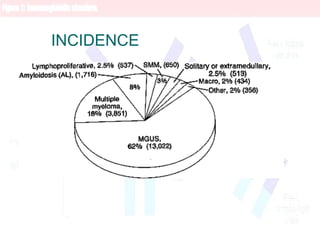
INCIDENCE
EPIDEMIOLOGY
 Age. The risk of increases with age. The
highest incidence is among adults age 85
and older.
 Race. Blacks are more likely to
experience this condition than are
whites.
 Sex. more common in men than it is in
women.
 Family history.
PATHOPHYSIOLOGY
Pathologically, the lesion in MGUS is in fact
very similar to that in multiple myeloma.
There is a predominance of clonal plasma
cells in the bone marrow with an
abnormal immunophenotype (CD38+
CD56+ CD19−) mixed in with cells of a
normal phenotype (CD38+ CD56−
CD19+); in MGUS, on average more than
3% of the clonal plasma cells have the
normal phenotype, whereas in multiple
myeloma, less than 3% of the cells have
the normal phenotype
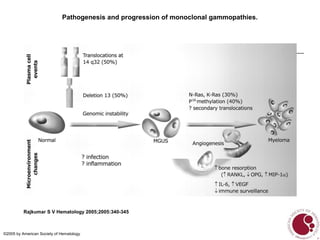
Pathogenesis
Approximately 50% of patients with MGUS and SMM have
primary translocations in the clonal plasma cells
involving the immunoglobulin heavy chain (IgH)
locus on chromosome 14q32 (IgH translocated
MGUS/SMM
The most common partner chromosome loci and genes
dysregulated in these translocations are: [cyclin D1
gene]), [cyclin D3 gene])
Deletion of chromosome 13, a major prognostic factor
in multiple myeloma, is seen in up to 50% of patients
with MGUS by interphase fluorescent in situ
hybridization; hence, the presence of this abnormality
cannot be used to differentiate MGUS from multiple
myeloma
It is felt that these translocations are important
pathogenetically in initiating and sustaining
clonal proliferation.
The precipitating event for these translocations
may be related to infection or immune
dysregulation, and likely occurs during IgH
switch recombination or somatic hypermutation
The pathogenesis in 40%–50% of MGUS and
SMM with no evidence of IgH translocations
(IgH non-translocated MGUS/SMM) is unclear.
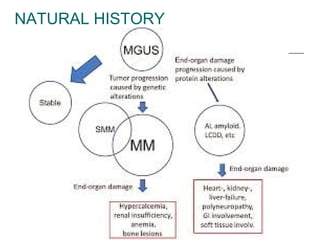
Pathogenesis and progression of monoclonal gammopathies.
Rajkumar S V Hematology 2005;2005:340-345
©2005 by American Society of Hematology
CLINICAL FEATURES
 Asymptomatic
 No abnormal physical findings
 Incidental discovery : ESR /↑
globlin↑
 Neuropathy may be ass attributed
to monoclonal gammopathy
 Thrombotic events
INVESTIGATIONS
exclude CRAB
 FBC: no anemia or other cytopenia
 Chemistry : RFT, s Ca++↔
 Serum protein electrophoresis:IgG 70%,IgM 15%,
IgA12%,biclonal 3%,LC<1%
 Immunoglobulin quantitation :immunoparesis
 SFLC:~30% have abn ĸ:λ ratio
 Urine electrophoresis:
 Skeletal survey:normal
 Serum β2 microglobulin:normal
 BMA or trephine biopsy:indicated if abn
FBC,RFT,sCa, SFLC,sk survey,non IgG
paraprotein,paraprotein>15g/L
DIAGNOSIS
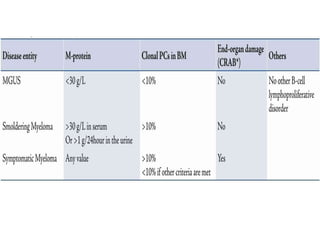
All 4 criteria must be met :
1. Serum monoclonal protein <3g/dL
2. BM plasma cells <10%
3. No evidence of other B cell LPDs
4. No myeloma related end organ or
tissue impairment ie CRAB
DIFFERENTIAL DIAGNOSIS
 MM,WM,AL
 Bone pains ,anemia, renal
impairment ??myeloma
 IgM with lymphadenopathy or
splenomegaly ??WM
NATURAL HISTORY
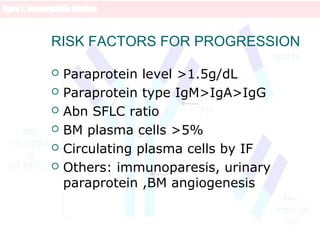
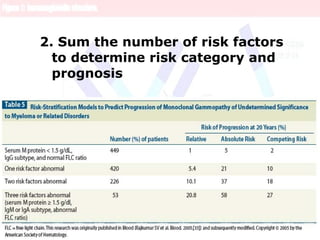
RISK FACTORS FOR PROGRESSION
 Paraprotein level >1.5g/dL
 Paraprotein type IgM>IgA>IgG
 Abn SFLC ratio
 BM plasma cells >5%
 Circulating plasma cells by IF
 Others: immunoparesis, urinary
paraprotein ,BM angiogenesis
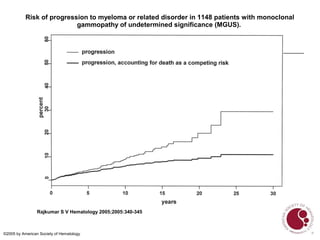
Risk of progression to myeloma or related disorder in 1148 patients with monoclonal
gammopathy of undetermined significance (MGUS).
Rajkumar S V Hematology 2005;2005:340-345
©2005 by American Society of Hematology
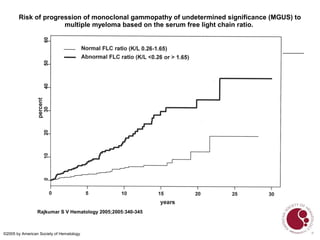
Risk of progression of monoclonal gammopathy of undetermined significance (MGUS) to
multiple myeloma based on the serum free light chain ratio.
Rajkumar S V Hematology 2005;2005:340-345
©2005 by American Society of Hematology
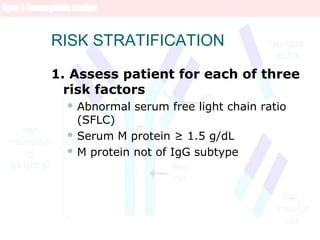
RISK STRATIFICATION
1. Assess patient for each of three
risk factors
 Abnormal serum free light chain ratio
(SFLC)
 Serum M protein ≥ 1.5 g/dL
 M protein not of IgG subtype
2. Sum the number of risk factors
to determine risk category and
prognosis
MANAGEMENT
 NO treatment
 Follow up every 6m then annually
(FBC, renal function ,serum Ca+
+ ,serum Igs, paraprotein
quantitation ,SFLC)
Smouldering multiple myeloma
(asymptomatic myeloma(
IDENTIFICATION
 Paraprotein > 3gm/dl
and / or
 Plasma cells in BM >10%
Without clinical evidence of complications
associated with MM (CRAB(
INCIDENCE
Accounts for about 15% o all new
cases of myeloma
PATHOGENESIS
 Almost all have either translocation
involving IgH (50%) or
hyperdiploidy(40%)
 Angiogenesis is greater than MGUS
but less than in MM
CLINICAL & LABORATORY
FEATURES
 Absence of signs & symptoms
 FBC : Hb >10 gm/dL
 S. creat <130 micromol /L ,normal
s Ca++
 β2 microglobulin :normal / minimal rise
 BMA: >10% plasma cells
 BM cytogenetics
 Skeletal radiology :normal
DIAGNOSTIC CRITERIA
 Paraprotein > 3gm/dl and / or
plasma cells in BM >10%
 No evidence of other B cell LPD
 No myeloma related end organ or
tissue impairment
DIFFERENTIAL DIANOSIS
1. MGUS
2. MM
3. WM
4. AL
RISK FACTORS FOR EARLY
PROGRESSION
Shorter time ass with:
 Serum paraprotein >3g/dL
 IgA protein type
 Urinary BenceJones proteinuria>50mg/d
 BM plasmacytosis>25%
 Suppression of uninvolved Ig
 SFLC<0.125 or >8
 Abn MRI
RISK STRATIFICATION
 A scoring system has been developed
using 2 parameters
1. Quantity of paraprotein <3 vs.>3 g/dL
2. Type of paraprotein IgG vs.IgA
 Another scoring system using 3
parameters
1. BM plasmacytosis>10%
2. Serum M protein>3g/dL
3. SFLC ratio <0.125 or >8
MANAGEMENT
 Chemotherapy is not indicated
 No benefit for therapy before
symptomatic disease
 Follow up every 3-4 months
 Clinical trials early treatment with
bisphosphonate, thalidomide and
lenalidomide ??? Delay progression
Paraprotienemia

Paraprotienemia

  • 1.
    By /Marwa MahmoudKhalifa Alexandria University
  • 2.
  • 3.
    WHAT’S MGUS?? MGUS describespremalignant disorder characterized by  Limited monoclonal plasma cell proliferation  Stable monoclonal paraprotien in serum or less commonly in urine  Absence of clinicopathological evidence of MM,WM,AL or LPDs.
  • 4.
  • 5.
    EPIDEMIOLOGY  Age. Therisk of increases with age. The highest incidence is among adults age 85 and older.  Race. Blacks are more likely to experience this condition than are whites.  Sex. more common in men than it is in women.  Family history.
  • 6.
    PATHOPHYSIOLOGY Pathologically, the lesionin MGUS is in fact very similar to that in multiple myeloma. There is a predominance of clonal plasma cells in the bone marrow with an abnormal immunophenotype (CD38+ CD56+ CD19−) mixed in with cells of a normal phenotype (CD38+ CD56− CD19+); in MGUS, on average more than 3% of the clonal plasma cells have the normal phenotype, whereas in multiple myeloma, less than 3% of the cells have the normal phenotype
  • 7.
    Pathogenesis Approximately 50% ofpatients with MGUS and SMM have primary translocations in the clonal plasma cells involving the immunoglobulin heavy chain (IgH) locus on chromosome 14q32 (IgH translocated MGUS/SMM The most common partner chromosome loci and genes dysregulated in these translocations are: [cyclin D1 gene]), [cyclin D3 gene]) Deletion of chromosome 13, a major prognostic factor in multiple myeloma, is seen in up to 50% of patients with MGUS by interphase fluorescent in situ hybridization; hence, the presence of this abnormality cannot be used to differentiate MGUS from multiple myeloma
  • 8.
    It is feltthat these translocations are important pathogenetically in initiating and sustaining clonal proliferation. The precipitating event for these translocations may be related to infection or immune dysregulation, and likely occurs during IgH switch recombination or somatic hypermutation The pathogenesis in 40%–50% of MGUS and SMM with no evidence of IgH translocations (IgH non-translocated MGUS/SMM) is unclear.
  • 9.
    Pathogenesis and progressionof monoclonal gammopathies. Rajkumar S V Hematology 2005;2005:340-345 ©2005 by American Society of Hematology
  • 10.
    CLINICAL FEATURES  Asymptomatic No abnormal physical findings  Incidental discovery : ESR /↑ globlin↑  Neuropathy may be ass attributed to monoclonal gammopathy  Thrombotic events
  • 11.
    INVESTIGATIONS exclude CRAB  FBC:no anemia or other cytopenia  Chemistry : RFT, s Ca++↔  Serum protein electrophoresis:IgG 70%,IgM 15%, IgA12%,biclonal 3%,LC<1%  Immunoglobulin quantitation :immunoparesis  SFLC:~30% have abn ĸ:λ ratio  Urine electrophoresis:  Skeletal survey:normal  Serum β2 microglobulin:normal  BMA or trephine biopsy:indicated if abn FBC,RFT,sCa, SFLC,sk survey,non IgG paraprotein,paraprotein>15g/L
  • 12.
    DIAGNOSIS All 4 criteriamust be met : 1. Serum monoclonal protein <3g/dL 2. BM plasma cells <10% 3. No evidence of other B cell LPDs 4. No myeloma related end organ or tissue impairment ie CRAB
  • 13.
    DIFFERENTIAL DIAGNOSIS  MM,WM,AL Bone pains ,anemia, renal impairment ??myeloma  IgM with lymphadenopathy or splenomegaly ??WM
  • 14.
  • 15.
    RISK FACTORS FORPROGRESSION  Paraprotein level >1.5g/dL  Paraprotein type IgM>IgA>IgG  Abn SFLC ratio  BM plasma cells >5%  Circulating plasma cells by IF  Others: immunoparesis, urinary paraprotein ,BM angiogenesis
  • 16.
    Risk of progressionto myeloma or related disorder in 1148 patients with monoclonal gammopathy of undetermined significance (MGUS). Rajkumar S V Hematology 2005;2005:340-345 ©2005 by American Society of Hematology
  • 17.
    Risk of progressionof monoclonal gammopathy of undetermined significance (MGUS) to multiple myeloma based on the serum free light chain ratio. Rajkumar S V Hematology 2005;2005:340-345 ©2005 by American Society of Hematology
  • 18.
    RISK STRATIFICATION 1. Assesspatient for each of three risk factors  Abnormal serum free light chain ratio (SFLC)  Serum M protein ≥ 1.5 g/dL  M protein not of IgG subtype
  • 19.
    2. Sum thenumber of risk factors to determine risk category and prognosis
  • 20.
    MANAGEMENT  NO treatment Follow up every 6m then annually (FBC, renal function ,serum Ca+ + ,serum Igs, paraprotein quantitation ,SFLC)
  • 21.
  • 22.
    IDENTIFICATION  Paraprotein >3gm/dl and / or  Plasma cells in BM >10% Without clinical evidence of complications associated with MM (CRAB(
  • 23.
    INCIDENCE Accounts for about15% o all new cases of myeloma
  • 24.
    PATHOGENESIS  Almost allhave either translocation involving IgH (50%) or hyperdiploidy(40%)  Angiogenesis is greater than MGUS but less than in MM
  • 25.
    CLINICAL & LABORATORY FEATURES Absence of signs & symptoms  FBC : Hb >10 gm/dL  S. creat <130 micromol /L ,normal s Ca++  β2 microglobulin :normal / minimal rise  BMA: >10% plasma cells  BM cytogenetics  Skeletal radiology :normal
  • 26.
    DIAGNOSTIC CRITERIA  Paraprotein> 3gm/dl and / or plasma cells in BM >10%  No evidence of other B cell LPD  No myeloma related end organ or tissue impairment
  • 27.
  • 28.
    RISK FACTORS FOREARLY PROGRESSION Shorter time ass with:  Serum paraprotein >3g/dL  IgA protein type  Urinary BenceJones proteinuria>50mg/d  BM plasmacytosis>25%  Suppression of uninvolved Ig  SFLC<0.125 or >8  Abn MRI
  • 29.
    RISK STRATIFICATION  Ascoring system has been developed using 2 parameters 1. Quantity of paraprotein <3 vs.>3 g/dL 2. Type of paraprotein IgG vs.IgA  Another scoring system using 3 parameters 1. BM plasmacytosis>10% 2. Serum M protein>3g/dL 3. SFLC ratio <0.125 or >8
  • 30.
    MANAGEMENT  Chemotherapy isnot indicated  No benefit for therapy before symptomatic disease  Follow up every 3-4 months  Clinical trials early treatment with bisphosphonate, thalidomide and lenalidomide ??? Delay progression

Editor's Notes

  • #10 Pathogenesis and progression of monoclonal gammopathies.
  • #17 Risk of progression to myeloma or related disorder in 1148 patients with monoclonal gammopathy of undetermined significance (MGUS). The upper curve illustrates risk of progression of all patients without taking into account competing causes of death. The lower curve illustrates risk of progression after accounting for other competing causes of death. This figure was originally published in Blood and is reproduced with permission. Rajkumar SV et al. Serum free light chain ratio is an independent risk factor for progression in monoclonal gammopathy of undetermined significance (MGUS) Blood. 2005;106:812–817 © the American Society of Hematology
  • #18 Risk of progression of monoclonal gammopathy of undetermined significance (MGUS) to multiple myeloma based on the serum free light chain ratio. The upper curve illustrates risk of progression of monoclonal gammopathy of undetermined significance in patients with an abnormal serum kappa/lambda free light chain ratio (&amp;lt; 0.26 or &amp;gt; 1.65). The lower curve illustrates the risk of progression in patients with a normal ratio. This figure was originally published in Blood and is reproduced with permission Rajkumar SV et al. Serum free light chain ratio is an independent risk factor for progression in monoclonal gammopathy of undetermined significance (MGUS). Blood. 2005;106:812–817 © the American Society of Hematology