Cirrhosis and Coagulation:
A paradigm of awareness
Dr/ Marwa Mahmoud Khalifa
MD PHD Internal medicine &
hematology, DMNI
Background
• Coagulopathy—characterized by prolonged PT,
elevated INR of the prothrombin time,
prolonged APTT, low fibrinogen levels, and low
platelet counts—is a hallmark of advanced
cirrhosis.
• Traditionally, cirrhosis has been considered a
hypocoagulable state in which the risk of life-
threatening bleeding complications is
increased.
• However, patients with cirrhosis also have a
high incidence of thrombotic complications
such as portal vein thrombosis and venous
thromboembolism, which are independently
associated with significant morbidity, acute
hepatic decompensation, and death.
• Significant bleeding events occurred in 5-10%
of patients per year.
• The bleeding rate is higher in patients with
advanced liver disease with acute
decompensation and patients with cirrhosis
admitted to the ICU for any reason.
• Most of these bleeding events are
gastrointestinal and most are thought to be
related to elevated portal pressures
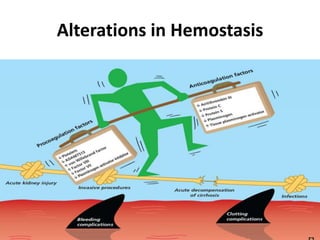
Alterations in Hemostasis
Primary Bemostasis
• Both platelet number and function are adversely affected by
liver disease.
• Mild to moderate thrombocytopenia occurs in up to 76% of
patients with cirrhotic liver disease
• The etiology of thrombocytopenia in liver disease is
multifactorial.
1- Platelet sequestration due to congestive splenomegaly
reflects portal hypertension and is characterized by
redistribution of circulating platelets to the splenic pool.
2- Bone marrow suppression by antiviral therapy, alcohol, or
folate deficiency impairs platelet production.
3- Impaired hepatic synthesis of thrombopoietin (TPO), the
primary physiologic regulator of platelet production. TPO
mRNA levels are significantly reduced in cirrhotic liver tissue,
and serum TPO levels are lower in patients with cirrhosis
4- Accelerated platelet turnover may contribute to
thrombocytopenia in chronic liver disease.
5- “Hypersplenism” reflects an exaggeration of the normal
function of splenic macrophages to remove senescent cells.
6-Immune-mediated platelet destruction occurs in patients
with hepatitis C and primary biliary cirrhosis.
7-Increased platelet consumption may also occur secondary
to cirrhosis related hypercoagulability resulting in platelet
activation.
Coagulation
• Liver parenchymal cells produce all of the coagulation factors
involved in the generation of a fibrin clot except for FVIII,
which is primarily synthesized by the endothelium (hepatic
sinusoids or extrahepatic endothelil cells).
• Chronic liver disease is characterized by reduced synthesis of
procoagulant proteins (FII, FV, FVII, FIX, FX, and FXI).
• Clotting factor levels usually fall in parallel with the
progression of liver disease.
• Fibrinogen levels are normal or increased in most
patients with stable cirrhosis. An acquired
dysfibrinogenemia develops in 50-78% of patients with
chronic liver disease.
• FVIII levels are often increased several fold in patients
with stable cirrhosis. High FVIII levels may result from
increased synthesis in response to cytokine release
from necrotic tissue, as well as reduced clearance due
to impaired hepatic expression of low density
lipoprotein receptor and stabilization by high levels of
VWF characteristic of liver disease.
Anticoagulation
• Natural anticoagulant protein levels fall progressively
with increasing severity of liver disease.
• Antithrombin, protein C and protein S levels range
from 10% to 65% of normal, similar to the range of
values found in patients with inherited deficiencies.
• Tissue factor pathway inhibitor (TFPI) is synthesized by
endothelial cells. TFPI levels are normal or elevated in
patients with chronic liver disease. However, the TPFI
anticoagulant pathway is functionally impaired by low
levels of protein S which functions as a cofactor for
TFPI-mediated downregulation of thrombin
generation.
Fibrinolysis
• Cirrhosis has been shown to be associated with both
quantitative and qualitative changes in the fibrinolytic
pathway.
• All of the profibrinolytic and antifibrinolytic proteins are
synthesized by the liver except tissue plasminogen activator
(tPA) and plasminogen activator inhibitor 1 (PAI-1) which
are synthesized by endothelial cells. Also, PAI-1 is produced
by a variety of sources including adipose tissue.
• Levels of plasminogen, antiplasmin, thrombin-activatable
fibrinolysis inhibitor (TAFI), and FXIII levels are often
reduced in chronic liver disease.
• In contrast, plasma levels of tPA are usually elevated
due to release by activated endothelial cells and
reduced hepatic clearance. PAI-1 levels are variable and
may be normal or increased.
• Oxidative stress, leading to modifications of fibrin, and
increased sialic acid content and altered calcium
binding lead to decreased clot permeability and
impaired fi brinolysis.
• Together these qualitative and quantitative changes
result in a net decrease in fibrinolysis in cirrhosis.
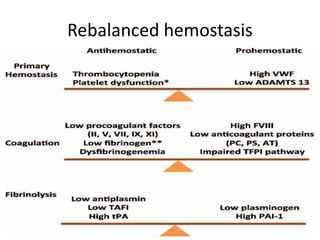
Rebalanced hemostasis
Inflammation and coagulopathy
• Inflammation and infection can tip the balance
• Systemic inflammation is an important factor in
the development and progression of chronic liver
disease, acute liver failure, and acute-on-chronic
liver failure.
• Moreover, patients with liver disease are at
increased risk of both primary and secondary
infections, which in turn contribute to disease
progression.
• Inflammatory cytokines lead to direct activation of
platelets and the endothelium, and endothelial
activation in turn prompts the release of tissue factor
and von Willebrand factor.
• Tissue factor activates the extrinsic coagulation
cascade, and increasing levels of von Willebrand factor
further promote platelet activation and adhesion.
• Increased levels of fibrinogen, an acute-phase reactant,
can tip the balance toward a more hypercoagulable
state.
• Similarly, inflammation- induced expression of
plasminogen activator inhibitor 1 further inhibits
fibrinolysis.
• Eventually, prolonged activation of a systemic
inflammatory response can result in exhaustion of
thrombotic and thrombolytic systems, leading to a
state of consumptive coagulopathy.
• These mechanisms highlight the complexity of
coagulopathy of advanced liver disease and
emphasize the importance of individualized
assessment and management of coagulopathy
in patients with cirrhosis and liver failure,
particularly in patients with systemic
inflammation or sepsis, or both.
Prevention of bleeding
Vitamin K
• Patients with cirrhosis and abnormal coagulation
screening tests often receive vitamin K despite a lack
of evidence supporting benefit.
• Supplemental vitamin K may correct abnormal
coagulation tests in patients at high risk for
deficiency due to biliary disease or gut sterilization
from broad-spectrum antibiotics.
• However, in cirrhotic patients with reduced synthetic
function, the benefit of vitamin K is uncertain.
• A single 10 mg subcutaneous dose of vitamin K
resulted in minimal improvement in PT and PTT in
patients with cirrhosis with no effect on the levels
of several vitamin K dependent proteins.
• Cirrhotic patients had normal PIVKA (Protein
Induced in Vitamin K Absence) levels suggesting
vitamin K deficiency does not play a major role in
the coagulopathy of liver disease.
Fresh frozen plasma
• Fresh frozen plasma (FFP) is often used for prophylaxis
prior to invasive procedures in patients with cirrhosis
despite the absence of clinical trials demonstrating
benefit.
• Multiple studies have demonstrated that transfusion of
FFP has minimal effect on a mildly prolonged INR.
• Thrombin generation was normal in patients with
cirrhosis despite prolonged routine coagulation tests
suggesting that prophylactic infusion of FFP prior to
invasive procedures is unlikely to have clinical benefit.
• The routine use of FFP for primary prophylaxis
prior to invasive procedures is not
recommended.
• The large volumes of FFP required to
significantly increase clotting factor levels may
result in volume overload and exacerbation of
portal hypertension paradoxically increasing
the risk of bleeding.
Platelets
• Thrombocytopenia may be an obstacle to the
timely performance of invasive procedures.
• There is no consensus on the threshold platelet
count for prophylactic transfusion in patients
with liver disease.
• Cirrhotic plasma with a platelet count adjusted to
at least 56 000
• showed a level of thrombin generation
corresponding to the lower limit of the normal
reference range.
• These in vitro results suggest that severe
thrombocytopenia may limit thrombin
generation in patients with cirrhosis and
support the common platelet count threshold
of 50 000 for high-risk procedures.
• AASLD guidelines for liver biopsy recommend
consideration of platelet transfusion prior to
liver biopsy for a platelet count 50 000-60 000.
Thrombopoietin receptor agonists
• The demonstration of reduced TPO production and
activity in chronic liver disease provides a rationale for
use of thrombopoietin receptor (TPO R) agonists to
increase platelet production.
• In a phase II study, patients with chronic hepatitis C,
cirrhosis, and thrombocytopenia (50 0000) received
romiplostim for up to 4 weeks prior to elective surgery.
A fixed weekly dose increased the platelet count above
the target threshold value of 70 000 required for
surgery in 94% of patients and there were no bleeding
or thrombotic complications.
• A randomized trial in patients with chronic liver disease and
thrombocytopenia (50 000) demonstrated that
administration of the oral TPO R agonist, eltrombopag for
14 days prior to elective invasive procedures reduced the
need for platelet transfusion compared with placebo.
• A 7 day pre-procedural course of the second-generation
TPO R agonist, avatrombopag, achieved a significant
increase in platelet count within 3--7 days in 50% of
cirrhotic patients with thrombocytopenia.
• The low incidence of portal vein thrombosis may reflect
dose selection and the shorter duration of therapy.
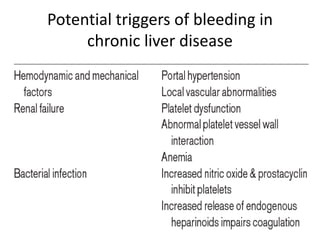
Potential triggers of bleeding in
chronic liver disease
Management of active bleeding
• Bleeding complications in chronic liver disease are
infrequently related to abnormal hemostasis.
• The majority of clinically significant bleeding episodes
are due to increased portal pressure rather than
deranged hemostasis.
• Risk factors for variceal bleeding are primarily related
to hemodynamic and mechanical factors (portal
• pressure, varix size).
• Few data suggest that the coagulopathy of liver disease
is directly related to variceal bleeding, although it may
affect the severity of bleeding in some cases.
Transfusion
• Resuscitation with red cell transfusion should aim for a target
hemoglobin of 8-9 g/dL
• Over transfusion of RBC or large volumes of FFP carries a risk of
increased portal pressure and re-bleeding.
• Platelet transfusion is recommended for patients with
thrombocytopenia and active bleeding. Platelet count should be
maintained 50 000 during acute bleeding
• The increment in platelet count is often poor in patients with
hypersplenism, active bleeding and/or coexistent infection.
• Transfusion of cryoprecipitate to maintain a fibrinogen level 100 is
usually recommended
• There is no evidence that prophylactic plasma or platelet
transfusions reduce the risk of re-bleeding in patients with varices.
Recombinant factor VIIa
• rfVIIa normalizes a prolonged PT/INR,
• Several randomized studies found the use of
rFVIIa in addition to standard pharmacologic and
endoscopic therapy didn’t show beneficial effect
on clinically relevant outcomes in patients with
cirrhosis and active variceal bleeding.
• Recombinant FVIIa is not approved for use in liver
disease and off-label use is associated with an
increased risk of arterial
Prothrombin complex concentrates
• Prothrombin complex concentrates (PCCs) are plasma-derived
products that contain vitamin K-dependent coagulation factors
(FVII, FIX, FX, prothrombin) and anticoagulant proteins (protein C
and protein S).
• PCC have several advantages over FFP including delivery of a
smaller volume with a 25-fold higher concentration of coagulation
factors and more rapid correction of hemostatic parameters.
• However there is no evidence that administration of PCC as
adjunctive or rescue therapy in cirrhotic patients with active
bleeding improves outcome and the routine use of PCC for bleeding
complications of chronic liver disease is not recommended.
• PCC may increase thrombotic risk in patients with liver disease.
Antifibrinolytic agents
• Antifibrinolytic agents such as tranexamic acid
(TXA) were shown to reduce blood loss during
liver transplantation.
• The use of TXA in upper GI bleeding appears
to have a beneficial effect in terms of
decreasing the risk of re-bleeding and
decreasing the need for surgery
• Thrombosis-related questions:
• Is venous thromboembolism (VTE) prophylaxis
indicated in hospitalized patients with
cirrhosis?
• In hospitalized patients with cirrhosis and who
otherwise meet standard guidelines for the
use of VTE prophylaxis, the AGA suggests
standard anticoagulation prophylaxis over no
anticoagulation.
• What, if any, specific anticoagulation therapies should
be offered for treatment of PVT in patients with
cirrhosis: low-molecular-weight heparin, direct-acting
oral anticoagulants (DOACs), or VKAs?
• In patients with cirrhosis and acute or subacute
nontumoral PVT, the AGA suggests using
anticoagulation over no anticoagulation for treatment
of PVT.
• There are no data to support the useof one
anticoagulant over another, as no comparative studies
between anticoagulants exist
• Should patients with atrial fibrillation and
cirrhosis be treated with anticoagulation?
• In patients with cirrhosis and atrial fibrillation
with an indication for anticoagulation, the
AGA suggests using anticoagulation over no
anticoagulation.
Conclusions
• Hemostasis is rebalanced in chronic liver disease. The
balance is fragile and may be disturbed by superimposed
insults such as infection or renal failure.
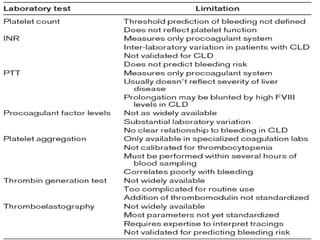
• Although clinical decisions are still often based on
conventional coagulation tests such as the PT/INR, these
tests are not designed to reflect the complex interaction
between cells and coagulation proteins.
• Global assays of hemostasis show promise for assessing
bleeding risk and guiding therapy but high quality data
validating their use is still lacking.
• Bleeding in chronic liver disease is more often the result of
hemodynamic and mechanical factors than deranged
hemostasis.
cirrhosis and coagulation.pptx

cirrhosis and coagulation.pptx

  • 1.
    Cirrhosis and Coagulation: Aparadigm of awareness Dr/ Marwa Mahmoud Khalifa MD PHD Internal medicine & hematology, DMNI
  • 2.
    Background • Coagulopathy—characterized byprolonged PT, elevated INR of the prothrombin time, prolonged APTT, low fibrinogen levels, and low platelet counts—is a hallmark of advanced cirrhosis. • Traditionally, cirrhosis has been considered a hypocoagulable state in which the risk of life- threatening bleeding complications is increased.
  • 3.
    • However, patientswith cirrhosis also have a high incidence of thrombotic complications such as portal vein thrombosis and venous thromboembolism, which are independently associated with significant morbidity, acute hepatic decompensation, and death.
  • 4.
    • Significant bleedingevents occurred in 5-10% of patients per year. • The bleeding rate is higher in patients with advanced liver disease with acute decompensation and patients with cirrhosis admitted to the ICU for any reason. • Most of these bleeding events are gastrointestinal and most are thought to be related to elevated portal pressures
  • 5.
  • 6.
    Primary Bemostasis • Bothplatelet number and function are adversely affected by liver disease. • Mild to moderate thrombocytopenia occurs in up to 76% of patients with cirrhotic liver disease • The etiology of thrombocytopenia in liver disease is multifactorial. 1- Platelet sequestration due to congestive splenomegaly reflects portal hypertension and is characterized by redistribution of circulating platelets to the splenic pool. 2- Bone marrow suppression by antiviral therapy, alcohol, or folate deficiency impairs platelet production.
  • 7.
    3- Impaired hepaticsynthesis of thrombopoietin (TPO), the primary physiologic regulator of platelet production. TPO mRNA levels are significantly reduced in cirrhotic liver tissue, and serum TPO levels are lower in patients with cirrhosis 4- Accelerated platelet turnover may contribute to thrombocytopenia in chronic liver disease. 5- “Hypersplenism” reflects an exaggeration of the normal function of splenic macrophages to remove senescent cells. 6-Immune-mediated platelet destruction occurs in patients with hepatitis C and primary biliary cirrhosis. 7-Increased platelet consumption may also occur secondary to cirrhosis related hypercoagulability resulting in platelet activation.
  • 8.
    Coagulation • Liver parenchymalcells produce all of the coagulation factors involved in the generation of a fibrin clot except for FVIII, which is primarily synthesized by the endothelium (hepatic sinusoids or extrahepatic endothelil cells). • Chronic liver disease is characterized by reduced synthesis of procoagulant proteins (FII, FV, FVII, FIX, FX, and FXI). • Clotting factor levels usually fall in parallel with the progression of liver disease.
  • 9.
    • Fibrinogen levelsare normal or increased in most patients with stable cirrhosis. An acquired dysfibrinogenemia develops in 50-78% of patients with chronic liver disease. • FVIII levels are often increased several fold in patients with stable cirrhosis. High FVIII levels may result from increased synthesis in response to cytokine release from necrotic tissue, as well as reduced clearance due to impaired hepatic expression of low density lipoprotein receptor and stabilization by high levels of VWF characteristic of liver disease.
  • 10.
    Anticoagulation • Natural anticoagulantprotein levels fall progressively with increasing severity of liver disease. • Antithrombin, protein C and protein S levels range from 10% to 65% of normal, similar to the range of values found in patients with inherited deficiencies. • Tissue factor pathway inhibitor (TFPI) is synthesized by endothelial cells. TFPI levels are normal or elevated in patients with chronic liver disease. However, the TPFI anticoagulant pathway is functionally impaired by low levels of protein S which functions as a cofactor for TFPI-mediated downregulation of thrombin generation.
  • 11.
    Fibrinolysis • Cirrhosis hasbeen shown to be associated with both quantitative and qualitative changes in the fibrinolytic pathway. • All of the profibrinolytic and antifibrinolytic proteins are synthesized by the liver except tissue plasminogen activator (tPA) and plasminogen activator inhibitor 1 (PAI-1) which are synthesized by endothelial cells. Also, PAI-1 is produced by a variety of sources including adipose tissue. • Levels of plasminogen, antiplasmin, thrombin-activatable fibrinolysis inhibitor (TAFI), and FXIII levels are often reduced in chronic liver disease.
  • 12.
    • In contrast,plasma levels of tPA are usually elevated due to release by activated endothelial cells and reduced hepatic clearance. PAI-1 levels are variable and may be normal or increased. • Oxidative stress, leading to modifications of fibrin, and increased sialic acid content and altered calcium binding lead to decreased clot permeability and impaired fi brinolysis. • Together these qualitative and quantitative changes result in a net decrease in fibrinolysis in cirrhosis.
  • 13.
  • 14.
    Inflammation and coagulopathy •Inflammation and infection can tip the balance • Systemic inflammation is an important factor in the development and progression of chronic liver disease, acute liver failure, and acute-on-chronic liver failure. • Moreover, patients with liver disease are at increased risk of both primary and secondary infections, which in turn contribute to disease progression.
  • 15.
    • Inflammatory cytokineslead to direct activation of platelets and the endothelium, and endothelial activation in turn prompts the release of tissue factor and von Willebrand factor. • Tissue factor activates the extrinsic coagulation cascade, and increasing levels of von Willebrand factor further promote platelet activation and adhesion. • Increased levels of fibrinogen, an acute-phase reactant, can tip the balance toward a more hypercoagulable state. • Similarly, inflammation- induced expression of plasminogen activator inhibitor 1 further inhibits fibrinolysis. • Eventually, prolonged activation of a systemic inflammatory response can result in exhaustion of thrombotic and thrombolytic systems, leading to a state of consumptive coagulopathy.
  • 16.
    • These mechanismshighlight the complexity of coagulopathy of advanced liver disease and emphasize the importance of individualized assessment and management of coagulopathy in patients with cirrhosis and liver failure, particularly in patients with systemic inflammation or sepsis, or both.
  • 18.
  • 19.
    Vitamin K • Patientswith cirrhosis and abnormal coagulation screening tests often receive vitamin K despite a lack of evidence supporting benefit. • Supplemental vitamin K may correct abnormal coagulation tests in patients at high risk for deficiency due to biliary disease or gut sterilization from broad-spectrum antibiotics. • However, in cirrhotic patients with reduced synthetic function, the benefit of vitamin K is uncertain.
  • 20.
    • A single10 mg subcutaneous dose of vitamin K resulted in minimal improvement in PT and PTT in patients with cirrhosis with no effect on the levels of several vitamin K dependent proteins. • Cirrhotic patients had normal PIVKA (Protein Induced in Vitamin K Absence) levels suggesting vitamin K deficiency does not play a major role in the coagulopathy of liver disease.
  • 21.
    Fresh frozen plasma •Fresh frozen plasma (FFP) is often used for prophylaxis prior to invasive procedures in patients with cirrhosis despite the absence of clinical trials demonstrating benefit. • Multiple studies have demonstrated that transfusion of FFP has minimal effect on a mildly prolonged INR. • Thrombin generation was normal in patients with cirrhosis despite prolonged routine coagulation tests suggesting that prophylactic infusion of FFP prior to invasive procedures is unlikely to have clinical benefit.
  • 22.
    • The routineuse of FFP for primary prophylaxis prior to invasive procedures is not recommended. • The large volumes of FFP required to significantly increase clotting factor levels may result in volume overload and exacerbation of portal hypertension paradoxically increasing the risk of bleeding.
  • 23.
    Platelets • Thrombocytopenia maybe an obstacle to the timely performance of invasive procedures. • There is no consensus on the threshold platelet count for prophylactic transfusion in patients with liver disease. • Cirrhotic plasma with a platelet count adjusted to at least 56 000 • showed a level of thrombin generation corresponding to the lower limit of the normal reference range.
  • 24.
    • These invitro results suggest that severe thrombocytopenia may limit thrombin generation in patients with cirrhosis and support the common platelet count threshold of 50 000 for high-risk procedures. • AASLD guidelines for liver biopsy recommend consideration of platelet transfusion prior to liver biopsy for a platelet count 50 000-60 000.
  • 25.
    Thrombopoietin receptor agonists •The demonstration of reduced TPO production and activity in chronic liver disease provides a rationale for use of thrombopoietin receptor (TPO R) agonists to increase platelet production. • In a phase II study, patients with chronic hepatitis C, cirrhosis, and thrombocytopenia (50 0000) received romiplostim for up to 4 weeks prior to elective surgery. A fixed weekly dose increased the platelet count above the target threshold value of 70 000 required for surgery in 94% of patients and there were no bleeding or thrombotic complications.
  • 26.
    • A randomizedtrial in patients with chronic liver disease and thrombocytopenia (50 000) demonstrated that administration of the oral TPO R agonist, eltrombopag for 14 days prior to elective invasive procedures reduced the need for platelet transfusion compared with placebo. • A 7 day pre-procedural course of the second-generation TPO R agonist, avatrombopag, achieved a significant increase in platelet count within 3--7 days in 50% of cirrhotic patients with thrombocytopenia. • The low incidence of portal vein thrombosis may reflect dose selection and the shorter duration of therapy.
  • 27.
    Potential triggers ofbleeding in chronic liver disease
  • 28.
    Management of activebleeding • Bleeding complications in chronic liver disease are infrequently related to abnormal hemostasis. • The majority of clinically significant bleeding episodes are due to increased portal pressure rather than deranged hemostasis. • Risk factors for variceal bleeding are primarily related to hemodynamic and mechanical factors (portal • pressure, varix size). • Few data suggest that the coagulopathy of liver disease is directly related to variceal bleeding, although it may affect the severity of bleeding in some cases.
  • 29.
    Transfusion • Resuscitation withred cell transfusion should aim for a target hemoglobin of 8-9 g/dL • Over transfusion of RBC or large volumes of FFP carries a risk of increased portal pressure and re-bleeding. • Platelet transfusion is recommended for patients with thrombocytopenia and active bleeding. Platelet count should be maintained 50 000 during acute bleeding • The increment in platelet count is often poor in patients with hypersplenism, active bleeding and/or coexistent infection. • Transfusion of cryoprecipitate to maintain a fibrinogen level 100 is usually recommended • There is no evidence that prophylactic plasma or platelet transfusions reduce the risk of re-bleeding in patients with varices.
  • 30.

    Recombinant factor VIIa •rfVIIa normalizes a prolonged PT/INR, • Several randomized studies found the use of rFVIIa in addition to standard pharmacologic and endoscopic therapy didn’t show beneficial effect on clinically relevant outcomes in patients with cirrhosis and active variceal bleeding. • Recombinant FVIIa is not approved for use in liver disease and off-label use is associated with an increased risk of arterial
  • 31.
    Prothrombin complex concentrates •Prothrombin complex concentrates (PCCs) are plasma-derived products that contain vitamin K-dependent coagulation factors (FVII, FIX, FX, prothrombin) and anticoagulant proteins (protein C and protein S). • PCC have several advantages over FFP including delivery of a smaller volume with a 25-fold higher concentration of coagulation factors and more rapid correction of hemostatic parameters. • However there is no evidence that administration of PCC as adjunctive or rescue therapy in cirrhotic patients with active bleeding improves outcome and the routine use of PCC for bleeding complications of chronic liver disease is not recommended. • PCC may increase thrombotic risk in patients with liver disease.
  • 32.
    Antifibrinolytic agents • Antifibrinolyticagents such as tranexamic acid (TXA) were shown to reduce blood loss during liver transplantation. • The use of TXA in upper GI bleeding appears to have a beneficial effect in terms of decreasing the risk of re-bleeding and decreasing the need for surgery
  • 33.
  • 34.
    • Is venousthromboembolism (VTE) prophylaxis indicated in hospitalized patients with cirrhosis? • In hospitalized patients with cirrhosis and who otherwise meet standard guidelines for the use of VTE prophylaxis, the AGA suggests standard anticoagulation prophylaxis over no anticoagulation.
  • 35.
    • What, ifany, specific anticoagulation therapies should be offered for treatment of PVT in patients with cirrhosis: low-molecular-weight heparin, direct-acting oral anticoagulants (DOACs), or VKAs? • In patients with cirrhosis and acute or subacute nontumoral PVT, the AGA suggests using anticoagulation over no anticoagulation for treatment of PVT. • There are no data to support the useof one anticoagulant over another, as no comparative studies between anticoagulants exist
  • 36.
    • Should patientswith atrial fibrillation and cirrhosis be treated with anticoagulation? • In patients with cirrhosis and atrial fibrillation with an indication for anticoagulation, the AGA suggests using anticoagulation over no anticoagulation.
  • 37.
    Conclusions • Hemostasis isrebalanced in chronic liver disease. The balance is fragile and may be disturbed by superimposed insults such as infection or renal failure. • Although clinical decisions are still often based on conventional coagulation tests such as the PT/INR, these tests are not designed to reflect the complex interaction between cells and coagulation proteins. • Global assays of hemostasis show promise for assessing bleeding risk and guiding therapy but high quality data validating their use is still lacking. • Bleeding in chronic liver disease is more often the result of hemodynamic and mechanical factors than deranged hemostasis.