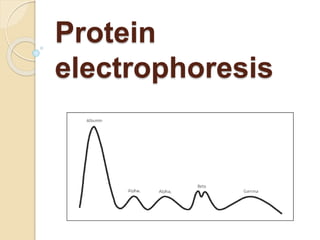
Protein
electrophoresis
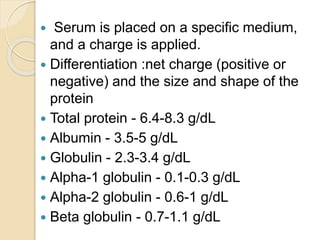
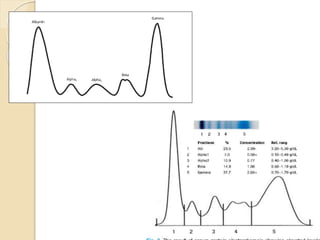
 Serum is placed on a specific medium,
and a charge is applied.
 Differentiation :net charge (positive or
negative) and the size and shape of the
protein
 Total protein - 6.4-8.3 g/dL
 Albumin - 3.5-5 g/dL
 Globulin - 2.3-3.4 g/dL
 Alpha-1 globulin - 0.1-0.3 g/dL
 Alpha-2 globulin - 0.6-1 g/dL
 Beta globulin - 0.7-1.1 g/dL
Components
 ALBUMIN
 ALPHA FRACTION:
 alpha1-protein fraction is comprised of
alpha1-antitrypsin, thyroid-binding
globulin, and transcortin.
 Ceruloplasmin, alpha2-macroglobulin,
and haptoglobin contribute to the
alpha2-protein
Liver disease
Acute inflammation, malignancy
 BETA FRACTION: two peaks labeled
beta1 (transferrin) and beta2 (beta-
lipoprotein)
+/- IgA, IgM, and sometimes IgG,
complement
Cirrhosis /Carcinoma/Cushing’s
Diabetes mellitus /Hypothyroidism
IDA/ Malignant hypertension
Nephrosis /Polyarteritis nodosa
/Obstructive jaundice /3rd tri pregnancy
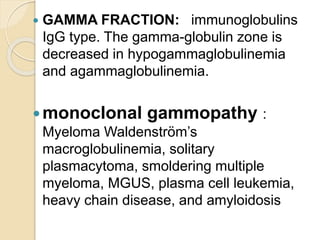
 GAMMA FRACTION: immunoglobulins
IgG type. The gamma-globulin zone is
decreased in hypogammaglobulinemia
and agammaglobulinemia.
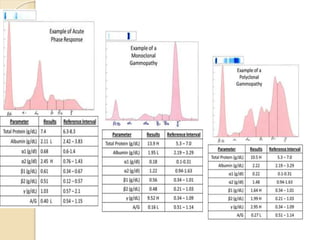
monoclonal gammopathy :
Myeloma Waldenström’s
macroglobulinemia, solitary
plasmacytoma, smoldering multiple
myeloma, MGUS, plasma cell leukemia,
heavy chain disease, and amyloidosis
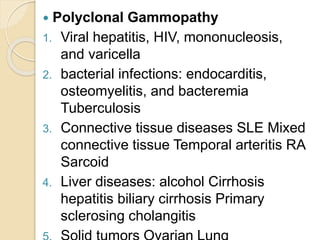
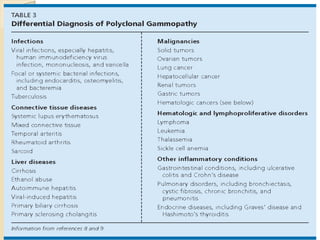
 Polyclonal Gammopathy
1. Viral hepatitis, HIV, mononucleosis,
and varicella
2. bacterial infections: endocarditis,
osteomyelitis, and bacteremia
Tuberculosis
3. Connective tissue diseases SLE Mixed
connective tissue Temporal arteritis RA
Sarcoid
4. Liver diseases: alcohol Cirrhosis
hepatitis biliary cirrhosis Primary
sclerosing cholangitis
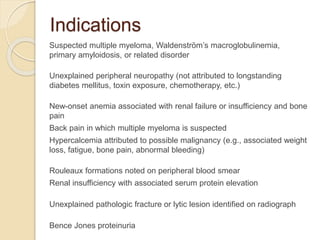
Indications
Suspected multiple myeloma, Waldenström’s macroglobulinemia,
primary amyloidosis, or related disorder
Unexplained peripheral neuropathy (not attributed to longstanding
diabetes mellitus, toxin exposure, chemotherapy, etc.)
New-onset anemia associated with renal failure or insufficiency and bone
pain
Back pain in which multiple myeloma is suspected
Hypercalcemia attributed to possible malignancy (e.g., associated weight
loss, fatigue, bone pain, abnormal bleeding)
Rouleaux formations noted on peripheral blood smear
Renal insufficiency with associated serum protein elevation
Unexplained pathologic fracture or lytic lesion identified on radiograph
Bence Jones proteinuria
Myeloma
Paving the
Way
1.8% of all cancers
17% of all haematological malignancies
median age at diagnosis of 69 years
Diagnosed among people 65-74y
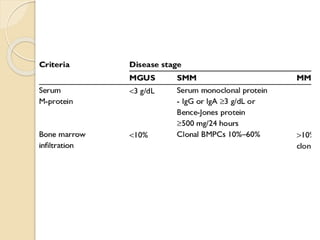
Diagnostic Criteria
2014 IMWG criteria
 Clonal bone marrow plasma cells ≥ 10% or biopsy-proven
bone or extramedullary plasmacytoma
 Any one or more of the following myeloma-defining events
 Hypercalcemia (greater than upper limit of normal)
 Renal insufficiency: serum creatinine >2 g/dL or creatinine
clearance <40 mL/min
 Anemia: hemoglobin <10 g/dL or 2 g/dL below lower limit of
normal
 Bone lesions: one or more osteolytic lesions (as demonstrated
on imaging studies)
New criteria
 Involved/uninvolved serum free light chains ratio ≥ 100, and
the involved serum free light chain level ≥ 100 mg/dL
 Clonal bone marrow plasma cells ≥ 60%
 ≥ 2 focal lesions based on MRI studies of the skeleton
Work up
 Serum and/or urine protein electrophoresis
(24h urine collection) : M band
 Quantification of IgG, IgA, IgM
immunoglobulins;
 Immunofixation; and serum-free light chain
(FLC) measurement.
 Bone marrow :plasma cell infiltration ,
cytogenetics, flowcytometry
 CBC: rouleaux formation
 serum creatinine, creatinine clearance and
calcium
 LDH , B2M, albumin
Lytic bone lesions: whole-body low-
dose computed tomography (WBLD-
CT). Conventional radiography if
WBLD-CT is not available
MRI used in selected situations (eg, risk
stratifying smoldering myeloma, for
monitoring response of nonsecretory
and oligosecretory myeloma, and if CT
or skeletal survey is inconclusive)
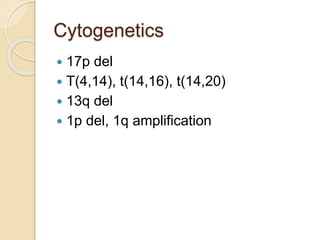
Cytogenetics
 17p del
 T(4,14), t(14,16), t(14,20)
 13q del
 1p del, 1q amplification
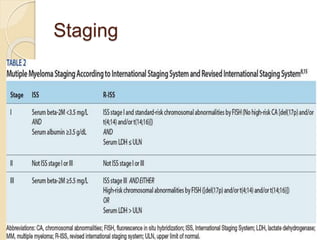
Staging
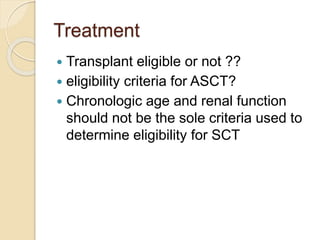
Treatment
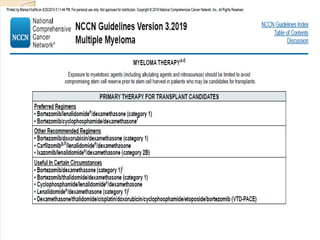
 Transplant eligible or not ??
 eligibility criteria for ASCT?
 Chronologic age and renal function
should not be the sole criteria used to
determine eligibility for SCT
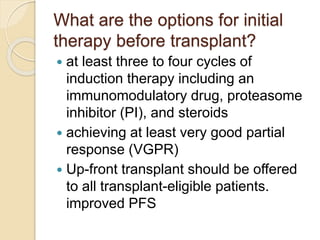
What are the options for initial
therapy before transplant?
 at least three to four cycles of
induction therapy including an
immunomodulatory drug, proteasome
inhibitor (PI), and steroids
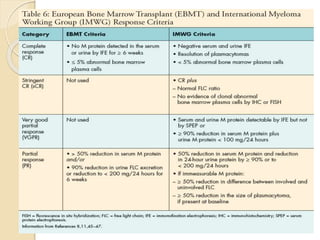
 achieving at least very good partial
response (VGPR)
 Up-front transplant should be offered
to all transplant-eligible patients.
improved PFS
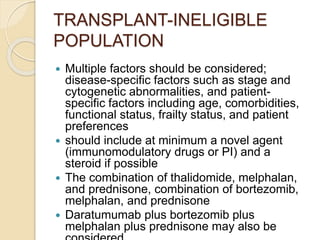
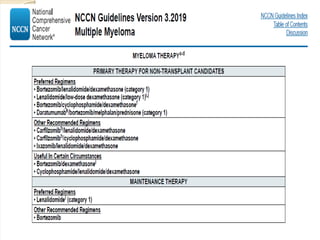
TRANSPLANT-INELIGIBLE
POPULATION
 Multiple factors should be considered;
disease-specific factors such as stage and
cytogenetic abnormalities, and patient-
specific factors including age, comorbidities,
functional status, frailty status, and patient
preferences
 should include at minimum a novel agent
(immunomodulatory drugs or PI) and a
steroid if possible
 The combination of thalidomide, melphalan,
and prednisone, combination of bortezomib,
melphalan, and prednisone
 Daratumumab plus bortezomib plus
melphalan plus prednisone may also be
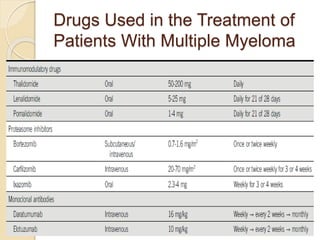
Drugs Used in the Treatment of
Patients With Multiple Myeloma
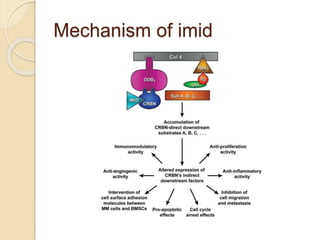
Mechanism of imid
Mechanism of PI
 PIs suppress the production of
cytokines (IL-6), (IGF-1), (TNFα), which
can affect MSC and myeloma cell
interactions.
 PIs suppress angiogenesis by
decreasing VEGF secretion.
 PIs allow for the accumulation of
misfolded and unfolded proteins,
resulting in endoplasmic reticulum (ER)
stress, reactive oxygen species (ROS)-
induced oxidative stress, and the
 PIs inhibit NF-κB signaling, a major
growth and survival signaling pathway in
MM
 PIs upregulate p53, a tumor
suppressor to induce cell cycle arrest.
 PIs can induce apoptosis through
extrinsic caspase-8 cascade ,
and via caspase-9 cleavage.
 PIs suppress adhesion molecule and
growth factor receptor expression (e.g.,
IL-6R) and inhibit cellular mechanisms
for repairing double-strand DNA breaks
 increasing use of immunomodulatory
drugs, lenalidomide in particular,
(beyond four to six cycles) may also
compromise stem-cell yield.
Tandem or not tandem ?
 A single ASCT is considered the
standard of care based upon the
randomized BMT Clinical Trial
 Tandem ASCT should not be routinely
recommended
 High-dose melphalan is the
recommended conditioning regimen
for ASCT
Role of Allo
 not routinely recommended but may
be considered in select high-risk
patients or in the context of a clinical
trial
Consolidation and Maintaince
 Consolidation therapy is not routinely
recommended
 For patients ineligible or unwilling to consider
maintenance therapy, consolidation therapy
for at least two cycles may be considered.
 Lenalidomide maintenance therapy should be
routinely offered to standard-risk patients
starting at approximately day 90 to 110 at 10
to 15 mg daily until progression.
 A minimum of 2 years of maintenance
therapy is associated with improved survival
 For patients intolerant of or unable to
receive lenalidomide, bortezomib
maintenance every 2 weeks may be
considered
 For high-risk patients, maintenance
therapy with a PI with or without
lenalidomide may be considered
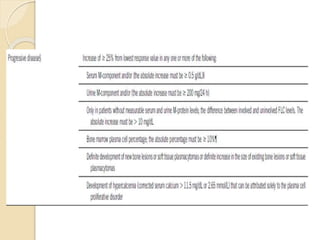
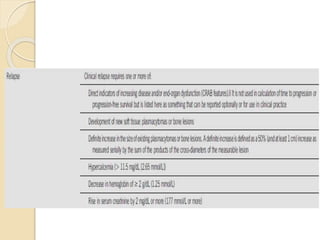
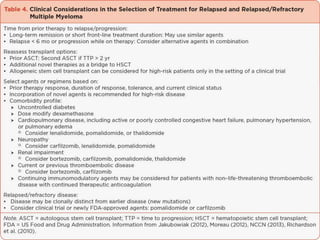
RELAPSED DISEASE
 should be treated immediately
 A triplet regimen with two novel agents
(PI, immunomodulatory drug, or
monoclonal antibody) in combination
with a steroid
 A monoclonal antibody–based regimen
in combination with an
immunomodulatory drug and/or PI
should be considered.
 Treatment of relapsed multiple myeloma
may be continued until disease
Transplant post relapse
 ASCT, if not received after primary
induction therapy, should be offered to
transplant eligible
 Repeat SCT may be considered in
relapsed multiple myeloma if PFS
after first transplant is ≥ 18 months
 Allogeneic hematopoietic cell
transplantation has the potential of
producing cure (TRM, GVHD)
Bone disease 80%
Pamidronate is administered at a
monthly dose of 90mg via a 2 h i.v.
infusion.
Zoledronic acid at a monthly dose of
4mg administered via a 15 min infusion.
In patients with creatinine clearance 30–
60 mL/min,
the dose of zoledronic acid must be
reduced to a maximum of 3mg
Patients with hypercalcaemia should
also receive zoledronic acid
osteonecrosis of the jaw.
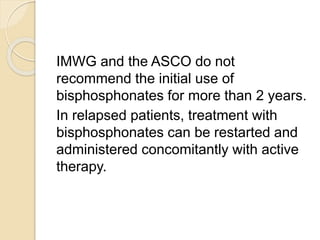
IMWG and the ASCO do not
recommend the initial use of
bisphosphonates for more than 2 years.
In relapsed patients, treatment with
bisphosphonates can be restarted and
administered concomitantly with active
therapy.
spinal cord compression
 emergency that requires treatment
with high-dose dexamethasone and
simultaneous local radiotherapy
should be started as soon as possible;
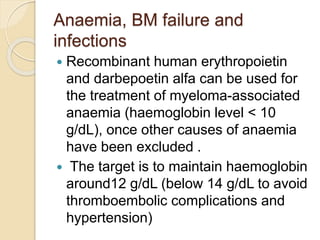
Anaemia, BM failure and
infections
 Recombinant human erythropoietin
and darbepoetin alfa can be used for
the treatment of myeloma-associated
anaemia (haemoglobin level < 10
g/dL), once other causes of anaemia
have been excluded .
 The target is to maintain haemoglobin
around12 g/dL (below 14 g/dL to avoid
thromboembolic complications and
hypertension)
 G-CSF may be required to treat
chemotherapy-induced severe
granulocytopaenia.
 Infectious episodes require immediate
therapy with broad spectrum antibiotics.
 Prophylaxis of infection controversial
,first 2–3 months of initiation of
lenalidomide or pomalidomide, or in
patients at high risk of infection
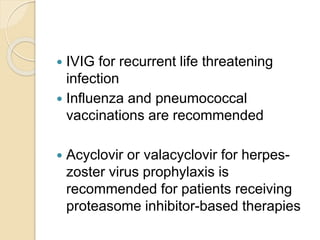
 IVIG for recurrent life threatening
infection
 Influenza and pneumococcal
vaccinations are recommended
 Acyclovir or valacyclovir for herpes-
zoster virus prophylaxis is
recommended for patients receiving
proteasome inhibitor-based therapies
Renal impairment 33%
 Bortezomib-based therapies (in
combination with dexamethasone
 thalidomide or doxorubicin or
cyclophosphamide is the treatment of
choice in patients with renal failure
Venous thromboembolism.
 Increased risk of thrombosis 3%–4%
 High-dose dexamethasone, cytotoxic
chemotherapy such as doxorubicin and
IMiDs (thalidomide and lenalidomide)
increase this risk
 The current recommendations for
patients with MM who are due to start
IMiD therapy are to use aspirin (81-325
mg) in the absence of risk factors for
thrombosis and to use full dose
anticoagulants for those at higher risk
Hypercalcemia
 Hydration
 Bisphosphonate
 Denosumab
 Steroids
Non-Secretory Myeloma: Ready
for a new Definition?
 monoclonal plasma cells ≥10% in the
bone marrow and by negative results
on serum and urine electrophoresis
and immunofixation studies.
 evidence of end-organ damage
 Either non producer or non secretors
Oligo-secretory “free light only”
myeloma light chain myeloma
 serum protein of < 1.0 g/dL, urine
protein of < 200 mg/24 hrs, and free
light chain values of < 100 mg/L
Solitary Plasmacytoma
 existence of a histologically confirmed
solitary plasma cell tumour either
osseous or extraosseous in the
absence of BM infiltration and CRAB
symptoms
 Local radiotherapy is the preferred
treatment of choice 30-60 Gy, but
about two-thirds of patients develop
MM at 10 years’ follow-up
 Follow up 3-6 m
Plasma cell leukaemia
 Poor outcomes OS≈ 1y
 >20% clonal plasma cells in peripheral
blood or >2 × 10⁹ /l
 no specific treatment approaches for
PCL.
 The use of multidrug combinations
(including both a proteasome inhibitor
and an IMiD) followed by HDT in
eligible patients, followed by
prolonged maintenance until
progression
POEMS syndrome

Myeloma &amp; spep interpretation Marwa Khalifa

  • 1.
  • 2.
     Serum isplaced on a specific medium, and a charge is applied.  Differentiation :net charge (positive or negative) and the size and shape of the protein  Total protein - 6.4-8.3 g/dL  Albumin - 3.5-5 g/dL  Globulin - 2.3-3.4 g/dL  Alpha-1 globulin - 0.1-0.3 g/dL  Alpha-2 globulin - 0.6-1 g/dL  Beta globulin - 0.7-1.1 g/dL
  • 3.
    Components  ALBUMIN  ALPHAFRACTION:  alpha1-protein fraction is comprised of alpha1-antitrypsin, thyroid-binding globulin, and transcortin.  Ceruloplasmin, alpha2-macroglobulin, and haptoglobin contribute to the alpha2-protein Liver disease Acute inflammation, malignancy
  • 4.
     BETA FRACTION:two peaks labeled beta1 (transferrin) and beta2 (beta- lipoprotein) +/- IgA, IgM, and sometimes IgG, complement Cirrhosis /Carcinoma/Cushing’s Diabetes mellitus /Hypothyroidism IDA/ Malignant hypertension Nephrosis /Polyarteritis nodosa /Obstructive jaundice /3rd tri pregnancy
  • 5.
     GAMMA FRACTION:immunoglobulins IgG type. The gamma-globulin zone is decreased in hypogammaglobulinemia and agammaglobulinemia. monoclonal gammopathy : Myeloma Waldenström’s macroglobulinemia, solitary plasmacytoma, smoldering multiple myeloma, MGUS, plasma cell leukemia, heavy chain disease, and amyloidosis
  • 6.
     Polyclonal Gammopathy 1.Viral hepatitis, HIV, mononucleosis, and varicella 2. bacterial infections: endocarditis, osteomyelitis, and bacteremia Tuberculosis 3. Connective tissue diseases SLE Mixed connective tissue Temporal arteritis RA Sarcoid 4. Liver diseases: alcohol Cirrhosis hepatitis biliary cirrhosis Primary sclerosing cholangitis
  • 10.
    Indications Suspected multiple myeloma,Waldenström’s macroglobulinemia, primary amyloidosis, or related disorder Unexplained peripheral neuropathy (not attributed to longstanding diabetes mellitus, toxin exposure, chemotherapy, etc.) New-onset anemia associated with renal failure or insufficiency and bone pain Back pain in which multiple myeloma is suspected Hypercalcemia attributed to possible malignancy (e.g., associated weight loss, fatigue, bone pain, abnormal bleeding) Rouleaux formations noted on peripheral blood smear Renal insufficiency with associated serum protein elevation Unexplained pathologic fracture or lytic lesion identified on radiograph Bence Jones proteinuria
  • 12.
  • 13.
    1.8% of allcancers 17% of all haematological malignancies median age at diagnosis of 69 years Diagnosed among people 65-74y
  • 14.
    Diagnostic Criteria 2014 IMWGcriteria  Clonal bone marrow plasma cells ≥ 10% or biopsy-proven bone or extramedullary plasmacytoma  Any one or more of the following myeloma-defining events  Hypercalcemia (greater than upper limit of normal)  Renal insufficiency: serum creatinine >2 g/dL or creatinine clearance <40 mL/min  Anemia: hemoglobin <10 g/dL or 2 g/dL below lower limit of normal  Bone lesions: one or more osteolytic lesions (as demonstrated on imaging studies) New criteria  Involved/uninvolved serum free light chains ratio ≥ 100, and the involved serum free light chain level ≥ 100 mg/dL  Clonal bone marrow plasma cells ≥ 60%  ≥ 2 focal lesions based on MRI studies of the skeleton
  • 15.
    Work up  Serumand/or urine protein electrophoresis (24h urine collection) : M band  Quantification of IgG, IgA, IgM immunoglobulins;  Immunofixation; and serum-free light chain (FLC) measurement.  Bone marrow :plasma cell infiltration , cytogenetics, flowcytometry  CBC: rouleaux formation  serum creatinine, creatinine clearance and calcium  LDH , B2M, albumin
  • 16.
    Lytic bone lesions:whole-body low- dose computed tomography (WBLD- CT). Conventional radiography if WBLD-CT is not available MRI used in selected situations (eg, risk stratifying smoldering myeloma, for monitoring response of nonsecretory and oligosecretory myeloma, and if CT or skeletal survey is inconclusive)
  • 17.
    Cytogenetics  17p del T(4,14), t(14,16), t(14,20)  13q del  1p del, 1q amplification
  • 18.
  • 19.
    Treatment  Transplant eligibleor not ??  eligibility criteria for ASCT?  Chronologic age and renal function should not be the sole criteria used to determine eligibility for SCT
  • 20.
    What are theoptions for initial therapy before transplant?  at least three to four cycles of induction therapy including an immunomodulatory drug, proteasome inhibitor (PI), and steroids  achieving at least very good partial response (VGPR)  Up-front transplant should be offered to all transplant-eligible patients. improved PFS
  • 21.
    TRANSPLANT-INELIGIBLE POPULATION  Multiple factorsshould be considered; disease-specific factors such as stage and cytogenetic abnormalities, and patient- specific factors including age, comorbidities, functional status, frailty status, and patient preferences  should include at minimum a novel agent (immunomodulatory drugs or PI) and a steroid if possible  The combination of thalidomide, melphalan, and prednisone, combination of bortezomib, melphalan, and prednisone  Daratumumab plus bortezomib plus melphalan plus prednisone may also be
  • 22.
    Drugs Used inthe Treatment of Patients With Multiple Myeloma
  • 25.
  • 26.
    Mechanism of PI PIs suppress the production of cytokines (IL-6), (IGF-1), (TNFα), which can affect MSC and myeloma cell interactions.  PIs suppress angiogenesis by decreasing VEGF secretion.  PIs allow for the accumulation of misfolded and unfolded proteins, resulting in endoplasmic reticulum (ER) stress, reactive oxygen species (ROS)- induced oxidative stress, and the
  • 27.
     PIs inhibitNF-κB signaling, a major growth and survival signaling pathway in MM  PIs upregulate p53, a tumor suppressor to induce cell cycle arrest.  PIs can induce apoptosis through extrinsic caspase-8 cascade , and via caspase-9 cleavage.  PIs suppress adhesion molecule and growth factor receptor expression (e.g., IL-6R) and inhibit cellular mechanisms for repairing double-strand DNA breaks
  • 30.
     increasing useof immunomodulatory drugs, lenalidomide in particular, (beyond four to six cycles) may also compromise stem-cell yield.
  • 31.
    Tandem or nottandem ?  A single ASCT is considered the standard of care based upon the randomized BMT Clinical Trial  Tandem ASCT should not be routinely recommended  High-dose melphalan is the recommended conditioning regimen for ASCT
  • 32.
    Role of Allo not routinely recommended but may be considered in select high-risk patients or in the context of a clinical trial
  • 33.
    Consolidation and Maintaince Consolidation therapy is not routinely recommended  For patients ineligible or unwilling to consider maintenance therapy, consolidation therapy for at least two cycles may be considered.  Lenalidomide maintenance therapy should be routinely offered to standard-risk patients starting at approximately day 90 to 110 at 10 to 15 mg daily until progression.  A minimum of 2 years of maintenance therapy is associated with improved survival
  • 34.
     For patientsintolerant of or unable to receive lenalidomide, bortezomib maintenance every 2 weeks may be considered  For high-risk patients, maintenance therapy with a PI with or without lenalidomide may be considered
  • 36.
    RELAPSED DISEASE  shouldbe treated immediately  A triplet regimen with two novel agents (PI, immunomodulatory drug, or monoclonal antibody) in combination with a steroid  A monoclonal antibody–based regimen in combination with an immunomodulatory drug and/or PI should be considered.  Treatment of relapsed multiple myeloma may be continued until disease
  • 39.
    Transplant post relapse ASCT, if not received after primary induction therapy, should be offered to transplant eligible  Repeat SCT may be considered in relapsed multiple myeloma if PFS after first transplant is ≥ 18 months  Allogeneic hematopoietic cell transplantation has the potential of producing cure (TRM, GVHD)
  • 41.
    Bone disease 80% Pamidronateis administered at a monthly dose of 90mg via a 2 h i.v. infusion. Zoledronic acid at a monthly dose of 4mg administered via a 15 min infusion. In patients with creatinine clearance 30– 60 mL/min, the dose of zoledronic acid must be reduced to a maximum of 3mg Patients with hypercalcaemia should also receive zoledronic acid osteonecrosis of the jaw.
  • 42.
    IMWG and theASCO do not recommend the initial use of bisphosphonates for more than 2 years. In relapsed patients, treatment with bisphosphonates can be restarted and administered concomitantly with active therapy.
  • 43.
    spinal cord compression emergency that requires treatment with high-dose dexamethasone and simultaneous local radiotherapy should be started as soon as possible;
  • 44.
    Anaemia, BM failureand infections  Recombinant human erythropoietin and darbepoetin alfa can be used for the treatment of myeloma-associated anaemia (haemoglobin level < 10 g/dL), once other causes of anaemia have been excluded .  The target is to maintain haemoglobin around12 g/dL (below 14 g/dL to avoid thromboembolic complications and hypertension)
  • 45.
     G-CSF maybe required to treat chemotherapy-induced severe granulocytopaenia.  Infectious episodes require immediate therapy with broad spectrum antibiotics.  Prophylaxis of infection controversial ,first 2–3 months of initiation of lenalidomide or pomalidomide, or in patients at high risk of infection
  • 46.
     IVIG forrecurrent life threatening infection  Influenza and pneumococcal vaccinations are recommended  Acyclovir or valacyclovir for herpes- zoster virus prophylaxis is recommended for patients receiving proteasome inhibitor-based therapies
  • 47.
    Renal impairment 33% Bortezomib-based therapies (in combination with dexamethasone  thalidomide or doxorubicin or cyclophosphamide is the treatment of choice in patients with renal failure
  • 48.
    Venous thromboembolism.  Increasedrisk of thrombosis 3%–4%  High-dose dexamethasone, cytotoxic chemotherapy such as doxorubicin and IMiDs (thalidomide and lenalidomide) increase this risk  The current recommendations for patients with MM who are due to start IMiD therapy are to use aspirin (81-325 mg) in the absence of risk factors for thrombosis and to use full dose anticoagulants for those at higher risk
  • 49.
  • 50.
    Non-Secretory Myeloma: Ready fora new Definition?  monoclonal plasma cells ≥10% in the bone marrow and by negative results on serum and urine electrophoresis and immunofixation studies.  evidence of end-organ damage  Either non producer or non secretors
  • 51.
    Oligo-secretory “free lightonly” myeloma light chain myeloma  serum protein of < 1.0 g/dL, urine protein of < 200 mg/24 hrs, and free light chain values of < 100 mg/L
  • 52.
    Solitary Plasmacytoma  existenceof a histologically confirmed solitary plasma cell tumour either osseous or extraosseous in the absence of BM infiltration and CRAB symptoms  Local radiotherapy is the preferred treatment of choice 30-60 Gy, but about two-thirds of patients develop MM at 10 years’ follow-up  Follow up 3-6 m
  • 53.
    Plasma cell leukaemia Poor outcomes OS≈ 1y  >20% clonal plasma cells in peripheral blood or >2 × 10⁹ /l  no specific treatment approaches for PCL.  The use of multidrug combinations (including both a proteasome inhibitor and an IMiD) followed by HDT in eligible patients, followed by prolonged maintenance until progression
  • 54.