Dr Naser Tadvi
 Thomas edison : Pernicious anemia
 Minot & Murphy 1926: liver preparation
 Castle: Postulated intrinsic factor theory
 1941 Mitchel : Folic acid
 1943: Pteroyl monoglutamic acid
 1948: Crystalline B12
 Megaloblastic anemia:
   Characterized by abnormally large nucleated
    red cell precursors called megaloblasts in bone
    marrow
   Megaloblast eg of unbalance between cytoplasm
    and nucleus due to improper and defective
    synthesis of nucleoproteins
   95 % cases due to vit B12 or folic acid deficiency
    leading to defective DNA synthesis
 DNA present in every basic cell so abnormality
  effects rapidly proliferating cells.
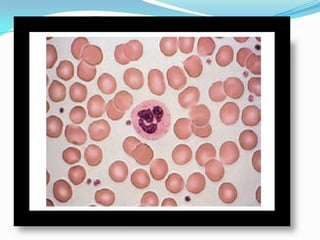
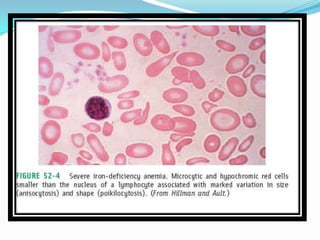
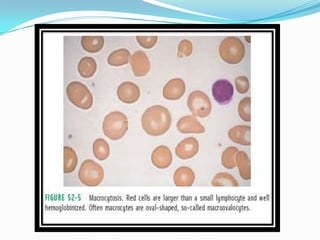
 Peripheral blood picture: Hemoglobinized large
  RBC (Macrocytes), PMN leucocytes &
  hypersegmented giant platelets.
 Anemia described is hyperchromic macrocytic
 Vit B12 deficiency causes damage to myelin in the
  peripheral nerves , spinal cord & brain
 Folate deficiency: weight loss, nervous instability
  but damage to myelin is doubtful
 Other causes of macrocytic anemias: Liver disease
  , myxedema, Leukemia & certain hemolytic states
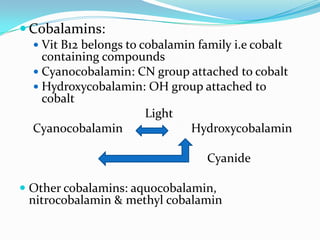
 Cobalamins:
   Vit B12 belongs to cobalamin family i.e cobalt
    containing compounds
   Cyanocobalamin: CN group attached to cobalt
   Hydroxycobalamin: OH group attached to
    cobalt
                     Light
  Cyanocobalamin             Hydroxycobalamin

                                   Cyanide

 Other cobalamins: aquocobalamin,
  nitrocobalamin & methyl cobalamin
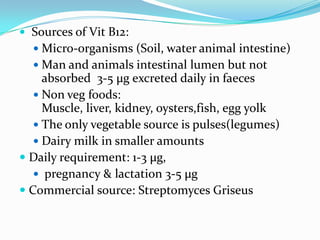
 Sources of Vit B12:
   Micro-organisms (Soil, water animal intestine)
   Man and animals intestinal lumen but not
     absorbed 3-5 µg excreted daily in faeces
    Non veg foods:
     Muscle, liver, kidney, oysters,fish, egg yolk
    The only vegetable source is pulses(legumes)
    Dairy milk in smaller amounts
 Daily requirement: 1-3 µg,
    pregnancy & lactation 3-5 µg
 Commercial source: Streptomyces Griseus
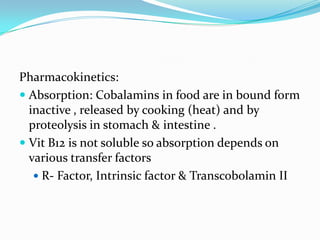
Pharmacokinetics:
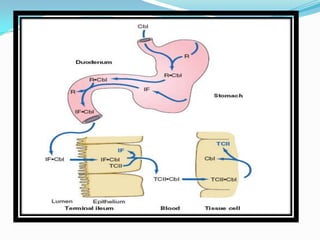
 Absorption: Cobalamins in food are in bound form
  inactive , released by cooking (heat) and by
  proteolysis in stomach & intestine .
 Vit B12 is not soluble so absorption depends on
  various transfer factors
    R- Factor, Intrinsic factor & Transcobolamin II
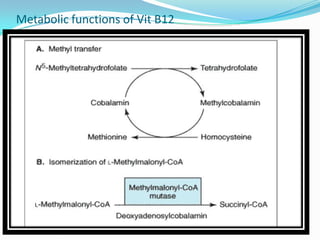
Metabolic functions of Vit B12
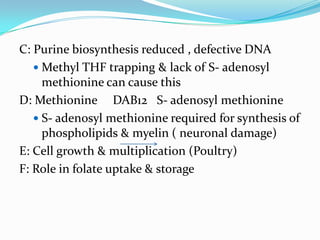
C: Purine biosynthesis reduced , defective DNA
    Methyl THF trapping & lack of S- adenosyl
     methionine can cause this
D: Methionine DAB12 S- adenosyl methionine
    S- adenosyl methionine required for synthesis of
     phospholipids & myelin ( neuronal damage)
E: Cell growth & multiplication (Poultry)
F: Role in folate uptake & storage
 Deficiency:
1. Addisonian pernicious anemia
2. Gastric mucosal damage
3. Malabsorption
4. Blind loop syndrome, Fish tape worm
5. Nutritional deficiency
6. Increased demand: Pregnancy and infancy
 Preparations & doses:
   Cyanocobalamin: Pink color injection 100
    µg/mL DOC in pernicious anemia 1000 µg once
    a week IM for 8 weeks then 1000 µg once a
    month life long
   Hydroxy cobalamin 100, 500, 1000 µg/mL,
    better retention but can induce antibody
    formation not used in US. 1 mg every 2 – 3 days
    5 doses , then 1 mg 3 monthly
   Methyl cobalamin 0.5 mg tab, Dose 1.5 mg
    promoted for neurological defects in diabetics
    and other peripheral neuropathies
 Uses :
  1. Treatment of vit B12 Deficiency: wise to add
     folic acid and iron, symptoms improvement in
     2 days ( appetite increased, feels good.
     Mucosal lesions heal in 1-2 weeks. Platelet
     count normal in 10 days. WBC`S = 2-3 weeks .
     Neurological parameters take several month.
  2. Prophylaxis : 3-10 µg/ day
  3. Mega dose of B12 used in neuropathic
     psychiatric disorders and as general tonic to
     allay fatigue , improve growth.
  4. Tobacco amblyopia: OH Cobalamine
 Adverse events
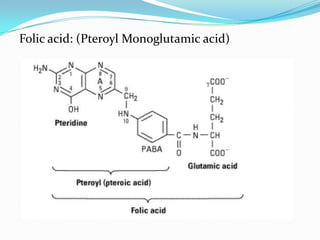
Folic acid: (Pteroyl Monoglutamic acid)
 Called as folic acid as it is found in green leafy
  vegetables
 Source: Green leafy vegetable , liver , yeast, kidney,
  egg, meat, fish and dairy foods
 Much of it is destroyed in cooking (heat)
 Micro-organisms
 Daily requirement: adult 50-100 µg pregnancy and
 lactation 500- 800 µg
 Absorption:
   Folic acid conjugates hydrolysed to pteroyl
    monoglutamic acid by conjugases
   Conjugases are enzymes present in vegetables
    and mammalian tissue, GIT mucosa & pancreas
   Pteroyl monoglutamic acid is completely
    absorbed in small intestine jejunum
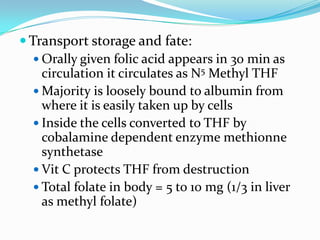
 Transport storage and fate:
    Orally given folic acid appears in 30 min as
     circulation it circulates as N5 Methyl THF
    Majority is loosely bound to albumin from
     where it is easily taken up by cells
    Inside the cells converted to THF by
     cobalamine dependent enzyme methionne
     synthetase
    Vit C protects THF from destruction
    Total folate in body = 5 to 10 mg (1/3 in liver
     as methyl folate)
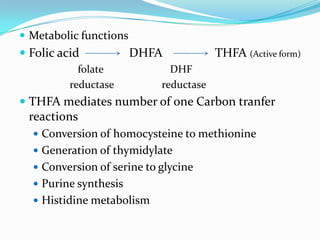
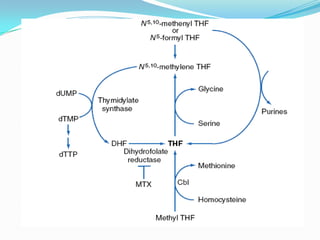
 Metabolic functions
 Folic acid            DHFA           THFA (Active form)
            folate           DHF
          reductase        reductase
 THFA mediates number of one Carbon tranfer
  reactions
    Conversion of homocysteine to methionine
    Generation of thymidylate
    Conversion of serine to glycine
    Purine synthesis
    Histidine metabolism
 Deficiency :
1. Inadequate dietary intake
2. Malabsorption : coeliac disease, tropical sprue
   , regional ileitus
3. Biliary fistula: no recirculation
4. Chronic alcoholism
5. Increased demand : Pregnancy , lactation
6. Drugs: Phenytoin, phenobarbitone, primidone
 Preparations and dose:
   Folic acid tab 5 mg ; dose = 5 to 20 mg
   Prophylaxis 0.5 mg/day
   Parenteral form available in combination only
   Folinic acid: N5 Formyl THFolinic acid
    (Citrovorum factor) 3 mg/mL Inj
 Uses:
1. Megaloblastic anemia
2. Prophylaxis
3. Methotrexate toxicity: Folinic acid used as it is an
   active no need to reduced by DHFR before it can
   act, Methotrexate is DHFR inhibitor, its toxicity
   not reversed by folic acid
4. Citrovorum factor rescue: Methotrexate high
   dose IV then half to 2 hr later 1-3 mg folinic acid
  IV to rescue normal cells
Adverse events:
 Short gun antianemia therapy
 Erythropoietin:
    Uses
   1. Primary : Anemia of CRF due to low EPO 25-100 µg/Kg
      S.C /IV Three times a week max 600 µg/Kg/week
   2. Anemia in AIDS patients on T/t with zidovudine
   3. Cancer chemotherapy induced anemia
   4. Autologus blood transfusion
 Adverse events : ↑ clot formation in AV shunts ,
   Hypertension, occasional seizures, flu like symptoms
 Drugs used in neutropenia:
    G- CSF , GM- CSF
    Recombinant drugs
    Filgrastim, molgrastim
  Uses:
  1. To decrease severity and duration of neutropenia
  2. Shorten duration of neutropenia in BMT, after
     high dose intense chemotherapy
  3. Stimulate release of harvested progenitor cells
  4. Expand the number of progenitor before
     harvesting
  5. Persistant neutropenia in advanced HIV
  6. Aplastic anemia
 Adverse events:
   Bone pain, fever, myalgia, lethargy, pain and
    reddening at site of injection
   Hypersensitivity: Skin rashes, hypotension,
    nausea, vomiting and dyspnoea
   Filgrastim: dysuria, derange liver function , mild
    to moderate spleenomegaly

Megaloblastic anemia

  • 1.
  • 2.
     Thomas edison: Pernicious anemia  Minot & Murphy 1926: liver preparation  Castle: Postulated intrinsic factor theory  1941 Mitchel : Folic acid  1943: Pteroyl monoglutamic acid  1948: Crystalline B12
  • 3.
     Megaloblastic anemia:  Characterized by abnormally large nucleated red cell precursors called megaloblasts in bone marrow  Megaloblast eg of unbalance between cytoplasm and nucleus due to improper and defective synthesis of nucleoproteins  95 % cases due to vit B12 or folic acid deficiency leading to defective DNA synthesis
  • 4.
     DNA presentin every basic cell so abnormality effects rapidly proliferating cells.  Peripheral blood picture: Hemoglobinized large RBC (Macrocytes), PMN leucocytes & hypersegmented giant platelets.  Anemia described is hyperchromic macrocytic
  • 8.
     Vit B12deficiency causes damage to myelin in the peripheral nerves , spinal cord & brain  Folate deficiency: weight loss, nervous instability but damage to myelin is doubtful  Other causes of macrocytic anemias: Liver disease , myxedema, Leukemia & certain hemolytic states
  • 9.
     Cobalamins:  Vit B12 belongs to cobalamin family i.e cobalt containing compounds  Cyanocobalamin: CN group attached to cobalt  Hydroxycobalamin: OH group attached to cobalt Light Cyanocobalamin Hydroxycobalamin Cyanide  Other cobalamins: aquocobalamin, nitrocobalamin & methyl cobalamin
  • 10.
     Sources ofVit B12:  Micro-organisms (Soil, water animal intestine)  Man and animals intestinal lumen but not absorbed 3-5 µg excreted daily in faeces  Non veg foods: Muscle, liver, kidney, oysters,fish, egg yolk  The only vegetable source is pulses(legumes)  Dairy milk in smaller amounts  Daily requirement: 1-3 µg,  pregnancy & lactation 3-5 µg  Commercial source: Streptomyces Griseus
  • 11.
    Pharmacokinetics:  Absorption: Cobalaminsin food are in bound form inactive , released by cooking (heat) and by proteolysis in stomach & intestine .  Vit B12 is not soluble so absorption depends on various transfer factors  R- Factor, Intrinsic factor & Transcobolamin II
  • 13.
  • 14.
    C: Purine biosynthesisreduced , defective DNA  Methyl THF trapping & lack of S- adenosyl methionine can cause this D: Methionine DAB12 S- adenosyl methionine  S- adenosyl methionine required for synthesis of phospholipids & myelin ( neuronal damage) E: Cell growth & multiplication (Poultry) F: Role in folate uptake & storage
  • 15.
     Deficiency: 1. Addisonianpernicious anemia 2. Gastric mucosal damage 3. Malabsorption 4. Blind loop syndrome, Fish tape worm 5. Nutritional deficiency 6. Increased demand: Pregnancy and infancy
  • 16.
     Preparations &doses:  Cyanocobalamin: Pink color injection 100 µg/mL DOC in pernicious anemia 1000 µg once a week IM for 8 weeks then 1000 µg once a month life long  Hydroxy cobalamin 100, 500, 1000 µg/mL, better retention but can induce antibody formation not used in US. 1 mg every 2 – 3 days 5 doses , then 1 mg 3 monthly  Methyl cobalamin 0.5 mg tab, Dose 1.5 mg promoted for neurological defects in diabetics and other peripheral neuropathies
  • 17.
     Uses : 1. Treatment of vit B12 Deficiency: wise to add folic acid and iron, symptoms improvement in 2 days ( appetite increased, feels good. Mucosal lesions heal in 1-2 weeks. Platelet count normal in 10 days. WBC`S = 2-3 weeks . Neurological parameters take several month. 2. Prophylaxis : 3-10 µg/ day 3. Mega dose of B12 used in neuropathic psychiatric disorders and as general tonic to allay fatigue , improve growth. 4. Tobacco amblyopia: OH Cobalamine  Adverse events
  • 18.
    Folic acid: (PteroylMonoglutamic acid)
  • 19.
     Called asfolic acid as it is found in green leafy vegetables  Source: Green leafy vegetable , liver , yeast, kidney, egg, meat, fish and dairy foods  Much of it is destroyed in cooking (heat)  Micro-organisms  Daily requirement: adult 50-100 µg pregnancy and lactation 500- 800 µg
  • 20.
     Absorption:  Folic acid conjugates hydrolysed to pteroyl monoglutamic acid by conjugases  Conjugases are enzymes present in vegetables and mammalian tissue, GIT mucosa & pancreas  Pteroyl monoglutamic acid is completely absorbed in small intestine jejunum
  • 21.
     Transport storageand fate:  Orally given folic acid appears in 30 min as circulation it circulates as N5 Methyl THF  Majority is loosely bound to albumin from where it is easily taken up by cells  Inside the cells converted to THF by cobalamine dependent enzyme methionne synthetase  Vit C protects THF from destruction  Total folate in body = 5 to 10 mg (1/3 in liver as methyl folate)
  • 22.
     Metabolic functions Folic acid DHFA THFA (Active form) folate DHF reductase reductase  THFA mediates number of one Carbon tranfer reactions  Conversion of homocysteine to methionine  Generation of thymidylate  Conversion of serine to glycine  Purine synthesis  Histidine metabolism
  • 24.
     Deficiency : 1.Inadequate dietary intake 2. Malabsorption : coeliac disease, tropical sprue , regional ileitus 3. Biliary fistula: no recirculation 4. Chronic alcoholism 5. Increased demand : Pregnancy , lactation 6. Drugs: Phenytoin, phenobarbitone, primidone
  • 25.
     Preparations anddose:  Folic acid tab 5 mg ; dose = 5 to 20 mg  Prophylaxis 0.5 mg/day  Parenteral form available in combination only  Folinic acid: N5 Formyl THFolinic acid (Citrovorum factor) 3 mg/mL Inj
  • 26.
     Uses: 1. Megaloblasticanemia 2. Prophylaxis 3. Methotrexate toxicity: Folinic acid used as it is an active no need to reduced by DHFR before it can act, Methotrexate is DHFR inhibitor, its toxicity not reversed by folic acid 4. Citrovorum factor rescue: Methotrexate high dose IV then half to 2 hr later 1-3 mg folinic acid IV to rescue normal cells Adverse events:
  • 27.
     Short gunantianemia therapy  Erythropoietin:  Uses 1. Primary : Anemia of CRF due to low EPO 25-100 µg/Kg S.C /IV Three times a week max 600 µg/Kg/week 2. Anemia in AIDS patients on T/t with zidovudine 3. Cancer chemotherapy induced anemia 4. Autologus blood transfusion  Adverse events : ↑ clot formation in AV shunts , Hypertension, occasional seizures, flu like symptoms
  • 28.
     Drugs usedin neutropenia:  G- CSF , GM- CSF  Recombinant drugs Filgrastim, molgrastim Uses: 1. To decrease severity and duration of neutropenia 2. Shorten duration of neutropenia in BMT, after high dose intense chemotherapy 3. Stimulate release of harvested progenitor cells 4. Expand the number of progenitor before harvesting 5. Persistant neutropenia in advanced HIV 6. Aplastic anemia
  • 29.
     Adverse events:  Bone pain, fever, myalgia, lethargy, pain and reddening at site of injection  Hypersensitivity: Skin rashes, hypotension, nausea, vomiting and dyspnoea  Filgrastim: dysuria, derange liver function , mild to moderate spleenomegaly