PYRUVATE KINASE ACTIVATION IN
HEMOGLOBINOPATHIES
Dr/ Marwa Mahmoud Khalifa MDPHD
DMNI
 Most human cells generate considerable ATP from
the citric acid cycle and oxidative phosphorylation
(Aerobic glycolytic pathway)
 As erythrocytes lack mitochondria the metabolic
machinery required for aerobic metabolism, so
RBCs are largely reliant on anaerobic glycolysis for
ATP production.
 ATP is critical for erythrocyte cellular maintenance
and survival, its deficiency leads to premature and
pathophysiologic red cell destruction in the form of
hemolytic anemia and ineffective erythropoiesis.
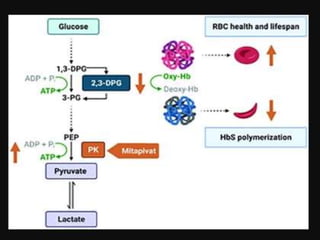
 As the final enzymatic step of the Embden–
Meyerhof glycolytic pathway, the pyruvate kinase
enzyme catalyzes the conversion of
phosphenolpyruvate to pyruvate, resulting in the
generation of ATP.
 There are four pyruvate kinase isoforms in
mammals (red cell, liver, muscle-1, and muscle-2)
encoded by two genes (PKLR and PKM).
 Pyruvate kinase deficiency (PKD)represents the
most common glycolytic enzyme defect and the
most common congenital nonspherocytic hemolytic
anemia
 Other erythrocyte disorders, such as sickle cell
disease and the thalassemias, may result in a state
of increased stress and energy utilization but limited
erythrocyte ATP production adequate in normal
physiologic circumstances is no longer adequate,
causing premature cell death.
 Therefore, therapeutics capable of augmenting
erythrocyte ATP production may be useful in a
broad range of hemolytic anemias with diverse
pathophysiologies
 Mitapivat (AG-348) is a first-in-class, oral small
molecule allosteric activator of the pyruvate kinase
enzyme.
 Erythrocyte pyruvate kinase (PKR) is a tetramer,
physiologically activated in allosteric fashion by
fructose bisphosphate (FBP).
 Mitapivat binds to a different allosteric site from
FBP on the PKR tetramer, allowing for the
activation of both wild-type and mutant forms of the
enzyme.
CLINICAL TRIALS OF MITAPIVAT IN PKD
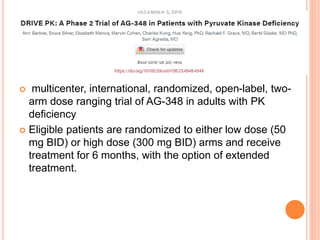
 multicenter, international, randomized, open-label, two-
arm dose ranging trial of AG-348 in adults with PK
deficiency
 Eligible patients are randomized to either low dose (50
mg BID) or high dose (300 mg BID) arms and receive
treatment for 6 months, with the option of extended
treatment.
 The trial population consists of 52 adult patients
with PK deficiency with Hb levels of ≤12.0 g/dL
(men) or ≤11.0 g/dL (women), who have received
three or fewer units of RBCs in the 12 months
preceding the first dose of mitapivat, and no
transfusion within 4 months
 The primary study objective was assessment of
safety and the side-effect profile. Patients were
closely followed for potential toxicities for mitapivat
with laboratory testing, electrocardiography, and
physical examination, and had DEXA scanning
 Monitoring with DEXA was done to monitor for
potential deleterious impacts of the off-target
aromatase inhibition of the drug on BMD, as well as
potential positive on-target effects on BMD from a
reduction in ineffective erythropoiesis and erythron
expansion
RESULTS
 Mitapivat was well-tolerated, with mild headache,
insomnia, and nausea being the most common
adverse events and resolved within a week.
 50% had a Hb increase from baseline of ⩾1.0 g/dl,
with a mean maximum increase of 3.4 g/dl, median
time was just 10 days, and improvements were
durable. Markers of hemolysis including reticulocyte
count, indirect bilirubin, and haptoglobin all
improved.
 BMD was largely stable over time in adults with
PKD receiving mitapivat up to 56 months
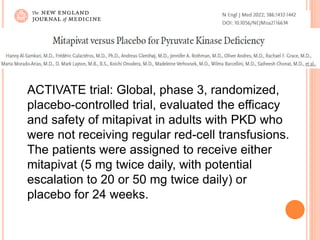
ACTIVATE trial: Global, phase 3, randomized,
placebo-controlled trial, evaluated the efficacy
and safety of mitapivat in adults with PKD who
were not receiving regular red-cell transfusions.
The patients were assigned to receive either
mitapivat (5 mg twice daily, with potential
escalation to 20 or 50 mg twice daily) or
placebo for 24 weeks.
 Sixteen of the 40 patients (40%) in the mitapivat
group had a hemoglobin response (an increase
from baseline of ≥1.5 g/dL sustained at two or more
scheduled assessments at weeks 16, 20, and 24)
compared with none of the 40 patients in the
placebo group
 ACTIVATE-T was an open-label, single-arm, phase 3 trial
conducted in 20 centres across Europe, North America,
and Asia (27 participants).
 Eligible participants were adults with PKD receiving
regular transfusions (at least six episodes in the previous
year).
 Participants received oral mitapivat during a 16-week
dose-optimization period (5 mg, 20 mg, 50 mg twice
daily) and 24-week fixed-dose period.
 The primary endpoint was a reduction in transfusion
burden (33% reduction in transfusion requirements)
RESULTS
 A reduction in transfusion burden by at least 33%
was found in ten (37%) participants
 The most common TEAEs were increase in ALT,
AST, headache, fatigue, and nausea.
CLINICAL TRIALS OF MITAPIVAT IN THALASSEMIA
AND SICKLE CELL DISEASE
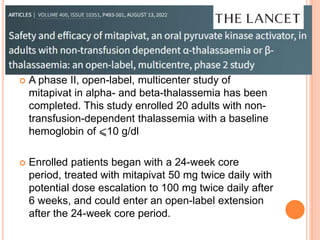
 A phase II, open-label, multicenter study of
mitapivat in alpha- and beta-thalassemia has been
completed. This study enrolled 20 adults with non-
transfusion-dependent thalassemia with a baseline
hemoglobin of ⩽10 g/dl
 Enrolled patients began with a 24-week core
period, treated with mitapivat 50 mg twice daily with
potential dose escalation to 100 mg twice daily after
6 weeks, and could enter an open-label extension
after the 24-week core period.
 The primary endpoint of the study was a hemoglobin
response, defined as an increase in hemoglobin from
baseline of ⩾1.0 g/dl at any time between weeks 4 and
12 of the study. A total of 15 patients with beta-
thalassemia (2 with HbE/beta-thalassemia) and 5
patients with alpha-thalassemia were enrolled.
 The study met its primary endpoint, with 16 patients
(80%) achieving a hemoglobin response, including 11 of
the patients with beta-thalassemia and all 5 of the
patients with alpha-thalassemia. This response was
sustained in eight of the beta-thalassemia patients and
all five alpha-thalassemia patients with ongoing
treatment.
 Another two international, phase III, randomized,
placebo-controlled studies of mitapivat in
thalassemia are ongoing: the ENERGIZE study,
evaluating mitapivat in nontransfusion- dependent
patients with thalassemia, and the ENERGIZE-T
study, evaluating mitapivat in transfusion-
dependent patients with thalassemia.
PHASE I AND II ESTIMATE STUDIES OF
MITAPIVAT IN SICKLE CELL DISEASE
 A phase I multiple ascending dose study of
mitapivat in sickle cell disease, which completed in
August 2021, enrolled a total of 16 patients adults
with sickle cell disease and a baseline Hb ⩾7.0 g/dl
without transfusions or erythropoietin therapy in the
preceding 3 months were eligible.
 Stable doses of hydroxyurea and/or l-glutamine
were permitted. Enrolled patients received either
three or four ascending doses of mitapivat (5, 20,
50, and 100 mg twice daily) for 2 weeks each.
 The mean change in hemoglobin at the 50 mg twice
daily dose was +1.2 g/dl (range = –0.3 to +2.9 g/dl),
which returned to baseline after the drug was
tapered
 Nine of 16 patients achieved a hemoglobin
response (improvement by ⩾1.0 g/dl relative to
baseline at any dose level). Hemolytic markers
including LDH, total bilirubin, reticulocytes, and AST
similarly improved with mitapivat and normalized
after its discontinuation.
PHASE II ESTIMATE
 This open-label study is enrolling patients with sickle cell disease aged
16 years or older.
 A significant reduction in PoS was found (p = 0.0032). Concomitantly,
an increase in Hb-oxygen affinity was shown, reflected by a left shift of
the oxygen equilibrium curves (p = 0.0026).
 This was accompanied by a decrease in 2,3-DPG level ( p = 0.0003).
 Hb level also increased upon mitapivat treatment (mean increase
1.3 ± 0.5 g/dL; p = 0.0003). Six patients (6/8, 75%) had an increase of
≥1 g/dL from baseline, the highest was 1.9 g/dL, with five patients (5/8,
63%) reaching this increase at day 28 on mitapivat 50 mg twice daily.
 In all patients, a significant reduction in laboratory markers of
hemolysis was found,
RISE UP STUDY, A PHASE II/III TRIAL
A Study Evaluating the Efficacy and Safety of
Mitapivat (AG-348) in Participants With Sickle Cell
Disease is ongoing
 Mitapivat is a promising, first-in-class allosteric
activator of pyruvate kinase with documented safety
and efficacy across a wide spectrum of hereditary
hemolytic anemias, including PKD, alpha- and beta-
thalassemia, and sickle cell disease.
pka.pptx

pka.pptx

  • 1.
    PYRUVATE KINASE ACTIVATIONIN HEMOGLOBINOPATHIES Dr/ Marwa Mahmoud Khalifa MDPHD DMNI
  • 2.
     Most humancells generate considerable ATP from the citric acid cycle and oxidative phosphorylation (Aerobic glycolytic pathway)  As erythrocytes lack mitochondria the metabolic machinery required for aerobic metabolism, so RBCs are largely reliant on anaerobic glycolysis for ATP production.
  • 3.
     ATP iscritical for erythrocyte cellular maintenance and survival, its deficiency leads to premature and pathophysiologic red cell destruction in the form of hemolytic anemia and ineffective erythropoiesis.  As the final enzymatic step of the Embden– Meyerhof glycolytic pathway, the pyruvate kinase enzyme catalyzes the conversion of phosphenolpyruvate to pyruvate, resulting in the generation of ATP.
  • 5.
     There arefour pyruvate kinase isoforms in mammals (red cell, liver, muscle-1, and muscle-2) encoded by two genes (PKLR and PKM).  Pyruvate kinase deficiency (PKD)represents the most common glycolytic enzyme defect and the most common congenital nonspherocytic hemolytic anemia
  • 6.
     Other erythrocytedisorders, such as sickle cell disease and the thalassemias, may result in a state of increased stress and energy utilization but limited erythrocyte ATP production adequate in normal physiologic circumstances is no longer adequate, causing premature cell death.  Therefore, therapeutics capable of augmenting erythrocyte ATP production may be useful in a broad range of hemolytic anemias with diverse pathophysiologies
  • 7.
     Mitapivat (AG-348)is a first-in-class, oral small molecule allosteric activator of the pyruvate kinase enzyme.  Erythrocyte pyruvate kinase (PKR) is a tetramer, physiologically activated in allosteric fashion by fructose bisphosphate (FBP).  Mitapivat binds to a different allosteric site from FBP on the PKR tetramer, allowing for the activation of both wild-type and mutant forms of the enzyme.
  • 8.
    CLINICAL TRIALS OFMITAPIVAT IN PKD
  • 9.
     multicenter, international,randomized, open-label, two- arm dose ranging trial of AG-348 in adults with PK deficiency  Eligible patients are randomized to either low dose (50 mg BID) or high dose (300 mg BID) arms and receive treatment for 6 months, with the option of extended treatment.
  • 10.
     The trialpopulation consists of 52 adult patients with PK deficiency with Hb levels of ≤12.0 g/dL (men) or ≤11.0 g/dL (women), who have received three or fewer units of RBCs in the 12 months preceding the first dose of mitapivat, and no transfusion within 4 months
  • 11.
     The primarystudy objective was assessment of safety and the side-effect profile. Patients were closely followed for potential toxicities for mitapivat with laboratory testing, electrocardiography, and physical examination, and had DEXA scanning  Monitoring with DEXA was done to monitor for potential deleterious impacts of the off-target aromatase inhibition of the drug on BMD, as well as potential positive on-target effects on BMD from a reduction in ineffective erythropoiesis and erythron expansion
  • 12.
    RESULTS  Mitapivat waswell-tolerated, with mild headache, insomnia, and nausea being the most common adverse events and resolved within a week.  50% had a Hb increase from baseline of ⩾1.0 g/dl, with a mean maximum increase of 3.4 g/dl, median time was just 10 days, and improvements were durable. Markers of hemolysis including reticulocyte count, indirect bilirubin, and haptoglobin all improved.  BMD was largely stable over time in adults with PKD receiving mitapivat up to 56 months
  • 13.
    ACTIVATE trial: Global,phase 3, randomized, placebo-controlled trial, evaluated the efficacy and safety of mitapivat in adults with PKD who were not receiving regular red-cell transfusions. The patients were assigned to receive either mitapivat (5 mg twice daily, with potential escalation to 20 or 50 mg twice daily) or placebo for 24 weeks.
  • 14.
     Sixteen ofthe 40 patients (40%) in the mitapivat group had a hemoglobin response (an increase from baseline of ≥1.5 g/dL sustained at two or more scheduled assessments at weeks 16, 20, and 24) compared with none of the 40 patients in the placebo group
  • 15.
     ACTIVATE-T wasan open-label, single-arm, phase 3 trial conducted in 20 centres across Europe, North America, and Asia (27 participants).  Eligible participants were adults with PKD receiving regular transfusions (at least six episodes in the previous year).  Participants received oral mitapivat during a 16-week dose-optimization period (5 mg, 20 mg, 50 mg twice daily) and 24-week fixed-dose period.  The primary endpoint was a reduction in transfusion burden (33% reduction in transfusion requirements)
  • 16.
    RESULTS  A reductionin transfusion burden by at least 33% was found in ten (37%) participants  The most common TEAEs were increase in ALT, AST, headache, fatigue, and nausea.
  • 17.
    CLINICAL TRIALS OFMITAPIVAT IN THALASSEMIA AND SICKLE CELL DISEASE
  • 18.
     A phaseII, open-label, multicenter study of mitapivat in alpha- and beta-thalassemia has been completed. This study enrolled 20 adults with non- transfusion-dependent thalassemia with a baseline hemoglobin of ⩽10 g/dl  Enrolled patients began with a 24-week core period, treated with mitapivat 50 mg twice daily with potential dose escalation to 100 mg twice daily after 6 weeks, and could enter an open-label extension after the 24-week core period.
  • 19.
     The primaryendpoint of the study was a hemoglobin response, defined as an increase in hemoglobin from baseline of ⩾1.0 g/dl at any time between weeks 4 and 12 of the study. A total of 15 patients with beta- thalassemia (2 with HbE/beta-thalassemia) and 5 patients with alpha-thalassemia were enrolled.  The study met its primary endpoint, with 16 patients (80%) achieving a hemoglobin response, including 11 of the patients with beta-thalassemia and all 5 of the patients with alpha-thalassemia. This response was sustained in eight of the beta-thalassemia patients and all five alpha-thalassemia patients with ongoing treatment.
  • 20.
     Another twointernational, phase III, randomized, placebo-controlled studies of mitapivat in thalassemia are ongoing: the ENERGIZE study, evaluating mitapivat in nontransfusion- dependent patients with thalassemia, and the ENERGIZE-T study, evaluating mitapivat in transfusion- dependent patients with thalassemia.
  • 21.
    PHASE I ANDII ESTIMATE STUDIES OF MITAPIVAT IN SICKLE CELL DISEASE  A phase I multiple ascending dose study of mitapivat in sickle cell disease, which completed in August 2021, enrolled a total of 16 patients adults with sickle cell disease and a baseline Hb ⩾7.0 g/dl without transfusions or erythropoietin therapy in the preceding 3 months were eligible.  Stable doses of hydroxyurea and/or l-glutamine were permitted. Enrolled patients received either three or four ascending doses of mitapivat (5, 20, 50, and 100 mg twice daily) for 2 weeks each.
  • 22.
     The meanchange in hemoglobin at the 50 mg twice daily dose was +1.2 g/dl (range = –0.3 to +2.9 g/dl), which returned to baseline after the drug was tapered  Nine of 16 patients achieved a hemoglobin response (improvement by ⩾1.0 g/dl relative to baseline at any dose level). Hemolytic markers including LDH, total bilirubin, reticulocytes, and AST similarly improved with mitapivat and normalized after its discontinuation.
  • 23.
    PHASE II ESTIMATE This open-label study is enrolling patients with sickle cell disease aged 16 years or older.  A significant reduction in PoS was found (p = 0.0032). Concomitantly, an increase in Hb-oxygen affinity was shown, reflected by a left shift of the oxygen equilibrium curves (p = 0.0026).  This was accompanied by a decrease in 2,3-DPG level ( p = 0.0003).  Hb level also increased upon mitapivat treatment (mean increase 1.3 ± 0.5 g/dL; p = 0.0003). Six patients (6/8, 75%) had an increase of ≥1 g/dL from baseline, the highest was 1.9 g/dL, with five patients (5/8, 63%) reaching this increase at day 28 on mitapivat 50 mg twice daily.  In all patients, a significant reduction in laboratory markers of hemolysis was found,
  • 24.
    RISE UP STUDY,A PHASE II/III TRIAL A Study Evaluating the Efficacy and Safety of Mitapivat (AG-348) in Participants With Sickle Cell Disease is ongoing
  • 25.
     Mitapivat isa promising, first-in-class allosteric activator of pyruvate kinase with documented safety and efficacy across a wide spectrum of hereditary hemolytic anemias, including PKD, alpha- and beta- thalassemia, and sickle cell disease.