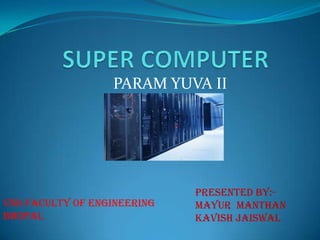
PARAM YUVA II


                             Presented by:-
VNS FACULTY OF ENGINEERING   Mayur manthan
BHOPAL                       KAVISH JAISWAL
Content:-
 Introduction
 History
 PARAM YUVA II
 Architecture
 Specifications
 Uses
Introduction
Supercomputer is a broad term for one of
the fastest computer currently available.
Super computers were designed and built
to work on extremely large jobs that could
not be handled by no other types of
computing systems
Introduction
Supercomputers speed are measured in
floating point operations per second
(FLOPS) in units of
megaflops (MFOPS)
gigaflops (GFLOPS)
teraflops (TFLOPS)
History:-
India's supercomputer program was started in late 1980s.
 PARAM 8000 is considered India's first supercomputer.
It was indigenously built in 1990 by Centre for
 Development of Advanced Computing(C-DAC).
It was replicated and installed at ICAD Moscow in 1991
 under Russian collaboration.
PARAM Series:-
 PARAM 8000
 PARAM 8600
 PARAM 9900/SS
 PARAM 10000
 PARAM Padma
 PARAM Yuva
 Param Yuva II
PARAM YUVA II
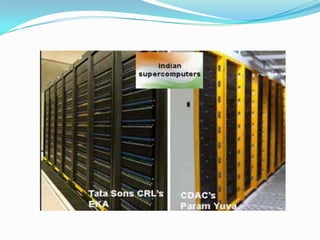
 Param Yuva-II, which is claimed to be
  India's fastest supercomputer, has been
  unveiled in Pune.
 It was unveiled on 8 February 2013.
 Thish is a series of PARAM.
 This is the first supercomputer that has
  crossed 500 teraflops in computing power in
  the country.
Architecture
 It performs at a peak speed of 524 Teraflops (a standard
  terminology in the computing industry which measures
  compute capacity).
 This supercomputer uses Hybrid Technology - which
  is network of high performance computers. This hybrid
  technology has enabled the up-gradation of existing 54
  Teraflops to 500 Teraflops peak computing power of
  Indian Supercomputers.
 Param Yuva II has high storage capacity(200 TB), it
  supports parallel computing(infact all Supercomputers
  must support this feature).
Architecture
 The interconnection of this fastest computer is
  comprised of Infiniband FDR System Area Network and
  PARAMNet-III which is sure to offer a remarkable
  efficiency.
 Param Yuva II is made energy efficient and consumes
  around 35% less power.
 Even parallel computing is made possible by the
  inclusion of required software.
 Even parallel computing is made possible by the
  inclusion of required software.
Specifications:-
 It would have been ranked 33rd in the November 2012
  List of Top Green 500 supercomputers of the world.
 The entire project is said to have involved around 300
  CDAC engineers. The Param Yuva-II is also said to be a
  milestone in the Indian Information Technology
  industry.
 This computer is a stepping stone towards building the
  future petaflop-range supercomputers in India.
 Also, if supposedly the current system was used to
  predict weather conditions in a 6 km area, Param Yuva II
  would help in predicting weather conditions for a 10km
  area etc.
 Param Yuva II was made in a period of three months,
 at a cost of 16 crore (US$3 million).
USES:-
 Research in space
 Bioinformatics
 Weather forecasting
 Seismic data analysis
 Aeronautical engineering
 Scientific data processing
 Pharmaceutical development
ANY
QUERY
Param yuva ii

Param yuva ii

  • 1.
    PARAM YUVA II Presented by:- VNS FACULTY OF ENGINEERING Mayur manthan BHOPAL KAVISH JAISWAL
  • 2.
    Content:-  Introduction  History PARAM YUVA II  Architecture  Specifications  Uses
  • 3.
    Introduction Supercomputer is abroad term for one of the fastest computer currently available. Super computers were designed and built to work on extremely large jobs that could not be handled by no other types of computing systems
  • 4.
    Introduction Supercomputers speed aremeasured in floating point operations per second (FLOPS) in units of megaflops (MFOPS) gigaflops (GFLOPS) teraflops (TFLOPS)
  • 5.
    History:- India's supercomputer programwas started in late 1980s.  PARAM 8000 is considered India's first supercomputer. It was indigenously built in 1990 by Centre for Development of Advanced Computing(C-DAC). It was replicated and installed at ICAD Moscow in 1991 under Russian collaboration.
  • 6.
    PARAM Series:- PARAM8000 PARAM 8600 PARAM 9900/SS PARAM 10000 PARAM Padma PARAM Yuva Param Yuva II
  • 7.
    PARAM YUVA II Param Yuva-II, which is claimed to be India's fastest supercomputer, has been unveiled in Pune.  It was unveiled on 8 February 2013.  Thish is a series of PARAM.  This is the first supercomputer that has crossed 500 teraflops in computing power in the country.
  • 9.
    Architecture  It performsat a peak speed of 524 Teraflops (a standard terminology in the computing industry which measures compute capacity).  This supercomputer uses Hybrid Technology - which is network of high performance computers. This hybrid technology has enabled the up-gradation of existing 54 Teraflops to 500 Teraflops peak computing power of Indian Supercomputers.  Param Yuva II has high storage capacity(200 TB), it supports parallel computing(infact all Supercomputers must support this feature).
  • 10.
    Architecture  The interconnectionof this fastest computer is comprised of Infiniband FDR System Area Network and PARAMNet-III which is sure to offer a remarkable efficiency.  Param Yuva II is made energy efficient and consumes around 35% less power.  Even parallel computing is made possible by the inclusion of required software.  Even parallel computing is made possible by the inclusion of required software.
  • 11.
    Specifications:-  It wouldhave been ranked 33rd in the November 2012 List of Top Green 500 supercomputers of the world.  The entire project is said to have involved around 300 CDAC engineers. The Param Yuva-II is also said to be a milestone in the Indian Information Technology industry.  This computer is a stepping stone towards building the future petaflop-range supercomputers in India.  Also, if supposedly the current system was used to predict weather conditions in a 6 km area, Param Yuva II would help in predicting weather conditions for a 10km area etc.
  • 12.
     Param YuvaII was made in a period of three months, at a cost of 16 crore (US$3 million).
  • 13.
    USES:-  Research inspace  Bioinformatics  Weather forecasting  Seismic data analysis  Aeronautical engineering  Scientific data processing  Pharmaceutical development
  • 14.