Presented by:  AVINASH MAURYA IT VI SEM 0829213008
Definition Background Applications Types of CAPTCHAs Breaking CAPTCHAs Proposed Approach Conclusion
CAPTCHA stands for Completely Automated Public Turing test to tell Computers and Humans Apart A program that can tell whether its user is a human or a computer. The challenge: develop a software program that can create and grade challenges most humans can pass but computers cannot
First used by Altavista in1997 Reduced SPAM add-url by over 95% CMU/Yahoo! Automated the creating and grading of challenges PARC Relies on document image degradation to prevent successful OCR Conducted user-focused studies to assess the effectiveness of CAPTCHAs
CAPTCHAs are based on open AI problems Breaking CAPTCHAs help advance AI by solving these open problems Improving CAPTCHAs help telling computers and human apart Win-win situation
Pessimal Print: A Reverse Turing Test Allison L. Coates, Henry S. Baird, Richard J. Fateman Telling Humans and Computer Apart Automatically Luis von Ahn, Manuel Blum, and John Langford CAPTCHA: Using Hard AI Problems for Security Luis von Ahn, Manuel Blum, Nicholas J. Hopper, and John Langford  Using Machine Learning to Break Visual Human Interaction Proofs (HIPs) Kumar Chellapilla, Patrice Y. Simard
Free email services Online polls Dictionary attacks Newsgroups, Blogs, etc… SPAM
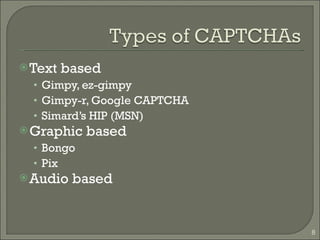
Text based Gimpy, ez-gimpy Gimpy-r, Google CAPTCHA Simard’s HIP (MSN) Graphic based Bongo Pix Audio based
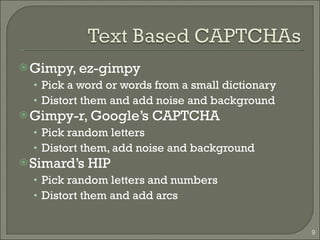
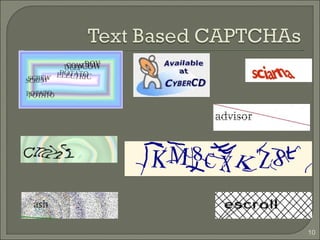
Gimpy, ez-gimpy Pick a word or words from a small dictionary Distort them and add noise and background Gimpy-r, Google’s CAPTCHA Pick random letters Distort them, add noise and background Simard’s HIP Pick random letters and numbers Distort them and add arcs
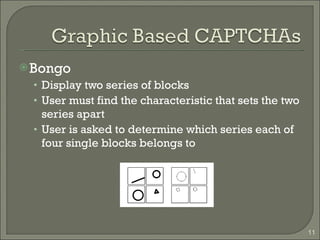
Bongo Display two series of blocks User must find the characteristic that sets the two series apart User is asked to determine which series each of four single blocks belongs to Difference? thick vs. thin lines
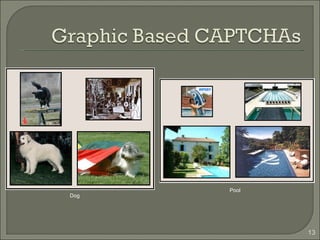
PIX Create a large database of labeled images Pick a concrete object Pick four images of the object from the images database Distort the images Ask the user to pick the object for a list of words
Dog Pool
Pick a word or a sequence of numbers at random Render them into an audio clip using a TTS software Distort the audio clip Ask the user to identify and type the word or numbers
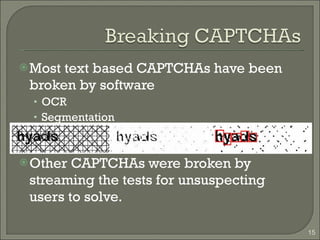
Most text based CAPTCHAs have been broken by software OCR Segmentation Other CAPTCHAs were broken by streaming the tests for unsuspecting users to solve.
Very similar to PIX Pick a concrete object Get 6 images at random from images.google.com that match the object Distort the images Build a list of 100 words: 90 from a full dictionary, 10 from the objects dictionary Prompt the user to pick the object from the list of words
Make an HTTP call to images.google.com and search for the object Screen scrape the result of 2-3 pages to get the list of images Pick 6 images at random Randomly distort both the images and their URLs before displaying them Expire the CAPTCHA in 30-45 seconds
The database already exists and is public The database is constantly being updated and maintained Adding “concrete objects” to the dictionary is virtually instantaneous Distortion prevents caching hacks Quick expiration limits streaming hacks
Not accessible to people with disabilities (which is the case of most CAPTCHAs) Relies on Google’s infrastructure Unlike CAPTCHAs using random letters and numbers, the number of challenge words is limited
 captcha.ppt
 captcha.ppt

captcha.ppt

  • 1.
    Presented by: AVINASH MAURYA IT VI SEM 0829213008
  • 2.
    Definition Background ApplicationsTypes of CAPTCHAs Breaking CAPTCHAs Proposed Approach Conclusion
  • 3.
    CAPTCHA stands forCompletely Automated Public Turing test to tell Computers and Humans Apart A program that can tell whether its user is a human or a computer. The challenge: develop a software program that can create and grade challenges most humans can pass but computers cannot
  • 4.
    First used byAltavista in1997 Reduced SPAM add-url by over 95% CMU/Yahoo! Automated the creating and grading of challenges PARC Relies on document image degradation to prevent successful OCR Conducted user-focused studies to assess the effectiveness of CAPTCHAs
  • 5.
    CAPTCHAs are basedon open AI problems Breaking CAPTCHAs help advance AI by solving these open problems Improving CAPTCHAs help telling computers and human apart Win-win situation
  • 6.
    Pessimal Print: AReverse Turing Test Allison L. Coates, Henry S. Baird, Richard J. Fateman Telling Humans and Computer Apart Automatically Luis von Ahn, Manuel Blum, and John Langford CAPTCHA: Using Hard AI Problems for Security Luis von Ahn, Manuel Blum, Nicholas J. Hopper, and John Langford Using Machine Learning to Break Visual Human Interaction Proofs (HIPs) Kumar Chellapilla, Patrice Y. Simard
  • 7.
    Free email servicesOnline polls Dictionary attacks Newsgroups, Blogs, etc… SPAM
  • 8.
    Text based Gimpy,ez-gimpy Gimpy-r, Google CAPTCHA Simard’s HIP (MSN) Graphic based Bongo Pix Audio based
  • 9.
    Gimpy, ez-gimpy Picka word or words from a small dictionary Distort them and add noise and background Gimpy-r, Google’s CAPTCHA Pick random letters Distort them, add noise and background Simard’s HIP Pick random letters and numbers Distort them and add arcs
  • 11.
    Bongo Display twoseries of blocks User must find the characteristic that sets the two series apart User is asked to determine which series each of four single blocks belongs to Difference? thick vs. thin lines
  • 12.
    PIX Create alarge database of labeled images Pick a concrete object Pick four images of the object from the images database Distort the images Ask the user to pick the object for a list of words
  • 13.
  • 14.
    Pick a wordor a sequence of numbers at random Render them into an audio clip using a TTS software Distort the audio clip Ask the user to identify and type the word or numbers
  • 15.
    Most text basedCAPTCHAs have been broken by software OCR Segmentation Other CAPTCHAs were broken by streaming the tests for unsuspecting users to solve.
  • 16.
    Very similar toPIX Pick a concrete object Get 6 images at random from images.google.com that match the object Distort the images Build a list of 100 words: 90 from a full dictionary, 10 from the objects dictionary Prompt the user to pick the object from the list of words
  • 17.
    Make an HTTPcall to images.google.com and search for the object Screen scrape the result of 2-3 pages to get the list of images Pick 6 images at random Randomly distort both the images and their URLs before displaying them Expire the CAPTCHA in 30-45 seconds
  • 18.
    The database alreadyexists and is public The database is constantly being updated and maintained Adding “concrete objects” to the dictionary is virtually instantaneous Distortion prevents caching hacks Quick expiration limits streaming hacks
  • 19.
    Not accessible topeople with disabilities (which is the case of most CAPTCHAs) Relies on Google’s infrastructure Unlike CAPTCHAs using random letters and numbers, the number of challenge words is limited