Neuralink is developing "neural laces", a mesh of electrodes that can be injected into the brain via arteries. The laces would connect the brain to a computer, allowing for direct uploading and downloading of thoughts. The laces are a polymer mesh with embedded nanowires and transistors that can monitor and stimulate individual neurons. Once injected, the laces unravel and integrate with the brain, potentially treating neurological disorders or allowing brain-computer interfaces without devices. The goal is for humans to keep pace with advancing artificial intelligence.
Neuralink, founded by Elon Musk, aims to merge human brains with AI through high-bandwidth brain-computer interfaces.
Neural laces, a digital interface above the cortex, enhance direct brain-computer interaction without traditional input methods.
Neural laces are made using biocompatible nanoscale polymer mesh with embedded nanowires, facilitating neural activity monitoring.
Injectable neural laces offer a wireless brain-computer connection, adapting to brain growth and changes.
Research shows neural laces accepted in mice, enabling brain signal monitoring; potential uses include treating disorders and enhancing military performance.
Elon Musk’s neural lace concept presents possibilities for significant advancements in brain-computer interfaces.
INTRODUCTION
• SpaceX andTesla CEO Elon Musk is developing ultra-high bandwidth
brain-computer interface venture called Neuralink.
• The company, which is still in the earliest stages of existence.
• Is centered on creating devices that can be implanted in the human
brain.
• Aim to helping human beings merge with software and keep pace
with advancements in artificial intelligence.
3.
• These enhancementscould improve memory or allow for more direct
interfacing with computing devices.
• Neuralink, is developing a science fiction concept called “neural laces”
• It is a “digital layer” located above the cortex, built into the brain.
• Neural lace could be the next advancement in the field of AI.
• It would help prevent humans from becoming “house cats” to AI.
• Which involves implanting electrodes into human brains that allow for the
uploading and downloading of thoughts to a computer.
4.
NEURAL LACES
• Developedby a group of chemists and engineers who works with
nanotechnology.
• Allows for direct connection between a human brain and a computer.
• It is also called a Brain Computer Interface (BCI).
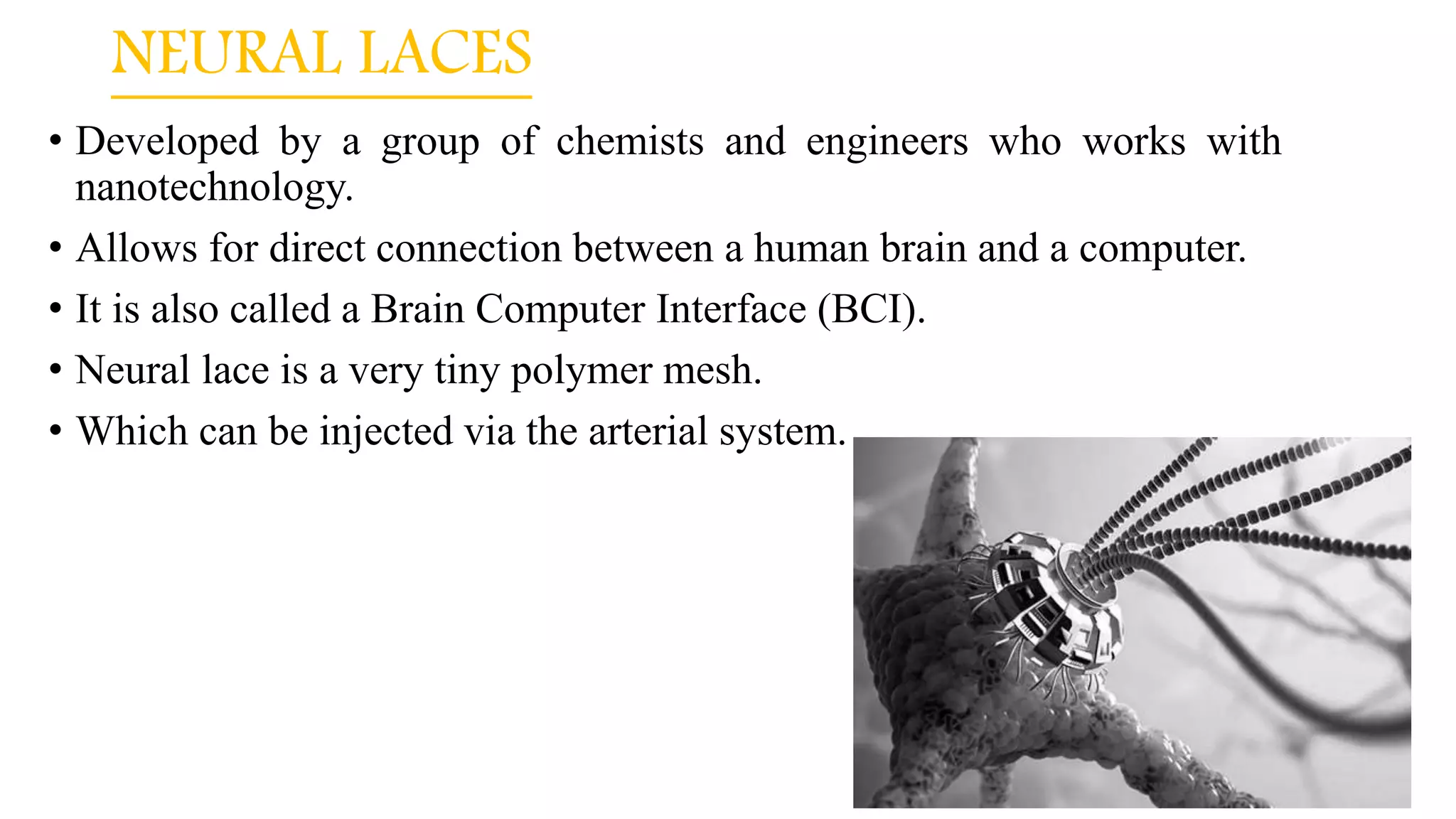
• Neural lace is a very tiny polymer mesh.
• Which can be injected via the arterial system.
5.
• Neural lacesare surgically connected to a human brain and allows
users to interact with a computer without the need for input methods
like keyboards or trackpads.
6.
How neural lacesare made
• The process for fabricating the scaffold is similar to that used to etch microchips.
• Begins with a dissolvable layer deposited on a biocompatible nanoscale polymer mesh
substrate, with embedded nanowires ,are made of a 10-nm-wide core of germanium,
surrounded by a 2-nm-thick shell of silicon , transistors, and other microelectronic devices
attached.
• To cover nanowires with a three-layer dielectric—first aluminum oxide, then zirconium
oxide, then another layer of aluminum oxide.
• The three-layer material lets the wires trap charge carriers, allowing them to act as a
nonvolatile memory, holding a positive or negative state even when no current is applied.
• The nanowires are laid out parallel to one another, with a source and drain on either end
7.
• A seriesof metal gate electrodes crosses the wires perpendicularly.
• Each nanowire contains multiple transistors, because each cross point between the
nanowire and metal gate makes an individual transistor.
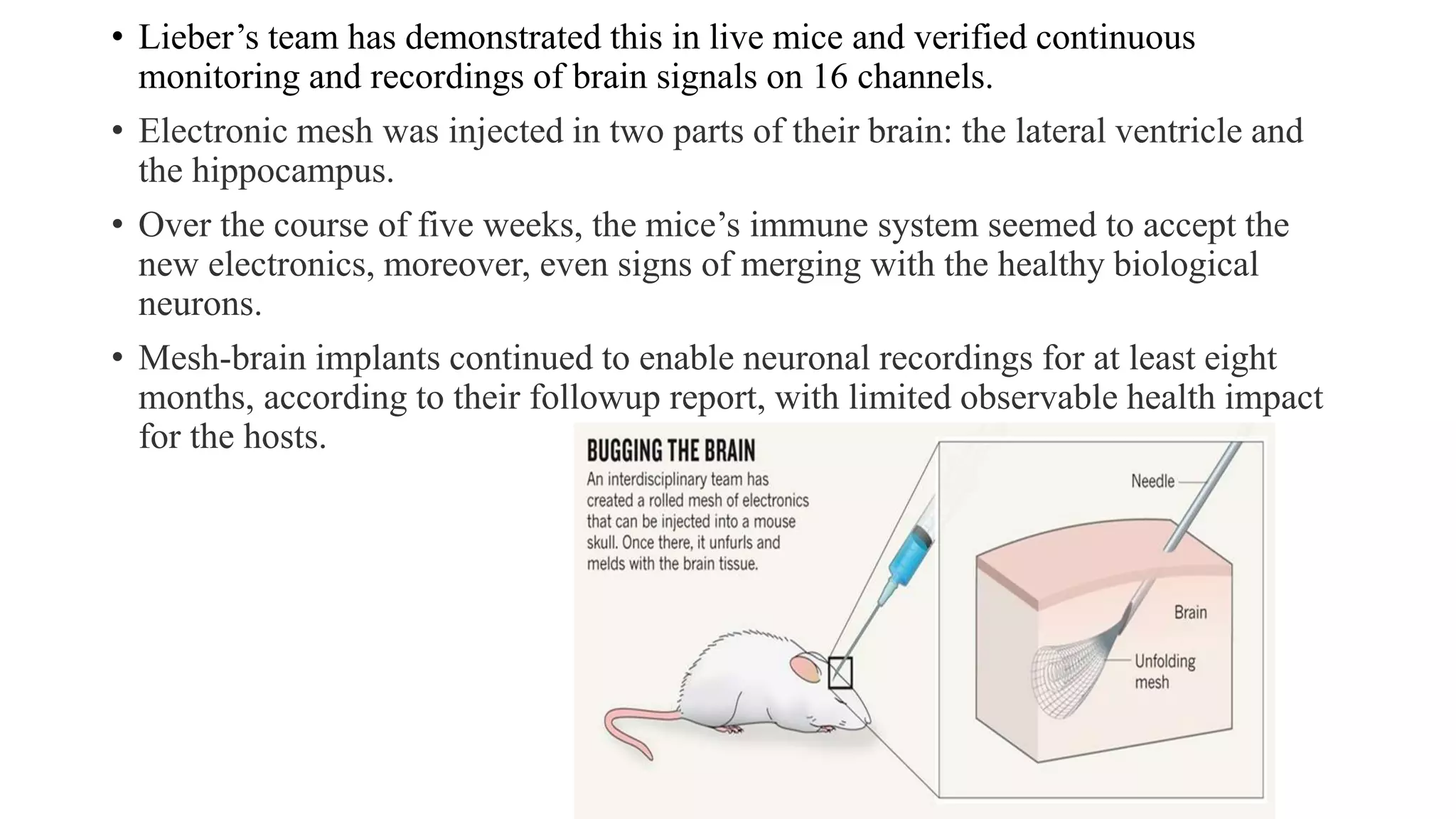
• The mesh is then tightly rolled up, allowing it to be sucked up into a syringe via a
thin glass needle having 100um internal diameter.
• Once in the brain, the mesh uncurls to about 80% of its original configuration, sits
on top of the neurons, and starts monitoring.
• The input-output connection of the mesh electronics can be connected to standard
electronics devices, allowing the mesh-embedded devices to be individually
addressed and used to precisely stimulate or record individual neural activity.
8.
How neural lacesworks
• Inserting a neural lace involve injecting a biocompatible polymer scaffold
mesh with attached microelectronic devices into the brain via syringe.
• When the mesh leaves the needle it unravels, spanning the brain as the
blood flows through the brain.
• If the mesh is inserted, accepted by the brain and will even move with it as
it grows or very slightly changes size.
• The brain would essentially be able to wirelessly connect to a computer,
providing an interface between your brain and a computer.
9.
• Lieber’s teamhas demonstrated this in live mice and verified continuous
monitoring and recordings of brain signals on 16 channels.
• Electronic mesh was injected in two parts of their brain: the lateral ventricle and
the hippocampus.
• Over the course of five weeks, the mice’s immune system seemed to accept the
new electronics, moreover, even signs of merging with the healthy biological
neurons.
• Mesh-brain implants continued to enable neuronal recordings for at least eight
months, according to their followup report, with limited observable health impact
for the hosts.
10.
What can neurallace be used for?
• Could treat neurodegenerative disorders such as Parkinson’s disease
and other life-altering brain disorders.
• Help people with missing limbs use 'connected' artificial body parts
unassisted, using only brain power.
• Neural lace could be used by the US military, via the US Air Force’s
Cyborg cell programme, 'which focuses on small-scale electronics for
the performance enhancement of cells'.