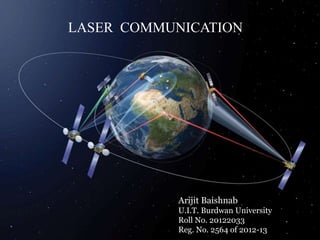
LASER COMMUNICATION
Arijit Baishnab
U.I.T. Burdwan University
Roll No. 20122033
Reg. No. 2564 of 2012-13
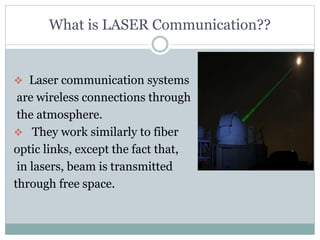
What is LASER Communication??
 Laser communication systems
are wireless connections through
the atmosphere.
 They work similarly to fiber
optic links, except the fact that,
in lasers, beam is transmitted
through free space.
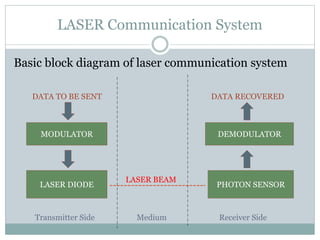
LASER Communication System
Basic block diagram of laser communication system
MODULATOR
LASER DIODE PHOTON SENSOR
DEMODULATOR
LASER BEAM
DATA TO BE SENT DATA RECOVERED
Transmitter Side Medium Receiver Side
Transmitter
Transmitters consist of
 Signal Processing unit
 Laser Diodes
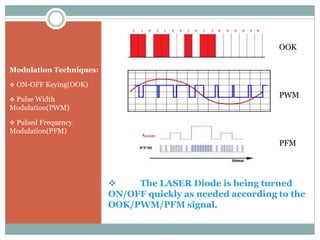
 The LASER Diode is being turned
ON/OFF quickly as needed according to the
OOK/PWM/PFM signal.
Modulation Techniques:
 ON-OFF Keying(OOK)
 Pulse Width
Modulation(PWM)
 Pulsed Frequency
Modulation(PFM)
OOK
PWM
PFM
RECEIVER
Receiver consist of
 Telescope (referred as Antenna)
It concentrates large number of photon into a smaller area
 Photon sensor
(a) Photon Multiplier Tubes
(b) Avalanche Photodiode
 Signal processing unit
Why LASER Communication??
Current mostly used high speed technologies:
 Fiber optics
 Microwave
Why not Fiber Optics??
 Installation cost
 Maintenance cost
 Cannot be used in Satellite links
 Laser Communication is low cost and can be
applicable where Fiber Optics is impractical to use.
Why not Microwave??
 Beam width: Laser beam
width is narrower than that of
Microwave antennas.
 Bandwidth: very much larger
for Laser than microwave.
 Security: Laser is more secure
than microwave.
 Power: Low power needed
for laser compared to microwave.
 Very antenna size for Laser
as compared to microwave.
Disadvantages!!
Laser link can be affected by-
 Atmospheric absorption
 Fog, Rain, Pollution (smoke)
 Physical obstructions
 Solar radiations
 These can be reduced by using Laser tuning,
multiple number of transmitters, filters etc.
Current Applications
Defense and sensitive areas
At airports for communication across the runways
Mass communication
NASA
 Satellite – satellite communication
 Earth – satellite communication
Future Scope
It is more secure and provides high bandwidth
requirements. The low power consumption is also a
great advantage.
It can be the mostly used technique worldwide in
near future.
LASER Communication

LASER Communication

  • 1.
    LASER COMMUNICATION Arijit Baishnab U.I.T.Burdwan University Roll No. 20122033 Reg. No. 2564 of 2012-13
  • 2.
    What is LASERCommunication??  Laser communication systems are wireless connections through the atmosphere.  They work similarly to fiber optic links, except the fact that, in lasers, beam is transmitted through free space.
  • 3.
    LASER Communication System Basicblock diagram of laser communication system MODULATOR LASER DIODE PHOTON SENSOR DEMODULATOR LASER BEAM DATA TO BE SENT DATA RECOVERED Transmitter Side Medium Receiver Side
  • 4.
    Transmitter Transmitters consist of Signal Processing unit  Laser Diodes
  • 5.
     The LASERDiode is being turned ON/OFF quickly as needed according to the OOK/PWM/PFM signal. Modulation Techniques:  ON-OFF Keying(OOK)  Pulse Width Modulation(PWM)  Pulsed Frequency Modulation(PFM) OOK PWM PFM
  • 6.
    RECEIVER Receiver consist of Telescope (referred as Antenna) It concentrates large number of photon into a smaller area  Photon sensor (a) Photon Multiplier Tubes (b) Avalanche Photodiode  Signal processing unit
  • 7.
    Why LASER Communication?? Currentmostly used high speed technologies:  Fiber optics  Microwave
  • 8.
    Why not FiberOptics??  Installation cost  Maintenance cost  Cannot be used in Satellite links  Laser Communication is low cost and can be applicable where Fiber Optics is impractical to use.
  • 9.
    Why not Microwave?? Beam width: Laser beam width is narrower than that of Microwave antennas.  Bandwidth: very much larger for Laser than microwave.  Security: Laser is more secure than microwave.  Power: Low power needed for laser compared to microwave.  Very antenna size for Laser as compared to microwave.
  • 10.
    Disadvantages!! Laser link canbe affected by-  Atmospheric absorption  Fog, Rain, Pollution (smoke)  Physical obstructions  Solar radiations  These can be reduced by using Laser tuning, multiple number of transmitters, filters etc.
  • 11.
    Current Applications Defense andsensitive areas At airports for communication across the runways Mass communication NASA  Satellite – satellite communication  Earth – satellite communication
  • 12.
    Future Scope It ismore secure and provides high bandwidth requirements. The low power consumption is also a great advantage. It can be the mostly used technique worldwide in near future.