Semantic Digital Libraries

Editor's Notes

  • #17 (page 6)
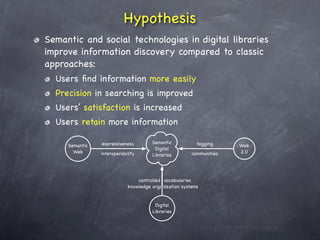
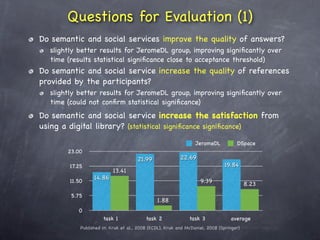
  • #18  SemDL is a superposition of 3 technologies Our hypothesis is that by introducing semantic and social technologies to digital libraries, we are able to improve information discovery in digital libraries compared to classic approaches: • Users are able to find information more easily. • Precision in searching is improved. • Users’ overall satisfaction with using the digital library to accomplish appointed tasks is increased. • Users are able to retain more information when using a semantic digital library. (page 8)
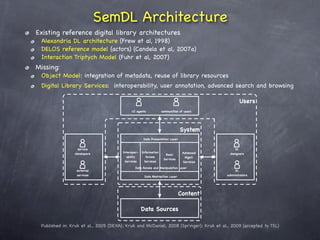
  • #20 Alexandria: UI+Agents, Middleware, Catalog+Resource+Data Engine, Librarian, Outside World DELOS: (Designers, SysAdmins, AppDevels) DLMS -> DLS -> DL (End-Users) Triptych: System (performance) Content (usefulness) User (usability -> System) System: semantic & social services Content: complex resources, dynamic objects, community annotations, semantic annotations User: community, external services Data Abstraction Layer: Access, Index, Registry, Preservation, Transactions, Replications, Reasoning & Inferencing (page 62)
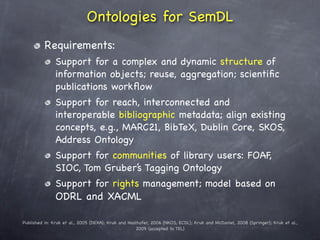
  • #21  * Open Digital Rights Language (ODRL) [Iannella, 2002] - XML schemata for Expr.Lang. and data dict - Asset, Permission, Constraint, Requirements, Condition, Rights holder * eXtensible Access Control Marcup Language (XACML) [Moses, 2005] - Rule, Policy, Target, Conditions (page 78)
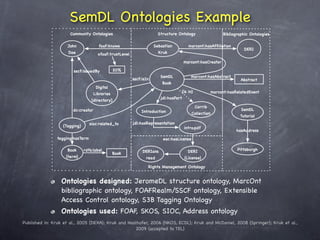
  • #22 This is not an RDF graph - just an overview of concepts (page 92)
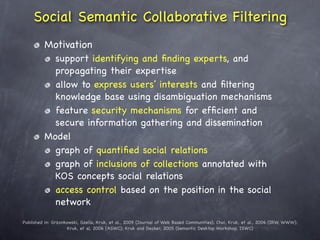
  • #24  Disadvantages of Typical Collaborative Filtering Although collaborative filtering techniques solve same problems of information seeking, spe- cific collaboration filtering implementations suffer various shortcomings: • A heterophilous diffusion (exchange of information across different socio-economic groups) is neglected in favor of a homophilous diffusion (exchange of information within socio- economic groups) (Canny, 2002). • The security and privacy issues are weakly supported; the reputation and trust among users is usually not developed (Procter and McKinlay, 1997). • When the social network is created automatically by harvesting various databases with advanced algorithms: – The critical mass of registered users is required to provide a satisfiable level of cor- relation to user’s interests (Guo, 1998). – Monopolies are supported (Polat and Du, 2003) because a service provider has to gather a lot of information to become accurate (critical mass). – It is impossible to create a digraph of social connection from most of the commonly used sources; also, the privacy of individuals is often violated (Canny, 2002). • When the user actively uses fora or mailing-lists: – There is no guarantee that there will be an answer to the posted question or that the answer will be thorough. – There might be no expert on the specific field of discourse in the direct social neigh- borhood of the user. • Some systems require that users answer long questionnaires (Shardanand and Maes, 1995; Procter and McKinlay, 1997) in order to find similarities in users’ interests. (page 126)
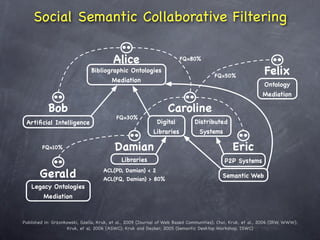
  • #25  (page 133)
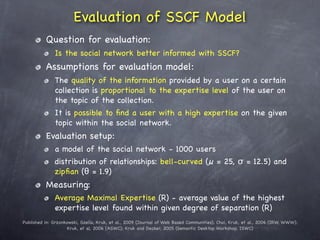
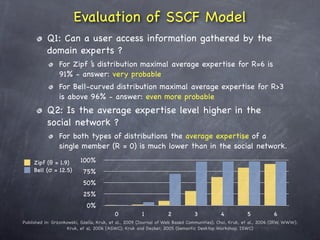
  • #26  * following Kautz et al, 1997a * Small World Phenonema (Barabasi, 2002) - Zipfian * Bell curved (Groot, 2005) - special types of networks, eg. academics (page 139)
  • #27  (page 143)
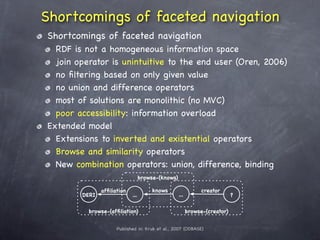
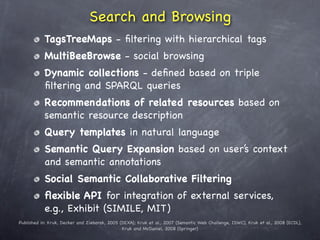
  • #28  * Flamenco (Yee, 2003) * Oren missing: join, filtering on value, union, difference, taxonomy of values, poor accesibility (page 96)
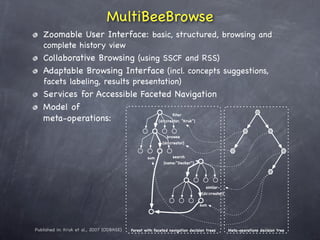
  • #29  * left - actual interactions in MBB: sum (filter-browse, search-similar); * right - tree of decision history tree (page 110)
  • #30  (page 117)
  • #31  (page 117)
  • #32  (page 117)
  • #33  (page 117)
  • #34  (page 117)
  • #35  (page 117)
  • #36  (page 117)
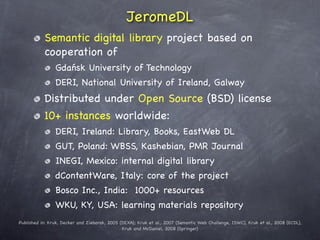
  • #38 - we’ve got phenomenal participation from users form all over the world and fantastic feedback - users create their own customizations and at the same time influence the the main line of development (page 150)
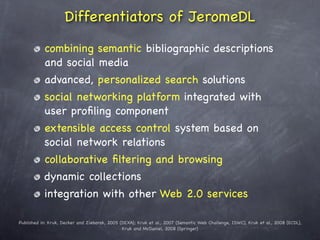
  • #39 - here are the most important features of the system- combining semantics, EAC, SN, collaborative (page 150)
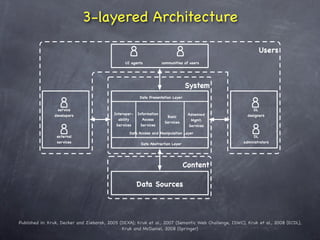
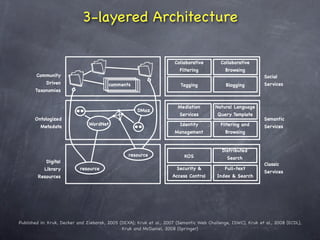
  • #40 3 layers - detailed scope on services and data layers distinctive layers (page 151)
  • #41 3 layers - detailed scope on services and data layers distinctive layers (page 151)
  • #42 3 layers - detailed scope on services and data layers distinctive layers (page 151)
  • #43 3 layers - detailed scope on services and data layers distinctive layers (page 151)
  • #44  (page 156)
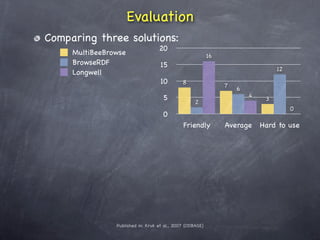
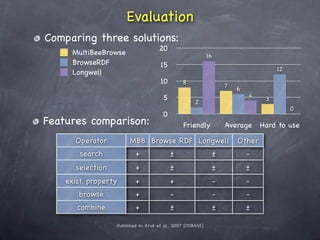
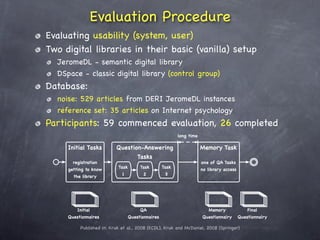
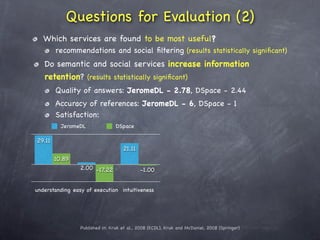
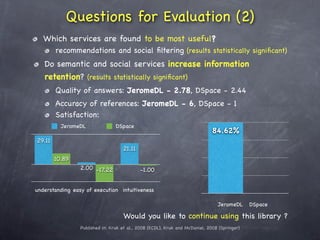
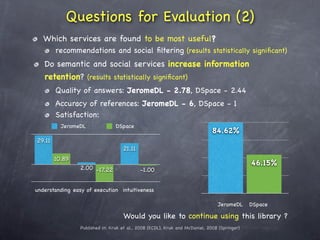
  • #46  * initial + 3 stages + memory * JeromeDL + DSpace (control group) * (page 169)