R.Pavithra,
II-MSc(IT),
Nadar saraswathi college of arts and science,
Theni.
CONCURRENCY CONTROL
CONTENTS
 What is concurrency control?
 Lock based protocol
 Two phase locking protocol
 deadlock
What is concurrency control?
 The technique is used to protect data when multiple users
are accessing same data concurrently(same time) is called
concurrency control.
Lock Based Protocol
o Lock is a mechanism to control concurrent access to data
item
o Data items can be locked in two modes:
a. Exclusive(X)Mode: Data item can be both read as well
as written. X-lock is request using lock-X instruction.
b. Shared (S) mode: data item can only be read,S-lock is
request using lock-s instruction.
o Lock request are made to concurrency-control manger.
o Transaction can proceed only after request s grated.
Cont……..
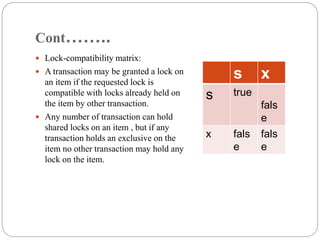
 Lock-compatibility matrix:
 A transaction may be granted a lock on
an item if the requested lock is
compatible with locks already held on
the item by other transaction.
 Any number of transaction can hold
shared locks on an item , but if any
transaction holds an exclusive on the
item no other transaction may hold any
lock on the item.
s x
s true
fals
e
x fals
e
fals
e
Cont……..
 A transaction may be granted a lock on an item if the
requested lock is compatible with locks already held
on the item by other transaction.
 Any number of transaction can hold shared locks on
an item , but if any transaction holds an exclusive on
the item no other transaction may hold any lock on
the item.
Cont…….
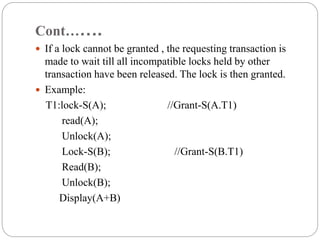
 If a lock cannot be granted , the requesting transaction is
made to wait till all incompatible locks held by other
transaction have been released. The lock is then granted.
 Example:
T1:lock-S(A); //Grant-S(A.T1)
read(A);
Unlock(A);
Lock-S(B); //Grant-S(B.T1)
Read(B);
Unlock(B);
Display(A+B)
Pitfalls of lock based protocol
 Locking as above is not sufficient to guarantee
serialializability- if A and B get in between the read of A and B
,the displayed sum would be wrong.
 A locking protocol is a set of rules followed by all transactions
while requesting and releasing locks . Locking protocols
restrict the set of possible schedules.
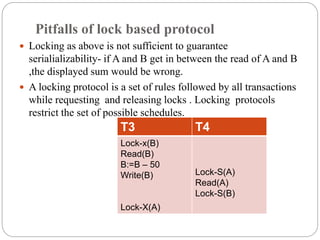
T3 T4
Lock-x(B)
Read(B)
B:=B – 50
Write(B)
Lock-X(A)
Lock-S(A)
Read(A)
Lock-S(B)
Cont….
 Neither T₃ nor T₄ can make progress –executing lock-S(B) causes T₄ to
wait for T₃ to release its lock on B , while executing lock-X(A) causes T₃
to wait for T₄ to relase its lock on A.
 To handle a deadlock one of T₃ or T₄ must be rolled back
and its locks relased.
 Starvation is also possible if concurrency control manager
is badly designed. For example:
I. A transaction may be waiting for an X –lock on an item
,while a sequence of other transactions request and are
granted an S-lock on the same item.
II. The same transaction is repeatedly rolled back due to
deadlocks.
 Concurrency control manager can be designed to prevent
starvation.
Two phase locking protocol
 This is a protocol which ensures conflict-serializable
schedules.
 Phase 1:Growing Phase
-transaction may obtain locks
-transaction may not release locks
 Phase 2: Shrinking Phase
-transaction may release locks
-transaction may not obtain locks
 The protocol assures serializability. It can be proved that
the transaction can be serialized in the order of their lock
points.
(i.e, the point where a transaction acquired its final lock).
Cont….
 Two –phase locking does not ensure from deadlocks.
 Cascading roll-back is possible under two-phase locking.
To avoid this, follow a modifed protocol called strict two-
phase locking. Here a transaction must hold all its
exclusive locks till it commits/aborts.
 Rigorous two-phase locking is even stricter: here all
locks are held till commit/abort. In this protocol
transaction can be serialized in the order in which they
commit.
DEADLOCK
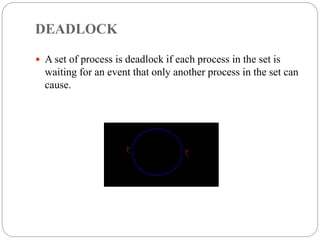
 A set of process is deadlock if each process in the set is
waiting for an event that only another process in the set can
cause.
Four conditions for deadlock
 Mutual exclusive condition
-each resource assigned to 1 process or is available
 Hold and wait condition
-process holding resources can request additional
 No preeption condition
-previously granted resoures cannot forcibly taken away
 Circular wait condition
-must be a circular chain of 2 or more process
-each is waiting for resource held by next member of the
chain
Strategies of deadlock handling
 Deadlock prevention:
prevents deadlocks by restraining requests made to ensure
that at least one of the deadlock conditions cannot occur.
• Deadlock avoidance:
Dynamically grants a resource to a process if the resulting
state is safe. A state is safe if there is at least one execution
sequence that allows all process to run to completion.
• Deadlock detection and recovery:
That allows dealocks to form; then finds and breaks them.
Deadlock avoidance
 WAIT- DIE RULE:
if Tᵢ request a lock on a data
item which is already locked
by Tʲ, then Tᵢ is permitted to
wait if ts (Tᵢ)<ts(Tʲ). If ts
(Tᵢ)>ts(Tʲ), then Tᵢ is aborted
and restarted with the same time
stamp.
-if ts (Tᵢ)<ts(Tʲ) then Tᵢ waits
else Tᵢ dies
-non-preempting: Tᵢ never
preempts Tʲ
-prefers younger transactions
 WOUND-WAIT RULE:
If Tᵢ request a lock on a data
item which is already locked by
Tʲ, then Tᵢ is permitted to wait if
ts (Tᵢ)>ts(Tʲ). If ts (Tᵢ)<ts(Tʲ),
then Tʲ is aborted and the lock is
granted to Tᵢ.
-if ts (Tᵢ)<ts(Tʲ) then Tʲ is
wounded else Tᵢ waits
- preemptive : Tᵢ preempts Tʲ if it
is younger
-prefers older transactions
Deadlock detection
For deadlock detection, the system must provide:
 An algorithm that examines the state of the system to detect
whether a deadlock has occurred
 And an algorithm to recover from the deadlock
A detection-and –recovery scheme require various kinds of
overhead
 Runtime –time costs of maintaining necessary information and
executing the detection algorithm.
concurrency control

concurrency control

  • 1.
    R.Pavithra, II-MSc(IT), Nadar saraswathi collegeof arts and science, Theni. CONCURRENCY CONTROL
  • 2.
    CONTENTS  What isconcurrency control?  Lock based protocol  Two phase locking protocol  deadlock
  • 3.
    What is concurrencycontrol?  The technique is used to protect data when multiple users are accessing same data concurrently(same time) is called concurrency control.
  • 4.
    Lock Based Protocol oLock is a mechanism to control concurrent access to data item o Data items can be locked in two modes: a. Exclusive(X)Mode: Data item can be both read as well as written. X-lock is request using lock-X instruction. b. Shared (S) mode: data item can only be read,S-lock is request using lock-s instruction. o Lock request are made to concurrency-control manger. o Transaction can proceed only after request s grated.
  • 5.
    Cont……..  Lock-compatibility matrix: A transaction may be granted a lock on an item if the requested lock is compatible with locks already held on the item by other transaction.  Any number of transaction can hold shared locks on an item , but if any transaction holds an exclusive on the item no other transaction may hold any lock on the item. s x s true fals e x fals e fals e
  • 6.
    Cont……..  A transactionmay be granted a lock on an item if the requested lock is compatible with locks already held on the item by other transaction.  Any number of transaction can hold shared locks on an item , but if any transaction holds an exclusive on the item no other transaction may hold any lock on the item.
  • 7.
    Cont…….  If alock cannot be granted , the requesting transaction is made to wait till all incompatible locks held by other transaction have been released. The lock is then granted.  Example: T1:lock-S(A); //Grant-S(A.T1) read(A); Unlock(A); Lock-S(B); //Grant-S(B.T1) Read(B); Unlock(B); Display(A+B)
  • 8.
    Pitfalls of lockbased protocol  Locking as above is not sufficient to guarantee serialializability- if A and B get in between the read of A and B ,the displayed sum would be wrong.  A locking protocol is a set of rules followed by all transactions while requesting and releasing locks . Locking protocols restrict the set of possible schedules. T3 T4 Lock-x(B) Read(B) B:=B – 50 Write(B) Lock-X(A) Lock-S(A) Read(A) Lock-S(B)
  • 9.
    Cont….  Neither T₃nor T₄ can make progress –executing lock-S(B) causes T₄ to wait for T₃ to release its lock on B , while executing lock-X(A) causes T₃ to wait for T₄ to relase its lock on A.  To handle a deadlock one of T₃ or T₄ must be rolled back and its locks relased.  Starvation is also possible if concurrency control manager is badly designed. For example: I. A transaction may be waiting for an X –lock on an item ,while a sequence of other transactions request and are granted an S-lock on the same item. II. The same transaction is repeatedly rolled back due to deadlocks.  Concurrency control manager can be designed to prevent starvation.
  • 10.
    Two phase lockingprotocol  This is a protocol which ensures conflict-serializable schedules.  Phase 1:Growing Phase -transaction may obtain locks -transaction may not release locks  Phase 2: Shrinking Phase -transaction may release locks -transaction may not obtain locks  The protocol assures serializability. It can be proved that the transaction can be serialized in the order of their lock points. (i.e, the point where a transaction acquired its final lock).
  • 11.
    Cont….  Two –phaselocking does not ensure from deadlocks.  Cascading roll-back is possible under two-phase locking. To avoid this, follow a modifed protocol called strict two- phase locking. Here a transaction must hold all its exclusive locks till it commits/aborts.  Rigorous two-phase locking is even stricter: here all locks are held till commit/abort. In this protocol transaction can be serialized in the order in which they commit.
  • 12.
    DEADLOCK  A setof process is deadlock if each process in the set is waiting for an event that only another process in the set can cause.
  • 13.
    Four conditions fordeadlock  Mutual exclusive condition -each resource assigned to 1 process or is available  Hold and wait condition -process holding resources can request additional  No preeption condition -previously granted resoures cannot forcibly taken away  Circular wait condition -must be a circular chain of 2 or more process -each is waiting for resource held by next member of the chain
  • 14.
    Strategies of deadlockhandling  Deadlock prevention: prevents deadlocks by restraining requests made to ensure that at least one of the deadlock conditions cannot occur. • Deadlock avoidance: Dynamically grants a resource to a process if the resulting state is safe. A state is safe if there is at least one execution sequence that allows all process to run to completion. • Deadlock detection and recovery: That allows dealocks to form; then finds and breaks them.
  • 15.
    Deadlock avoidance  WAIT-DIE RULE: if Tᵢ request a lock on a data item which is already locked by Tʲ, then Tᵢ is permitted to wait if ts (Tᵢ)<ts(Tʲ). If ts (Tᵢ)>ts(Tʲ), then Tᵢ is aborted and restarted with the same time stamp. -if ts (Tᵢ)<ts(Tʲ) then Tᵢ waits else Tᵢ dies -non-preempting: Tᵢ never preempts Tʲ -prefers younger transactions  WOUND-WAIT RULE: If Tᵢ request a lock on a data item which is already locked by Tʲ, then Tᵢ is permitted to wait if ts (Tᵢ)>ts(Tʲ). If ts (Tᵢ)<ts(Tʲ), then Tʲ is aborted and the lock is granted to Tᵢ. -if ts (Tᵢ)<ts(Tʲ) then Tʲ is wounded else Tᵢ waits - preemptive : Tᵢ preempts Tʲ if it is younger -prefers older transactions
  • 16.
    Deadlock detection For deadlockdetection, the system must provide:  An algorithm that examines the state of the system to detect whether a deadlock has occurred  And an algorithm to recover from the deadlock A detection-and –recovery scheme require various kinds of overhead  Runtime –time costs of maintaining necessary information and executing the detection algorithm.