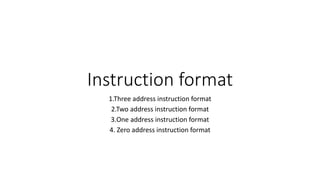
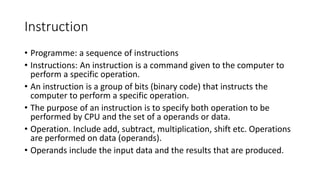
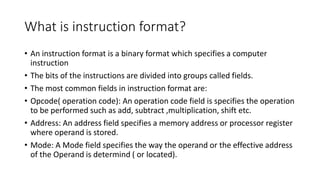
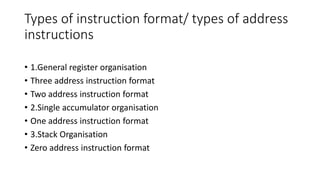
The document provides an overview of different instruction formats in computer architecture, including zero, one, two, and three address instruction formats, and explains their significance in CPU operations. It distinguishes between single accumulator, general register, and stack organization types, highlighting how these architectures affect the number of address fields used in instructions. Examples illustrate how operations are performed using various address formats, emphasizing the role of opcode and operands in instruction execution.
![Classification of instructions based on CPU
organisations
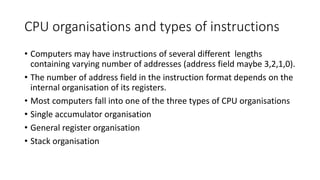
• Single accumulator organisation
• All operations are performed on one implied accumulator(AC)register.
• With one operand implicitly in the accumulated register minimise the internal complexity of the
machine and allow for short instructions.
• The instruction format uses only one address field.
• Ex. Evaluate X=(A+B) *(C+D)
• LOAD. A. AC<— M[A]
• ADD B. AC<—AC+M[B]
• STORE. T. M[T]<— AC
• LOAD C. AC M[C]
• ADD D. AC<—AC+M[D]
• MUL. T. AC<—AC*. M[T]
• STORE. X. M[X]<—AC](https://image.slidesharecdn.com/instructionformats-221105133714-9c853ea5/85/Instruction-Formats-6-320.jpg)
![General register organisation
• It uses set of general purpose register R0, R1 ,R2…. one of the most
widely accepted models for machine architecture today.
• The instruction format needs two or three address fields according to
the operation.
• Ex. Evaluate X=(A+B)*(C+D)
• Three address instructions
• ADD R1,A,B R1<—M[A]+M[B]
• ADD R2,C,D R2<—M[C]+M[D]
• MUL X,R1,R2 M[X]<—R1*R2](https://image.slidesharecdn.com/instructionformats-221105133714-9c853ea5/85/Instruction-Formats-7-320.jpg)
![Two address instruction
• Ex. X=(A+B)*(C+D)
• MOV R1,A R1<—M[A]
• ADD R1,B R1<—R1+M[B]
• MOV R2,C R2<—M[C]
• ADD R2,D R2<—R2+M[D]
• MUL R1,R2 R1<—R1+R2
• MOV X,R1 M[X]<—R1](https://image.slidesharecdn.com/instructionformats-221105133714-9c853ea5/85/Instruction-Formats-8-320.jpg)
![Zero address instruction
• PUSH A TOS<—A
• PUSH B TOS<—B
• ADD TOS<—(A+B)
• PUSH C TOS<—C
• PUSH D TOS<—D
• ADD TOS<—(C+D)
• MUL TOS<—(C+D)*(A+B)
• POP X M[X]<—TOS](https://image.slidesharecdn.com/instructionformats-221105133714-9c853ea5/85/Instruction-Formats-9-320.jpg)


![5G Explained! A High Level Overview [Introduction]](https://cdn.slidesharecdn.com/ss_thumbnails/5gexplainedahighleveloverview-260119165306-cc137a3e-thumbnail.jpg?width=640&height=640&fit=bounds)


