Advanced Computer Architecture
Program Flow Mechanisms
There are three flow mechanism
Control flow mechanism(used by conventional
computers)
Data-driven mechanism(used by data-flow
computers)
Demand-driven mechanism(used by reduction
computers)
Control flow mechanism(used
Conventional von Neumann computers use a
program counter to sequence the execution of
instruction in a program. This sequential execution
style is called control-driven.
Conventional computers are based on a control
flow mechanism by which the order of program
execution is explicitly stated in the user programs
Control flow computers use sheared memory to
hold program instructions and data objects.
A uniprocessor computers is inherently
sequential ,due to use of the control-driven
mechanism.
Control flow can be made parallel by using parallel
language constructs or parallel compiler.
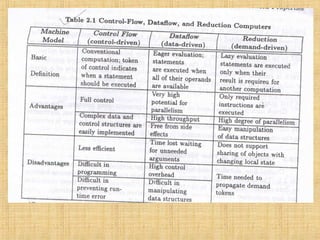
Control flow machines give complete control, but
are less efficient than other approaches.
Data-driven mechanism
Dataflow computers are based on a data-driven
mechanism which allows the execution of any
instruction to be driven by data (operand)
availability. Dataflow computers emphasize a high
degree of parallelism at the fine-grain instructional
level.
Data flow machines have high potential for
parallelism and throughput and freedom from side
effects, but have high control overhead, lose time
waiting for unneeded arguments, and difficulty in
manipulating data structures.
Data Flow Features
No need for
shared memory
program counter
control sequencer
Special mechanisms are required to
detect data availability
match data tokens with instructions needing them
enable chain reaction of asynchronous instruction
execution
Control Flow vs. Data Flow
Control flow machines used shared memory for instructions
and data. Since variables are updated by many instructions,
there may be side effects on other instructions. These side
effects frequently prevent parallel processing. Single
processor systems are inherently sequential.
Instructions in dataflow machines are unordered and can be
executed as soon as their operands are available; data is
held in the instructions themselves. Data tokens are
passed from an instruction to its dependents to trigger
execution.
Demand-Driven Mechanisms
Data-driven machines select instructions for execution
based on the availability of their operands; this is essentially
a bottom-up approach.
Demand-driven machines take a top-down approach,
attempting to execute the instruction (a demander) that
yields the final result. This triggers the execution of
instructions that yield its operands, and so forth.
The demand-driven approach matches naturally with
functional programming languages (e.g. LISP and
SCHEME).
Reduction Machine Models
String-reduction model:
each demander gets a separate copy of the expression string to
evaluate
each reduction step has an operator and embedded reference to
demand the corresponding operands
each operator is suspended while arguments are evaluated
Graph-reduction model:
expression graph reduced by evaluation of branches or subgraphs,
possibly in parallel, with demanders given pointers to results of
reductions.
based on sharing of pointers to arguments; traversal and reversal of
pointers continues until constant arguments are encountered.
Summary
Reduction machines have high parallelism potential, easy
manipulation of data structures, and only execute required
instructions. But they do not share objects with changing
local state, and do require time to propagate tokens.
example
Consider the following example of a arithmetic
expression :
a=[(b+1) * c – (d / e)]
The data-driven computation chooses a bottom-up
approach , starting from b+1 and d / e then
proceding to the ‘*’ operation finally to the
outermost operation.
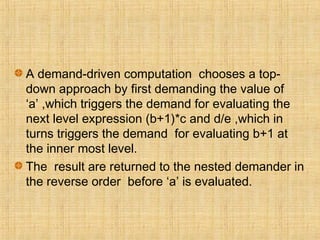
A demand-driven computation chooses a top-
down approach by first demanding the value of
‘a’ ,which triggers the demand for evaluating the
next level expression (b+1)*c and d/e ,which in
turns triggers the demand for evaluating b+1 at
the inner most level.
The result are returned to the nested demander in
the reverse order before ‘a’ is evaluated.
A data-driven computation has been called eager
evaluation because operation are carried out
immediately after all their operands becomes
available.
a demand-driven computation corresponds to lazy
evaluation because operation are executed only
when their result are required by another
instruction.

program flow mechanisms, advanced computer architecture

  • 1.
  • 2.
    Program Flow Mechanisms Thereare three flow mechanism Control flow mechanism(used by conventional computers) Data-driven mechanism(used by data-flow computers) Demand-driven mechanism(used by reduction computers)
  • 3.
    Control flow mechanism(used Conventionalvon Neumann computers use a program counter to sequence the execution of instruction in a program. This sequential execution style is called control-driven. Conventional computers are based on a control flow mechanism by which the order of program execution is explicitly stated in the user programs Control flow computers use sheared memory to hold program instructions and data objects.
  • 4.
    A uniprocessor computersis inherently sequential ,due to use of the control-driven mechanism. Control flow can be made parallel by using parallel language constructs or parallel compiler. Control flow machines give complete control, but are less efficient than other approaches.
  • 5.
    Data-driven mechanism Dataflow computersare based on a data-driven mechanism which allows the execution of any instruction to be driven by data (operand) availability. Dataflow computers emphasize a high degree of parallelism at the fine-grain instructional level. Data flow machines have high potential for parallelism and throughput and freedom from side effects, but have high control overhead, lose time waiting for unneeded arguments, and difficulty in manipulating data structures.
  • 6.
    Data Flow Features Noneed for shared memory program counter control sequencer Special mechanisms are required to detect data availability match data tokens with instructions needing them enable chain reaction of asynchronous instruction execution
  • 7.
    Control Flow vs.Data Flow Control flow machines used shared memory for instructions and data. Since variables are updated by many instructions, there may be side effects on other instructions. These side effects frequently prevent parallel processing. Single processor systems are inherently sequential. Instructions in dataflow machines are unordered and can be executed as soon as their operands are available; data is held in the instructions themselves. Data tokens are passed from an instruction to its dependents to trigger execution.
  • 8.
    Demand-Driven Mechanisms Data-driven machinesselect instructions for execution based on the availability of their operands; this is essentially a bottom-up approach. Demand-driven machines take a top-down approach, attempting to execute the instruction (a demander) that yields the final result. This triggers the execution of instructions that yield its operands, and so forth. The demand-driven approach matches naturally with functional programming languages (e.g. LISP and SCHEME).
  • 9.
    Reduction Machine Models String-reductionmodel: each demander gets a separate copy of the expression string to evaluate each reduction step has an operator and embedded reference to demand the corresponding operands each operator is suspended while arguments are evaluated Graph-reduction model: expression graph reduced by evaluation of branches or subgraphs, possibly in parallel, with demanders given pointers to results of reductions. based on sharing of pointers to arguments; traversal and reversal of pointers continues until constant arguments are encountered.
  • 10.
    Summary Reduction machines havehigh parallelism potential, easy manipulation of data structures, and only execute required instructions. But they do not share objects with changing local state, and do require time to propagate tokens.
  • 12.
    example Consider the followingexample of a arithmetic expression : a=[(b+1) * c – (d / e)] The data-driven computation chooses a bottom-up approach , starting from b+1 and d / e then proceding to the ‘*’ operation finally to the outermost operation.
  • 13.
    A demand-driven computationchooses a top- down approach by first demanding the value of ‘a’ ,which triggers the demand for evaluating the next level expression (b+1)*c and d/e ,which in turns triggers the demand for evaluating b+1 at the inner most level. The result are returned to the nested demander in the reverse order before ‘a’ is evaluated.
  • 14.
    A data-driven computationhas been called eager evaluation because operation are carried out immediately after all their operands becomes available. a demand-driven computation corresponds to lazy evaluation because operation are executed only when their result are required by another instruction.