
Adeel Rasheed
 For More Slides Visit:
 https://www.slideshare.net/adeel02

 Independent Processes:
Operating concurrently on a
systems are those that can neither affect other processes
or be affected by other processes.
 Cooperating Processes:
Are those that can affect or
be affected by other processes.
IPC

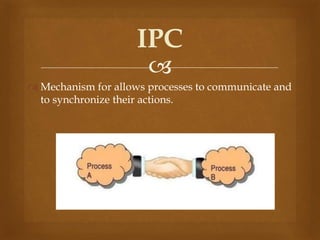
 Mechanism for allows processes to communicate and
to synchronize their actions.
IPC

 Information sharing: Several processes may need
to access the same data (such as stored in a file.)
 Computation speedup: A task can offer be run
faster if it is broken into subtasks and distributed
among different processes.
 Resource Sharing: Sharing Hardware, memory etc
Why We Use IPC

 Modularity: It may be easier to organize a complex
task into separate subtasks, then have different
processes or threads running each subtask.
 Convenience: An individual user can run several
programs at the same time, to perform some task.
Why We Use IPC

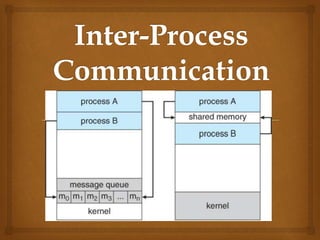
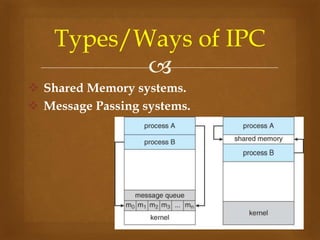
 Shared Memory systems.
 Message Passing systems.
Types/Ways of IPC
Shared Memory
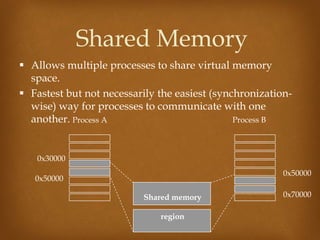
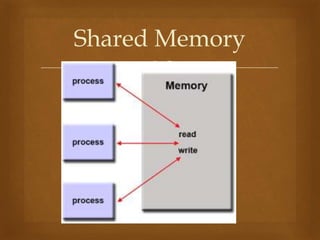
 Allows multiple processes to share virtual memory
space.
 Fastest but not necessarily the easiest (synchronization-
wise) way for processes to communicate with one
another. Process A Process B
0x30000
0x50000
0x50000
0x70000Shared memory
region

Shared Memory

 There are two processes: Producer and
Consumer.
 Producer produces some item and Consumer
consumes that item.
 The two processes shares a common space or
memory location known as buffer where the item
produced by Producer is stored and from where the
Consumer consumes the item if needed.
Producer-Consumer
problem

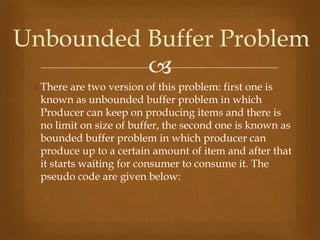
 There are two version of this problem: first one is
known as unbounded buffer problem in which
Producer can keep on producing items and there is
no limit on size of buffer, the second one is known as
bounded buffer problem in which producer can
produce up to a certain amount of item and after that
it starts waiting for consumer to consume it. The
pseudo code are given below:
Unbounded Buffer Problem

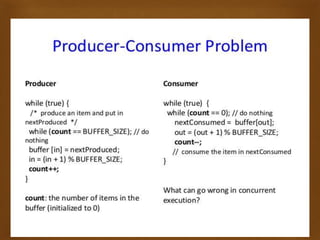
 We will discuss the bounded buffer problem. First, the
Producer and the Consumer will share some common
memory, then producer will start producing items. If
the total produced item is equal to the size of buffer,
producer will wait to get it consumed by the
Consumer. Similarly, the consumer first check for the
availability of the item and if no item is available,
Consumer will wait for producer to produce it. If there
are items available, consumer will consume it.
Bounded Buffer Problem


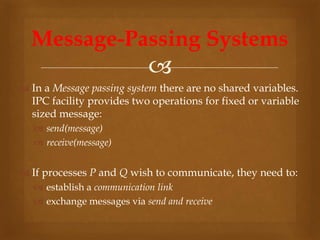
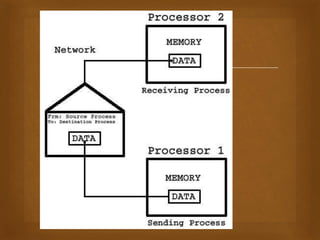
 In a Message passing system there are no shared variables.
IPC facility provides two operations for fixed or variable
sized message:
 send(message)
 receive(message)
 If processes P and Q wish to communicate, they need to:
 establish a communication link
 exchange messages via send and receive
Message-Passing Systems


 There are key issues to be resolved in message
passing systems as further explored in the next
subsections:
 Direct or indirect communication ( naming )
 Synchronous or asynchronous communication
Key Issues

 With direct communication the sender must know the
name of the receiver to which it wishes to send a
message. There is a one-to-one link between every
sender-receiver pair.
 Symmetric communication, the receiver must also
know the specific name of the sender from which it
wishes to receive messages.
 Asymmetric communications, this is not necessary.
Direct Communication
 Indirect communication uses shared mailboxes, or
ports. Multiple processes can share the same mailbox or
boxes.
 Only one process can read any given message in a
mailbox. Initially the process that creates the mailbox is
the owner, and is the only one allowed to read mail in
the mailbox, although this privilege may be transferred.
 The OS must provide system calls to create and delete
mailboxes, and to send and receive messages to/from
mailboxes.
Indirect communication

 synchronous messaging involves a client that waits
for the server to respond to a message. Messages are
able to flow in both directions, to and from.
 Asynchronous messaging involves a client that does
not wait for a message from the server. An event is
used to trigger a message from a server. So even if
the client is down, the messaging will complete
successfully. Asynchronous Messaging means that, it
is a one way communication and the flow of
communication is one way only.
Synchronous or asynchronous
communication


Inter Process Communication

  • 2.
     Adeel Rasheed  ForMore Slides Visit:  https://www.slideshare.net/adeel02
  • 3.
      Independent Processes: Operatingconcurrently on a systems are those that can neither affect other processes or be affected by other processes.  Cooperating Processes: Are those that can affect or be affected by other processes. IPC
  • 4.
      Mechanism forallows processes to communicate and to synchronize their actions. IPC
  • 5.
      Information sharing:Several processes may need to access the same data (such as stored in a file.)  Computation speedup: A task can offer be run faster if it is broken into subtasks and distributed among different processes.  Resource Sharing: Sharing Hardware, memory etc Why We Use IPC
  • 6.
      Modularity: Itmay be easier to organize a complex task into separate subtasks, then have different processes or threads running each subtask.  Convenience: An individual user can run several programs at the same time, to perform some task. Why We Use IPC
  • 7.
      Shared Memorysystems.  Message Passing systems. Types/Ways of IPC
  • 8.
    Shared Memory  Allowsmultiple processes to share virtual memory space.  Fastest but not necessarily the easiest (synchronization- wise) way for processes to communicate with one another. Process A Process B 0x30000 0x50000 0x50000 0x70000Shared memory region
  • 9.
  • 10.
      There aretwo processes: Producer and Consumer.  Producer produces some item and Consumer consumes that item.  The two processes shares a common space or memory location known as buffer where the item produced by Producer is stored and from where the Consumer consumes the item if needed. Producer-Consumer problem
  • 11.
      There aretwo version of this problem: first one is known as unbounded buffer problem in which Producer can keep on producing items and there is no limit on size of buffer, the second one is known as bounded buffer problem in which producer can produce up to a certain amount of item and after that it starts waiting for consumer to consume it. The pseudo code are given below: Unbounded Buffer Problem
  • 12.
      We willdiscuss the bounded buffer problem. First, the Producer and the Consumer will share some common memory, then producer will start producing items. If the total produced item is equal to the size of buffer, producer will wait to get it consumed by the Consumer. Similarly, the consumer first check for the availability of the item and if no item is available, Consumer will wait for producer to produce it. If there are items available, consumer will consume it. Bounded Buffer Problem
  • 13.
  • 14.
      In aMessage passing system there are no shared variables. IPC facility provides two operations for fixed or variable sized message:  send(message)  receive(message)  If processes P and Q wish to communicate, they need to:  establish a communication link  exchange messages via send and receive Message-Passing Systems
  • 15.
  • 16.
      There arekey issues to be resolved in message passing systems as further explored in the next subsections:  Direct or indirect communication ( naming )  Synchronous or asynchronous communication Key Issues
  • 17.
      With directcommunication the sender must know the name of the receiver to which it wishes to send a message. There is a one-to-one link between every sender-receiver pair.  Symmetric communication, the receiver must also know the specific name of the sender from which it wishes to receive messages.  Asymmetric communications, this is not necessary. Direct Communication
  • 18.
     Indirect communicationuses shared mailboxes, or ports. Multiple processes can share the same mailbox or boxes.  Only one process can read any given message in a mailbox. Initially the process that creates the mailbox is the owner, and is the only one allowed to read mail in the mailbox, although this privilege may be transferred.  The OS must provide system calls to create and delete mailboxes, and to send and receive messages to/from mailboxes. Indirect communication
  • 19.
      synchronous messaginginvolves a client that waits for the server to respond to a message. Messages are able to flow in both directions, to and from.  Asynchronous messaging involves a client that does not wait for a message from the server. An event is used to trigger a message from a server. So even if the client is down, the messaging will complete successfully. Asynchronous Messaging means that, it is a one way communication and the flow of communication is one way only. Synchronous or asynchronous communication
  • 20.