E-Governance
Submitted by
D.Shanmugapriya
II-MSC(IT)
Department of CS&IT
Nadar Saraswathi college of arts and science
Theni.
What is E- Governance
• E-Governance is nothing but a mediator between government and citizens.
• It is use of a range of modern information and technologies by government to
improve efficiency,service etc…
• Ex- internet, mobile,local area network.
• E Governance is the application of information technology to the processes of
government functioning to bring about….
• Smart
• Moral
• Accountable
• Responsive
• Transparent Governance.
Introduction of E-Governance
• E-Governance can be defined as
• Use of information & communication
• By government to enhance the range
• Quality of information & services provided
• To the citizen in an cost effective manner.
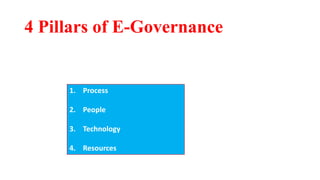
4 Pillars of E-Governance
1. Process
2. People
3. Technology
4. Resources
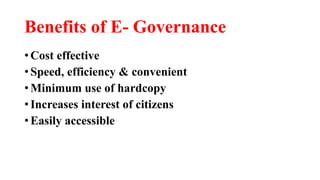
Benefits of E- Governance
• Cost effective
• Speed, efficiency & convenient
• Minimum use of hardcopy
• Increases interest of citizens
• Easily accessible
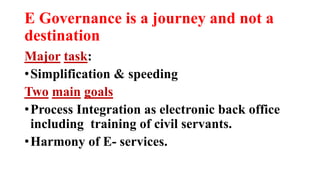
E Governance is a journey and not a
destination
Major task:
•Simplification & speeding
Two main goals
•Process Integration as electronic back office
including training of civil servants.
•Harmony of E- services.
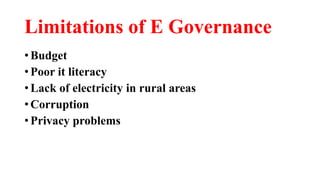
Limitations of E Governance
• Budget
• Poor it literacy
• Lack of electricity in rural areas
• Corruption
• Privacy problems
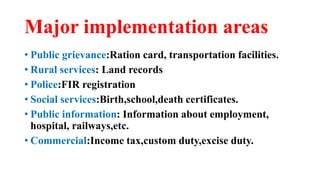
Major implementation areas
• Public grievance:Ration card, transportation facilities.
• Rural services: Land records
• Police:FIR registration
• Social services:Birth,school,death certificates.
• Public information: Information about employment,
hospital, railways,etc.
• Commercial:Income tax,custom duty,excise duty.
Importance of E Governance
• Building strong and effective information chain.
• To bridge the gap between India and developed
countries
• Effective utilization of resources.
• Reduction in delays,red tape and corruption.
Challenges of E Governance
• Lack of integrated services
• Lack of key persons
• Population
• Lack of communication between different
departments
• Different languages
Conclusion
• The goal of E Governance Is the ability to access &
interact with the world.
• Developing countries have many opportunities to
better themselves through E Governance.
• WALK WITH THE WORLD.
Thank
you

e governance

  • 1.
    E-Governance Submitted by D.Shanmugapriya II-MSC(IT) Department ofCS&IT Nadar Saraswathi college of arts and science Theni.
  • 2.
    What is E-Governance • E-Governance is nothing but a mediator between government and citizens. • It is use of a range of modern information and technologies by government to improve efficiency,service etc… • Ex- internet, mobile,local area network. • E Governance is the application of information technology to the processes of government functioning to bring about…. • Smart • Moral • Accountable • Responsive • Transparent Governance.
  • 3.
    Introduction of E-Governance •E-Governance can be defined as • Use of information & communication • By government to enhance the range • Quality of information & services provided • To the citizen in an cost effective manner.
  • 4.
    4 Pillars ofE-Governance 1. Process 2. People 3. Technology 4. Resources
  • 5.
    Benefits of E-Governance • Cost effective • Speed, efficiency & convenient • Minimum use of hardcopy • Increases interest of citizens • Easily accessible
  • 6.
    E Governance isa journey and not a destination Major task: •Simplification & speeding Two main goals •Process Integration as electronic back office including training of civil servants. •Harmony of E- services.
  • 7.
    Limitations of EGovernance • Budget • Poor it literacy • Lack of electricity in rural areas • Corruption • Privacy problems
  • 8.
    Major implementation areas •Public grievance:Ration card, transportation facilities. • Rural services: Land records • Police:FIR registration • Social services:Birth,school,death certificates. • Public information: Information about employment, hospital, railways,etc. • Commercial:Income tax,custom duty,excise duty.
  • 9.
    Importance of EGovernance • Building strong and effective information chain. • To bridge the gap between India and developed countries • Effective utilization of resources. • Reduction in delays,red tape and corruption.
  • 10.
    Challenges of EGovernance • Lack of integrated services • Lack of key persons • Population • Lack of communication between different departments • Different languages
  • 11.
    Conclusion • The goalof E Governance Is the ability to access & interact with the world. • Developing countries have many opportunities to better themselves through E Governance. • WALK WITH THE WORLD.
  • 12.