Article overview by
Ilya Kuzovkin
K. He, X. Zhang, S. Ren and J. Sun
Microsoft Research
Computational Neuroscience Seminar
University of Tartu
2016
Deep Residual Learning for
Image Recognition ILSVRC 2015
MS COCO 2015
WINNER
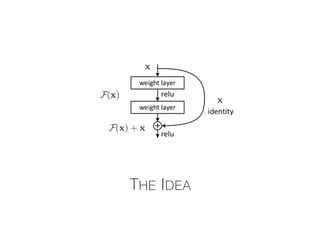
THE IDEA
1000 classes
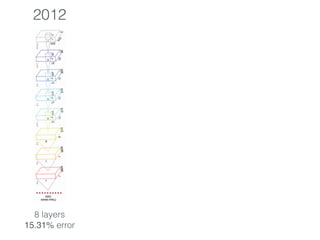
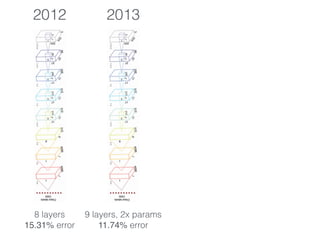
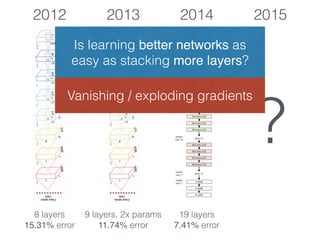
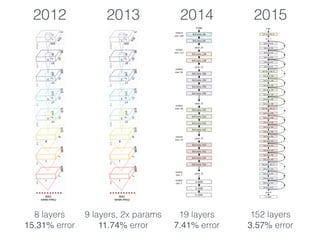
2012
8 layers
15.31% error
2012
8 layers
15.31% error
2013
9 layers, 2x params
11.74% error
2012
8 layers
15.31% error
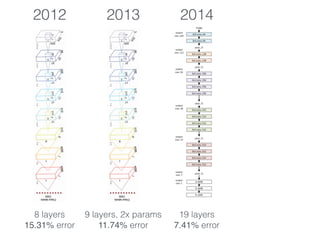
2013 2014
9 layers, 2x params
11.74% error
19 layers
7.41% error
2012
8 layers
15.31% error
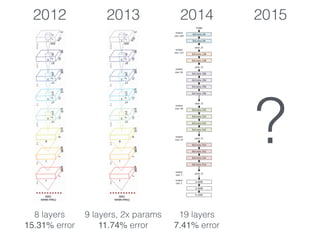
2013 2014 2015
9 layers, 2x params
11.74% error
19 layers
7.41% error
?
2012
8 layers
15.31% error
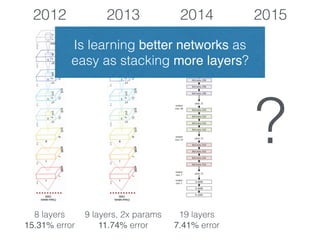
2013 2014 2015
9 layers, 2x params
11.74% error
19 layers
7.41% error
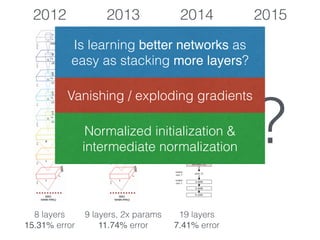
Is learning better networks as
easy as stacking more layers?
?
?
2012
8 layers
15.31% error
2013 2014 2015
9 layers, 2x params
11.74% error
19 layers
7.41% error
Is learning better networks as
easy as stacking more layers?
Vanishing / exploding gradients
?
2012
8 layers
15.31% error
2013 2014 2015
9 layers, 2x params
11.74% error
19 layers
7.41% error
Is learning better networks as
easy as stacking more layers?
Vanishing / exploding gradients
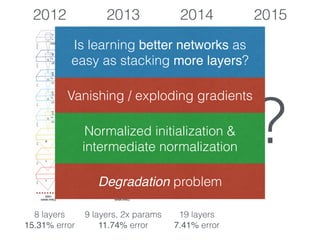
Normalized initialization &
intermediate normalization
?
2012
8 layers
15.31% error
2013 2014 2015
9 layers, 2x params
11.74% error
19 layers
7.41% error
Is learning better networks as
easy as stacking more layers?
Vanishing / exploding gradients
Normalized initialization &
intermediate normalization
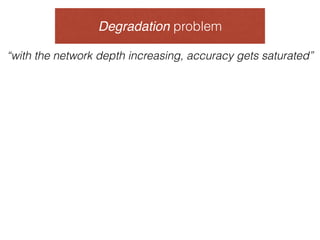
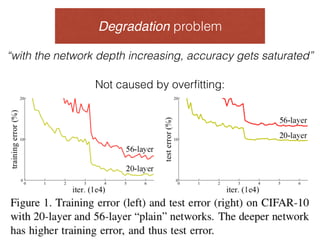
Degradation problem
Degradation problem
“with the network depth increasing, accuracy gets saturated”
Not caused by overfitting:
Degradation problem
“with the network depth increasing, accuracy gets saturated”
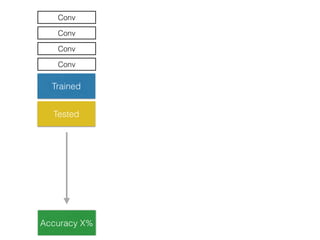
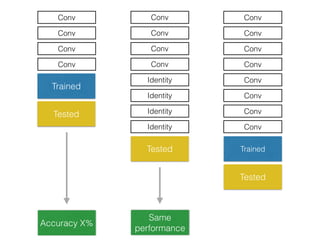
Conv
Conv
Conv
Conv
Trained
Accuracy X%
Tested
Conv
Conv
Conv
Conv
Trained
Accuracy X%
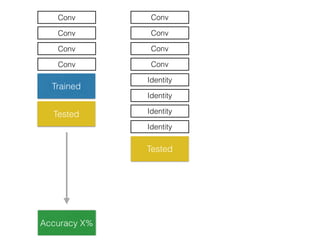
Conv
Conv
Conv
Conv
Identity
Identity
Identity
Identity
Tested
Tested
Conv
Conv
Conv
Conv
Trained
Accuracy X%
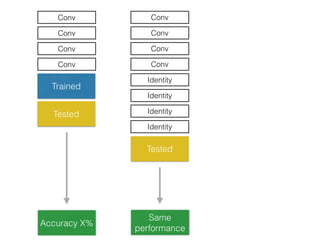
Conv
Conv
Conv
Conv
Identity
Identity
Identity
Identity
Same
performance
Tested
Tested
Conv
Conv
Conv
Conv
Trained
Accuracy X%
Conv
Conv
Conv
Conv
Identity
Identity
Identity
Identity
Same
performance
Conv
Conv
Conv
Conv
Conv
Conv
Conv
Conv
Trained
Tested
Tested
Tested
Conv
Conv
Conv
Conv
Trained
Accuracy X%
Conv
Conv
Conv
Conv
Identity
Identity
Identity
Identity
Same
performance
Conv
Conv
Conv
Conv
Conv
Conv
Conv
Conv
Trained
Worse!
Tested
Tested
Tested
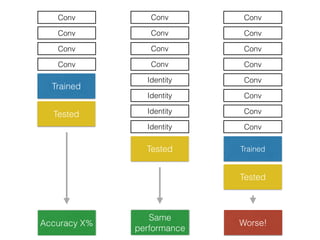
Conv
Conv
Conv
Conv
Trained
Accuracy X%
Conv
Conv
Conv
Conv
Identity
Identity
Identity
Identity
Same
performance
Conv
Conv
Conv
Conv
Conv
Conv
Conv
Conv
Trained
Worse!
Tested
Tested
Tested
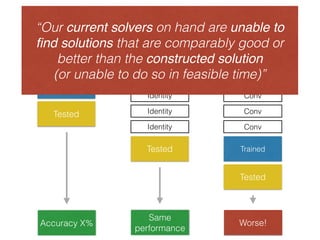
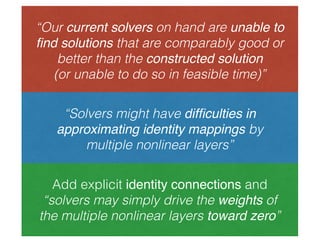
“Our current solvers on hand are unable to
find solutions that are comparably good or
better than the constructed solution
(or unable to do so in feasible time)”
Conv
Conv
Conv
Conv
Trained
Accuracy X%
Conv
Conv
Conv
Conv
Identity
Identity
Identity
Identity
Same
performance
Conv
Conv
Conv
Conv
Conv
Conv
Conv
Conv
Trained
Worse!
Tested
Tested
Tested
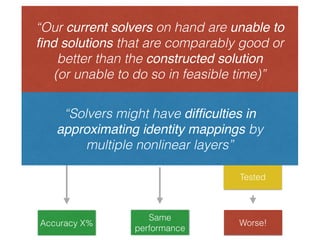
“Our current solvers on hand are unable to
find solutions that are comparably good or
better than the constructed solution
(or unable to do so in feasible time)”
“Solvers might have difficulties in
approximating identity mappings by
multiple nonlinear layers”
Conv
Conv
Conv
Conv
Trained
Accuracy X%
Conv
Conv
Conv
Conv
Identity
Identity
Identity
Identity
Same
performance
Conv
Conv
Conv
Conv
Conv
Conv
Conv
Conv
Trained
Worse!
Tested
Tested
Tested
“Our current solvers on hand are unable to
find solutions that are comparably good or
better than the constructed solution
(or unable to do so in feasible time)”
“Solvers might have difficulties in
approximating identity mappings by
multiple nonlinear layers”
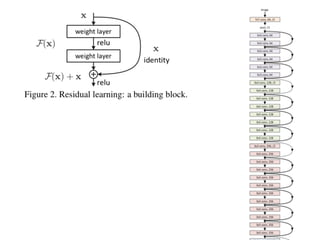
Add explicit identity connections and
“solvers may simply drive the weights of
the multiple nonlinear layers toward zero”
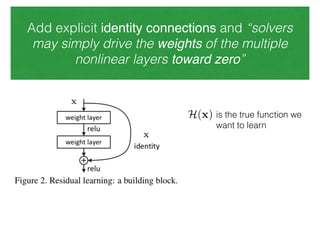
Add explicit identity connections and “solvers
may simply drive the weights of the multiple
nonlinear layers toward zero”
is the true function we
want to learn
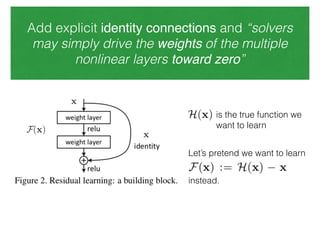
Add explicit identity connections and “solvers
may simply drive the weights of the multiple
nonlinear layers toward zero”
is the true function we
want to learn
Let’s pretend we want to learn
instead.
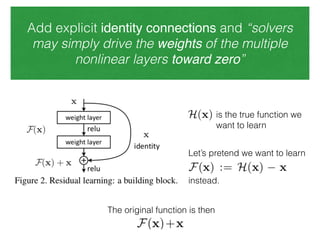
Add explicit identity connections and “solvers
may simply drive the weights of the multiple
nonlinear layers toward zero”
is the true function we
want to learn
Let’s pretend we want to learn
instead.
The original function is then
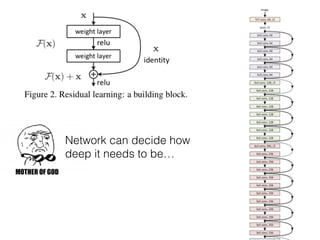
Network can decide how
deep it needs to be…
Network can decide how
deep it needs to be…
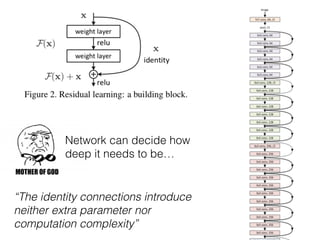
“The identity connections introduce
neither extra parameter nor
computation complexity”
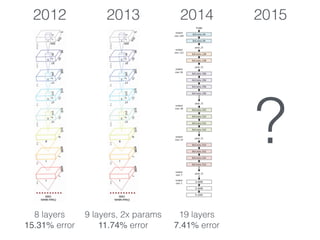
2012
8 layers
15.31% error
2013 2014 2015
9 layers, 2x params
11.74% error
19 layers
7.41% error
?
2012
8 layers
15.31% error
2013 2014 2015
9 layers, 2x params
11.74% error
19 layers
7.41% error
152 layers
3.57% error
EXPERIMENTS AND DETAILS
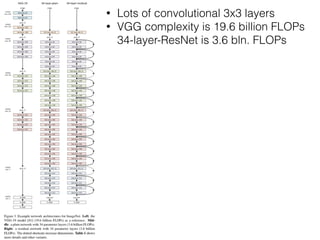
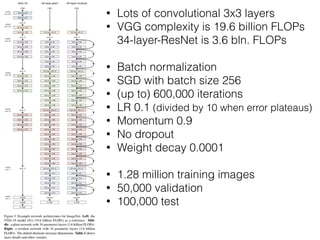
• Lots of convolutional 3x3 layers
• VGG complexity is 19.6 billion FLOPs
34-layer-ResNet is 3.6 bln. FLOPs
• Lots of convolutional 3x3 layers
• VGG complexity is 19.6 billion FLOPs
34-layer-ResNet is 3.6 bln. FLOPs
!
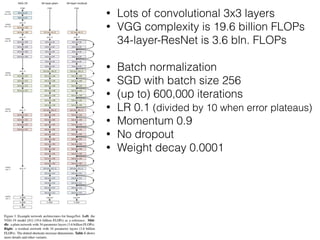
• Batch normalization
• SGD with batch size 256
• (up to) 600,000 iterations
• LR 0.1 (divided by 10 when error plateaus)
• Momentum 0.9
• No dropout
• Weight decay 0.0001
• Lots of convolutional 3x3 layers
• VGG complexity is 19.6 billion FLOPs
34-layer-ResNet is 3.6 bln. FLOPs
!
• Batch normalization
• SGD with batch size 256
• (up to) 600,000 iterations
• LR 0.1 (divided by 10 when error plateaus)
• Momentum 0.9
• No dropout
• Weight decay 0.0001
!
• 1.28 million training images
• 50,000 validation
• 100,000 test
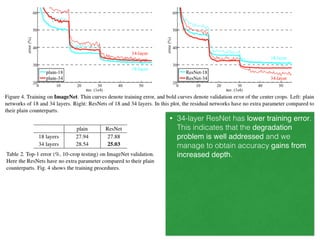
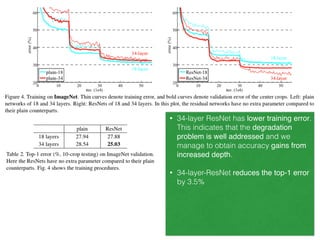
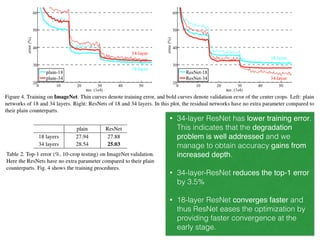
• 34-layer ResNet has lower training error.
This indicates that the degradation
problem is well addressed and we
manage to obtain accuracy gains from
increased depth.
• 34-layer ResNet has lower training error.
This indicates that the degradation
problem is well addressed and we
manage to obtain accuracy gains from
increased depth.
!
• 34-layer-ResNet reduces the top-1 error
by 3.5%
• 34-layer ResNet has lower training error.
This indicates that the degradation
problem is well addressed and we
manage to obtain accuracy gains from
increased depth.
!
• 34-layer-ResNet reduces the top-1 error
by 3.5%
!
• 18-layer ResNet converges faster and
thus ResNet eases the optimization by
providing faster convergence at the
early stage.
GOING DEEPER
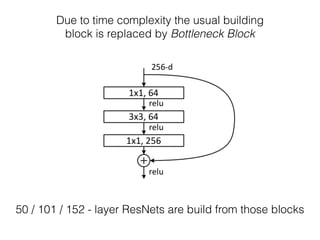
Due to time complexity the usual building
block is replaced by Bottleneck Block
50 / 101 / 152 - layer ResNets are build from those blocks
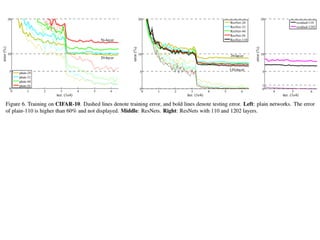
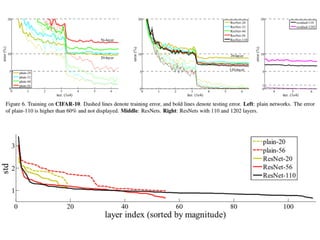
ANALYSIS ON CIFAR-10
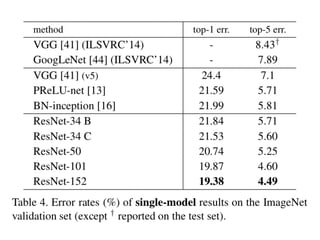
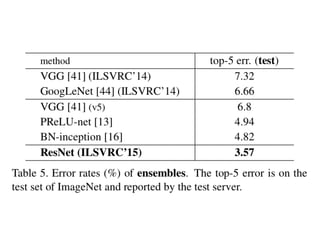
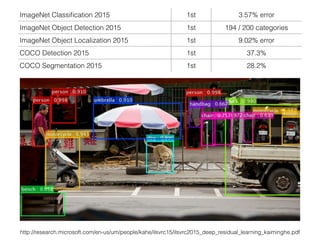
ImageNet Classification 2015 1st 3.57% error
ImageNet Object Detection 2015 1st 194 / 200 categories
ImageNet Object Localization 2015 1st 9.02% error
COCO Detection 2015 1st 37.3%
COCO Segmentation 2015 1st 28.2%
http://research.microsoft.com/en-us/um/people/kahe/ilsvrc15/ilsvrc2015_deep_residual_learning_kaiminghe.pdf

Paper overview: "Deep Residual Learning for Image Recognition"