Anusua Trivedi, Data Scientist
Algorithm Data Science (ADS)
antriv@microsoft.com
Transfer Learning and Fine-
tuning Deep Neural Networks
1. Traditional Machine Learning (ML)
2. ML Vs. Deep Learning
3. Why Deep Learning for Image Analysis
4. Deep Convolutional Neural Network (DCNN)
5. Transfer Learning DCNN
6. Fine-tuning DCNN
7. Recurrent Neural Network (RNN)
8. Case Studies
Talk Outline
2
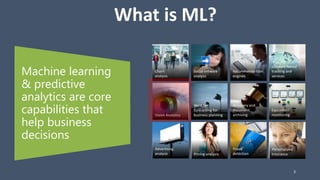
Vision Analytics
Recommenda-tion
engines
Advertising
analysis
Weather
forecasting for
business planning
Social network
analysis
Legal
discovery and
document
archiving
Pricing analysis
Fraud
detection
Churn
analysis
Equipment
monitoring
Location-based
tracking and
services
Personalized
Insurance
Machine learning
& predictive
analytics are core
capabilities that
help business
decisions
What is ML?
3
Traditional ML Vs Deep Learning
 Deep learning can
automatically learn
features in data​
 Deep learning is largely a
"black box" technique,
updating learned weights
at each layer
 Traditional ML requires
manual feature
extraction/engineering
 Feature extraction for
unstructured data is very
difficult
4
1. Image data requires subject-matter expertise to extract
key features
2. Deep learning extracts feature automatically from
domain-specific images, without any feature engineering
technique
3. This step makes the image analysis process much easier
Why use Deep Learning for Image
Analysis?
5
Early Work
1. Fukushima (1980) – Neo-Cognitron
2. LeCun (1989) – Convolutional Neural Networks
(CNN)
3. With the advent of GPUs, DCNN popularity grew
4. Most popular – AlexNet (on ImageNet images)
6
1. Train networks with many layers
2. Multiple layers work to build an improved feature space
3. First layer learns 1st order features (e.g. edges)
4. 2nd layer learns higher order features
5. Lastly, final layer features are fed into supervised layer(s)
Deep Neural Network (DNN)
7
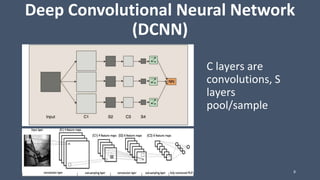
Deep Convolutional Neural Network
(DCNN)
8
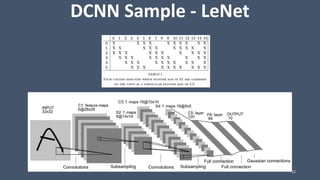
C layers are
convolutions, S
layers
pool/sample
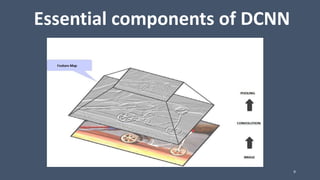
Essential components of DCNN
9
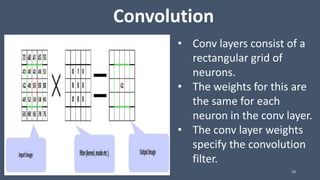
Convolution
10
• Conv layers consist of a
rectangular grid of
neurons.
• The weights for this are
the same for each
neuron in the conv layer.
• The conv layer weights
specify the convolution
filter.
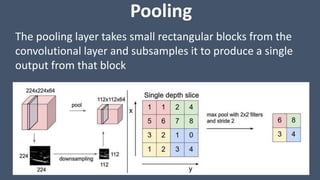
Pooling
11
The pooling layer takes small rectangular blocks from the
convolutional layer and subsamples it to produce a single
output from that block
DCNN Sample - LeNet
12
Transfer Learning & Fine-tuning
DCNN
13
1.Non-symbolic frameworks
• The main drawback of imperative frameworks
(like torch, caffe etc. ) is manual optimization.
• Most imperative frameworks are not easily modified.
2.Symbolic frameworks
• Symbolic frameworks (like Theano, Tensorflow, CNTK,
MXNET etc.) can infer optimization automatically from the
dependency graph.
• A symbolic framework can exploit much more memory reuse
Deep Learning Frameworks
14
1. Easy to implement new networks
2. Easy to modify existing networks using Lasagne/Keras
3. Very mature python interface
4. Easy to customize with domain-specific data.
5. Transfer learning and fine tuning in Lasagne/Keras is very
easy
Theano
15
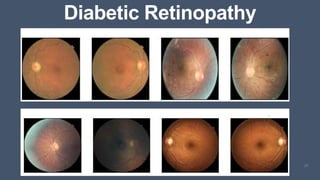
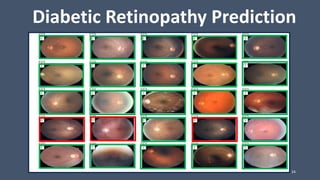
1. Here we use labeled fluorescein angiography images of
eyes to improve Diabetic Retinopathy (DR) prediction.
2. We use a DCNN to improve DR prediction.
Case Study: Diabetic Retinopathy
Prediction
16
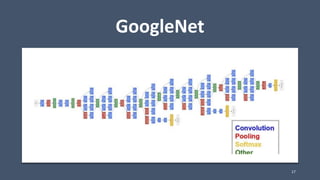
GoogleNet
17
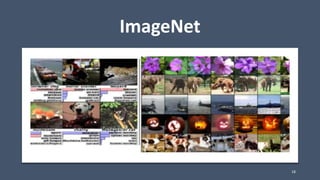
ImageNet
18
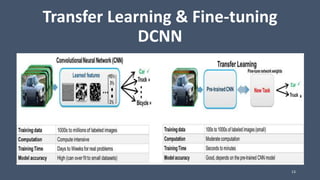
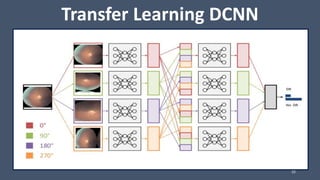
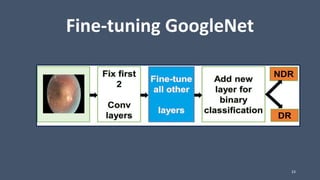
1. We use an ImageNet pre-trained DCNN
2. We fine-tune that DCNN to transfer generic learned
features to DR prediction.
3. Lower layers of the pre-trained DCNN contain generic
features that can be used for the DR prediction task.
Transfer Learning & Fine-tuning our
DCNN model
19
Diabetic Retinopathy
20
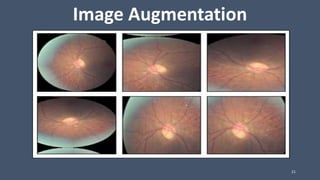
Image Augmentation
21
Transfer Learning DCNN
22
Fine-tuning GoogleNet
23
Diabetic Retinopathy Prediction
24
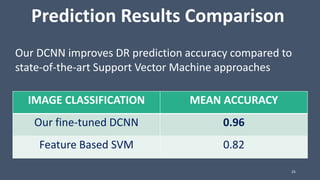
Prediction Results Comparison
Our DCNN improves DR prediction accuracy compared to
state-of-the-art Support Vector Machine approaches
IMAGE CLASSIFICATION MEAN ACCURACY
Our fine-tuned DCNN 0.96
Feature Based SVM 0.82
25
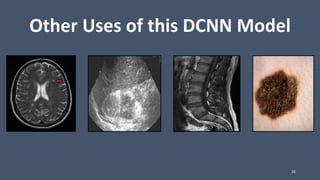
Other Uses of this DCNN Model
26
Re-usability of this DCNN Model
1. We fine-tune ImageNet-trained DCNN for medical
image analysis
2. We can fine-tune the same ImageNet-trained
DCNN model in a completely different domain, and
for a completely different task.
27
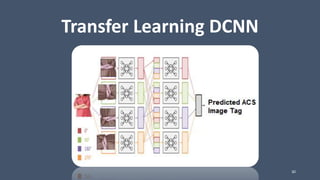
1. We use the ImageNet-trained DCNN and learn Apparel
Classification with Style (ACS) image features through
transfer learning and fine-tuning.
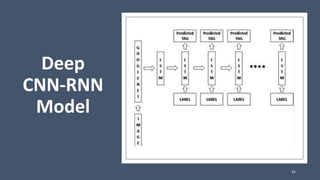
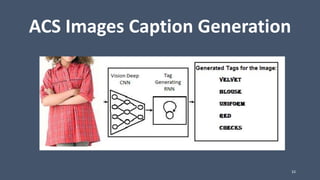
2. Then we use a Long short-term memory (LSTM)
Recurrent Neural Network (RNN) on the learned image
features for the image caption generation.
Case Study: Fashion Image Caption
Generation
28
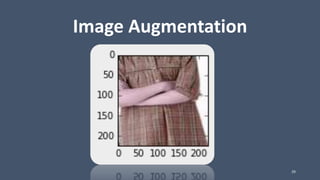
Image Augmentation
29
Transfer Learning DCNN
30
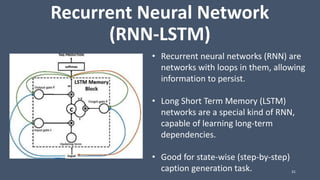
Recurrent Neural Network
(RNN-LSTM)
31
• Recurrent neural networks (RNN) are
networks with loops in them, allowing
information to persist.
• Long Short Term Memory (LSTM)
networks are a special kind of RNN,
capable of learning long-term
dependencies.
• Good for state-wise (step-by-step)
caption generation task.
Deep
CNN-RNN
Model
32
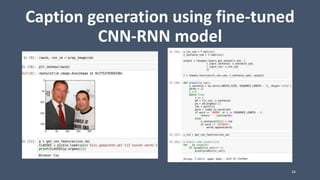
ACS Images Caption Generation
33
Caption generation using fine-tuned
CNN-RNN model
34
Microsoft Cognitive APIs and BOTs
35
 Transfer Learning and Fine-tuning Deep Neural Networks

Transfer Learning and Fine-tuning Deep Neural Networks

  • 1.
    Anusua Trivedi, DataScientist Algorithm Data Science (ADS) antriv@microsoft.com Transfer Learning and Fine- tuning Deep Neural Networks
  • 2.
    1. Traditional MachineLearning (ML) 2. ML Vs. Deep Learning 3. Why Deep Learning for Image Analysis 4. Deep Convolutional Neural Network (DCNN) 5. Transfer Learning DCNN 6. Fine-tuning DCNN 7. Recurrent Neural Network (RNN) 8. Case Studies Talk Outline 2
  • 3.
    Vision Analytics Recommenda-tion engines Advertising analysis Weather forecasting for businessplanning Social network analysis Legal discovery and document archiving Pricing analysis Fraud detection Churn analysis Equipment monitoring Location-based tracking and services Personalized Insurance Machine learning & predictive analytics are core capabilities that help business decisions What is ML? 3
  • 4.
    Traditional ML VsDeep Learning  Deep learning can automatically learn features in data​  Deep learning is largely a "black box" technique, updating learned weights at each layer  Traditional ML requires manual feature extraction/engineering  Feature extraction for unstructured data is very difficult 4
  • 5.
    1. Image datarequires subject-matter expertise to extract key features 2. Deep learning extracts feature automatically from domain-specific images, without any feature engineering technique 3. This step makes the image analysis process much easier Why use Deep Learning for Image Analysis? 5
  • 6.
    Early Work 1. Fukushima(1980) – Neo-Cognitron 2. LeCun (1989) – Convolutional Neural Networks (CNN) 3. With the advent of GPUs, DCNN popularity grew 4. Most popular – AlexNet (on ImageNet images) 6
  • 7.
    1. Train networkswith many layers 2. Multiple layers work to build an improved feature space 3. First layer learns 1st order features (e.g. edges) 4. 2nd layer learns higher order features 5. Lastly, final layer features are fed into supervised layer(s) Deep Neural Network (DNN) 7
  • 8.
    Deep Convolutional NeuralNetwork (DCNN) 8 C layers are convolutions, S layers pool/sample
  • 9.
  • 10.
    Convolution 10 • Conv layersconsist of a rectangular grid of neurons. • The weights for this are the same for each neuron in the conv layer. • The conv layer weights specify the convolution filter.
  • 11.
    Pooling 11 The pooling layertakes small rectangular blocks from the convolutional layer and subsamples it to produce a single output from that block
  • 12.
    DCNN Sample -LeNet 12
  • 13.
    Transfer Learning &Fine-tuning DCNN 13
  • 14.
    1.Non-symbolic frameworks • Themain drawback of imperative frameworks (like torch, caffe etc. ) is manual optimization. • Most imperative frameworks are not easily modified. 2.Symbolic frameworks • Symbolic frameworks (like Theano, Tensorflow, CNTK, MXNET etc.) can infer optimization automatically from the dependency graph. • A symbolic framework can exploit much more memory reuse Deep Learning Frameworks 14
  • 15.
    1. Easy toimplement new networks 2. Easy to modify existing networks using Lasagne/Keras 3. Very mature python interface 4. Easy to customize with domain-specific data. 5. Transfer learning and fine tuning in Lasagne/Keras is very easy Theano 15
  • 16.
    1. Here weuse labeled fluorescein angiography images of eyes to improve Diabetic Retinopathy (DR) prediction. 2. We use a DCNN to improve DR prediction. Case Study: Diabetic Retinopathy Prediction 16
  • 17.
  • 18.
  • 19.
    1. We usean ImageNet pre-trained DCNN 2. We fine-tune that DCNN to transfer generic learned features to DR prediction. 3. Lower layers of the pre-trained DCNN contain generic features that can be used for the DR prediction task. Transfer Learning & Fine-tuning our DCNN model 19
  • 20.
  • 21.
  • 22.
  • 23.
  • 24.
  • 25.
    Prediction Results Comparison OurDCNN improves DR prediction accuracy compared to state-of-the-art Support Vector Machine approaches IMAGE CLASSIFICATION MEAN ACCURACY Our fine-tuned DCNN 0.96 Feature Based SVM 0.82 25
  • 26.
    Other Uses ofthis DCNN Model 26
  • 27.
    Re-usability of thisDCNN Model 1. We fine-tune ImageNet-trained DCNN for medical image analysis 2. We can fine-tune the same ImageNet-trained DCNN model in a completely different domain, and for a completely different task. 27
  • 28.
    1. We usethe ImageNet-trained DCNN and learn Apparel Classification with Style (ACS) image features through transfer learning and fine-tuning. 2. Then we use a Long short-term memory (LSTM) Recurrent Neural Network (RNN) on the learned image features for the image caption generation. Case Study: Fashion Image Caption Generation 28
  • 29.
  • 30.
  • 31.
    Recurrent Neural Network (RNN-LSTM) 31 •Recurrent neural networks (RNN) are networks with loops in them, allowing information to persist. • Long Short Term Memory (LSTM) networks are a special kind of RNN, capable of learning long-term dependencies. • Good for state-wise (step-by-step) caption generation task.
  • 32.
  • 33.
    ACS Images CaptionGeneration 33
  • 34.
    Caption generation usingfine-tuned CNN-RNN model 34
  • 35.

Editor's Notes

  • #2 Main page: http://cortanaanalytics.com
  • #13 The lower-layers are composed to alternating convolution and max-pooling layers. The upper-layers are fully-connected and correspond to a traditional MLP (hidden layer + logistic regression).