
WELCOME TO OUR
PRESENTATION
Jony Ahmmed Id: 13143103119
Md Rajib Bhuiyan Id: 13142103134
CNN
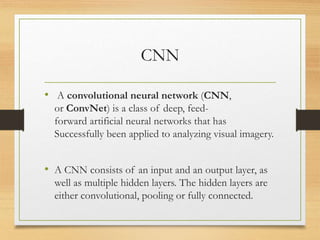
• A convolutional neural network (CNN,
or ConvNet) is a class of deep, feed-
forward artificial neural networks that has
Successfully been applied to analyzing visual imagery.
• A CNN consists of an input and an output layer, as
well as multiple hidden layers. The hidden layers are
either convolutional, pooling or fully connected.
Convolutional Layer:
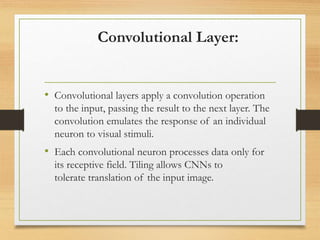
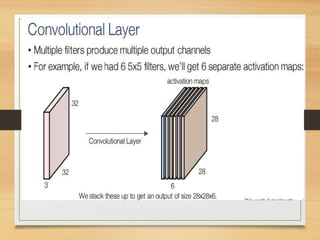
• Convolutional layers apply a convolution operation
to the input, passing the result to the next layer. The
convolution emulates the response of an individual
neuron to visual stimuli.
• Each convolutional neuron processes data only for
its receptive field. Tiling allows CNNs to
tolerate translation of the input image.
Pooling Layer:
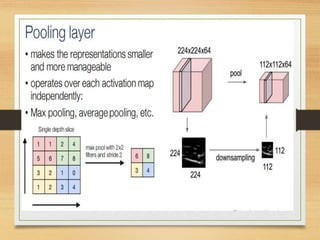
• Convolutional networks may include local or global
pooling layers , which combine the outputs of
neuron clusters at one layer into a single neuron in
the next layer for minimizing the risk.
Fully Connected layer:
• Fully connected layers connect every neuron in one
layer to every neuron in another layer. It is in
principle the same as the traditional multi-layer
perceptron neural network.
EXAMPLE
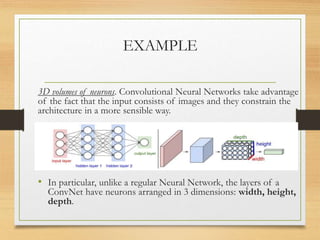
3D volumes of neurons. Convolutional Neural Networks take advantage
of the fact that the input consists of images and they constrain the
architecture in a more sensible way.
• In particular, unlike a regular Neural Network, the layers of a
ConvNet have neurons arranged in 3 dimensions: width, height,
depth.
EXAMPLE
• For example, the input images in CIFAR-10 are an input
volume of activations, and the volume has dimensions
32x32x3 (width, height, depth respectively). As we will
soon see, the neurons in a layer will only be connected to
a small region of the layer before it, instead of all of the
neurons in a fully-connected manner. Moreover, the final
output layer would for CIFAR-10 have dimensions
1x1x10, because by the end of the ConvNet architecture
we will reduce the full image into a single vector of class
scores, arranged along the depth dimension. Here is a
visualization:
Thank You !!

CONVOLUTIONAL NEURAL NETWORK

  • 1.
    WELCOME TO OUR PRESENTATION JonyAhmmed Id: 13143103119 Md Rajib Bhuiyan Id: 13142103134
  • 2.
    CNN • A convolutionalneural network (CNN, or ConvNet) is a class of deep, feed- forward artificial neural networks that has Successfully been applied to analyzing visual imagery. • A CNN consists of an input and an output layer, as well as multiple hidden layers. The hidden layers are either convolutional, pooling or fully connected.
  • 3.
    Convolutional Layer: • Convolutionallayers apply a convolution operation to the input, passing the result to the next layer. The convolution emulates the response of an individual neuron to visual stimuli. • Each convolutional neuron processes data only for its receptive field. Tiling allows CNNs to tolerate translation of the input image.
  • 5.
    Pooling Layer: • Convolutionalnetworks may include local or global pooling layers , which combine the outputs of neuron clusters at one layer into a single neuron in the next layer for minimizing the risk.
  • 7.
    Fully Connected layer: •Fully connected layers connect every neuron in one layer to every neuron in another layer. It is in principle the same as the traditional multi-layer perceptron neural network.
  • 9.
    EXAMPLE 3D volumes ofneurons. Convolutional Neural Networks take advantage of the fact that the input consists of images and they constrain the architecture in a more sensible way. • In particular, unlike a regular Neural Network, the layers of a ConvNet have neurons arranged in 3 dimensions: width, height, depth.
  • 10.
    EXAMPLE • For example,the input images in CIFAR-10 are an input volume of activations, and the volume has dimensions 32x32x3 (width, height, depth respectively). As we will soon see, the neurons in a layer will only be connected to a small region of the layer before it, instead of all of the neurons in a fully-connected manner. Moreover, the final output layer would for CIFAR-10 have dimensions 1x1x10, because by the end of the ConvNet architecture we will reduce the full image into a single vector of class scores, arranged along the depth dimension. Here is a visualization:
  • 11.