CLASS 10 [BASED ON N.C.E.R.T]
COMPILED BY : SHASHANK SHEKHAR PANDEY
How do organisms reproduce?
PART -I
INTRODUCTION
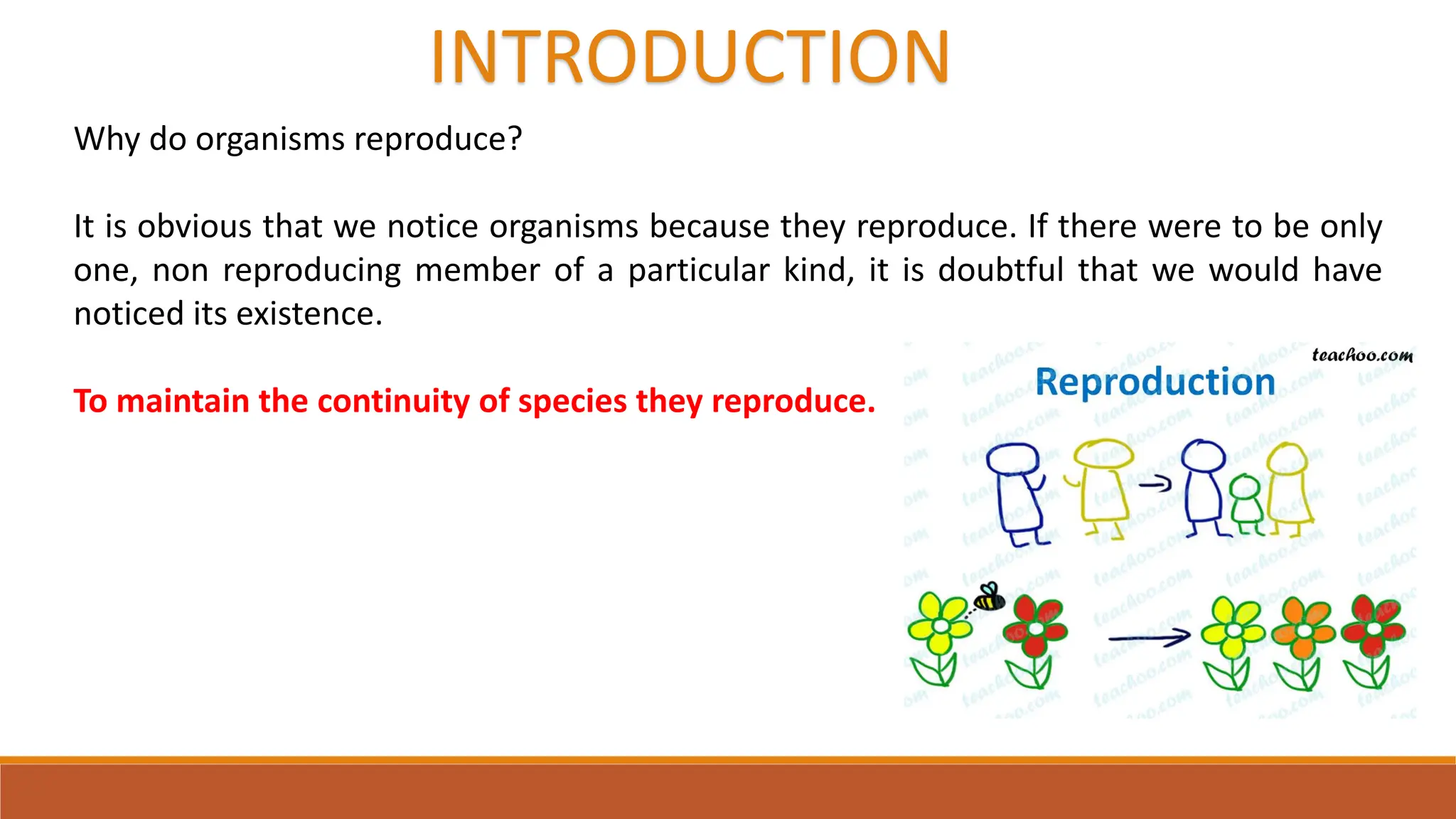
Why do organisms reproduce?
It is obvious that we notice organisms because they reproduce. If there were to be only
one, non reproducing member of a particular kind, it is doubtful that we would have
noticed its existence.
To maintain the continuity of species they reproduce.
DO ORGANISMS CREATE EXACT COPIES
OF THEMSELVES?
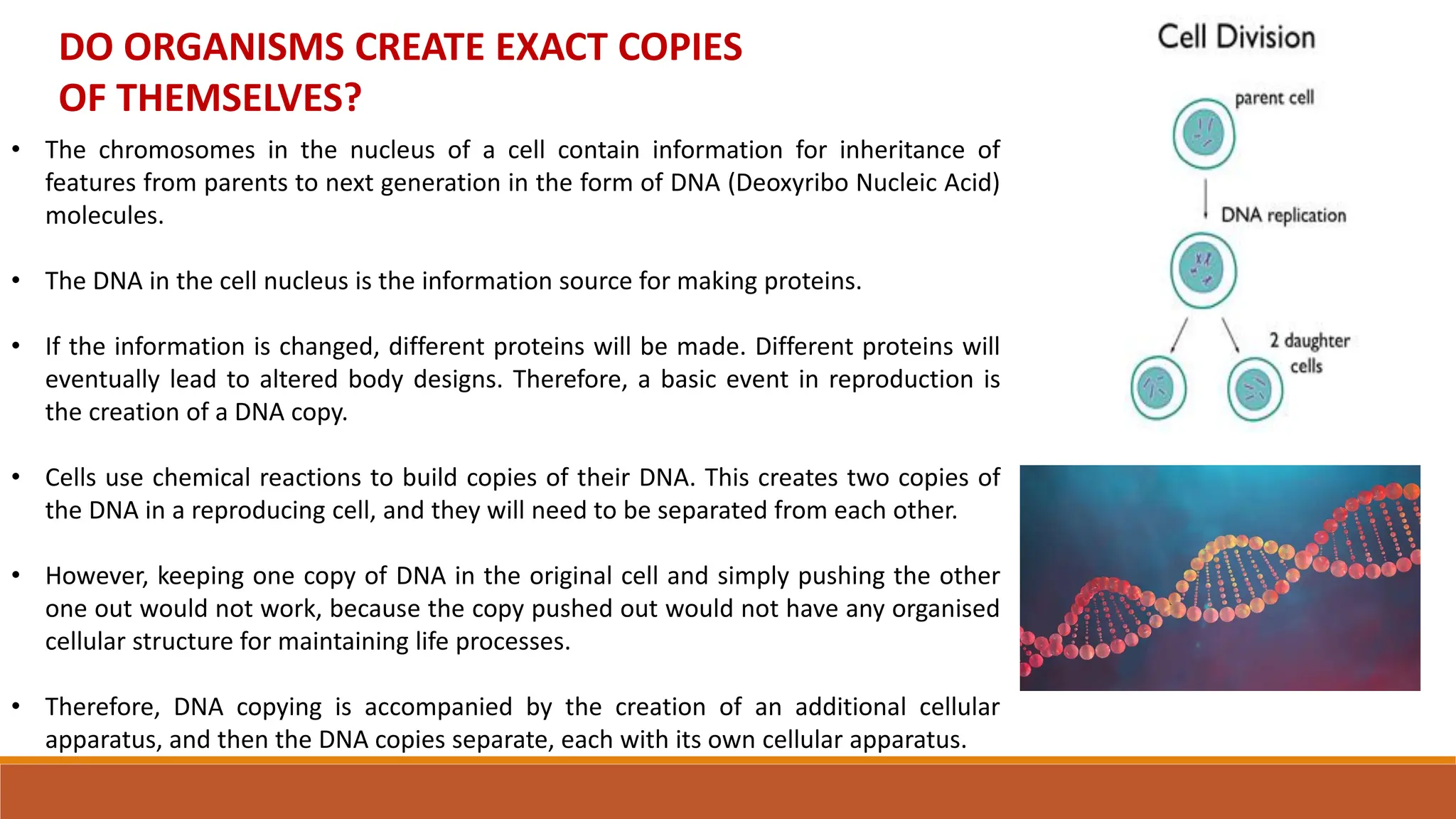
• The chromosomes in the nucleus of a cell contain information for inheritance of
features from parents to next generation in the form of DNA (Deoxyribo Nucleic Acid)
molecules.
• The DNA in the cell nucleus is the information source for making proteins.
• If the information is changed, different proteins will be made. Different proteins will
eventually lead to altered body designs. Therefore, a basic event in reproduction is
the creation of a DNA copy.
• Cells use chemical reactions to build copies of their DNA. This creates two copies of
the DNA in a reproducing cell, and they will need to be separated from each other.
• However, keeping one copy of DNA in the original cell and simply pushing the other
one out would not work, because the copy pushed out would not have any organised
cellular structure for maintaining life processes.
• Therefore, DNA copying is accompanied by the creation of an additional cellular
apparatus, and then the DNA copies separate, each with its own cellular apparatus.
• Effectively, a cell divides to give rise to two cells.
• These two cells are of course similar, but are they likely to be absolutely identical?
• The answer to this question will depend on how accurately the copying reactions involved occur.
• No bio-chemical reaction is absolutely reliable. Therefore, it is only to be expected that the process of copying the
DNA will have some variations each time.
• As a result, the DNA copies generated will be similar, but may not be identical to the original.
• Some of these variations might be so drastic that the new DNA copy cannot work with the cellular apparatus it
inherits.
• Such a newborn cell will simply die.
• On the other hand, there could still be many other variations in the DNA copies that would not lead to such a drastic
outcome.
• Thus, the surviving cells are similar to, but subtly different from each other
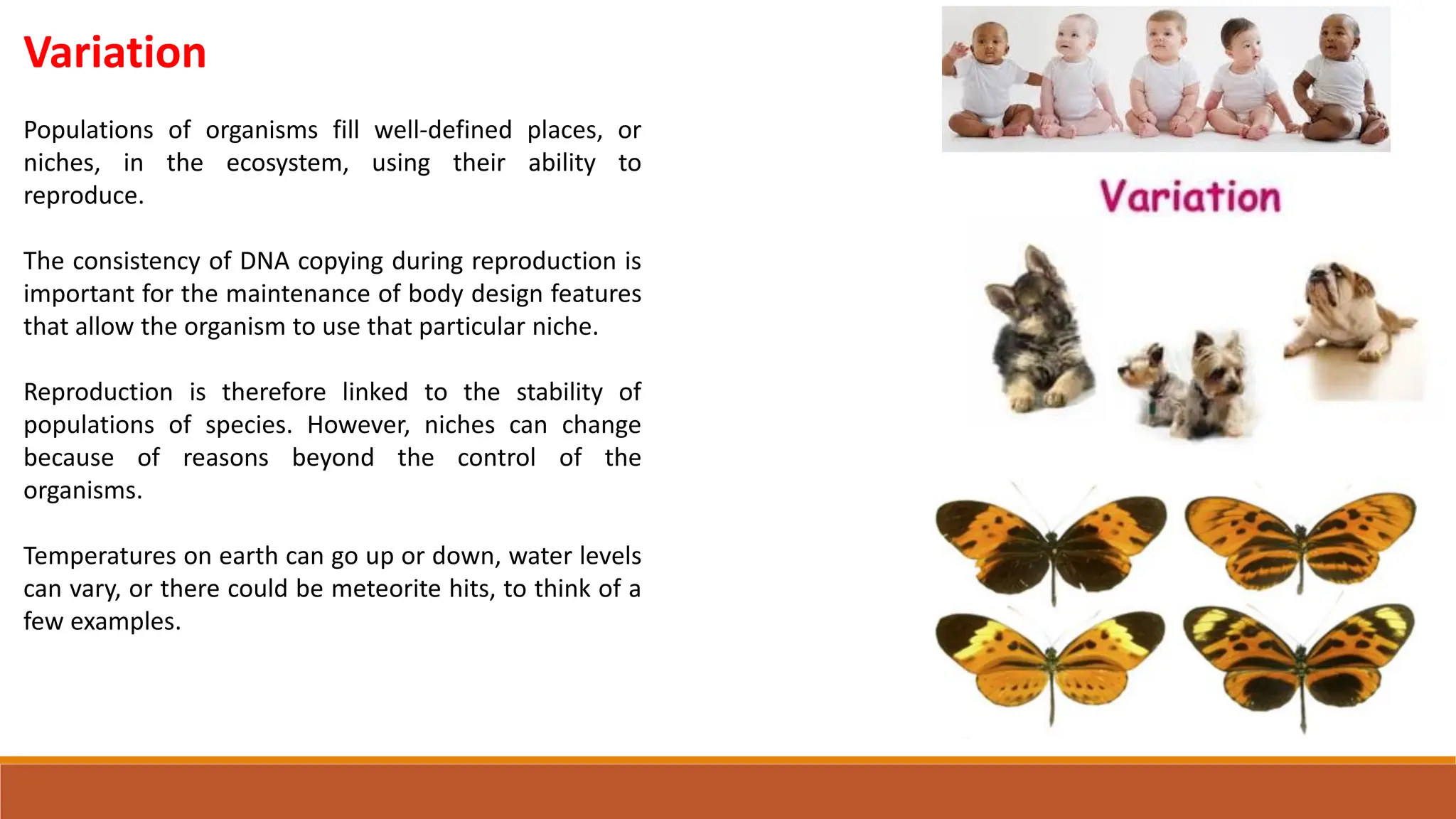
Variation
Populations of organisms fill well-defined places, or
niches, in the ecosystem, using their ability to
reproduce.
The consistency of DNA copying during reproduction is
important for the maintenance of body design features
that allow the organism to use that particular niche.
Reproduction is therefore linked to the stability of
populations of species. However, niches can change
because of reasons beyond the control of the
organisms.
Temperatures on earth can go up or down, water levels
can vary, or there could be meteorite hits, to think of a
few examples.
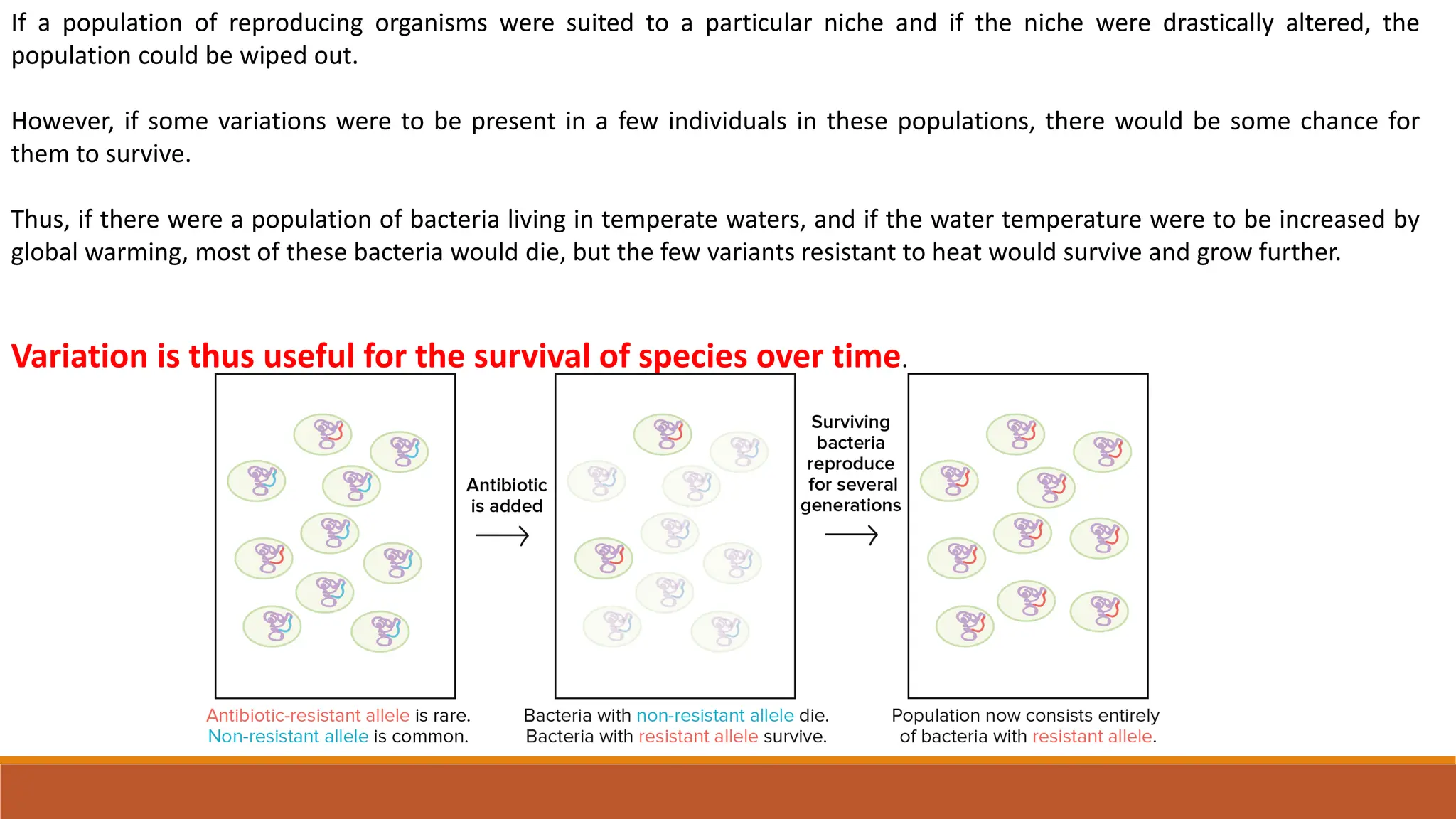
If a population of reproducing organisms were suited to a particular niche and if the niche were drastically altered, the
population could be wiped out.
However, if some variations were to be present in a few individuals in these populations, there would be some chance for
them to survive.
Thus, if there were a population of bacteria living in temperate waters, and if the water temperature were to be increased by
global warming, most of these bacteria would die, but the few variants resistant to heat would survive and grow further.
Variation is thus useful for the survival of species over time.
1.What is the importance of DNA copying in reproduction?
2. Why is variation beneficial to the species but not necessarily
for the individual?
QUESTIONS
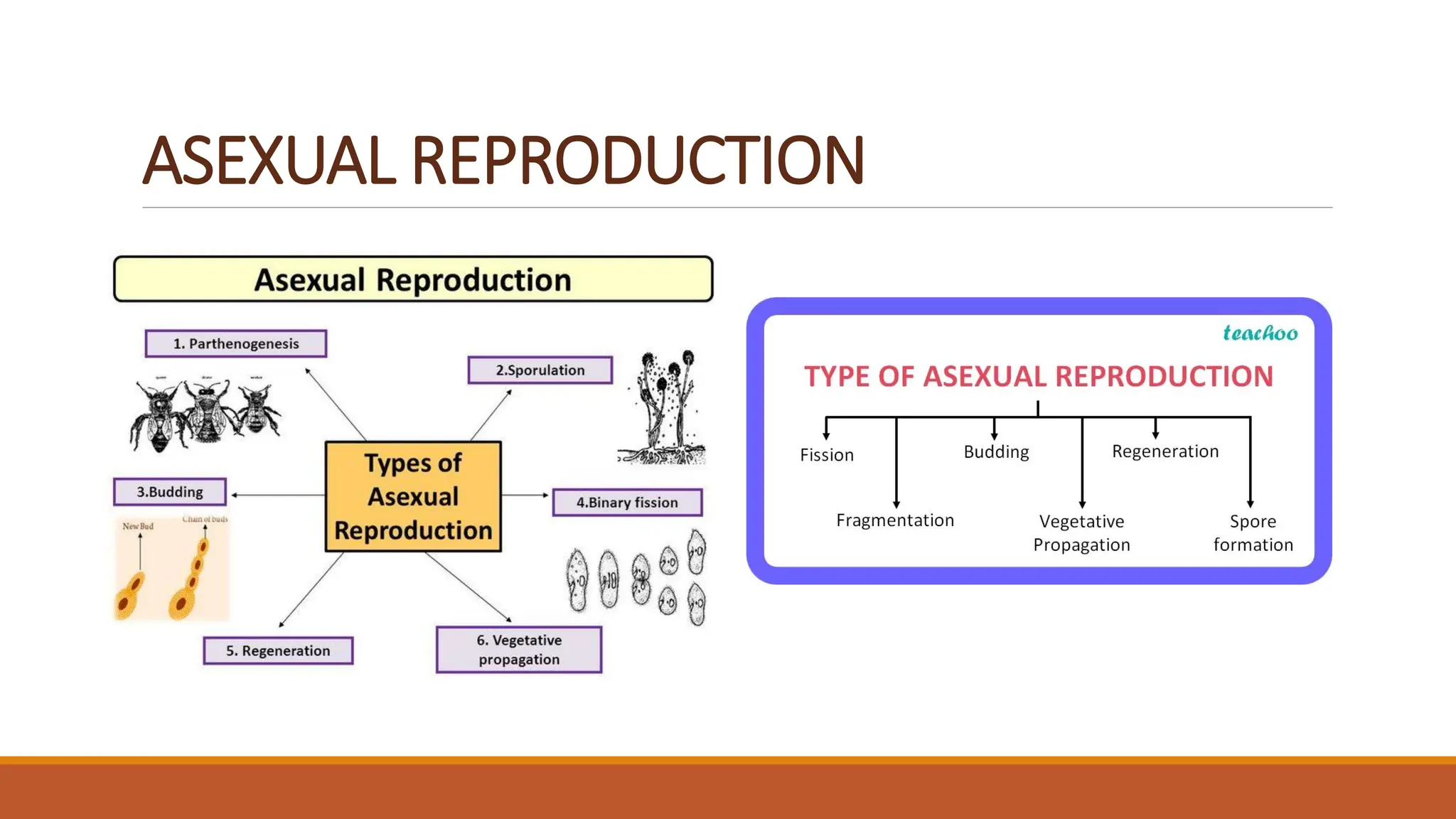
ASEXUAL REPRODUCTION
MODES OF REPRODUCTION USED BY SINGLE ORGANISMS
• BUDDING
• SPORULATION
• BINARY FISSION
• MULTIPLE FISSION
• FRAGMENTATION
• REGENERATION
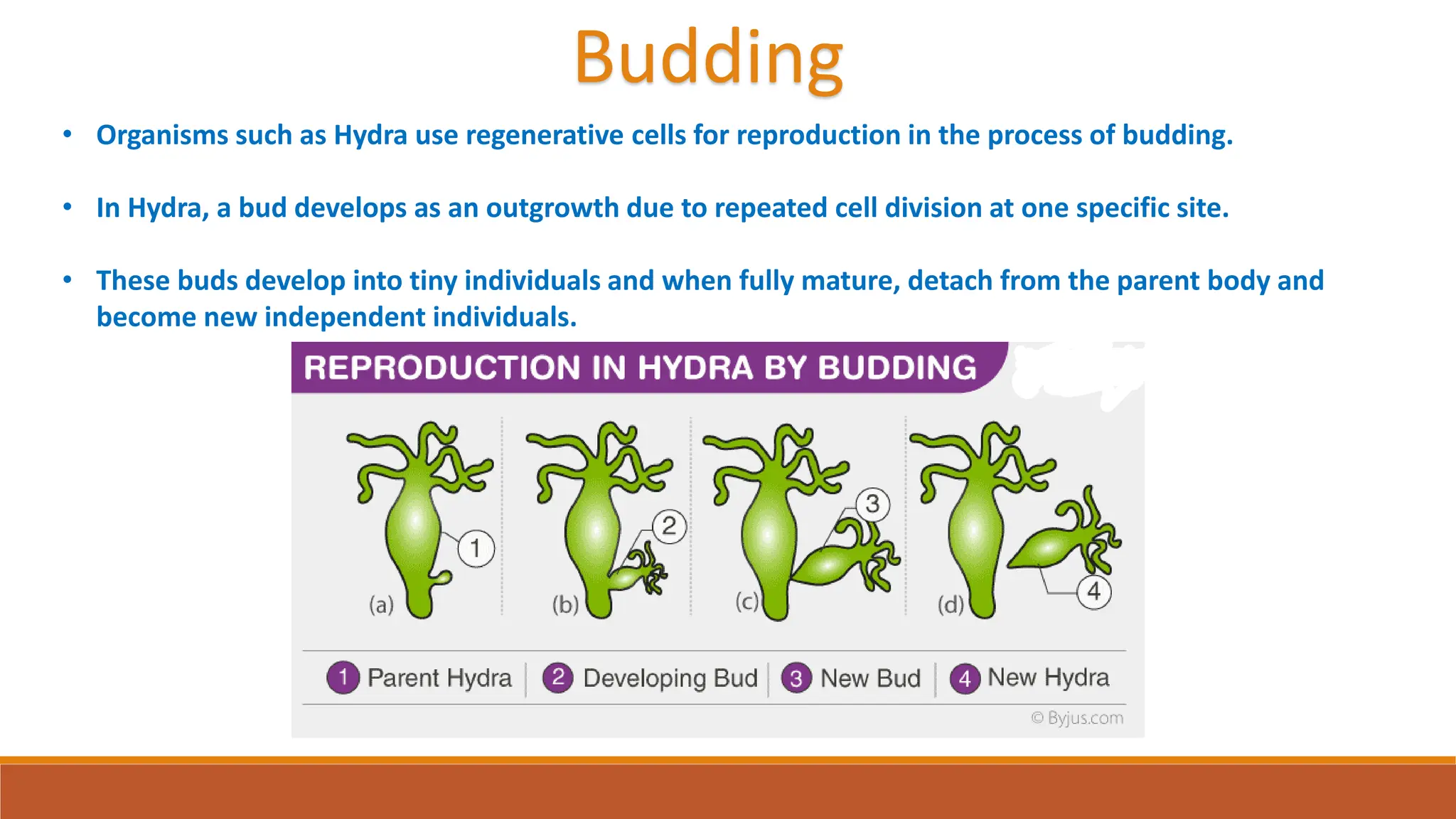
• Organisms such as Hydra use regenerative cells for reproduction in the process of budding.
• In Hydra, a bud develops as an outgrowth due to repeated cell division at one specific site.
• These buds develop into tiny individuals and when fully mature, detach from the parent body and
become new independent individuals.
Budding
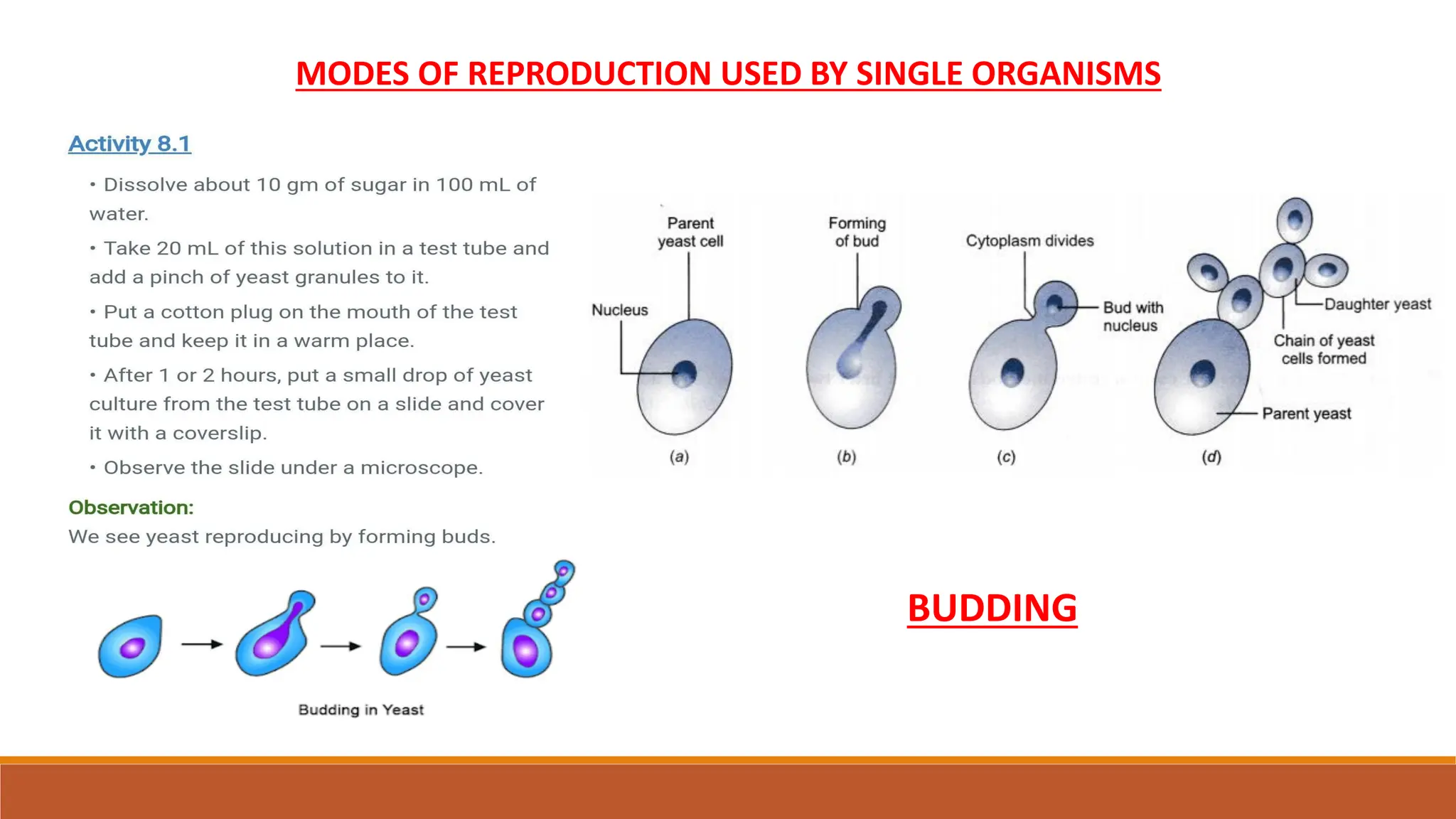
MODES OF REPRODUCTION USED BY SINGLE ORGANISMS
BUDDING
• Even in many simple multi-cellular organisms, specific
reproductive parts can be identified.
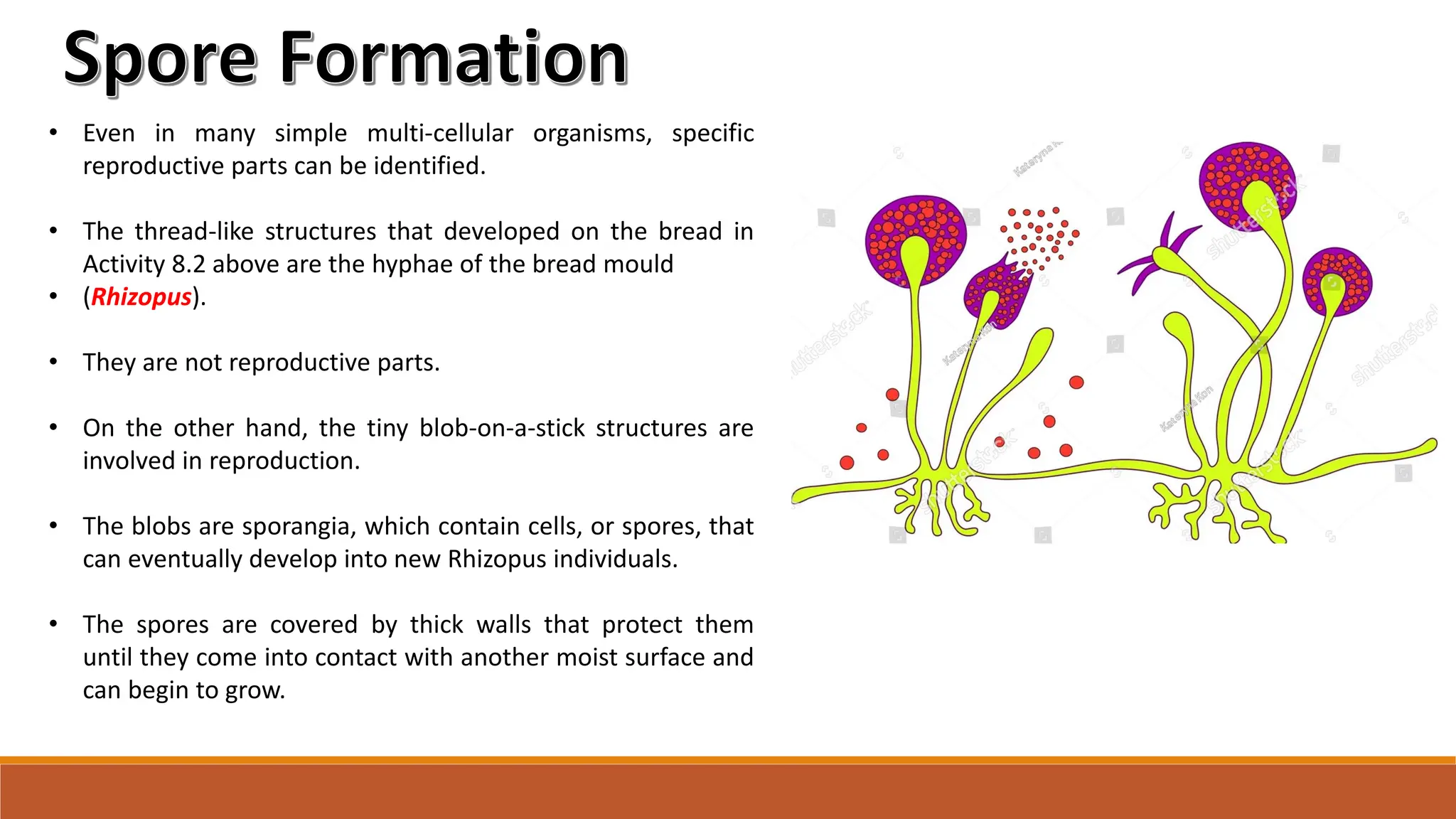
• The thread-like structures that developed on the bread in
Activity 8.2 above are the hyphae of the bread mould
• (Rhizopus).
• They are not reproductive parts.
• On the other hand, the tiny blob-on-a-stick structures are
involved in reproduction.
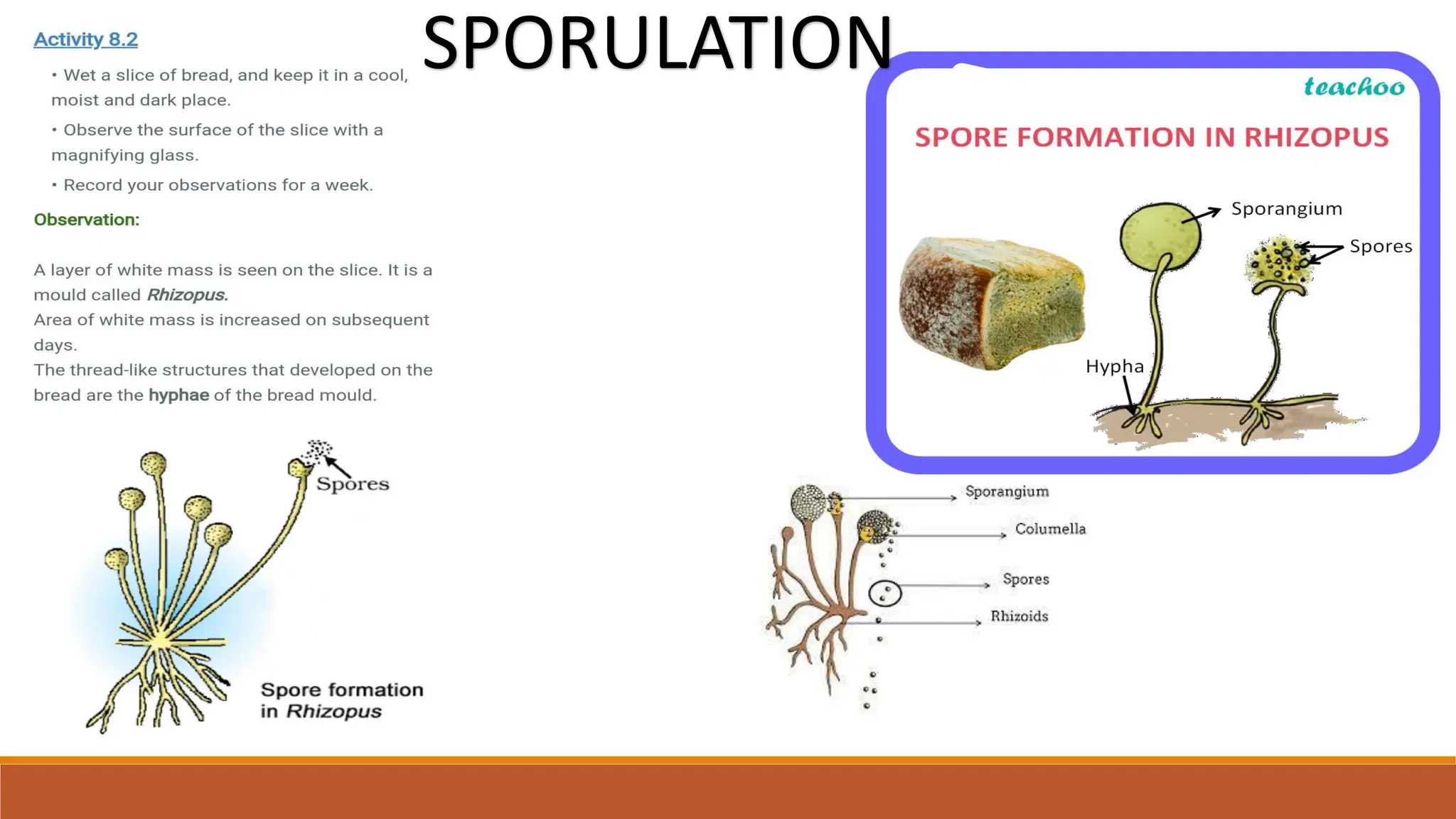
• The blobs are sporangia, which contain cells, or spores, that
can eventually develop into new Rhizopus individuals.
• The spores are covered by thick walls that protect them
until they come into contact with another moist surface and
can begin to grow.
Spore Formation
SPORULATION
Fission
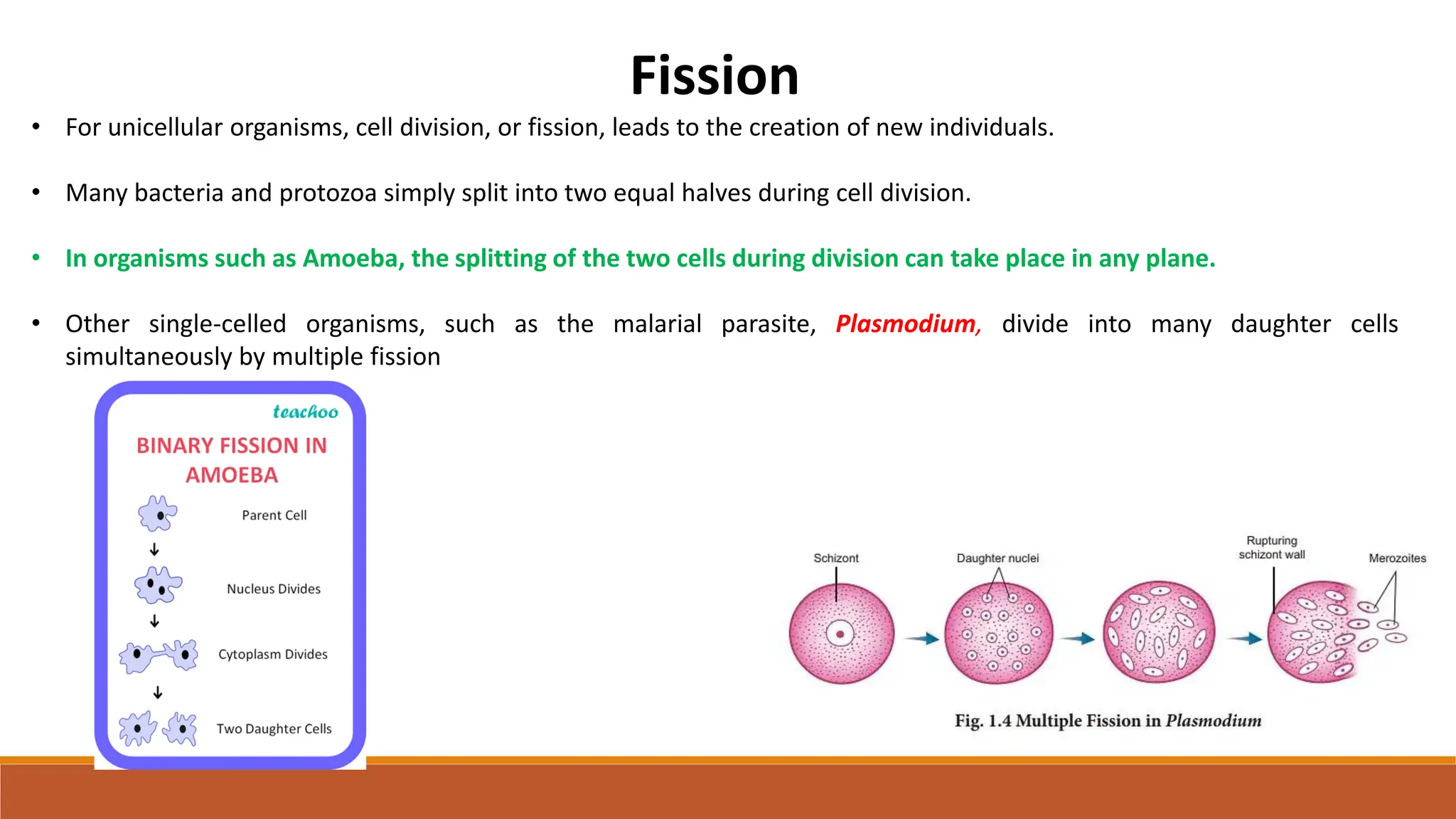
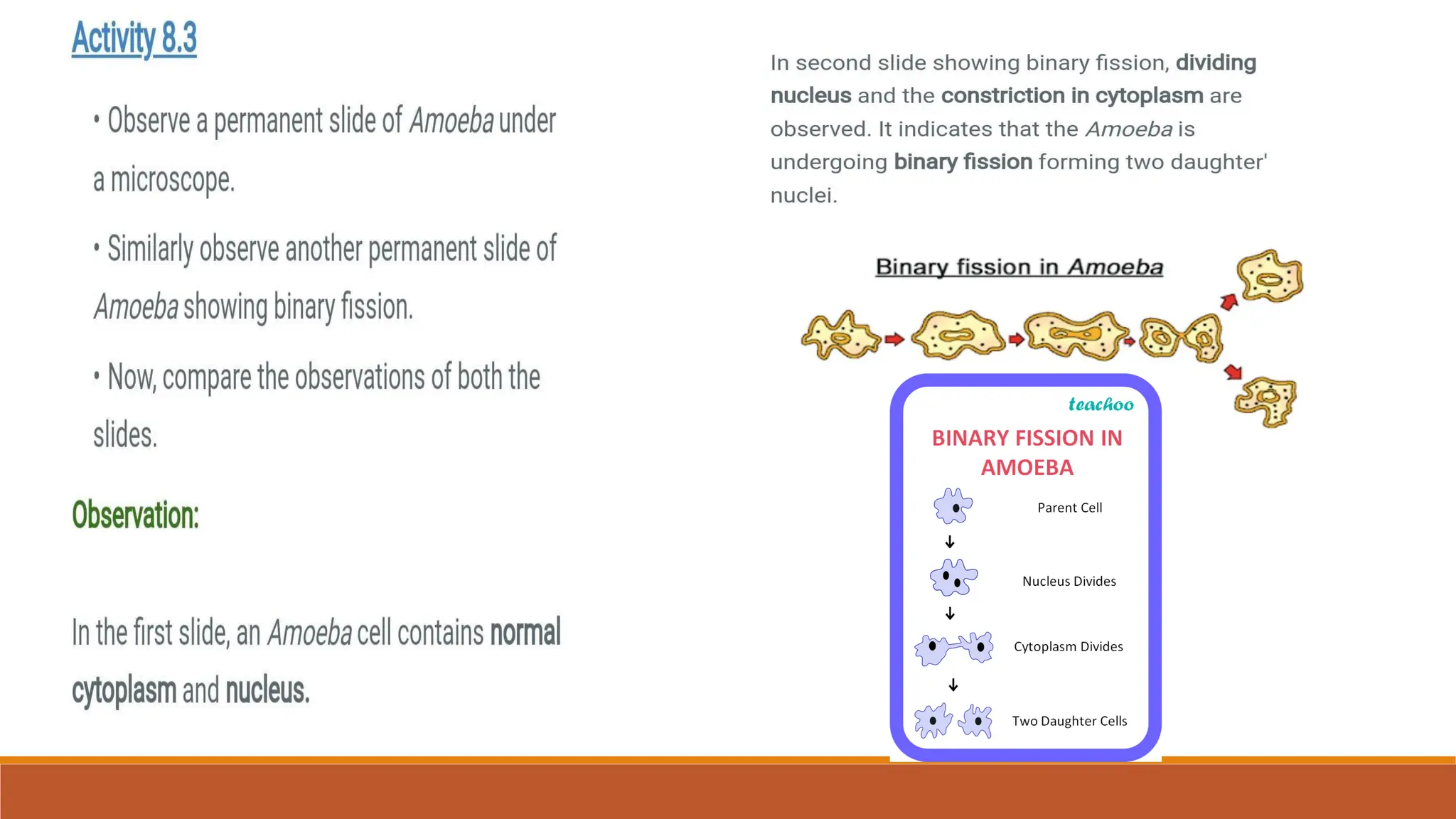
• For unicellular organisms, cell division, or fission, leads to the creation of new individuals.
• Many bacteria and protozoa simply split into two equal halves during cell division.
• In organisms such as Amoeba, the splitting of the two cells during division can take place in any plane.
• Other single-celled organisms, such as the malarial parasite, Plasmodium, divide into many daughter cells
simultaneously by multiple fission
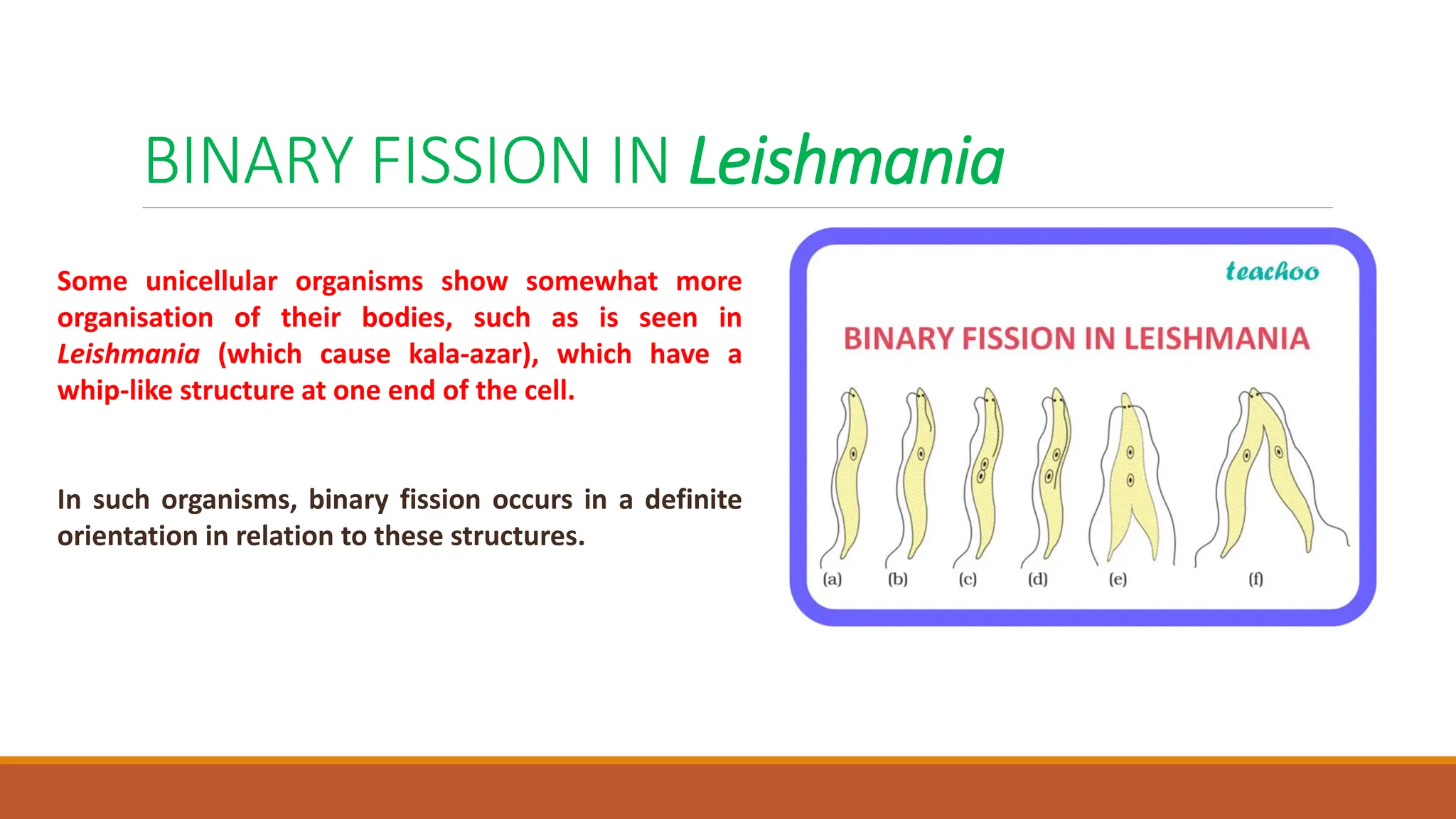
BINARY FISSION IN Leishmania
Some unicellular organisms show somewhat more
organisation of their bodies, such as is seen in
Leishmania (which cause kala-azar), which have a
whip-like structure at one end of the cell.
In such organisms, binary fission occurs in a definite
orientation in relation to these structures.
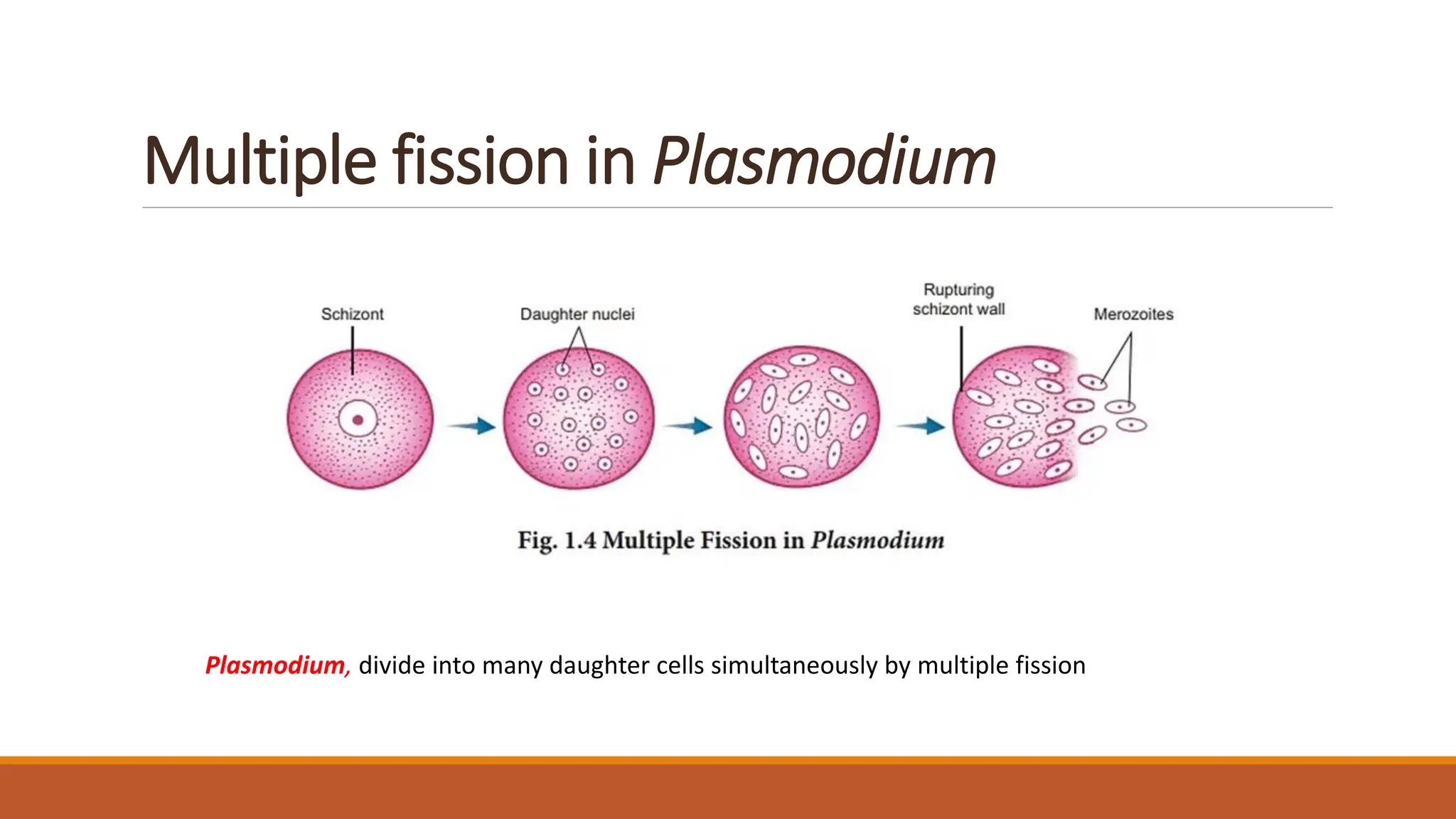
Multiple fission in Plasmodium
Plasmodium, divide into many daughter cells simultaneously by multiple fission
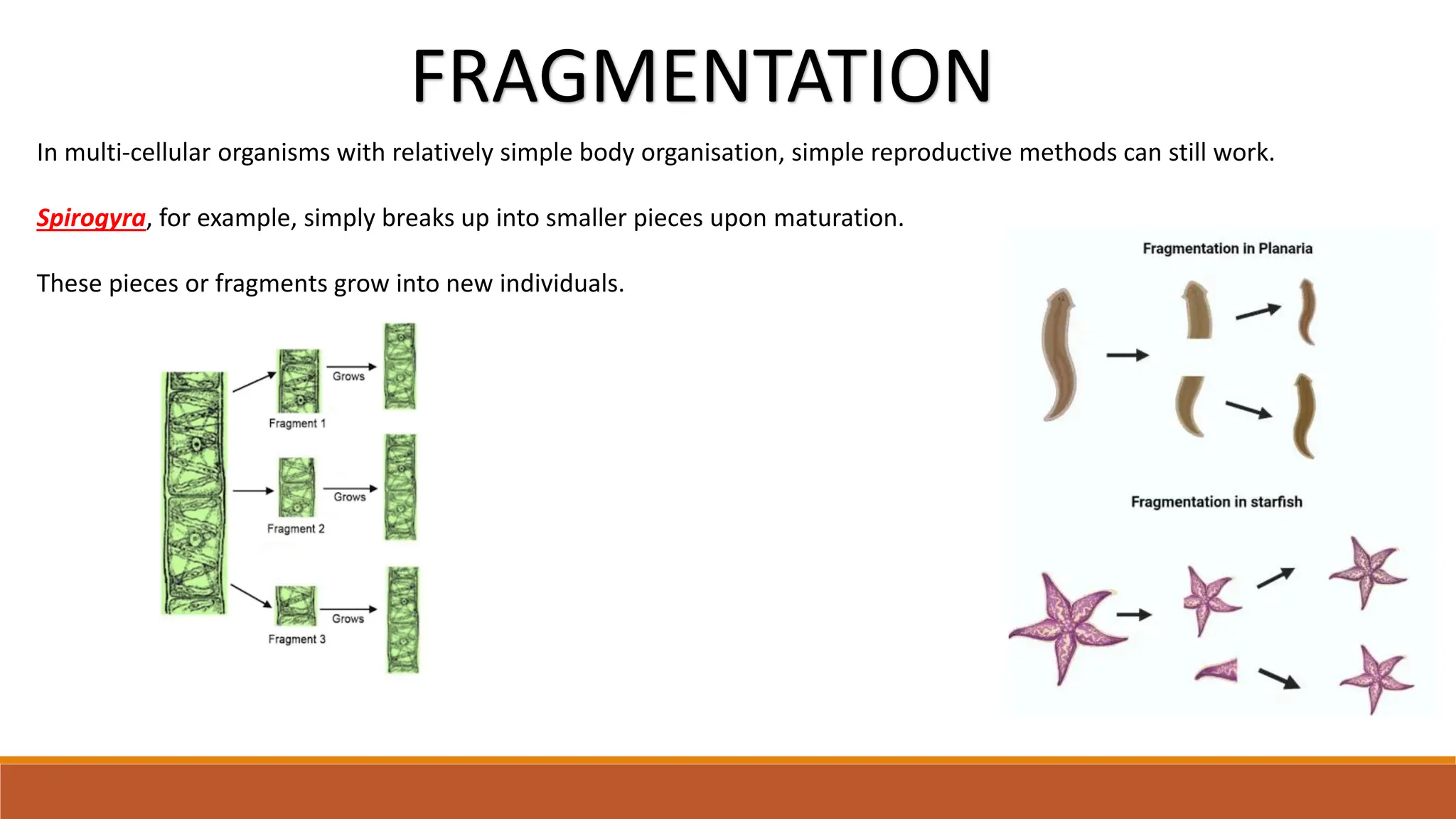
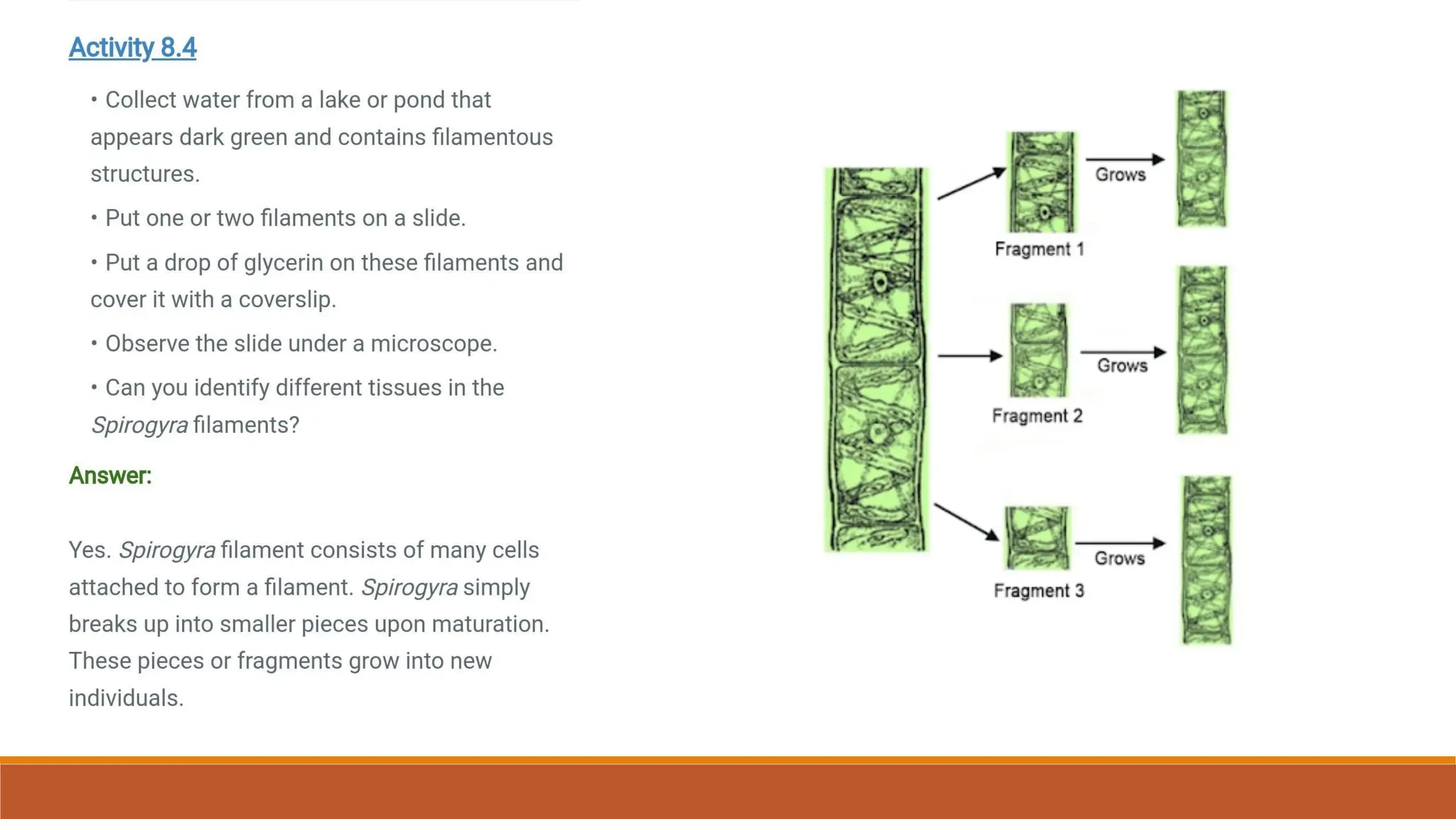
In multi-cellular organisms with relatively simple body organisation, simple reproductive methods can still work.
Spirogyra, for example, simply breaks up into smaller pieces upon maturation.
These pieces or fragments grow into new individuals.
FRAGMENTATION
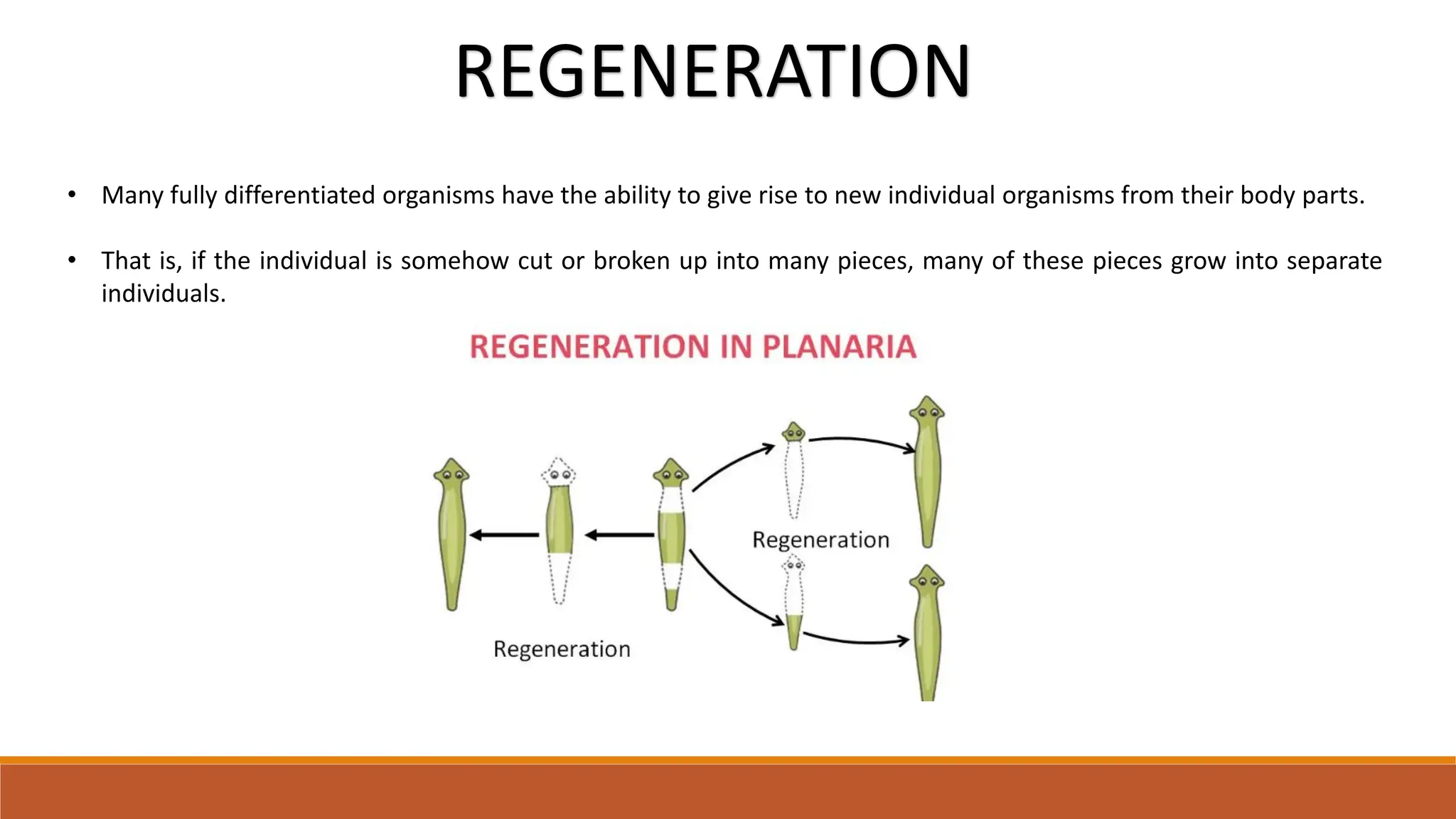
• Many fully differentiated organisms have the ability to give rise to new individual organisms from their body parts.
• That is, if the individual is somehow cut or broken up into many pieces, many of these pieces grow into separate
individuals.
REGENERATION
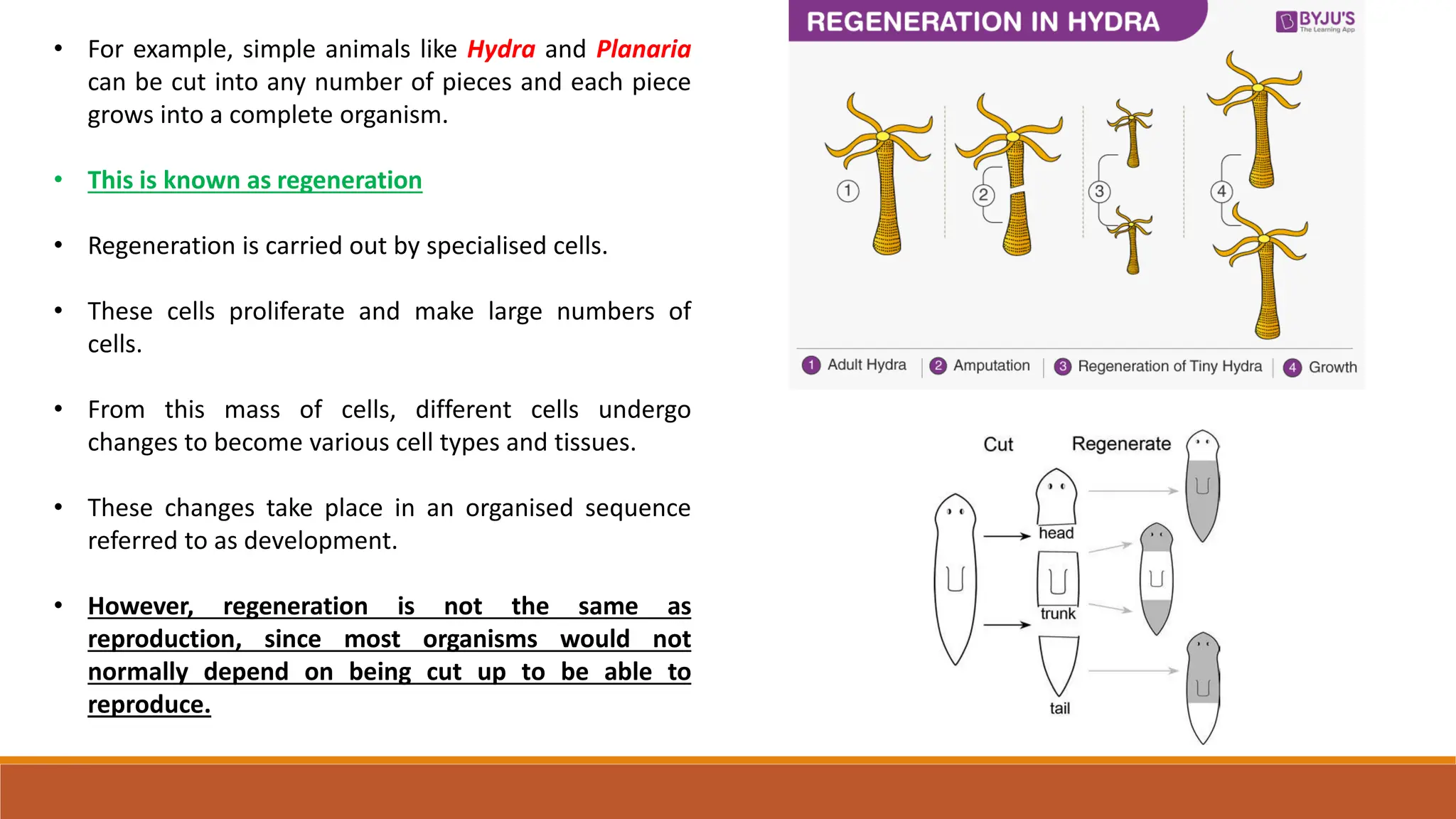
• For example, simple animals like Hydra and Planaria
can be cut into any number of pieces and each piece
grows into a complete organism.
• This is known as regeneration
• Regeneration is carried out by specialised cells.
• These cells proliferate and make large numbers of
cells.
• From this mass of cells, different cells undergo
changes to become various cell types and tissues.
• These changes take place in an organised sequence
referred to as development.
• However, regeneration is not the same as
reproduction, since most organisms would not
normally depend on being cut up to be able to
reproduce.
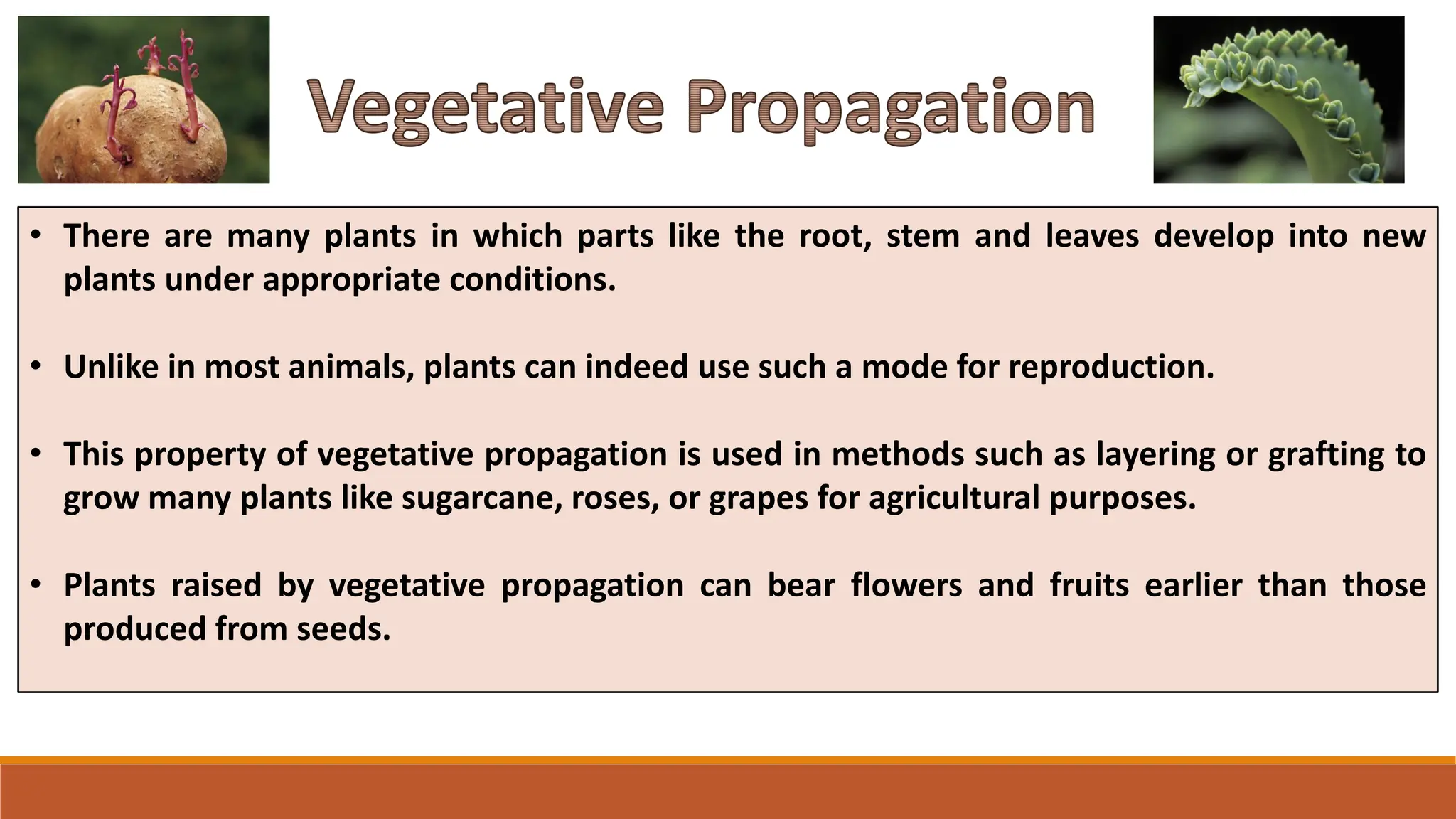
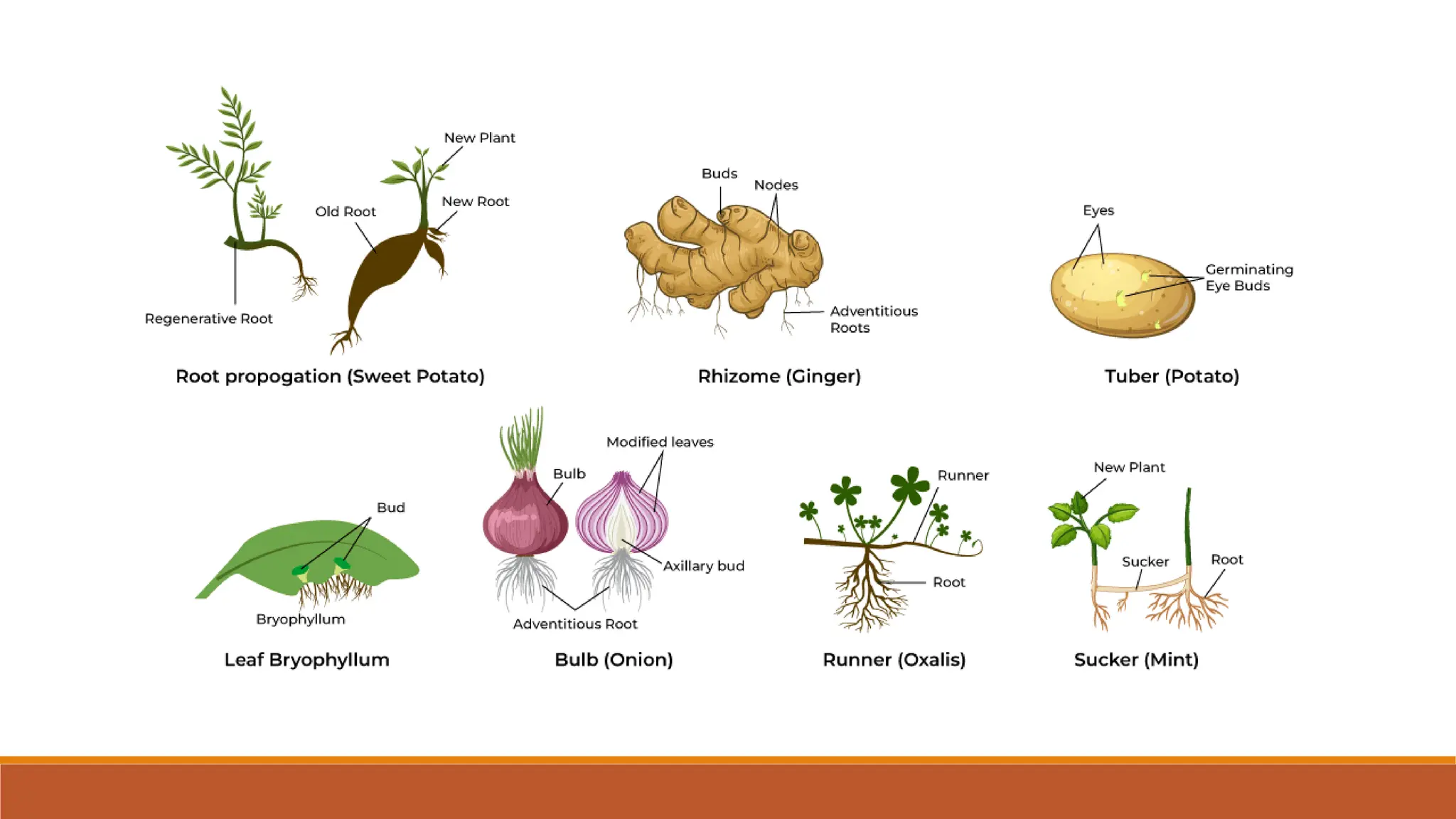
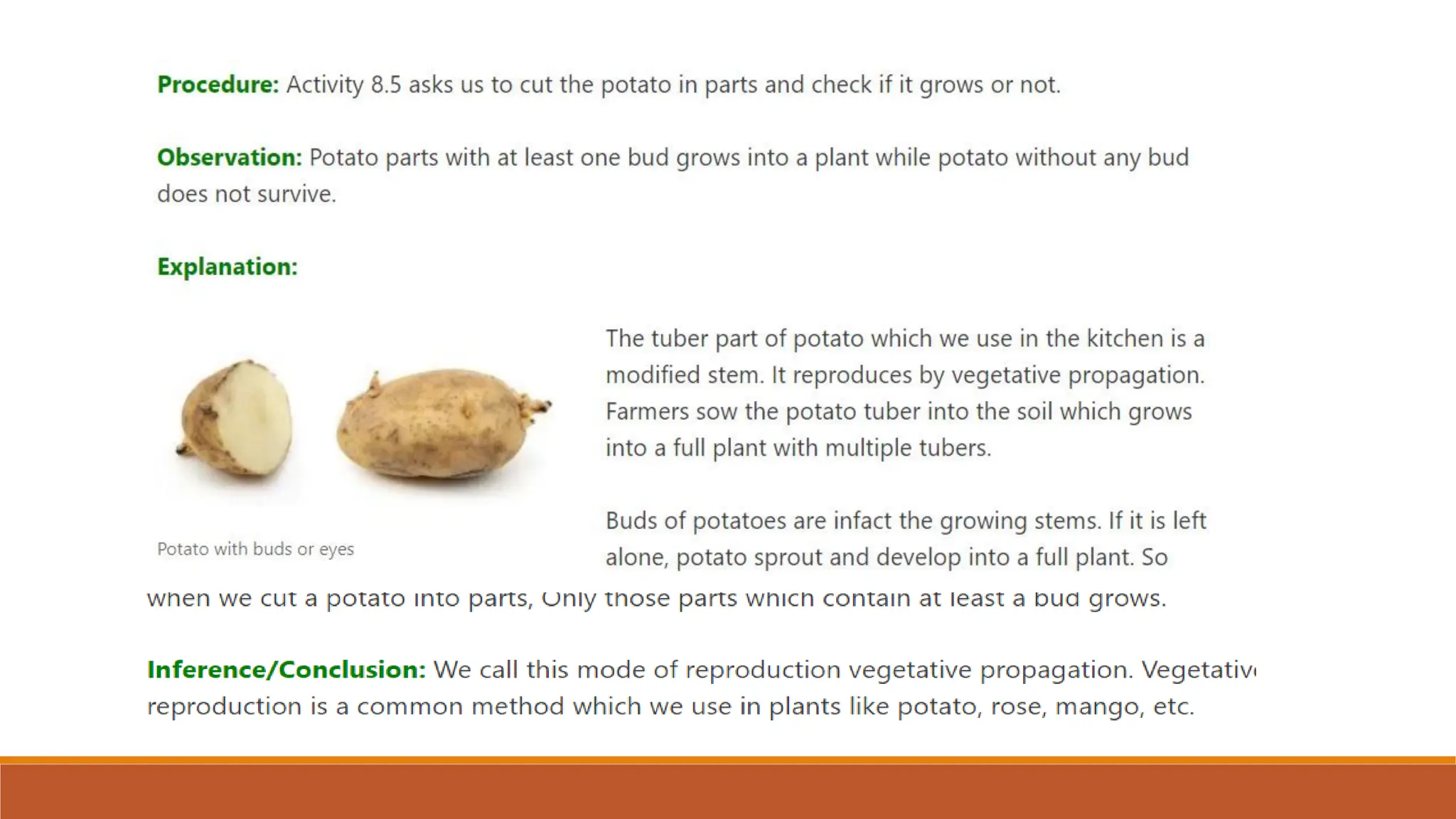
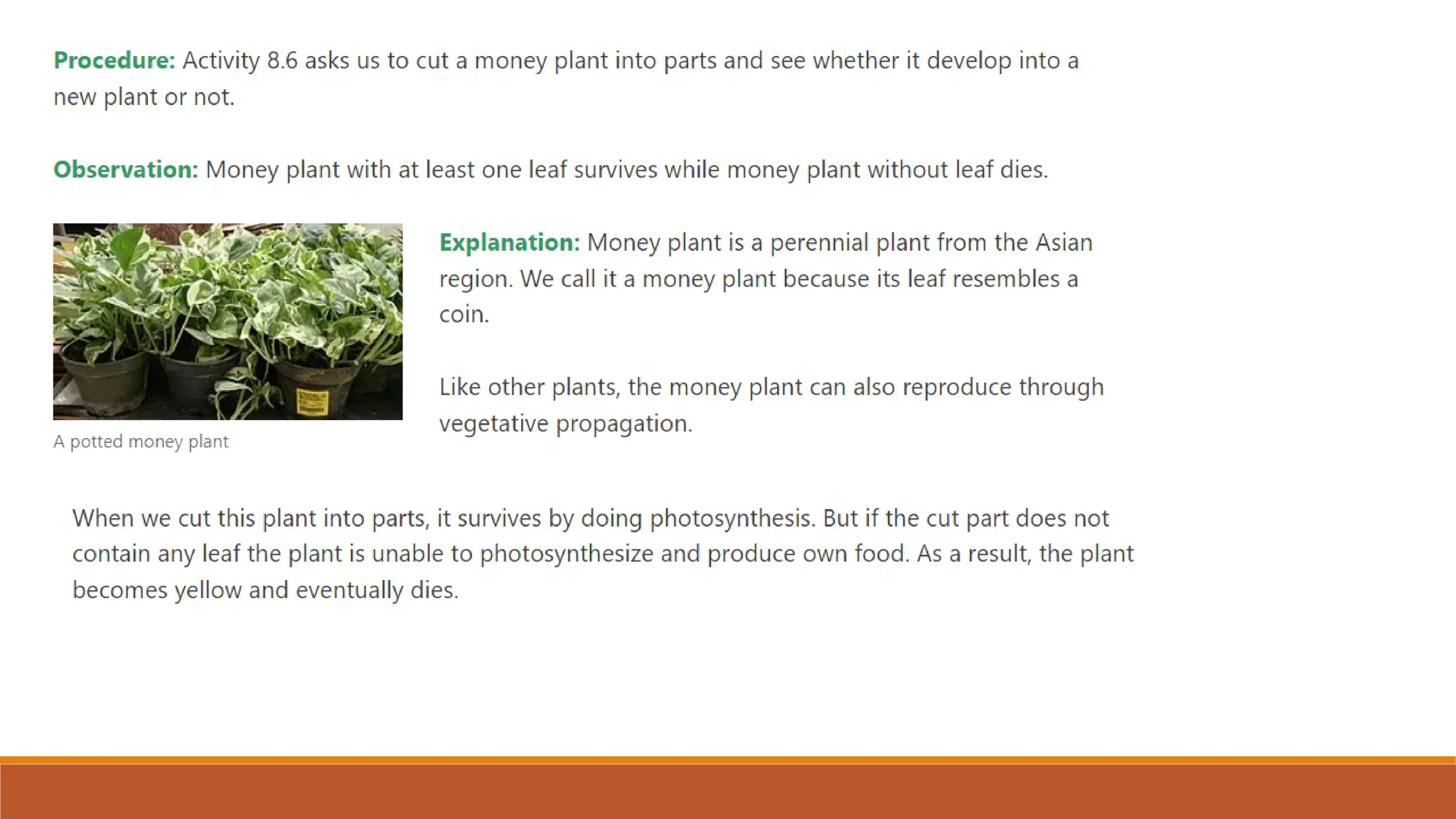
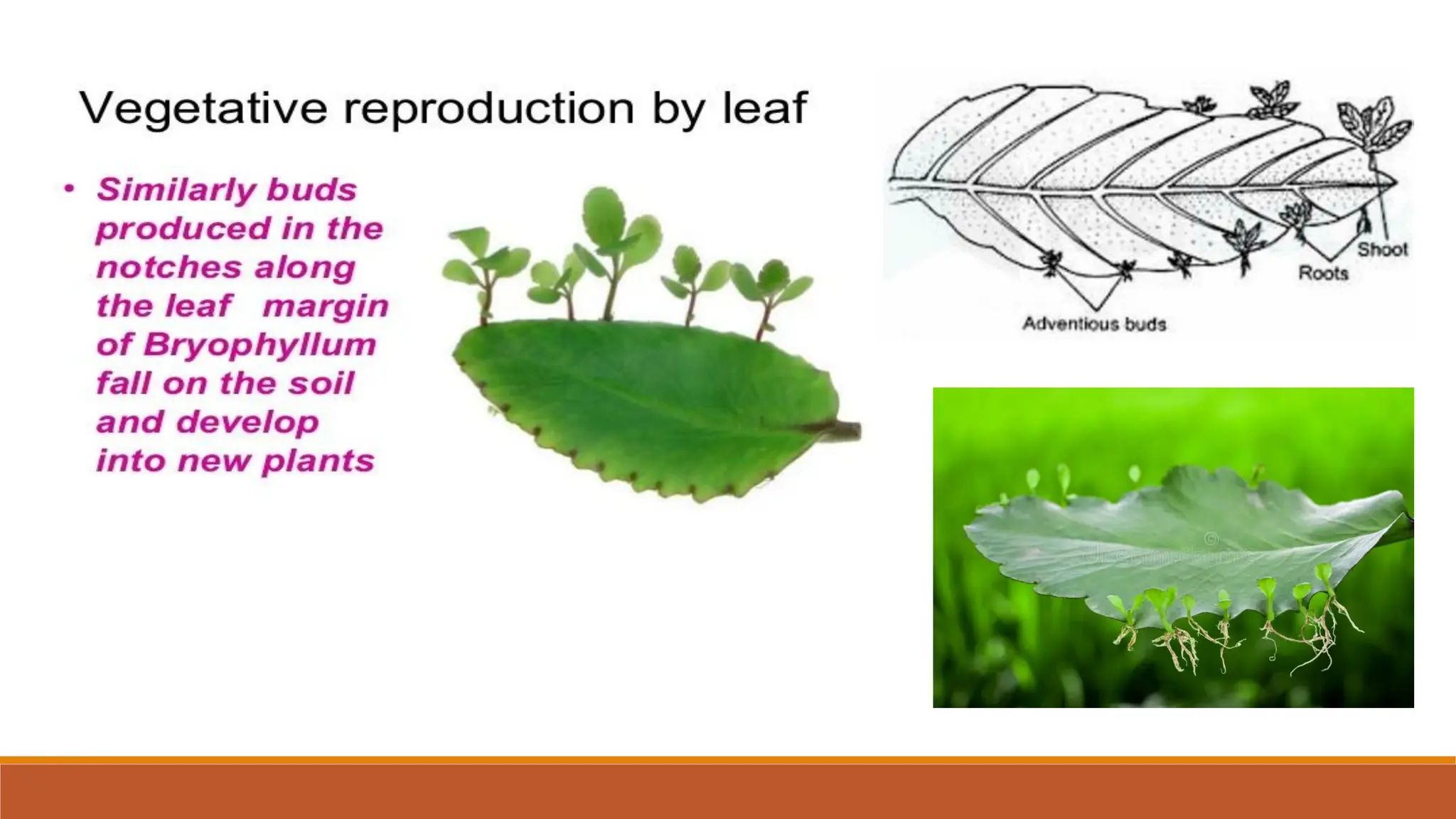
• There are many plants in which parts like the root, stem and leaves develop into new
plants under appropriate conditions.
• Unlike in most animals, plants can indeed use such a mode for reproduction.
• This property of vegetative propagation is used in methods such as layering or grafting to
grow many plants like sugarcane, roses, or grapes for agricultural purposes.
• Plants raised by vegetative propagation can bear flowers and fruits earlier than those
produced from seeds.
Vegetative Propagation
Such methods also make possible the propagation of plants such as banana, orange, rose and jasmine that
have lost the capacity to produce seeds.
Another advantage of vegetative propagation is that all plants produced are genetically similar enough to
the parent plant to have all its characteristics.
ADVANTAGES OF VEGETATIVE PROPAGATION
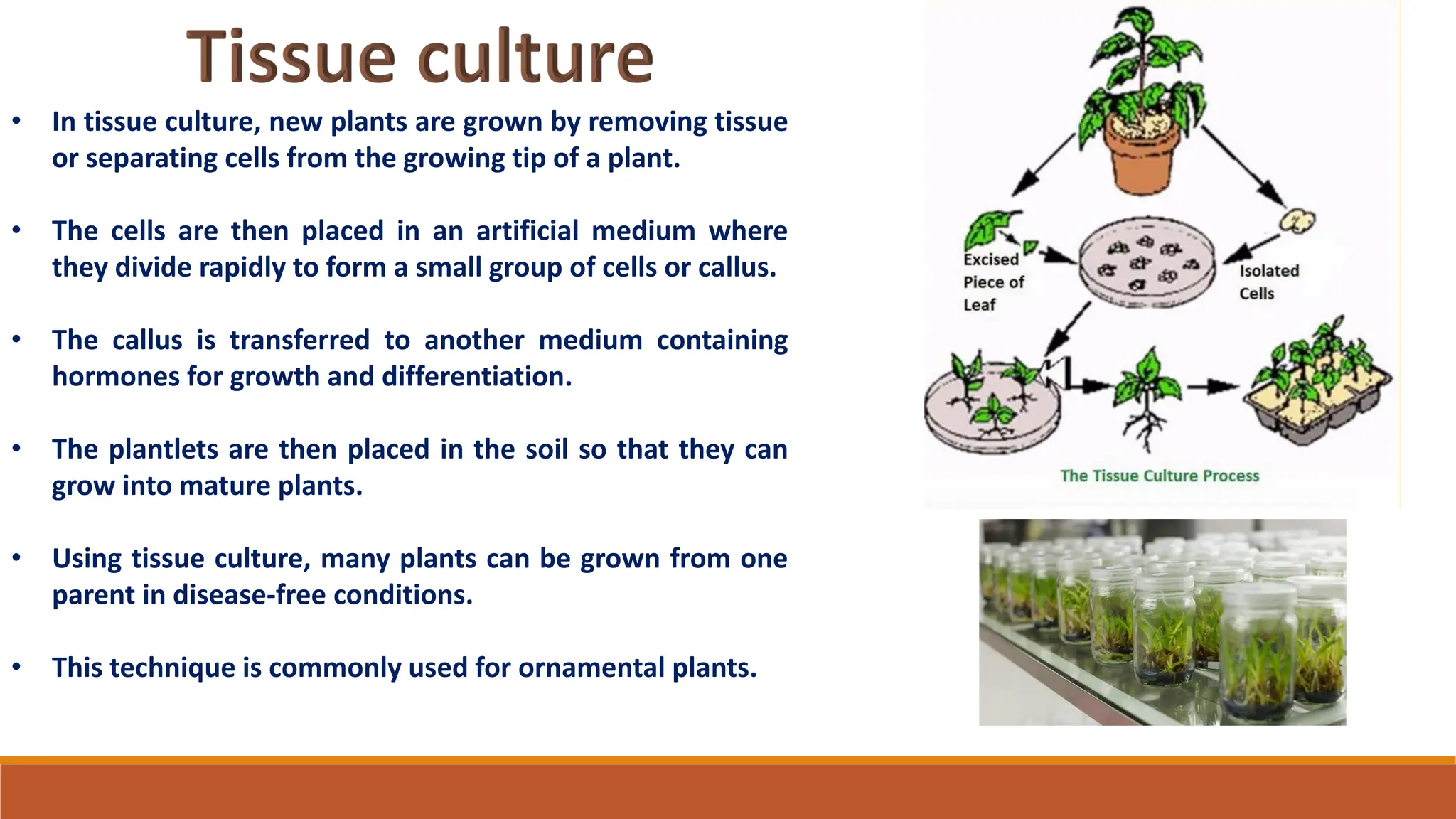
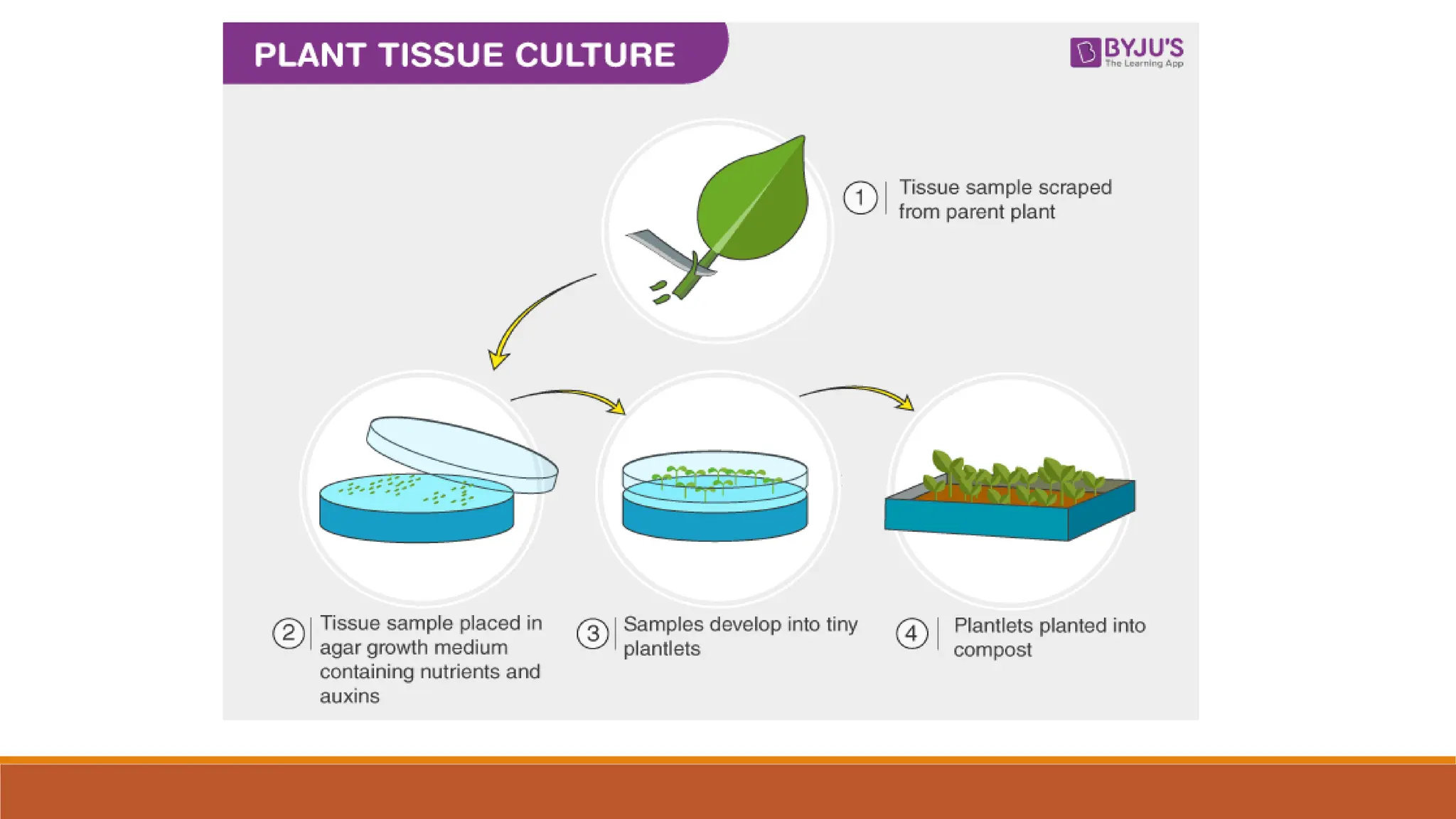
• In tissue culture, new plants are grown by removing tissue
or separating cells from the growing tip of a plant.
• The cells are then placed in an artificial medium where
they divide rapidly to form a small group of cells or callus.
• The callus is transferred to another medium containing
hormones for growth and differentiation.
• The plantlets are then placed in the soil so that they can
grow into mature plants.
• Using tissue culture, many plants can be grown from one
parent in disease-free conditions.
• This technique is commonly used for ornamental plants.
1. How does binary fission differ from multiple fission?
2. How will an organism be benefited if it reproduces through spores?
3. Can you think of reasons why more complex organisms cannot give rise to
new individuals through regeneration?
4. Why is vegetative propagation practised for growing some types of plants?
5. Why is DNA copying an essential part of the process of reproduction?
QUESTIONS
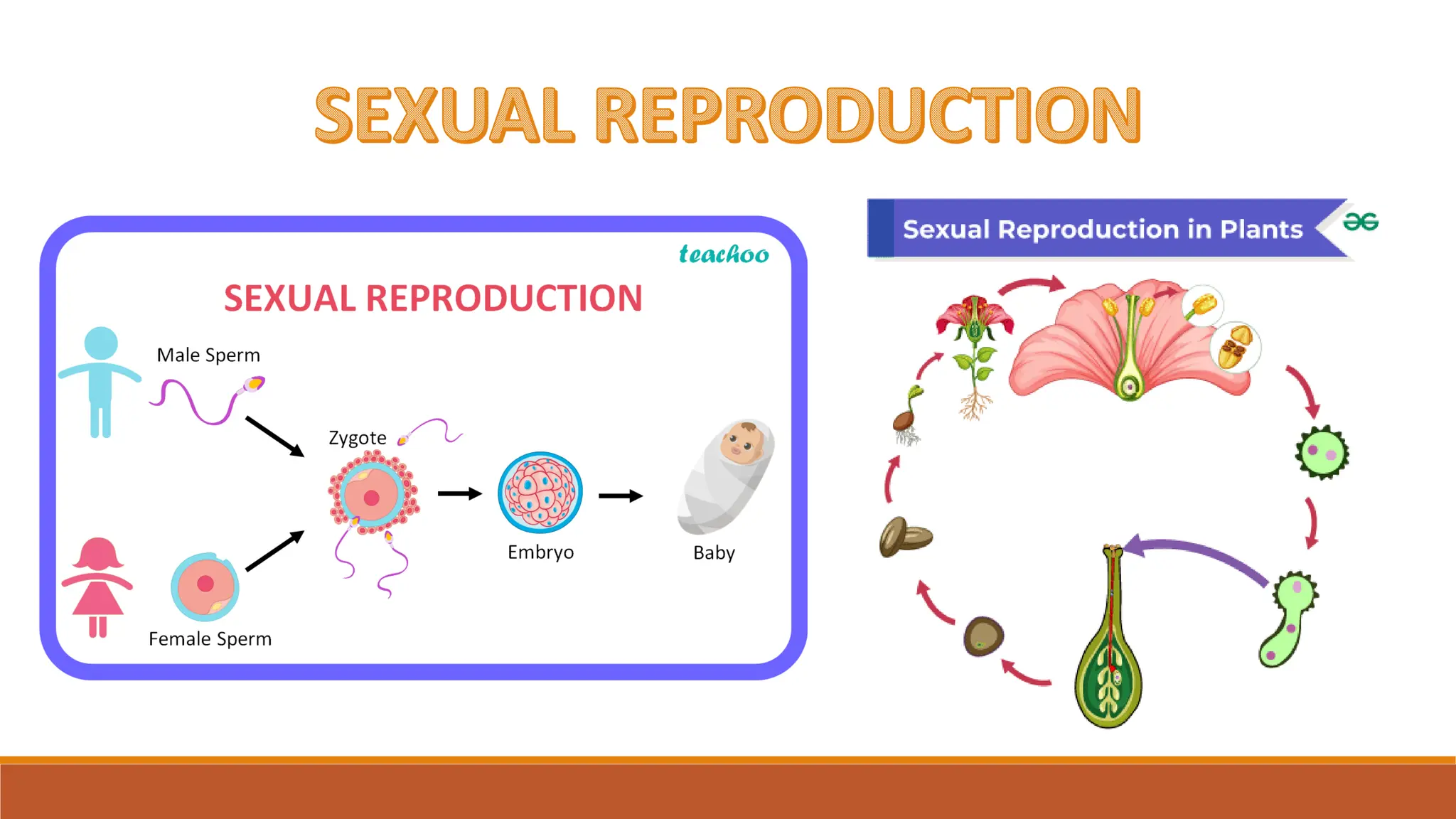
SEXUAL REPRODUCTION
We are also familiar with modes of reproduction that depend on the involvement of two individuals before a new generation
can be created.
Bulls alone cannot produce new calves, nor can hens alone produce new chicks.
In such cases, both sexes, males and females, are needed to produce new generations
SEXUAL REPRODUCTION
the production of new organisms by the combination of genetic information of two
individuals of different sexes.
SEXUAL REPRODUCTION
Why the Sexual Mode of Reproduction?
The creation of two new cells from one involves copying of the DNA as well as of the cellular apparatus.
The DNA copying mechanism, as we have noted, cannot be absolutely accurate, and the resultant errors are a source of
variations in populations of organisms.
Every individual organism cannot be protected by variations, but in a population, variations are useful for ensuring the survival
of the species.
It would therefore make sense if organisms came up with reproductive modes that allowed more and more variation to be
generated.
While DNA-copying mechanisms are not absolutely accurate, they are precise enough to make the generation of variation a
fairly slow process.
If the DNA copying mechanisms were to be less accurate, many of the resultant DNA copies would not be able to work with
the cellular apparatus, and would die.
Each new variation is made in a DNA copy that already has variations accumulated from previous generations.
Thus, two different individuals in a population would have quite different patterns of accumulated variations.
Since all of these variations are in living individuals, it is assured that they do not have any really bad effects.
Combining variations from two or more individuals would thus create new combinations of variants.
Each combination would be novel, since it would involve two different individuals.
The sexual mode of reproduction incorporates such a process of combining DNA from two different individuals during
reproduction.
But this creates a major difficulty.
If each new generation is to be the combination of the DNA copies from two pre-existing
individuals, then each new generation will end up having twice the amount of DNA that the
previous generation had.
This is likely to mess up the control of the cellular apparatus by the DNA.
Besides, if each generation doubles its DNA, fairly soon there will be only DNA on earth,
with no room for anything else.
We have seen earlier that as organisms become more complex, the specialisation of tissue
increases.
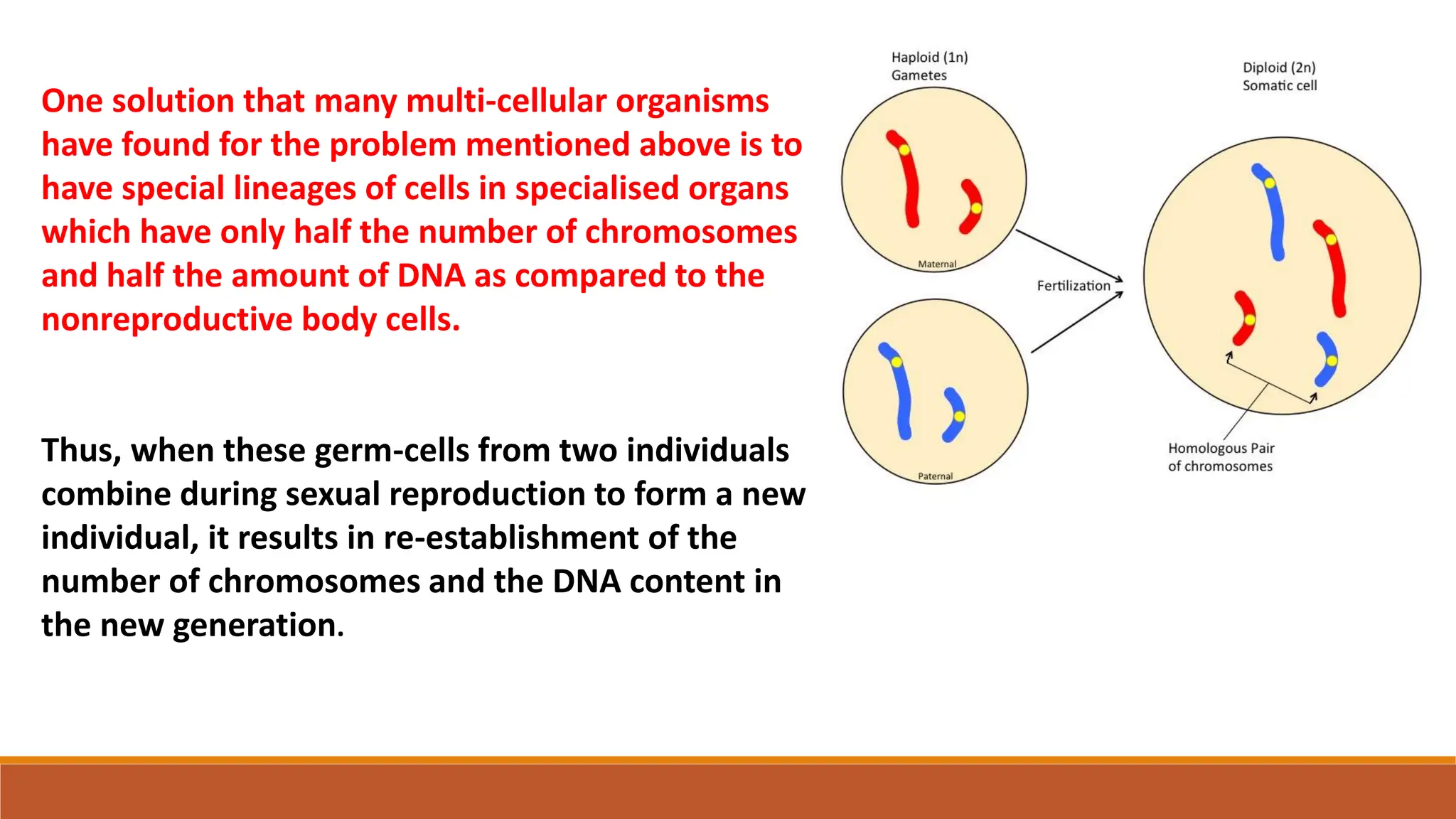
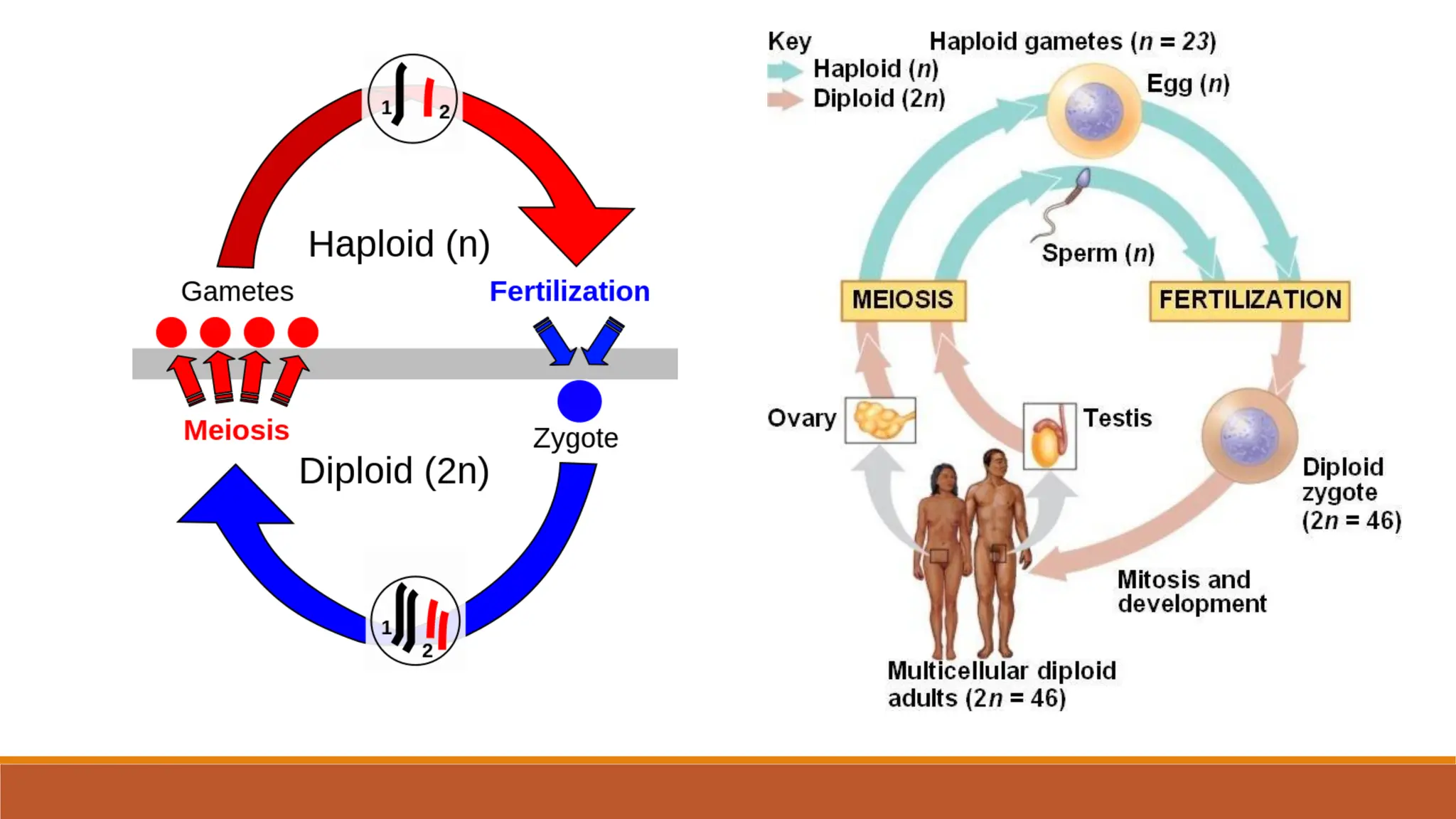
One solution that many multi-cellular organisms
have found for the problem mentioned above is to
have special lineages of cells in specialised organs
which have only half the number of chromosomes
and half the amount of DNA as compared to the
nonreproductive body cells.
Thus, when these germ-cells from two individuals
combine during sexual reproduction to form a new
individual, it results in re-establishment of the
number of chromosomes and the DNA content in
the new generation.
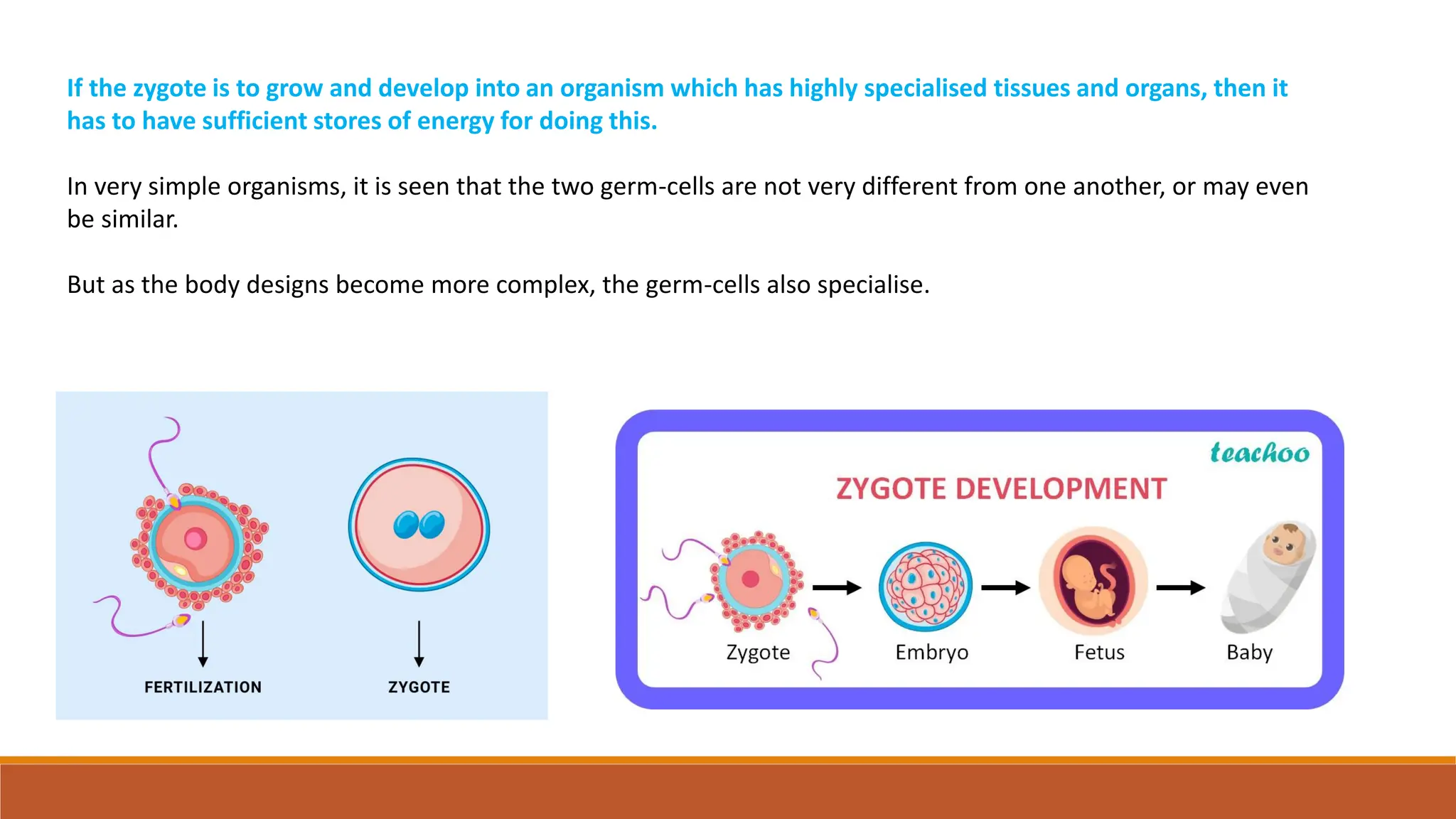
If the zygote is to grow and develop into an organism which has highly specialised tissues and organs, then it
has to have sufficient stores of energy for doing this.
In very simple organisms, it is seen that the two germ-cells are not very different from one another, or may even
be similar.
But as the body designs become more complex, the germ-cells also specialise.
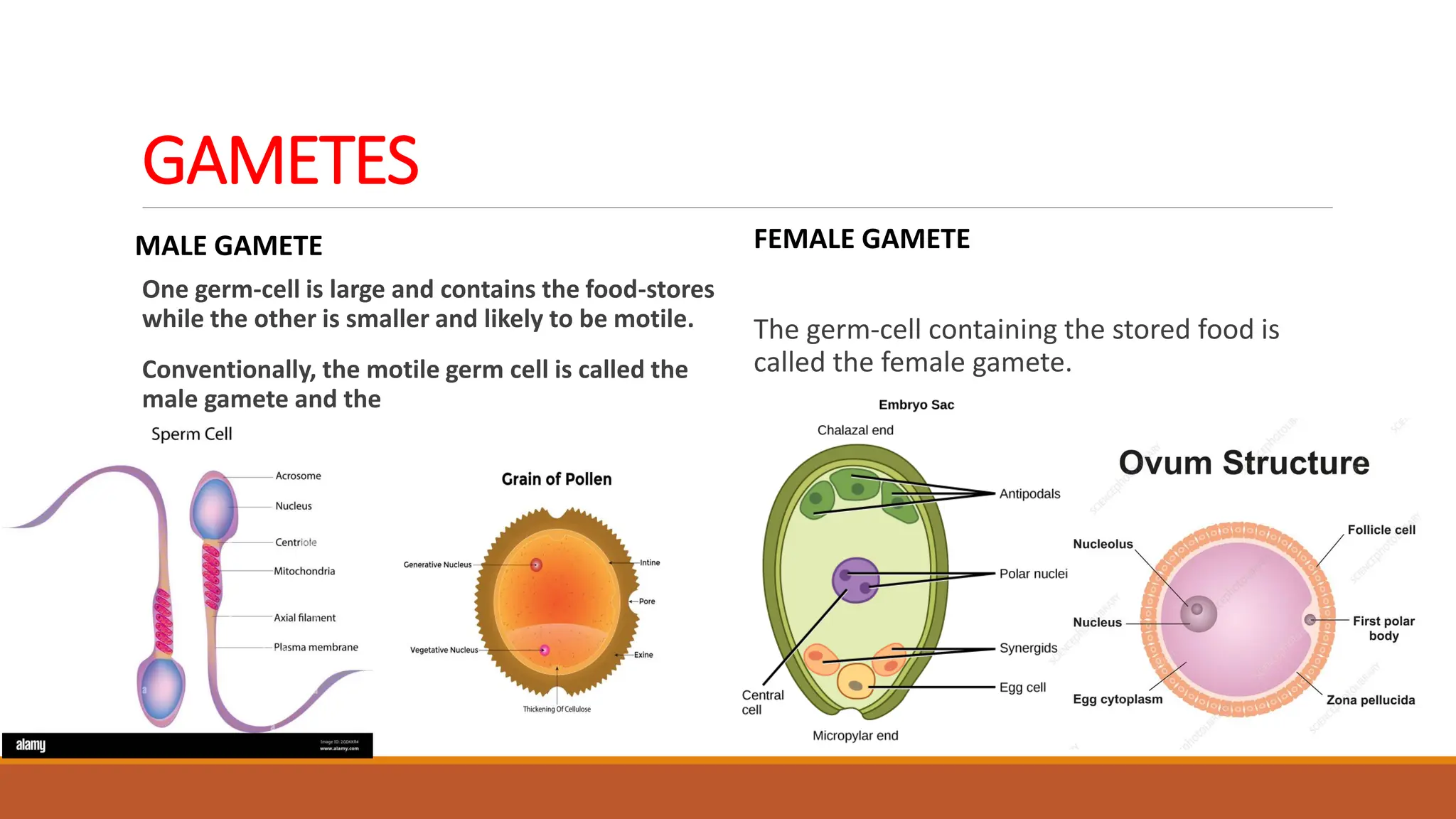
GAMETES
MALE GAMETE
One germ-cell is large and contains the food-stores
while the other is smaller and likely to be motile.
Conventionally, the motile germ cell is called the
male gamete and the
FEMALE GAMETE
The germ-cell containing the stored food is
called the female gamete.
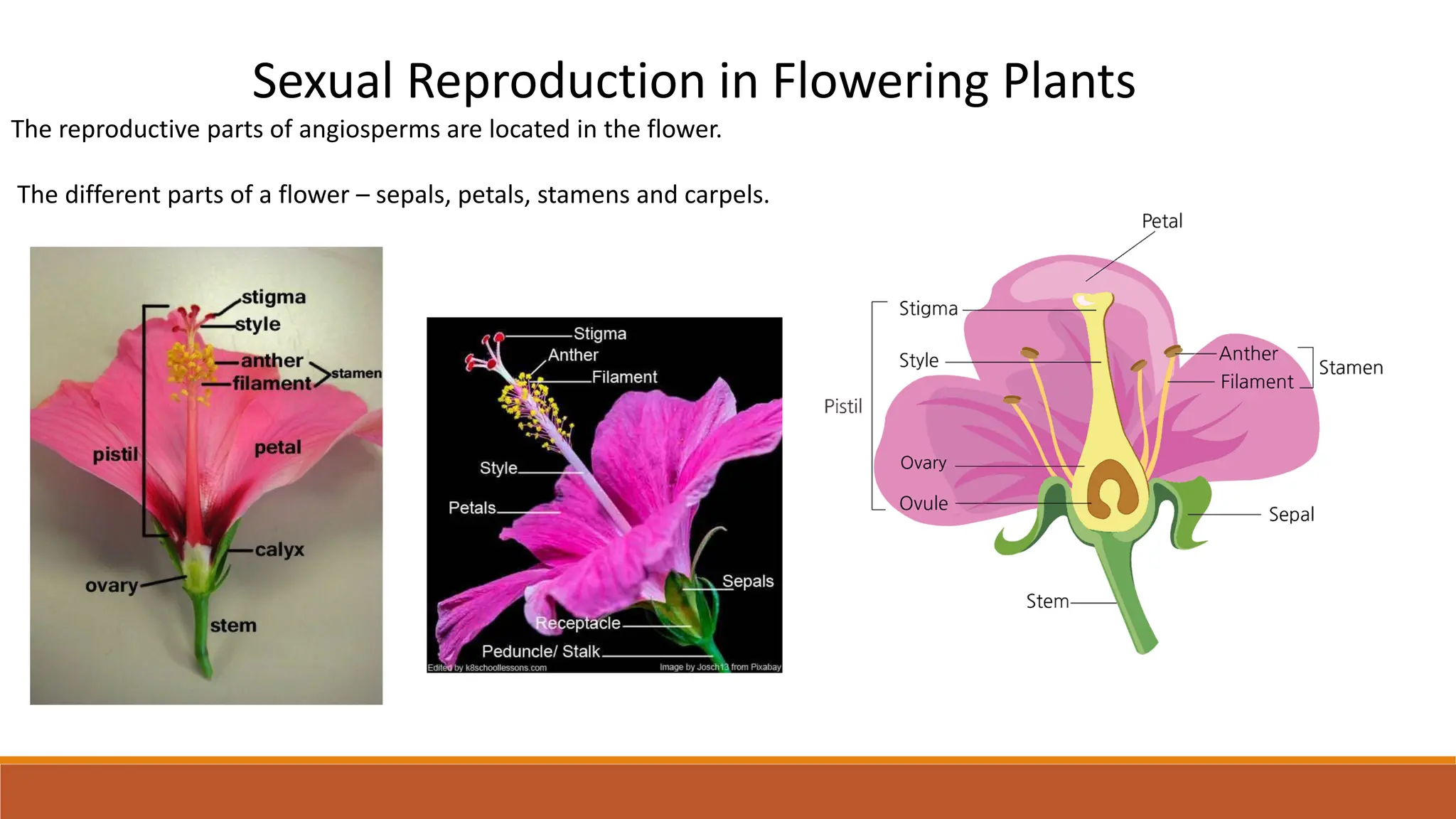
Sexual Reproduction in Flowering Plants
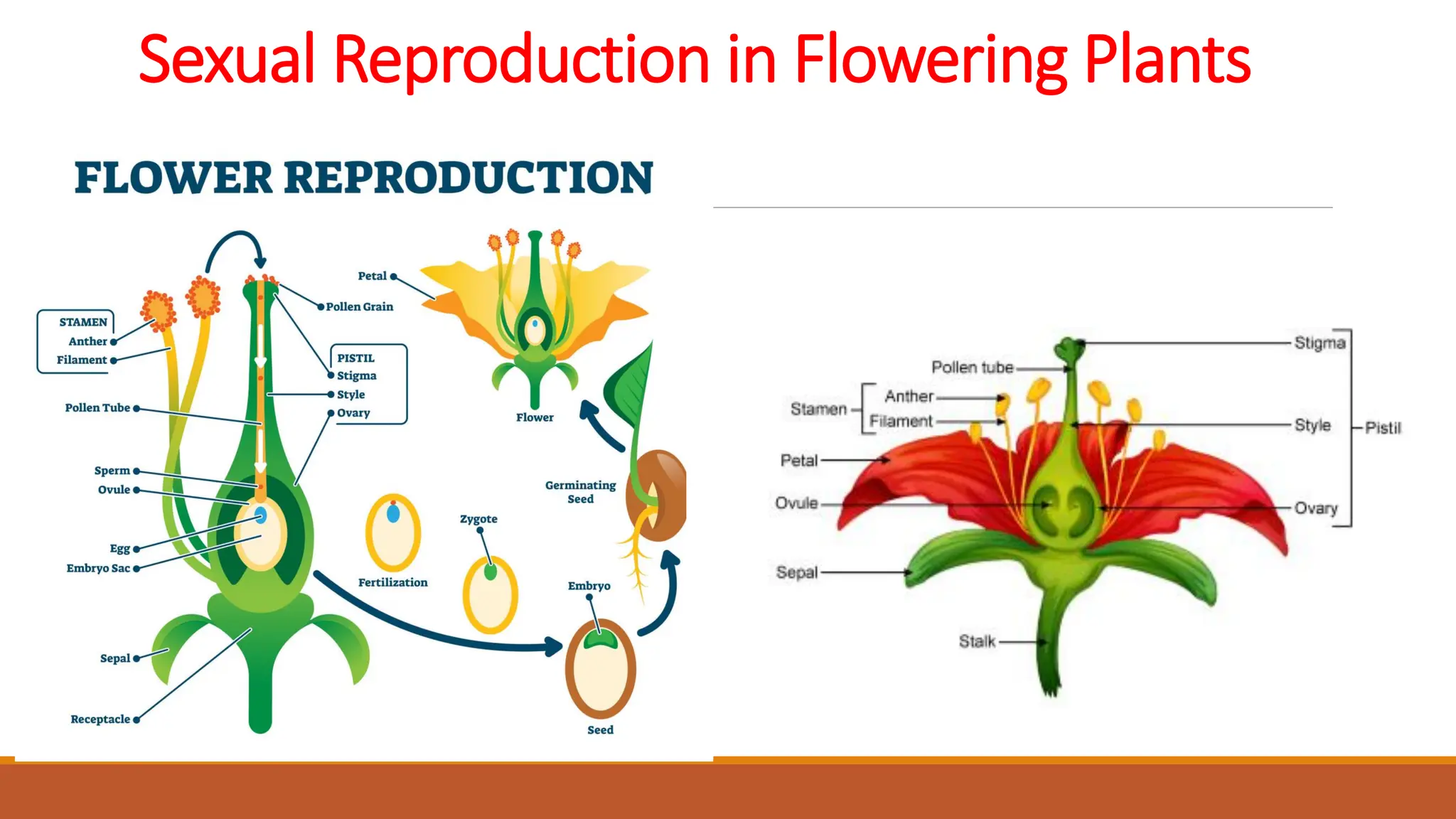
The reproductive parts of angiosperms are located in the flower.
The different parts of a flower – sepals, petals, stamens and carpels.
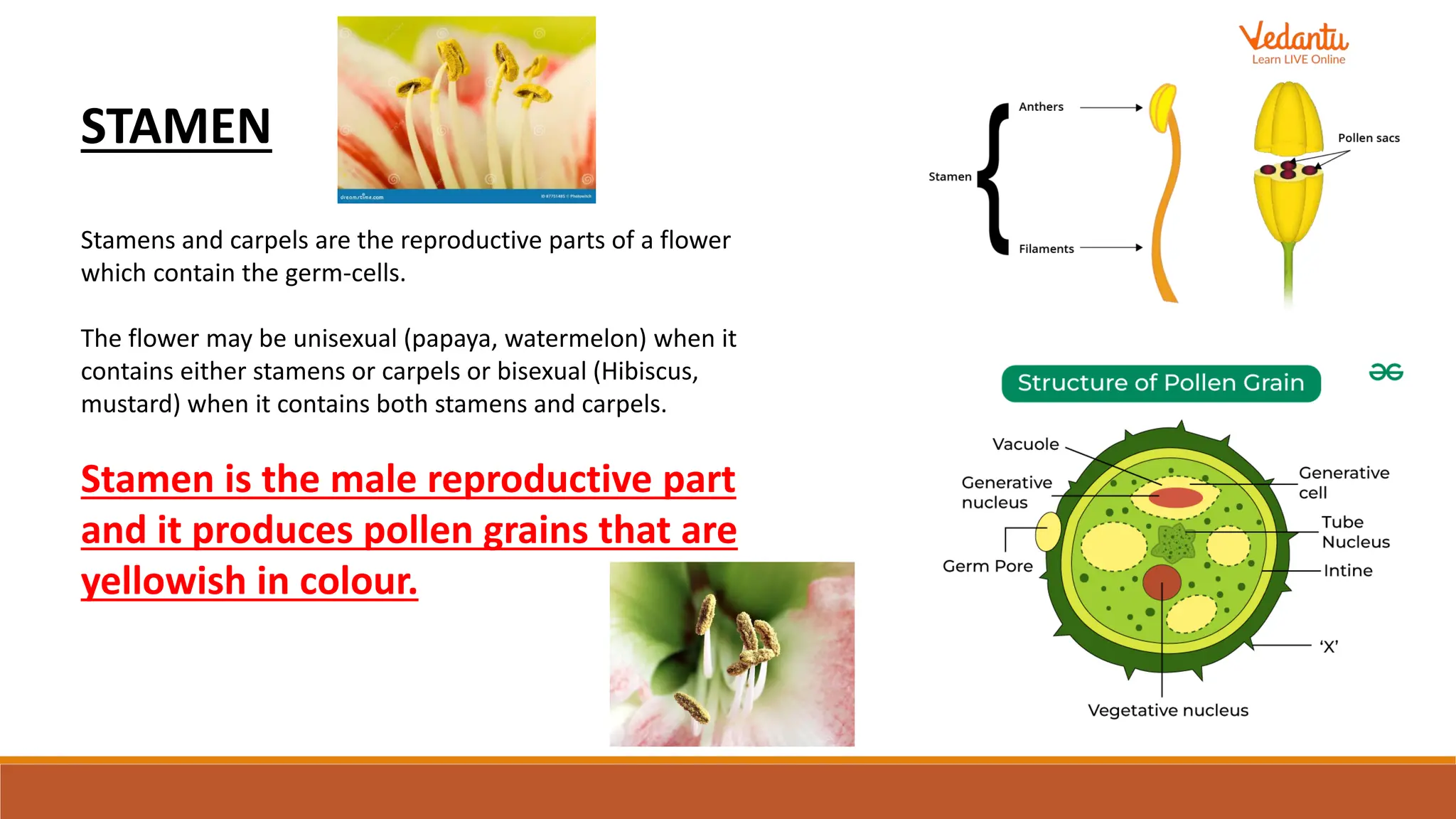
STAMEN
Stamens and carpels are the reproductive parts of a flower
which contain the germ-cells.
The flower may be unisexual (papaya, watermelon) when it
contains either stamens or carpels or bisexual (Hibiscus,
mustard) when it contains both stamens and carpels.
Stamen is the male reproductive part
and it produces pollen grains that are
yellowish in colour.
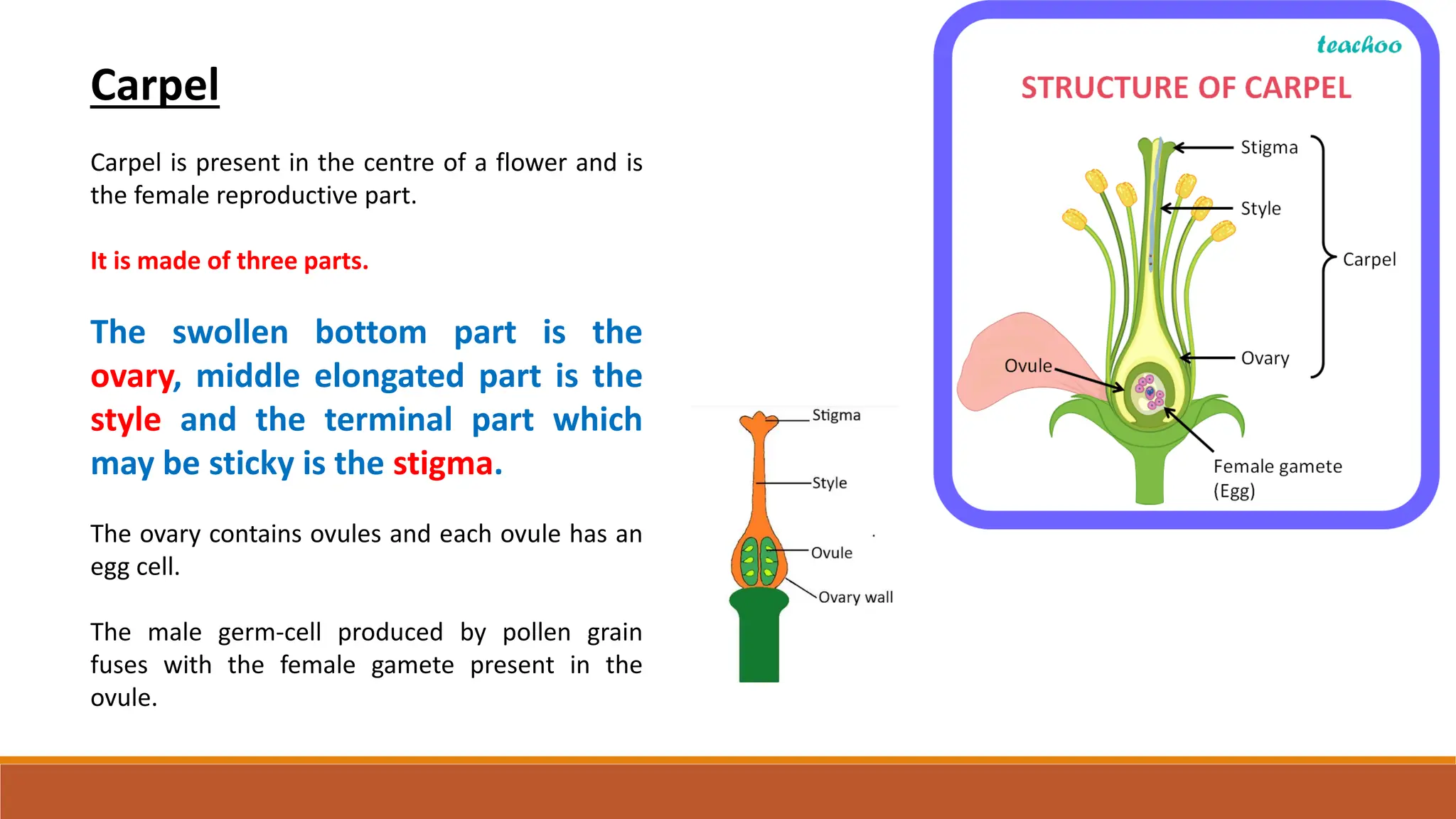
Carpel
Carpel is present in the centre of a flower and is
the female reproductive part.
It is made of three parts.
The swollen bottom part is the
ovary, middle elongated part is the
style and the terminal part which
may be sticky is the stigma.
The ovary contains ovules and each ovule has an
egg cell.
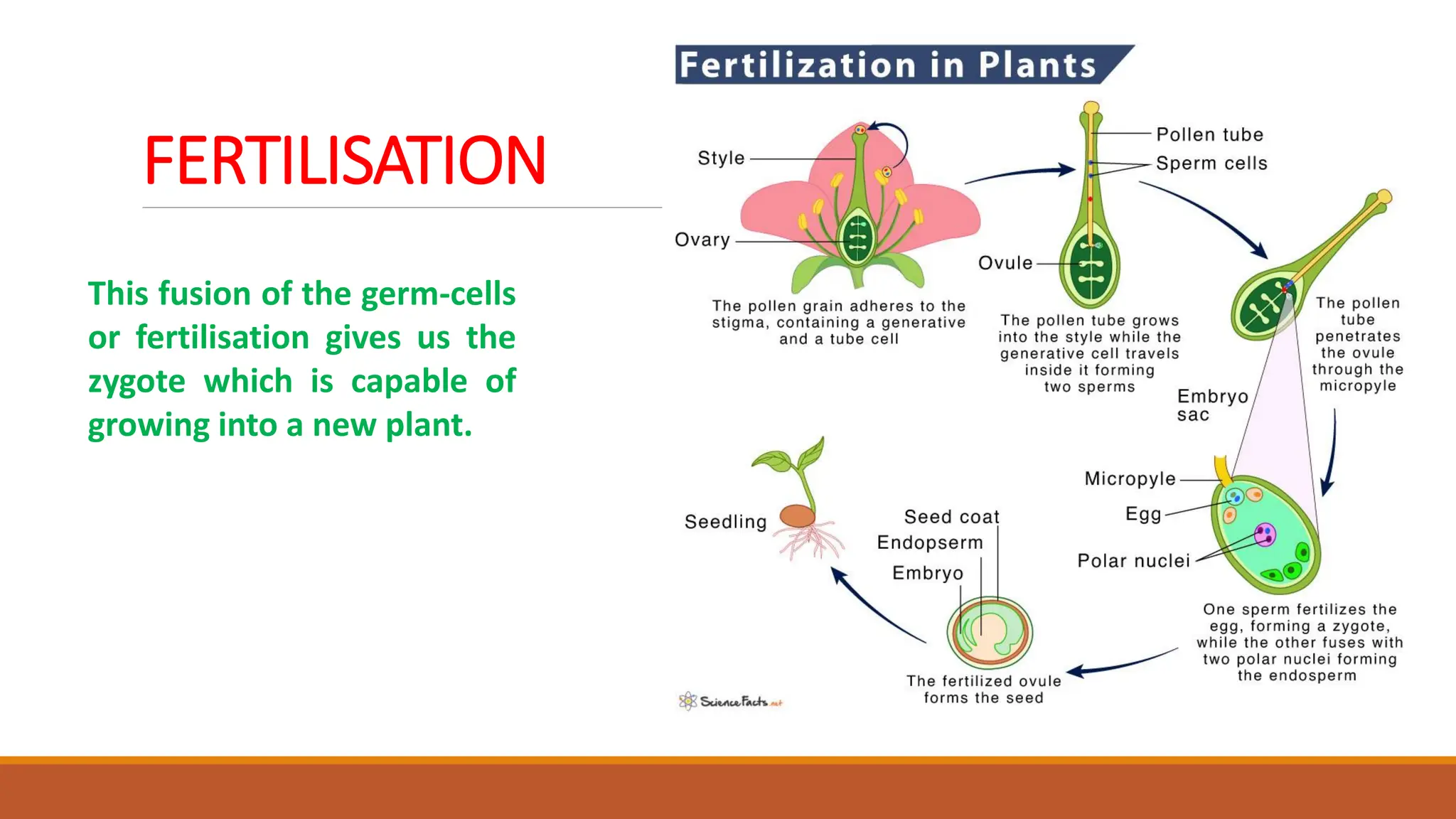
The male germ-cell produced by pollen grain
fuses with the female gamete present in the
ovule.
This fusion of the germ-cells
or fertilisation gives us the
zygote which is capable of
growing into a new plant.
FERTILISATION
POLLINATION
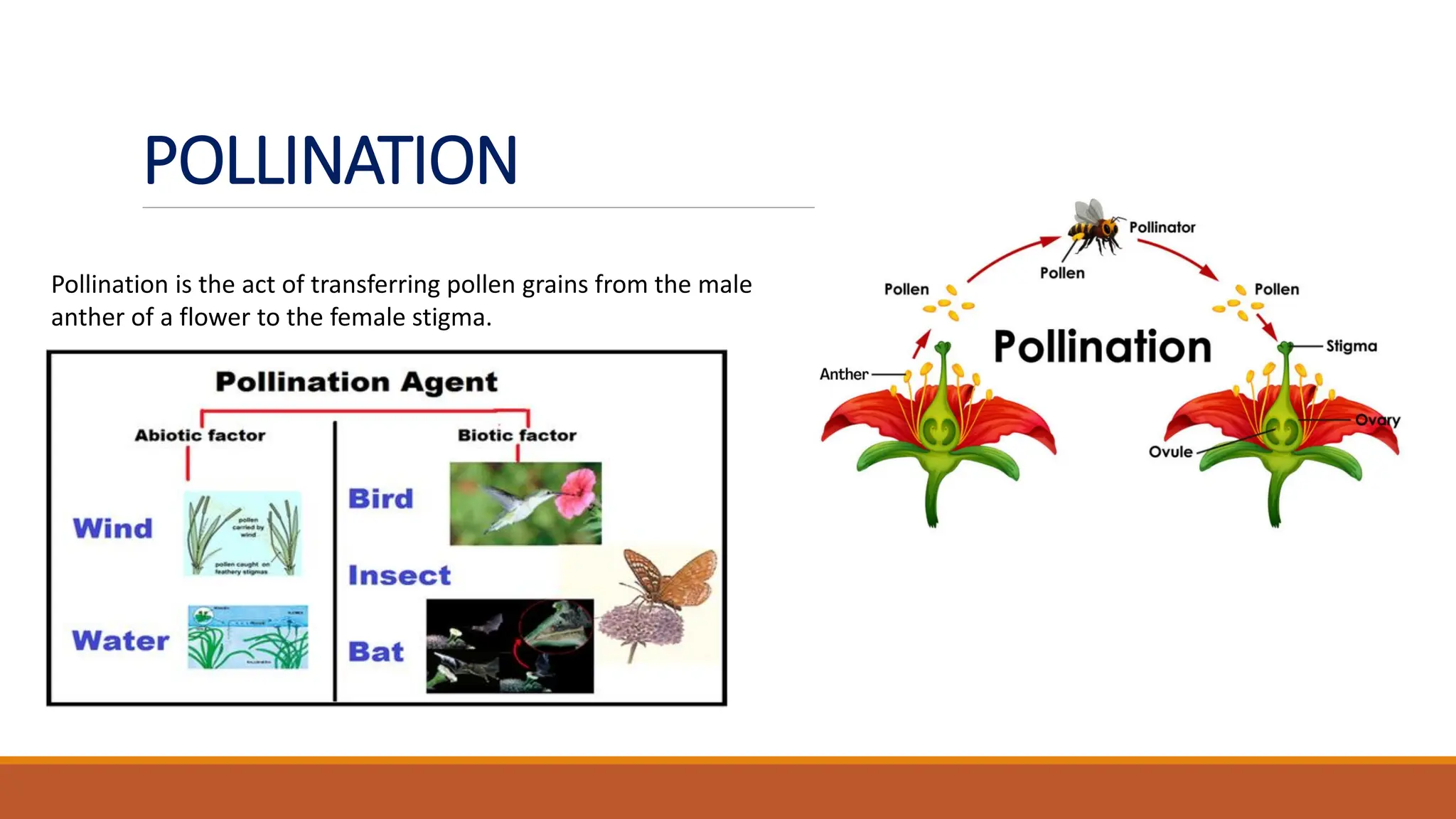
Pollination is the act of transferring pollen grains from the male
anther of a flower to the female stigma.
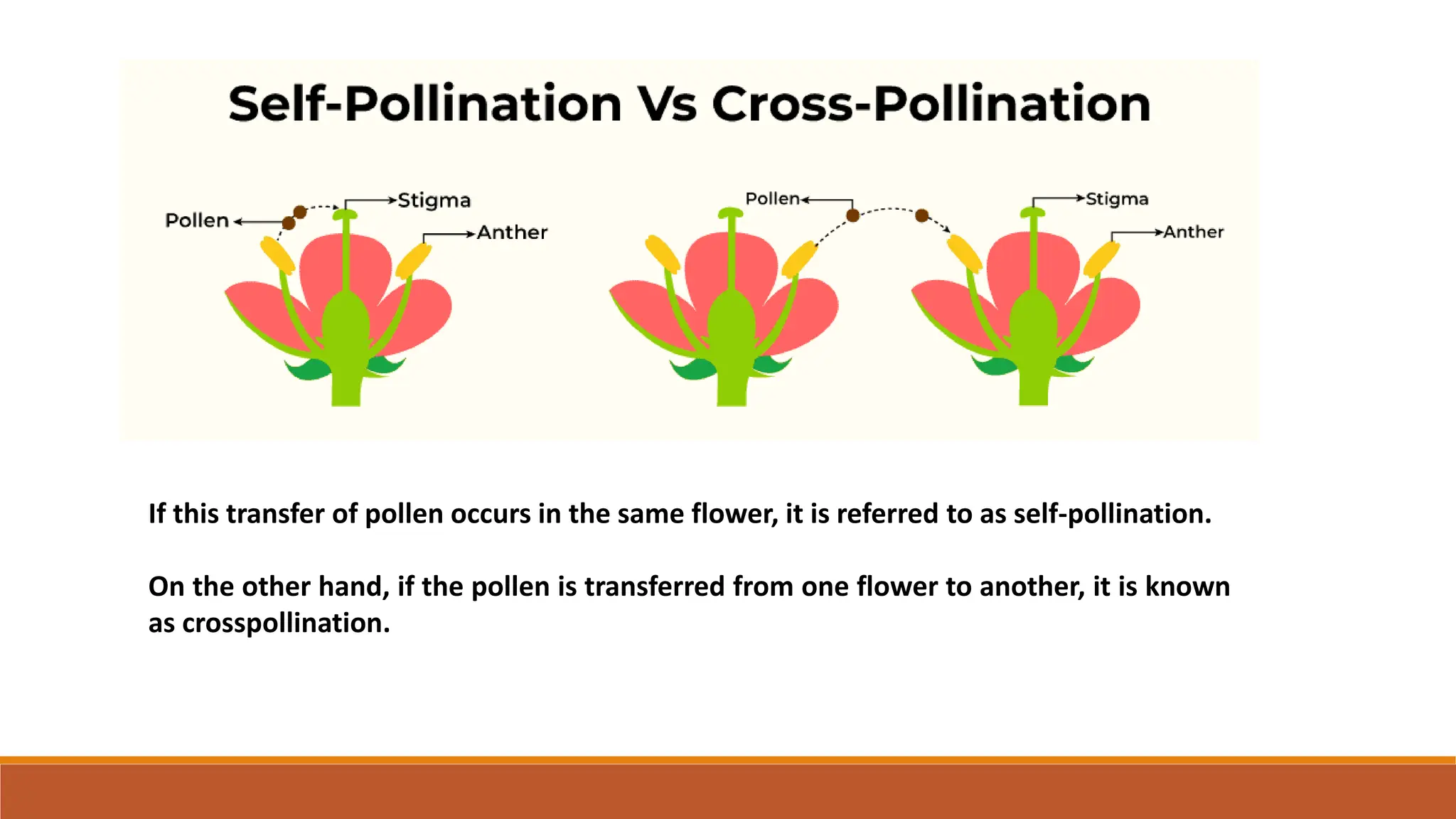
If this transfer of pollen occurs in the same flower, it is referred to as self-pollination.
On the other hand, if the pollen is transferred from one flower to another, it is known
as crosspollination.
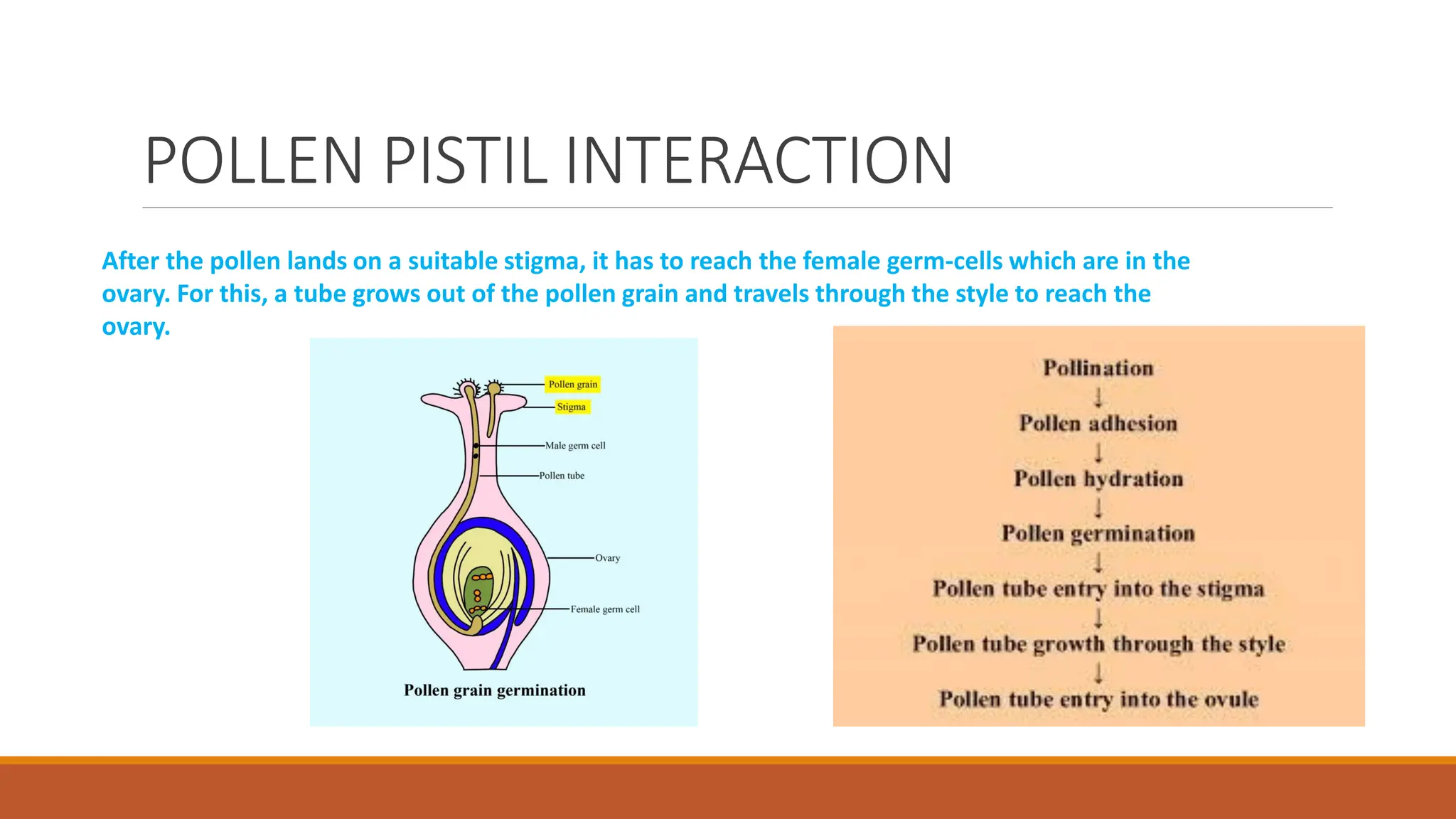
POLLEN PISTIL INTERACTION
After the pollen lands on a suitable stigma, it has to reach the female germ-cells which are in the
ovary. For this, a tube grows out of the pollen grain and travels through the style to reach the
ovary.
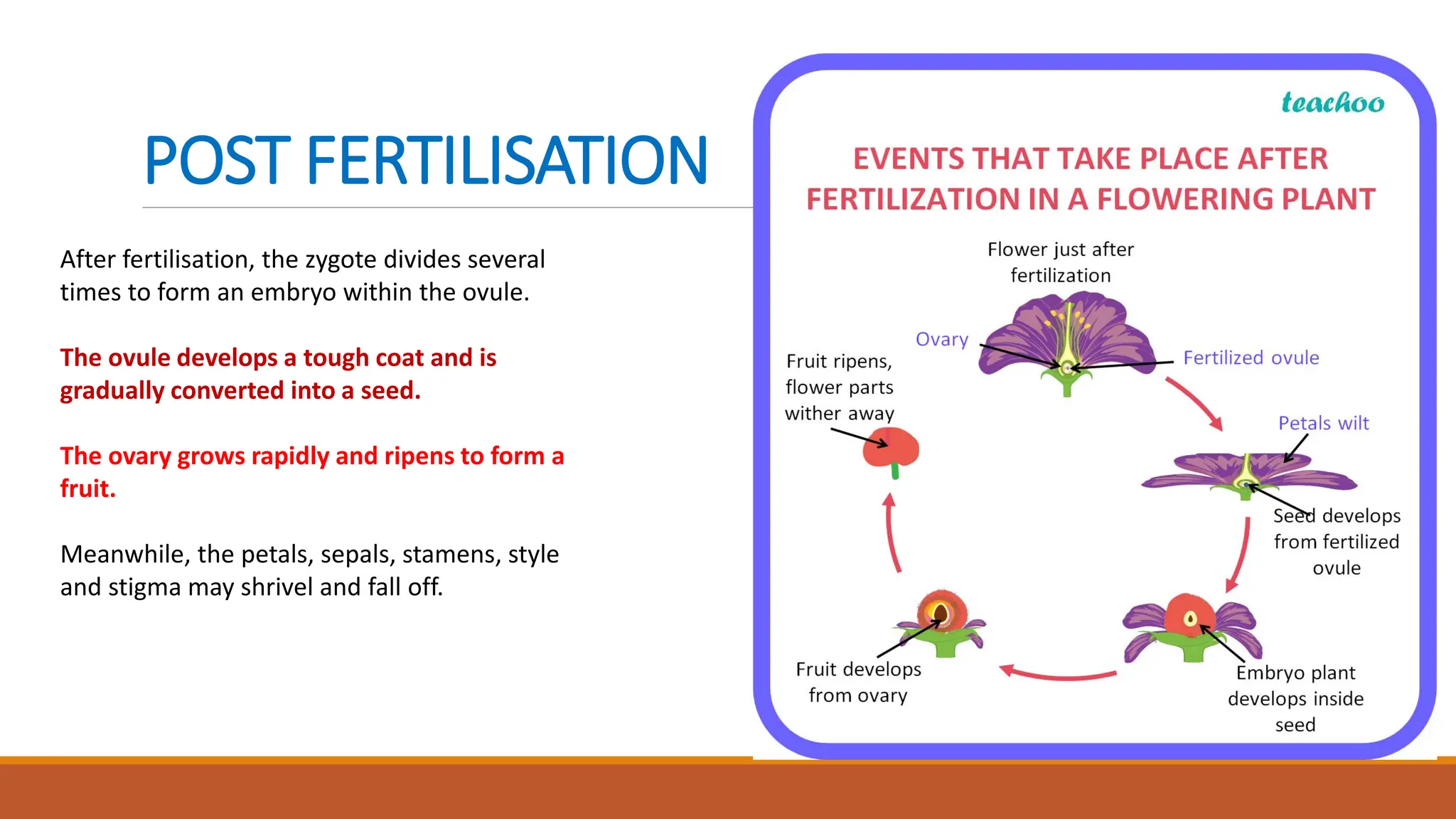
After fertilisation, the zygote divides several
times to form an embryo within the ovule.
The ovule develops a tough coat and is
gradually converted into a seed.
The ovary grows rapidly and ripens to form a
fruit.
Meanwhile, the petals, sepals, stamens, style
and stigma may shrivel and fall off.
POST FERTILISATION
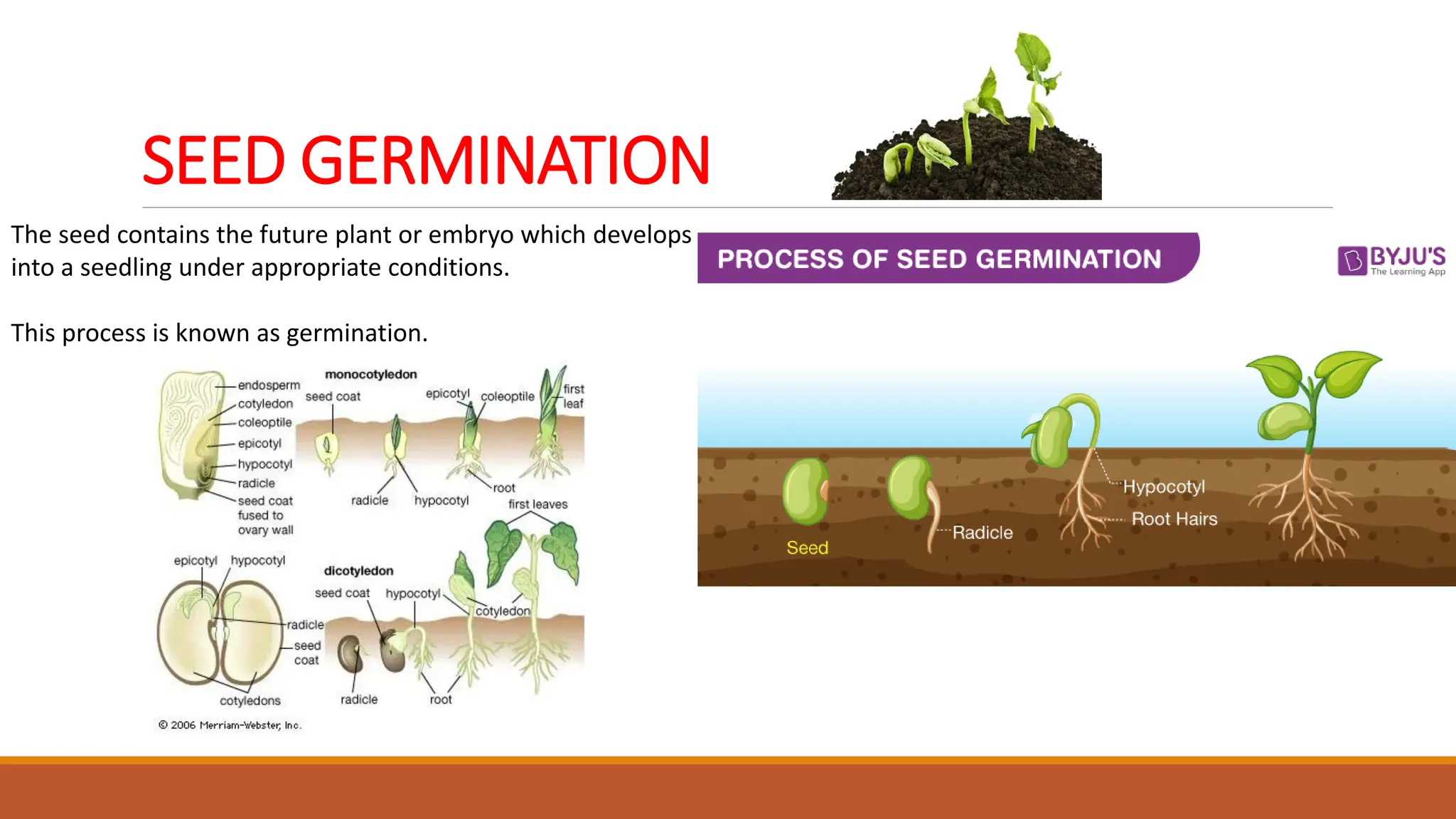
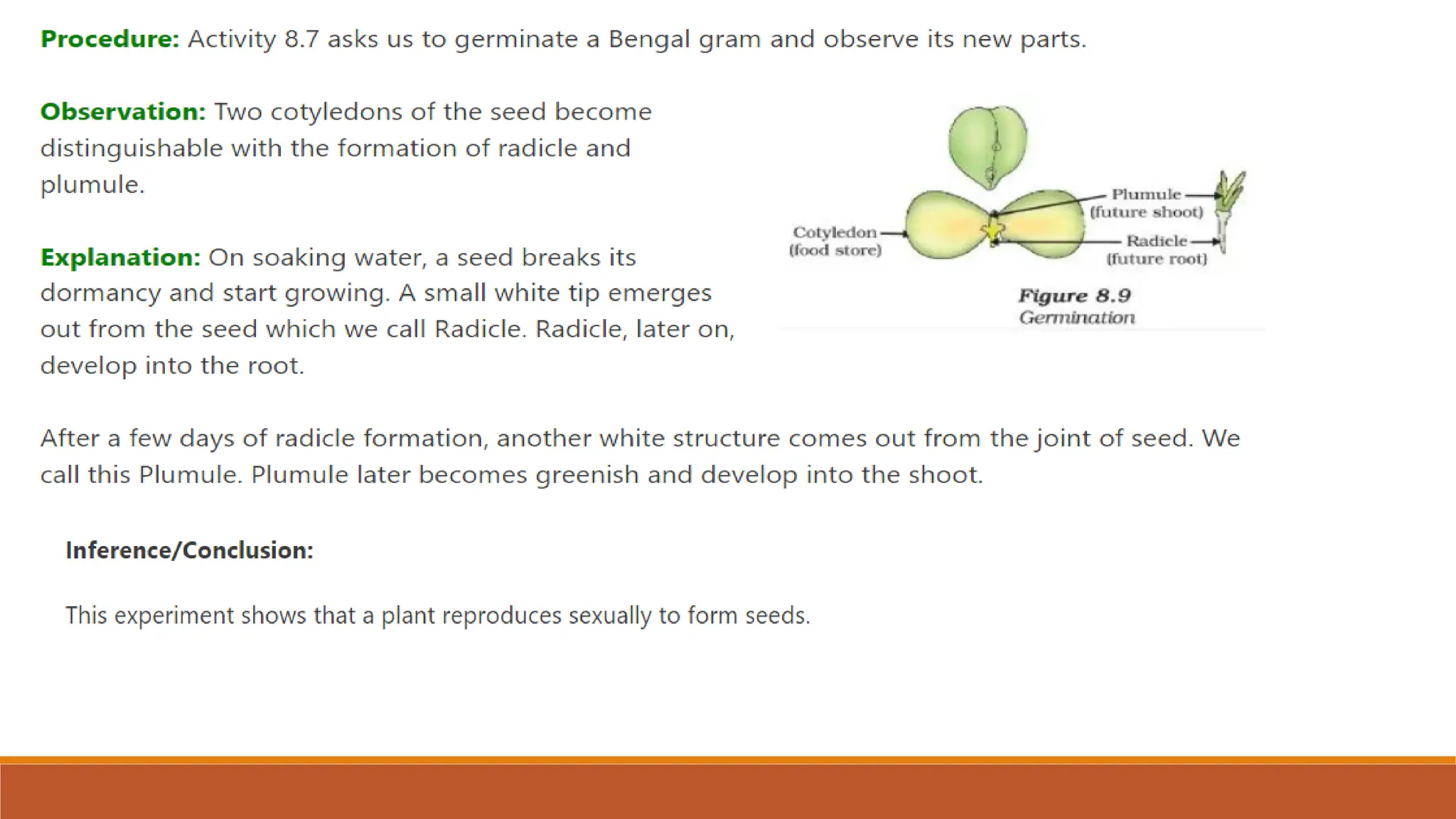
SEED GERMINATION
The seed contains the future plant or embryo which develops
into a seedling under appropriate conditions.
This process is known as germination.
HOW DO ORGANISMS REPRODUCE?reproduction part 1

HOW DO ORGANISMS REPRODUCE?reproduction part 1

  • 1.
    CLASS 10 [BASEDON N.C.E.R.T] COMPILED BY : SHASHANK SHEKHAR PANDEY How do organisms reproduce? PART -I
  • 2.
    INTRODUCTION Why do organismsreproduce? It is obvious that we notice organisms because they reproduce. If there were to be only one, non reproducing member of a particular kind, it is doubtful that we would have noticed its existence. To maintain the continuity of species they reproduce.
  • 3.
    DO ORGANISMS CREATEEXACT COPIES OF THEMSELVES? • The chromosomes in the nucleus of a cell contain information for inheritance of features from parents to next generation in the form of DNA (Deoxyribo Nucleic Acid) molecules. • The DNA in the cell nucleus is the information source for making proteins. • If the information is changed, different proteins will be made. Different proteins will eventually lead to altered body designs. Therefore, a basic event in reproduction is the creation of a DNA copy. • Cells use chemical reactions to build copies of their DNA. This creates two copies of the DNA in a reproducing cell, and they will need to be separated from each other. • However, keeping one copy of DNA in the original cell and simply pushing the other one out would not work, because the copy pushed out would not have any organised cellular structure for maintaining life processes. • Therefore, DNA copying is accompanied by the creation of an additional cellular apparatus, and then the DNA copies separate, each with its own cellular apparatus.
  • 4.
    • Effectively, acell divides to give rise to two cells. • These two cells are of course similar, but are they likely to be absolutely identical? • The answer to this question will depend on how accurately the copying reactions involved occur. • No bio-chemical reaction is absolutely reliable. Therefore, it is only to be expected that the process of copying the DNA will have some variations each time. • As a result, the DNA copies generated will be similar, but may not be identical to the original. • Some of these variations might be so drastic that the new DNA copy cannot work with the cellular apparatus it inherits. • Such a newborn cell will simply die. • On the other hand, there could still be many other variations in the DNA copies that would not lead to such a drastic outcome. • Thus, the surviving cells are similar to, but subtly different from each other
  • 5.
    Variation Populations of organismsfill well-defined places, or niches, in the ecosystem, using their ability to reproduce. The consistency of DNA copying during reproduction is important for the maintenance of body design features that allow the organism to use that particular niche. Reproduction is therefore linked to the stability of populations of species. However, niches can change because of reasons beyond the control of the organisms. Temperatures on earth can go up or down, water levels can vary, or there could be meteorite hits, to think of a few examples.
  • 6.
    If a populationof reproducing organisms were suited to a particular niche and if the niche were drastically altered, the population could be wiped out. However, if some variations were to be present in a few individuals in these populations, there would be some chance for them to survive. Thus, if there were a population of bacteria living in temperate waters, and if the water temperature were to be increased by global warming, most of these bacteria would die, but the few variants resistant to heat would survive and grow further. Variation is thus useful for the survival of species over time.
  • 7.
    1.What is theimportance of DNA copying in reproduction? 2. Why is variation beneficial to the species but not necessarily for the individual? QUESTIONS
  • 8.
  • 9.
    MODES OF REPRODUCTIONUSED BY SINGLE ORGANISMS • BUDDING • SPORULATION • BINARY FISSION • MULTIPLE FISSION • FRAGMENTATION • REGENERATION
  • 10.
    • Organisms suchas Hydra use regenerative cells for reproduction in the process of budding. • In Hydra, a bud develops as an outgrowth due to repeated cell division at one specific site. • These buds develop into tiny individuals and when fully mature, detach from the parent body and become new independent individuals. Budding
  • 11.
    MODES OF REPRODUCTIONUSED BY SINGLE ORGANISMS BUDDING
  • 12.
    • Even inmany simple multi-cellular organisms, specific reproductive parts can be identified. • The thread-like structures that developed on the bread in Activity 8.2 above are the hyphae of the bread mould • (Rhizopus). • They are not reproductive parts. • On the other hand, the tiny blob-on-a-stick structures are involved in reproduction. • The blobs are sporangia, which contain cells, or spores, that can eventually develop into new Rhizopus individuals. • The spores are covered by thick walls that protect them until they come into contact with another moist surface and can begin to grow. Spore Formation
  • 13.
  • 14.
    Fission • For unicellularorganisms, cell division, or fission, leads to the creation of new individuals. • Many bacteria and protozoa simply split into two equal halves during cell division. • In organisms such as Amoeba, the splitting of the two cells during division can take place in any plane. • Other single-celled organisms, such as the malarial parasite, Plasmodium, divide into many daughter cells simultaneously by multiple fission
  • 15.
    BINARY FISSION INLeishmania Some unicellular organisms show somewhat more organisation of their bodies, such as is seen in Leishmania (which cause kala-azar), which have a whip-like structure at one end of the cell. In such organisms, binary fission occurs in a definite orientation in relation to these structures.
  • 16.
    Multiple fission inPlasmodium Plasmodium, divide into many daughter cells simultaneously by multiple fission
  • 18.
    In multi-cellular organismswith relatively simple body organisation, simple reproductive methods can still work. Spirogyra, for example, simply breaks up into smaller pieces upon maturation. These pieces or fragments grow into new individuals. FRAGMENTATION
  • 20.
    • Many fullydifferentiated organisms have the ability to give rise to new individual organisms from their body parts. • That is, if the individual is somehow cut or broken up into many pieces, many of these pieces grow into separate individuals. REGENERATION
  • 21.
    • For example,simple animals like Hydra and Planaria can be cut into any number of pieces and each piece grows into a complete organism. • This is known as regeneration • Regeneration is carried out by specialised cells. • These cells proliferate and make large numbers of cells. • From this mass of cells, different cells undergo changes to become various cell types and tissues. • These changes take place in an organised sequence referred to as development. • However, regeneration is not the same as reproduction, since most organisms would not normally depend on being cut up to be able to reproduce.
  • 22.
    • There aremany plants in which parts like the root, stem and leaves develop into new plants under appropriate conditions. • Unlike in most animals, plants can indeed use such a mode for reproduction. • This property of vegetative propagation is used in methods such as layering or grafting to grow many plants like sugarcane, roses, or grapes for agricultural purposes. • Plants raised by vegetative propagation can bear flowers and fruits earlier than those produced from seeds. Vegetative Propagation
  • 23.
    Such methods alsomake possible the propagation of plants such as banana, orange, rose and jasmine that have lost the capacity to produce seeds. Another advantage of vegetative propagation is that all plants produced are genetically similar enough to the parent plant to have all its characteristics. ADVANTAGES OF VEGETATIVE PROPAGATION
  • 28.
    • In tissueculture, new plants are grown by removing tissue or separating cells from the growing tip of a plant. • The cells are then placed in an artificial medium where they divide rapidly to form a small group of cells or callus. • The callus is transferred to another medium containing hormones for growth and differentiation. • The plantlets are then placed in the soil so that they can grow into mature plants. • Using tissue culture, many plants can be grown from one parent in disease-free conditions. • This technique is commonly used for ornamental plants.
  • 30.
    1. How doesbinary fission differ from multiple fission? 2. How will an organism be benefited if it reproduces through spores? 3. Can you think of reasons why more complex organisms cannot give rise to new individuals through regeneration? 4. Why is vegetative propagation practised for growing some types of plants? 5. Why is DNA copying an essential part of the process of reproduction? QUESTIONS
  • 31.
  • 32.
    We are alsofamiliar with modes of reproduction that depend on the involvement of two individuals before a new generation can be created. Bulls alone cannot produce new calves, nor can hens alone produce new chicks. In such cases, both sexes, males and females, are needed to produce new generations SEXUAL REPRODUCTION the production of new organisms by the combination of genetic information of two individuals of different sexes. SEXUAL REPRODUCTION
  • 33.
    Why the SexualMode of Reproduction? The creation of two new cells from one involves copying of the DNA as well as of the cellular apparatus. The DNA copying mechanism, as we have noted, cannot be absolutely accurate, and the resultant errors are a source of variations in populations of organisms. Every individual organism cannot be protected by variations, but in a population, variations are useful for ensuring the survival of the species. It would therefore make sense if organisms came up with reproductive modes that allowed more and more variation to be generated. While DNA-copying mechanisms are not absolutely accurate, they are precise enough to make the generation of variation a fairly slow process. If the DNA copying mechanisms were to be less accurate, many of the resultant DNA copies would not be able to work with the cellular apparatus, and would die.
  • 34.
    Each new variationis made in a DNA copy that already has variations accumulated from previous generations. Thus, two different individuals in a population would have quite different patterns of accumulated variations. Since all of these variations are in living individuals, it is assured that they do not have any really bad effects. Combining variations from two or more individuals would thus create new combinations of variants. Each combination would be novel, since it would involve two different individuals. The sexual mode of reproduction incorporates such a process of combining DNA from two different individuals during reproduction. But this creates a major difficulty.
  • 35.
    If each newgeneration is to be the combination of the DNA copies from two pre-existing individuals, then each new generation will end up having twice the amount of DNA that the previous generation had. This is likely to mess up the control of the cellular apparatus by the DNA. Besides, if each generation doubles its DNA, fairly soon there will be only DNA on earth, with no room for anything else. We have seen earlier that as organisms become more complex, the specialisation of tissue increases.
  • 36.
    One solution thatmany multi-cellular organisms have found for the problem mentioned above is to have special lineages of cells in specialised organs which have only half the number of chromosomes and half the amount of DNA as compared to the nonreproductive body cells. Thus, when these germ-cells from two individuals combine during sexual reproduction to form a new individual, it results in re-establishment of the number of chromosomes and the DNA content in the new generation.
  • 38.
    If the zygoteis to grow and develop into an organism which has highly specialised tissues and organs, then it has to have sufficient stores of energy for doing this. In very simple organisms, it is seen that the two germ-cells are not very different from one another, or may even be similar. But as the body designs become more complex, the germ-cells also specialise.
  • 39.
    GAMETES MALE GAMETE One germ-cellis large and contains the food-stores while the other is smaller and likely to be motile. Conventionally, the motile germ cell is called the male gamete and the FEMALE GAMETE The germ-cell containing the stored food is called the female gamete.
  • 40.
    Sexual Reproduction inFlowering Plants
  • 41.
    Sexual Reproduction inFlowering Plants The reproductive parts of angiosperms are located in the flower. The different parts of a flower – sepals, petals, stamens and carpels.
  • 42.
    STAMEN Stamens and carpelsare the reproductive parts of a flower which contain the germ-cells. The flower may be unisexual (papaya, watermelon) when it contains either stamens or carpels or bisexual (Hibiscus, mustard) when it contains both stamens and carpels. Stamen is the male reproductive part and it produces pollen grains that are yellowish in colour.
  • 43.
    Carpel Carpel is presentin the centre of a flower and is the female reproductive part. It is made of three parts. The swollen bottom part is the ovary, middle elongated part is the style and the terminal part which may be sticky is the stigma. The ovary contains ovules and each ovule has an egg cell. The male germ-cell produced by pollen grain fuses with the female gamete present in the ovule.
  • 44.
    This fusion ofthe germ-cells or fertilisation gives us the zygote which is capable of growing into a new plant. FERTILISATION
  • 45.
    POLLINATION Pollination is theact of transferring pollen grains from the male anther of a flower to the female stigma.
  • 46.
    If this transferof pollen occurs in the same flower, it is referred to as self-pollination. On the other hand, if the pollen is transferred from one flower to another, it is known as crosspollination.
  • 47.
    POLLEN PISTIL INTERACTION Afterthe pollen lands on a suitable stigma, it has to reach the female germ-cells which are in the ovary. For this, a tube grows out of the pollen grain and travels through the style to reach the ovary.
  • 48.
    After fertilisation, thezygote divides several times to form an embryo within the ovule. The ovule develops a tough coat and is gradually converted into a seed. The ovary grows rapidly and ripens to form a fruit. Meanwhile, the petals, sepals, stamens, style and stigma may shrivel and fall off. POST FERTILISATION
  • 49.
    SEED GERMINATION The seedcontains the future plant or embryo which develops into a seedling under appropriate conditions. This process is known as germination.