Surgical Management of
Chronic Pancreatitis
Dr Happykumar Kagathara
(M.S., Fellowship in Surgical Gastroenterology and Liver Transplantation)
Department of GI Surgery and Advanced Minimal Access
Surgery
Nidhi Hospital, Ahmedabad
CME – IMA, Morbi: September, 2014
• Definition
– One end of spectrum of inflammatory and
fibrosing conditions of the pancreas
– Progressive, permanent loss of exocrine and
endocrine
– Irreversible morphologic changes
– Recurrent acute exacerbation or persistent pain
www.nidhihospital.org
• Etiology
– Alcohol (70%)
– Idiopathic (Tropical) (20%)
– Hypercalcemia
– Recurrent acute severe pancreatitis
– Hereditary and Genetics____
– Obstructive causes_____
• Incidence
– Indian scenario
• 115-200 / 1,00,000 people
• Idiopathic – Most common
www.nidhihospital.org
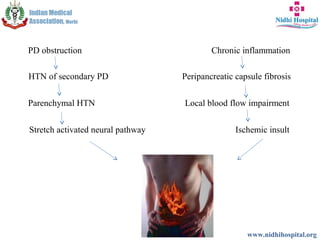
PD obstruction
HTN of secondary PD
Parenchymal HTN
Stretch activated neural pathway
Chronic inflammation
Peripancreatic capsule fibrosis
Local blood flow impairment
Ischemic insult
www.nidhihospital.org
• Symptomatology
– Abdominal pain (90%)
• Episodic
• Exacerbated by eating
• “Burnout” period in late phase
– Weight loss
• Avoidance of meals because of exacerbation of pain
• Malabsorption
– Exocrine insufficieny (4-30%)
• Steatorrhoea
• Malabsorption www.nidhihospital.org
– Endocrine insufficiency
• 90% parenchyma replaced by fibrosis
– Extrapancreatic complications
• Biliary obstruction (3-30%), due to fibrosis of head of
pancreas
• Duodenal obstruction (2-12%)
• Splenic vein thrombosis (2%)
– Risk of pancreatic cancer
www.nidhihospital.org
• Treatment strategy
– Lifestyle modification
– Diet modification
– Pancreatic enzyme supplementation
– Pain control
• Narcotics
• NSAID
• Anti-depresant
• Octreotide
• Celiac plexus nerve block
www.nidhihospital.org
• Indication for surgery
– Intractable abdominal pain
– Secondary complications of chronic pancreatitis
(biliary stricture, duodenal stenosis, pseudocyst,
and suspected pancreatic neoplasm)
www.nidhihospital.org
• Objectives of surgical management
– Pain relief
– Control of complications
– Preservation of exocrine and endocrine functions
– Social and occupational rehabilitation
– Improvement of quality of life www.nidhihospital.org
• Role of surgery in management of pain
– 75-90% success in pain relief
– Pain relief with surgery vs medical treatment
• 63 vs 43% @10 yr
www.nidhihospital.org
– Timing of surgery
• Non-surgical management as long as possible to avoid
surgical complications
• Better pain relief with early surgical drainage
• Decision regarding timing of surgery be individualized
on a patient to patient basis.
• With failure of medical management, counsel regarding
the risks and benefits of both modalities.
www.nidhihospital.org
Surgery
Resection
Total Pancreatectomy
Whipples PD
Traverso PPPD
DPPHR
Beger
Bern
Distal Pancreatectomy
Decompression
Duval’s
Puestow’s
Partington’s
Hybrid – LR+ LPJ
Frey
Izbicki
www.nidhihospital.org
• Hybrid procedures (LR+LPJ)
– Indications
• Dilated duct disease + Inflammation in head of pancres
– Complete pain relief in 92%
www.nidhihospital.org
• Frey procedure (1987)
– Duodenum-sparing resection of the pancreatic head + No
division of the neck of the pancreas + Longitudinal P-J
of the dorsal duct
– Long-term pain relief and decrease opiate dependence
www.nidhihospital.org
• Technical variations in Frey procedure
– Izbicki procedure (1998)
» Known as “Hamburg modification”
» Inflammatory head mass + Small duct disease
» More extensive excavation of head + lateral
decompressive pancreaticojejunostomy of the body and
tail
www.nidhihospital.org
• Drainage procedures
– Indication
• Isolated dilatation of the pancreatic duct >7mm or
“chain of lakes” appearance without an inflammatory
mass in the head
• Generalized parenchymal involvement (no focal
involvement)
• Recurrent or progressive segmental stenosis of the
pancreatic duct
www.nidhihospital.org
– Procedures
• Duval’s procedure (1954)
– Drainage of the tail with a Roux-en-Y limb of jejunum
– Not effective for disease in the proximal pancreas
www.nidhihospital.org
• Puestow’s procedure (Lateral P-J) (1958)
– Longitudinal decompression of the body and tail of the
pancreas into a Roux limb of jejunum
– Initially described in conjunction with splenectomy and
the distal pancreatectomy
www.nidhihospital.org
• Partington’s lateral P-J (1960)
– P-J without resection of the pancreatic tail
– Maximum pancreatic tissue preservation
– Recurrence of symptoms on long term due to incomplete
decompression of MPD in head
www.nidhihospital.org
• Resection procedures
– Indications
• Focal disease, confined to head of pancreas (except in
distal pancreatectomy)
• Suspicious malignant lesion
• Obstructive complication developed by fibrosis
• Non dilated duct
– Disadvantages
• Endocrine insufficiency
• Exocrine insufficiency
www.nidhihospital.org
– Procedures
• Whipples PD
– Resection of the head of the pancreas+distal CBD+distal
stomach+duodenum +proximal jejunum
– Also treat bile duct stricture and duodenal obstruction
www.nidhihospital.org
• Traverso’s pylorus preserving
pancreaticoduodenectomy
– Preservation of pylorus
– Improved QOL compare to Whipples’
pancreaticoduodenectomy
www.nidhihospital.org
• Distal pancreatectomy
– Isolated involvement of body and tail
– With or without splenectomy
– Stump closure by sutures or stapler application or by
creating a Roux-en-Y pancreatojejunostomy
– Post-operative outcome is similar in both groups
– Drainage procedure should be reserved for patients with
a dilated duct and/or a stricture in the pancreatic
head
www.nidhihospital.org
– Major portion of parenchyma remains untreated
– High risk of recurrence
– Requirement of completion pancreatectomy in 13%
www.nidhihospital.org
• Total pancreatectomy
– For persistence or recurrent pain
– Extended hospitalisation due to poor diabetes control
– Profound metabolic consequences in absence of islet
transplantation
– Outcomes identicles with Whipple’s
pancreaticoduodenectomy
www.nidhihospital.org
• Beger’s duodenum preserving pancreatic head resection
– Division of the neck overlying the confluence of the
splenic and superior mesenteric veins + Removal of the
head of the pancreas, leaving a small rim of pancreatic
tissue along the duodenum
– Maintain GI and biliary continuity
– Better long term outcomes
www.nidhihospital.org
• Bern Modification of DPPHR
– Pancreas is not divided at level of portal vein
– Useful in significant inflammation and PHTN
– Less intra-operative bleeding
– Equal outcome compare to Beger’s procedure
www.nidhihospital.org
• Comparison of results (PD vs Beger’s vs Frey)
– Study of 43 patients by Klempa et al
• DPPHR patients had a shorter hospital stay, greater
weight gain, less post operative diabetes, and exocrine
dysfunction than standard Whipple patients
• Pain control was similar between two groups
Klempa I, Spatny M, Menzel J, et al. Chirurg.1995;66:350 –359
www.nidhihospital.org
– Study of 40 patients by Buchler et al
• DPPHR patients had better pain relief, glucose
tolerance, and weight gain compared with PPPD
patients
Buchler MW, Friess H, Muller MW, et al. Am J Surg. 1995;169:65– 69; discussion 69 –70
– LR-LPJ and DPPHR compared with the PPPD
• Shorter operation times
• Less intraoperative blood loss
• Less perioperative transfusion requirements
Aspelund G, Topazian MD, Lee JH, et al.J Gastrointest Surg. 2005;9: 400 – 409
Koninger J, Seiler CM, Sauerland S, et al. Surgery. 2008;143:490 – 498.
www.nidhihospital.org
– Study by Farkas et al examined 40 patients
• Randomized to PPPD or organ-preserving pancreatic
head resection (OPPHR)
• OPPHR was associated with a shorter operating time,
less post operative morbidity, shorter hospital stay, and
better quality of life than PPPD.
• The degree of pain relief was equal
Farkas G, Leindler L, Daroczi M, et al. Langenbecks Arch Surg. 2006;391:338 –342
www.nidhihospital.org
• Role of minimal access surgery
• Conclusion
– Pain relief and quality of life - main concern in
treatment of chronic pancreatitis
– Surgery is indicated for relief of intractable pain
and complications associated with CP
– Timing of surgery should be individualized on a
patient to patient basis.
www.nidhihospital.org
– Surgical options
• Resection, Decompression procedures, Hybrid
procedures
– DPPHR and LR+LPJ are superior to resection in
term of
• Post-operative outcome,
• Quality of life
• Pain control,
• Glucose tolerance
• Weight gain
• Shorter OT time
• Less blood loss
www.nidhihospital.org
– Bern’s DPPHR is technically simpler, as reflected
by a significantly shorter operative time and a
significantly shorter hospital stay
– It has broader acceptance in the future because of
technical and economic advantages.
www.nidhihospital.org
Surgical Management of Chronic Pancreatitis

Surgical Management of Chronic Pancreatitis

  • 1.
    Surgical Management of ChronicPancreatitis Dr Happykumar Kagathara (M.S., Fellowship in Surgical Gastroenterology and Liver Transplantation) Department of GI Surgery and Advanced Minimal Access Surgery Nidhi Hospital, Ahmedabad CME – IMA, Morbi: September, 2014
  • 2.
    • Definition – Oneend of spectrum of inflammatory and fibrosing conditions of the pancreas – Progressive, permanent loss of exocrine and endocrine – Irreversible morphologic changes – Recurrent acute exacerbation or persistent pain www.nidhihospital.org
  • 3.
    • Etiology – Alcohol(70%) – Idiopathic (Tropical) (20%) – Hypercalcemia – Recurrent acute severe pancreatitis – Hereditary and Genetics____ – Obstructive causes_____ • Incidence – Indian scenario • 115-200 / 1,00,000 people • Idiopathic – Most common www.nidhihospital.org
  • 4.
    PD obstruction HTN ofsecondary PD Parenchymal HTN Stretch activated neural pathway Chronic inflammation Peripancreatic capsule fibrosis Local blood flow impairment Ischemic insult www.nidhihospital.org
  • 5.
    • Symptomatology – Abdominalpain (90%) • Episodic • Exacerbated by eating • “Burnout” period in late phase – Weight loss • Avoidance of meals because of exacerbation of pain • Malabsorption – Exocrine insufficieny (4-30%) • Steatorrhoea • Malabsorption www.nidhihospital.org
  • 6.
    – Endocrine insufficiency •90% parenchyma replaced by fibrosis – Extrapancreatic complications • Biliary obstruction (3-30%), due to fibrosis of head of pancreas • Duodenal obstruction (2-12%) • Splenic vein thrombosis (2%) – Risk of pancreatic cancer www.nidhihospital.org
  • 7.
    • Treatment strategy –Lifestyle modification – Diet modification – Pancreatic enzyme supplementation – Pain control • Narcotics • NSAID • Anti-depresant • Octreotide • Celiac plexus nerve block www.nidhihospital.org
  • 8.
    • Indication forsurgery – Intractable abdominal pain – Secondary complications of chronic pancreatitis (biliary stricture, duodenal stenosis, pseudocyst, and suspected pancreatic neoplasm) www.nidhihospital.org
  • 9.
    • Objectives ofsurgical management – Pain relief – Control of complications – Preservation of exocrine and endocrine functions – Social and occupational rehabilitation – Improvement of quality of life www.nidhihospital.org
  • 10.
    • Role ofsurgery in management of pain – 75-90% success in pain relief – Pain relief with surgery vs medical treatment • 63 vs 43% @10 yr www.nidhihospital.org
  • 11.
    – Timing ofsurgery • Non-surgical management as long as possible to avoid surgical complications • Better pain relief with early surgical drainage • Decision regarding timing of surgery be individualized on a patient to patient basis. • With failure of medical management, counsel regarding the risks and benefits of both modalities. www.nidhihospital.org
  • 12.
    Surgery Resection Total Pancreatectomy Whipples PD TraversoPPPD DPPHR Beger Bern Distal Pancreatectomy Decompression Duval’s Puestow’s Partington’s Hybrid – LR+ LPJ Frey Izbicki www.nidhihospital.org
  • 13.
    • Hybrid procedures(LR+LPJ) – Indications • Dilated duct disease + Inflammation in head of pancres – Complete pain relief in 92% www.nidhihospital.org
  • 14.
    • Frey procedure(1987) – Duodenum-sparing resection of the pancreatic head + No division of the neck of the pancreas + Longitudinal P-J of the dorsal duct – Long-term pain relief and decrease opiate dependence www.nidhihospital.org
  • 15.
    • Technical variationsin Frey procedure – Izbicki procedure (1998) » Known as “Hamburg modification” » Inflammatory head mass + Small duct disease » More extensive excavation of head + lateral decompressive pancreaticojejunostomy of the body and tail www.nidhihospital.org
  • 16.
    • Drainage procedures –Indication • Isolated dilatation of the pancreatic duct >7mm or “chain of lakes” appearance without an inflammatory mass in the head • Generalized parenchymal involvement (no focal involvement) • Recurrent or progressive segmental stenosis of the pancreatic duct www.nidhihospital.org
  • 17.
    – Procedures • Duval’sprocedure (1954) – Drainage of the tail with a Roux-en-Y limb of jejunum – Not effective for disease in the proximal pancreas www.nidhihospital.org
  • 18.
    • Puestow’s procedure(Lateral P-J) (1958) – Longitudinal decompression of the body and tail of the pancreas into a Roux limb of jejunum – Initially described in conjunction with splenectomy and the distal pancreatectomy www.nidhihospital.org
  • 19.
    • Partington’s lateralP-J (1960) – P-J without resection of the pancreatic tail – Maximum pancreatic tissue preservation – Recurrence of symptoms on long term due to incomplete decompression of MPD in head www.nidhihospital.org
  • 20.
  • 21.
    • Resection procedures –Indications • Focal disease, confined to head of pancreas (except in distal pancreatectomy) • Suspicious malignant lesion • Obstructive complication developed by fibrosis • Non dilated duct – Disadvantages • Endocrine insufficiency • Exocrine insufficiency www.nidhihospital.org
  • 22.
    – Procedures • WhipplesPD – Resection of the head of the pancreas+distal CBD+distal stomach+duodenum +proximal jejunum – Also treat bile duct stricture and duodenal obstruction www.nidhihospital.org
  • 23.
    • Traverso’s pyloruspreserving pancreaticoduodenectomy – Preservation of pylorus – Improved QOL compare to Whipples’ pancreaticoduodenectomy www.nidhihospital.org
  • 24.
    • Distal pancreatectomy –Isolated involvement of body and tail – With or without splenectomy – Stump closure by sutures or stapler application or by creating a Roux-en-Y pancreatojejunostomy – Post-operative outcome is similar in both groups – Drainage procedure should be reserved for patients with a dilated duct and/or a stricture in the pancreatic head www.nidhihospital.org
  • 25.
    – Major portionof parenchyma remains untreated – High risk of recurrence – Requirement of completion pancreatectomy in 13% www.nidhihospital.org
  • 26.
    • Total pancreatectomy –For persistence or recurrent pain – Extended hospitalisation due to poor diabetes control – Profound metabolic consequences in absence of islet transplantation – Outcomes identicles with Whipple’s pancreaticoduodenectomy www.nidhihospital.org
  • 27.
    • Beger’s duodenumpreserving pancreatic head resection – Division of the neck overlying the confluence of the splenic and superior mesenteric veins + Removal of the head of the pancreas, leaving a small rim of pancreatic tissue along the duodenum – Maintain GI and biliary continuity – Better long term outcomes www.nidhihospital.org
  • 28.
    • Bern Modificationof DPPHR – Pancreas is not divided at level of portal vein – Useful in significant inflammation and PHTN – Less intra-operative bleeding – Equal outcome compare to Beger’s procedure www.nidhihospital.org
  • 29.
    • Comparison ofresults (PD vs Beger’s vs Frey) – Study of 43 patients by Klempa et al • DPPHR patients had a shorter hospital stay, greater weight gain, less post operative diabetes, and exocrine dysfunction than standard Whipple patients • Pain control was similar between two groups Klempa I, Spatny M, Menzel J, et al. Chirurg.1995;66:350 –359 www.nidhihospital.org
  • 30.
    – Study of40 patients by Buchler et al • DPPHR patients had better pain relief, glucose tolerance, and weight gain compared with PPPD patients Buchler MW, Friess H, Muller MW, et al. Am J Surg. 1995;169:65– 69; discussion 69 –70 – LR-LPJ and DPPHR compared with the PPPD • Shorter operation times • Less intraoperative blood loss • Less perioperative transfusion requirements Aspelund G, Topazian MD, Lee JH, et al.J Gastrointest Surg. 2005;9: 400 – 409 Koninger J, Seiler CM, Sauerland S, et al. Surgery. 2008;143:490 – 498. www.nidhihospital.org
  • 31.
    – Study byFarkas et al examined 40 patients • Randomized to PPPD or organ-preserving pancreatic head resection (OPPHR) • OPPHR was associated with a shorter operating time, less post operative morbidity, shorter hospital stay, and better quality of life than PPPD. • The degree of pain relief was equal Farkas G, Leindler L, Daroczi M, et al. Langenbecks Arch Surg. 2006;391:338 –342 www.nidhihospital.org
  • 32.
  • 33.
    • Role ofminimal access surgery
  • 34.
    • Conclusion – Painrelief and quality of life - main concern in treatment of chronic pancreatitis – Surgery is indicated for relief of intractable pain and complications associated with CP – Timing of surgery should be individualized on a patient to patient basis. www.nidhihospital.org
  • 35.
    – Surgical options •Resection, Decompression procedures, Hybrid procedures – DPPHR and LR+LPJ are superior to resection in term of • Post-operative outcome, • Quality of life • Pain control, • Glucose tolerance • Weight gain • Shorter OT time • Less blood loss www.nidhihospital.org
  • 36.
    – Bern’s DPPHRis technically simpler, as reflected by a significantly shorter operative time and a significantly shorter hospital stay – It has broader acceptance in the future because of technical and economic advantages. www.nidhihospital.org