HPB CLINIC
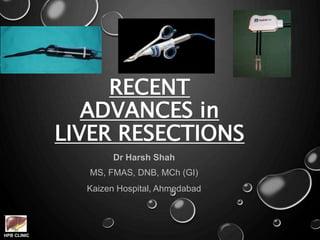
RECENT
ADVANCES in
LIVER RESECTIONS
Dr Harsh Shah
MS, FMAS, DNB, MCh (GI)
Kaizen Hospital, Ahmedabad
HPB CLINIC
INTRODUCTION
• First successful elective liver resection - 1888
(Langenbuch)
• True anatomical right hepatectomy in 1952 (Lortat-
Jacob)
• Subsequent experience
• Not encouraging till 20 years back
• Morbidity (30%) & mortality (5%)
• Most common complications being bleeding and bile leak
• Techniques and Instruments
• Large, non-anatomical wedge resections
• Possible due to development of new instruments and
techniques
HPB CLINIC
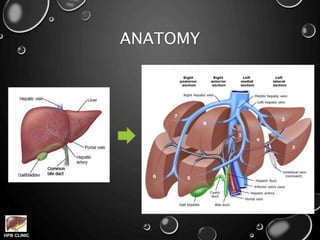
ANATOMY
HPB CLINIC
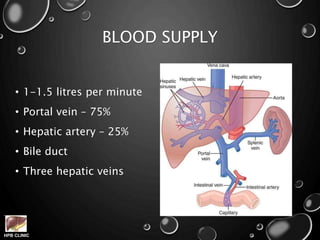
BLOOD SUPPLY
• 1-1.5 litres per minute
• Portal vein – 75%
• Hepatic artery – 25%
• Bile duct
• Three hepatic veins
HPB CLINIC
INDICATIONS FOR LIVER RESECTION
• Benign liver tumours
• Hemangioma
• Adenoma
• FNH
• Cystadenoma
• Malignant liver tumours
• HCC
• Cholangiocarcinoma
• Metastasis
• Carcinoma GB
• Benign conditions
• Intrahepatic stones
• RPC
• Caroli’s disease
• Hydatid cyst
• Liver cysts
• Liver trauma
• LDLT
HPB CLINIC
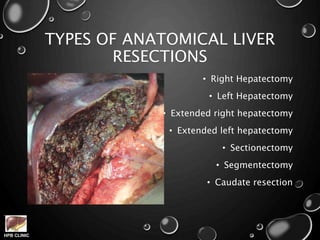
TYPES OF ANATOMICAL LIVER
RESECTIONS
• Right Hepatectomy
• Left Hepatectomy
• Extended right hepatectomy
• Extended left hepatectomy
• Sectionectomy
• Segmentectomy
• Caudate resection
HPB CLINIC
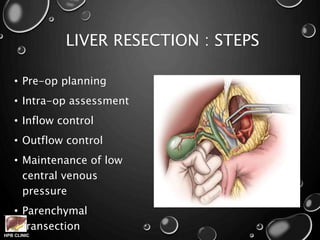
LIVER RESECTION : STEPS
• Pre-op planning
• Intra-op assessment
• Inflow control
• Outflow control
• Maintenance of low
central venous
pressure
• Parenchymal
transection
HPB CLINIC
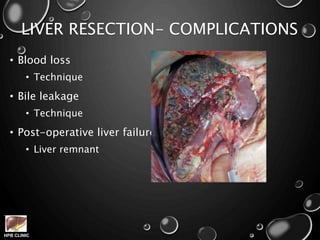
LIVER RESECTION- COMPLICATIONS
• Blood loss
• Technique
• Bile leakage
• Technique
• Post-operative liver failure
• Liver remnant
HPB CLINIC
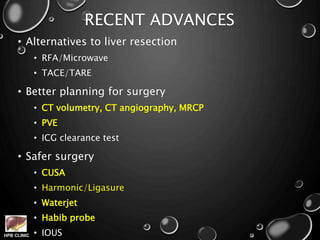
RECENT ADVANCES
• Alternatives to liver resection
• RFA/Microwave
• TACE/TARE
• Better planning for surgery
• CT volumetry, CT angiography, MRCP
• PVE
• ICG clearance test
• Safer surgery
• CUSA
• Harmonic/Ligasure
• Waterjet
• Habib probe
• IOUS
HPB CLINIC
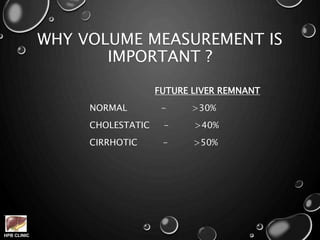
WHY VOLUME MEASUREMENT IS
IMPORTANT ?
FUTURE LIVER REMNANT
NORMAL - >30%
CHOLESTATIC - >40%
CIRRHOTIC - >50%
HPB CLINIC
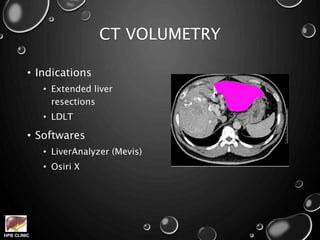
CT VOLUMETRY
• Indications
• Extended liver
resections
• LDLT
• Softwares
• LiverAnalyzer (Mevis)
• Osiri X
HPB CLINIC
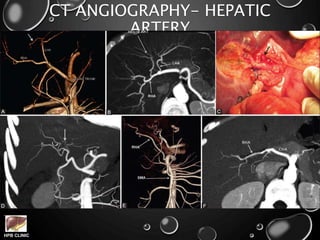
CT ANGIOGRAPHY- HEPATIC
ARTERY
HPB CLINIC
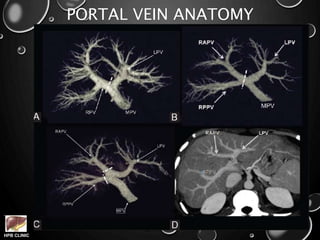
PORTAL VEIN ANATOMY
HPB CLINIC
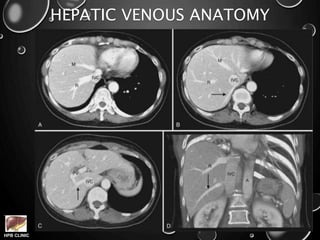
HEPATIC VENOUS ANATOMY
HPB CLINIC
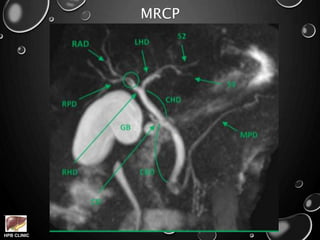
MRCP
HPB CLINIC
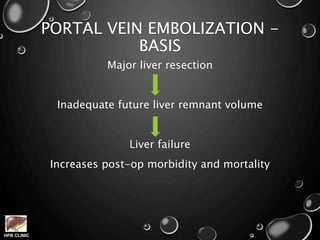
PORTAL VEIN EMBOLIZATION -
BASIS
Major liver resection
Inadequate future liver remnant volume
Liver failure
Increases post-op morbidity and mortality
HPB CLINIC
WHAT IS PVE ?
Embolization of PV on the side to be resected
Concept – atrophy hypertrophy complex
Leads to hypertrophy of future liver remnant (FLR)
Allows major resection without post op liver failure
HPB CLINIC
INDICATIONS
1. Hilar cholangiocarcinoma requiring right
trisegmentectomy.
PTBD before PVE, reduces chances of porto-biliary
fistula
2. Multiple liver metastasis occupying right lobe
requiring major hepatectomy
3. HCC – PVE (7-10 days after TAE) combine with
TAE reduces tumor growth while waiting period
HPB CLINIC
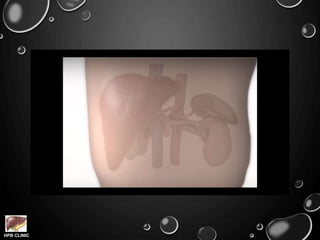
TECHNIQUE
Three approaches –
1. Laparotomy and through ileocolic vein
2. Transhepatic ipsilateral approach
3. Transhepatic contralateral approach
HPB CLINIC
HPB CLINIC
EMBOLIZATION MATERIALS
No ideal embolization material
1. Gelfoam (gelatin sponge with thrombin)
2. Fibrin glue (fibrinogen + thrombin)
3. Synthetic glue (n-butyl-2-cyanoacrylate)
Permanent, massive perivascular fibrosis, difficult dissection
4. Polyvinyl alcohol
5. Coils
6. Iodized oil
7. Absolute ethanol (significant more hypertrophy, increase
enzymes)
All – similar hypertrophy 2-4 weeks after PVE
HPB CLINIC
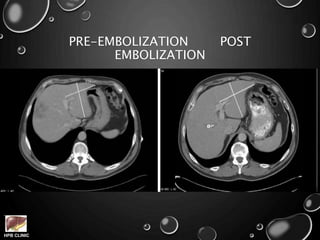
PRE-EMBOLIZATION POST
EMBOLIZATION
HPB CLINIC
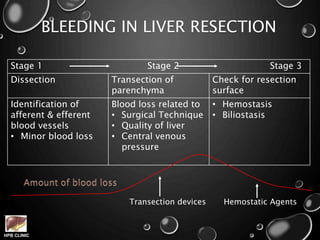
BLEEDING IN LIVER RESECTION
Stage 1 Stage 2 Stage 3
Dissection Transection of
parenchyma
Check for resection
surface
Identification of
afferent & efferent
blood vessels
• Minor blood loss
Blood loss related to
• Surgical Technique
• Quality of liver
• Central venous
pressure
• Hemostasis
• Biliostasis
Transection devices Hemostatic Agents
HPB CLINIC
PARENCHYMAL
TRANSECTION
HPB CLINIC
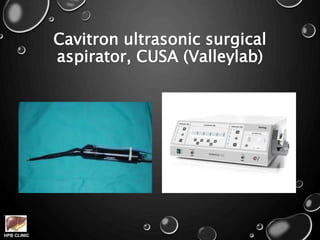
Cavitron ultrasonic surgical aspirator,
CUSA (Valleylab)
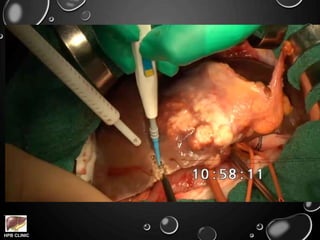
Pencil-grip surgical hand piece contains a
transducer
Oscillates longitudinally at 23 KHz
Explosion of cells with a high water content
(hepatocytes) and fragmentation of
parenchyma, sparing blood and bile vessel
HPB CLINIC
Cavitron ultrasonic surgical
aspirator, CUSA (Valleylab)
HPB CLINIC
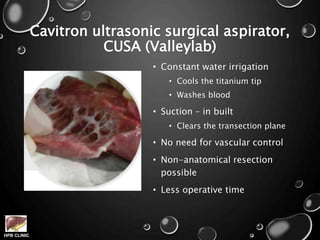
Cavitron ultrasonic surgical aspirator,
CUSA (Valleylab)
• Constant water irrigation
• Cools the titanium tip
• Washes blood
• Suction – in built
• Clears the transection plane
• No need for vascular control
• Non-anatomical resection
possible
• Less operative time
HPB CLINIC
HPB CLINIC
WATER-JET
HPB CLINIC
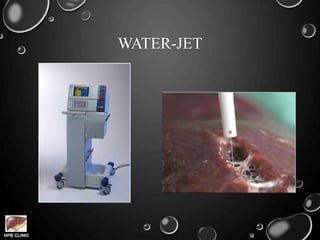
WATER-JET
‘Intelligent knife’
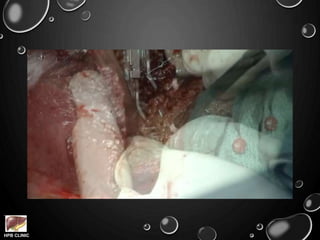
• Consists of pressure generating pump connected to a hand-piece
• Jet nozzle with a pinhole 0.1 mm
• Projects physiologic saline
• Suction line connected to a transparent hollow tip
• Separates ducts & blood vessels from parenchyma
• Splashing (source infection) avoided by
• Keep hollow tip into direct contact with liver
HPB CLINIC
WATER-JET
• Intrahepatic vessels and bile ducts (>0.2mm) not
injured with water jet pressure
• 10 kgf/cm2 in normal liver parenchyma
• 15-18 kgf/cm2 in cirrhotic patients
• Compared with CUSA
• Less blood loss
• Similar operating time
• Less positive margins
HPB CLINIC
HPB CLINIC
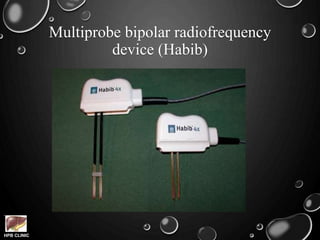
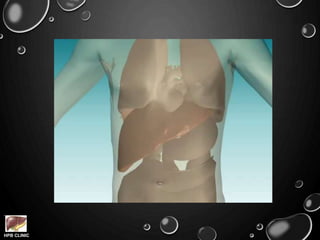
Multiprobe bipolar radiofrequency
device (Habib)
HPB CLINIC
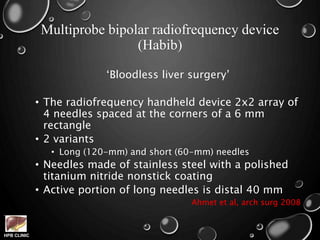
Multiprobe bipolar radiofrequency device
(Habib)
‘Bloodless liver surgery’
• The radiofrequency handheld device 2x2 array of
4 needles spaced at the corners of a 6 mm
rectangle
• 2 variants
• Long (120-mm) and short (60-mm) needles
• Needles made of stainless steel with a polished
titanium nitride nonstick coating
• Active portion of long needles is distal 40 mm
Ahmet et al, arch surg 2008
HPB CLINIC
HPB CLINIC
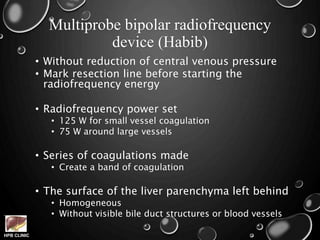
Multiprobe bipolar radiofrequency
device (Habib)
• Without reduction of central venous pressure
• Mark resection line before starting the
radiofrequency energy
• Radiofrequency power set
• 125 W for small vessel coagulation
• 75 W around large vessels
• Series of coagulations made
• Create a band of coagulation
• The surface of the liver parenchyma left behind
• Homogeneous
• Without visible bile duct structures or blood vessels
HPB CLINIC
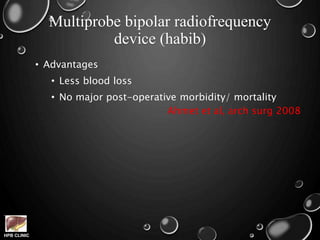
Multiprobe bipolar radiofrequency
device (habib)
• Advantages
• Less blood loss
• No major post-operative morbidity/ mortality
Ahmet et al, arch surg 2008
HPB CLINIC
Harmonic ‘Focus’
• Ultrasonically activated shear
• Causes protein denaturation and coagulation by high
frequency ultrasound vibration
• Ultrasonic generator, foot switch, hand piece
• Vibration frequency 55,500 Hz
• Simultaneous coagulation (3mm) & cutting
• No smoke & minimal lateral spread (0.5mm)
• Only for superficial parenchymal transection
Kim J et al, am surg 2003
HPB CLINIC
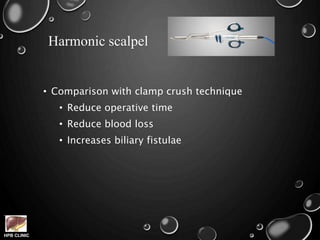
Harmonic scalpel
• Comparison with clamp crush technique
• Reduce operative time
• Reduce blood loss
• Increases biliary fistulae
HPB CLINIC
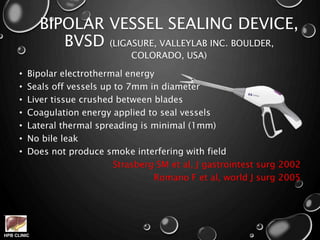
BIPOLAR VESSEL SEALING DEVICE,
BVSD (LIGASURE, VALLEYLAB INC. BOULDER,
COLORADO, USA)
• Bipolar electrothermal energy
• Seals off vessels up to 7mm in diameter
• Liver tissue crushed between blades
• Coagulation energy applied to seal vessels
• Lateral thermal spreading is minimal (1mm)
• No bile leak
• Does not produce smoke interfering with field
Strasberg SM et al, J gastrointest surg 2002
Romano F et al, world J surg 2005
HPB CLINIC
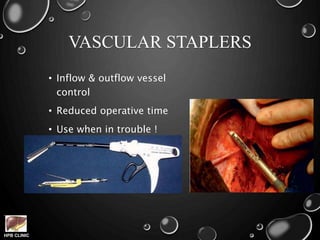
VASCULAR STAPLERS
• Inflow & outflow vessel
control
• Reduced operative time
• Use when in trouble !
HPB CLINIC
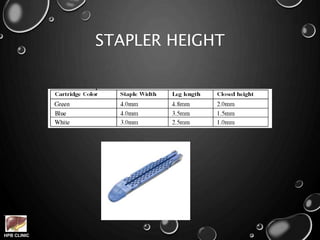
STAPLER HEIGHT
HPB CLINIC
LAPAROSCOPY
• First anatomical laparoscopic liver resection
• 1996 by Azagra
• Left lateral sectionectomy for hepatic adenoma
• Small and localized tumors on anterolateral segments
• Oncological principal has to be followed
• Need of intra-operative ultrasound
HPB CLINIC
LAPAROSCOPY
• Laparoscopic assisted hepatectomy (LAH)
• Total laparoscopic liver resection (TLLR)
HPB CLINIC
LAPAROSCOPY
• Pneumoperitoneum
• Carbon dioxide
• Pressure aiming for 6–8 mmHg during transection
• 300 laparoscope
• Hepatic transection
• Harmonic scalpel/ CUSA/Ligasure
• Bleeder control
• Bipolar coagulation for minor bleeding
• Endoclips/ endo GIA staplers for larger structures
Gagner et al, surg clin N am 2004
HPB CLINIC
LAPAROSCOPY
• TLLR
• Usually possible in patients with tumor size < 5
cm
• Wedge resection
• Left lateral sectionectomy
• Safe procedure in antero-inferior segments
Meta analysis by simillis et al, surgery 2007
Sasaki et al, BJS 2009
• Few reports of right hepatectomy
Ibrahim et al, J am coll surg 2005
• Can be performed safely in cirrhotic patients
Buell et al, J am coll surg 2005
HPB CLINIC
LAPAROSCOPY
• Laparoscopic procedure
• Advantages
• Decreased operating time
• Lower overall cost
Francesco et al, surg endosc 2008
• Less pain, early discharge, faster recovery
• Less adhesions
Topal et al, surg endosc 2008
Sasaki et al, BJS 2009
HPB CLINIC
LAPAROSCOPY
• Disadvantages
• Chance of gas embolism
• Tumor dissemination
• Tumor margin
HPB CLINIC
CONCLUSION
• Surgery without vascular occlusion possible with aid
of new instruments
• Newer devices make liver surgery
• Less bloody
• Easy to perform
• safer
• Superiority of newer devices still needs to be proven
compared to clamp crushing in terms of blood loss,
blood transfusion, time consumption, cost,
complications
HPB CLINIC

Recent advances in liver resections

  • 1.
    HPB CLINIC RECENT ADVANCES in LIVERRESECTIONS Dr Harsh Shah MS, FMAS, DNB, MCh (GI) Kaizen Hospital, Ahmedabad
  • 2.
    HPB CLINIC INTRODUCTION • Firstsuccessful elective liver resection - 1888 (Langenbuch) • True anatomical right hepatectomy in 1952 (Lortat- Jacob) • Subsequent experience • Not encouraging till 20 years back • Morbidity (30%) & mortality (5%) • Most common complications being bleeding and bile leak • Techniques and Instruments • Large, non-anatomical wedge resections • Possible due to development of new instruments and techniques
  • 3.
  • 4.
    HPB CLINIC BLOOD SUPPLY •1-1.5 litres per minute • Portal vein – 75% • Hepatic artery – 25% • Bile duct • Three hepatic veins
  • 5.
    HPB CLINIC INDICATIONS FORLIVER RESECTION • Benign liver tumours • Hemangioma • Adenoma • FNH • Cystadenoma • Malignant liver tumours • HCC • Cholangiocarcinoma • Metastasis • Carcinoma GB • Benign conditions • Intrahepatic stones • RPC • Caroli’s disease • Hydatid cyst • Liver cysts • Liver trauma • LDLT
  • 6.
    HPB CLINIC TYPES OFANATOMICAL LIVER RESECTIONS • Right Hepatectomy • Left Hepatectomy • Extended right hepatectomy • Extended left hepatectomy • Sectionectomy • Segmentectomy • Caudate resection
  • 7.
    HPB CLINIC LIVER RESECTION: STEPS • Pre-op planning • Intra-op assessment • Inflow control • Outflow control • Maintenance of low central venous pressure • Parenchymal transection
  • 8.
    HPB CLINIC LIVER RESECTION-COMPLICATIONS • Blood loss • Technique • Bile leakage • Technique • Post-operative liver failure • Liver remnant
  • 9.
    HPB CLINIC RECENT ADVANCES •Alternatives to liver resection • RFA/Microwave • TACE/TARE • Better planning for surgery • CT volumetry, CT angiography, MRCP • PVE • ICG clearance test • Safer surgery • CUSA • Harmonic/Ligasure • Waterjet • Habib probe • IOUS
  • 10.
    HPB CLINIC WHY VOLUMEMEASUREMENT IS IMPORTANT ? FUTURE LIVER REMNANT NORMAL - >30% CHOLESTATIC - >40% CIRRHOTIC - >50%
  • 11.
    HPB CLINIC CT VOLUMETRY •Indications • Extended liver resections • LDLT • Softwares • LiverAnalyzer (Mevis) • Osiri X
  • 12.
  • 13.
  • 14.
  • 15.
  • 16.
    HPB CLINIC PORTAL VEINEMBOLIZATION - BASIS Major liver resection Inadequate future liver remnant volume Liver failure Increases post-op morbidity and mortality
  • 17.
    HPB CLINIC WHAT ISPVE ? Embolization of PV on the side to be resected Concept – atrophy hypertrophy complex Leads to hypertrophy of future liver remnant (FLR) Allows major resection without post op liver failure
  • 18.
    HPB CLINIC INDICATIONS 1. Hilarcholangiocarcinoma requiring right trisegmentectomy. PTBD before PVE, reduces chances of porto-biliary fistula 2. Multiple liver metastasis occupying right lobe requiring major hepatectomy 3. HCC – PVE (7-10 days after TAE) combine with TAE reduces tumor growth while waiting period
  • 19.
    HPB CLINIC TECHNIQUE Three approaches– 1. Laparotomy and through ileocolic vein 2. Transhepatic ipsilateral approach 3. Transhepatic contralateral approach
  • 20.
  • 21.
    HPB CLINIC EMBOLIZATION MATERIALS Noideal embolization material 1. Gelfoam (gelatin sponge with thrombin) 2. Fibrin glue (fibrinogen + thrombin) 3. Synthetic glue (n-butyl-2-cyanoacrylate) Permanent, massive perivascular fibrosis, difficult dissection 4. Polyvinyl alcohol 5. Coils 6. Iodized oil 7. Absolute ethanol (significant more hypertrophy, increase enzymes) All – similar hypertrophy 2-4 weeks after PVE
  • 22.
  • 23.
    HPB CLINIC BLEEDING INLIVER RESECTION Stage 1 Stage 2 Stage 3 Dissection Transection of parenchyma Check for resection surface Identification of afferent & efferent blood vessels • Minor blood loss Blood loss related to • Surgical Technique • Quality of liver • Central venous pressure • Hemostasis • Biliostasis Transection devices Hemostatic Agents
  • 24.
  • 25.
    HPB CLINIC Cavitron ultrasonicsurgical aspirator, CUSA (Valleylab) Pencil-grip surgical hand piece contains a transducer Oscillates longitudinally at 23 KHz Explosion of cells with a high water content (hepatocytes) and fragmentation of parenchyma, sparing blood and bile vessel
  • 26.
    HPB CLINIC Cavitron ultrasonicsurgical aspirator, CUSA (Valleylab)
  • 27.
    HPB CLINIC Cavitron ultrasonicsurgical aspirator, CUSA (Valleylab) • Constant water irrigation • Cools the titanium tip • Washes blood • Suction – in built • Clears the transection plane • No need for vascular control • Non-anatomical resection possible • Less operative time
  • 28.
  • 29.
  • 30.
    HPB CLINIC WATER-JET ‘Intelligent knife’ •Consists of pressure generating pump connected to a hand-piece • Jet nozzle with a pinhole 0.1 mm • Projects physiologic saline • Suction line connected to a transparent hollow tip • Separates ducts & blood vessels from parenchyma • Splashing (source infection) avoided by • Keep hollow tip into direct contact with liver
  • 31.
    HPB CLINIC WATER-JET • Intrahepaticvessels and bile ducts (>0.2mm) not injured with water jet pressure • 10 kgf/cm2 in normal liver parenchyma • 15-18 kgf/cm2 in cirrhotic patients • Compared with CUSA • Less blood loss • Similar operating time • Less positive margins
  • 32.
  • 33.
    HPB CLINIC Multiprobe bipolarradiofrequency device (Habib)
  • 34.
    HPB CLINIC Multiprobe bipolarradiofrequency device (Habib) ‘Bloodless liver surgery’ • The radiofrequency handheld device 2x2 array of 4 needles spaced at the corners of a 6 mm rectangle • 2 variants • Long (120-mm) and short (60-mm) needles • Needles made of stainless steel with a polished titanium nitride nonstick coating • Active portion of long needles is distal 40 mm Ahmet et al, arch surg 2008
  • 35.
  • 36.
    HPB CLINIC Multiprobe bipolarradiofrequency device (Habib) • Without reduction of central venous pressure • Mark resection line before starting the radiofrequency energy • Radiofrequency power set • 125 W for small vessel coagulation • 75 W around large vessels • Series of coagulations made • Create a band of coagulation • The surface of the liver parenchyma left behind • Homogeneous • Without visible bile duct structures or blood vessels
  • 37.
    HPB CLINIC Multiprobe bipolarradiofrequency device (habib) • Advantages • Less blood loss • No major post-operative morbidity/ mortality Ahmet et al, arch surg 2008
  • 38.
    HPB CLINIC Harmonic ‘Focus’ •Ultrasonically activated shear • Causes protein denaturation and coagulation by high frequency ultrasound vibration • Ultrasonic generator, foot switch, hand piece • Vibration frequency 55,500 Hz • Simultaneous coagulation (3mm) & cutting • No smoke & minimal lateral spread (0.5mm) • Only for superficial parenchymal transection Kim J et al, am surg 2003
  • 39.
    HPB CLINIC Harmonic scalpel •Comparison with clamp crush technique • Reduce operative time • Reduce blood loss • Increases biliary fistulae
  • 40.
    HPB CLINIC BIPOLAR VESSELSEALING DEVICE, BVSD (LIGASURE, VALLEYLAB INC. BOULDER, COLORADO, USA) • Bipolar electrothermal energy • Seals off vessels up to 7mm in diameter • Liver tissue crushed between blades • Coagulation energy applied to seal vessels • Lateral thermal spreading is minimal (1mm) • No bile leak • Does not produce smoke interfering with field Strasberg SM et al, J gastrointest surg 2002 Romano F et al, world J surg 2005
  • 41.
    HPB CLINIC VASCULAR STAPLERS •Inflow & outflow vessel control • Reduced operative time • Use when in trouble !
  • 42.
  • 43.
    HPB CLINIC LAPAROSCOPY • Firstanatomical laparoscopic liver resection • 1996 by Azagra • Left lateral sectionectomy for hepatic adenoma • Small and localized tumors on anterolateral segments • Oncological principal has to be followed • Need of intra-operative ultrasound
  • 44.
    HPB CLINIC LAPAROSCOPY • Laparoscopicassisted hepatectomy (LAH) • Total laparoscopic liver resection (TLLR)
  • 45.
    HPB CLINIC LAPAROSCOPY • Pneumoperitoneum •Carbon dioxide • Pressure aiming for 6–8 mmHg during transection • 300 laparoscope • Hepatic transection • Harmonic scalpel/ CUSA/Ligasure • Bleeder control • Bipolar coagulation for minor bleeding • Endoclips/ endo GIA staplers for larger structures Gagner et al, surg clin N am 2004
  • 46.
    HPB CLINIC LAPAROSCOPY • TLLR •Usually possible in patients with tumor size < 5 cm • Wedge resection • Left lateral sectionectomy • Safe procedure in antero-inferior segments Meta analysis by simillis et al, surgery 2007 Sasaki et al, BJS 2009 • Few reports of right hepatectomy Ibrahim et al, J am coll surg 2005 • Can be performed safely in cirrhotic patients Buell et al, J am coll surg 2005
  • 47.
    HPB CLINIC LAPAROSCOPY • Laparoscopicprocedure • Advantages • Decreased operating time • Lower overall cost Francesco et al, surg endosc 2008 • Less pain, early discharge, faster recovery • Less adhesions Topal et al, surg endosc 2008 Sasaki et al, BJS 2009
  • 48.
    HPB CLINIC LAPAROSCOPY • Disadvantages •Chance of gas embolism • Tumor dissemination • Tumor margin
  • 49.
    HPB CLINIC CONCLUSION • Surgerywithout vascular occlusion possible with aid of new instruments • Newer devices make liver surgery • Less bloody • Easy to perform • safer • Superiority of newer devices still needs to be proven compared to clamp crushing in terms of blood loss, blood transfusion, time consumption, cost, complications
  • 50.