

ENDOCRINE SYSTEM
(Pancreas)
Mr N.JEGAN
Associate Professor
K.M.COLLEGE OF PHARMACY.
MADURAI.
Pancreas- Location
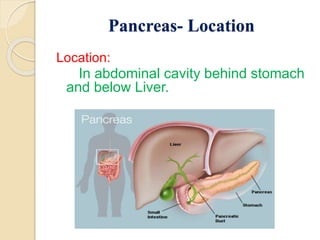
Location:
In abdominal cavity behind stomach
and below Liver.
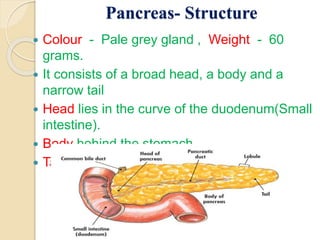
Pancreas- Structure
 Colour - Pale grey gland , Weight - 60
grams.
 It consists of a broad head, a body and a
narrow tail
 Head lies in the curve of the duodenum(Small
intestine).
 Body behind the stomach.
 Tail lies in front of the left kidney.
Pancreas-Structure
 It Consists of two major types of secretary
tissues which reflects its dual function
◦ Exocrine function of Pancreas
 Secretes digestive juice to small intestine
for Digestion.
◦ Endocrine gland function of Pancreas
 It releases hormones from islet cells
(islets of Langerhans) in pancreas.
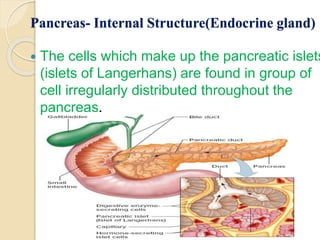
Pancreas- Internal Structure(Endocrine gland)
 The cells which make up the pancreatic islets
(islets of Langerhans) are found in group of
cell irregularly distributed throughout the
pancreas.
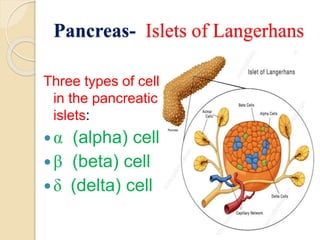
Pancreas- Islets of Langerhans
Three types of cells
in the pancreatic
islets:
α (alpha) cell
β (beta) cell
δ (delta) cell
The islets of Langerhans-
Hormones
 It secrete three hormones from the cells of
islets of langerhans.
 α (alpha) cell - Glucagon
 β (beta) cell - Insulin
 δ (delta) cell - Somatostatin
Hormones-Functions
Glucagon
It increase the blood sugar by
-Stimulate Breakdown of glycogen to glucose
(Glycogen is the storage form of Glucose in
liver) called Glycogenolysis.
- Stimulate the formation of glucose from
Amino acids and Glycerol (Gluconeogensis)
Glucagon
Hormones-Functions
Insulin
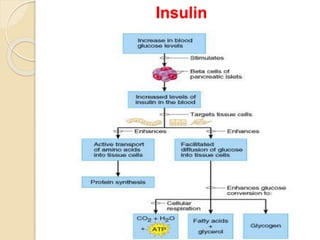
It lower the Blood sugar level by
 Stimulating uptake and use of
glucose by muscle and connective
tissue cells.
 Increasing conversion of glucose to
glycogen in Liver.
 promoting synthesis of fatty acids
Insulin
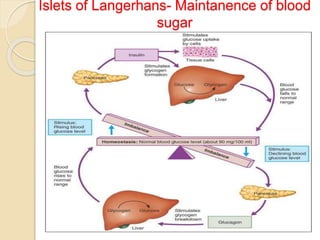
Islets of Langerhans- Maintanence of blood
sugar
Hormones-Functions
Somatostatin
It control the secretion of
glucagon and insulin
DISORDERS OF THE PANCREATIC
ISLETS
Diabetes mellitus
This is due to deficiency or
absence of insulin.
 Two types of Diabetes mellitus
1. Type I, insulin-dependent diabetes
mellitus (IDDM).
2. Type II, non-insulin-dependent
diabetes mellitus (NIDDM).
Type I-Diabetes mellitus
 This occurs mainly in children and young
adults.
 The deficiency or absence of insulin is
due to the destruction of beta-islet cells.
 Increase the blood sugar level
 The causes are unknown but mostly
genetically.
Type II-Diabetes mellitus
 This is the most common form of diabetes,
occur 90% diabetic cases.
 Insulin secretion below the normal
 Increase the blood sugar level
Symptoms:
 Frequent urination, Unusual thirst
 Extreme hunger , Unusual weight loss
 Blurred vision
 Cuts that are slow to heal
 Tingling/numbness in the hands/feet
Diabetes mellitus
THANKING YOU

Pancreas endocrine function ppt

  • 1.
    ENDOCRINE SYSTEM (Pancreas) Mr N.JEGAN AssociateProfessor K.M.COLLEGE OF PHARMACY. MADURAI.
  • 2.
    Pancreas- Location Location: In abdominalcavity behind stomach and below Liver.
  • 3.
    Pancreas- Structure  Colour- Pale grey gland , Weight - 60 grams.  It consists of a broad head, a body and a narrow tail  Head lies in the curve of the duodenum(Small intestine).  Body behind the stomach.  Tail lies in front of the left kidney.
  • 4.
    Pancreas-Structure  It Consistsof two major types of secretary tissues which reflects its dual function ◦ Exocrine function of Pancreas  Secretes digestive juice to small intestine for Digestion. ◦ Endocrine gland function of Pancreas  It releases hormones from islet cells (islets of Langerhans) in pancreas.
  • 5.
    Pancreas- Internal Structure(Endocrinegland)  The cells which make up the pancreatic islets (islets of Langerhans) are found in group of cell irregularly distributed throughout the pancreas.
  • 6.
    Pancreas- Islets ofLangerhans Three types of cells in the pancreatic islets: α (alpha) cell β (beta) cell δ (delta) cell
  • 7.
    The islets ofLangerhans- Hormones  It secrete three hormones from the cells of islets of langerhans.  α (alpha) cell - Glucagon  β (beta) cell - Insulin  δ (delta) cell - Somatostatin
  • 8.
    Hormones-Functions Glucagon It increase theblood sugar by -Stimulate Breakdown of glycogen to glucose (Glycogen is the storage form of Glucose in liver) called Glycogenolysis. - Stimulate the formation of glucose from Amino acids and Glycerol (Gluconeogensis)
  • 9.
  • 10.
    Hormones-Functions Insulin It lower theBlood sugar level by  Stimulating uptake and use of glucose by muscle and connective tissue cells.  Increasing conversion of glucose to glycogen in Liver.  promoting synthesis of fatty acids
  • 11.
  • 12.
    Islets of Langerhans-Maintanence of blood sugar
  • 13.
    Hormones-Functions Somatostatin It control thesecretion of glucagon and insulin
  • 14.
    DISORDERS OF THEPANCREATIC ISLETS Diabetes mellitus This is due to deficiency or absence of insulin.  Two types of Diabetes mellitus 1. Type I, insulin-dependent diabetes mellitus (IDDM). 2. Type II, non-insulin-dependent diabetes mellitus (NIDDM).
  • 15.
    Type I-Diabetes mellitus This occurs mainly in children and young adults.  The deficiency or absence of insulin is due to the destruction of beta-islet cells.  Increase the blood sugar level  The causes are unknown but mostly genetically.
  • 16.
    Type II-Diabetes mellitus This is the most common form of diabetes, occur 90% diabetic cases.  Insulin secretion below the normal  Increase the blood sugar level Symptoms:  Frequent urination, Unusual thirst  Extreme hunger , Unusual weight loss  Blurred vision  Cuts that are slow to heal  Tingling/numbness in the hands/feet
  • 17.
  • 18.