


HAP-II
ENERGETICS
BASIC METABOLIC RATE(BMR)
Mr N.JEGAN
Associate Professor
K.M.COLLEGE OF PHARMACY.
MADURAI.
BMR-Introduction
Food is the fuel source of the body, the ingested
food undergoes metabolism to liberate energy required
for the vital activities of the body.
BMR-Definition
BMR is minimum amount of energy required by the
body to maintain life at complete physical and mental rest in
post absorptive state.
Several functions within the body occurs at basal condition
Working of heart and other organs
Conduction of nerve impulse
Reabsorption by renal tubules
Gi motility
Ion transport across membranes
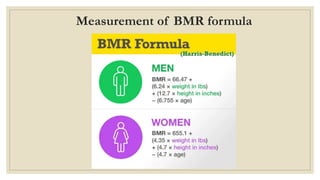
Measurement of BMR formula
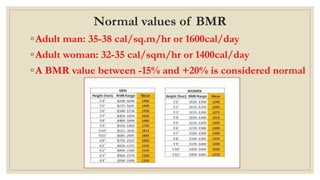
Normal values of BMR
◦Adult man: 35-38 cal/sq.m/hr or 1600cal/day
◦Adult woman: 32-35 cal/sqm/hr or 1400cal/day
◦A BMR value between -15% and +20% is considered normal
Factors affecting BMR
1.Surface area: directly proportional to surface area
2.Sex: men have marginally higher BMR (5%)
3.Age: in infants and growing children BMR is higher. In adults
BMR decreases at the rate of 2% per decade of life
4. Physical activity: increase with regular exercise
5.Hormones: Thyroid hormones increase BMR. Epinephrine,
cortisol, sex hormones and growth hormone hormones
increase BMR
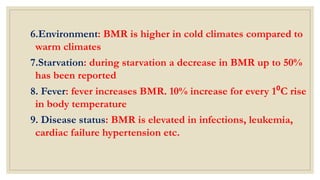
6.Environment: BMR is higher in cold climates compared to
warm climates
7.Starvation: during starvation a decrease in BMR up to 50%
has been reported
8. Fever: fever increases BMR. 10% increase for every 1⁰C rise
in body temperature
9. Disease status: BMR is elevated in infections, leukemia,
cardiac failure hypertension etc.
THANK YOU…!

BMR

  • 1.
    HAP-II ENERGETICS BASIC METABOLIC RATE(BMR) MrN.JEGAN Associate Professor K.M.COLLEGE OF PHARMACY. MADURAI.
  • 2.
    BMR-Introduction Food is thefuel source of the body, the ingested food undergoes metabolism to liberate energy required for the vital activities of the body.
  • 3.
    BMR-Definition BMR is minimumamount of energy required by the body to maintain life at complete physical and mental rest in post absorptive state. Several functions within the body occurs at basal condition Working of heart and other organs Conduction of nerve impulse Reabsorption by renal tubules Gi motility Ion transport across membranes
  • 4.
  • 5.
    Normal values ofBMR ◦Adult man: 35-38 cal/sq.m/hr or 1600cal/day ◦Adult woman: 32-35 cal/sqm/hr or 1400cal/day ◦A BMR value between -15% and +20% is considered normal
  • 6.
    Factors affecting BMR 1.Surfacearea: directly proportional to surface area 2.Sex: men have marginally higher BMR (5%) 3.Age: in infants and growing children BMR is higher. In adults BMR decreases at the rate of 2% per decade of life 4. Physical activity: increase with regular exercise 5.Hormones: Thyroid hormones increase BMR. Epinephrine, cortisol, sex hormones and growth hormone hormones increase BMR
  • 7.
    6.Environment: BMR ishigher in cold climates compared to warm climates 7.Starvation: during starvation a decrease in BMR up to 50% has been reported 8. Fever: fever increases BMR. 10% increase for every 1⁰C rise in body temperature 9. Disease status: BMR is elevated in infections, leukemia, cardiac failure hypertension etc.
  • 8.