REFLEX ACTION
Reflex action
Reflex action --------Rapid, Involuntary response to stimuli.
It is a defence mechanism manifesting as a quick and automatic motor response for a
sensory stimulus.
Reflex arc:
It consist of structures which are involved in the production of a reflex action.
These structures are:
Sensory organ
Sensory nerve
Spinal cord
Motor nerve
Effector organ
Reflex Arc……
Reflex Arc……
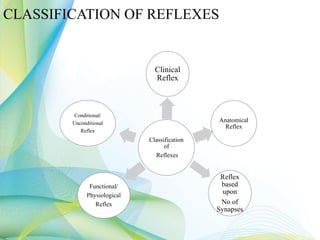
CLASSIFICATION OF REFLEXES
Classification
of
Reflexes
Clinical
Reflex
Anatomical
Reflex
Conditional/
Unconditional
Reflex
Reflex
based
upon
No of
Synapses
Functional/
Physiological
Reflex
I.) CLINICAL REFLEXES
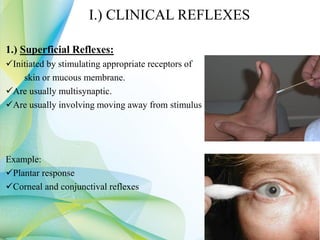
1.) Superficial Reflexes:
Initiated by stimulating appropriate receptors of
skin or mucous membrane.
Are usually multisynaptic.
Are usually involving moving away from stimulus
Example:
Plantar response
Corneal and conjunctival reflexes
I.) CLINICAL REFLEXES
2.) Deep Reflexes:
Stimulating receptors deep in muscles.
Are basically stretch reflexes.
Are also called Tendon reflexes
Example:
Knee jerk,
Ankle jerk
I.) CLINICAL REFLEXES
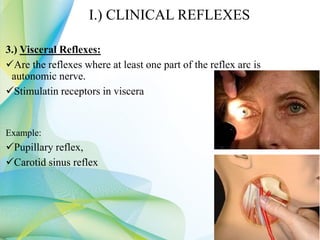
3.) Visceral Reflexes:
Are the reflexes where at least one part of the reflex arc is
autonomic nerve.
Stimulatin receptors in viscera
Example:
Pupillary reflex,
Carotid sinus reflex
I.) CLINICAL REFLEXES
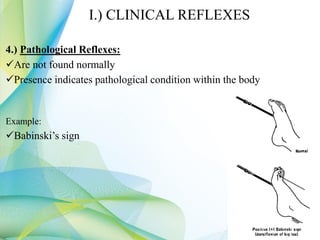
4.) Pathological Reflexes:
Are not found normally
Presence indicates pathological condition within the body
Example:
Babinski’s sign
II.) ANATOMICAL REFLEXES
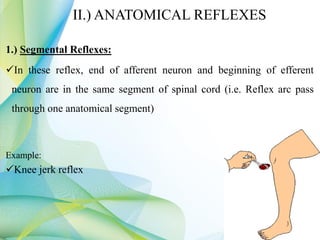
1.) Segmental Reflexes:
In these reflex, end of afferent neuron and beginning of efferent
neuron are in the same segment of spinal cord (i.e. Reflex arc pass
through one anatomical segment)
Example:
Knee jerk reflex
II.) ANATOMICAL REFLEXES
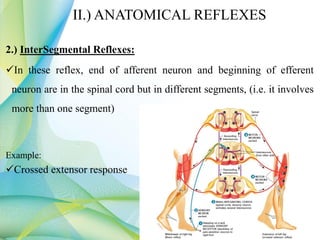
2.) InterSegmental Reflexes:
In these reflex, end of afferent neuron and beginning of efferent
neuron are in the spinal cord but in different segments, (i.e. it involves
more than one segment)
Example:
Crossed extensor response
II.) ANATOMICAL REFLEXES
3.) SupraSegmental Reflexes:
Centre for such reflex lies above the spinal cord, involves interaction
with suprasegmental components.
Example:
Postural reflex (head-limb)
III.) REFLEX BASED UPON NUMBER OF
SYNAPSES
1.) Monosynaptic Reflexes:
The sensory neuron comes in and directly synapses on the motor neuron.
(SN--------< MN)
Example: Stretch reflex
2.) Bisynaptic Reflexes:
It requires that one interneuron be interposed between the sensory neuron and motor neuron.
(SN----------<IN----------<MN)
Example: Reciprocal innervation
3.) Polysynaptic Reflexes:
It has more than two synapses in the spinal cord.
(SN----------<IN-----------<IN -------------<MN)
Example: Superficial reflexes
IV.) FUNCTIONAL/PHYSIOLOGICAL
REFLEXES
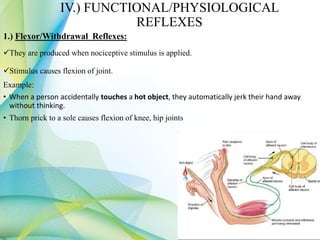
1.) Flexor/Withdrawal Reflexes:
They are produced when nociceptive stimulus is applied.
Stimulus causes flexion of joint.
Example:
• When a person accidentally touches a hot object, they automatically jerk their hand away
without thinking.
• Thorn prick to a sole causes flexion of knee, hip joints
IV.) FUNCTIONAL/PHYSIOLOGICAL
REFLEXES
2.) Extensor reflexes:
Theses reflexes causes extension of the joints.
Example:
Stretch reflexes are extensor reflexes which are the basis of tone and
posture.
V.) UNCONDITIONAL/CONDITIONAL
REFLEXES
1.) Unconditional Reflexes:
These are inborn reflexes.
Example:
The smell of food is an unconditioned stimulus, a feeling of hunger in
response to the smell is a unconditioned response.
V.) UNCONDITIONAL/CONDITIONAL
REFLEXES
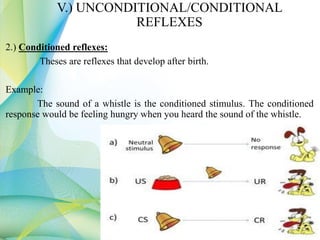
2.) Conditioned reflexes:
Theses are reflexes that develop after birth.
Example:
The sound of a whistle is the conditioned stimulus. The conditioned
response would be feeling hungry when you heard the sound of the whistle.
SENSATION & SENSORY PATH
SENSATION:
Sensations can be classified into two types:
1.) Special sensation which can be felt by specialized organs e.g. sensation of
smell, taste, sight, hearing etc.
2.) General sensation which can be felt by all parts of the body. General
sensations can again be classified into two types:
i. Superficial sensations (like pain, touch and temperature which are
felt by the skin)
ii. Deep sensations (like pain, touch and deep pain) felt by muscles,
joints and other organs.
SENSORY ORGANS:
The organs which receive the sensory stimuli are called as sensory
organs. It can be classified into:
1.) Exteroceptive organs which receive sensations produced by
stimuli which occur outside the body e.g. smell, taste, sight and temperature.
2.) Interoceptive organs which receive sensations produced from
stimuli inside the body.
The interoceptive organs are further classified into:
a.) Enteroceptive organs which receive stimuli from visceral organs
(e.g. thirst and hunger)
b.) Proprioceptive organs which receive stimuli from muscles and
joints (e.g. touching the mouth after closing the eyes. The muscle and joints
can identify the mouth or any other organ even in the absence of vision)
SENSORY PATH:
The peripheral nerves carry superficial sensations (from skin) and deep sensations
(from muscles and joint) towards the spinal cord.
These sensory fibres enter the posterior horn of grey matter of spinal cord through
nerve root.
Then the fibres of deep and superficial sensation travel by different paths as follows:
Fibres carrying superficial sensation travel upwards in the anterior column of
spinal cord.
Fibres carrying deep sensation travel upwards in the posterior column of spinal
cord.
SENSORY PATH:
Both theses fibres cross each other and go to the opposite side of spinal cord.
This crossing occurs at the level of medulla oblongata.
The impulses are then conveyed to sensory areas of brain through brain stem,
thalamus and white matter of brain.
MOTOR PATH:
The motor path for voluntary movements consists of two neurones 1.) The upper
motor neurone 2.) The lower motor neurone
Upper motor neurone extends from the pyramidal cells of motor cortex of brain to
the anterior horn cells of spinal cord.
The path is as follows:
Impulses commence from the pyramidal cells of motor cortex(situated in front of
central sulcus)
The fibres pass through internal capsule and pons and reach the medulla oblongata.
These fibres cross each other in the medulla oblongata.
Then they travel through the lateral column of spinal cord and terminate in the
anterior horn cells.
MOTOR PATH:
Lower motor neurone extends from the anterior horn to the peripheral nerve
supplying the muscle. The path is as follows:
 The fibres from anterior horn cells reach the anterior nerve root.
 The fibres of anterior nerve root unite with the incoming fibres of posterior
nerve root and form the spinal nerve.
The motor nerves emerging from the spinal nerves supply the muscle.
Importance of Reflex action:
The impulses of reflex action are carried only to the spinal cord and
not to the motor cortex of brain.
The impulses from the spinal cord are then conveyed to the motor
organ. So the response is quick and immediate.
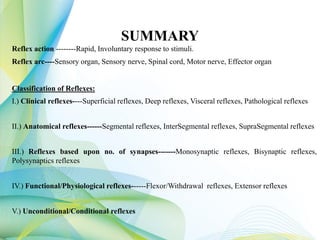
SUMMARY
Reflex action --------Rapid, Involuntary response to stimuli.
Reflex arc----Sensory organ, Sensory nerve, Spinal cord, Motor nerve, Effector organ
Classification of Reflexes:
I.) Clinical reflexes----Superficial reflexes, Deep reflexes, Visceral reflexes, Pathological reflexes
II.) Anatomical reflexes------Segmental reflexes, InterSegmental reflexes, SupraSegmental reflexes
III.) Reflexes based upon no. of synapses-------Monosynaptic reflexes, Bisynaptic reflexes,
Polysynaptics reflexes
IV.) Functional/Physiological reflexes------Flexor/Withdrawal reflexes, Extensor reflexes
V.) Unconditional/Conditional reflexes
Reflex action

Reflex action

  • 1.
  • 2.
    Reflex action Reflex action--------Rapid, Involuntary response to stimuli. It is a defence mechanism manifesting as a quick and automatic motor response for a sensory stimulus. Reflex arc: It consist of structures which are involved in the production of a reflex action. These structures are: Sensory organ Sensory nerve Spinal cord Motor nerve Effector organ
  • 3.
  • 4.
  • 5.
  • 6.
    I.) CLINICAL REFLEXES 1.)Superficial Reflexes: Initiated by stimulating appropriate receptors of skin or mucous membrane. Are usually multisynaptic. Are usually involving moving away from stimulus Example: Plantar response Corneal and conjunctival reflexes
  • 7.
    I.) CLINICAL REFLEXES 2.)Deep Reflexes: Stimulating receptors deep in muscles. Are basically stretch reflexes. Are also called Tendon reflexes Example: Knee jerk, Ankle jerk
  • 8.
    I.) CLINICAL REFLEXES 3.)Visceral Reflexes: Are the reflexes where at least one part of the reflex arc is autonomic nerve. Stimulatin receptors in viscera Example: Pupillary reflex, Carotid sinus reflex
  • 9.
    I.) CLINICAL REFLEXES 4.)Pathological Reflexes: Are not found normally Presence indicates pathological condition within the body Example: Babinski’s sign
  • 10.
    II.) ANATOMICAL REFLEXES 1.)Segmental Reflexes: In these reflex, end of afferent neuron and beginning of efferent neuron are in the same segment of spinal cord (i.e. Reflex arc pass through one anatomical segment) Example: Knee jerk reflex
  • 11.
    II.) ANATOMICAL REFLEXES 2.)InterSegmental Reflexes: In these reflex, end of afferent neuron and beginning of efferent neuron are in the spinal cord but in different segments, (i.e. it involves more than one segment) Example: Crossed extensor response
  • 12.
    II.) ANATOMICAL REFLEXES 3.)SupraSegmental Reflexes: Centre for such reflex lies above the spinal cord, involves interaction with suprasegmental components. Example: Postural reflex (head-limb)
  • 13.
    III.) REFLEX BASEDUPON NUMBER OF SYNAPSES 1.) Monosynaptic Reflexes: The sensory neuron comes in and directly synapses on the motor neuron. (SN--------< MN) Example: Stretch reflex 2.) Bisynaptic Reflexes: It requires that one interneuron be interposed between the sensory neuron and motor neuron. (SN----------<IN----------<MN) Example: Reciprocal innervation 3.) Polysynaptic Reflexes: It has more than two synapses in the spinal cord. (SN----------<IN-----------<IN -------------<MN) Example: Superficial reflexes
  • 14.
    IV.) FUNCTIONAL/PHYSIOLOGICAL REFLEXES 1.) Flexor/WithdrawalReflexes: They are produced when nociceptive stimulus is applied. Stimulus causes flexion of joint. Example: • When a person accidentally touches a hot object, they automatically jerk their hand away without thinking. • Thorn prick to a sole causes flexion of knee, hip joints
  • 15.
    IV.) FUNCTIONAL/PHYSIOLOGICAL REFLEXES 2.) Extensorreflexes: Theses reflexes causes extension of the joints. Example: Stretch reflexes are extensor reflexes which are the basis of tone and posture.
  • 16.
    V.) UNCONDITIONAL/CONDITIONAL REFLEXES 1.) UnconditionalReflexes: These are inborn reflexes. Example: The smell of food is an unconditioned stimulus, a feeling of hunger in response to the smell is a unconditioned response.
  • 17.
    V.) UNCONDITIONAL/CONDITIONAL REFLEXES 2.) Conditionedreflexes: Theses are reflexes that develop after birth. Example: The sound of a whistle is the conditioned stimulus. The conditioned response would be feeling hungry when you heard the sound of the whistle.
  • 18.
    SENSATION & SENSORYPATH SENSATION: Sensations can be classified into two types: 1.) Special sensation which can be felt by specialized organs e.g. sensation of smell, taste, sight, hearing etc. 2.) General sensation which can be felt by all parts of the body. General sensations can again be classified into two types: i. Superficial sensations (like pain, touch and temperature which are felt by the skin) ii. Deep sensations (like pain, touch and deep pain) felt by muscles, joints and other organs.
  • 19.
    SENSORY ORGANS: The organswhich receive the sensory stimuli are called as sensory organs. It can be classified into: 1.) Exteroceptive organs which receive sensations produced by stimuli which occur outside the body e.g. smell, taste, sight and temperature. 2.) Interoceptive organs which receive sensations produced from stimuli inside the body.
  • 20.
    The interoceptive organsare further classified into: a.) Enteroceptive organs which receive stimuli from visceral organs (e.g. thirst and hunger) b.) Proprioceptive organs which receive stimuli from muscles and joints (e.g. touching the mouth after closing the eyes. The muscle and joints can identify the mouth or any other organ even in the absence of vision)
  • 21.
    SENSORY PATH: The peripheralnerves carry superficial sensations (from skin) and deep sensations (from muscles and joint) towards the spinal cord. These sensory fibres enter the posterior horn of grey matter of spinal cord through nerve root. Then the fibres of deep and superficial sensation travel by different paths as follows: Fibres carrying superficial sensation travel upwards in the anterior column of spinal cord. Fibres carrying deep sensation travel upwards in the posterior column of spinal cord.
  • 22.
    SENSORY PATH: Both thesesfibres cross each other and go to the opposite side of spinal cord. This crossing occurs at the level of medulla oblongata. The impulses are then conveyed to sensory areas of brain through brain stem, thalamus and white matter of brain.
  • 23.
    MOTOR PATH: The motorpath for voluntary movements consists of two neurones 1.) The upper motor neurone 2.) The lower motor neurone Upper motor neurone extends from the pyramidal cells of motor cortex of brain to the anterior horn cells of spinal cord. The path is as follows: Impulses commence from the pyramidal cells of motor cortex(situated in front of central sulcus) The fibres pass through internal capsule and pons and reach the medulla oblongata. These fibres cross each other in the medulla oblongata. Then they travel through the lateral column of spinal cord and terminate in the anterior horn cells.
  • 24.
    MOTOR PATH: Lower motorneurone extends from the anterior horn to the peripheral nerve supplying the muscle. The path is as follows:  The fibres from anterior horn cells reach the anterior nerve root.  The fibres of anterior nerve root unite with the incoming fibres of posterior nerve root and form the spinal nerve. The motor nerves emerging from the spinal nerves supply the muscle.
  • 25.
    Importance of Reflexaction: The impulses of reflex action are carried only to the spinal cord and not to the motor cortex of brain. The impulses from the spinal cord are then conveyed to the motor organ. So the response is quick and immediate.
  • 26.
    SUMMARY Reflex action --------Rapid,Involuntary response to stimuli. Reflex arc----Sensory organ, Sensory nerve, Spinal cord, Motor nerve, Effector organ Classification of Reflexes: I.) Clinical reflexes----Superficial reflexes, Deep reflexes, Visceral reflexes, Pathological reflexes II.) Anatomical reflexes------Segmental reflexes, InterSegmental reflexes, SupraSegmental reflexes III.) Reflexes based upon no. of synapses-------Monosynaptic reflexes, Bisynaptic reflexes, Polysynaptics reflexes IV.) Functional/Physiological reflexes------Flexor/Withdrawal reflexes, Extensor reflexes V.) Unconditional/Conditional reflexes