Respiratory system
Lung volumes and capacities
Mr N.JEGAN
Associate Professor
K.M.COLLEGE OF PHARMACY.
MADURAI.
Respiratory system
Lungs volume-Introduction
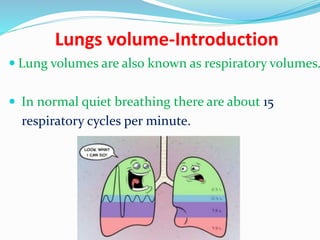
 Lung volumes are also known as respiratory volumes.
 In normal quiet breathing there are about 15
respiratory cycles per minute.
Importance to measure the lungs volume
Lung function tests are based on the
measurement of volume of air breathed in and out in
quiet breathing and forced breathing.
These volumes tend to vary, depending on the
depth of respiration, gender, age, body
composition and in certain respiratory diseases.
It used to find the person have any lungs related
diseases.
Lung volumes
Lung volumes are the volumes of air breathed by an
individual.
Lung volumes are of four types:
1. Tidal volume
2. Inspiratory reserve volume
3. Expiratory reserve volume
4. Residual volume
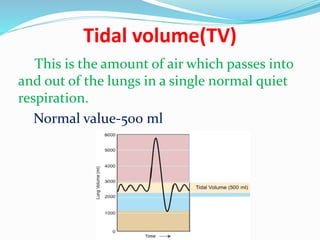
Tidal volume(TV)
This is the amount of air which passes into
and out of the lungs in a single normal quiet
respiration.
Normal value-500 ml
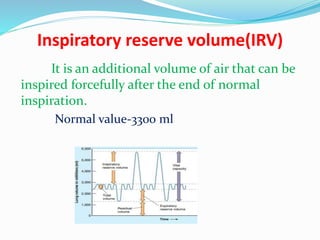
Inspiratory reserve volume(IRV)
It is an additional volume of air that can be
inspired forcefully after the end of normal
inspiration.
Normal value-3300 ml
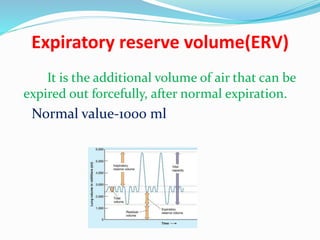
Expiratory reserve volume(ERV)
It is the additional volume of air that can be
expired out forcefully, after normal expiration.
Normal value-1000 ml
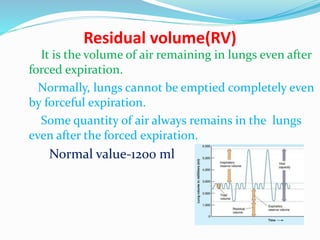
Residual volume(RV)
It is the volume of air remaining in lungs even after
forced expiration.
Normally, lungs cannot be emptied completely even
by forceful expiration.
Some quantity of air always remains in the lungs
even after the forced expiration.
Normal value-1200 ml
LUNG CAPACITIES
Lung capacities are the combination of two or
more lung volumes.
Lung capacities are of four types:
1. Inspiratory capacity
2. Vital capacity
3. Functional residual capacity
4. Total lung capacity.
Inspiratory capacity(IC)
It is the maximum volume of air that is inspired
after normal expiration (end expiratory position).
It includes tidal volume and inspiratory reserve
volume
IC = TV + IRV
IC= 500 + 3,300 = 3,800 ml
Normal value-3800 ml
Vital capacity(VC)
It is the maximum volume of air that can be
expelled out forcefully after a deep (maximal)
inspiration.
VC includes inspiratory reserve volume, tidal
volume and expiratory reserve volume.
VC = IRV + TV + ERV
VC= 3,300 + 500 + 1,000 = 4,800 ml
Normal value-4800 ml
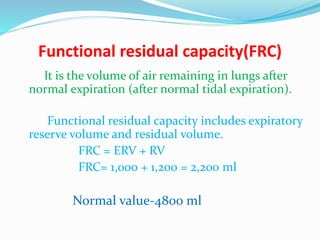
Functional residual capacity(FRC)
It is the volume of air remaining in lungs after
normal expiration (after normal tidal expiration).
Functional residual capacity includes expiratory
reserve volume and residual volume.
FRC = ERV + RV
FRC= 1,000 + 1,200 = 2,200 ml
Normal value-4800 ml
Total lung capacity(TLC)
It is the volume of air present in lungs
after a deep (maximal) inspiration.
It includes all the volumes.
TLC = IRV + TV + ERV + RV
TLC= 3,300 + 500 + 1,000 + 1,200 = 6,000 ml
Normal value- 6000 ml
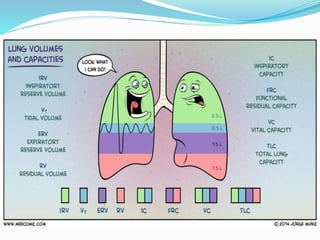
Lungs capacities- Diagram
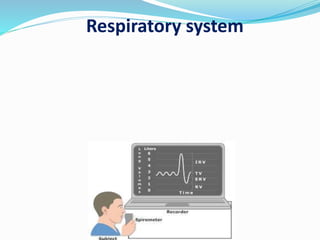
How to measure Lungs volume
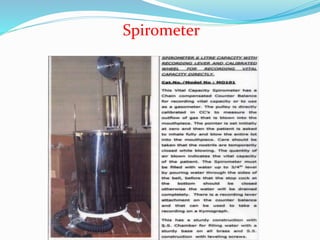
Apparatus name-The Spirometer
A spirometer is an apparatus for measuring the
volume of air inspired and expired by the lungs.
you sit and breathe into a small machine called
a spirometer. This medical device records the amount
of air you breathe in and out and the speed of your
breath.
Spirometer
Next Topic
Artificial respiration,
and resuscitation methods.

Lungs volume and Capacities

  • 1.
    Respiratory system Lung volumesand capacities Mr N.JEGAN Associate Professor K.M.COLLEGE OF PHARMACY. MADURAI.
  • 2.
  • 3.
    Lungs volume-Introduction  Lungvolumes are also known as respiratory volumes.  In normal quiet breathing there are about 15 respiratory cycles per minute.
  • 4.
    Importance to measurethe lungs volume Lung function tests are based on the measurement of volume of air breathed in and out in quiet breathing and forced breathing. These volumes tend to vary, depending on the depth of respiration, gender, age, body composition and in certain respiratory diseases. It used to find the person have any lungs related diseases.
  • 5.
    Lung volumes Lung volumesare the volumes of air breathed by an individual. Lung volumes are of four types: 1. Tidal volume 2. Inspiratory reserve volume 3. Expiratory reserve volume 4. Residual volume
  • 6.
    Tidal volume(TV) This isthe amount of air which passes into and out of the lungs in a single normal quiet respiration. Normal value-500 ml
  • 7.
    Inspiratory reserve volume(IRV) Itis an additional volume of air that can be inspired forcefully after the end of normal inspiration. Normal value-3300 ml
  • 8.
    Expiratory reserve volume(ERV) Itis the additional volume of air that can be expired out forcefully, after normal expiration. Normal value-1000 ml
  • 9.
    Residual volume(RV) It isthe volume of air remaining in lungs even after forced expiration. Normally, lungs cannot be emptied completely even by forceful expiration. Some quantity of air always remains in the lungs even after the forced expiration. Normal value-1200 ml
  • 10.
    LUNG CAPACITIES Lung capacitiesare the combination of two or more lung volumes. Lung capacities are of four types: 1. Inspiratory capacity 2. Vital capacity 3. Functional residual capacity 4. Total lung capacity.
  • 12.
    Inspiratory capacity(IC) It isthe maximum volume of air that is inspired after normal expiration (end expiratory position). It includes tidal volume and inspiratory reserve volume IC = TV + IRV IC= 500 + 3,300 = 3,800 ml Normal value-3800 ml
  • 13.
    Vital capacity(VC) It isthe maximum volume of air that can be expelled out forcefully after a deep (maximal) inspiration. VC includes inspiratory reserve volume, tidal volume and expiratory reserve volume. VC = IRV + TV + ERV VC= 3,300 + 500 + 1,000 = 4,800 ml Normal value-4800 ml
  • 14.
    Functional residual capacity(FRC) Itis the volume of air remaining in lungs after normal expiration (after normal tidal expiration). Functional residual capacity includes expiratory reserve volume and residual volume. FRC = ERV + RV FRC= 1,000 + 1,200 = 2,200 ml Normal value-4800 ml
  • 15.
    Total lung capacity(TLC) Itis the volume of air present in lungs after a deep (maximal) inspiration. It includes all the volumes. TLC = IRV + TV + ERV + RV TLC= 3,300 + 500 + 1,000 + 1,200 = 6,000 ml Normal value- 6000 ml
  • 16.
  • 18.
    How to measureLungs volume Apparatus name-The Spirometer A spirometer is an apparatus for measuring the volume of air inspired and expired by the lungs. you sit and breathe into a small machine called a spirometer. This medical device records the amount of air you breathe in and out and the speed of your breath.
  • 19.
  • 21.