Pituitary Hormones
EXPERT VISION ACADEMY
Pituitary Gland and Its Relation
to the Hypothalamus
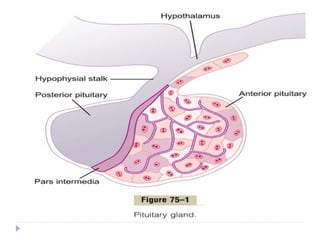
 The pituitary gland also called the hypophysis, is a small gland
 About 1 cm in diameter
 0.5 to 1 gm in weight
 Location: at the base of the brain
 It is connected to the hypothalamus by the pituitary (or hypophysial)
stalk.
 Physiologically, the pituitary gland is divisible into two distinct
portions:
1. anterior pituitary or adenohypophysis
2. posterior pituitary or neurohypophysis
 Between these is a small, relatively avascular zone called the pars
intermedia, absent in the human being but is much larger and much
more functional in some lower animals.
Pituitary hormones
 The 6 hormones of the anterior pituitary play major roles in the
control of metabolic functions throughout the body:
1. Growth hormone
2. Adrenocorticotropin (corticotropin)
3. Thyroid-stimulating hormone (thyrotropin)
4. Prolactin
5. Gonadotropic hormones: follicle-stimulating hormone and luteinizing
hormone
 The two hormones secreted by the posterior pituitary play other
roles.
1. Antidiuretic hormone or vasopressin
2. Oxytocin
Pituitary hormones
 Growth hormone promotes growth of the entire body by
affecting protein formation, cell multiplication, and cell
differentiation.
 ACTH controls the secretion of some of the adrenocortical
hormones, which affect the metabolism of glucose, proteins and
fats.
 TSH controls the rate of secretion of thyroxine and
triiodothyronine by the thyroid gland, and these hormones
control the rates of most intracellular chemical reactions in the
body.
Pituitary hormones
 Prolactin promotes mammary gland development and milk
production.
 FSH and LH control growth of the ovaries and testes, as
well as their hormonal and reproductive activities.
 ADH controls the rate of water excretion into the urine, thus
helping to control the concentration of water in the body
fluids.
 Oxytocin helps express milk from the glands of the breast
and possibly helps in the delivery of the baby at the end of
gestation.
Anterior Pituitary Gland
 Contains different Cell Types that Synthesize and Secrete
Hormones.
 There is one cell type for each major hormone
 Five cell types:
1. Somatotropes—human growth hormone (hGH), 30-40%
2. Corticotropes—adrenocorticotropin (ACTH), 20%
3. Thyrotropes—thyroid-stimulating hormone (TSH)
4. Gonadotropes—gonadotropic hormones, LH and FSH
5. Lactotropes—prolactin (PRL)
 Somatotropes stain strongly with acid dyes and are therefore called
acidophils. Thus, pituitary tumors that secrete large quantities of
human growth hormone are called acidophilic tumors.
Posterior Pituitary Hormones
 Are Synthesized by Cell Bodies in the Hypothalamus.
 The bodies of the cells that secrete the posterior pituitary
hormones are not located in the pituitary gland itself but are
large neurons, called magnocellular neurons, located in the
hypothalamus.
 The hormones are then transported in the axoplasm of the
neurons’ nerve fibers passing from the hypothalamus to the
posterior pituitary gland.
Hypothalamus Controls Pituitary
Secretion
 Almost all secretion by the pituitary is controlled by either
hormonal or nervous signals from the hypothalamus.
 Secretion from the posterior pituitary is controlled by nerve signals
that originate in the hypothalamus and terminate in the posterior
pituitary.
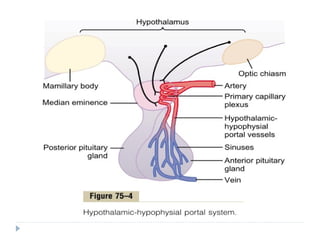
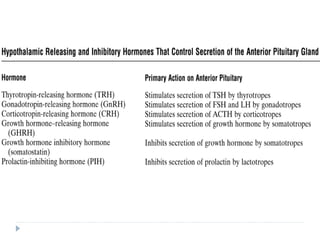
 Secretion by the anterior pituitary is controlled by hormones called
hypothalamic releasing and hypothalamic inhibitory hormones (or
factors) secreted within the hypothalamus itself and then conducted
to the anterior pituitary through minute blood vessels called
hypothalamic-hypophysial portal vessels.
 In the anterior pituitary, these releasing and inhibitory
hormones act on the glandular cells to control their
secretion.
 The hypothalamus receives signals from many sources in the
nervous system.
 Hypothalamus is a collecting center for information
concerning the internal well-being of the body, and much of
this information is used to control secretions of the many
globally important pituitary hormones.
Growth Hormone
Physiological Functions of Growth
Hormone
 All the major anterior pituitary hormones, except for
growth hormone, exert their principal effects by stimulating
target glands.
 Growth hormone does not function through a target gland
but exerts its effects directly on all or almost all tissues of
the body.
Growth Hormone Promotes Growth
of Many Body Tissues
 Somatotropic hormone or somatotropin
 A small protein molecule
 191 amino acids in a single chain
 It causes growth of almost all tissues of the body that are capable of
growing.
 It promotes:
 Increased sizes of the cells
 Increased mitosis
 Development of greater numbers of cells and specific differentiation
of certain types of cells.
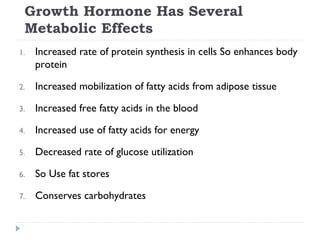
Growth Hormone Has Several
Metabolic Effects
1. Increased rate of protein synthesis in cells So enhances body
protein
2. Increased mobilization of fatty acids from adipose tissue
3. Increased free fatty acids in the blood
4. Increased use of fatty acids for energy
5. Decreased rate of glucose utilization
6. So Use fat stores
7. Conserves carbohydrates
Growth Hormone Promotes Protein
Deposition in Tissues
 Enhancement of Amino Acid Transport Through the Cell
Membranes.
 Enhancement of RNA Translation to Cause Protein Synthesis
by the Ribosomes.
 Increased Nuclear Transcription of DNA to Form RNA.
 Decreased Catabolism of Protein and Amino Acids.
 Growth hormone enhances almost all facets of amino acid
uptake and protein synthesis by cells, while at the same time
reducing the breakdown of proteins.
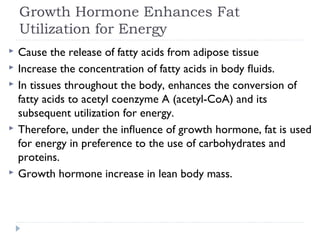
Growth Hormone Enhances Fat
Utilization for Energy
 Cause the release of fatty acids from adipose tissue
 Increase the concentration of fatty acids in body fluids.
 In tissues throughout the body, enhances the conversion of
fatty acids to acetyl coenzyme A (acetyl-CoA) and its
subsequent utilization for energy.
 Therefore, under the influence of growth hormone, fat is used
for energy in preference to the use of carbohydrates and
proteins.
 Growth hormone increase in lean body mass.
“Ketogenic” Effect of Growth Hormone
 In excessive amounts of growth hormone, fat
mobilization from adipose tissue sometimes becomes so
great that large quantities of acetoacetic acid are formed
by the liver
 Then released into the body fluids, thus causing ketosis.
 This excessive mobilization of fatfrom the adipose tissue
also frequently causes a fatty liver
Growth Hormone Decreases
Carbohydrate Utilization
 Growth hormone causes multiple effects that influence
carbohydrate metabolism
1. Decreased glucose uptake in tissues such as skeletal muscle and fat
2. Increased glucose production by the liver
3. Increased insulin secretion.
 Each of these changes results from growth hormone–induced
“insulin resistance”
 This leads to increased blood glucose concentration and a
compensatory increase in insulin secretion.
 Growth hormone’s effects are called diabetogenic
 Excess secretion of growth hormone can produce
metabolic disturbances very similar to those found in
patients with type II (non-insulindependent)diabetes.
 Growth hormone–induced increases in blood
concentrations of fatty acids may impair insulin’s actions
on tissue glucose utilization
Growth Hormone Stimulates Cartilage
and Bone Growth
 Growth hormone stimulates increased deposition of protein
and increased growth in almost all tissues of the body
 Also Increase growth of the skeletal frame.
 Multiple effects of growth hormone on bone:
1. Increased deposition of protein by the chondrocytic and
osteogenic cells that cause bone growth,
2. Increased rate of reproduction of these cells,
3. A specific effect of converting chondrocytes into osteogenic
cells, thus causing deposition of new bone.
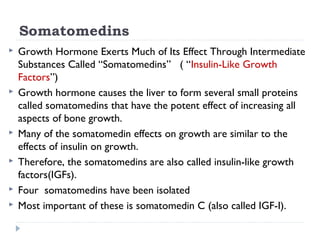
Somatomedins
 Growth Hormone Exerts Much of Its Effect Through Intermediate
Substances Called “Somatomedins” ( “Insulin-Like Growth
Factors”)
 Growth hormone causes the liver to form several small proteins
called somatomedins that have the potent effect of increasing all
aspects of bone growth.
 Many of the somatomedin effects on growth are similar to the
effects of insulin on growth.
 Therefore, the somatomedins are also called insulin-like growth
factors(IGFs).
 Four somatomedins have been isolated
 Most important of these is somatomedin C (also called IGF-I).
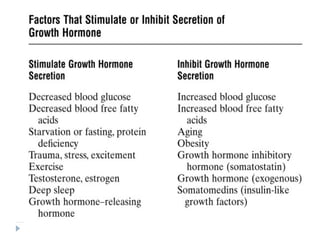
Regulation of Growth Hormone Secretion
 Normal concentration in plasma of an adult = 1.6-3 ng/ml
 Child or adolescent = 6 ng/ml.
 These values often increase to as high as 50 ng/ml after
depletion of the body stores of proteins or carbohydrates
during prolonged starvation.
 After adolescence, secretion decreases slowly with aging.
 Growth hormone is secreted in a pulsatile pattern, increasing
and decreasing.
Abnormalities of Growth Hormone
Secretion
Panhypopituitarism
 Decreased secretion of all the anterior pituitary
hormones.
 May be congenital (present from birth), or it may occur
suddenly or slowly at any time during life, most often
resulting from a pituitary tumor that destroys the
pituitary gland.
Dwarfism
 Result from generalized deficiency of anterior pituitary secretion
during childhood.
 All the physical parts of the body develop in appropriate
proportion to one another, but the rate of development is
greatly decreased.
 A child who has reached the age of 10 years may have the
bodily development of a child aged 4 to 5 years.
 A person with panhypopituitary dwarfism does not pass through
puberty and never secretes sufficient quantities of gonadotropic
hormones to develop adult sexual functions.
 In one third of dwarfs, only growth hormone is deficient,
these persons do mature sexually.
 Treatment: human growth hormone
 Human growth hormone can now be synthesized by
Escherichia coli bacteria by recombinant DNA technology.
 Dwarfs who have pure growth hormone deficiency can be
completely cured if treated early in life.
Panhypopituitarism in the Adult
 Panhypopituitarism first occurring in adulthood results from:
1. tumors that compress the pituitary gland until the functioning
anterior pituitary cells are totally destroyed
2. thrombosis of the pituitary blood vessels.
 The general effects are:
1. Hypothyroidism so Lethargic person
2. Depressed production of glucocorticoids by adrenal gland
3. Suppressed secretion of the gonadotropic hormones so lost all sexual
functions
4. Weight gain (lack of fat mobilization by hormones)
 Treatment : administer adrenocortical and thyroid hormones.
Gigantism
 The acidophilic, growth hormone–producing cells of the
anterior pituitary gland become excessively active, and
sometimes even acidophilic tumors occur in the gland.
 Large quantities of growth hormone are produced.
 All body tissues grow rapidly, including the bones.
 If the condition occurs before adolescence, height increases so
that the person becomes a giant— up to 8 feet tall.
 Hyperglycemia
 Beta cells in the pancreas are prone to degenerate
 About 10% of giants, full-blown diabetes mellitus develops
 However, once gigantism is diagnosed, further effects can
often be blocked by microsurgical removal of the tumor or
by irradiation of the pituitary gland.
Acromegaly
 If an acidophilic tumor occurs after adolescence then person
cannot grow taller, but the bones can become thicker and the
soft tissues can continue to grow.
 Enlargement is especially marked in the bones of the hands and
feet and in the membranous bones, including the cranium, nose,
forehead, supraorbital ridges, lower jawbone, and portions of
the vertebrae
 Because their growth does not cease at adolescence
 The lower jaw protrudes forward, as much as half an inch
 The forehead slants forward
 The nose increases to as much as twice normal size
 The feet require size 14 or larger shoes
 Fingers become extremely thickened
 The hands are almost twice normal size.
 Changes in the vertebrae ordinarily cause a hunched back,
which is known clinically as kyphosis.
 Many soft tissue organs, such as the tongue, the liver, and
especially the kidneys, become greatly enlarged.
Posterior Pituitary Gland
Hypothalamic control of the posterior
pituitary glands
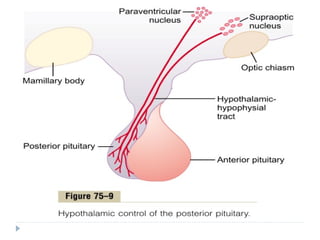
 The posterior pituitary gland, is composed mainly of glial-like
cells called pituicytes.
 The pituicytes do not secrete hormones
 They act simply as a supporting structure for large numbers of
terminal nerve fibers and terminal nerve endings from nerve
tracts that originate in the supraoptic and paraventricular nuclei
of the hypothalamus.
 These tracts pass to the neurohypophysis through the pituitary
stalk (hypophysial stalk).
 The nerve endings are bulbous knobs that contain many
secretory granules.
 These endings secrete posterior pituitary hormones
ADH and Oxytocin
 ADH is formed primarily in the supraoptic nuclei
 Oxytocin is formed primarily in the paraventricular
nuclei.
 Oxytocin and ADH (vasopressin) are polypeptides
 Each containing nine amino acids
 These two hormones are almost identical
Physiological Functions of ADH
 Extremely minute quantities of ADH can cause decreased
excretion of water by the kidneys (antidiuresis).
 In the absence of ADH, the collecting tubules and ducts become
almost impermeable to water, which prevents significant
reabsorption of water and allows extreme loss of water into the
urine, also causing extreme dilution of the urine.
 Conversely, in the presence of ADH, the permeability of the
collecting ducts and tubules to water increases greatly and
allows most of the water to be reabsorbed, thereby conserving
water in the body and producing very concentrated urine.
Regulation of ADH Production
 Osmotic Regulation
 Increased electrolyte concentration in body fluids increases
ADH in body
 Concentrated body fluids stimulate the supraoptic nuclei, to
increase ADH secretion whereas dilute body fluids inhibit it.
Vasoconstrictor and Pressor Effects of
ADH
 Higher concentrations of ADH have a potent effect of
constricting the arterioles throughout the body and Increase
the arterial pressure vasopressin.
 One of the stimuli for causing intense ADH secretion is
decreased blood volume.
Oxytocic Hormone
 Oxytocin Causes Contraction of the Pregnant Uterus.
 Especially toward the end of gestation.
 Therefore, it is believed that this hormone is at least partially
responsible for causing birth of the baby.
 Oxytocin also plays an especially important role in lactation

Hormones Released by Pituitary Gland

  • 1.
  • 2.
    Pituitary Gland andIts Relation to the Hypothalamus  The pituitary gland also called the hypophysis, is a small gland  About 1 cm in diameter  0.5 to 1 gm in weight  Location: at the base of the brain  It is connected to the hypothalamus by the pituitary (or hypophysial) stalk.  Physiologically, the pituitary gland is divisible into two distinct portions: 1. anterior pituitary or adenohypophysis 2. posterior pituitary or neurohypophysis  Between these is a small, relatively avascular zone called the pars intermedia, absent in the human being but is much larger and much more functional in some lower animals.
  • 4.
    Pituitary hormones  The6 hormones of the anterior pituitary play major roles in the control of metabolic functions throughout the body: 1. Growth hormone 2. Adrenocorticotropin (corticotropin) 3. Thyroid-stimulating hormone (thyrotropin) 4. Prolactin 5. Gonadotropic hormones: follicle-stimulating hormone and luteinizing hormone  The two hormones secreted by the posterior pituitary play other roles. 1. Antidiuretic hormone or vasopressin 2. Oxytocin
  • 6.
    Pituitary hormones  Growthhormone promotes growth of the entire body by affecting protein formation, cell multiplication, and cell differentiation.  ACTH controls the secretion of some of the adrenocortical hormones, which affect the metabolism of glucose, proteins and fats.  TSH controls the rate of secretion of thyroxine and triiodothyronine by the thyroid gland, and these hormones control the rates of most intracellular chemical reactions in the body.
  • 7.
    Pituitary hormones  Prolactinpromotes mammary gland development and milk production.  FSH and LH control growth of the ovaries and testes, as well as their hormonal and reproductive activities.  ADH controls the rate of water excretion into the urine, thus helping to control the concentration of water in the body fluids.  Oxytocin helps express milk from the glands of the breast and possibly helps in the delivery of the baby at the end of gestation.
  • 8.
    Anterior Pituitary Gland Contains different Cell Types that Synthesize and Secrete Hormones.  There is one cell type for each major hormone  Five cell types: 1. Somatotropes—human growth hormone (hGH), 30-40% 2. Corticotropes—adrenocorticotropin (ACTH), 20% 3. Thyrotropes—thyroid-stimulating hormone (TSH) 4. Gonadotropes—gonadotropic hormones, LH and FSH 5. Lactotropes—prolactin (PRL)  Somatotropes stain strongly with acid dyes and are therefore called acidophils. Thus, pituitary tumors that secrete large quantities of human growth hormone are called acidophilic tumors.
  • 9.
    Posterior Pituitary Hormones Are Synthesized by Cell Bodies in the Hypothalamus.  The bodies of the cells that secrete the posterior pituitary hormones are not located in the pituitary gland itself but are large neurons, called magnocellular neurons, located in the hypothalamus.  The hormones are then transported in the axoplasm of the neurons’ nerve fibers passing from the hypothalamus to the posterior pituitary gland.
  • 10.
    Hypothalamus Controls Pituitary Secretion Almost all secretion by the pituitary is controlled by either hormonal or nervous signals from the hypothalamus.  Secretion from the posterior pituitary is controlled by nerve signals that originate in the hypothalamus and terminate in the posterior pituitary.  Secretion by the anterior pituitary is controlled by hormones called hypothalamic releasing and hypothalamic inhibitory hormones (or factors) secreted within the hypothalamus itself and then conducted to the anterior pituitary through minute blood vessels called hypothalamic-hypophysial portal vessels.
  • 11.
     In theanterior pituitary, these releasing and inhibitory hormones act on the glandular cells to control their secretion.  The hypothalamus receives signals from many sources in the nervous system.  Hypothalamus is a collecting center for information concerning the internal well-being of the body, and much of this information is used to control secretions of the many globally important pituitary hormones.
  • 14.
  • 15.
    Physiological Functions ofGrowth Hormone  All the major anterior pituitary hormones, except for growth hormone, exert their principal effects by stimulating target glands.  Growth hormone does not function through a target gland but exerts its effects directly on all or almost all tissues of the body.
  • 16.
    Growth Hormone PromotesGrowth of Many Body Tissues  Somatotropic hormone or somatotropin  A small protein molecule  191 amino acids in a single chain  It causes growth of almost all tissues of the body that are capable of growing.  It promotes:  Increased sizes of the cells  Increased mitosis  Development of greater numbers of cells and specific differentiation of certain types of cells.
  • 17.
    Growth Hormone HasSeveral Metabolic Effects 1. Increased rate of protein synthesis in cells So enhances body protein 2. Increased mobilization of fatty acids from adipose tissue 3. Increased free fatty acids in the blood 4. Increased use of fatty acids for energy 5. Decreased rate of glucose utilization 6. So Use fat stores 7. Conserves carbohydrates
  • 18.
    Growth Hormone PromotesProtein Deposition in Tissues  Enhancement of Amino Acid Transport Through the Cell Membranes.  Enhancement of RNA Translation to Cause Protein Synthesis by the Ribosomes.  Increased Nuclear Transcription of DNA to Form RNA.  Decreased Catabolism of Protein and Amino Acids.  Growth hormone enhances almost all facets of amino acid uptake and protein synthesis by cells, while at the same time reducing the breakdown of proteins.
  • 19.
    Growth Hormone EnhancesFat Utilization for Energy  Cause the release of fatty acids from adipose tissue  Increase the concentration of fatty acids in body fluids.  In tissues throughout the body, enhances the conversion of fatty acids to acetyl coenzyme A (acetyl-CoA) and its subsequent utilization for energy.  Therefore, under the influence of growth hormone, fat is used for energy in preference to the use of carbohydrates and proteins.  Growth hormone increase in lean body mass.
  • 20.
    “Ketogenic” Effect ofGrowth Hormone  In excessive amounts of growth hormone, fat mobilization from adipose tissue sometimes becomes so great that large quantities of acetoacetic acid are formed by the liver  Then released into the body fluids, thus causing ketosis.  This excessive mobilization of fatfrom the adipose tissue also frequently causes a fatty liver
  • 21.
    Growth Hormone Decreases CarbohydrateUtilization  Growth hormone causes multiple effects that influence carbohydrate metabolism 1. Decreased glucose uptake in tissues such as skeletal muscle and fat 2. Increased glucose production by the liver 3. Increased insulin secretion.  Each of these changes results from growth hormone–induced “insulin resistance”  This leads to increased blood glucose concentration and a compensatory increase in insulin secretion.  Growth hormone’s effects are called diabetogenic
  • 22.
     Excess secretionof growth hormone can produce metabolic disturbances very similar to those found in patients with type II (non-insulindependent)diabetes.  Growth hormone–induced increases in blood concentrations of fatty acids may impair insulin’s actions on tissue glucose utilization
  • 23.
    Growth Hormone StimulatesCartilage and Bone Growth  Growth hormone stimulates increased deposition of protein and increased growth in almost all tissues of the body  Also Increase growth of the skeletal frame.  Multiple effects of growth hormone on bone: 1. Increased deposition of protein by the chondrocytic and osteogenic cells that cause bone growth, 2. Increased rate of reproduction of these cells, 3. A specific effect of converting chondrocytes into osteogenic cells, thus causing deposition of new bone.
  • 24.
    Somatomedins  Growth HormoneExerts Much of Its Effect Through Intermediate Substances Called “Somatomedins” ( “Insulin-Like Growth Factors”)  Growth hormone causes the liver to form several small proteins called somatomedins that have the potent effect of increasing all aspects of bone growth.  Many of the somatomedin effects on growth are similar to the effects of insulin on growth.  Therefore, the somatomedins are also called insulin-like growth factors(IGFs).  Four somatomedins have been isolated  Most important of these is somatomedin C (also called IGF-I).
  • 25.
    Regulation of GrowthHormone Secretion  Normal concentration in plasma of an adult = 1.6-3 ng/ml  Child or adolescent = 6 ng/ml.  These values often increase to as high as 50 ng/ml after depletion of the body stores of proteins or carbohydrates during prolonged starvation.  After adolescence, secretion decreases slowly with aging.  Growth hormone is secreted in a pulsatile pattern, increasing and decreasing.
  • 27.
    Abnormalities of GrowthHormone Secretion Panhypopituitarism  Decreased secretion of all the anterior pituitary hormones.  May be congenital (present from birth), or it may occur suddenly or slowly at any time during life, most often resulting from a pituitary tumor that destroys the pituitary gland.
  • 28.
    Dwarfism  Result fromgeneralized deficiency of anterior pituitary secretion during childhood.  All the physical parts of the body develop in appropriate proportion to one another, but the rate of development is greatly decreased.  A child who has reached the age of 10 years may have the bodily development of a child aged 4 to 5 years.  A person with panhypopituitary dwarfism does not pass through puberty and never secretes sufficient quantities of gonadotropic hormones to develop adult sexual functions.
  • 29.
     In onethird of dwarfs, only growth hormone is deficient, these persons do mature sexually.  Treatment: human growth hormone  Human growth hormone can now be synthesized by Escherichia coli bacteria by recombinant DNA technology.  Dwarfs who have pure growth hormone deficiency can be completely cured if treated early in life.
  • 30.
    Panhypopituitarism in theAdult  Panhypopituitarism first occurring in adulthood results from: 1. tumors that compress the pituitary gland until the functioning anterior pituitary cells are totally destroyed 2. thrombosis of the pituitary blood vessels.  The general effects are: 1. Hypothyroidism so Lethargic person 2. Depressed production of glucocorticoids by adrenal gland 3. Suppressed secretion of the gonadotropic hormones so lost all sexual functions 4. Weight gain (lack of fat mobilization by hormones)  Treatment : administer adrenocortical and thyroid hormones.
  • 31.
    Gigantism  The acidophilic,growth hormone–producing cells of the anterior pituitary gland become excessively active, and sometimes even acidophilic tumors occur in the gland.  Large quantities of growth hormone are produced.  All body tissues grow rapidly, including the bones.  If the condition occurs before adolescence, height increases so that the person becomes a giant— up to 8 feet tall.  Hyperglycemia  Beta cells in the pancreas are prone to degenerate  About 10% of giants, full-blown diabetes mellitus develops
  • 32.
     However, oncegigantism is diagnosed, further effects can often be blocked by microsurgical removal of the tumor or by irradiation of the pituitary gland.
  • 33.
    Acromegaly  If anacidophilic tumor occurs after adolescence then person cannot grow taller, but the bones can become thicker and the soft tissues can continue to grow.  Enlargement is especially marked in the bones of the hands and feet and in the membranous bones, including the cranium, nose, forehead, supraorbital ridges, lower jawbone, and portions of the vertebrae  Because their growth does not cease at adolescence  The lower jaw protrudes forward, as much as half an inch  The forehead slants forward  The nose increases to as much as twice normal size
  • 34.
     The feetrequire size 14 or larger shoes  Fingers become extremely thickened  The hands are almost twice normal size.  Changes in the vertebrae ordinarily cause a hunched back, which is known clinically as kyphosis.  Many soft tissue organs, such as the tongue, the liver, and especially the kidneys, become greatly enlarged.
  • 35.
  • 36.
    Hypothalamic control ofthe posterior pituitary glands  The posterior pituitary gland, is composed mainly of glial-like cells called pituicytes.  The pituicytes do not secrete hormones  They act simply as a supporting structure for large numbers of terminal nerve fibers and terminal nerve endings from nerve tracts that originate in the supraoptic and paraventricular nuclei of the hypothalamus.  These tracts pass to the neurohypophysis through the pituitary stalk (hypophysial stalk).  The nerve endings are bulbous knobs that contain many secretory granules.  These endings secrete posterior pituitary hormones
  • 38.
    ADH and Oxytocin ADH is formed primarily in the supraoptic nuclei  Oxytocin is formed primarily in the paraventricular nuclei.  Oxytocin and ADH (vasopressin) are polypeptides  Each containing nine amino acids  These two hormones are almost identical
  • 39.
    Physiological Functions ofADH  Extremely minute quantities of ADH can cause decreased excretion of water by the kidneys (antidiuresis).  In the absence of ADH, the collecting tubules and ducts become almost impermeable to water, which prevents significant reabsorption of water and allows extreme loss of water into the urine, also causing extreme dilution of the urine.  Conversely, in the presence of ADH, the permeability of the collecting ducts and tubules to water increases greatly and allows most of the water to be reabsorbed, thereby conserving water in the body and producing very concentrated urine.
  • 40.
    Regulation of ADHProduction  Osmotic Regulation  Increased electrolyte concentration in body fluids increases ADH in body  Concentrated body fluids stimulate the supraoptic nuclei, to increase ADH secretion whereas dilute body fluids inhibit it.
  • 41.
    Vasoconstrictor and PressorEffects of ADH  Higher concentrations of ADH have a potent effect of constricting the arterioles throughout the body and Increase the arterial pressure vasopressin.  One of the stimuli for causing intense ADH secretion is decreased blood volume.
  • 42.
    Oxytocic Hormone  OxytocinCauses Contraction of the Pregnant Uterus.  Especially toward the end of gestation.  Therefore, it is believed that this hormone is at least partially responsible for causing birth of the baby.  Oxytocin also plays an especially important role in lactation