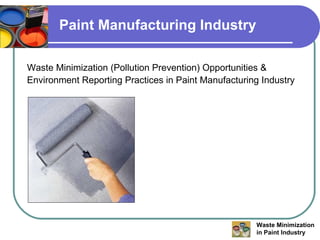
Paint Manufacturing Industry Waste Minimization (Pollution Prevention) Opportunities &  Environment Reporting Practices in Paint Manufacturing Industry
Why Waste Minimization? Waste Minimization   Makes Good Business Sense Wastes Costs Money Prices to landfill wastes are steadily increasing Cost for disposal of hazardous wastes are prohibitive to many small businesses Waste Minimization   Can Improve Your Public Image Environmental concerns share public spotlight Commitment to environmental issues ca be used as marketing tool for product and services Waste Minimization   Can Reduce Your Liability Many legislations impose heavy penalties for non-compliance with waste management legislation
Success Stories Reuse  of Washings in Primer Product As color of the primer is not important, wash wastes are added into the primer without having to segregate colors Hence, no disposal method & transportation costs required Accurate Quality Control Manufacturer uses a sophisticated method of ensuring quality control of the product, which significantly reduces amount of off-spec product Amount of off-spec paint produced has decreased by 50% since the method has been implemented, resulting in greater customer satisfaction & reduced waste management costs
Waste Minimization Program Step 1: Build Interest Gain support of management and employees Designate a company waste co-ordinator Create your audit team
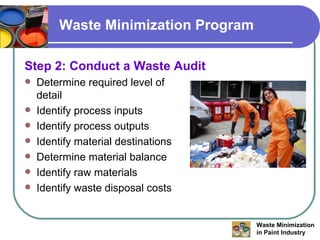
Waste Minimization Program Step 2: Conduct a Waste Audit Determine required level of  detail Identify process inputs Identify process outputs Identify material destinations Determine material balance Identify raw materials Identify waste disposal costs
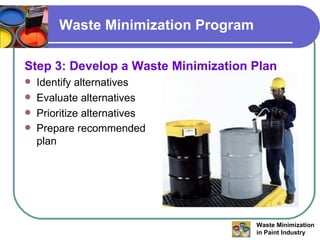
Waste Minimization Program Step 3: Develop a Waste Minimization Plan Identify alternatives Evaluate alternatives Prioritize alternatives Prepare recommended  plan
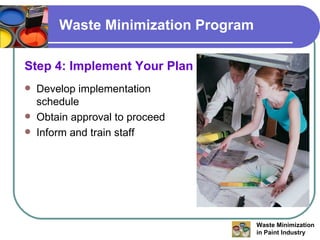
Waste Minimization Program Step 4: Implement Your Plan Develop implementation schedule Obtain approval to proceed Inform and train staff
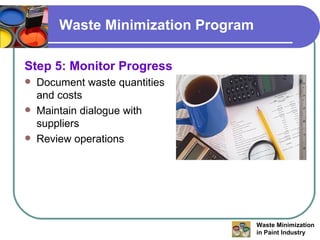
Waste Minimization Program Step 5: Monitor Progress Document waste quantities and costs Maintain dialogue with suppliers Review operations
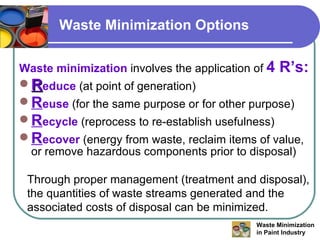
Waste Minimization Options Waste minimization  involves the application of  4 R’s: R educe  (at point of generation) R euse  (for the same purpose or for other purpose) R ecycle  (reprocess to re-establish usefulness) R ecover   (energy from waste, reclaim items of value, or remove hazardous components prior to disposal) Through proper management (treatment and disposal), the quantities of waste streams generated and the associated costs of disposal can be minimized.
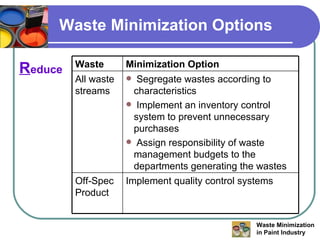
Waste Minimization Options R educe Waste Minimization Option All waste streams Segregate wastes according to characteristics Implement an inventory control system to prevent unnecessary purchases Assign responsibility of waste management budgets to the departments generating the wastes Off-Spec Product Implement quality control systems
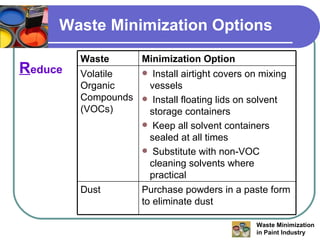
Waste Minimization Options R educe Waste Minimization Option Volatile Organic Compounds (VOCs) Install airtight covers on mixing vessels Install floating lids on solvent storage containers Keep all solvent containers sealed at all times Substitute with non-VOC cleaning solvents where practical Dust Purchase powders in a paste form to eliminate dust
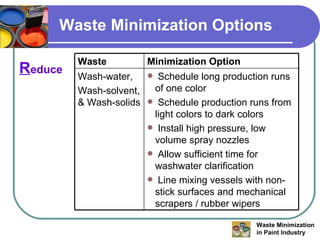
Waste Minimization Options R educe Waste Minimization Option Wash-water,  Wash-solvent, & Wash-solids Schedule long production runs of one color Schedule production runs from light colors to dark colors Install high pressure, low volume spray nozzles Allow sufficient time for washwater clarification Line mixing vessels with non-stick surfaces and mechanical scrapers / rubber wipers
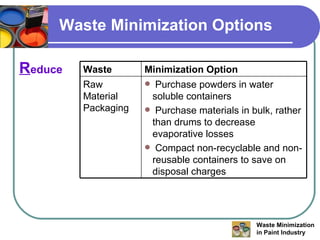
Waste Minimization Options R educe Waste Minimization Option Raw Material Packaging Purchase powders in water soluble containers Purchase materials in bulk, rather than drums to decrease evaporative losses Compact non-recyclable and non-reusable containers to save on disposal charges
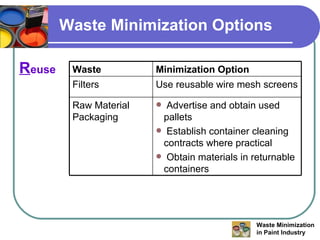
Waste Minimization Options R euse Waste Minimization Option Filters Use reusable wire mesh screens Raw Material Packaging Advertise and obtain used pallets Establish container cleaning contracts where practical Obtain materials in returnable containers
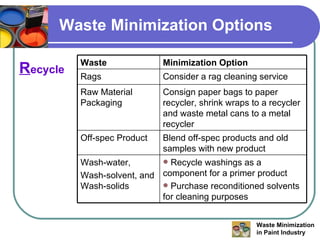
Waste Minimization Options R ecycle Waste Minimization Option Rags Consider a rag cleaning service Raw Material Packaging Consign paper bags to paper recycler, shrink wraps to a recycler and waste metal cans to a metal recycler Off-spec Product Blend off-spec products and old samples with new product Wash-water,  Wash-solvent, and Wash-solids Recycle washings as a component for a primer product Purchase reconditioned solvents for cleaning purposes
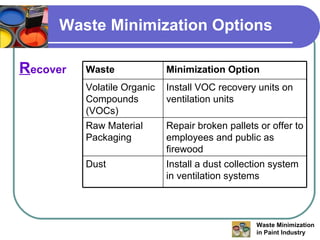
Waste Minimization Options R ecover Waste Minimization Option Volatile Organic Compounds (VOCs) Install VOC recovery units on ventilation units Raw Material Packaging Repair broken pallets or offer to employees and public as firewood Dust Install a dust collection system in ventilation systems
Asian Paints  - Success Asian Paints Limited  takes up the environment issue from the perspective of waste minimization and conservation of resources. It makes a continued attempt to reuse, recycle and eliminate waste, which results in a diminished amount of waste being generated. It has succeeded at building synergy between business and environment which has enabled it to follow the path of profit-making along with growth for sustainable development. It has succeeded at driving eco-friendly initiatives using environment management systems and thereby diminishing the impact on the environment. The bulk storage facilities have been upgraded thereby reducing material losses as well as eliminating effluent generation.
Asian Paints  - Success Asian Paints Limited  has been among the forerunners in adapting principles of 'Green Productivity'. Plants have achieved  ' zero industrial discharge '  capability by installing upgraded effluent treatment facilities and setting up plants in accordance  with appropriate recycling & reuse schemes working towards substantially reducing material losses. Company's emulsion manufacturing facility has also achieved  ' zero waste '  status . Innovations in filtration process technology have resulted in higher filtration rates and lower losses and, consequently lesser pollution. Company has also reduced waste by over 72 % after upgrading incinerating systems. The rest of the waste is re-used.
Paint Manufacturing Industry

Paint Manufacturing Industry Waste Minimization

  • 1.
    Paint Manufacturing IndustryWaste Minimization (Pollution Prevention) Opportunities & Environment Reporting Practices in Paint Manufacturing Industry
  • 2.
    Why Waste Minimization?Waste Minimization Makes Good Business Sense Wastes Costs Money Prices to landfill wastes are steadily increasing Cost for disposal of hazardous wastes are prohibitive to many small businesses Waste Minimization Can Improve Your Public Image Environmental concerns share public spotlight Commitment to environmental issues ca be used as marketing tool for product and services Waste Minimization Can Reduce Your Liability Many legislations impose heavy penalties for non-compliance with waste management legislation
  • 3.
    Success Stories Reuse of Washings in Primer Product As color of the primer is not important, wash wastes are added into the primer without having to segregate colors Hence, no disposal method & transportation costs required Accurate Quality Control Manufacturer uses a sophisticated method of ensuring quality control of the product, which significantly reduces amount of off-spec product Amount of off-spec paint produced has decreased by 50% since the method has been implemented, resulting in greater customer satisfaction & reduced waste management costs
  • 4.
    Waste Minimization ProgramStep 1: Build Interest Gain support of management and employees Designate a company waste co-ordinator Create your audit team
  • 5.
    Waste Minimization ProgramStep 2: Conduct a Waste Audit Determine required level of detail Identify process inputs Identify process outputs Identify material destinations Determine material balance Identify raw materials Identify waste disposal costs
  • 6.
    Waste Minimization ProgramStep 3: Develop a Waste Minimization Plan Identify alternatives Evaluate alternatives Prioritize alternatives Prepare recommended plan
  • 7.
    Waste Minimization ProgramStep 4: Implement Your Plan Develop implementation schedule Obtain approval to proceed Inform and train staff
  • 8.
    Waste Minimization ProgramStep 5: Monitor Progress Document waste quantities and costs Maintain dialogue with suppliers Review operations
  • 9.
    Waste Minimization OptionsWaste minimization involves the application of 4 R’s: R educe (at point of generation) R euse (for the same purpose or for other purpose) R ecycle (reprocess to re-establish usefulness) R ecover (energy from waste, reclaim items of value, or remove hazardous components prior to disposal) Through proper management (treatment and disposal), the quantities of waste streams generated and the associated costs of disposal can be minimized.
  • 10.
    Waste Minimization OptionsR educe Waste Minimization Option All waste streams Segregate wastes according to characteristics Implement an inventory control system to prevent unnecessary purchases Assign responsibility of waste management budgets to the departments generating the wastes Off-Spec Product Implement quality control systems
  • 11.
    Waste Minimization OptionsR educe Waste Minimization Option Volatile Organic Compounds (VOCs) Install airtight covers on mixing vessels Install floating lids on solvent storage containers Keep all solvent containers sealed at all times Substitute with non-VOC cleaning solvents where practical Dust Purchase powders in a paste form to eliminate dust
  • 12.
    Waste Minimization OptionsR educe Waste Minimization Option Wash-water, Wash-solvent, & Wash-solids Schedule long production runs of one color Schedule production runs from light colors to dark colors Install high pressure, low volume spray nozzles Allow sufficient time for washwater clarification Line mixing vessels with non-stick surfaces and mechanical scrapers / rubber wipers
  • 13.
    Waste Minimization OptionsR educe Waste Minimization Option Raw Material Packaging Purchase powders in water soluble containers Purchase materials in bulk, rather than drums to decrease evaporative losses Compact non-recyclable and non-reusable containers to save on disposal charges
  • 14.
    Waste Minimization OptionsR euse Waste Minimization Option Filters Use reusable wire mesh screens Raw Material Packaging Advertise and obtain used pallets Establish container cleaning contracts where practical Obtain materials in returnable containers
  • 15.
    Waste Minimization OptionsR ecycle Waste Minimization Option Rags Consider a rag cleaning service Raw Material Packaging Consign paper bags to paper recycler, shrink wraps to a recycler and waste metal cans to a metal recycler Off-spec Product Blend off-spec products and old samples with new product Wash-water, Wash-solvent, and Wash-solids Recycle washings as a component for a primer product Purchase reconditioned solvents for cleaning purposes
  • 16.
    Waste Minimization OptionsR ecover Waste Minimization Option Volatile Organic Compounds (VOCs) Install VOC recovery units on ventilation units Raw Material Packaging Repair broken pallets or offer to employees and public as firewood Dust Install a dust collection system in ventilation systems
  • 17.
    Asian Paints - Success Asian Paints Limited takes up the environment issue from the perspective of waste minimization and conservation of resources. It makes a continued attempt to reuse, recycle and eliminate waste, which results in a diminished amount of waste being generated. It has succeeded at building synergy between business and environment which has enabled it to follow the path of profit-making along with growth for sustainable development. It has succeeded at driving eco-friendly initiatives using environment management systems and thereby diminishing the impact on the environment. The bulk storage facilities have been upgraded thereby reducing material losses as well as eliminating effluent generation.
  • 18.
    Asian Paints - Success Asian Paints Limited has been among the forerunners in adapting principles of 'Green Productivity'. Plants have achieved ' zero industrial discharge ' capability by installing upgraded effluent treatment facilities and setting up plants in accordance with appropriate recycling & reuse schemes working towards substantially reducing material losses. Company's emulsion manufacturing facility has also achieved ' zero waste ' status . Innovations in filtration process technology have resulted in higher filtration rates and lower losses and, consequently lesser pollution. Company has also reduced waste by over 72 % after upgrading incinerating systems. The rest of the waste is re-used.
  • 19.